Posts Tagged ‘travel’

In the tradition of the Food Network’s extremely popular show “Diners, Drive-Ins and Dives,” I get a special thrill in discovering great old eating establishments while on the road.

One way to easily hunt down those local gems is by downloading an app like MapMuse on my iPhone, which tells me all of the locations of every joint featured on “Diners, Drive-Ins and Dives.”

So whenever I’m heading home to New York to see my family, I check the website out for the possibility of a fun eating experience along the way, not too far off I-95.

One time I made a stop in Westport, CT at the Black Duck Cafe, and chowed down on an amazing sauteed crawfish po-boy and Caesar salad, on the waterfront of this sleepy blue-collar town, the elevated highway directly above.

More recently, I stopped in New Haven, CT at the legendary Louis’ Lunch, established in 1895. With room for only 25 people, this tiny hot spot claims it is where the hamburger was invented. If you want a fancy burger, this is not the place. They serve ’em just a few ways: with cheese or without, with tomatoes and onions or without. All burgers are cooked medium-rare, and come on toasted white bread. No ketchup in the building. No salt and pepper. For sides: potato salad or chips. Some drinks. And that’s it!

Apparently, they don’t need to cater to the masses, because there’s always a line out the door, and the wait can be as long as 2 hours for a burger…and people gladly wait.

A fresh batch of burgers right out of the grill!

I was lucky: I got there on a Friday afternoon and missed the lunch rush, so I only had to wait a half-hour for my taste of history, still grilled in the funky-looking original gas-fired grills built back in the 1800’s.

The original grills at Louis’ Lunch: 9 burgers are cooked at a time, placed in a screen that holds them while they cook sideways.

In all honesty, it was not the best burger I’ve ever had…and I don’t know if I’d wait 2 hours for one. But it was a fun experience being there…watching others in line doing what I was doing: whipping out the phone and taking pictures of this legendary establishment…one that almost succumbed to the wrecking ball until the people of New Haven came to the aid of Louis’ Lunch and had it moved down the road to its current location.

At the counter: White plastic bags full of sliced bread await the toaster that sends them spinning around on a belt.
It just takes a couple of minutes off I-95 to get to Louis’ Lunch. Certainly more fun than stopping at some fast food joint. And a chance to taste a bit of  history.


One of the true delicacies of New Zealand is their version of lobster they call crayfish. It’s similar in appearance to a Maine lobster, but it has no claws. And prices are very high. For example, a single crayfish that weighs about 1 1/2 pounds costs 54 New Zealand dollars. That’s about $38 US for what amounts to a 1/2 pound of actual meat.

On the South Island of New Zealand, on the Pacific (eastern) coast near the beach town of Kaikoura, there is a shack that has been serving up crayfish for years…and it’s earned a cult following among foodies that, like me, have traveled thousands of miles just to have a taste of this seafood delicacy.

The place is called Nins Bin, and it’s simply a little shack that sits on the rugged, windy coastline of the Pacific. You walk in, and a plastic container holds already-cooked crayfish, caught that day. The prices for each are marked right on the shell. You pick one, they cut it in half, and serve it with your choice of two sauces: one a sort of thousand island thing, and the other a garlic aioli. We took one of each, walked over to the only picnic table nearby, and quickly finished off this little treat, hungry seagulls buzzing all around us, waiting for any morsel we might accidentally drop. (Not a chance!)


The flesh of the crayfish was sweet…but not really sweet like Maine lobster can be. And although it was a beautiful white in color, its texture was almost meat-like, like chicken. But really good. We devoured the tail, sucked whatever meat we could out of the legs, and that was it…crayfish gone. Experience had. It totally lived up to the foodie hype I had read about.


We hung out around Nins Bin a little longer, taking in the atmosphere before we got back in the rental car and headed down the road to the town of Kaikoura, our next stop on our 3-week, 2000 mile journey through New Zealand.

Paris has a special place in the hearts of my wife, myself, and even my 5-year-old daughter. It’s where my wife and I got engaged back in 2002. It’s where we celebrated my wife’s 40th birthday with family and friends in 2005. And it’s where my daughter has ridden on seven—count ‘em—seven—carousels…a record I’m sure she’ll want to break on her next trip.

One of the reasons why Paris is so special to us is a small, unpretentious wine bar called Juvenile’s, at 47 Rue de Richelieu. The owner is Tim Johnston, a sharp-tongued wise-cracking Scotsman who happens to know a helluva lot about wine and spirits, and is in fact a consulting editor to Saveur magazine. Tim takes no BS from his clients, and that adds to the entertainment value of every visit.

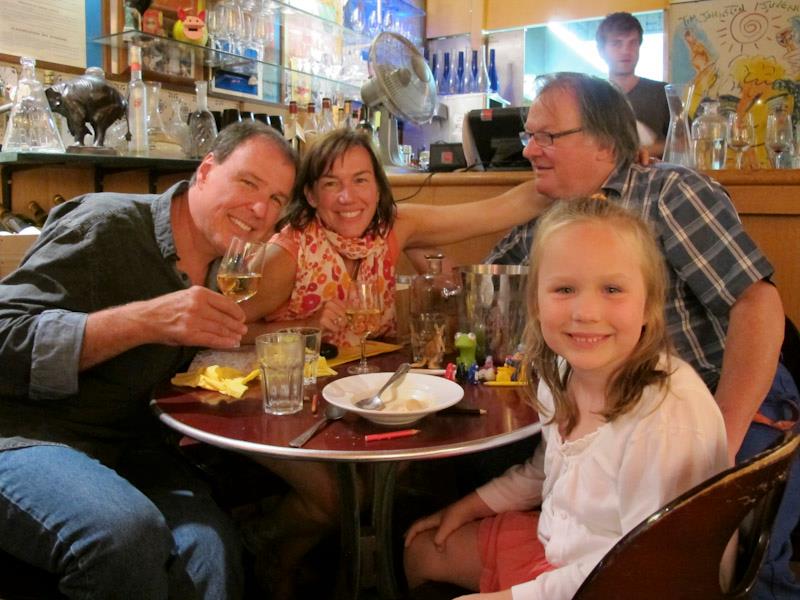
Hangin’ with Tim.

My wife met Tim back in 2001, just a few months before she had met me, when she and her Mom took a trip to France. The friendship with Tim was forged, and it has been going strong ever since. Tim, in typical fashion, tolerates me because he enjoys the company of my lovely wife…and I can’t say that I blame him!

The food at Juvenile’s is rustic…nothing fancy here. But it is all very good and satisfying. We’ve found what we consider the best foie gras in Paris here. The potatoes with raclette and bacon are fantastic. Sausage dishes, duck dishes…all the favorites, all wonderfully prepared in a very, very small kitchen in this wine bar that holds, perhaps, 30 people.

Paolo, Tim’s right-hand man, working the tiny kitchen at Juvenile’s.

Juvenile’s is one of Paris’ original wine bars, serving wine by the glass way before everyone else thought it was cool to do so. And even the locals will come in on a regular basis to ask Tim what the latest great wines are. The man has earned the respect of those who know.

We make Juvenile’s a mandatory stop with every visit to Paris we make, lingering sometimes for an entire day…eating, chatting, and sampling wine and even fine cognacs that Tim is willing to share with us. Often, we come back for a second and even third visit during the same trip. It’s a great place to unwind and get away from the hectic pace of the day, whether you’re a tourist or a local.

Yes, that says 1962!

The next time you’re in Paris, stop by Juvenile’s and tell Tim I sent you. He will promptly throw you out!

Tim and me. Great t-shirt!

It’s all about the salt.

I fell in love with Fleur de Sel, the rare hand-raked salt, several years ago. I’ve got high blood pressure, and unfortunately, I need to limit my intake of salt. So my discovery of “finishing salts” allows me to cook completely without salt until the very end, where I can then sprinkle just a few crystals of this moist, hand-harvested miracle on my plate, enjoying every tiny burst of salty ocean flavor without a lot of guilt.

Inspired by an episode of “No Reservations” where Anthony Bourdain journeyed to Brittany, my wife and I dreamed of traveling to what is arguably the epicenter of Fleur de Sel production, the small town of Guerande, France. Located on the Atlantic coast in the Pays de La Loire region just south of Brittany, it’s about a 5-hour drive from Charles de Gaulle airport outside of Paris.

A salt flat in Guerande


Some of the comments we read about the medieval town of Guerande said it was too touristy, but we found that it had a lot of charm: the perfect combination of old and new, with many interesting shops and eateries inside the ancient walls of this small town. Built in the 15th century and fortified in the 19th century, the surrounding wall around Guerande is one of the best preserved in all of France.

The salt marshes outside the city walls have been around a long time…the last of them built around 1800. Salt production here declined soon after, because salt was available more cheaply from salt mines. But you gotta love foodies…the influence of chefs and food lovers around the world have brought back the demand for this very special product. Salt workers now harvest about 15,000 tons of cooking salt a year, and about 300 tons of the very precious Fleur de Sel.

Worth its weight in gold!

The process is simple: the ocean tides bring the salt water in and channel it into shallow pools where the water then evaporates, leaving behind the beautiful sea salt Guerande is known for. When just a few inches of water remain, a salty crystalized film floats on the surface of the water. This is very gently hand-raked and produces the much sought after Fleur de Sel. Traditionally only women were allowed to rake this salt because it was believed they had a gentler touch.

Driving through the salt field was a wonderful experience. The roads are narrow, and wind almost endlessly through these flat marshes where salt workers spend their days raking, gathering and then bagging their precious harvest. You can stop anywhere along the way to buy your salt directly from these salt workers, which we did. It was easy to get carried away…we brought home over 20 lbs of salt! Of course, we shared it with friends. Otherwise, not only would my blood pressure have gone through the roof, but I’d probably be dealing with kidney stones as well!

Harvesting and selling salt in Guerande is a family affair.

One taste of Fleur de Sel, letting it gently melt on your tongue, and you’ll know what the big fuss is all about.

Our Fleur de Sel journey did not end in Guerande, however. After a couple of nights in that region, we headed south to the island of Ile de Re, just off the coast of La Rochelle, France. Connected by a 3km bridge, Ile de Re is a beautiful world unto itself, with an intricate network of bicycle paths that allow you to travel safely from one end of this flat island to the other, enjoying beautiful views as you ride through vineyards, salt marshes, beaches and small port towns.

As in Guerande, not only can you sample the local salt, but also the abundant supply of incredibly fresh seafood, especially their famous oysters. The salt flats seem somewhat newer in Ile de Re, but still very much a large part of the local economy. The salt itself differs in only the most subtle of ways from its Guerande counterpart and I would find it difficult to say which I liked better.

Ile de Re is long and flat, so many of the salt pools are larger than those in Guerande.

It may seem a bit silly to travel all this way for something is simple as salt. But it’s a journey I’m very happy I made…and will gladly make again in the near future.