Archive for the ‘drink recipes’ Category

It seemed almost silly to try to make one…but the classic James Bond martini has always fascinated me. I’m not talking about the clichéd Sean Connery “vodka martini, shaken, not stirred.”  I’m talking about the real James Bond martini, which appeared in Ian Fleming’s first 007 novel “Casino Royale” and only appeared in the most recent “Casino Royale” movie starring Daniel Craig.
Bondtini
To quote the novel:
‘A dry martini,’ he said. ‘One. In a deep champagne goblet.’ ‘Oui, monsieur.’ ‘Just a moment. Three measures of Gordon’s (gin), one of vodka, half a measure of Kina Lillet.  Shake it very well until it’s ice-cold, then add a large thin slice of lemon peel. Got it?’ ‘Certainly, monsieur.’ The barman seemed pleasant with the idea. ‘Gosh that’s certainly a drink,’ said Leiter. 

Bond laughed. ‘When I’m … er … concentrating.’ he explained, ‘I never have more than one drink before dinner. But I do like that one to be large and very strong and very cold and very well-made. I hate small portions of anything, particularly when they taste bad. This drink’s my own invention. I’m going to patent it when I can think of a good name.’ 

He watched carefully as the deep glass became frosted with the pale golden drink, slightly aerated by the bruising of the shaker. He reached for it and took a long sip. 

‘Excellent,’ he said to the barman, ‘but if you can get a vodka made with grain instead of potatoes, you will find it still better.’ 

To quote the movie: http://youtu.be/Vc7n7yyXWsU

Bond named this drink the Vesper martini, after a female agent in the story.
My version of this classic drink remains true to the original, though I’ve changed brands due to personal preference. In the novel, Bond just asks for “vodka.” (Of course, this was back in the 1950’s when we didn’t have 100 brands to choose from!) My choice for best-bang-for-the-buck grain vodka is Tito’s: it has just enough of an edge, which is what this drink needs, and it’s half the price of other grain vodkas, like Grey Goose.
Bond asks for Gordon’s gin. I’m partial to Hendrick’s, which adds wonderful floral notes to the drink.
And the original Kina Lillet has had its formula changed in the 1980’s to keep up with the times by reducing the quinine, which made it bitter. The French aperitif wine, Lillet, is today’s version: a blend of wine grapes, oranges, orange peels and quinine. Lillet is not a vermouth, though you’ll find it in the vermouth section of your favorite liquor store. Some aficionados claim the martini is just not the same without the original Kina Lillet formulation, but I find that the drink works just fine for me.
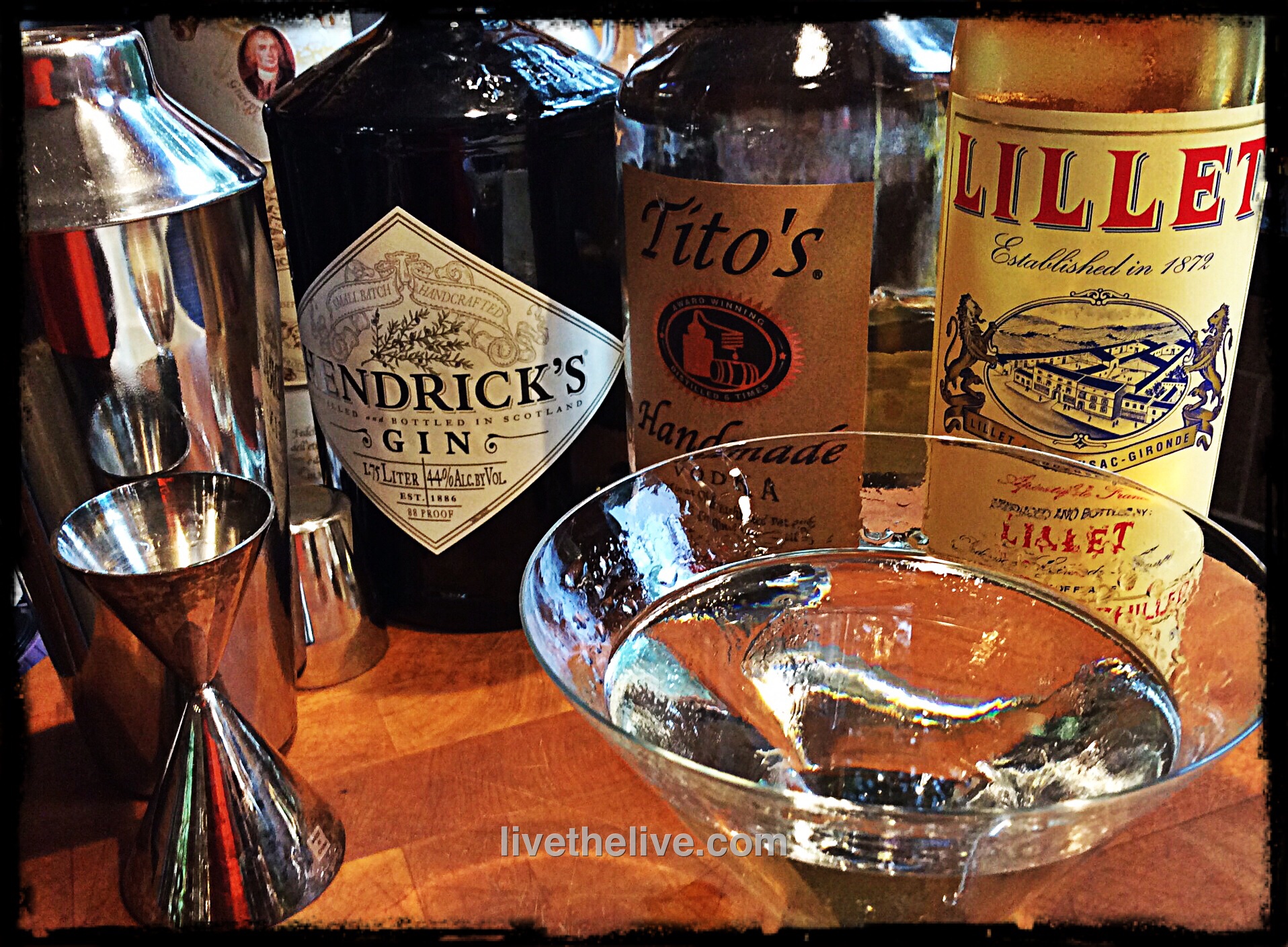
ingredients again
So…measurements true to Bond:
3 oz Hendrick’s
1 oz Tito’s
1/2 oz Lillet
I prefer combining these over ice in a cocktail shaker, and I stir, not shake.
I strain it into a chilled martini glass and I skip the lemon peel. I prefer three olives instead…stuffed with garlic, if my wife is away on a business trip!
Bondtini2
A side note: the correct pronunciation of Lillet is Lih-LAY. Grammatically in French, the double-l would make it sound like Lih-YAY. So to keep that from happening, they spelled it Lilet for a while until the French were used to the correct pronunciation, then they went back to Lillet on the bottle.

Bitters have been around forever, but the recent resurgence in the art of mixology has made bitters a real buzzword among bartenders and cocktail enthusiasts alike. Ten years ago, I almost never would have asked for a cocktail that included bitters. Now, I almost always do.

But bitters aren’t the only way to spice up your libations. Other tinctures have been around for centuries as well, many of which are finding their way to the forefront of mixology. Two of those are falernum and shrub.

Despite that falernum and shrub sound like the name of a bad law firm, they are welcome additions to many simple spirits we enjoy.

Falernum is a sweet syrup used in Caribbean and tropical drinks. It often has flavors of almond, ginger, cloves, lime and sometimes vanilla or allspice. Some people drink falernum by itself on the rocks, but most often it is mixed in a cocktail. The bottle below is falernum made by my friend Roy, who used ginger, cloves and lime juice in an alcohol base.

image


Shrub, meanwhile, can be several different kinds of drinks. It was a fruit liqueur popular in 17th and 18th England, made with rum or brandy mixed with sugar or the juice or rinds of citrus fruit. A shrub was also a drink popular in American colonial times, featuring a mix of vinegared syrup mixed with spirits or water. But most times, today’s version of shrub is the sweetened vinegar-based syrup itself. If you’re curious about shrub, there’s a great source for a variety of shrub flavors: http://www.shrubandco.com.

Alz Espresso martini

Alz Espresso martini

One of my recent mixology projects was to finally create my own version of the perfect espresso martini…one that has been developed from painstaking research (that means drinking a lot of other espresso martinis.) My favorite local espresso martini here in Rhode Island comes from Asterisk in Newport. They sell thousands of them in the summer season, and part of their success is using freshly brewed espresso. But overall, my favorite espresso martini was one that I sampled a couple of years ago at the Le Parker Meridien Hotel in New York City. It featured an Irish cream liqueur called Coole Swan. The bartender was nice enough to write down the recipe for me, but I guess I had a little too much to drink…because I lost it! So it was up to me to come up with my own combination.   So here it is… ALZ ESPRESSO MARTINI 3 oz. good quality vodka, like Belvedere 3 oz. freshly brewed espresso 1.5 oz. Kahlua 1.5 oz. Coole Swan Chill your martini glasses. Pour all ingredients into a large shaker with ice. Shake vigorously. Pour into chilled glasses. Makes 2 martinis. Let me tell ya…this tasted as good the first time as it did several martinis later! I’ve found that using a high-end vodka really does make a difference in the quality and taste of the martini…as does brewing your espresso just before assembling the drink.

The Mint Julep is such a perfect, classic and historic bourbon drink, it seems silly to wait until Derby day to have one. Of course, as any aficionado of spirits will tell you, there are as many right ways as wrong ways of making one. And I enjoy the taste of bourbon in my Manhattans so much that I don’t really get a craving for a Mint Julep as often as one might think.

The first step in my Mint Julep is making the simple syrup. I use the standard ratio of 1 cup of clean, filtered water to 1 cup of sugar, but I use an organic product like Woodstock Farms Organic Pure Cane Sugar. Place the sugar and water in a saucepan and heat until just boiling. I’ve found that it needs to reach this stage for the unbleached sugar to really dissolve. As soon as it starts to boil, remove the saucepan from the heat, and throw in a handful of freshly picked mint leaves. Stir to make sure the mint gets in there, and then leave the saucepan to cool to room temperature. Once it’s at room temp, strain the simple syrup into a bottle with a tight sealing lid, and place in the refrigerator to cool. It will keep for about a week.

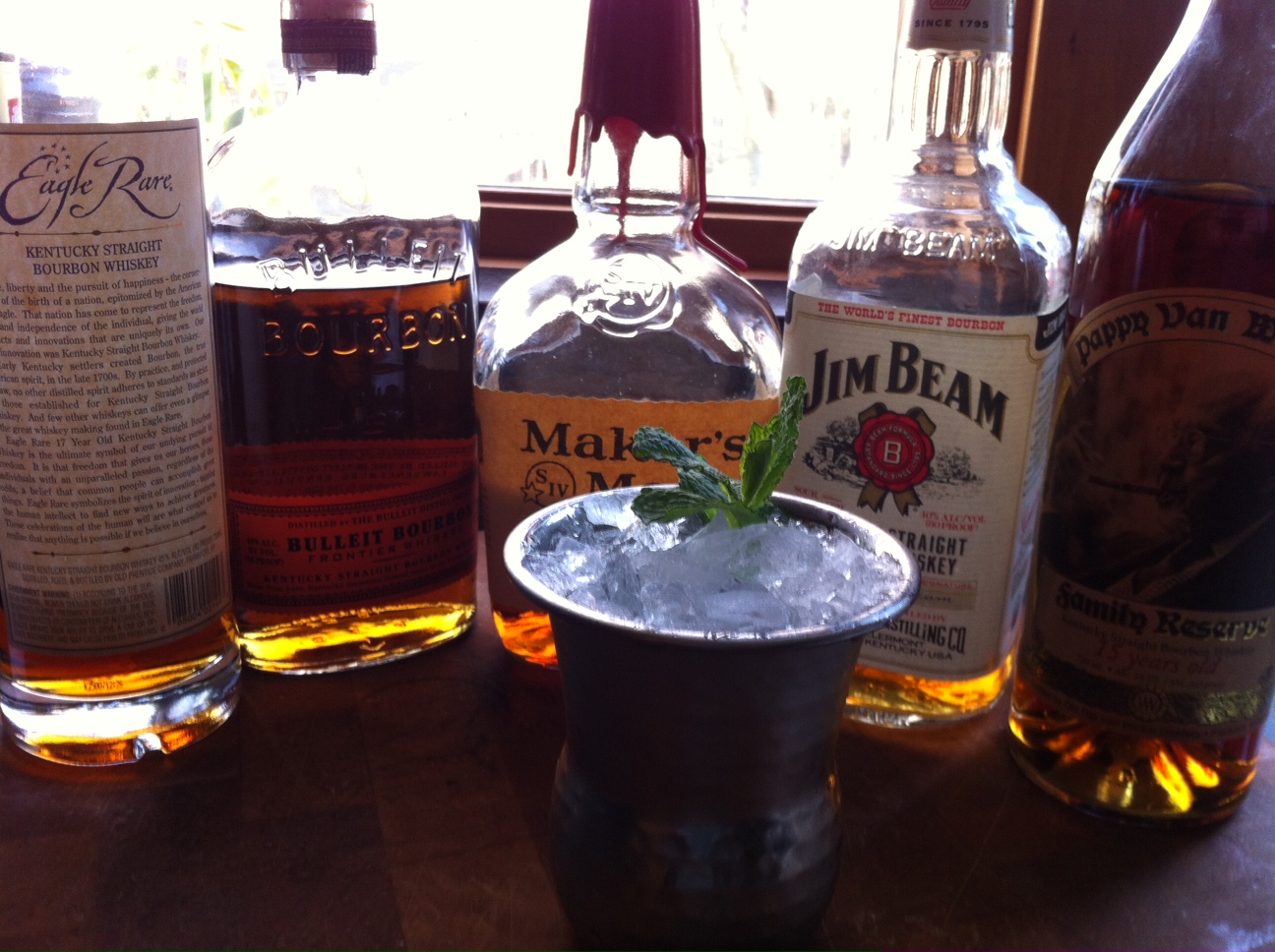
The next step is the tough part: the battles of the bourbons! The recent explosion of choices on the bourbon market has made it all but impossible for the average imbiber to know which bourbon is best for their tastes. My suggestion for this is to go to a trusted bartender and explain that you’re new to the bourbon world, and could you have the tiniest of tastes and sniffs of what he’s got at his bar. Chances are, you’ll get a sampling of some of the better known brands: Maker’s Mark, Woodford Reserve, perhaps Buffalo Trace or Bulleit, and the standard Jim Beam. This is a very good start. If you have deeper pockets, go to the manager of a trusted higher end liquor store and explain that you’ve had all the rest, now what does he think is the best? This is how I came across a fabulous 17-year-old bottle of Eagle Rare, my choice for my Mint Julep, though currently incredibly difficult to find. And of course, hinting to wife and friends that “I’m trying new bourbons” around your birthday or the holidays inevitably gets you a few bottles as well!

Other ingredients for my perfect Mint Julep include crushed ice from clean, filtered water. Don’t even think of using tap water for any cocktail much less this one. Why ruin an expensive bottle of bourbon by going cheap on the ice? I make my own ice cubes, then put them in a canvas ice bag and bash them to the perfect crushed size.

And a Mint Julep needs a metal–not glass– Julep cup. Made of pewter or aluminum, it frosts on the outside as you stir your drink, keeping your beverage ice-cold on even the hottest of days. You simply need to have one to make the perfect Mint Julep.

So many choices...

From left to right: the now hard-to-find Eagle Rare 17-yr-old, Bulleit, Maker’s Mark, Jim Beam, and the now impossible to find Pappy Van Winkle 15-yr-old.


So here’s my recipe…


ALZ MINT JULEP


Ingredients:

3 oz bourbon (my go-to these days is Russell’s Reserve Single Barrel)

1 oz mint-infused simple syrup

crushed ice

Julep cup

Fresh mint for garnish

Crush the ice and pack it into the Julep cup, even letting it dome slightly over the top. Don’t worry…the alcohol will melt it.

I like to add 1 jigger of bourbon (1.5 oz), then the shot of simple syrup (1 oz), then another jigger of bourbon on top. Break off a few mint leaves from the stem and push into the ice. Using a long spoon, stir the drink well. A beautiful layer of frost will form on the outside of the cup. Add more ice, if necessary, and garnish with a sprig of mint.


Used to be that only the big distilleries were able to age their finest spirits in charred oak barrels. But now, there’s a movement goin’ on…and hand-crafted oak barrels are available to aficionados at home.

Companies like Redhead Barrels (www.redheadoakbarrels.com) are offering oak barrels for aging that range in size from 1 liter to 20 liters. And that’s where this enthusiast comes in: with a 1-liter barrel, I’m able to age my favorite spirit–vodka, rum, whiskey, bourbon, anything–in just a few weeks, elevating the flavors to levels previously unknown. For example, they claim that Crown Royal will age to Crown Reserve in 14–15 days! Imagine what it can do for any spirit–or wine–you choose.

wood

My  1-liter barrel arrived with the spigot and bung separately. The instructions say that curing the barrel is necessary before using it. You do this by rinsing the barrel out a few times to remove any loose pieces of wood chips or splinters that may still be inside. You hand-turn the spigot into the barrel until it fits snugly and you place the barrel in your sink on the included stand. You fill the barrel with very hot water…and watch. Some barrels are totally watertight and will not leak. Others may take literally a few days of repeated fillings with hot water before it thoroughly seeps into the wood, expanding it to seal the barrel.

Once there are no leaks, you are ready to go. Simply empty the water out of the barrel and fill it with your favorite spirit. Because there is more wood surface area to less liquid, as compared to the large barrels companies like Jack Daniels use, your alcohol will age faster…in weeks instead of years. Once you’ve aged it as much as you want, you simply pour it into a bottle to stop the aging process. Rinse the barrel out thoroughly, and you are ready to age yet another spirit.

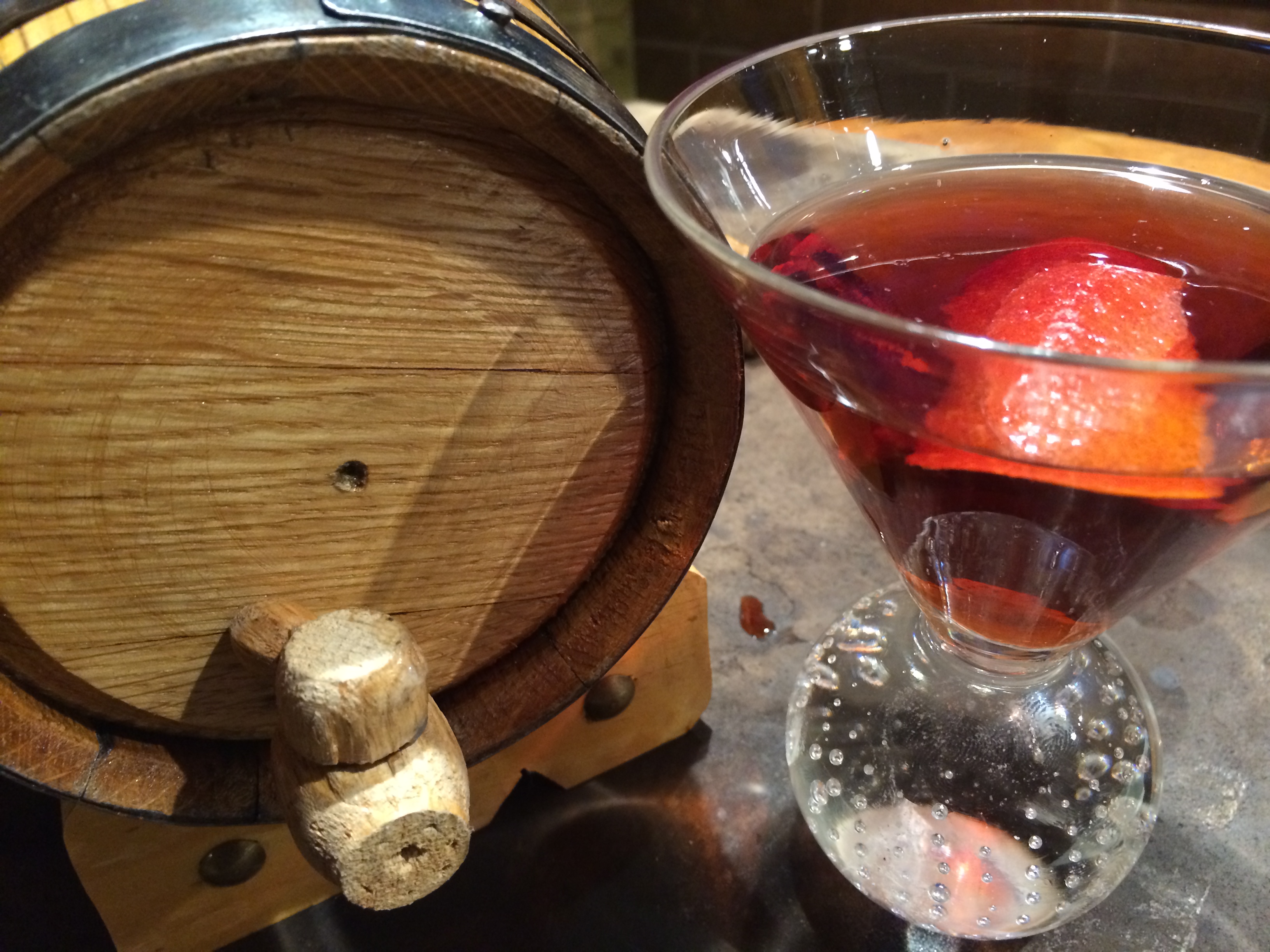
I chose to age a favorite cocktail that I first savored at the Greenhouse Tavern in Cleveland, Ohio, the brainchild of the insanely talented chef Jonathon Sawyer. The call it a Negroski, their take on a Negroni. It features equal parts Campari, Cocchi sweet vermouth, and OYO stone fruit vodka. They make large batches of it and keep it in a barrel until they serve it. So enamoured my wife and I were with this drink, that I begged the bartender to give me the recipe. He did, and though I could easily find Campari back home, I went on an internet search for the Cocchi vermouth (found it at http://www.drinkupny.com, a great wine and spirits website) and the OYO stone fruit vodka (an Ohio product that I finally found at http://www.thepartysource.com.)

Doing the math, equal parts of each ingredient meant 1 1/3 cups of each to make a quart…which fit perfectly in my 1-liter barrel. Once I corked the top with the bung, it was time to let it age.

A slight daily rotation of the barrel gently rocks the liquid inside, exposing it to the barrel’s charred wood interior, giving it more flavor. And at the end of   a week, I was ready for my first tasting: the wood had a subtle influence, rounding out the flavors. I wanted a little more, so I waited another week.: even better, but not quite there. It took a total of three weeks before the drink reached its flavorful peak.

I poured some of the drink into a cocktail shaker with ice, stirred briskly with a spoon, and strained it into a martini glass, garnishing with a twist of blood orange peel. Delicious!

cask

What’s next for my little wooden cask? Perhaps some of my Krupnikas (http://wp.me/p1c1Nl-lq).

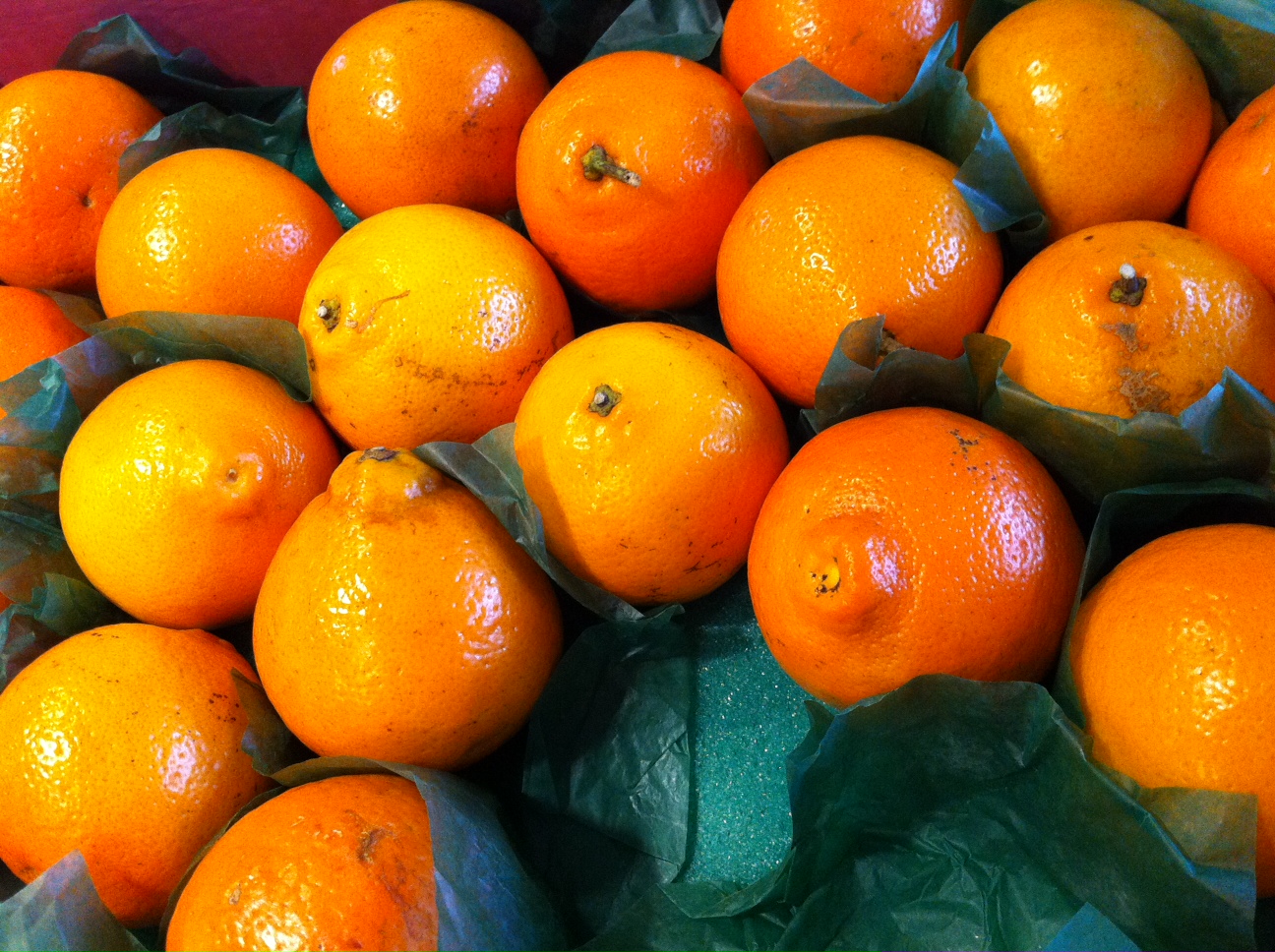
My wife’s aunt in Florida sends us an awesome gift every year. It’s a box of Cushman’s HoneyBells. They look like fiery red bell-shaped oranges, and they are the sweetest and juiciest fruit you will ever have! But they’re not really oranges at all.
honey bells
HoneyBells are a unique natural hybrid of Dancy Tangerine and Duncan Grapefruit. The plants are grafted to a sour orange root-stock, and when the tree reaches maturity, it looks just like a grapefruit tree…but with oranges growing on it.
HoneyBells are available for a very short time every winter…and that time is NOW. So if you’re at all interested, check out http://www.honeybell.com/. Cushman’s was bought out by the fruit giant Harry & David some years ago, but the excellent quality of the product and their fine service has not changed.
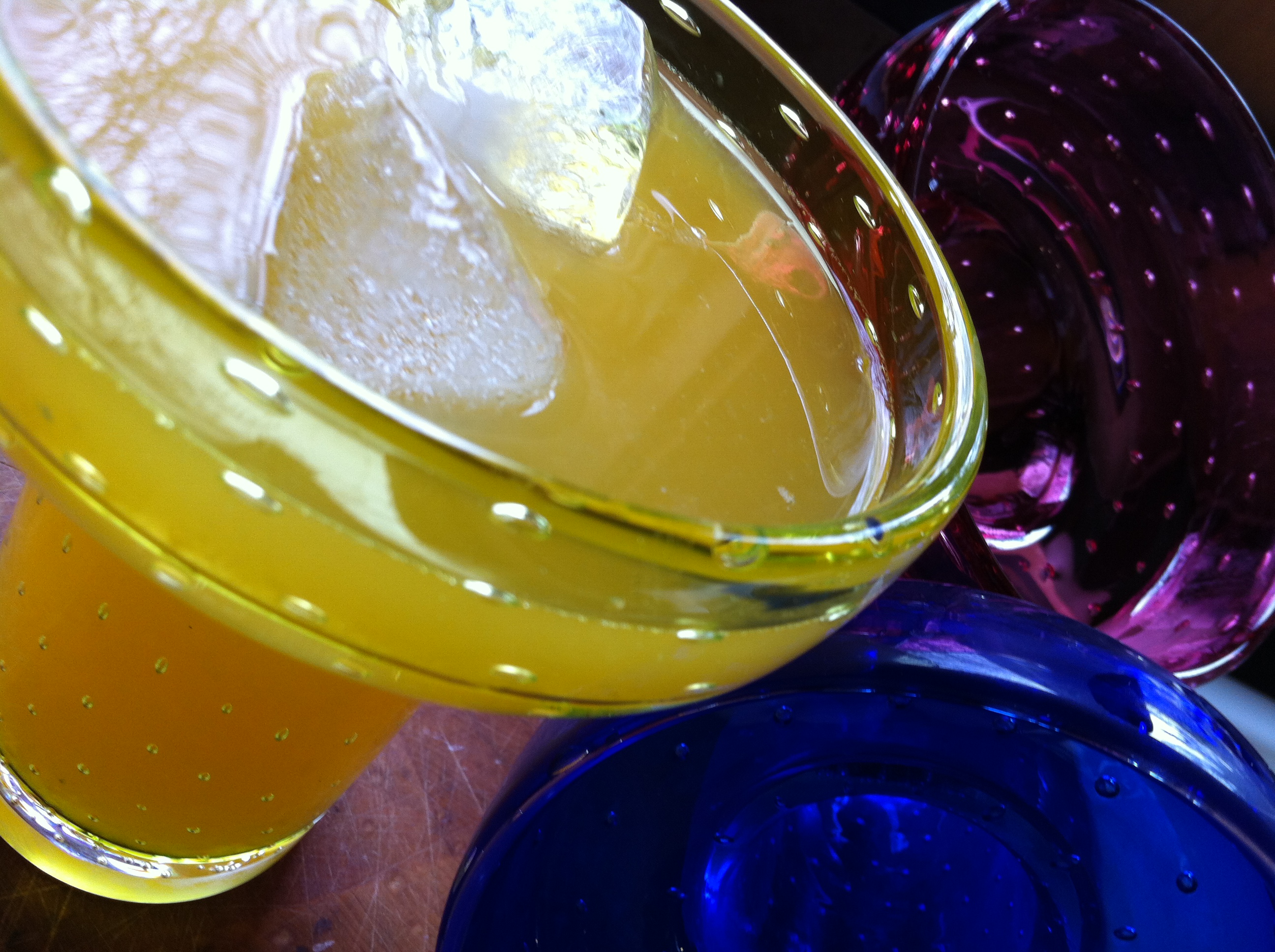
I usually make my signature margarita, the Algarita, with pineapple juice. But when I get those HoneyBells in the mail, my recipe takes on a new twist:
algarita 1
HONEYBELL ALGARITAS
2 oz Patron silver tequila
1/2 oz Cointreau orange liqueur
4 oz fresh squeezed HoneyBell juice
1/2 oz fresh squeezed lime juice
Fill a tall glass with ice and add all the ingredients. Stir vigorously. Pour into a large margarita glass. Garnish with lime wedge. Salt optional.
photo3.jpg
The HoneyBell clock is ticking…get ‘em soon or you’ll need to wait a year!
Any other time of the year, substitute pineapple juice, orange juice or a combination of both for the Honey Bells.

I can’t believe it took this long to write about something that is near and dear to my heart…and liver.

I’ve been making a Lithuanian honey liqueur called Krupnikas for over 30 years. (And no, I won’t be posting my secret recipe here.) It’s a honey-based liqueur that is popular in eastern Europe, especially in countries like Lithuania (where my parents were born) and Poland. Though most of the Krupnikas that I’ve tasted is similar, no two recipes are exactly alike.

krupnikas

If you Google “Krupnikas,” you’ll find many different recipes for the stuff…some pretty good, some incredibly awful…and none as good as mine! But still…you can make it at home. I make it with grain alcohol, but if that’s not available in your state, you’ll have to settle for vodka.

My Krupnikas making story started with my uncle, who would make batches of the stuff in his kitchen. Because I am the godfather of my cousin, Victor (his son), starting at the then-drinking age of 18, I got a bottle from my uncle every Christmas…and by New Year’s that bottle would be gone. It wasn’t long before I got very tired of waiting 51 weeks for another bottle and I asked my uncle if he would share his recipe with me. He never did that, exactly, but he did let me sit in on a brewing session and take notes.

I took my notes home and tried to decipher what I wrote. Since there was no such thing as the internet back then, I drove all over New York in search of some of the more exotic spices used in making Krupnikas. I became a regular in several Asian and Indian stores, where they looked at me somewhat suspiciously as I brought my spices to the counter for purchase.

Over the decades, through trial and error, I tweaked and even drastically changed my uncle’s original recipe to the one that I proudly call my own today. You can’t buy it in a store (obviously), but if you have tons of money and want to go into business with me, I’m sure we can work something out! Or become my best friend and you’ll get a bottle every Christmas…and then you’ll be the one waiting 51 weeks for another!

krup glasses

Versions of Krupnikas are available in liquor stores: Old Krupnik is a Polish liqueur, and the German brand Barenjager is another. And brands like Dewar’s and Jack Daniels are adding honey to their spirits as well.

Though quite different from my own recipe, there is one authentic Lithuanian style Krupnikas made in the United States. Based out of Durham, North Carolina, the Brothers Vilgalys Spirits Company (www.brothersvilgalys.com) has a pepperier version that uses local North Carolina wildflower honey. President of the company, Rim Vilgalys, the son of my good childhood friend from New York, has done what I never got around to do: make this fabulous elixir available to the public. You’ll find it at ABC stores throughout the state of North Carolina. On line, you’ll find it at Federal Spirits, based in Washington, DC…a very interesting website full of regional spirits from around the USA and Canada. www.federalspirits.com

Sveiks! (Cheers!)

Why does bacon taste “off” when it’s infused, mixed with chocolate, or even on a fast food burger? And Bakon, the bacon infused vodka you can buy at your local liquor store, is another example of “it’s better when you do it yourself.”

To make bacon infused vodka, I use the bacon I love to eat: my own homemade stuff. But your favorite store-bought bacon will work just as well.

bacon vodka

Some bacon infused vodka recipes have you cook the bacon and soak the strips in vodka for a week or so. But I like this idea better:

Cook your favorite bacon in a pan. Eat the bacon. Set the fat aside. For a 750 ml bottle of vodka, use 2 tablespoons bacon fat. Place both in  a mason jar, shake well, and let it sit at room temperature for about 6 hours, shaking occasionally. After 6 hours, place the mason jar in the freezer. The alcohol will not freeze, but the fat will. After 30 minutes, strain through paper coffee filters and you’ve got bacon infused vodka!

Cheers!

I know that winter has only started. But I’m cold, dammit, and I’m thinking about the Caribbean!

One of the tastiest rum drinks you can make, and one that certainly brings you back to the Caribbean—or at least makes you feel like you’ve been there—is the legendary Painkiller. It was invented on the tiny island of Jost Van Dyke in the British Virgin Islands, at the famous Soggy Dollar Bar. Located on White Bay, a stretch of the whitest most beautiful sand in the Caribbean, surrounded by beautiful turquoise waters, there is no dock. You have to anchor your boat offshore and swim…hence the name: the Soggy Dollar.

SOGGY1

Daphne Henderson was the owner of the Soggy Dollar years ago, and she is credited for inventing the Painkiller, which used Pusser’s rum, a British rum that is readily available here in the United States. Charles Tobias, a businessman that received permission from the British Royal Navy to commercialize Pusser’s rum in 1980, tasted the Painkiller and realized the potential of this amazing drink. He took some Painkillers home to the island of Tortola, where he experimented in recreating that drink, coming up with what he thought was something that was as good as—if not better than—the original. He called it the Pusser’s Painkiller.

Tobias never found out what Daphne Henderson’s original recipe was, but when he brought his own Pusser’s Painkillers back to the Soggy Dollar, and had a tasting battle between the two recipes, his recipe apparently won 10 out of 10 times. With 4 Pusser’s bars and restaurants in the Caribbean and 2 more in the states, Tobias quickly made the Pusser’s Painkiller the signature drink of these now-famous establishments…and perhaps the most popular drink among the sailing community in the US, Caribbean and West Indies.

The drink itself is simple…

PUSSER’S PAINKILLER

4 parts pineapple juice

1 part cream of coconut

1 part orange juice

Combine these 3 ingredients, with lots of fresh grated nutmeg in a glass with ice. How much Pusser’s rum you use depends on how hammered you want to get! A Pusser’s #2 uses 2 parts rum…a Pusser’s #3 uses 3 parts rum…and a Pusser’s #4 uses 4 parts rum!

I’ve had several Pusser’s #4’s back in the day when there was a Pusser’s bar on the island of St John in the USVI many years ago. I’ve also sampled them in the BVI at the 2 Pusser’s locations on Tortola.  But I still prefer going back to Jost Van Dyke and knocking back a few at the place where the Painkiller was born, the greatest beach bar on planet Earth: The Soggy Dollar Bar.

I don’t know when I’ll get a chance to go back. But my bathing suit is already packed.

SOGGY2

Thanks to my buddy, Dr Chezwick, for the photos. No children were harmed during this catamaran trip.

20121220-172330.jpg

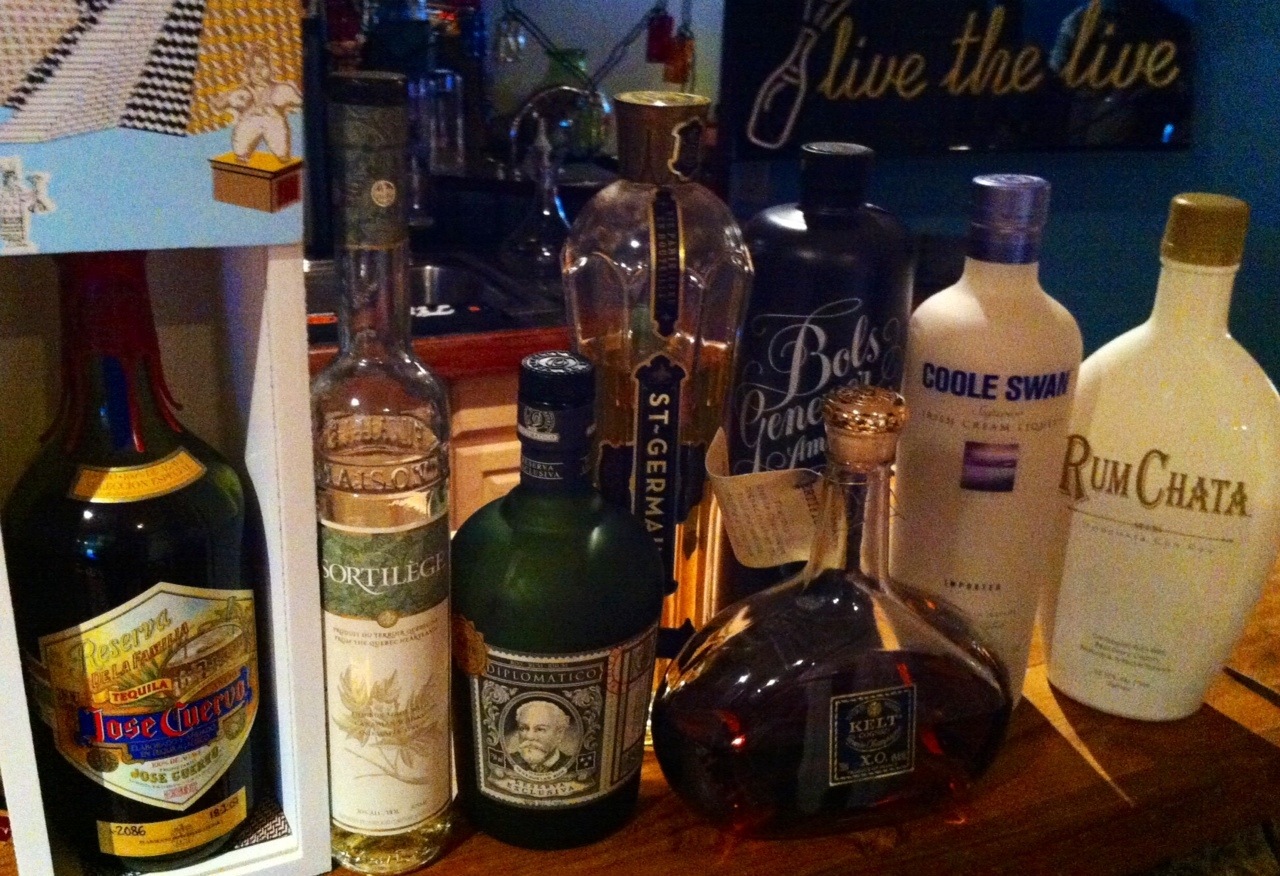
For me, fine spirits are the best gift for the holidays. You can go with some aged rums…sipping tequilas…or classic cognacs. And then there’s the whole list of liqueurs…sweets for the end of the meal or a key ingredient in a flavorful cocktail. Here’s my list of favorite bottles…

Kelt XO Cognac: What makes this cognac special is that it leaves the Cognac region of France in barrels and gets loaded onto ships that travel the world for months at a time. The barrels of cognac mellow, as they slowly rock back and forth in the ship’s hold out in open seas, much like they did hundreds of years ago before we loaded pallets of product onto cargo planes. The ships then return to Cognac, where the spirit is unloaded and bottled. The result is an exceptionally smooth cognac that is still my favorite to date. What’s really cool is that each bottle has a summary of what ship it was on and where it traveled. The VSOP is great, but the XO is outstanding. And they say it makes a difference if the ships go around the world clockwise or counterclockwise!
Diplomatico Reserva Exclusiva Rum: If you’ve got a friend that likes sipping rum, this takes it to a whole new level. Made in Venezuela, it has a sweetness that you won’t want to mix…on the rocks is perfect. I have turned more friends on to this rum in the last couple of years than any other spirit I’ve discovered. Thanks to Jeff and Geremie, owners of Fluke restaurant in Newport, Rhode Island, for giving me my first sip of this wonderful rum years ago.

Jose Cuervo Reserva de la Familia tequila: I am not a fan of Jose Cuervo tequila in general. If all you want is a reposado or anejo, there are so many other better ones out there: Don Julio, Don Eduardo, Corazon, and Sauza Tres Generaciones just to name a few. And for silver, nothing beats Patron. But this top-of-the-line Cuervo is excellent, and you pay the price for the designer box as well as the tequila. Worth every penny.

St Germaine: a sweet liqueur crafted from hand-picked Elderflowers that grow in the Alps, and featured in an excellent house drink called The Elixir at Cooke and Brown Public House in Providence, Rhode Island, featuring Irish whisky, St Germain, honey, lemon and bitters.

Bols Genever: First made in Holland in 1575, this is the stuff the British fell in love with, tried to copy, and then shortened the name of their resulting product and called it “gin.” But it’s better than gin. Many a great cocktail starts with this key ingredient. One of my favorites is a take on the classic Negroni: combine 1.5 oz Bols Genever, 1 oz Gran Classico, and .5 oz Punt e Mes.

Coole Swan: Imagine a Bailey’s that tastes like melted vanilla ice cream, and you sort of have an idea of the flavor of this terrific cream liqueur. It’s a key ingredient in my espresso martinis. Here’s my recipe: 3 oz Belvedere vodka, 3 oz freshly brewed espresso, 1.5 oz Kahlua and 1.5 oz Coole Swan. Mix all ingredients in a shaker with ice. Shake vigorously. Makes 2 martinis. You will never drink another espresso martini as long as you live!

Rumchata: Horchata is a very popular drink in Hispanic countries. It comes from many ingredient combinations, but one of the most popular is rice, vanilla and cinnamon. Imagine a liquid version of rice pudding and you sort of get the idea. So if you add rum to it…you get a liqueur unlike anything you’ve had before. Very tasty.

Castries: This creamy liqueur takes its name from the capital city of the island of St Lucia….and it surprises me that it took this long for someone to come up with a peanut flavored liqueur. Sure, there are other nut liqueurs: almond liqueurs, like real Amaretto (not Disaronno, which is made from peach or apricot pits)…and hazel nut liqueurs like Frangelico. But this one is very different. It’s creamy, not clear, and delicious.
Sortilege: This liqueur made from Canadian whisky and maple syrup is the definition of liquid dessert. It’s hard to describe how good this stuff is. All I can say is: once you open it, it will vanish very quickly. I haven’t poured it on pancakes yet, but some hungover morning I will!
Cheers!