It’s my birthday! I just might have a Vesper (or two) to celebrate!
An update on the Dukes Hotel: right now, they are refurbishing it, so the hotel is closed. But the Dukes Bar remains open for business! That means you don’t have to battle with hotel guests to get a seat at this iconic bar! Almost worth a trip to London just to get a seat before the hotel reopens this fall!
A few years ago, I took a trip to London with my daughter, and we checked off quite a large list of things we wanted to do: trips to Oxford and Stonehenge, museums, the theater, restaurants with fabulous food (and some with equally amazing views), college tours, a proper British afternoon tea at the Ritz, and much more.
One of the top things on my personal list was to pay a visit to the renowned Dukes Bar at the Dukes Hotel, where, as legend has it, Ian Fleming, the author of the James Bond novels, not only came up with the phrase “shaken, not stirred,” but also created the now-famous Vesper martini.
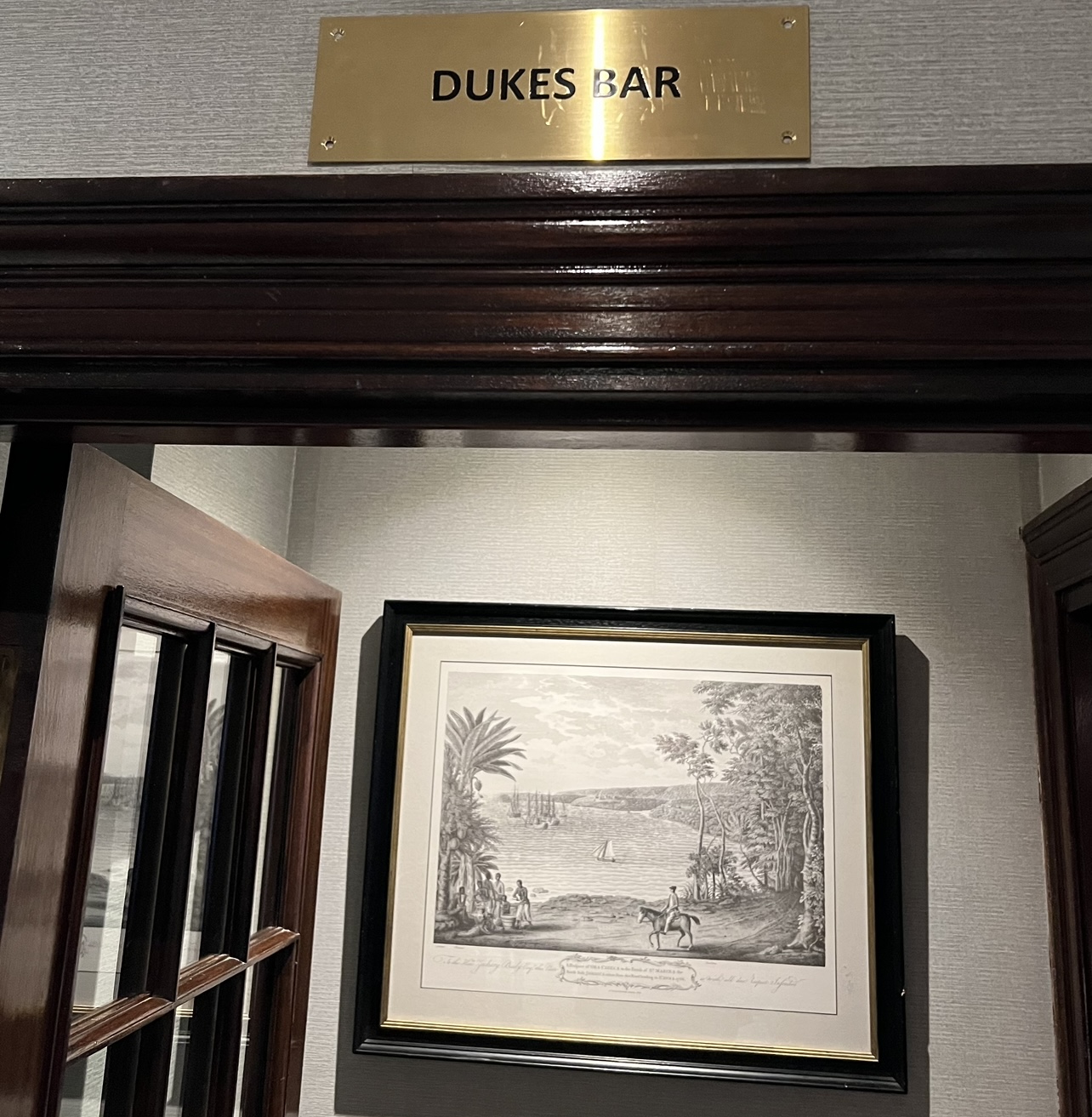
Sadly, this is as close as I got to the Dukes Bar. People who stay at the hotel get to reserve a space in the incredibly small bar area, and everyone else has to wait in line on a first-come, first-served basis. Unfortunately for me, the wait to be seated was way too long and I never got to experience the Dukes Bar for myself.
*sigh*…looks like I’ll need to make another trip to London to check this one off my bucket list.
In the meantime, I can enjoy a Vesper at home…
At first, it seemed almost silly to try to make one…but the classic James Bond martini has always fascinated me. I’m not talking about the clichéd Sean Connery “vodka martini, shaken, not stirred.” I’m talking about the real James Bond martini, which appeared in Ian Fleming’s first 007 novel “Casino Royale” and only appeared in the 2006 “Casino Royale” motion picture starring Daniel Craig (the best Bond of all, if you ask me.)
To quote the novel:
‘A dry martini,’ he said. ‘One. In a deep champagne goblet.’ ‘Oui, monsieur.’ ‘Just a moment. Three measures of Gordon’s (gin), one of vodka, half a measure of Kina Lillet. Shake it very well until it’s ice-cold, then add a large thin slice of lemon peel. Got it?’ ‘Certainly, monsieur.’ The barman seemed pleasant with the idea. ‘Gosh that’s certainly a drink,’ said Leiter.
Bond laughed. ‘When I’m … er … concentrating.’ he explained, ‘I never have more than one drink before dinner. But I do like that one to be large and very strong and very cold and very well-made. I hate small portions of anything, particularly when they taste bad. This drink’s my own invention. I’m going to patent it when I can think of a good name.’
He watched carefully as the deep glass became frosted with the pale golden drink, slightly aerated by the bruising of the shaker. He reached for it and took a long sip.
‘Excellent,’ he said to the barman, ‘but if you can get a vodka made with grain instead of potatoes, you will find it still better.’
Bond named this drink the Vesper martini, after the character Vesper Lynd, portrayed by Ursula Andress in the 1967 adaptation, and Eva Green in the 2006 adaptation of “Casino Royale.”
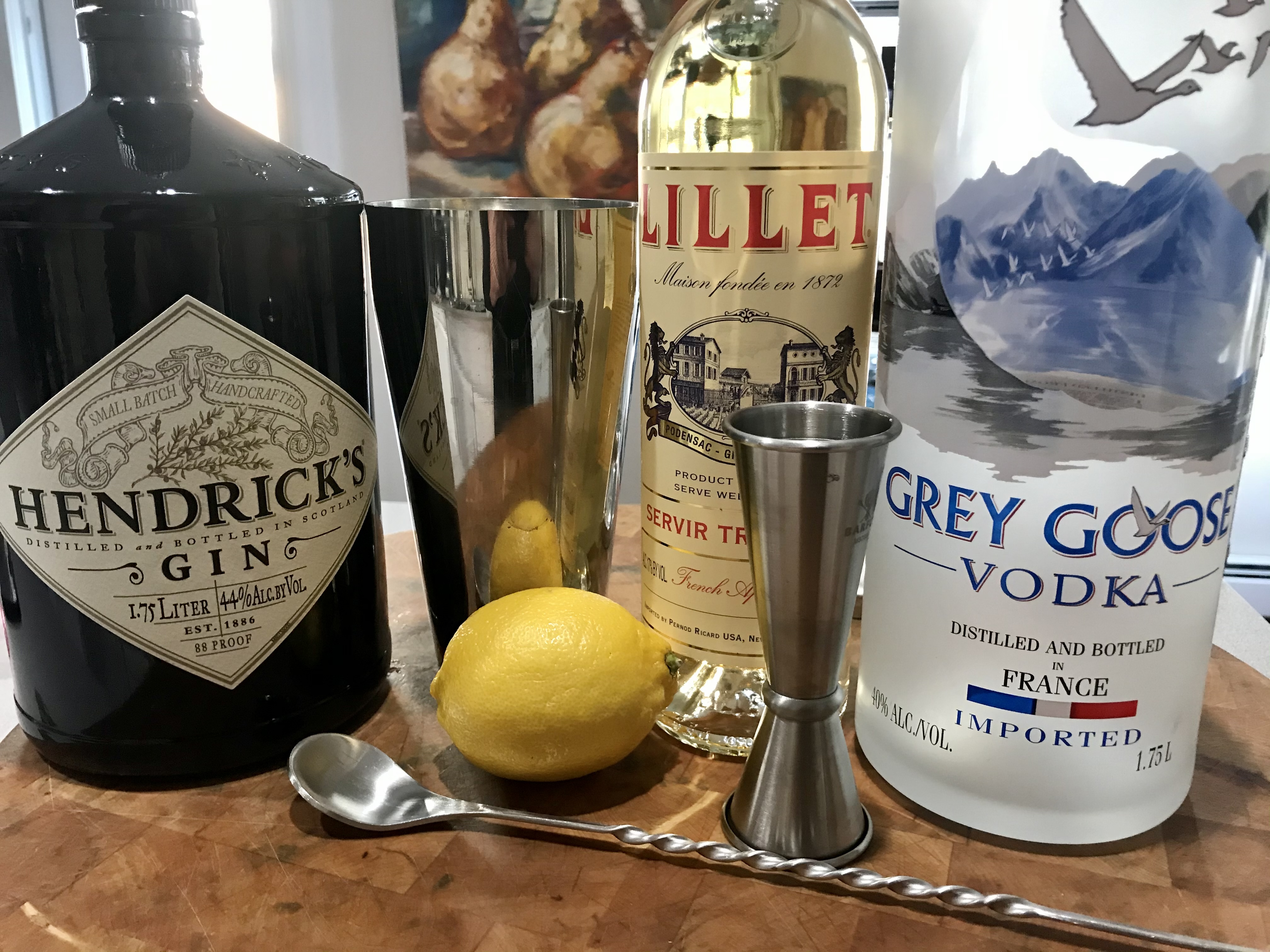
My first homemade version of this classic drink remained true to the measurements of the original, though I changed brands due to personal preference. In the novel, Bond just asks for “vodka.” (Of course, this was back in the 1950’s when we didn’t have hundreds of brands to choose from!) My choice for best-bang-for-the-buck grain vodka is Tito’s, made from corn. But an excellent choice for wheat-based vodka is Grey Goose.
Bond asks for Gordon’s gin. I’m partial to the floral notes of Hendrick’s.Again, in the 50’s, what good British agent wouldn’t drink Gordon’s?
And the original Kina Lillet had its recipe changed in the 1980’s to keep up with the times by reducing the quinine, which made it bitter. (Kina refers to the quinine, so it was removed from the label when the quinine was removed from the formula.) The French aperitif wine, Lillet, is today’s version: a blend of wine grapes, oranges, orange peels and quinine. Lillet is not a vermouth, though you’ll find it in the vermouth section of your favorite liquor store. With the rise in popularity of the Vesper martini, many bartenders and aficionados claim it’s just not the same without the original Kina Lillet formulation, and a search began to find a better substitute, one with a more pronounced quinine assertiveness.
Enter Cocchi Americano, an aromatized wine also found in the vermouth section of many liquor stores. With its quinine-forward recipe, Vesper fans claim it comes closer to the original Kina Lillet. Add a more London-style dry gin to the mix, like Bombay Sapphire, and you just about nail the cocktail Bond created all those years ago.
So…with measurements true to Bond, may I suggest two versions of the same cocktail!
My original, more floral, version…
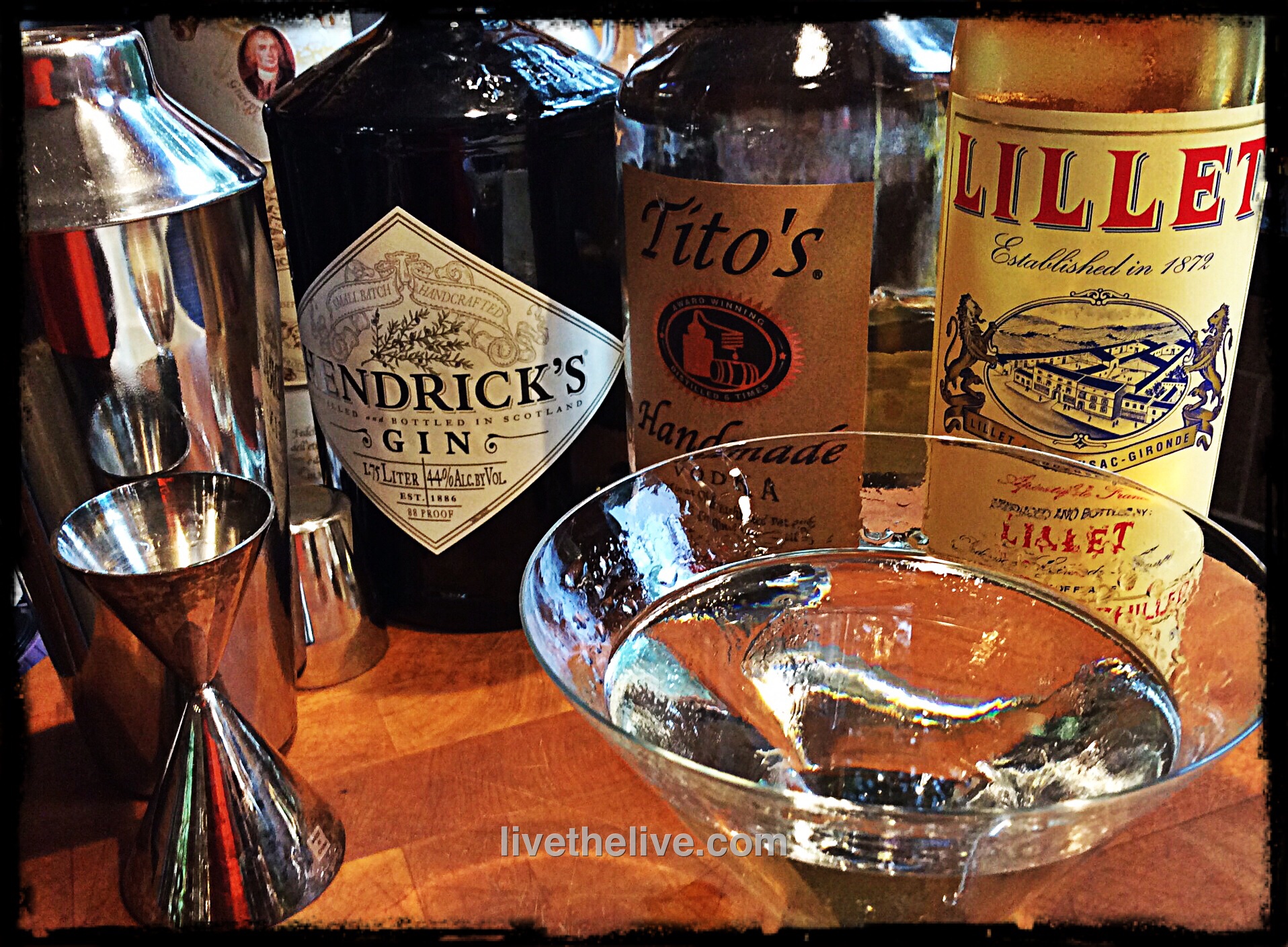
3 oz. Hendrick’s gin 1 oz. grain-based vodka (like Tito’s or Grey Goose) 1/2 oz. Lillet
Combine these over ice in a cocktail shaker, and shake vigorously. Strain it into a chilled martini glass. I’m happy with a lemon peel or even olives with this combination.
Or…
The version closer to Bond’s original, which is equally wonderful in its own right: crisp and refreshing, a strong drink with a hint of bitterness from the quinine. Dangerously addictive!
3 oz. London dry gin (like Bombay Sapphire)
1 oz. grain-based vodka (like Grey Goose)
1/2 oz. Cocchi Americano
Combine these over ice in a cocktail shaker, and shake vigorously. Strain it into a chilled martini glass. Garnish with a large, thin lemon peel.
With the rising popularity of the Vesper martini, and the use of Cocchi Americano instead of Lillet, the makers of Lillet now claim they “never removed” the quinine from their original recipe. Many feel this is an outright lie, (back-pedaling a bit, aren’t we?) because they themselves stated they changed in the formula back in the 80’s. A little too late now for them to re-formulate. CocchiAmericano has become the go-to with many bartenders (and myself) when recreating this classic cocktail. But if I can’t find it at my favorite liquor store, Lillet will do in a pinch.
If you don’t want to spend the extra cash for Grey Goose, I found that this combination is also very satisfying: for the vodka, go with the original red label of Stoli with Bombay Sapphire gin and CocchiAmericano in the original proportions.
I love onions! Raw, sautéed, caramelized, yellow, Spanish, Bermuda, Vidalia, Texas Sweets, scallion, pearl, Crimini, Walla Walla…they can do no wrong. In fact, my family gave me the Lithuanian nickname: “Ponas Svogūnas.” (“Mr. Onion.”)
I also love vodka martinis! So if I’m going to buy a top shelf vodka like Stoli Elit or Chopin, I’m not going to ruin it with jarred cocktail onions, brined with cheap vermouth, found in the bar mixers section of my local supermarket. Who knows how long those nasty things have been sitting on the shelf?
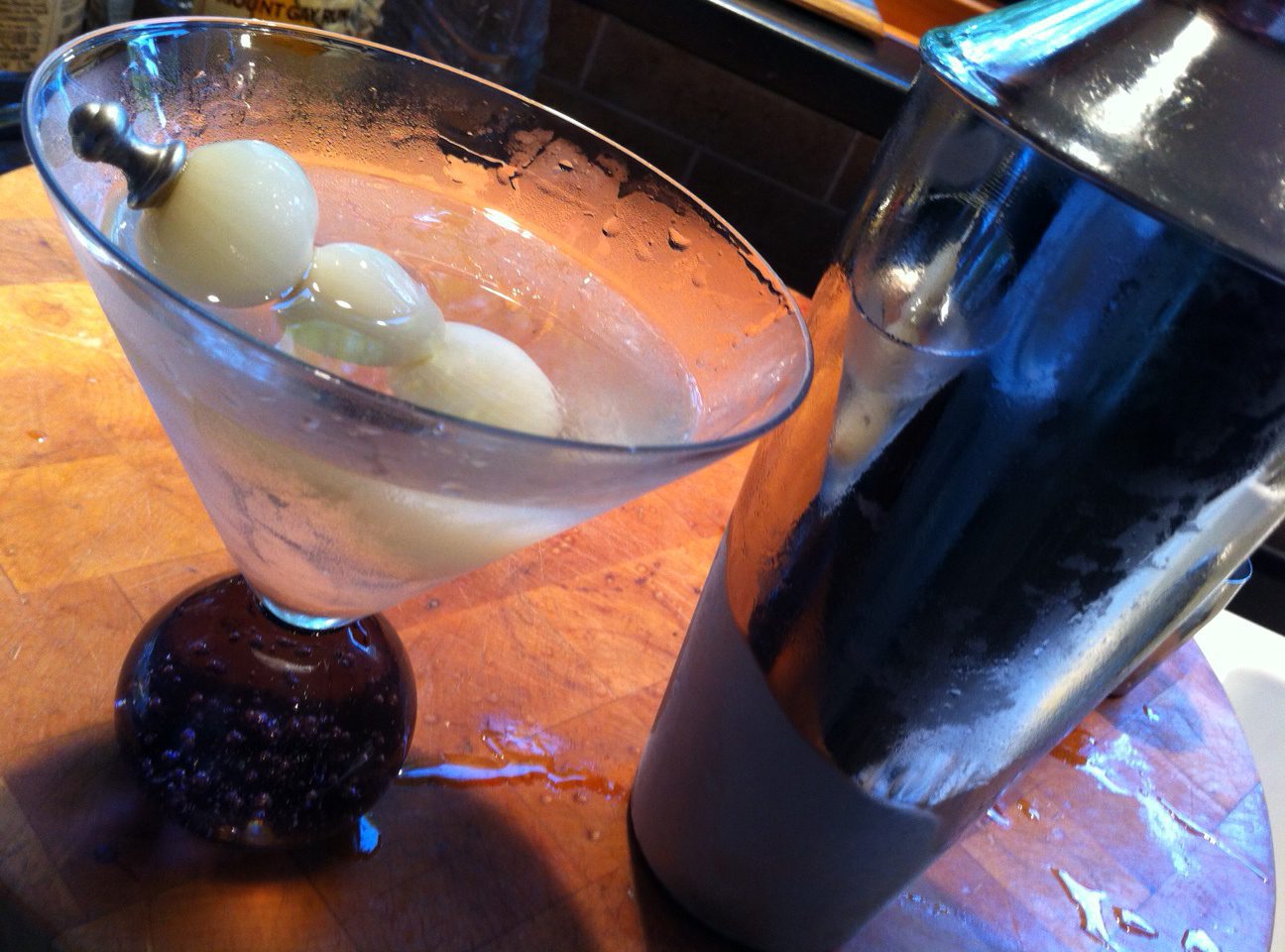
No, I’m going to make my own cocktail onions to enjoy a proper Gibson!
The Gibson martini is simply one with onions instead of olives, and the story of its origin is somewhat unclear. According to one story, it was invented by Charles Dana Gibson, who created the popular Gibson Girl illustrations. Supposedly, he challenged Charley Connolly, the bartender of the private club, ThePlayers, in New York City, to improve on a martini. Connolly simply substituted an onion for the olive and named it after Gibson.
Another story claims a man named Gibson dropped an onion in his water-filled martini glass to differentiate between his own drink and that of his colleagues, who were imbibing heavily.
Some stories about the Gibson don’t even mention an onion. (?)
And yet another story, now considered the more probable one, is that the Gibson martini was invented at the BohemianClub in San Francisco in the 1890’s by Walter D. K. Gibson. There is documentation as early as 1898 to back that up.
Whatever story you want to believe, the Gibson martini was originally made with gin, not vodka, but that’s strictly a personal preference–and I don’t use any vermouth. (I think the biggest injustice you can do to high-quality vodka is ruin it with low-quality vermouth. But that rule applies to any alcohol and any mixer. It’s only as good as its worst ingredient–and that includes the ice!)
My first attempt at homemade cocktail onions was not a success. I bought pearl onions and did what the package instructions said: I dropped them in boiling water for a couple of minutes, then moved them to ice water to let them cool. Then a gentle squeeze on one end of the onion would make it pop right out of its skin. Easy, right?
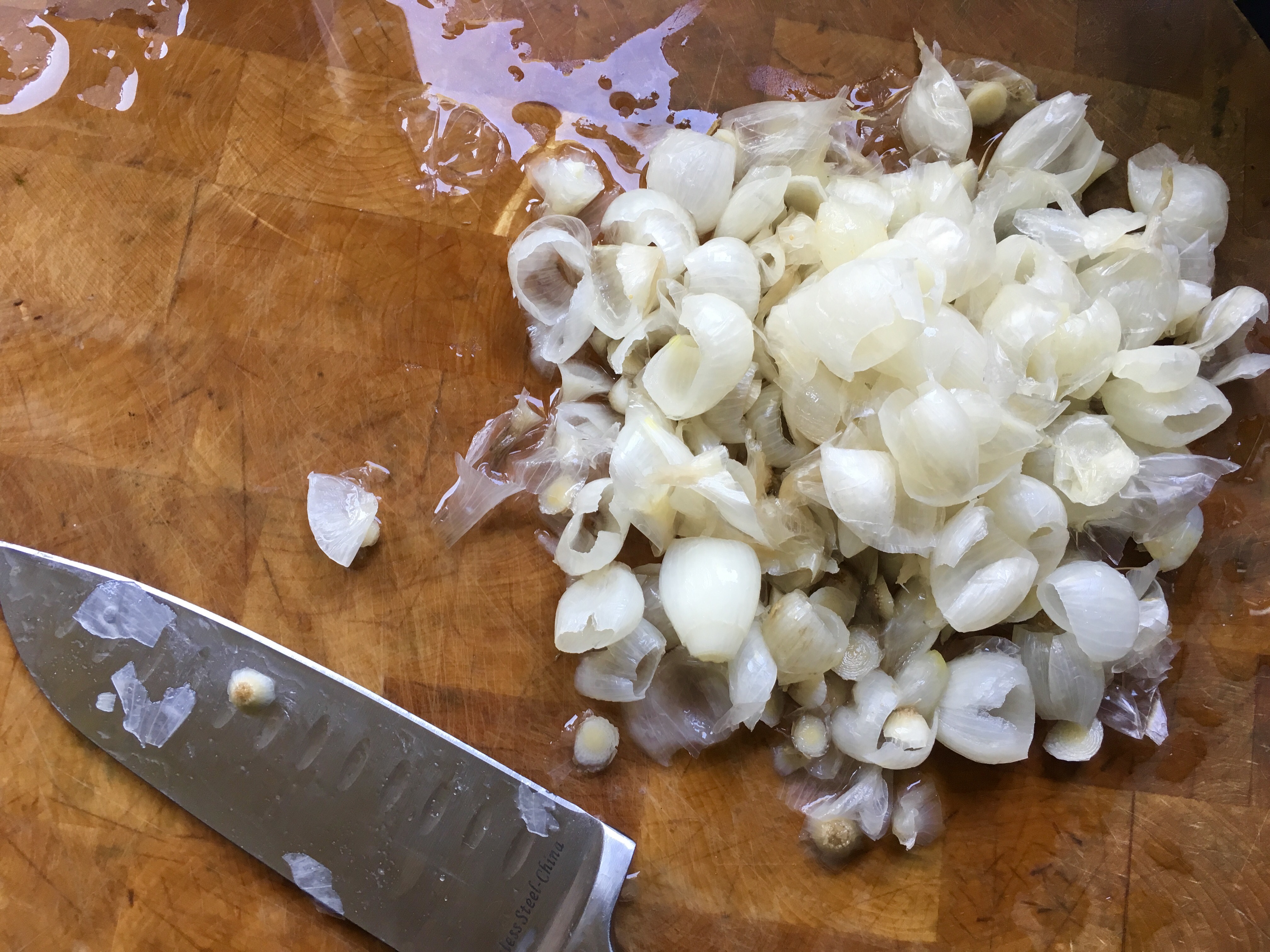
Well, it didn’t work out that way. For one thing, the onions got soft…not what I wanted. I had to cut one end of the bulb with a knife. And even then, when I squeezed the onion, the part that popped out was about half the size of the original onion…there was a lot of waste.
After brining, they tasted OK, but they never had that crisp bite I wanted. They were mushy. I realized that boiling was not the way to go.
A lot of waste.
I knew there had to be a better way. Then I discovered already peeled pearl onions at Whole Foods. I have to be honest…I won’t use any other onions now. They’re big, plump, and exactly what I want. Some might say they’re too big…but I don’t have a problem with that.
Sure, these are much larger than the onions you find in a jar. But tell me how that’s a problem!
1 lb. pearl onions, peeled, ends cut off
1 cup white vinegar
1/2 cup apple cider vinegar
1 1/2 cups water
3/4 cup sugar (I like turbinado sugar)
10 peppercorns
1 teaspoon salt (per quart-sized Mason jar)
2 cloves garlic
Combine the white vinegar, apple cider vinegar, water, sugar, and peppercorns in a medium-sized saucepan. Bring it to a boil, making sure the sugar dissolves completely. Remove it from the heat.
Slice the ends off the onions.
I’ve found that if I allow the brining liquid to get inside the onions, especially these larger ones, they’ll get tastier faster…and who doesn’t want that? So I take a thin metal or bamboo barbecue skewer and push it through the center of the top of the onions, all the way through the center of the bottom of the onions. Now there’s a little “tunnel” for that brine to get in, and it can work its magic from the inside out!
Not skewering the onions simply means it’ll take longer for that brine to seep in…but that’s perfectly fine if you want a not-so-briny onion.
In a quart-sized Mason jar, add the teaspoon of salt and garlic cloves. Pour a little of the hot vinegar liquid in the Mason jar to dissolve the salt. Add the onions to the jar, as tightly as you can, then fill the jar to the top with the vinegar liquid.
Screw the top of the jar on tightly, and turn it upside-down a couple of times to mix everything together. If it looks like the level of the liquid has gone down a bit, open the jar and top it off with the vinegar liquid, then re-seal it.
Let the jar cool to room temperature, then move it to the fridge. You can use the onions as soon as the craving hits you, but they’ll taste better if you give them a few days to a week.
OK…so if after reading this, you just don’t want to go through the whole process of making your own cocktail onions, there is one product that I just recently discovered that does the trick: Aunt Nellie’s. You can find them in the jarred veggie section of just about any supermarket, next to pickled beets and things like that. It’s a milder brine, and so the onions taste quite good. No nasty cheap vermouth to ruin your good martini.
Years ago, I gave my self an important research project: Create your own version of the perfect espresso martini.
It took painstaking research, which required drinking many espresso martinis in many a bar on my travels.
My favorite version came from a bartender working at Knave, the lobby bar at the at the former Le Parker Meridien Hotel in Manhattan. It featured Coole Swan, an Irish cream liqueur I had never heard of before. The bartender was nice enough to write down the recipe for me, but I guess I had a little too much to drink…because I lost it! So it was up to me to use those brain cells I didn’t fry and come up with my own combination.
For me, the perfect espresso martini needs to celebrate the unique, bold flavor of coffee. I never dilute my morning coffee with such nonsense as hazelnut or caramel flavorings, so there’s none of that here. I save the Bailey’s for mudslides.
I do, however, like a touch of cream in my coffee, and the Coole Swan works perfectly in this recipe to add that element to my martini.
A few years after I thought I came up with my perfect recipe, I discovered a coffee liqueur that blew Kahlua out of the water…50 proof versus 40 proof (and now Kahlua has reduced the alcohol in some countries to 32 proof) with less sweetness and more bold coffee flavor. It comes from Australia, and it’s called Mr. Black.
You won’t find Coole Swan or Mr. Black at your tiny corner liquor store, but if you have a quality store a little further away from home, make the trip.
Brewing your own espresso is another step toward martini perfection, but if you don’t have a machine, you can buy some pre-made espressos in the refrigerated coffee section of many supermarkets. Go for the ones without sugar.
3 oz. freshly brewed espresso
2.5 oz. good quality vodka (I think Stoli Elit is the best out there)
1.5 oz. Mr. BlackCold Brew Coffee Liqueur
1.5 oz. Coole Swan Superior Irish Creme Liqueur Espresso or coffee beans
Chill your martini glasses. Pour all the ingredients (except the beans) into a large shaker with ice. Shake vigorously. Strain into chilled glasses. Garnish with 3 beans. (Tradition says the three beans represent health, wealth, and happiness.)
This recipe makes 2 martinis.
And by the way, if you pronounce it “expresso,” we can’t be friends.
The holidays mean guests are coming over, and everyone will be enjoying more cocktails than usual. Here’s the story of a classic.
Last year, I took a trip to London with my daughter, and we checked off quite a large list of things we wanted to do: trips to Oxford and Stonehenge, museums, the theater, restaurants with fabulous food and some with equally amazing views, college tours, a proper British afternoon tea at the Ritz, and much more.
One of the top things on my personal list was to pay a visit to the renowned Dukes Bar at the Dukes Hotel, where, as legend has it, Ian Fleming, the author of the James Bond novels, not only came up with the phrase “shaken, not stirred,” but also created the now-famous Vesper martini.
Sadly, this is as close as I got to the Dukes Bar. People who stay at the hotel get to reserve a space in the incredibly small bar area, and everyone else has to wait in line on a first-come, first-served basis. Unfortunately for me, the wait to be seated was way too long and I never got to experience the Dukes Bar for myself.
*sigh*…looks like I’ll need to make another trip to London to check this one off my bucket list.
In the meantime, I can enjoy a Vesper at home…
At first, it seemed almost silly to try to make one…but the classic James Bond martini has always fascinated me. I’m not talking about the clichéd Sean Connery “vodka martini, shaken, not stirred.” I’m talking about the real James Bond martini, which appeared in Ian Fleming’s first 007 novel “Casino Royale” and only appeared in the 2006 “Casino Royale” motion picture starring Daniel Craig (the best Bond of all, if you ask me.)
To quote the novel:
‘A dry martini,’ he said. ‘One. In a deep champagne goblet.’ ‘Oui, monsieur.’ ‘Just a moment. Three measures of Gordon’s (gin), one of vodka, half a measure of Kina Lillet. Shake it very well until it’s ice-cold, then add a large thin slice of lemon peel. Got it?’ ‘Certainly, monsieur.’ The barman seemed pleasant with the idea. ‘Gosh that’s certainly a drink,’ said Leiter.
Bond laughed. ‘When I’m … er … concentrating.’ he explained, ‘I never have more than one drink before dinner. But I do like that one to be large and very strong and very cold and very well-made. I hate small portions of anything, particularly when they taste bad. This drink’s my own invention. I’m going to patent it when I can think of a good name.’
He watched carefully as the deep glass became frosted with the pale golden drink, slightly aerated by the bruising of the shaker. He reached for it and took a long sip.
‘Excellent,’ he said to the barman, ‘but if you can get a vodka made with grain instead of potatoes, you will find it still better.’
Bond named this drink the Vesper martini, after the character Vesper Lynd, portrayed by Ursula Andress in the 1967 adaptation, and Eva Green in the 2006 adaptation of “Casino Royale.”
My first homemade version of this classic drink remained true to the measurements of the original, though I changed brands due to personal preference. In the novel, Bond just asks for “vodka.” (Of course, this was back in the 1950’s when we didn’t have hundreds of brands to choose from!) My choice for best-bang-for-the-buck grain vodka is Tito’s, made from corn. But an excellent choice for wheat-based vodka is Grey Goose.
Bond asks for Gordon’s gin. I’m partial to the floral notes of Hendrick’s.Again, in the 50’s, what good British agent wouldn’t drink Gordon’s?
And the original Kina Lillet had its recipe changed in the 1980’s to keep up with the times by reducing the quinine, which made it bitter. (Kina refers to the quinine, so it was removed from the label when the quinine was removed from the formula.) The French aperitif wine, Lillet, is today’s version: a blend of wine grapes, oranges, orange peels and quinine. Lillet is not a vermouth, though you’ll find it in the vermouth section of your favorite liquor store. With the rise in popularity of the Vesper martini, many bartenders and aficionados claim it’s just not the same without the original Kina Lillet formulation, and a search began to find a better substitute, one with a more pronounced quinine assertiveness.
Enter Cocchi Americano, an aromatized wine also found in the vermouth section of many liquor stores. With its quinine-forward recipe, Vesper fans claim it comes closer to the original Kina Lillet. Add a more London-style dry gin to the mix, like Bombay Sapphire, and you just about nail the cocktail Bond created all those years ago.
So…with measurements true to Bond, may I suggest two versions of the same cocktail!
My original, more floral, version…
3 oz. Hendrick’s gin 1 oz. grain-based vodka (like Tito’s or Grey Goose) 1/2 oz. Lillet
Combine these over ice in a cocktail shaker, and shake vigorously. Strain it into a chilled martini glass. I’m happy with a lemon peel or even olives with this combination.
Or…
The version closer to Bond’s original, which is equally wonderful in its own right: crisp and refreshing, a strong drink with a hint of bitterness from the quinine. Dangerously addictive!
3 oz. London dry gin (like Bombay Sapphire)
1 oz. grain-based vodka (like Grey Goose)
1/2 oz. Cocchi Americano
Combine these over ice in a cocktail shaker, and shake vigorously. Strain it into a chilled martini glass. Garnish with a large, thin lemon peel.
With the rising popularity of the Vesper martini, and the use of Cocchi Americano instead of Lillet, the makers of Lillet now claim they “never removed” the quinine from their original recipe. Many feel this is an outright lie, (back-pedaling a bit, aren’t we?) because they themselves stated they changed in the formula back in the 80’s. A little too late now for them to re-formulate. CocchiAmericano has become the go-to with many bartenders (and myself) when recreating this classic cocktail. But if I can’t find it at my favorite liquor store, Lillet will do in a pinch.
If you don’t want to spend the extra cash for Grey Goose, I found that this combination is also very satisfying: for the vodka, go with the original red label of Stoli with Bombay Sapphire gin and CocchiAmericano in the original proportions.
It’s a Leap Year! This weekend, have a sip of the infamous Leap Year Cocktail.
This special drink was created in 1928 by Harry Craddock, who worked at the American Bar in London at that time.
2 oz. gin (I use Hendrick’s)
1/2 oz. Grand Marnier
1/2 oz. sweet vermouth (I use Antica Formula)
1/4 oz. fresh lemon juice
Combine all the ingredients with ice in a cocktail shaker and shake vigorously for 30 seconds. Pour into a chilled martini glass and garnish with a twist of lemon.
The holidays mean guests are coming over, and everyone will be enjoying more cocktails than usual. Here’s the story of a classic.
Earlier this year, I took a trip to London with my daughter, and we checked off quite a large list of things we wanted to do: trips to Oxford and Stonehenge, museums, the theater, restaurants with fabulous food and some with equally amazing views, college tours, a proper British afternoon tea at the Ritz, and much more.
One of the top things on my personal list was to pay a visit to the renowned Dukes Bar at the Dukes Hotel, where, as legend has it, Ian Fleming, the author of the James Bond novels, not only came up with the phrase “shaken, not stirred,” but also created the now-famous Vesper martini.
Sadly, this is as close as I got to the Dukes Bar. People who stay at the hotel get to reserve a space in the incredibly small bar area, and everyone else has to wait in line on a first-come, first-served basis. Unfortunately for me, the wait to be seated was way too long and I never got to experience the Dukes Bar for myself.
*sigh*…looks like I’ll need to make another trip to London to check this one off my bucket list.
In the meantime, I can enjoy a Vesper at home…
At first, it seemed almost silly to try to make one…but the classic James Bond martini has always fascinated me. I’m not talking about the clichéd Sean Connery “vodka martini, shaken, not stirred.” I’m talking about the real James Bond martini, which appeared in Ian Fleming’s first 007 novel “Casino Royale” and only appeared in the 2006 “Casino Royale” motion picture starring Daniel Craig (the best Bond of all, if you ask me.)
To quote the novel:
‘A dry martini,’ he said. ‘One. In a deep champagne goblet.’ ‘Oui, monsieur.’ ‘Just a moment. Three measures of Gordon’s (gin), one of vodka, half a measure of Kina Lillet. Shake it very well until it’s ice-cold, then add a large thin slice of lemon peel. Got it?’ ‘Certainly, monsieur.’ The barman seemed pleasant with the idea. ‘Gosh that’s certainly a drink,’ said Leiter.
Bond laughed. ‘When I’m … er … concentrating.’ he explained, ‘I never have more than one drink before dinner. But I do like that one to be large and very strong and very cold and very well-made. I hate small portions of anything, particularly when they taste bad. This drink’s my own invention. I’m going to patent it when I can think of a good name.’
He watched carefully as the deep glass became frosted with the pale golden drink, slightly aerated by the bruising of the shaker. He reached for it and took a long sip.
‘Excellent,’ he said to the barman, ‘but if you can get a vodka made with grain instead of potatoes, you will find it still better.’
Bond named this drink the Vesper martini, after the character Vesper Lynd, portrayed by Ursula Andress in the 1967 adaptation, and Eva Green in the 2006 adaptation of “Casino Royale.”
My first homemade version of this classic drink remained true to the measurements of the original, though I changed brands due to personal preference. In the novel, Bond just asks for “vodka.” (Of course, this was back in the 1950’s when we didn’t have hundreds of brands to choose from!) My choice for best-bang-for-the-buck grain vodka is Tito’s, made from corn. But an excellent choice for wheat-based vodka is Grey Goose.
Bond asks for Gordon’s gin. I’m partial to the floral notes of Hendrick’s.Again, in the 50’s, what good British agent wouldn’t drink Gordon’s?
And the original Kina Lillet had its recipe changed in the 1980’s to keep up with the times by reducing the quinine, which made it bitter. (Kina refers to the quinine, so it was removed from the label when the quinine was removed from the formula.) The French aperitif wine, Lillet, is today’s version: a blend of wine grapes, oranges, orange peels and quinine. Lillet is not a vermouth, though you’ll find it in the vermouth section of your favorite liquor store. With the rise in popularity of the Vesper martini, many bartenders and aficionados claim it’s just not the same without the original Kina Lillet formulation, and a search began to find a better substitute, one with a more pronounced quinine assertiveness.
Enter Cocchi Americano, an aromatized wine also found in the vermouth section of many liquor stores. With its quinine-forward recipe, Vesper fans claim it comes closer to the original Kina Lillet. Add a more London-style dry gin to the mix, like Bombay Sapphire, and you just about nail the cocktail Bond created all those years ago.
So…with measurements true to Bond, may I suggest two versions of the same cocktail!
My original, more floral, version…
3 oz. Hendrick’s gin 1 oz. grain-based vodka (like Tito’s or Grey Goose) 1/2 oz. Lillet
Combine these over ice in a cocktail shaker, and shake vigorously. Strain it into a chilled martini glass. I’m happy with a lemon peel or even olives with this combination.
Or…
The version closer to Bond’s original, which is equally wonderful in its own right: crisp and refreshing, a strong drink with a hint of bitterness from the quinine. Dangerously addictive!
3 oz. London dry gin (like Bombay Sapphire)
1 oz. grain-based vodka (like Grey Goose)
1/2 oz. Cocchi Americano
Combine these over ice in a cocktail shaker, and shake vigorously. Strain it into a chilled martini glass. Garnish with a large, thin lemon peel.
With the rising popularity of the Vesper martini, and the use of Cocchi Americano instead of Lillet, the makers of Lillet now claim they “never removed” the quinine from their original recipe. Many feel this is an outright lie, (back-pedaling a bit, aren’t we?) because they themselves stated they changed in the formula back in the 80’s. A little too late now for them to re-formulate. CocchiAmericano has become the go-to with many bartenders (and myself) when recreating this classic cocktail. I no longer stock my bar with Lillet.
If you don’t want to spend the extra cash for Grey Goose, I found that this combination is also very satisfying: for the vodka, go with the original red label of Stoli with Bombay Sapphire gin and CocchiAmericano in the original proportions.
I love onions! Raw, sautéed, caramelized, yellow, Spanish, Bermuda, Vidalia, Texas Sweets, scallion, pearl, Crimini, Walla Walla…they can do no wrong. In fact, my family gave me the Lithuanian nickname: “Ponas Svogūnas.” (“Mr. Onion.”)
I also love vodka martinis! So if I’m going to buy a top shelf vodka like Stoli Elit or Chopin, I’m not going to ruin it with jarred cocktail onions, brined with cheap vermouth, found in the bar mixers section of my local supermarket. Who knows how long those nasty things have been sitting on the shelf?
No, I’m going to make my own cocktail onions to enjoy a proper Gibson!
The Gibson martini is simply one with onions instead of olives, and the story of its origin is somewhat unclear. According to one story, it was invented by Charles Dana Gibson, who created the popular Gibson Girl illustrations. Supposedly, he challenged Charley Connolly, the bartender of the private club, ThePlayers, in New York City, to improve on a martini. Connolly simply substituted an onion for the olive and named it after Gibson.
Another story claims a man named Gibson dropped an onion in his water-filled martini glass to differentiate between his own drink and that of his colleagues, who were imbibing heavily.
Some stories about the Gibson don’t even mention an onion. (?)
And yet another story, now considered the more probable one, is that the Gibson martini was invented at the BohemianClub in San Francisco in the 1890’s by Walter D. K. Gibson. There is documentation as early as 1898 to back that up.
Whatever story you want to believe, the Gibson martini was originally made with gin, not vodka, but that’s strictly a personal preference–and I don’t use any vermouth. (I think the biggest injustice you can do to high-quality vodka is ruin it with low-quality vermouth. But that rule applies to any alcohol and any mixer. It’s only as good as its worst ingredient–and that includes the ice!)
My first attempt at homemade cocktail onions was not a success. I bought pearl onions and did what the package instructions said: I dropped them in boiling water for a couple of minutes, then moved them to ice water to let them cool. Then a gentle squeeze on one end of the onion would make it pop right out of its skin. Easy, right?
Well, it didn’t work out that way. For one thing, the onions got soft…not what I wanted. I had to cut one end of the bulb with a knife. And even then, when I squeezed the onion, the part that popped out was about half the size of the original onion…there was a lot of waste.
After brining, they tasted OK, but they never had that crisp bite I wanted. They were mushy. I realized that boiling was not the way to go.
A lot of waste.
I knew there had to be a better way. Then I discovered already peeled pearl onions at Whole Foods. I have to be honest…I won’t use any other onions now. They’re big, plump, and exactly what I want. Some might say they’re too big…but I don’t have a problem with that.
Sure, these are much larger than the onions you find in a jar. But tell me how that’s a problem!
1 lb. pearl onions, peeled, ends cut off
1 cup white vinegar
1/2 cup apple cider vinegar
1 1/2 cups water
3/4 cup sugar (I like turbinado sugar)
10 peppercorns
1 teaspoon salt (per quart-sized Mason jar)
2 cloves garlic
Combine the white vinegar, apple cider vinegar, water, sugar, and peppercorns in a medium-sized saucepan. Bring it to a boil, making sure the sugar dissolves completely. Remove it from the heat.
Slice the ends off the onions.
I’ve found that if I allow the brining liquid to get inside the onions, especially these larger ones, they’ll get tastier faster…and who doesn’t want that? So I take a thin metal or bamboo barbecue skewer and push it through the center of the top of the onions, all the way through the center of the bottom of the onions. Now there’s a little “tunnel” for that brine to get in, and it can work its magic from the inside out!
Not skewering the onions simply means it’ll take longer for that brine to seep in…but that’s perfectly fine if you want a not-so-briny onion.
In a quart-sized Mason jar, add the teaspoon of salt and garlic cloves. Pour a little of the hot vinegar liquid in the Mason jar to dissolve the salt. Add the onions to the jar, as tightly as you can, then fill the jar to the top with the vinegar liquid.
Screw the top of the jar on tightly, and turn it upside-down a couple of times to mix everything together. If it looks like the level of the liquid has gone down a bit, open the jar and top it off with the vinegar liquid, then re-seal it.
Let the jar cool to room temperature, then move it to the fridge. You can use the onions as soon as the craving hits you, but they’ll taste better if you give them a few days to a week.
OK…so if after reading this, you just don’t want to go through the whole process of making your own cocktail onions, there is one product that I just recently discovered that does the trick: Aunt Nellie’s. You can find them in the jarred veggie section of just about any supermarket, next to pickled beets and things like that. It’s a milder brine, and so the onions taste quite good. No nasty cheap vermouth to ruin your good martini.
I’m planning a trip to London with my daughter this April, and we’ve got quite a list of things to do. One of the top things on my list is to pay a visit to the renowned Dukes Bar at the Dukes Hotel, where, as legend has it, Ian Fleming, the author of the James Bond novels, not only came up with the phrase “shaken, not stirred,” but also created the now-famous Vesper martini. Once I heard that, it became a must-go-to destination on my trip. I’ll keep you posted.
In the meantime, let’s enjoy a Vesper and its history, shall we?
At first, it seemed almost silly to try to make one…but the classic James Bond martini has always fascinated me. I’m not talking about the clichéd Sean Connery “vodka martini, shaken, not stirred.” I’m talking about the real James Bond martini, which appeared in Ian Fleming’s first 007 novel “Casino Royale” and only appeared in the 2006 “Casino Royale” motion picture starring Daniel Craig (the best Bond of all, if you ask me.)
To quote the novel:
‘A dry martini,’ he said. ‘One. In a deep champagne goblet.’ ‘Oui, monsieur.’ ‘Just a moment. Three measures of Gordon’s (gin), one of vodka, half a measure of Kina Lillet. Shake it very well until it’s ice-cold, then add a large thin slice of lemon peel. Got it?’ ‘Certainly, monsieur.’ The barman seemed pleasant with the idea. ‘Gosh that’s certainly a drink,’ said Leiter.
Bond laughed. ‘When I’m … er … concentrating.’ he explained, ‘I never have more than one drink before dinner. But I do like that one to be large and very strong and very cold and very well-made. I hate small portions of anything, particularly when they taste bad. This drink’s my own invention. I’m going to patent it when I can think of a good name.’
He watched carefully as the deep glass became frosted with the pale golden drink, slightly aerated by the bruising of the shaker. He reached for it and took a long sip.
‘Excellent,’ he said to the barman, ‘but if you can get a vodka made with grain instead of potatoes, you will find it still better.’
Bond named this drink the Vesper martini, after the character Vesper Lynd, portrayed by Ursula Andress in the 1967 adaptation, and Eva Green in the 2006 adaptation of “Casino Royale.”
My first homemade version of this classic drink remained true to the measurements of the original, though I changed brands due to personal preference. In the novel, Bond just asks for “vodka.” (Of course, this was back in the 1950’s when we didn’t have hundreds of brands to choose from!) My choice for best-bang-for-the-buck grain vodka is Tito’s, made from corn. But an excellent choice for wheat-based vodka is Grey Goose.
Bond asks for Gordon’s gin. I’m partial to the floral notes of Hendrick’s.Again, in the 50’s, what good British agent wouldn’t drink Gordon’s?
And the original Kina Lillet had its recipe changed in the 1980’s to keep up with the times by reducing the quinine, which made it bitter. (Kina refers to the quinine, so it was removed from the label when the quinine was removed from the formula.) The French aperitif wine, Lillet, is today’s version: a blend of wine grapes, oranges, orange peels and quinine. Lillet is not a vermouth, though you’ll find it in the vermouth section of your favorite liquor store. With the rise in popularity of the Vesper martini, many bartenders and aficionados claim it’s just not the same without the original Kina Lillet formulation, and a search began to find a better substitute, one with a more pronounced quinine assertiveness.
Enter Cocchi Americano, an aromatized wine also found in the vermouth section of many liquor stores. With its quinine-forward recipe, Vesper fans claim it comes closer to the original Kina Lillet. Add a more London-style dry gin to the mix, like Bombay Sapphire, and you just about nail the cocktail Bond created all those years ago.
So…with measurements true to Bond, may I suggest two versions of the same cocktail!
My original, more floral, version…
3 oz. Hendrick’s gin 1 oz. grain-based vodka (like Tito’s or Grey Goose) 1/2 oz. Lillet
Combine these over ice in a cocktail shaker, and shake vigorously. Strain it into a chilled martini glass. I’m happy with a lemon peel or olives with this combination.
Or…
The version closer to Bond’s original, which is equally wonderful in its own right: crisp and refreshing, a strong drink with a hint of bitterness from the quinine. Dangerously addictive!
3 oz. London dry gin (like Bombay Sapphire)
1 oz. grain-based vodka (like Grey Goose)
1/2 oz. Cocchi Americano
Combine these over ice in a cocktail shaker, and shake vigorously. Strain it into a chilled martini glass. Garnish with a large, thin lemon peel.
With the rising popularity of the Vesper martini, and the use of Cocchi Americano instead of Lillet, the makers of Lillet now claim they “never removed” the quinine from their original recipe. Many feel this is an outright lie, (back-pedaling a bit, aren’t we?) because they themselves stated they changed in the formula back in the 80’s. A little too late now for them to re-formulate. CocchiAmericano has become the go-to with many bartenders (and myself) when recreating this classic cocktail. I no longer stock my bar with Lillet.
Years ago, I gave my self an important research project: Create your own version of the perfect espresso martini.
It took painstaking research, which required drinking many espresso martinis in many a bar on my travels.
My favorite version came from a bartender working at Knave, the lobby bar at the at Parker New York, the former Le Parker Meridien Hotel in Manhattan. It featured Coole Swan, an Irish cream liqueur I had never heard of before. The bartender was nice enough to write down the recipe for me, but I guess I had a little too much to drink…because I lost it! So it was up to me to use those brain cells I didn’t fry and come up with my own combination.
For me, the perfect espresso martini needs to celebrate the unique, bold flavor of coffee. I never dilute my morning coffee with such nonsense as hazelnut or caramel flavorings, so there’s none of that here. I save the Bailey’s for mudslides.
I do, however, like a touch of cream in my coffee, and the Coole Swan works perfectly in this recipe to add that element to my martini.
A few years after I thought I came up with my perfect recipe, I discovered a coffee liqueur that blew Kahlua out of the water…50 proof versus 40 proof (and now Kahlua has reduced the alcohol in some countries to 32 proof) with less sweetness and more bold coffee flavor. It comes from Australia, and it’s called Mr. Black.
You won’t find Coole Swan or Mr. Black at your tiny corner liquor store, but if you have a quality store a little further away from home, make the trip.
Brewing your own espresso is another step toward martini perfection, but if you don’t have a machine, you can buy some pre-made espressos in the refrigerated coffee section of many supermarkets. Go for the ones without sugar.
3 oz. freshly brewed espresso
2.5 oz. good quality vodka (I think Stoli Elit is the best out there)
1.5 oz. Mr. BlackCold Brew Coffee Liqueur
1.5 oz. Coole Swan Superior Irish Creme Liqueur Espresso or coffee beans (optional)
Chill your martini glasses. Pour all the ingredients (except the beans) into a large shaker with ice. Shake vigorously. Strain into chilled glasses. Garnish with 3 beans. (Tradition says the three beans represent health, wealth, and happiness.)
This recipe makes 2 martinis.
And by the way, if you pronounce it “expresso,” we can’t be friends.
I love onions! Raw, sautéed, caramelized, yellow, Spanish, Bermuda, Vidalia, Texas Sweets, scallion, pearl, Crimini, Walla Walla…they can do no wrong. In fact, my family gave me the Lithuanian nickname: “Ponas Svogūnas.” (“Mr. Onion.”)
I also love vodka martinis! So if I’m going to buy a top shelf vodka like Stoli Elit or Chopin, I’m not going to ruin it with jarred cocktail onions, brined with cheap vermouth, found in the bar mixers section of my local supermarket. Who knows how long those nasty things have been sitting on the shelf?
No, I’m going to make my own cocktail onions to enjoy a proper Gibson!
The Gibson martini is simply one with onions instead of olives, and the story of its origin is somewhat unclear. According to one story, it was invented by Charles Dana Gibson, who created the popular Gibson Girl illustrations. Supposedly, he challenged Charley Connolly, the bartender of the private club, ThePlayers, in New York City, to improve on a martini. Connolly simply substituted an onion for the olive and named it after Gibson.
Another story claims a man named Gibson dropped an onion in his water-filled martini glass to differentiate between his own drink and that of his colleagues, who were imbibing heavily.
Some stories about the Gibson don’t even mention an onion. (?)
And yet another story, now considered the more probable one, is that the Gibson martini was invented at the BohemianClub in San Francisco in the 1890’s by Walter D. K. Gibson. There is documentation as early as 1898 to back that up.
Whatever story you want to believe, the Gibson martini was originally made with gin, not vodka, but that’s strictly a personal preference–and I don’t use any vermouth. (I think the biggest injustice you can do to high-quality vodka is ruin it with low-quality vermouth. But that rule applies to any alcohol and any mixer. (It’s only as good as its worst ingredient!)
My first attempt at homemade cocktail onions was not a success. I bought pearl onions and did what the package instructions said: I dropped them in boiling water for a couple of minutes, then moved them to ice water to let them cool. Then a gentle squeeze on one end of the onion would make it pop right out of its skin. Easy, right?
Well, it didn’t work out that way. For one thing, the onions got soft…not what I wanted. I had to cut one end of the bulb with a knife. And even then, when I squeezed the onion, the part that popped out was about half the size of the original onion…there was a lot of waste.
After brining, they tasted OK, but they never had that crisp bite I wanted. They were mushy. I realized that boiling was not the way to go.
A lot of waste.
I knew there had to be a better way. Then I discovered already peeled pearl onions at Whole Foods. I have to be honest…I won’t use any other onions now. They’re big, plump, and exactly what I want. Some might say they’re too big…but I don’t have a problem with that.
Sure, these are much larger than the onions you find in a jar. But tell me how that’s a problem!
1 lb. pearl onions, peeled, ends cut off
1 cup white vinegar
1/2 cup apple cider vinegar
1 1/2 cups water
3/4 cup sugar (I like turbinado sugar)
10 peppercorns
1 teaspoon salt (per quart-sized Mason jar)
2 cloves garlic
Combine the white vinegar, apple cider vinegar, water, sugar, and peppercorns in a medium-sized saucepan. Bring it to a boil, making sure the sugar dissolves completely. Remove it from the heat.
Slice the ends off the onions.
I’ve found that if I allow the brining liquid to get inside the onions, especially these larger ones, they’ll get tastier faster…and who doesn’t want that? So I take a thin metal or bamboo barbecue skewer and push it through the center of the top of the onions, all the way through the center of the bottom of the onions. Now there’s a little “tunnel” for that brine to get in, and it can work its magic from the inside out!
Not skewering the onions simply means it’ll take longer for that brine to seep in…but that’s perfectly fine if you want a not-so-briny onion.
In a quart-sized Mason jar, add the teaspoon of salt and garlic cloves. Pour a little of the hot vinegar liquid in the Mason jar to dissolve the salt. Add the onions to the jar, as tightly as you can, then fill the jar to the top with the vinegar liquid.
Screw the top of the jar on tightly, and turn it upside-down a couple of times to mix everything together. If it looks like the level of the liquid has gone down a bit, open the jar and top it off with the vinegar liquid, then re-seal it.
Let the jar cool to room temperature, then move it to the fridge. You can use the onions as soon as the craving hits you, but they’ll taste better if you give them a few days to a week.









 Live the Live ™