It’s all about the salt.

I fell in love with Fleur de Sel, the rare hand-raked salt, several years ago. I’ve got high blood pressure, and unfortunately, I need to limit my intake of salt. So my discovery of “finishing salts” allows me to cook completely without salt until the very end, where I can then sprinkle just a few crystals of this moist, hand-harvested miracle on my plate, enjoying every tiny burst of salty ocean flavor without a lot of guilt.

Inspired by an episode of “No Reservations” where Anthony Bourdain journeyed to Brittany, my wife and I dreamed of traveling to what is arguably the epicenter of Fleur de Sel production, the small town of Guerande, France. Located on the Atlantic coast in the Pays de La Loire region just south of Brittany, it’s about a 5-hour drive from Charles de Gaulle airport outside of Paris.

A salt flat in Guerande


Some of the comments we read about the medieval town of Guerande said it was too touristy, but we found that it had a lot of charm: the perfect combination of old and new, with many interesting shops and eateries inside the ancient walls of this small town. Built in the 15th century and fortified in the 19th century, the surrounding wall around Guerande is one of the best preserved in all of France.

The salt marshes outside the city walls have been around a long time…the last of them built around 1800. Salt production here declined soon after, because salt was available more cheaply from salt mines. But you gotta love foodies…the influence of chefs and food lovers around the world have brought back the demand for this very special product. Salt workers now harvest about 15,000 tons of cooking salt a year, and about 300 tons of the very precious Fleur de Sel.

Worth its weight in gold!

The process is simple: the ocean tides bring the salt water in and channel it into shallow pools where the water then evaporates, leaving behind the beautiful sea salt Guerande is known for. When just a few inches of water remain, a salty crystalized film floats on the surface of the water. This is very gently hand-raked and produces the much sought after Fleur de Sel. Traditionally only women were allowed to rake this salt because it was believed they had a gentler touch.

Driving through the salt field was a wonderful experience. The roads are narrow, and wind almost endlessly through these flat marshes where salt workers spend their days raking, gathering and then bagging their precious harvest. You can stop anywhere along the way to buy your salt directly from these salt workers, which we did. It was easy to get carried away…we brought home over 20 lbs of salt! Of course, we shared it with friends. Otherwise, not only would my blood pressure have gone through the roof, but I’d probably be dealing with kidney stones as well!

Harvesting and selling salt in Guerande is a family affair.

One taste of Fleur de Sel, letting it gently melt on your tongue, and you’ll know what the big fuss is all about.

Our Fleur de Sel journey did not end in Guerande, however. After a couple of nights in that region, we headed south to the island of Ile de Re, just off the coast of La Rochelle, France. Connected by a 3km bridge, Ile de Re is a beautiful world unto itself, with an intricate network of bicycle paths that allow you to travel safely from one end of this flat island to the other, enjoying beautiful views as you ride through vineyards, salt marshes, beaches and small port towns.

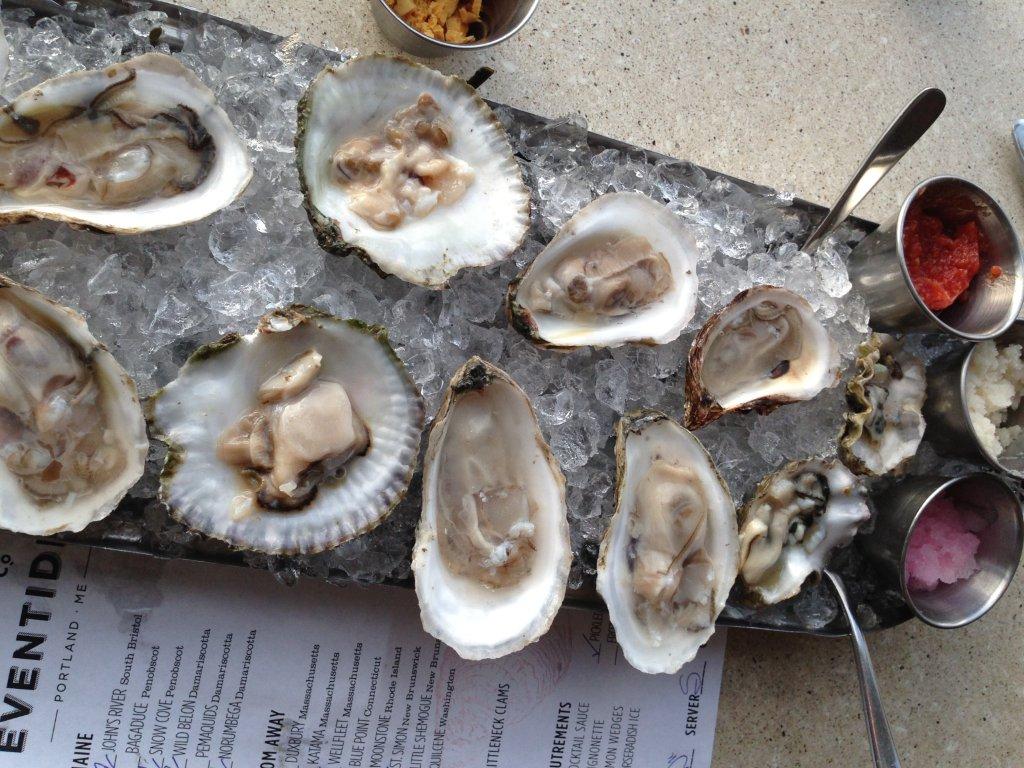
As in Guerande, not only can you sample the local salt, but also the abundant supply of incredibly fresh seafood, especially their famous oysters. The salt flats seem somewhat newer in Ile de Re, but still very much a large part of the local economy. The salt itself differs in only the most subtle of ways from its Guerande counterpart and I would find it difficult to say which I liked better.

Ile de Re is long and flat, so many of the salt pools are larger than those in Guerande.

It may seem a bit silly to travel all this way for something is simple as salt. But it’s a journey I’m very happy I made…and will gladly make again in the near future.

I love French cooking. Whatever they create, no matter how simple, is almost always better than its American counterpart. Part of that comes from the demand for the best quality ingredients. Nothing comes out of a box or a packet…everything’s made from scratch.

So it was no surprise that when I was in Paris on vacation recently, and I was walking through a Sunday farmers market in the Marais district, that something as simple as chicken and potatoes knocked my socks off.

You can find rotiserrie chicken anywhere in the USA, and it’s common in France as well. But what made this so special was the potatoes. They took small fingerling potatoes, peeled them, and then placed them on the bottom of the rotiserrie oven, where all the juices, herbs, flavors, and yes–fat, slowly dripped down from the rotating chickens above, basting and flavoring these spuds like nothing I’ve ever had before.

It was an incredible moment, popping one of those golden morsels in my mouth, and savoring the wonderful flavor of something as simple…as a spud.

Read more: http://www.94hjy.com/pages/alz_food_blog.html#ixzz264Ffyp3j

Even if you’re a huge fan of cheese, chances are you’ve never tried cheese curds. Cheese curds are the solid parts of soured milk, either eaten alone or used in regional recipes, mainly in Canada and the Midwest of the United States. The locals call it “squeaky cheese,” because it literally squeaks against your teeth as you eat it.

Cheese curds are usually found only in areas where cheese is made, because it is at its best when it’s freshly made. American varieties are usually yellow or orange, colored much like cheddar cheese, though you can find uncolored curds as well.

My first taste of cheese curds came from an airport store in Milwaukee, Wisconsin, as I was traveling to the Upper Peninsula of Michigan to visit the in-laws.

But now, you can find cheese curds here in our area…and closer to home means fresher curds.

Our friends at Simmons organic farm in Middletown, RI make their own organic goat cheese from milk they get from their own goats. And every once in a while, Karla and Mark treat us customers to cheese curds as well. They are awesome and worth asking for.

Meanwhile, in Westport, Mass, the Shy Brothers farm, makers of those delicious thimble-shaped Hannabel cheeses, also have their own cheese curds, which I find occasionally at Lee’s Market in Westport. Worth a look the next time you’re there.

Whether you eat them by themselves–and they are addictive–or add them to a recipe (most famously used in that classic Canadian dish, Poutine, featuring french fries, brown gravy and cheese curds) cheese curds are something you have got to try.

With the home garden in full swing, we enjoy freshly sliced tomatoes, drizzled with balsamic vinegar and crumbled cheese curds. Or, we take fresh corn on the cob, drizzle a little fresh lime juice on it, and then crumble curds on top. Fantastic!

Read more: http://www.94hjy.com/pages/alz_food_blog.html#ixzz25gdnUVLo

Cucumber season is winding down here in Southern New England. If you think these veggies are nothing special, it’s probably because you bought them from a supermarket, where they’ve been grown on the other side of the planet, covered in wax to prevent bruising, and then shipped to your local store where they place them under artificial lighting.

Go to your local farmer now. Buy some amazing fresh cukes. Then try any or all of these suggestions…

CRISPY CUCUMBER SOUP

3 medium-sized cucumbers, peeled and seeded

1 clove garlic, crushed

1 cup vegetable broth

4 cups plain yogurt (I like the full fat yogurt)

1/2 cup mint leaves

juice of 1 lemon

salt and pepper

Peel and seed 2 1/2 of the cucumbers and place in a blender with garlic, broth, 3 cups of the yogurt, mint leaves, lemon juice, and salt and pepper to taste.

Mix well. Add remaining yogurt and wisk in.

Finely dice the leftover 1/2 cucumber and place in soup bowl. Add soup on top.

Garnish with a pinch of SEA salt, preferably Fleur de Sel.

REFRESHING CUCUMBER DRINK

This is a recipe I found last summer, and it’s one of the most refreshing summer drinks you can make for yourself. But it also requires a lot of preparation. It’s worth it. I made a pitcher this past weekend, and I can’t even begin to tell you how good it was!

Ingredients per pitcher:

8 English cucumbers, peeled and seeded

4 cups lightly packed fresh mint leaves

12 Tablepsoons fresh lime juice

8 teaspoons sugar

16 ounces vodka

4 ounces Cointreau

Peel cucumbers and quarter lengthwise. Remove any seeds. Cut a couple of quarters into thin stalks for garnish. Rough chop the rest of the cukes and put them in a food processor. Blend until totally liquefied. Strain cuke juice through a fine sieve, squeezing out as much liquid as you can from the solids. Throw the solids in your compost bin.

In a pitcher, combine mint, sugar and lime juice. Muddle the mint leaves, then add 1 cup crushed ice to the pitcher and stir well.

Add 3 cups cucumber juice, the vodka and Cointreau to the pitcher and stir well again.

Strain liquid into tall glasses filled with ice. Garnish with cucumber stalks.

PIMM’S CUP

Pimm’s No. 1 is a gin-based liqueur made in England. There are many variations of this drink, but my favorite is this simple:

Pimm’s No. 1

Ginger ale

1 smaller cucumber, peeled and quartered lengthwise

In a tall glass filled with ice, pour 2 oz of the Pimm’s No. 1. Fill to top of glass with ginger ale, leaving enough room to place a stalk of cucumber in the glass.

And nothing comforts me more than a bowl of chopped cukes with sour cream, some finely chopped fresh dill and a pinch of salt. Something my Mom gave us as kids that I still love today.

Read more: http://www.94hjy.com/pages/alz_food_blog.html#ixzz25algwxHE

One last batch of photos…

Posted: January 24, 2011 in Uncategorized

As I mentioned before, all photos were taken by Kelly. My job was operating the camcorders (we had 2 of them) and the official family DVD of this trip should be available sometime soon. You can see a collection of clips from my Flip video camera here…

http://www.youtube.com/watch?v=bagrebSBwy4

New Zealand green-lipped mussels

Herzog winery in Marlborough

Kiwi sunset

The sheep were everywhere...

The bounty we brought home!

Rafting trip photos…

Posted: January 21, 2011 in Uncategorized

Thanks to my new friends, Alasdair and Leila from Australia, for sending these photos along. The calm before (and one after) the storm…

How far we traveled

Posted: January 19, 2011 in Uncategorized

It’s about 945 miles from Auckland, where our trip started, to Queenstown, where it ended…if you don’t make any detours. We clocked almost 2000 miles by the time our trip was over!

Here’s the map of New Zealand I posted at the very beginning of this trip…

And here’s the map with our travel route…

The dotted lines from Queenstown to Milford Sound represent the helicopter ride.

More things Kiwi…

Posted: January 17, 2011 in Uncategorized

I suppose that as life continues, and we move further and further away from this incredible trip we had, bits and pieces of events will come back to me. I’m posting those thoughts as much for myself and for anyone that chooses to read it.

As I suggested before, please scroll down to the beginning of our blog if you’re reading for the first time. I think that starting at the beginning is the right way to go.

OK…so more things Kiwi…

Bacon. Although we saw thousands and thousands of cattle, sheep, goats, and even venison roaming the vast countryside of New Zealand, we never saw a single pig farm. I’m sure they were there…we just didn’t spot one.

Nonetheless, there is bacon in New Zealand. But I’m not sure whether it was the presentation of the bacon, meaning the amount of doneness or lack thereof…or whether it was the quality and smoky taste of the bacon itself…but we weren’t thrilled with it.
Most times it was served undercooked, flapping around alike a gooey rubber band. I don’t need my bacon to be super-crispy, but half-raw is not what I want, either.
The other interesting factor of New Zealand bacon is that comes in two forms. The first form, simply called “bacon,” looks like pancetta. The pork belly is rolled and then smoked and then sliced thinly.

The second form is called “streaky bacon,” and that’s the kind that more closely resembles the bacon we find here at home.

I don’t know what kind of wood they use to smoke their bacon, but for me, nothing beats good old American hickory.

Cool names. Not every place in New Zealand has a cool name. Many are Maori tribe names. (For example, I mentioned Kaikoura before, which means “food, crayfish.” ) Many are names of towns found back in Europe: Christchurch, Glenorchy, etc.

But here’s my short list of cool Kiwi names:

Cape Kidnappers: named by Captain Cook, who arrived in New Zealand with a Tahitian translator onboard. The natives tried to kidnap the translator (unsuccessfully) but the name of the area stuck.

The Remarkables: Truly the most remarkable mountain range we’ve ever seen, and the view you get at any waterfront restaurant or bar in Queenstown. Like the Grand Canyon, no amount of words or pictures can convey the real beauty of these mountains.

Mount Difficulty: a winery in the Otago region, about 40 km from Queenstown. One look at how these determined people decided to plant grapevines in what seems like an unfriendly environment, and you’ll understand the name.

Rotorua: known for it’s geysers, bubbling mud pits, and Maori tourist attractions, the town reeks of sulfur. Though my daughter aptly named it “Smellytown,” to my wife and me, Rotorua sounded more like “roto-rooter.” The smell didn’t help.

The rafting trip…finally posted

Posted: January 13, 2011 in Uncategorized

I wrote this blog on January 6th, after I went rafting on the Shotover River. I still think about the events of that day, now one week later. I’ve had many flashbacks and dreams about it. I don’t know why I hesitated to post this when I wrote it, but I found that waiting a while has made me actually remember more details for some reason, and I can also wrap my head around the day a little better now that I’ve had some time to look back.

For those reading this for the first time, I suggest you scroll down and start at the beginning of our trip.

Here goes…

It’s hard to even wrap my head around what happened on the Shotover River today. If I had to describe it in one sentence, I would say that it was the most harrowing rafting trip I have ever taken in over 20 years of rafting.

It rained all night last night, and so the river level was rising quickly. I called ahead this morning from the lodge to see if they were still going to have a trip today, and at that moment, the answer was yes…so I had a quick breakfast and drove over the to Queenstown Rafting headquarters located literally two minutes away from our lodge in Arthurs Point. It was still pouring.

I was a bit early, but soon the buses that picked up rafters from downtown arrived, and we were given the green light to get our gear for the trip: a very thick farmer john wetsuit, booties, neoprene jacket and then a nylon shell with neck and wrist gaskets to go over all that. Underneath, I wore a bathing suit, two thin layers of poly shirts and fleece socks. I knew the water was going to be cold.

We loaded ourselves into the very tightly cramped buses that would take us upriver where our journey would begin. It was on that bus that I met the wonderful people that would be my raft mates on this trip.

The bus ride itself was so crazy, you’d think I was making it up. It started on a winding paved road, but soon emptied onto a narrow dirt road (Skippers Road) that was first built along the edge of the mountains over a hundred years ago when gold was discovered in that area. Barely wide enough for one bus, there were very few places where an oncoming vehicle could pass…and there were absolutely no guard rails of any kind. The road was rocky and muddy, and it amazed all of us that these rafting guides traveled this route twice every day during rafting season…there are two rafting trips each day.

There were times where everyone on the bus let out a scream, as we could see the river thousands of feet below us. Thank goodness the foggy windows of the bus prevented us from seeing at least some of it!

The road we traveled is only one of two roads in all of New Zealand that is banned by all car rental companies, and we were not the only adventurers out on it: four-wheel-drive companies, jet boat companies, bungy companies…they were all out there competing for road space as well. Even the rafting guide on our bus admitted that if they ever really accurately described this bus ride on their website, they wouldn’t get half the customers.

You have one last chance to change your mind about rafting the river when the bus finally reaches the drop-off point. But no one thinks the river could be any worse than the return bus ride you would have to take…so they stay. (By the way, we were lucky in that we had a smaller bus that held about 22 people. The larger ones hold up to 30 PLUS they tow the large trailer with all the rafts behind them! Insane.)

It seemed pretty clear during the safety lecture that we had a very small window of time to ride this river. Two solid days of rain meant that water levels were rising dangerously fast, and we had to get moving. Soon we were off and the first part of the trip was much like any other rafting trip where we hit a series of small rapids that got us all to get in synch with each other and to work as a team. Our rafting guide, who looked kinda like a Kiwi Drew Barrymore, seemed knowledgeable enough.

For those who have never rafted before, the rapids are given a designation of levels…one being the easiest rapid, going up to level six, which is considered unsafe. What makes New Zealand different than the rivers I’ve run in Maine and Massachusetts is that their ratings system of levels are not the same as ours…not by a longshot! For example, what they considered a level three here…we would never raft in New England because it’s too dangerous…it’s that big of a difference. The massive rocks that are all around the river gorge are also razor-sharp, most of it eroded by the millions of gallons of water running through it every day. When we made it through a level three rapid and I saw just how big it was, I got this bad feeling about what might lie ahead.

But we were doing OK…we had our rhythm together and we were in a calm spot about halfway through our trip, looking at the next series of rapids ahead. They listed these as level four, and there were six of those huge rapids in succession without an option to bail anywhere.

The general consensus from everyone in our raft is that Drew Barrymore made a pilot error. Instead of running straight through the rapid, our boat went sideways from left to right and hit the rocks with the right side of the boat. The right side went up over the rocks, lifting the three people on that side into the air. The force of the river was too strong and the boat flipped, the people on the right side of the boat falling on top of those on the left side of the boat, pushing them below the surface of the water.

I was on the front left of the boat, so Ian, the guy on my right, was now above me, and he came crashing down on top of me as the boat flipped. Suddenly, it was lights out. I was deep underwater with Ian’s entire body weight holding me down. Ian was fortunate to be able to swim to shore almost immediately and even helped pull a few others out. I was still underwater.

I was struggling to hold my breath, struggling to somehow get to the surface. The water was a silty gray, so it was hard to see what was going on above me. When I finally surfaced, I was gasping for air and trying to find the side of the raft so that I could grab the safety line that ran around the outside of it. I grabbed on with both hands, but by this time I had swallowed a lot of cold water and breathing was very difficult.

All this time, of course, the raft is still hurling through those six huge rapids, spinning, bouncing off large boulders in the middle of the water. I see one of my boat mates, an older woman, clinging to the safety line next to me. Our guide is now on top of the overturned boat and shouting commands to people: “Swim! Swim! Watch out for the rock! Hang on!!!”

The water is really cold. My chest feels like someone is stomping on it, and I still can’t breath. My helmet is pushing down over my eyes and I struggle to push it back, so I can at least try to see what’s ahead of me. My life jacket, though tightly strapped around my body, is trying to come up over my head and is cutting my chin and covering my mouth. The waves from the upcoming rapids are pounding me in the face and making me gag. I am swallowing and inhaling lots of water. I keep telling myself: if you only do one thing, it’s hang on to that safety line! (Lucky for me, I chose to wear biking gloves because I never would have been able to hang onto the nylon safety rope without slicing my hands up.)

The next thing I know, the raft crashes hard into a large rock, and I slip underwater again, this time under the raft itself. This is very not good. I have to get myself out, but I can’t see anything, so I have to feel my way around under the raft until I sense I’ve reached the edge of it. (I’ve been under overturned rafts before. Very often, you can look around you, grab a breath from the air pocket created by the overturned boat, and push yourself off and under. There was none of that this time…no visibility, no air pocket…nothing.)

I managed to grab the safety line around the raft again, and I hear the guide yelling for me to swim to the edge of the river. A very big rock is quickly approaching and I’m between it and the raft. My arms are so numb from clinging to the safety line, that I can barely move them, but somehow I think I stumbled and swam my way to another raft that was securely parked on the side of the river. I grabbed the safety line around that raft, clinging for dear life. I was absolutely exhausted, and the river still wanted to take me downstream. My legs and feet were literally sideways, pointing downstream, and I was just hanging on!

It took three young people who in total weighed less than I do to help me into their raft. I was gagging, hyperventilating, coughing up water. I could not calm down. The guide on that boat, a big guy they call Chief, gave me what I needed: he basically gave me shit! In the back of my mind, as scared as I was, I knew that I was out of danger if he was yelling at me like that. It actually helped calm me down.

I was out of breath for a good 15 minutes, and they were still plucking people out of the water. I could see by the rafting guides’ faces that a few people were still missing, and husbands and wives were struggling to see if their spouses were rescued by other boats.

Clearly, this was not what was supposed to happen. And despite the way the rafting guides tried to calm everyone down by saying things like: “Hey, you got your money’s worth today,” it was very obvious that not only was this not in the game plan, but that they were seriously shitting bricks and were overwhelmed. Rather than refund money to about 150 rafters, these guys took a chance that they could beat the rising waters of the river and make it through before it got really dangerous, and they were wrong.

Most of my raft mates did not have the dramatic experience I did, fortunately. We all swam, but most were picked up by other boats or got to safety quickly. I think I was one of the people that really got the worst of it…other than one guy who we found out later had to be evacuated by helicopter…which, as you might imagine, is very difficult and takes a long time in such a remote area. We were all already back at base having coffee when we heard the news.

Once everyone was accounted for, we still had to go through a series of other rapids before we could get off the river. We had only gotten through four of the six rapids in this cluster, and there was more whitewater to come downriver. So despite the fact that the last thing I wanted to do at this point was to continue rafting, that’s exactly what I had to do.

Chief plopped me into his boat, wedging me in between two paddlers, so all I had to do for the next two rapids was to hang on for dear life until we got to an eddy where we could all get back to our original rafts. The extra weight of myself and another rescued rafter helped keep the raft a little more stable.

Once we were all back on our raft, I could see that everyone was nervously babbling about what had just happened, but they were all smiling, high-fiving each other. I was sort of in a fog, still breathing hard, just trying to focus my thoughts on what was still ahead. I was a bit nauseous from swallowing all that silty water.

One more challenge before the rafting day was over: the Oxenbridge Tunnel…a 170 meter tunnel originally built by gold miners. It is cramped…barely wide enough for a raft to get through, and it has a very low ceiling. So the idea is to hit it straight on and have everyone in the raft scrunch down in the middle of the boat as low as possible and let the river squeeze you through. Then, when you get to the end of the tunnel, you have to jump back into paddling position as quickly as possible, because you get spit out into another huge rapid! Fortunately, this rapid ended in a pool of calmer water that also signaled the end of the trip.

It’s hours after trip and I’m still shaken. Kelly and Ava went shopping, so I just told Kelly the story.

I went on a rafting trip with my buddy Lee back when we both turned 40. We rafted the Penobscot River in Maine with a bunch of fearless young rafting guides that put us old dudes through the ringer. We hit rapids on that river that you were not allowed to run commercially, because of the dangerous whitewater. I was pinned to the floor of that river by the pressure of a waterfall in that trip…held down for what seemed like eternity but was probably about 30 seconds. I kept telling myself: “Just hold your breath…hold your breath!” Finally, the river just spit me up and threw me 50 feet downstream in an instant. For the last 12 years, Lee and I and my rafting guide buddies have told the story of that crazy trip time and time again, shaking our heads in disbelief, laughing about how insane we were to do it.

Today’s trip made that look like a walk in the park.

Posted: January 10, 2011 in Uncategorized

Chard Farm...Ava didn't dig the sculpture