Posts Tagged ‘drinks’

Used to be that only the big distilleries were able to age their finest spirits in charred oak barrels. But now, there’s a movement goin’ on…and hand-crafted oak barrels are available to aficionados at home.

Companies like Redhead Barrels (www.redheadoakbarrels.com) are offering oak barrels for aging that range in size from 1 liter to 20 liters. And that’s where this enthusiast comes in: with a 1-liter barrel, I’m able to age my favorite spirit–vodka, rum, whiskey, bourbon, anything–in just a few weeks, elevating the flavors to levels previously unknown. For example, they claim that Crown Royal will age to Crown Reserve in 14–15 days! Imagine what it can do for any spirit–or wine–you choose.

wood

My  1-liter barrel arrived with the spigot and bung separately. The instructions say that curing the barrel is necessary before using it. You do this by rinsing the barrel out a few times to remove any loose pieces of wood chips or splinters that may still be inside. You hand-turn the spigot into the barrel until it fits snugly and you place the barrel in your sink on the included stand. You fill the barrel with very hot water…and watch. Some barrels are totally watertight and will not leak. Others may take literally a few days of repeated fillings with hot water before it thoroughly seeps into the wood, expanding it to seal the barrel.

Once there are no leaks, you are ready to go. Simply empty the water out of the barrel and fill it with your favorite spirit. Because there is more wood surface area to less liquid, as compared to the large barrels companies like Jack Daniels use, your alcohol will age faster…in weeks instead of years. Once you’ve aged it as much as you want, you simply pour it into a bottle to stop the aging process. Rinse the barrel out thoroughly, and you are ready to age yet another spirit.

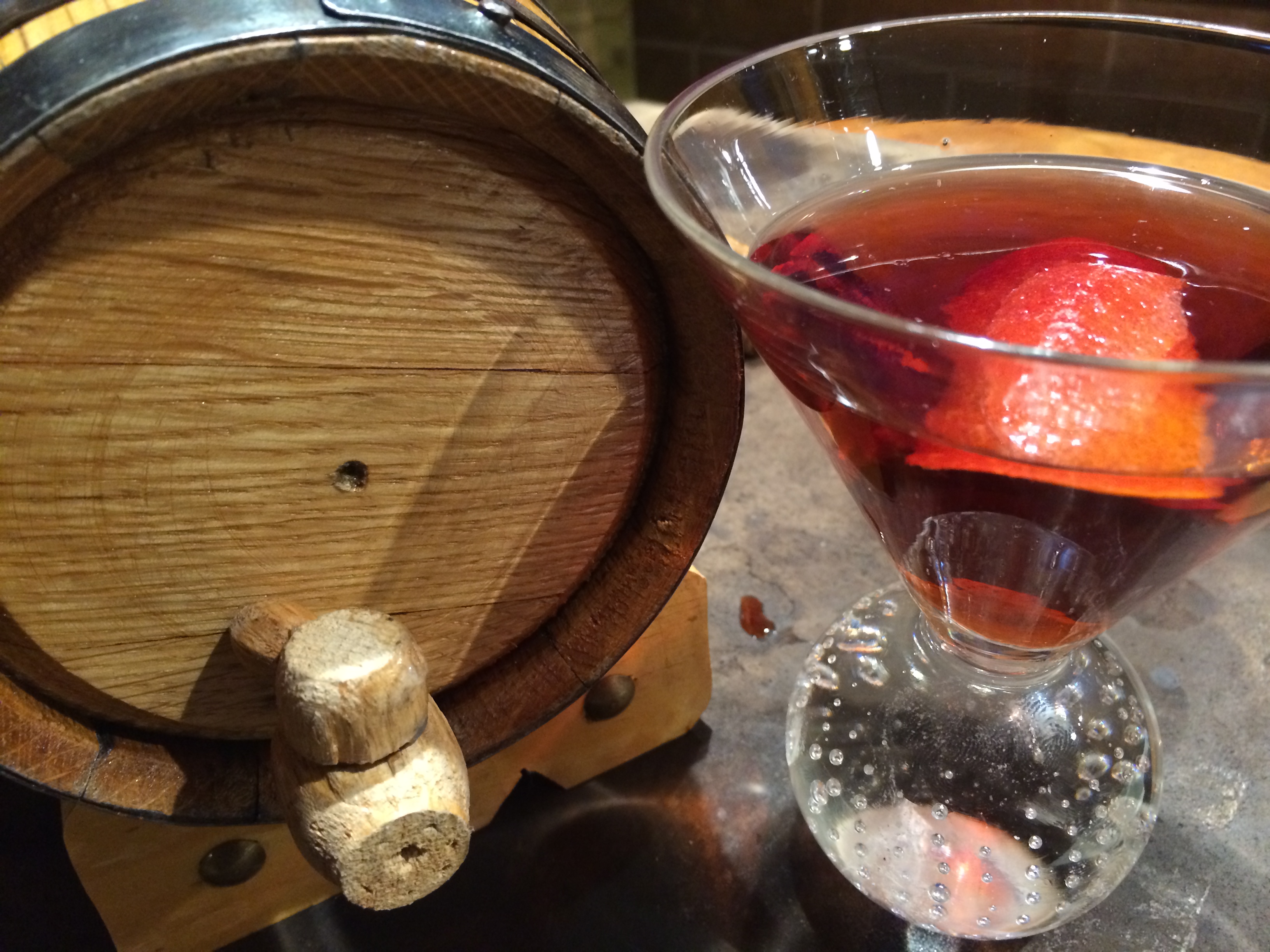
I chose to age a favorite cocktail that I first savored at the Greenhouse Tavern in Cleveland, Ohio, the brainchild of the insanely talented chef Jonathon Sawyer. The call it a Negroski, their take on a Negroni. It features equal parts Campari, Cocchi sweet vermouth, and OYO stone fruit vodka. They make large batches of it and keep it in a barrel until they serve it. So enamoured my wife and I were with this drink, that I begged the bartender to give me the recipe. He did, and though I could easily find Campari back home, I went on an internet search for the Cocchi vermouth (found it at http://www.drinkupny.com, a great wine and spirits website) and the OYO stone fruit vodka (an Ohio product that I finally found at http://www.thepartysource.com.)

Doing the math, equal parts of each ingredient meant 1 1/3 cups of each to make a quart…which fit perfectly in my 1-liter barrel. Once I corked the top with the bung, it was time to let it age.

A slight daily rotation of the barrel gently rocks the liquid inside, exposing it to the barrel’s charred wood interior, giving it more flavor. And at the end of   a week, I was ready for my first tasting: the wood had a subtle influence, rounding out the flavors. I wanted a little more, so I waited another week.: even better, but not quite there. It took a total of three weeks before the drink reached its flavorful peak.

I poured some of the drink into a cocktail shaker with ice, stirred briskly with a spoon, and strained it into a martini glass, garnishing with a twist of blood orange peel. Delicious!

cask

What’s next for my little wooden cask? Perhaps some of my Krupnikas (http://wp.me/p1c1Nl-lq).

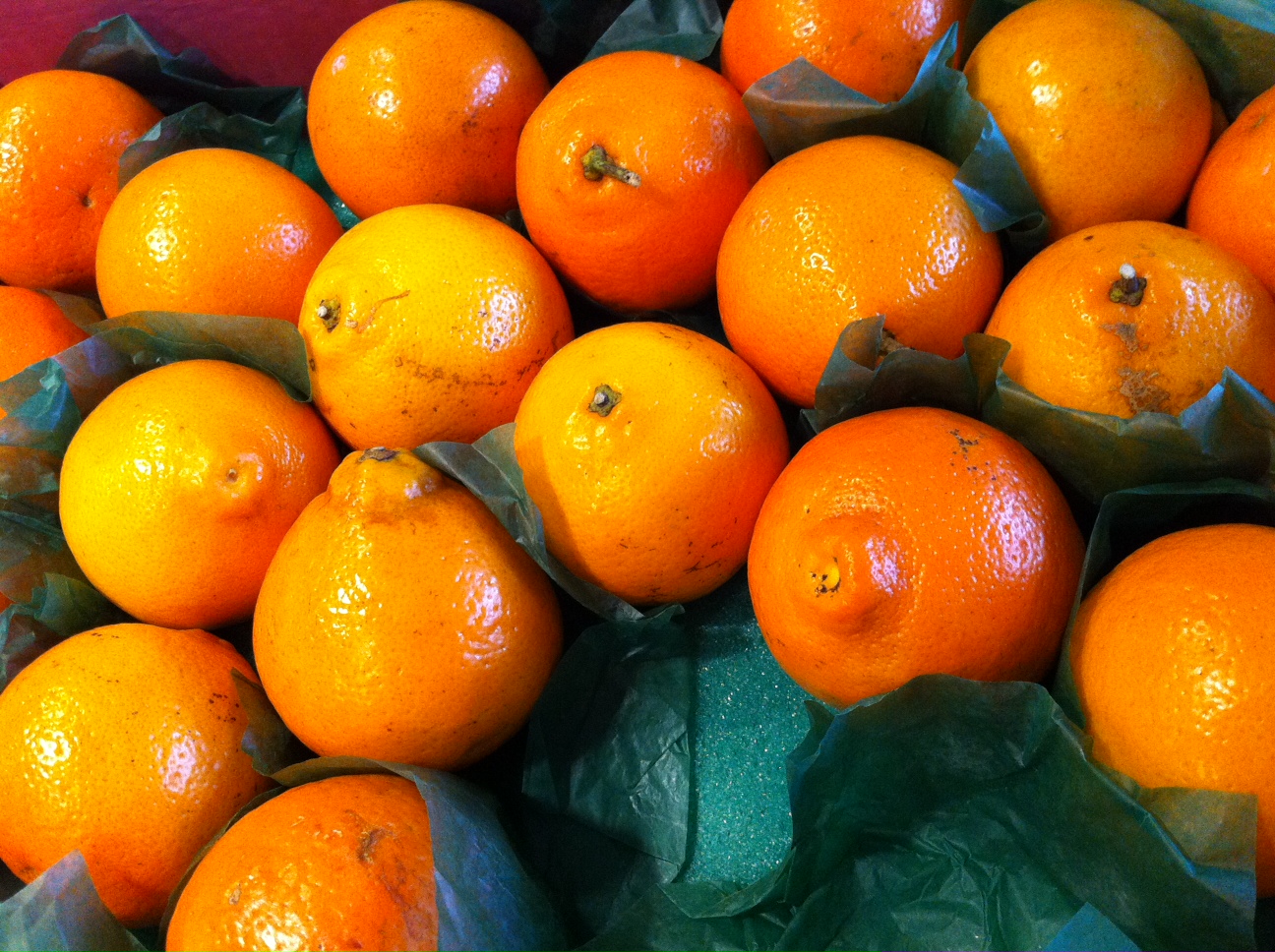
My wife’s aunt in Florida sends us an awesome gift every year. It’s a box of Cushman’s HoneyBells. They look like fiery red bell-shaped oranges, and they are the sweetest and juiciest fruit you will ever have! But they’re not really oranges at all.
honey bells
HoneyBells are a unique natural hybrid of Dancy Tangerine and Duncan Grapefruit. The plants are grafted to a sour orange root-stock, and when the tree reaches maturity, it looks just like a grapefruit tree…but with oranges growing on it.
HoneyBells are available for a very short time every winter…and that time is NOW. So if you’re at all interested, check out http://www.honeybell.com/. Cushman’s was bought out by the fruit giant Harry & David some years ago, but the excellent quality of the product and their fine service has not changed.
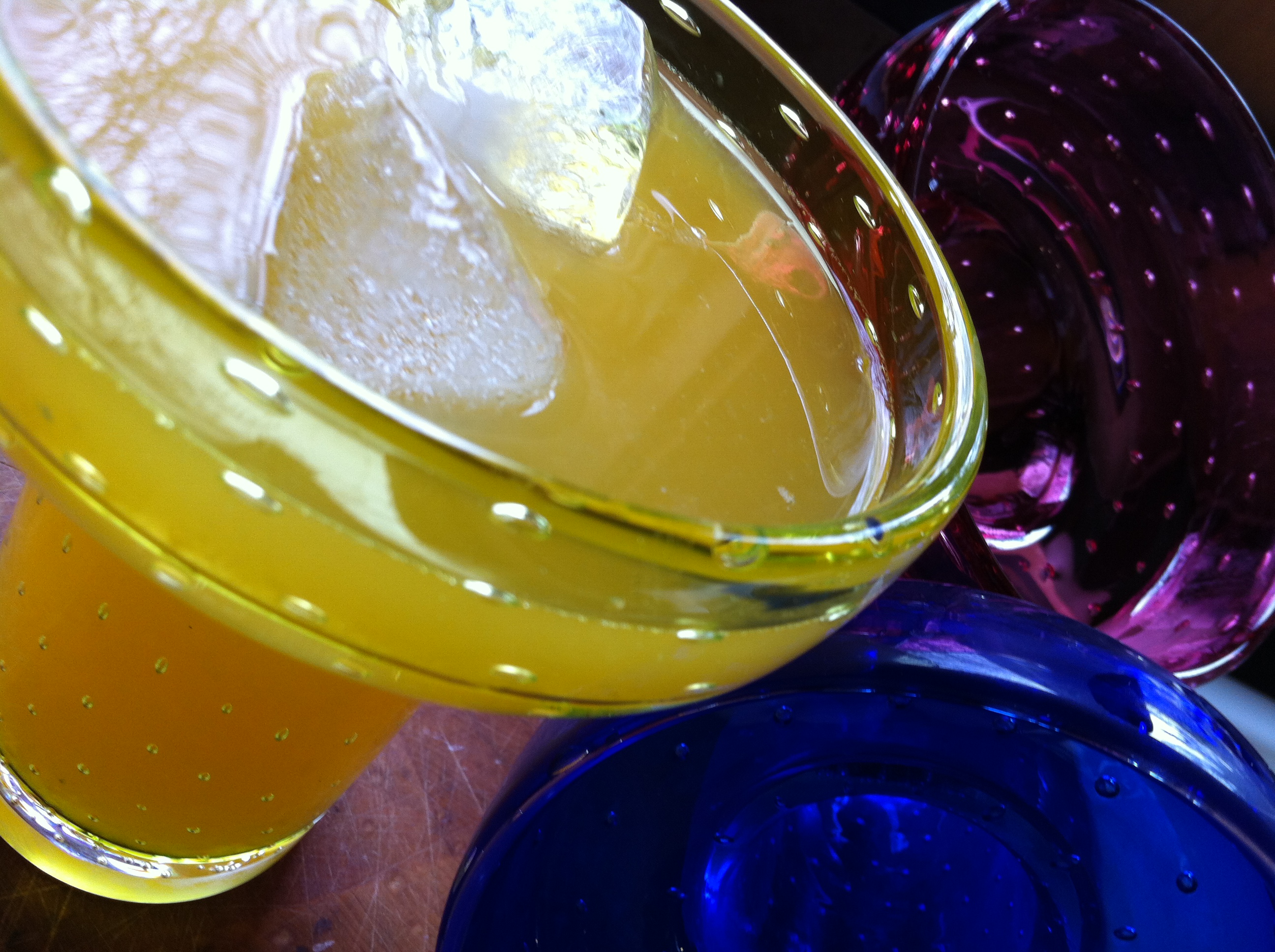
I usually make my signature margarita, the Algarita, with pineapple juice. But when I get those HoneyBells in the mail, my recipe takes on a new twist:
algarita 1
HONEYBELL ALGARITAS
2 oz Patron silver tequila
1/2 oz Cointreau orange liqueur
4 oz fresh squeezed HoneyBell juice
1/2 oz fresh squeezed lime juice
Fill a tall glass with ice and add all the ingredients. Stir vigorously. Pour into a large margarita glass. Garnish with lime wedge. Salt optional.
photo3.jpg
The HoneyBell clock is ticking…get ‘em soon or you’ll need to wait a year!
Any other time of the year, substitute pineapple juice, orange juice or a combination of both for the Honey Bells.

I can’t believe it took this long to write about something that is near and dear to my heart…and liver.

I’ve been making a Lithuanian honey liqueur called Krupnikas for over 30 years. (And no, I won’t be posting my secret recipe here.) It’s a honey-based liqueur that is popular in eastern Europe, especially in countries like Lithuania (where my parents were born) and Poland. Though most of the Krupnikas that I’ve tasted is similar, no two recipes are exactly alike.

krupnikas

If you Google “Krupnikas,” you’ll find many different recipes for the stuff…some pretty good, some incredibly awful…and none as good as mine! But still…you can make it at home. I make it with grain alcohol, but if that’s not available in your state, you’ll have to settle for vodka.

My Krupnikas making story started with my uncle, who would make batches of the stuff in his kitchen. Because I am the godfather of my cousin, Victor (his son), starting at the then-drinking age of 18, I got a bottle from my uncle every Christmas…and by New Year’s that bottle would be gone. It wasn’t long before I got very tired of waiting 51 weeks for another bottle and I asked my uncle if he would share his recipe with me. He never did that, exactly, but he did let me sit in on a brewing session and take notes.

I took my notes home and tried to decipher what I wrote. Since there was no such thing as the internet back then, I drove all over New York in search of some of the more exotic spices used in making Krupnikas. I became a regular in several Asian and Indian stores, where they looked at me somewhat suspiciously as I brought my spices to the counter for purchase.

Over the decades, through trial and error, I tweaked and even drastically changed my uncle’s original recipe to the one that I proudly call my own today. You can’t buy it in a store (obviously), but if you have tons of money and want to go into business with me, I’m sure we can work something out! Or become my best friend and you’ll get a bottle every Christmas…and then you’ll be the one waiting 51 weeks for another!

krup glasses

Versions of Krupnikas are available in liquor stores: Old Krupnik is a Polish liqueur, and the German brand Barenjager is another. And brands like Dewar’s and Jack Daniels are adding honey to their spirits as well.

Though quite different from my own recipe, there is one authentic Lithuanian style Krupnikas made in the United States. Based out of Durham, North Carolina, the Brothers Vilgalys Spirits Company (www.brothersvilgalys.com) has a pepperier version that uses local North Carolina wildflower honey. President of the company, Rim Vilgalys, the son of my good childhood friend from New York, has done what I never got around to do: make this fabulous elixir available to the public. You’ll find it at ABC stores throughout the state of North Carolina. On line, you’ll find it at Federal Spirits, based in Washington, DC…a very interesting website full of regional spirits from around the USA and Canada. www.federalspirits.com

Sveiks! (Cheers!)

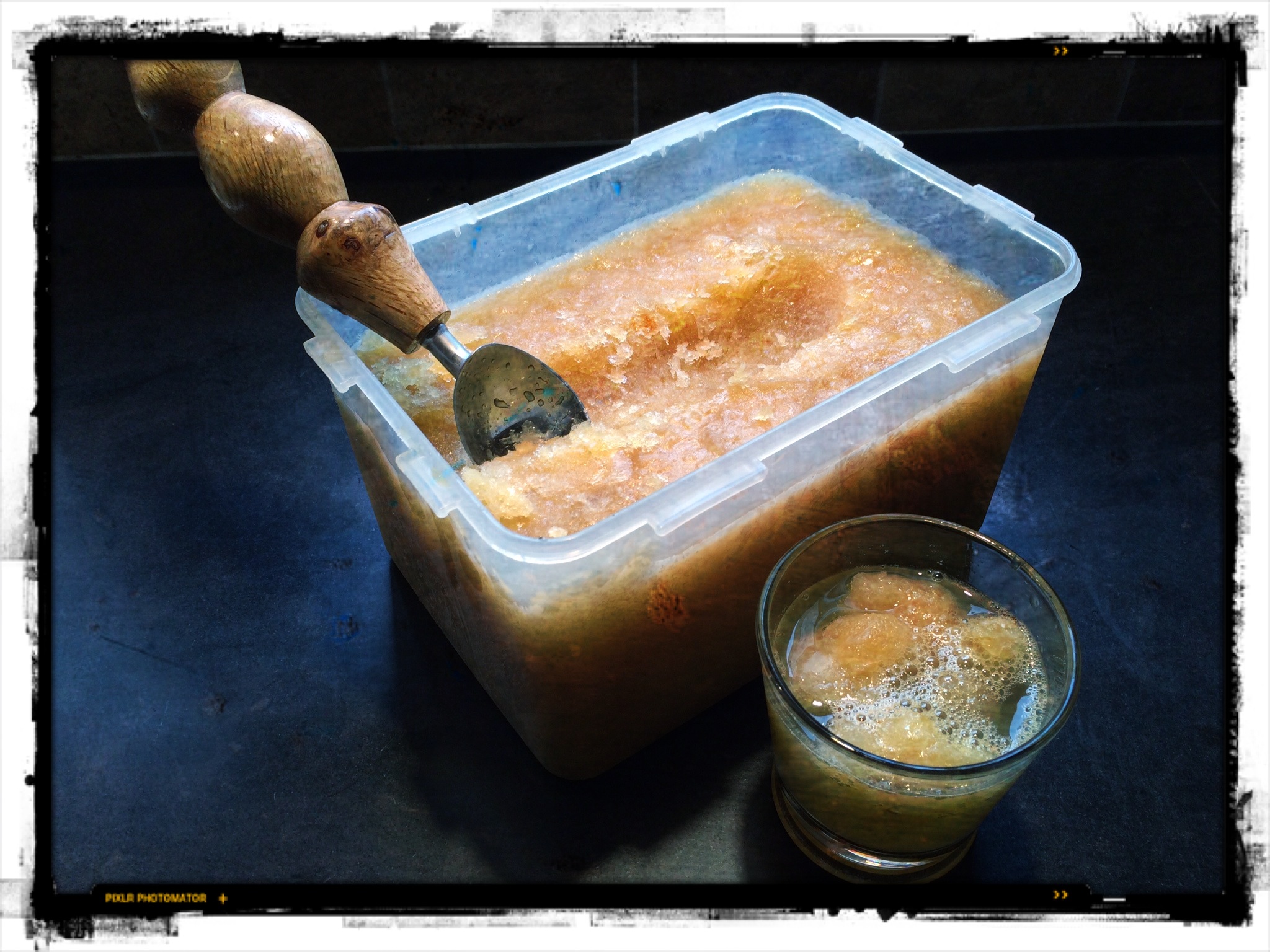
This is my version of a holiday drink I was introduced to by my mother-in-law from the Upper Peninsula of Michigan. I knew I was marrying into the right family after one sip!

Whiskey slush

Ingredients:

9 cups water
2 cups sugar
4 “Constant Comment” tea bags
12 oz frozen OJ concentrate
12 oz frozen lemonade concentrate
2 cups whiskey (I use Crown Royal)
7Up or Sprite

Boil water and sugar, making sure sugar dissolves. Turn off heat and steep tea bags in liquid for 10 minutes. Discard tea bags.
Add OJ, lemonade and whiskey. Mix well, pour into a freezeable container with a lid. Freeze.
To serve: Scoop the slush out of the container (it doesn’t freeze solid) and mix in a tall glass with 7 Up.

Let’s face it: there’s no such thing as healthy eggnog. This recipe kicks ass but is also a heart attack in a glass.

My buddy, Rick Sammarco, a former bartender at Mill’s Tavern in Providence, RI, credits his father, Al, for this eggnog. The original recipe calls for a lot more of everything. I’ve cut it down to a “more reasonable” size. It’s been so long since I bought ice cream, that I didn’t even know that the standard half-gallon size was replaced by a 1.5 quart size!

A word about salmonella: most cases are caused by raw chicken, not raw eggs. Eggs you get in the supermarket are washed so the chance of salmonella, found on the exterior, is minimal. (The inside of the egg is sterile.) Plus, you’re dumping a lot of booze into this drink and that will kill bacteria. In fact, some recipes say to make your eggnog weeks in advance to “sterilize” the drink.

eggnog


Ingredients:


1.5 quarts vanilla ice cream (I use Breyer’s)

1 pint half and half

15 whole eggs (raw)

½ teaspoon vanilla extract

1/4 teaspoon cinnamon

1/4 teaspoon nutmeg


At least 3/8 cup of each:

spiced rum (I use Capt. Morgan)

whiskey (I use Crown Royal)

brandy (I use E&J)


Let the ice cream soften 1 day in the fridge. Mix ice cream, eggs, vanilla, half and half in a blender.

Add spices and liquor. Blend until it’s frothy.

Taste, and add more cinnamon and nutmeg if you like.

After fully blended, let sit in fridge 12-24 hours for flavors to blend. Even longer is better.


Many years ago, my wife and I visited the Amalfi coast, and we spent several nights on the beautiful island of Capri. On our last night, we dined at the legendary Grand Hotel Quisisana, and our incredible meal ended with a glass of the most delicious limoncello I had ever had.

I asked the waiter if it was possible to get the recipe of the limoncello, and he made a big deal about the fact that the recipe was a “secret.” Though disappointed, I understood, and I left Capri thinking that I would never taste that limoncello again.

Two weeks later, now back at home, I was reading the latest issue of Conde Nast Traveler, and there in black and white, was the Quisisana limoncello recipe! WTF?

My twist on the recipe: instead of lemons, use grapefruit. I’ve tried other citrus, too, like oranges, but grapefruit-cello is fantastic!

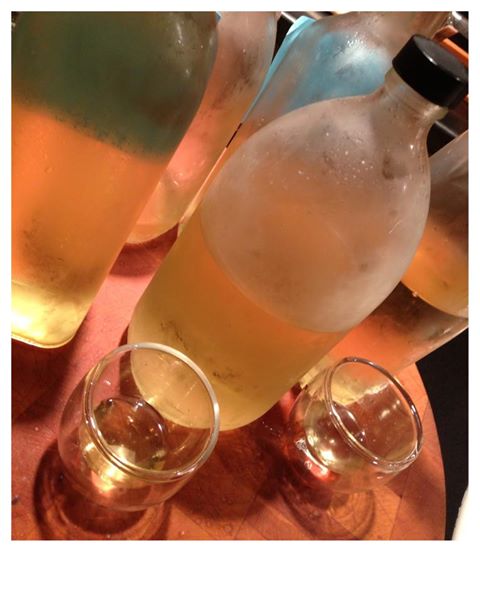
Sampling vintage limoncello and grapefruit-cello,  aged 2 years or more

Sampling vintage limoncello and grapefruit-cello, aged 2 years or more

Four ingredients, easy to make. The toughest part is waiting for it to mellow a bit.

Ingredients:

4 lbs lemons, zest only

2 750-ml bottles 100 proof vodka (I prefer Absolut)

5 1/2 cups sugar

6 cups filtered water

Peel the zest off all the lemons, making sure you don’t get any of the white pith that could make the limoncello bitter. Place all the zest in the bottom of a glass jar with a lid that can hold all the vodka.

Pour the vodka on top of the lemon zest pieces, seal the container, and keep at room temperature for a week, swirling the jar around gently once a day.

On the sixth day, combine the sugar and water in a pot over medium-high heat, and stir until all the sugar completely dissolves. Remove from the heat, cover, and let it thoroughly cool to room temperature (overnight is best.)

On day seven, strain the lemon zest, pouring the infused vodka into a clean glass jar. Discard the lemon zest.

Pour the sugar/water mixture into the vodka and mix well.

At this point, you can pour the finished product into individual bottles, but let it mellow for about a month before drinking.

I keep my limoncello refrigerated.

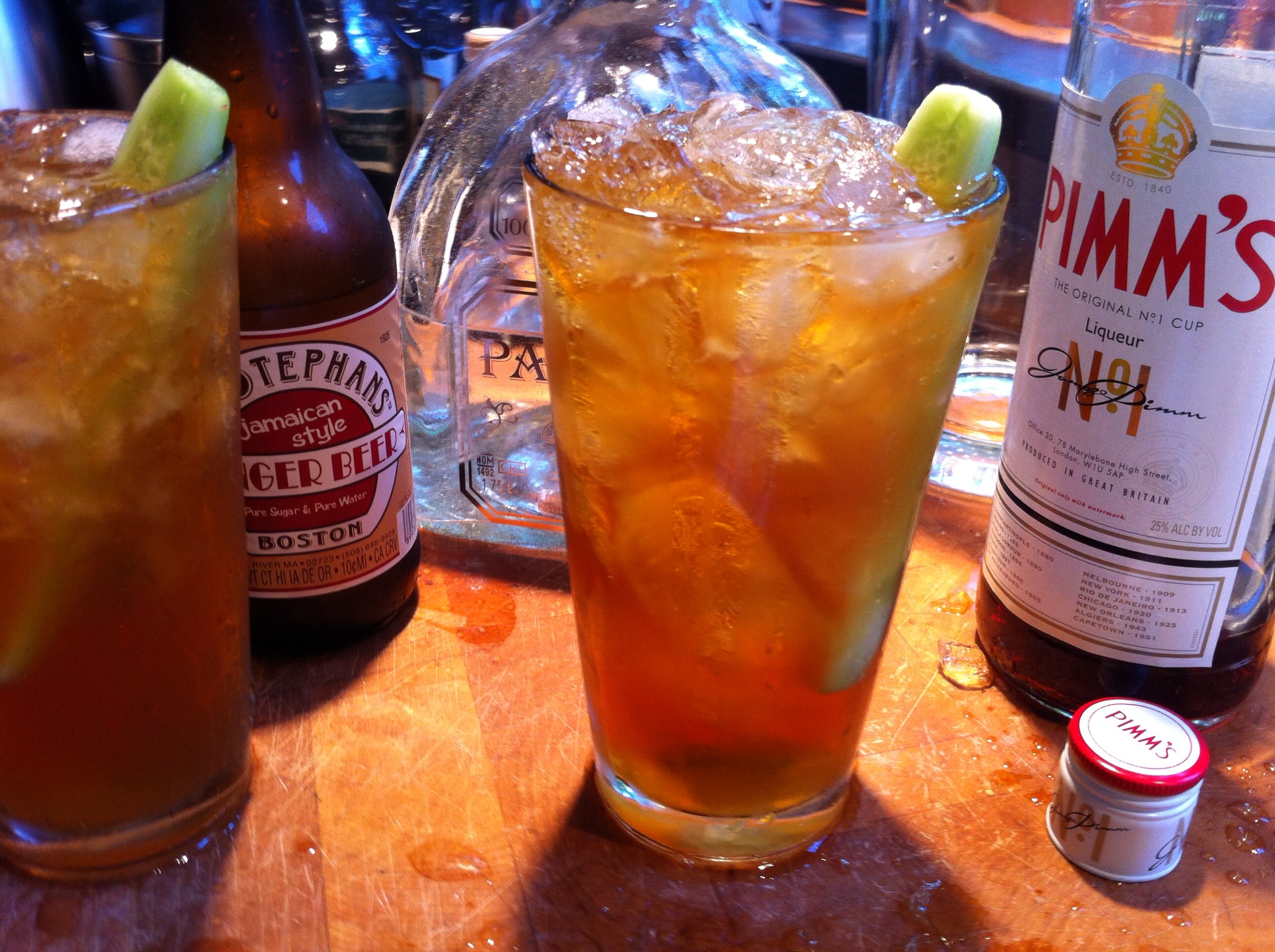
I love tequila. I love Pimm’s. And I love Dark & Stormies. I’m a lush. This cocktail has an interesting nod to all three.

tequila cup


Ingredients:

3 oz Patron silver tequila
1.5 oz Pimm’s No. 1
1 dash fresh lime juice
Chilled Ginger beer (I use AJ Stephan’s, a local product made with cane sugar, not high-fructose corn syrup)
Ice cubes
Fresh mint
Cucumber slices (optional)

Combine tequila, Pimm’s and lime juice in a highball glass filled with ice.
Place slices of cucumber in the glass, if desired.
Top with Ginger beer and stir gently.
Garnish with mint sprig.

If you’ve been to the Capital Grille, you might be familiar with the Stoli Doli, a drink made by soaking fresh cut pieces of pineapple in Stoli vodka. A large glass container sits on the bar, and they simply pour out the wonderfully infused pineapple vodka into a cocktail shaker with some ice, shake vigorously, then strain into a martini glass.

When I decided to make this at home for myself, I only had a bottle of Stoli Vanil (vanilla) vodka in my liquor cabinet. But I thought: how could vanilla hurt this recipe? Turns out it made an even better cocktail than I ever could have imagined. The touch of vanilla accents the sweetness of the pineapple.

Velvet Elvis

Comprised of just 2 ingredients and named after my old dog, Elvis, this is a huge hit at parties. Here’s how I make it…


Ingredients:

2 fresh, ripe pineapples, peeled, cored and sliced

1 bottle (1.75l) Stoli Vanil vodka

1 glass jar with lid (1 gallon size)

Cut the top off, then peel, core and slice the pineapples and place the slices in the glass jar. Feed the top, peel and core to your compost pile. Pour the vodka over the slices. Tightly seal the lid, shake well, then place the jar somewhere where it won’t be disturbed for 3 weeks at room temperature.

At the end of 3 weeks, strain the vodka, squeezing as much vodka out of the pineapple slices as you can. Discard the spent pineapple slices.

Store the Velvet Elvis in glass containers in the refrigerator. Enjoy over ice!

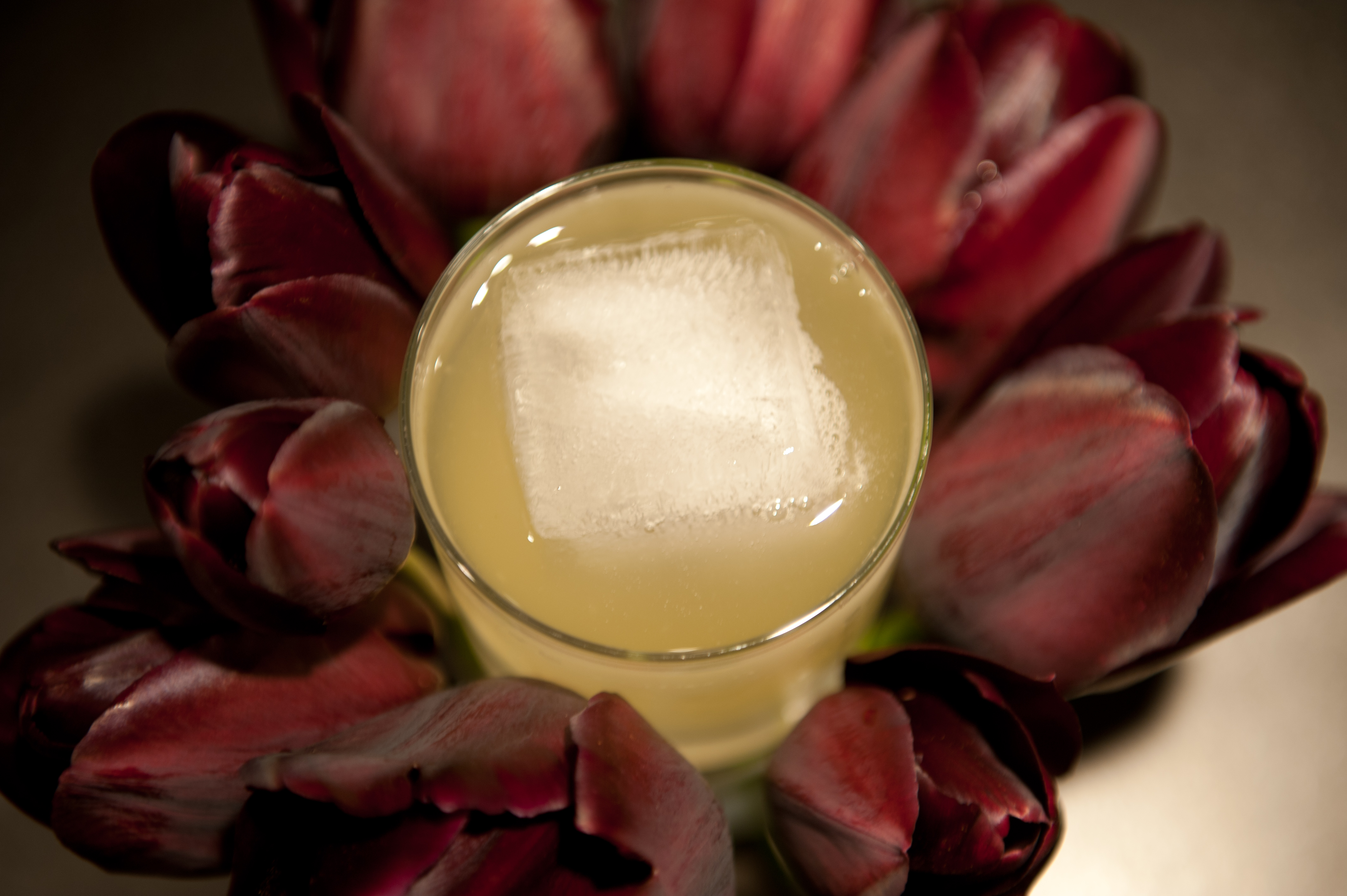
This a fantastic drink that requires a little prep. If you have a juicer, use that instead of pureeing in a food processor. Just peel the cukes and juice.

cuke drink pic


Ingredients:

2 English cucumbers or 4 regular cucumbers

Small ice cubes

1 cup loosely packed fresh mint leaves

2 teaspoons granulated organic cane sugar

3 tablespoons fresh lime juice

1/2 cup top shelf vodka, like Chopin

1 oz (2 Tablespoons) Cointreau


Peel and seed cucumbers. Coarsely chop them and then purée in a food processor until smooth. Strain through a fine sieve, pressing solids to extract as much liquid as possible.

To a large glass pitcher, add mint leaves, sugar and lime juice. Muddle ingredients so that mint leaves release their oils. Add 3/4 cup (at least) cucumber juice, the vodka and Cointreau. Muddle again briefly.

Fill tall drinking glasses with ice cubes. Strain cocktail into glasses. Garnish with cucumber spear or mint.

Schweppes Bitter Lemon is a carbonated beverage that was invented in 1957 and was available in the United States for a while, but poor sales forced Schweppes to withdraw the product from US store shelves.

Fanatics, however, have kept the demand up for Schweppes Bitter Lemon, and so you can now find the import at websites like amazon.com and britishdelights.com. Some say that a proper Pimm’s cup is not made with ginger ale, but with this stuff. I was curious, so I bought a few bottles and started out with a simple vodka + Schweppes Bitter Lemon: refreshing, and a wonderful twist on the basic vodka-and-tonic.

So I’m hooked.

One of my favorite new drinks of the summer is this recipe that I found on line and tweaked the proportions of the ingredients to make my own. For the light rum, I like to use the new Caliche Puerto Rican rum from the Serralles family of rums, makers of Don Q and Captain Morgan. And second to Angostura bitters, Peychaud’s bitters, invented by famous New Orleans apothecary Antoine Peychaud around 1830, should be a staple of any home bar, especially since it is a key ingredient in making the perfect Sazerac cocktail. It works equally well here.

banana1

BITTER BANANA COOLER

Ingredients:

3 oz light rum

3 oz of ripe banana

1 1/2 oz pineapple juice

2 tablespoons fresh lemon juice

4 dashes Peychaud’s bitters

Schweppes Bitter Lemon


In a blender (no ice) combine all ingredients except Schweppes, and blend until smooth: just a few seconds will do. Pour into a cocktail shaker with ice, shake and strain into a 16 oz glass filled with ice. Top off with Schweppes Bitter lemon.

banana2