Archive for the ‘Uncategorized’ Category

Recently, my daughter and I visited Pittsburgh, and we really enjoyed a meal at an Argentinian restaurant, Balvanera. Interestingly, there was one dish on the menu that seemed more Mediterranean than Argentinian: roasted carrots on a bed of labneh. We enjoyed it so much, I made it my mission to find a recipe similar to it and prepare it as part of our Thanksgiving dinner. It was a success!


If you’re not familiar with labneh, it’s a soft cheese made by straining yogurt to remove the whey. It’s not always easy to find, but supermarkets like Whole Foods do carry it. You can also make your own by straining Greek yogurt through cheese cloth in a fridge overnight.

We used the already-peeled bagged organic carrots for this dish, but if you can’t find them, simply peel and slice your carrots to about a 2-inch diagonal length.

1 lb. organic carrots, peeled and sliced into 2-inch diagonal pieces
2 tablespoons garlic, minced
2 teaspoons fresh lemon juice
2 teaspoons Za’atar spice blend
1 teaspoon dried parsley
1 teaspoon Kosher salt
1/2 teaspoon cracked black pepper
1/2 teaspoon ground cumin
2 tablespoons roughly chopped pistachios
2–3 tablespoons maple syrup
Fleur de Sel or other finishing salt

Preheat the oven to 425.

Line a baking sheet with parchment or non-stick foil and place the carrots on the sheet.

In a bowl, combine the olive oil, garlic, lemon juice, Za’atar, parsley, salt, pepper, and cumin. Mix well, and then pour it all over the carrots.

Toss the carrots and the other ingredients using your hands to get the seasoning all over every part of the carrots, until they’re evenly coated. (The carrots, not your hands!)


Roast the carrots for about 30 minutes. Look for them to start caramelizing around the edges. You don’t want them mushy…you still want some bite to them.

Spread the labneh onto a plate or platter, and then top with the roasted carrots. Sprinkle the pistachios on top, and drizzle with the maple syrup. A finishing touch of Fleur de Sel makes it perfect!


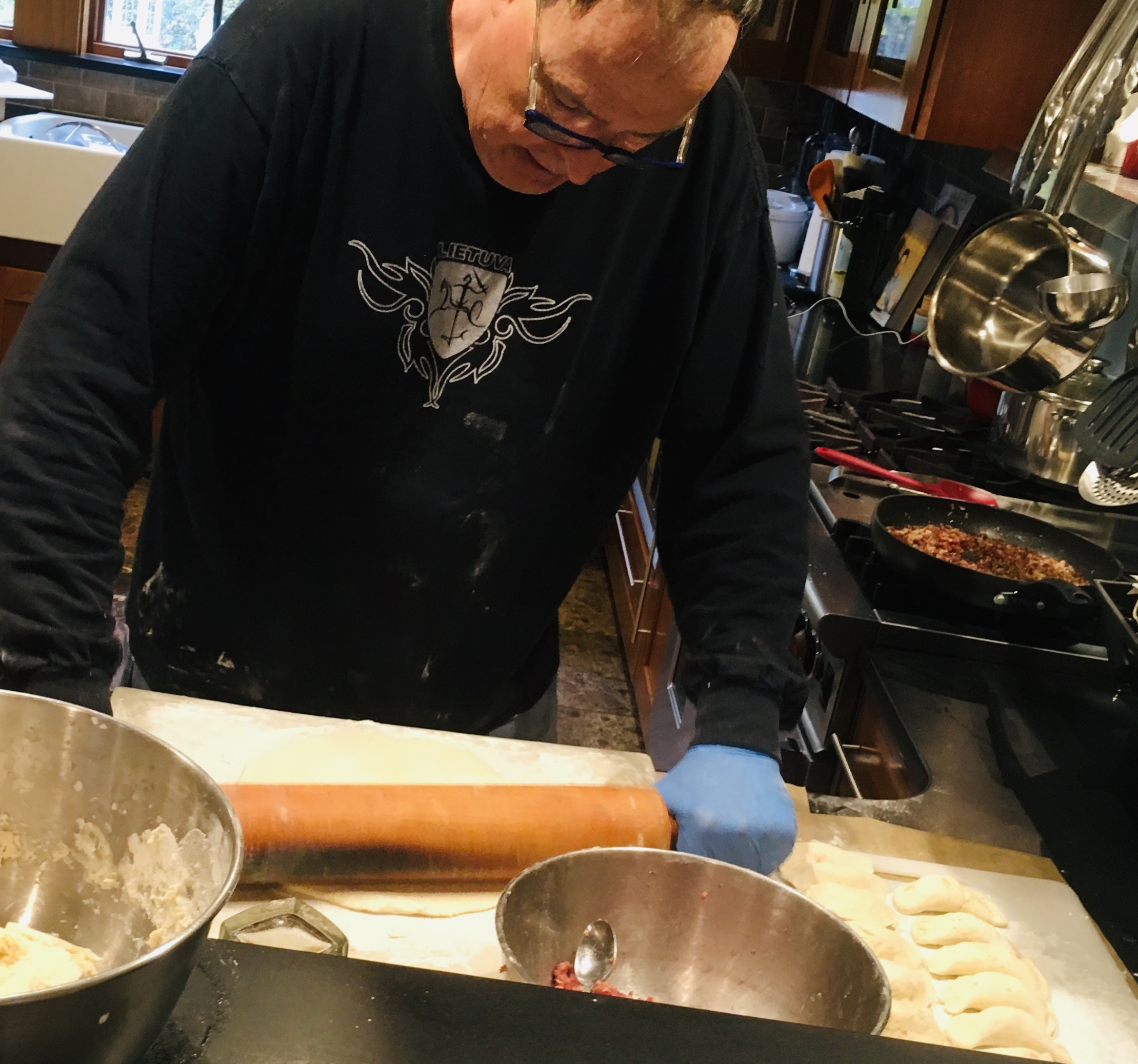
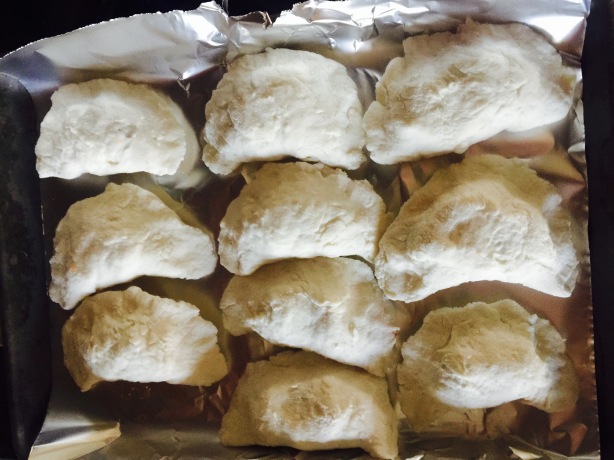
I think I spent half of my childhood in the kitchen, watching my Mom and grandmother make koldūnai (kohl-doo-nayh), the Lithuanian version of a pierogi, by hand, at lightning speed. They would roll a simple dough into a log about 1″ in diameter, then cut it into 1″ pieces, twirling each piece between their fingers to make a flat pancake, filling each with a small spoonful of meat or mushrooms, then folding it over, crimping the edges to make a crescent-shaped dumpling. It blew my mind that they could crank out over a hundred of these little masterpieces in no time, placing them on a cookie sheet and freezing them until it was time to cook.


One of the main reasons why I prefer Lithuanian koldūnai over the basic Polish pierogi is the filling. For me, standard pierogi fillings like potatoes, cheese, and sauerkraut just don’t cut it. My Mom would mix ground beef with chopped onions sautéed in butter, a couple of eggs, and milk crackers soaked in milk. She’d add salt and pepper, then spoon that beautiful beef blend into her koldūnai.

The other delicious stuffing, usually reserved for special holidays like Christmas Eve and Easter, was made from mushrooms. Italy may lay claim to the porcini, but the fact of the matter is, Lithuania is bolete heaven. (We call them baravykai.)

When they’re dried and rehydrated, their incredible flavor is so intense, you don’t need many of them to flavor a large amount of regular button mushrooms. We’d get our dried boletes from relatives in Lithuania every year. Mom would place a handful in some boiling water and let them steep until they swelled up and could easily be chopped and added to the other mushrooms. She’d then pour the mushroom liquid into the pan as well, not wasting a bit of that magical porcini flavor. The mushrooms were simply sautéed in butter, cooled, and then used to fill the koldūnai.
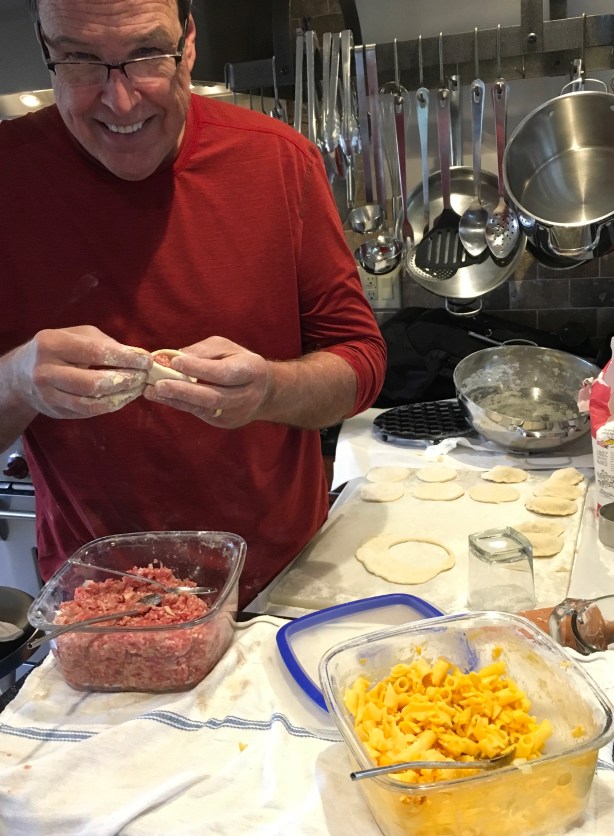
 

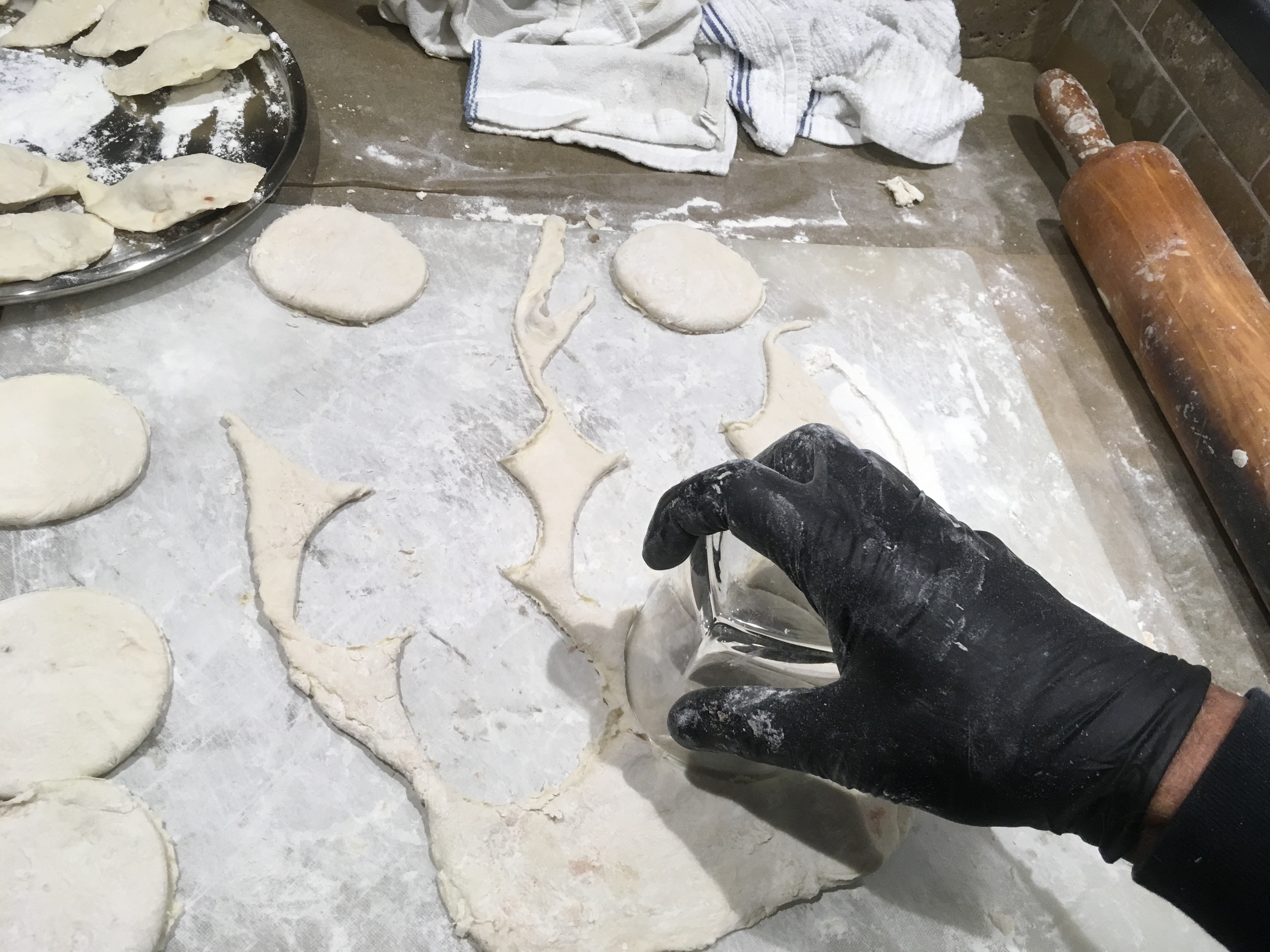
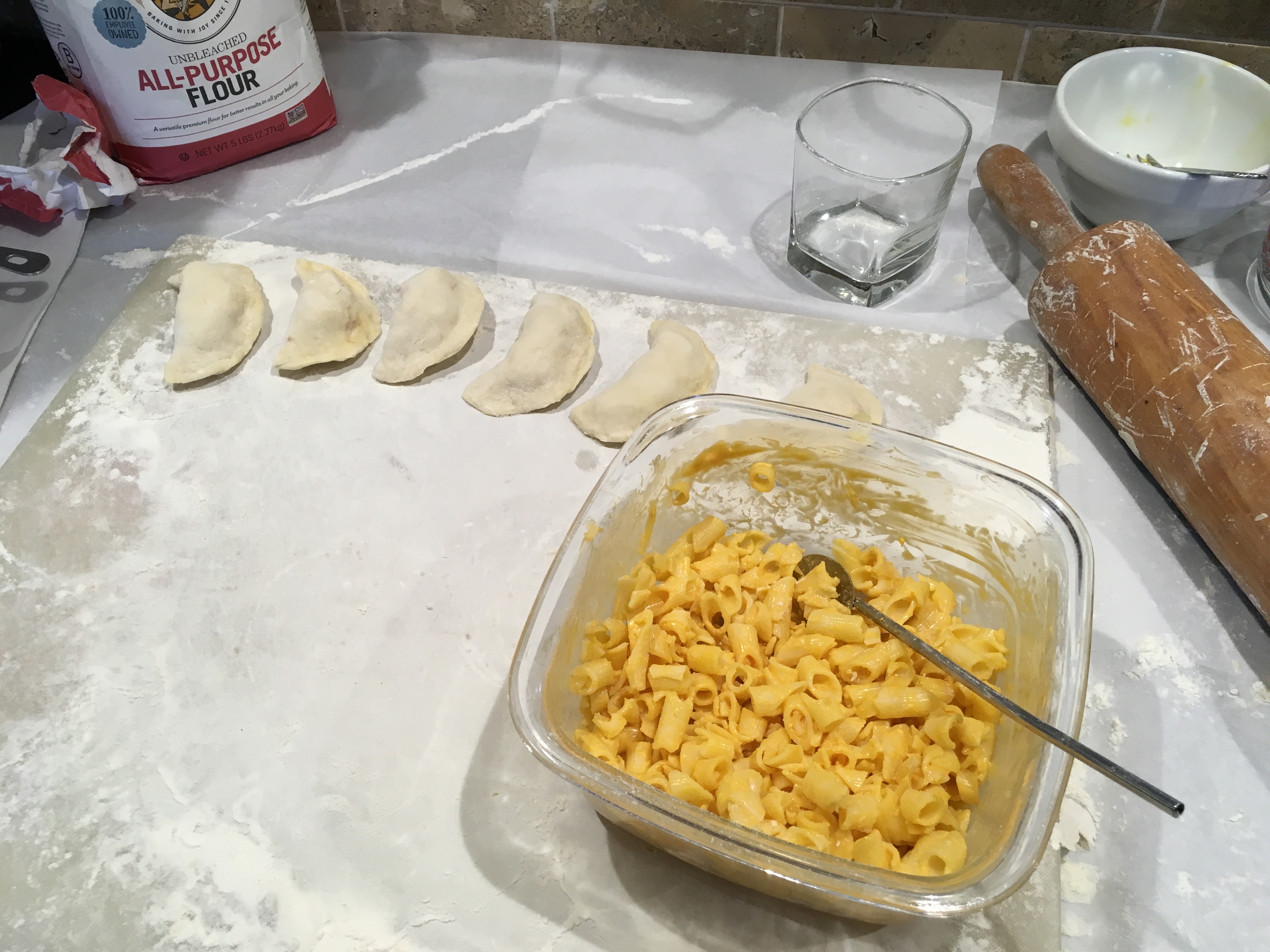
I found that my Mom’s log method was too much work. I roll the dough out into a sheet with a rolling pin, then cut circles with a glass. Yes, that’s mac-and-cheese up front!


A few years ago, I decided it was time to try my hand at making koldūnai. As I recall, my Mom simply mixed water with flour to make the dough, kneaded it into a log, and off she went. I decided to go with the rolling pin and glass cutting method, because I found it to be a bit easier creating more uniform koldūnai.

The biggest challenges I had making koldūnai was my own clumsiness and lack of experience. Once I got the hang of it, things moved along steadily, and it didn’t take long for me to make a decent batch–not all perfect, but not bad for a first try.

My recipe follows. If you’re on a gluten-free diet, have no fear! That recipe is at the bottom of the blog.
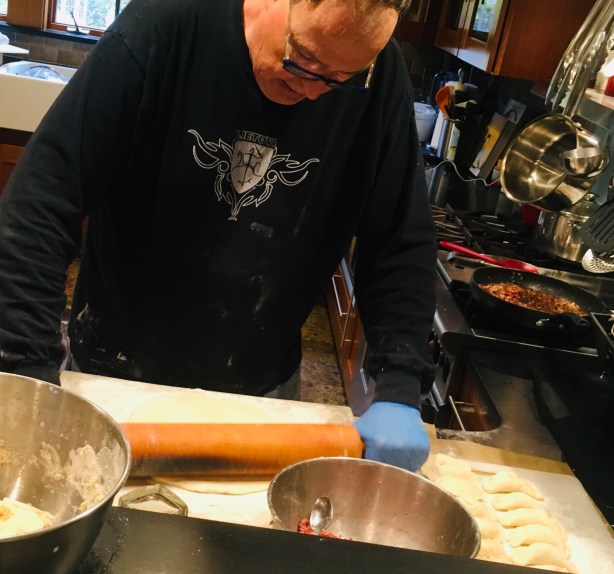
 

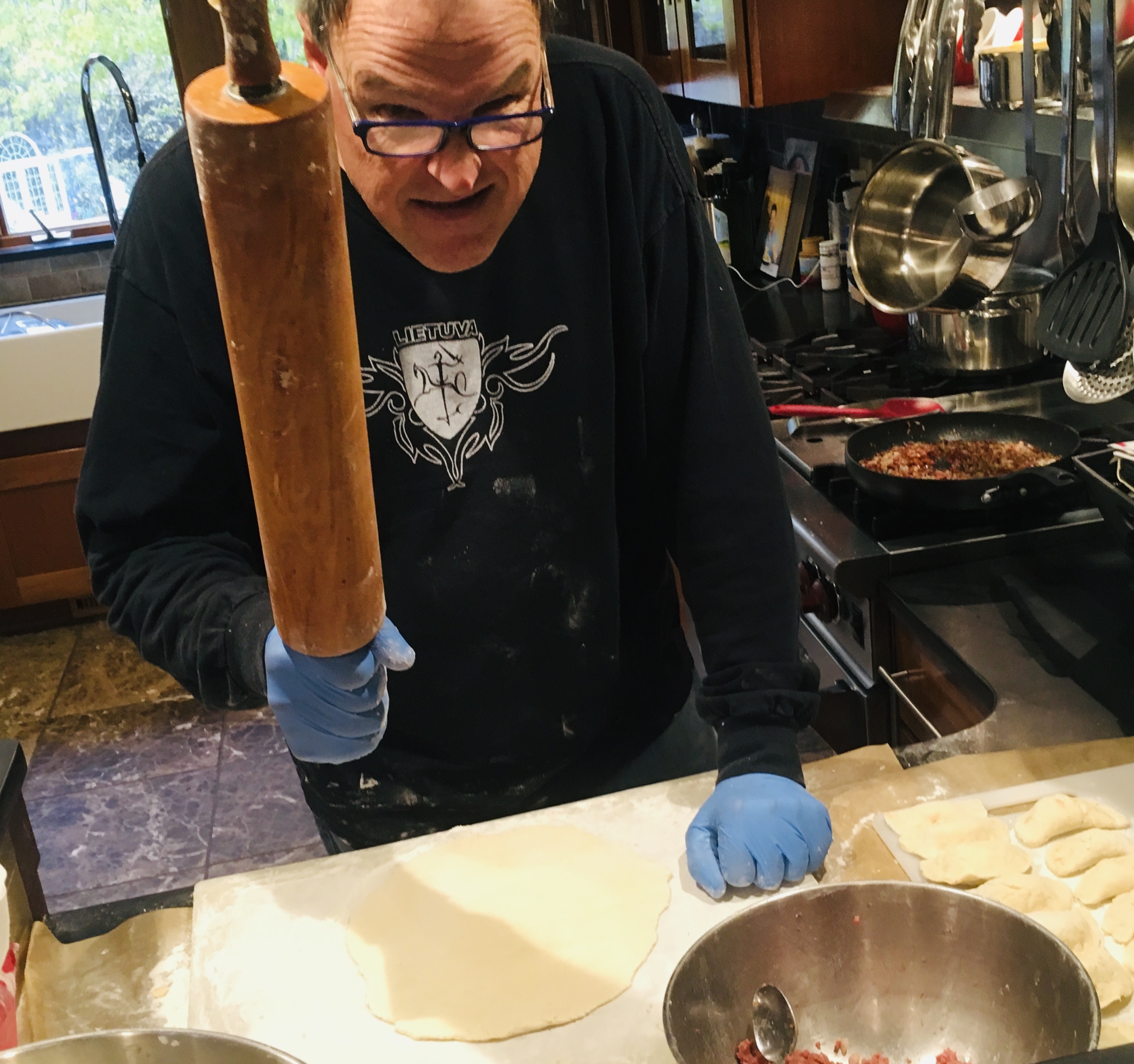
The rolling pin method.


This time around, I made four kinds of koldūnai: traditional (ground beef as well as mushroom) and non-traditional (mac & cheese and pulled pork.)  Patty’s Pierogis, a restaurant in nearby Fall River, Massachusetts, and featured on Food Network’s “Diners, Drive-Ins and Dives,” is where my daughter first had mac & cheese pierogis. She was instantly hooked and begs for them every year.

Here’s my beef recipe…

1/2 onion, finely chopped
1 pat of butter
1 lb. ground beef
1 egg
1/2 cup breadcrumbs

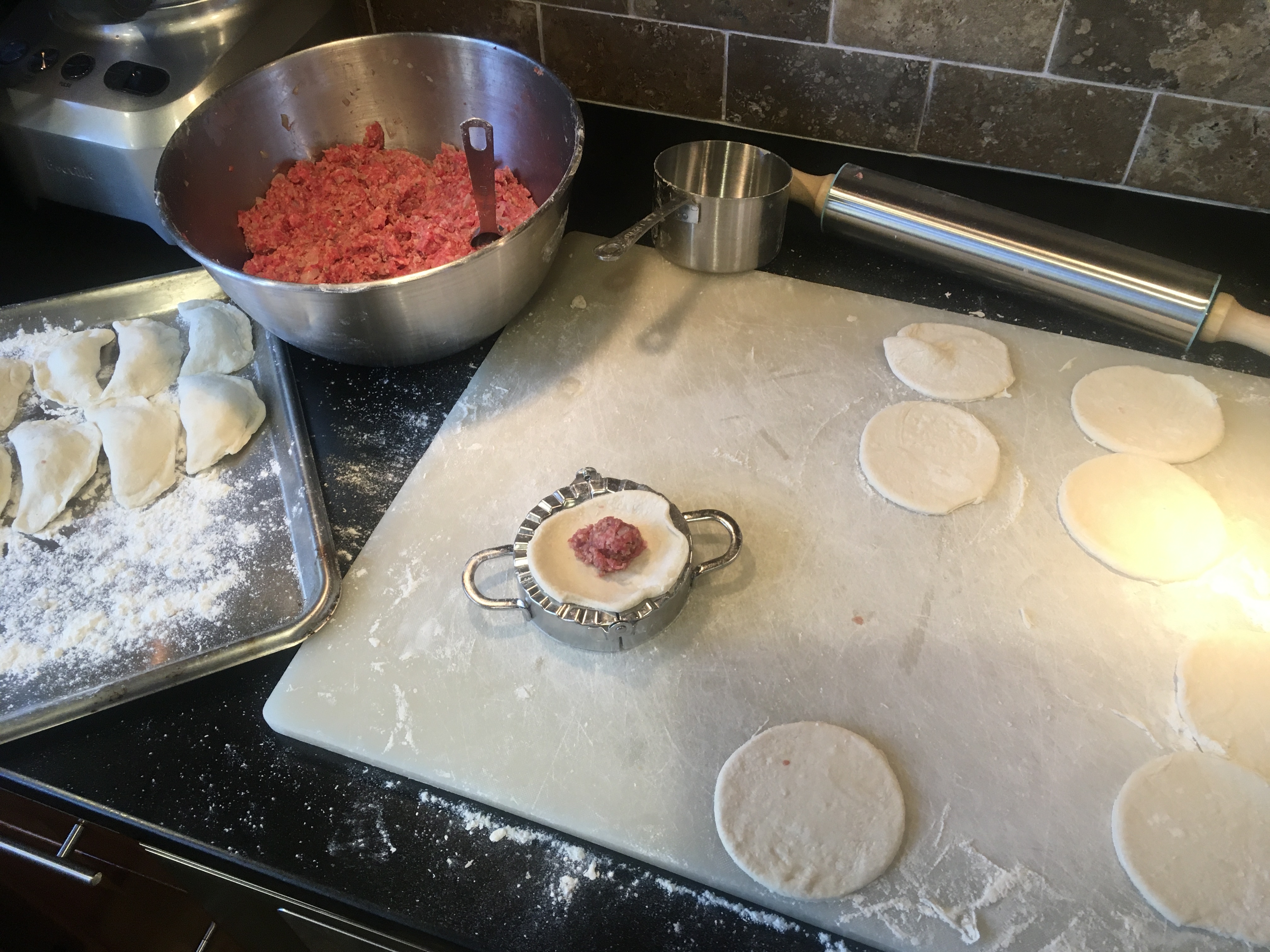
Finely chop the onion and sauté it in the butter until translucent. Let it cool, then add it to 1 lb. of thawed ground beef. Add the egg and the breadcrumbs. Season with salt and pepper. Mix the ingredients thoroughly and keep the meat in the fridge until you’re ready to use it.


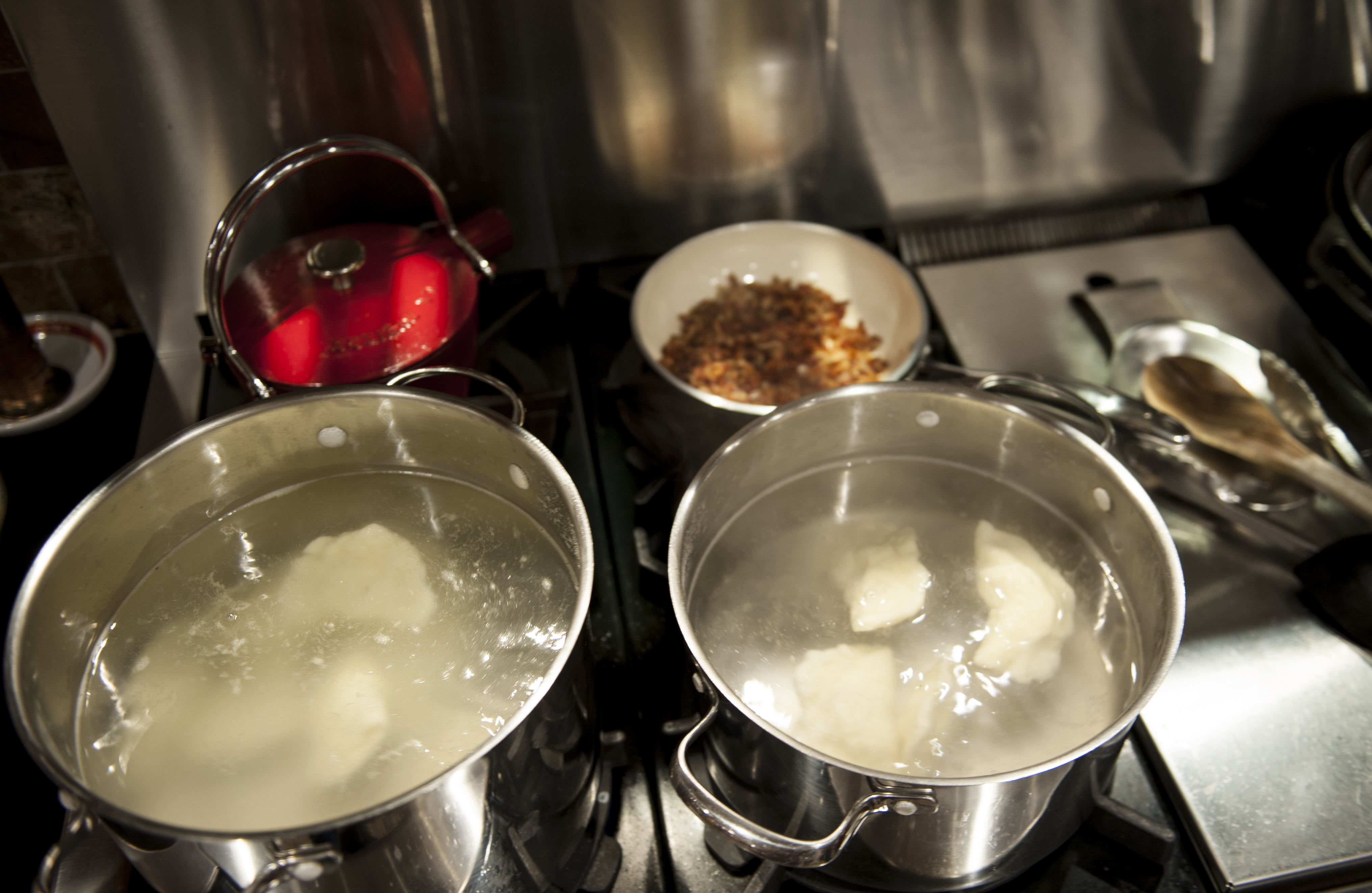
Two pots of boiling salted water: one for the meat-filled koldūnai, and one for the mac-and-cheese filled koldūnai.

Two pots of boiling salted water: one for the meat-filled koldūnai, and one for the mac-and-cheese filled koldūnai…so I don’t get ’em mixed up!


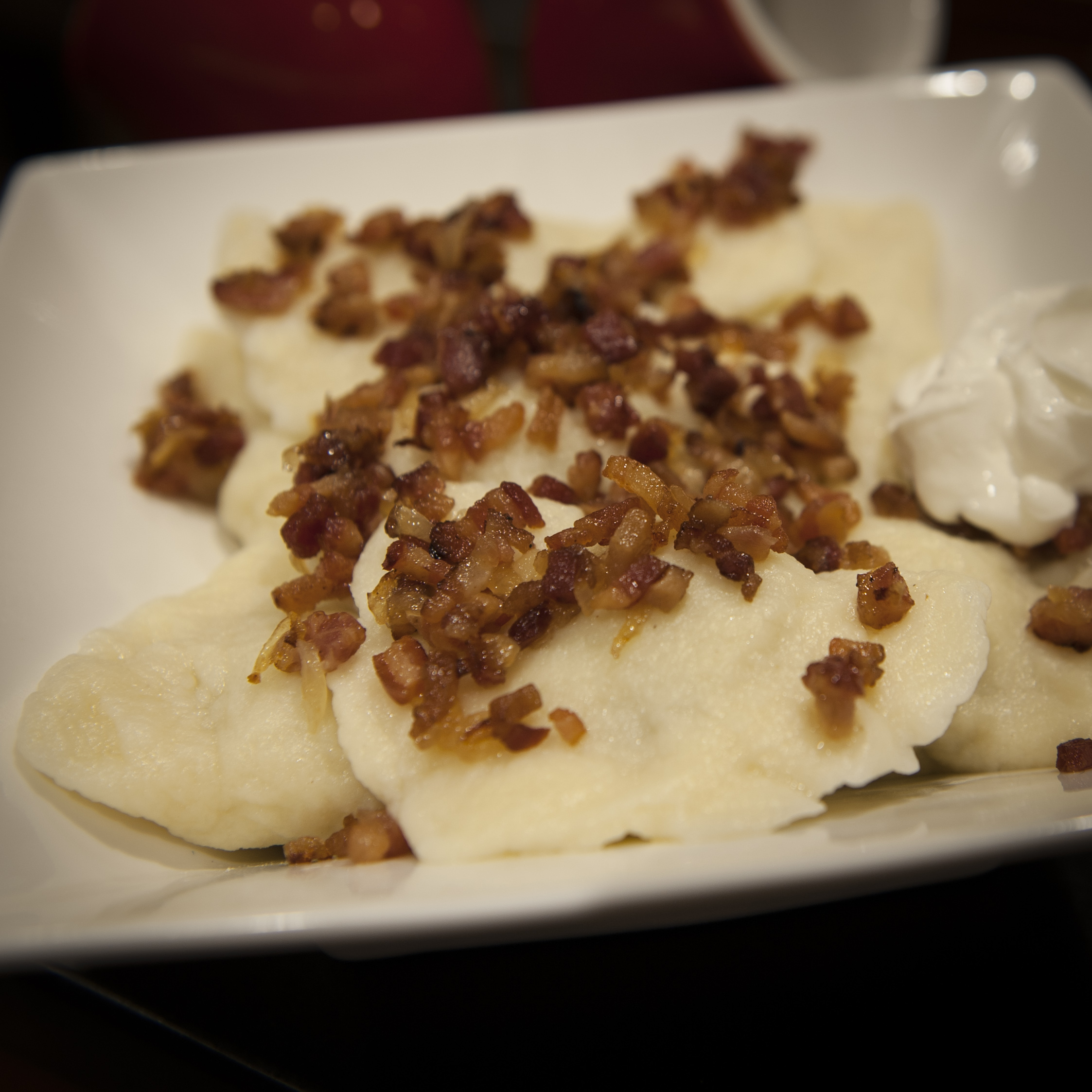
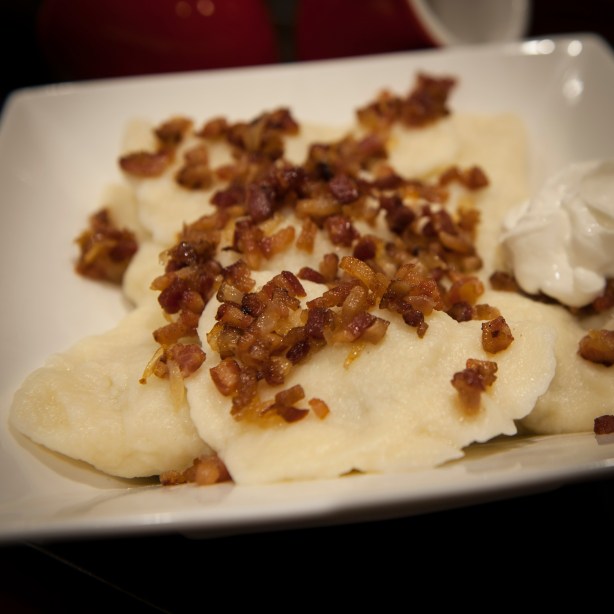
In my childhood home, you cannot possibly serve koldūnai without sour cream on the side and without spirgučiai (spir-guh-chay), chopped and fried bacon and onions, that are sprinkled on top.

1 lb. bacon, finely chopped
1 large onion, finely chopped

In a large pan, fry the chopped bacon until it’s almost crisp. Never drain the fat! Add the chopped onions and cook until they are soft. Set aside.  (My Mom always kept a stash of spirgučiai in a container in the fridge, and sprinkled them on anything and everything.)
 

duni 4


Making the dough is simple.

2 cups all-purpose flour
1 cup water

I don’t use salt in the dough because I boil the koldūnai in salted water later.

Combine the ingredients in a bowl, mixing with your hands. Keep adding flour in small amounts until the dough isn’t wet and sticky. When it forms a nice ball, remove it from the bowl and place it on a floured surface and knead it a bit more. Cut the ball into quarters, and work with these smaller pieces of dough.

For the rolling-pin method, roll each quarter out until the dough is about 1/8″ thick. Cut circles out of the dough using a cookie cutter, rocks glass, or whatever else you have handy. Add about a teaspoonful of filling in the center of the dough (a melon baller works great), then fold the edges over and pinch them with your fingers. Flip it over and pinch again, making sure none of the filling seeps out. A tight edge means the koldūnai won’t break open when you put them in boiling water.


Who knew a rocks glass had more uses than just to hold a great Manhattan?
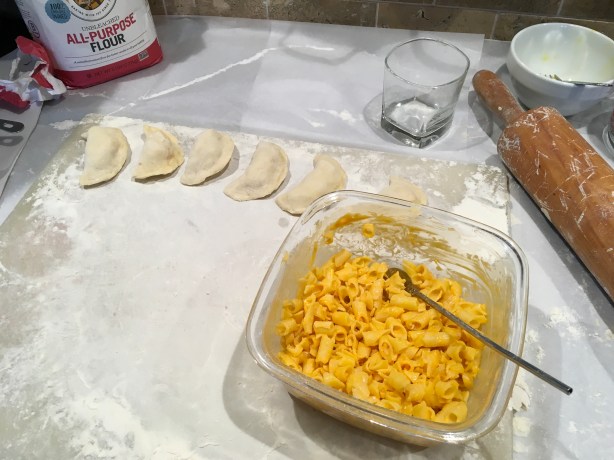
 

Some stuffed with mac and cheese!


I recently discovered these “pierogi makers.” You lay the dough in them, add your filling, and then close them. They automatically crimp the edges for you. They work pretty well…sometimes. It’s faster with the traditional method.
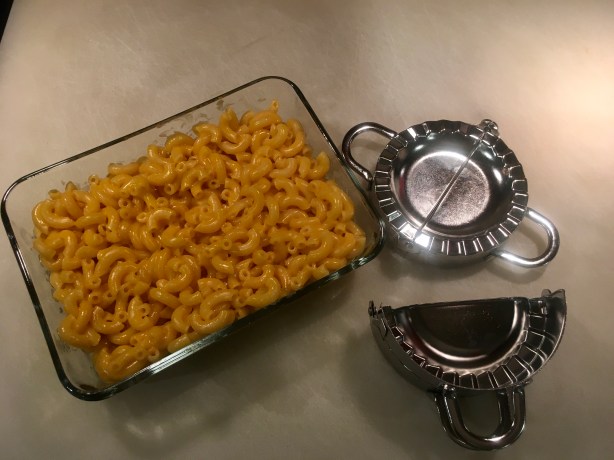
 

I always double-check the crimped edges, because your koldūnai will fall apart in the boiling water if you don’t seal them well!


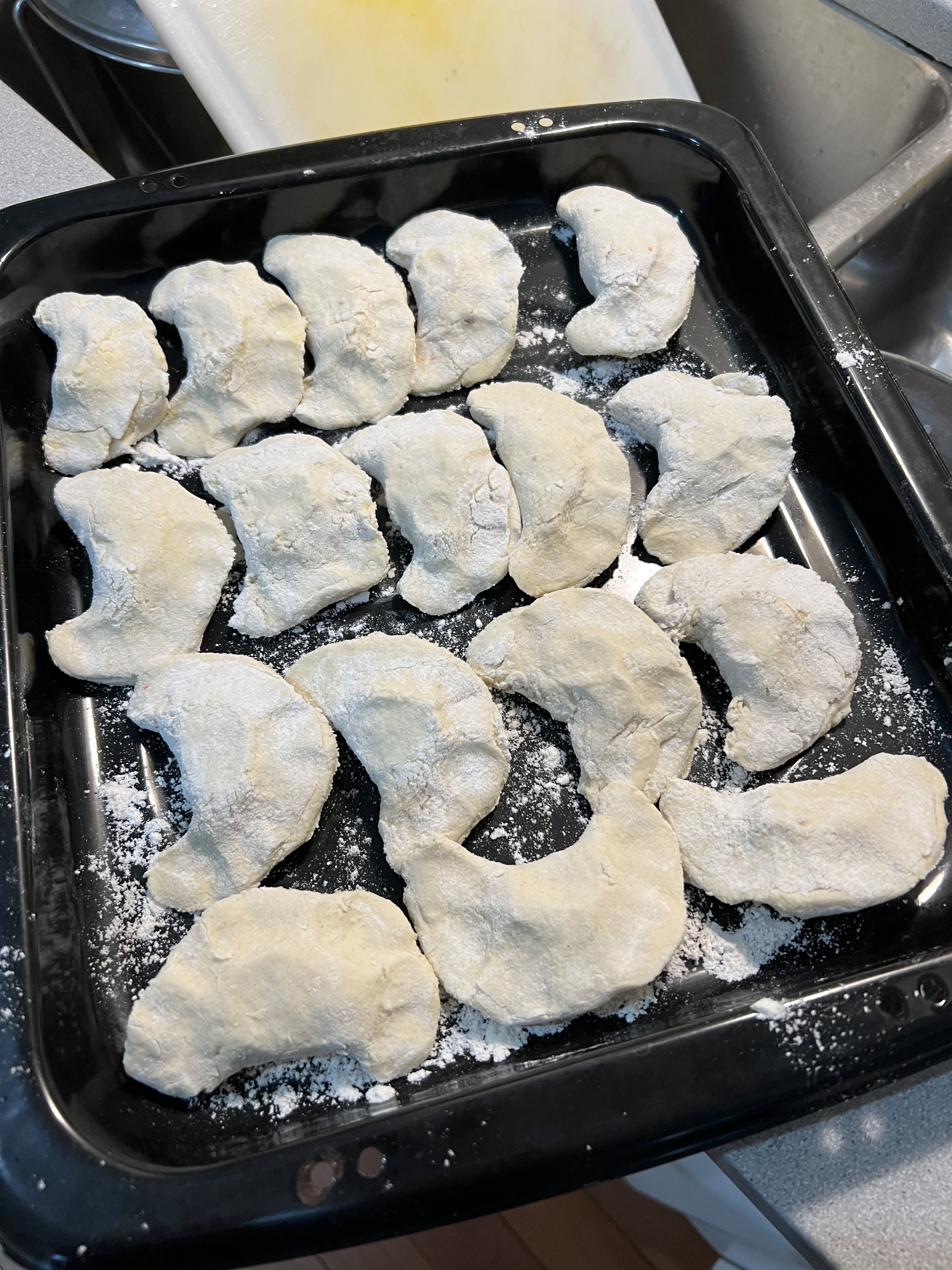
Place the koldūnai on a sheet pan dusted with flour, and when you’re done, place the sheet pan in the freezer.


Ready for the freezer!


Sometimes the chef gets punchy after making koldūnai all day long!


Get a large pot of salted water boiling. Drop the koldūnai in gently, being careful not to overcrowd them. If the dough is thin, the koldūnai will be ready when they float up to the surface. A thicker dough will need longer cooking. The best way to know if they’re done is by taking one out, cutting it open and having a look (and taste!)

When plating, sprinkle generously with spirgučiai, and serve with sour cream on the side.


duni 4


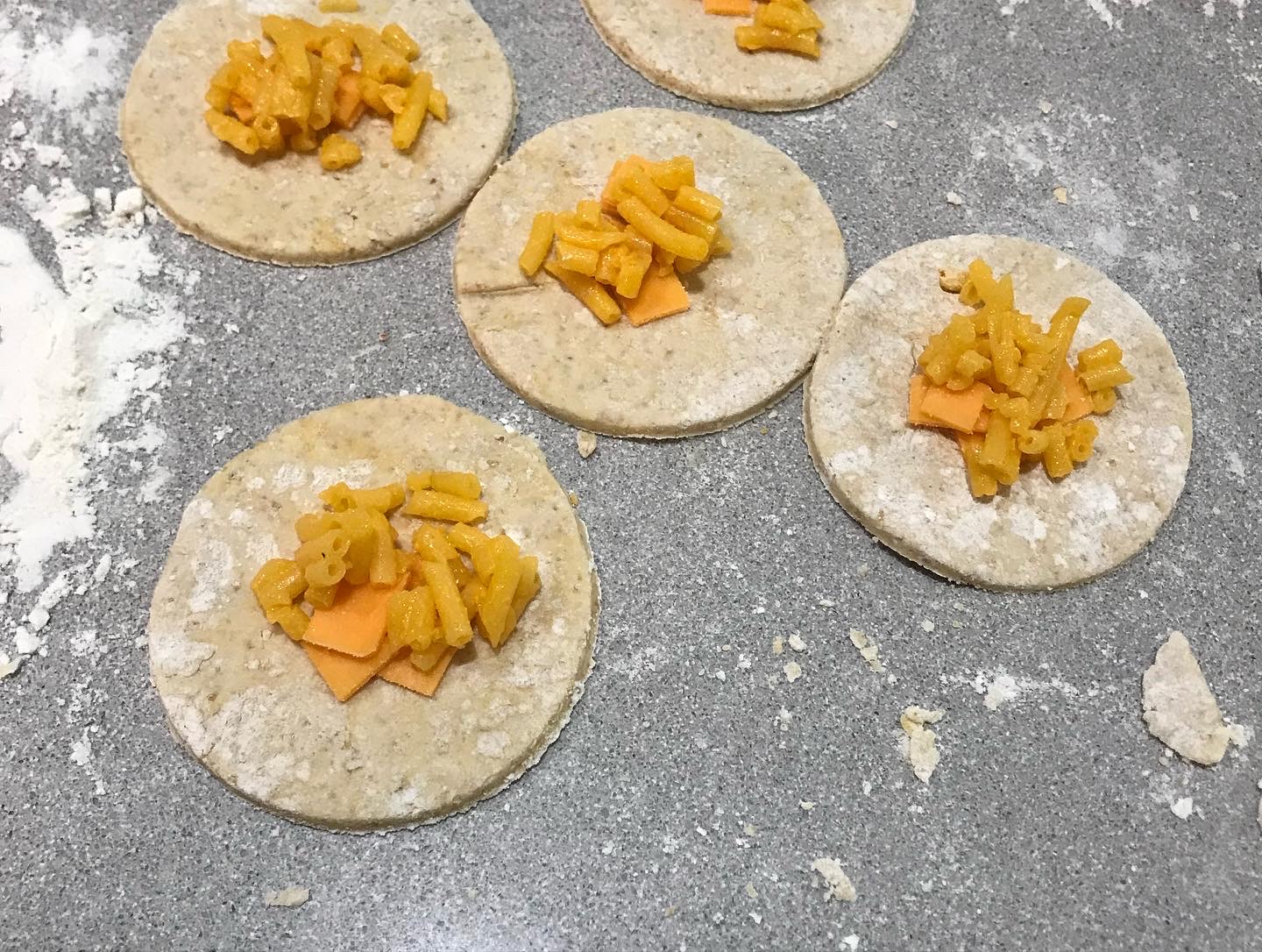
If you need to go gluten-free…good news! You can still have your koldūnai! The mushroom filling is already gluten-free. For the breadcrumbs in the beef filling, I take slices of Udi GF bread, toast them, and zap them in a food processor. Excellent breadcrumbs! And I use store-bought GF mac-and-cheese.


GF Mac and cheese, with a little extra cheddar.


For a rustic dough, this recipe works great. (Thanks to my sister, who shared it with me.)


Excellent GF flours.

1 1/2 cups all-purpose gluten-free flour (I use Cup4Cup)
1 1/2 cups rice flour (I use Cup4Cup Wholesome Flour)
2 eggs
pinch of salt
water

Combine the flour and salt in a bowl. Add the eggs and mix. (I use my hands for this.) Slowly add water to the dough until it pulls from the sides of the bowl and makes a nice ball of dough. I cut the dough in half and use a well-floured rolling pin to roll it flat.


The finished product! The rice flour gives it a darker, grainier texture. A more rustic taste, but still delicious!


A newer, less rustic gluten-free version here…
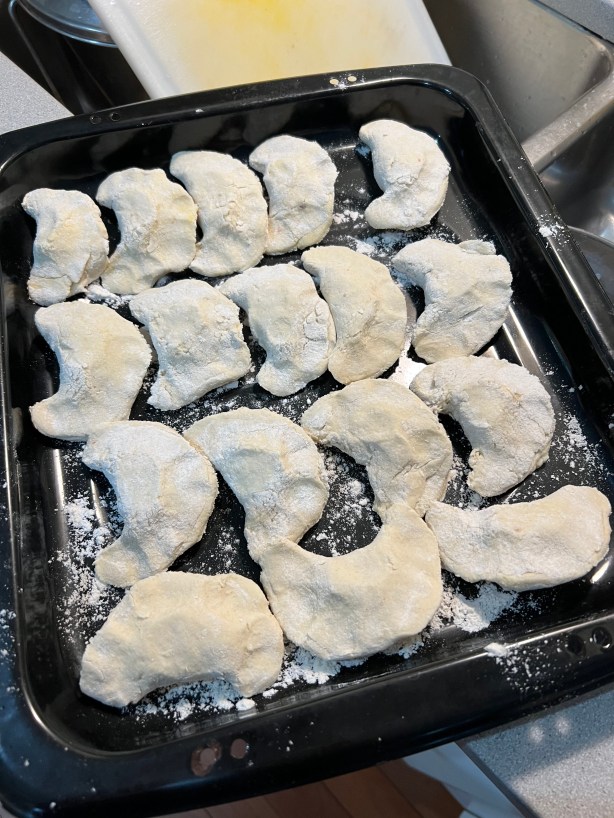
These are also gluten-free, but I used a different recipe and a different brand of flour. I mixed 2 cups of King Arthur GF flour with one cup of water and 1 teaspoon of xanthan gum. Then I added more flour or water, depending what was needed, to get the right consistency. A very easy to work with dough!


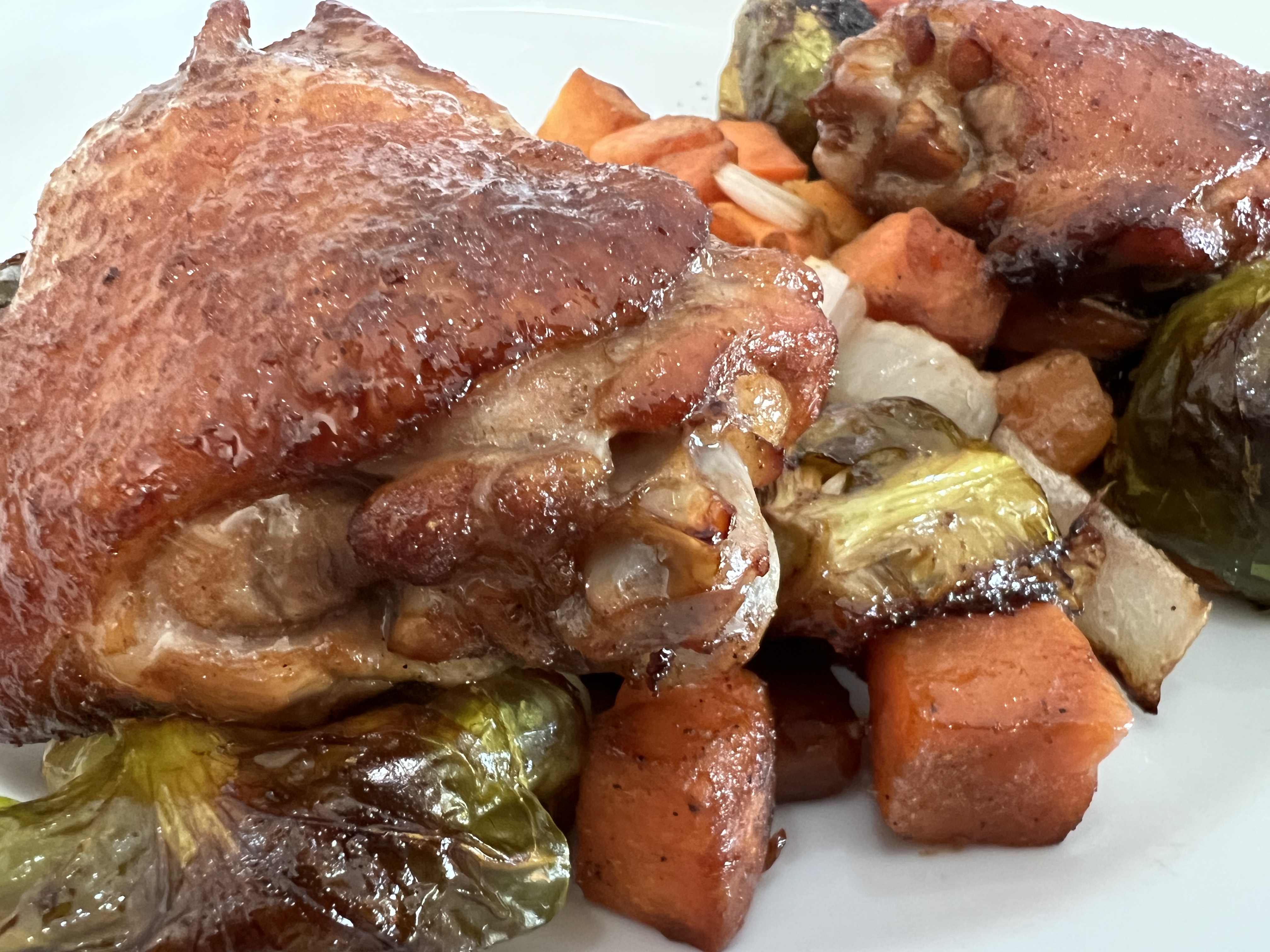
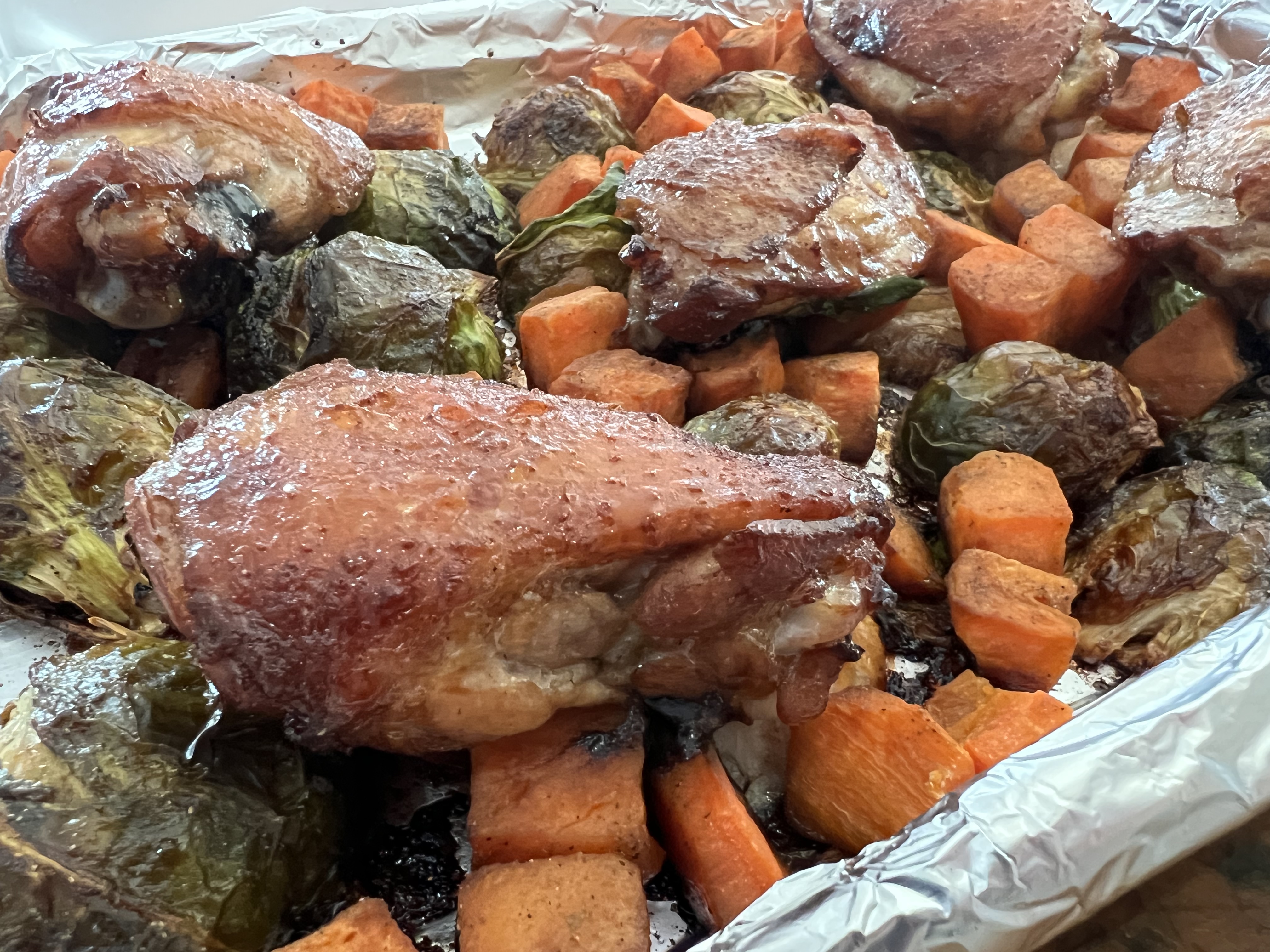
I recently saw what I thought was a pretty clever idea of taking a cabbage and slicing it into thick, steak-like pieces, laying them flat in a pan, and then placing marinated chicken on top of them to roast in the oven. The juices from the chicken would flavor the cabbage as it all cooked. I decided I’d try my own version of that recipe.


You can use any part of a chicken you like, even a whole spatchcocked chicken which would lay flat in a larger pan if you’re serving a group of people. But cooking for myself, I choose leg quarters (which are the thigh and drumstick together) or simply chicken thighs. They’re full of flavor, and have the fat content you need to drip down into the veggies below to flavor them as well. Something like chicken breast would simply be too dry.

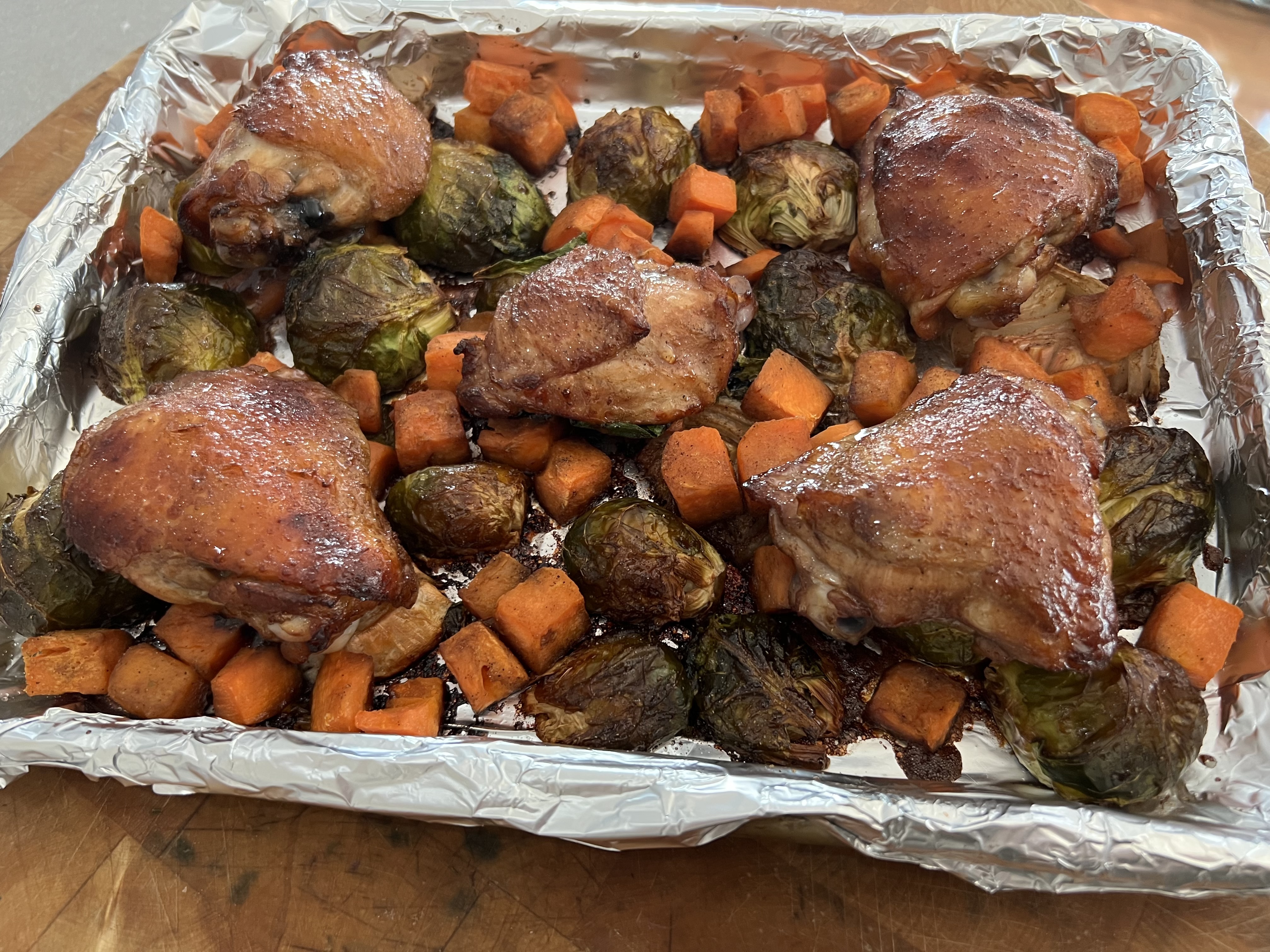
I wanted to use what I had in my fridge, so instead of cabbage, I had Brussels sprouts–baby cabbages, in essence. I cut them in half and layer them flame-side down in a roasting pan covered with non-stick aluminum foil. I wanted more veggies, though, so I sliced up a half-onion I had in the fridge, and I also added a package of frozen organic sweet potatoes I had in my freezer. Now the bottom of my pan was full.


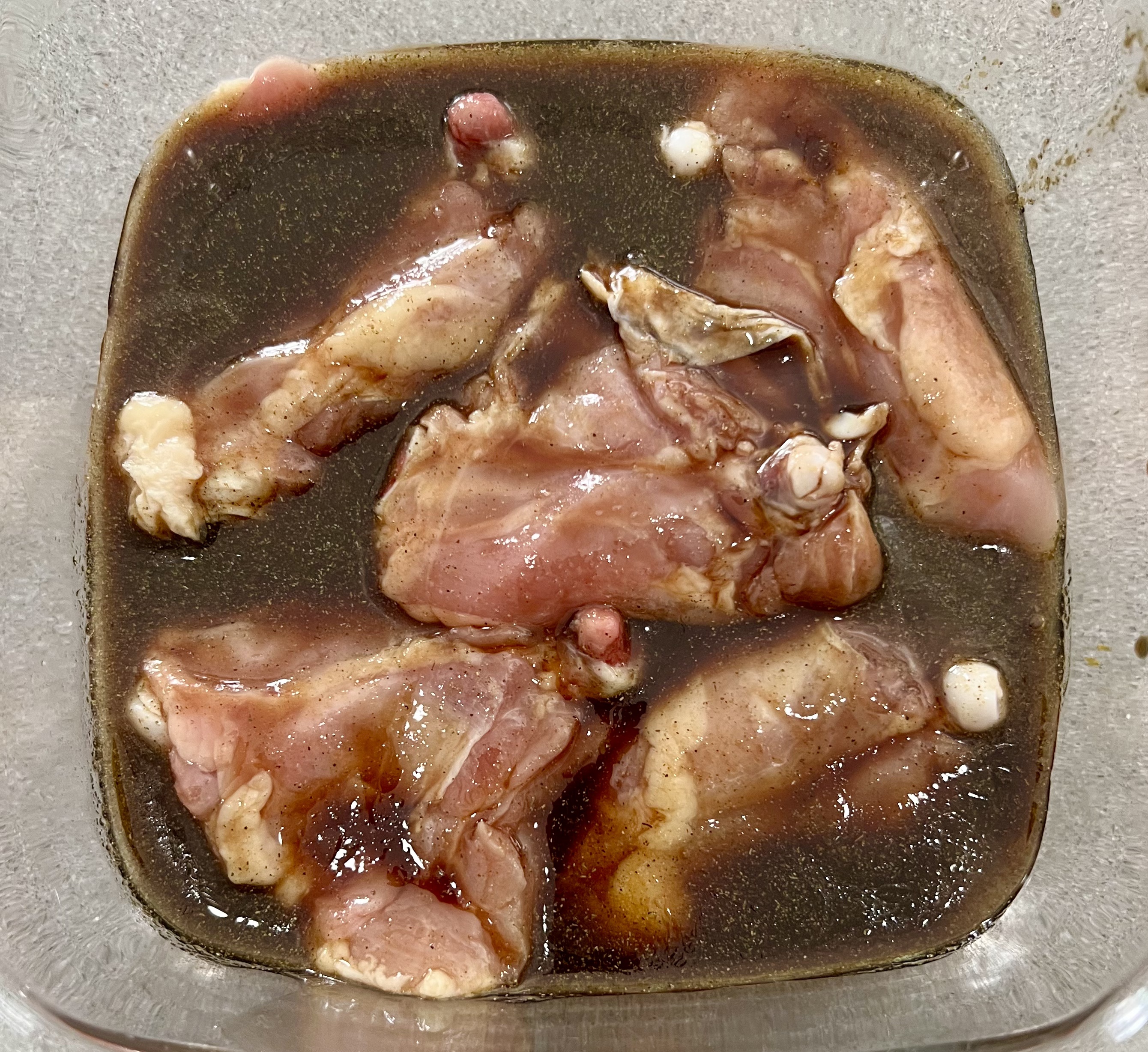
I buy humanely-raised pastured chicken, which means the birds are usually smaller than what you’d find in a supermarket (no steroid monsters here!), so one package contained 5 small chicken thighs. Once thawed, I placed them skin-side down in a glass container. Then it was time to make the marinade.

I chose a marinade that would give a beautiful caramelized color to the dish, using some of my favorite marinade ingredients.


3 oz (6 tablespoons) maple syrup
2 oz (1/4 cup) extra virgin olive oil
2 oz (1/4 cup) balsamic vinegar
1 oz (2 tablespoons) soy sauce
1 oz (2 tablespoons) Worcestershire sauce
1 tablespoon lemon juice
1 tablespoon Dijon mustard
3/4 teaspoon Kosher salt
1 teaspoon powdered rosemary
1 teaspoon granulated garlic
1/2 teaspoon black pepper


I combine all the marinade ingredients in a bowl and whisk well to mix.


I brush the tray of veggies with some of the marinade just to give them a head start on flavor.


I use about a 1/2 cup of the marinade on the chicken thighs, tossing them around in the marinade to make sure they’re well coated. Then I pour the rest of the marinade in a saucepan that I will cook on the stove top.


I like to place the thighs skin-side down and then poke some holes into the meat with a fork to really let the marinade soak in. I let them marinate at room temperature for about an hour. Any longer than that, and they need to go into the fridge.

Once I’m ready to cook, I pre-heat the oven to 325. I place the marinated thighs skin-side up over the veggies in the tray. I discard any leftover marinade in the bowl with the chicken.

While the thighs and veggies are cooking, I take the reserved marinade and heat it over medium heat in a saucepan until it reduces by half to make a nice glaze that I will brush onto the chicken when it’s done cooking.


It’s important to remember that once any of the marinade touches raw chicken, to avoid salmonella, you have to cook it before you can taste it!


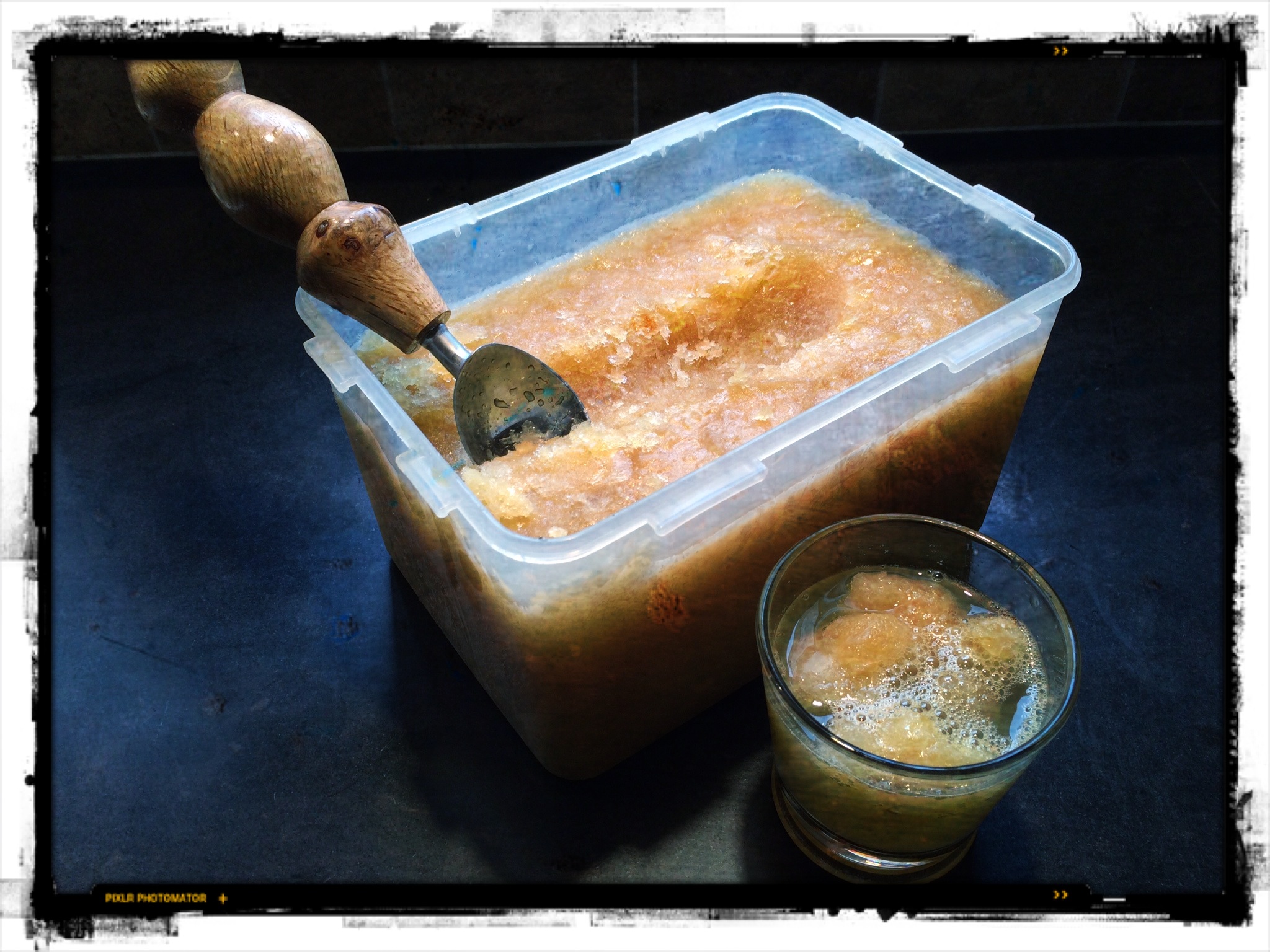
This is my version of a holiday drink I was introduced to me by my mother-in-law from the Upper Peninsula of Michigan.

This classic is loaded with sugar. But then…so is everything else around the holidays!

Whiskey slush

9 cups water
2 cups sugar
4 “Constant Comment” tea bags
12 oz. frozen OJ concentrate
12 oz. frozen lemonade concentrate
2 cups whiskey (I use Crown Royal)
7-Up or Sprite

Boil the water and sugar, making sure the sugar dissolves. Turn off the heat and steep the tea bags in the liquid for 10 minutes. Discard the tea bags.

Add the OJ, lemonade and whiskey. Mix well, then pour it all into a freezable container with a lid. Freeze.

To serve: Scoop the slush out of the container (it doesn’t freeze solid) and mix it in a tall glass with 7-Up.

If you’re concerned about all that sugar, you can use a sugar substitute in the mix, and diet soda at the end. Some stores also carry low-sugar juice concentrates. I haven’t tried any of these substitutions, because when it comes to the holidays, I go big or go home!

CLASSIC PARKER HOUSE ROLLS

Posted: November 16, 2024 in Uncategorized

The holidays on on our minds already. Time to start bringing out the recipes…

What’s a Thanksgiving dinner without Parker House rolls?

Parker House rolls are one of my all-time favorite treats. They’re so light and delicious because milk and melted butter are used to make the dough. I’d make and eat them every weekend if it wasn’t for the fact that I’d gain a ton of weight in the process! So…I save them for special occasions.


There really is a Parker House. It’s a hotel in Boston where the rolls originated in the 1870’s. Legend has it that a disgruntled hotel baker threw a batch of unfinished rolls in the oven, and when they came out, they had a folded pocketbook shape that made them light on the inside, and crisp and buttery on the outside. A legend was born.

There are hundreds of Parker House Roll recipes out there, but this is the one I swear by. It’s a great excuse to get out my old Kitchenaid standing mixer.


1 stick unsalted butter, melted and cooled, plus softened butter for brushing
1 tablespoon active dry yeast
1/4 cup lukewarm water (100 to 110 degrees)
1/4 cup sugar 1 cup whole milk, warmed
2 large eggs, at room temperature
4 cups all-purpose flour, plus more for dusting
2 1/2 teaspoons Kosher salt (I use Diamond Crystal)


Brush a large bowl with butter.

In the bowl of a stand mixer fitted with a paddle, combine the yeast with the water and a pinch of sugar. Let it stand until it gets foamy, about 10 minutes. This gets the yeast happy.


Add the milk, melted butter, eggs and remaining sugar and mix until it’s all combined.

Now switch to the dough hook and add the flour and salt. Knead at low speed until a smooth ball forms, about 2 minutes.

Scrape the dough onto a lightly floured board and knead it gently into a ball. Then place the ball in the buttered bowl, covering it with plastic wrap, and placing the bowl in a warm place. Let the dough double in volume. It’ll take about 1 1/2 hours.


Pre-heat the oven to 350.

Grease a 9-by-13 baking dish with more butter.

Turn the dough out onto a lightly floured board again, punching out the air bubbles, and forming it into a ball again. Cut the ball in half, then each half into 8 pieces.


You can either leave the pieces in their wedge shape, placing them in the baking dish top side up. Or you can roll the wedges into balls, placing them into the baking dish, spacing them out evenly.


Cover the baking dish with plastic wrap and let the dough rise again for about 30 minutes. By then, your oven will be nice and warm.


Bake the rolls for 20 to 25minutes, until they’re a beautiful golden color.


Serve them warm or at room temperature. If you bake the rolls earlier in the day, you can cover them in plastic wrap, and the re-heat gently before serving.

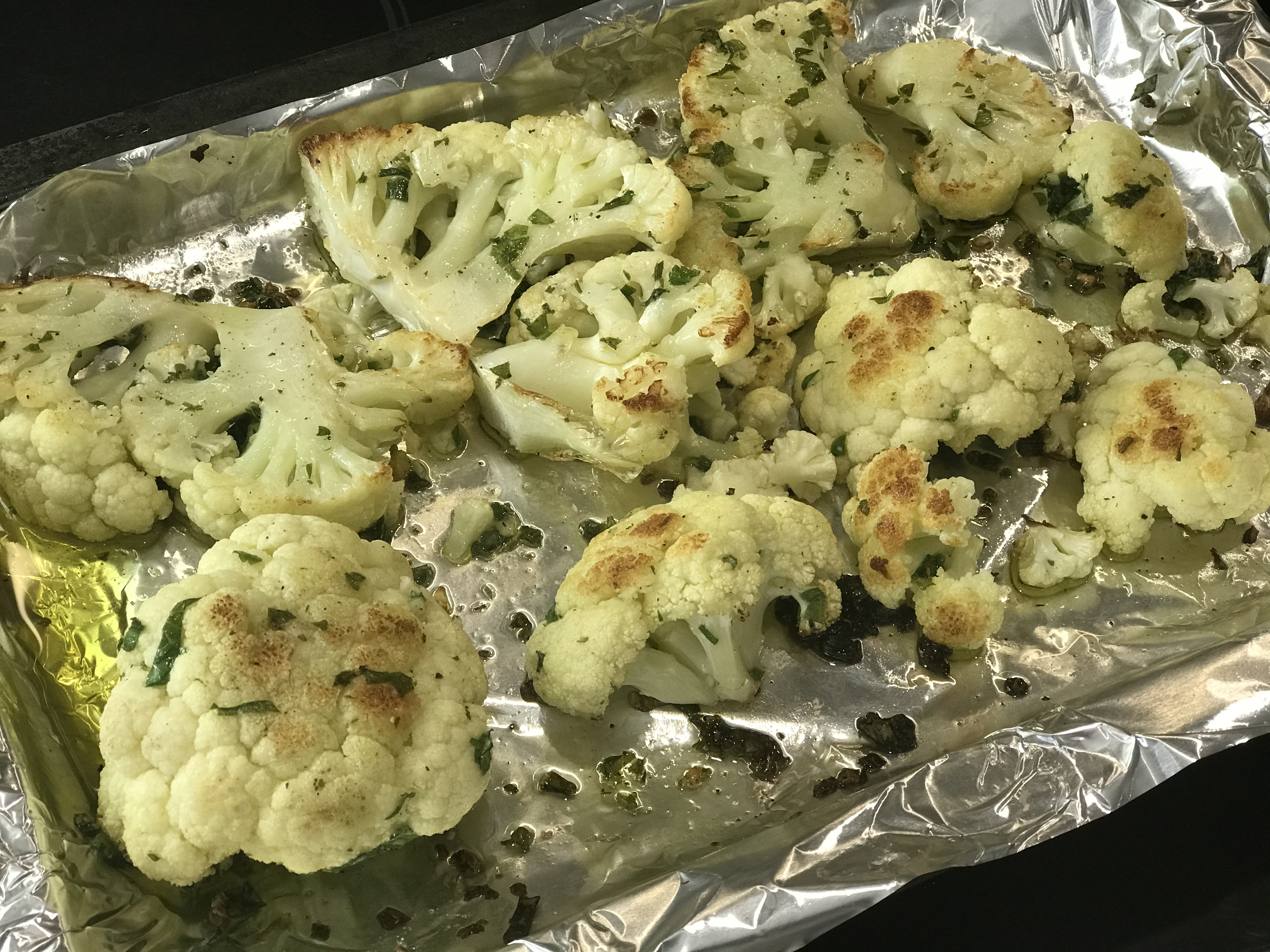
Cauliflower seems to be the “it” veggie these days. You’ll find it riced to take the place of rice or mashed potatoes, in a crust for pizza, and now, the dish du jour is a cauliflower steak. All you need to do is to slice the cauliflower into thick, steak-like pieces, and then bake them. The thicker cut gives the cauliflower a more meaty texture. Of course, with a meat sauce, I’m using cauliflower as a pasta substitute in this dish.


The marinade I use for the cauliflower is pretty simple, with my favorite Italian flavors. I use fresh herbs when I can, but you can use dry as well.


1/4 cup extra virgin olive oil
1/2 cups chopped scallions
2 garlic cloves, finely chopped
chopped fresh parsley and oregano to taste
salt and pepper

Combine these ingredients in a bowl.

Slice the head of cauliflower across the whole head into 1 1/2-inch steak-like pieces. Place them on a baking pan covered with non-stick aluminum foil. Brush the cauliflower on both sides with the marinade. Use it all up!

Place the baking pan in a pre-heated 400-degree oven and bake it for about an hour, until the cauliflower is golden brown on the edges. Flip the cauliflower steaks over after the first 30 minutes.


It’s OK if your cauliflower steaks break apart a bit. They’ll still taste great!


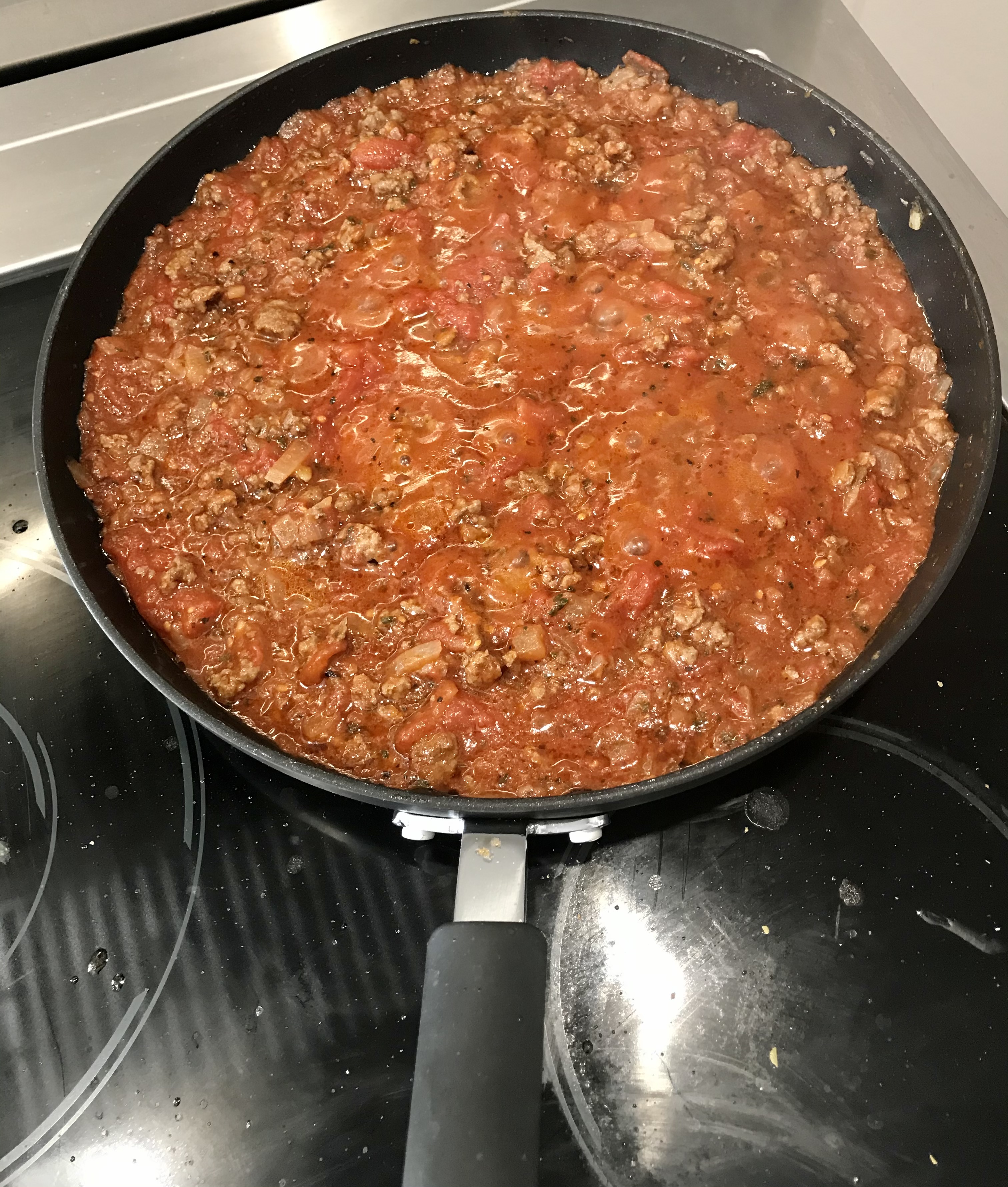
This meat sauce I use is one that I make all the time with simple ingredients…


1 lb. grass-fed ground beef
1 medium onion, finely chopped
1 28-oz. can of whole San Marzano tomatoes
dried oregano, basil and parsley
granulated garlic
extra virgin olive oil
salt and pepper


Heat the olive oil in a pan and add the onions. Sauté them until they’re translucent, then add the ground beef. Cook the beef until it has browned completely. Add the can of tomatoes, chopping the whole tomatoes up with a spatula (or squeezing them with your hands), breaking up the big pieces into smaller chunks. (I like my sauce a little chunky.) Add the oregano, basil, parsley, garlic, salt and pepper to taste.


Let the sauce cook down until it has thickened.


When the cauliflower steaks are ready, place them on a plate and pour the awesome meat sauce on them. Garnish with some freshly grated Parmigiano Reggiano.

Lamb is such an underrated meat. It was one of the things my Mom cooked really well, so I grew up loving it, and was never bothered by the gaminess of it.

If the gaminess does bother you, look for American lamb. If gamier meat doesn’t bother you, go for the gusto and get grass-fed New Zealand or Australian lamb.

The balsamic vinegar in this recipe is not the crazy expensive stuff. It’s the bottle you can get for about 9 bucks in the supermarket.

Screenshot

Here’s the marinade I used…

1/2 cup olive oil
1/4 cup balsamic vinegar
1 tablespoon fresh rosemary, chopped (or 1 teaspoon dry)
1 tablespoon fresh thyme leaves, chopped (or 1 teaspoon dry)
1 tablespoon Kosher salt
1 tablespoon maple syrup
1 tablespoon Dijon mustard
1 teaspoon black pepper
1 teaspoon dried oregano
1 teaspoon granulated onion
1 teaspoon granulated garlic

Mix the marinade ingredients together in a bowl. 

Place the lamb in a plastic bag and pour the marinade in, squishing it around to make sure it makes contact with the meat. Place it in a pan or a bowl to prevent accidental leaking.

Screenshot

Let the lamb marinate for several hours at room temperature, or in the fridge overnight.

Before cooking, bring the lamb back to room temperature.

Screenshot

Use some oil in a hot pan, and then sear the lamb on both sides. Place a lid on the pan, and reduce the heat to medium-low.

I cook lamb until I get the lamb to a perfect medium. That means cooking to 130-135 degrees. But cook it the way you like it!

Update:

Last night, I used this recipe to marinate some baby lamb chops. I love these, because they look like mini porterhouse steaks, and meat off the bone is always juicier and tastier.

I placed the lamb in a freezer bag with the marinade, and let it marinate a solid three hours at room temperature. Any longer than that, and it would go to the fridge.

I always remove meat from the fridge and let it come back to room temperature before I cook it…and this time, I decided to try my air fryer, set at 400. Not only did it cook the lamb perfectly, it gave it that nice slight char on the outside, as if I grilled it. Delicious!

BANG FOR THE BUCK BOOZE

Posted: October 25, 2024 in Uncategorized

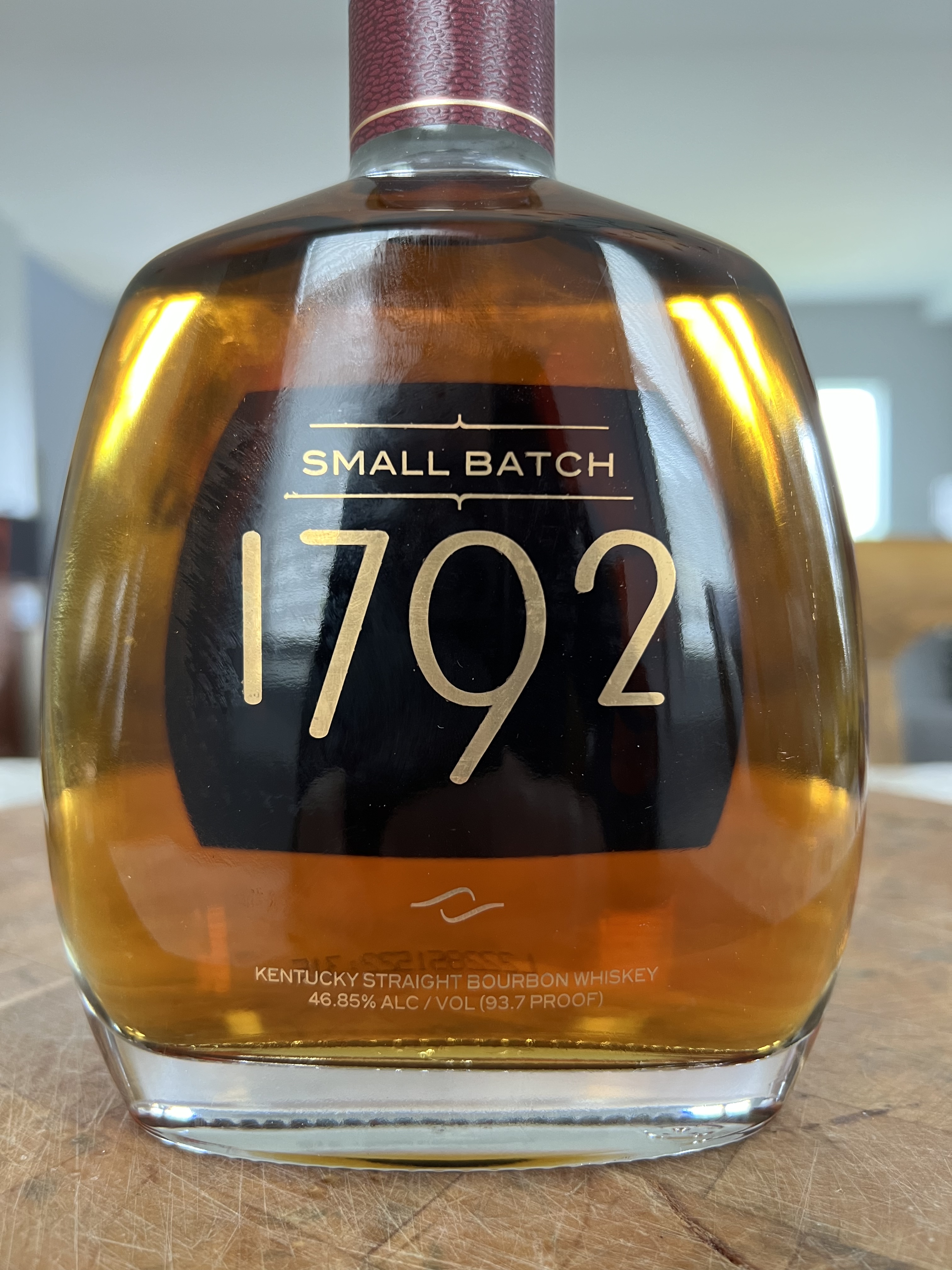
There seems to be no end to the bourbon craze, and until it does end, I’m constantly looking for new bargains. For example, for a long time, my go-to bourbon was Eagle Rare 10 Year Old, which I could get for about $32 a bottle. It’s now up to $80 a bottle in some places. Don’t get me wrong…I’m not complaining. It probably deserves that price, being a 10 year old. But I’m not going to buy it for mixed drinks anymore. A good choice to replace Eagle Rare is Buffalo Trace. Interestingly, both are made by the Buffalo Trace distillery. But I can’t always find Buffalo Trace when I want it, so I needed to find something else. What I found was 1792 Small Batch.


A Manhattan or a Boulevardier, shown here, needs a solid bourbon that doesn’t break the bank. 1792 is a good choice.


1792 Small Batch bourbon is my latest bang-for-the-buck bargain bourbon find. At $28.99 for a 750 ml bottle, you just can’t beat it for mixing or dropping a big cube in it for sipping.

Barton 1792 Distillery makes the 1792 line of bourbons. They were established in 1879, and continue today as the oldest fully operational distillery in Bardstown, Kentucky.

I originally thought the name 1792 came from the year the distillery first created it, but in actuality, 1792 was the year Kentucky, widely recognized as the birthplace of bourbon, became a state.


I wasn’t much of a gin drinker until my trips to New Zealand and Scotland, where I discovered a whole new world of gin.

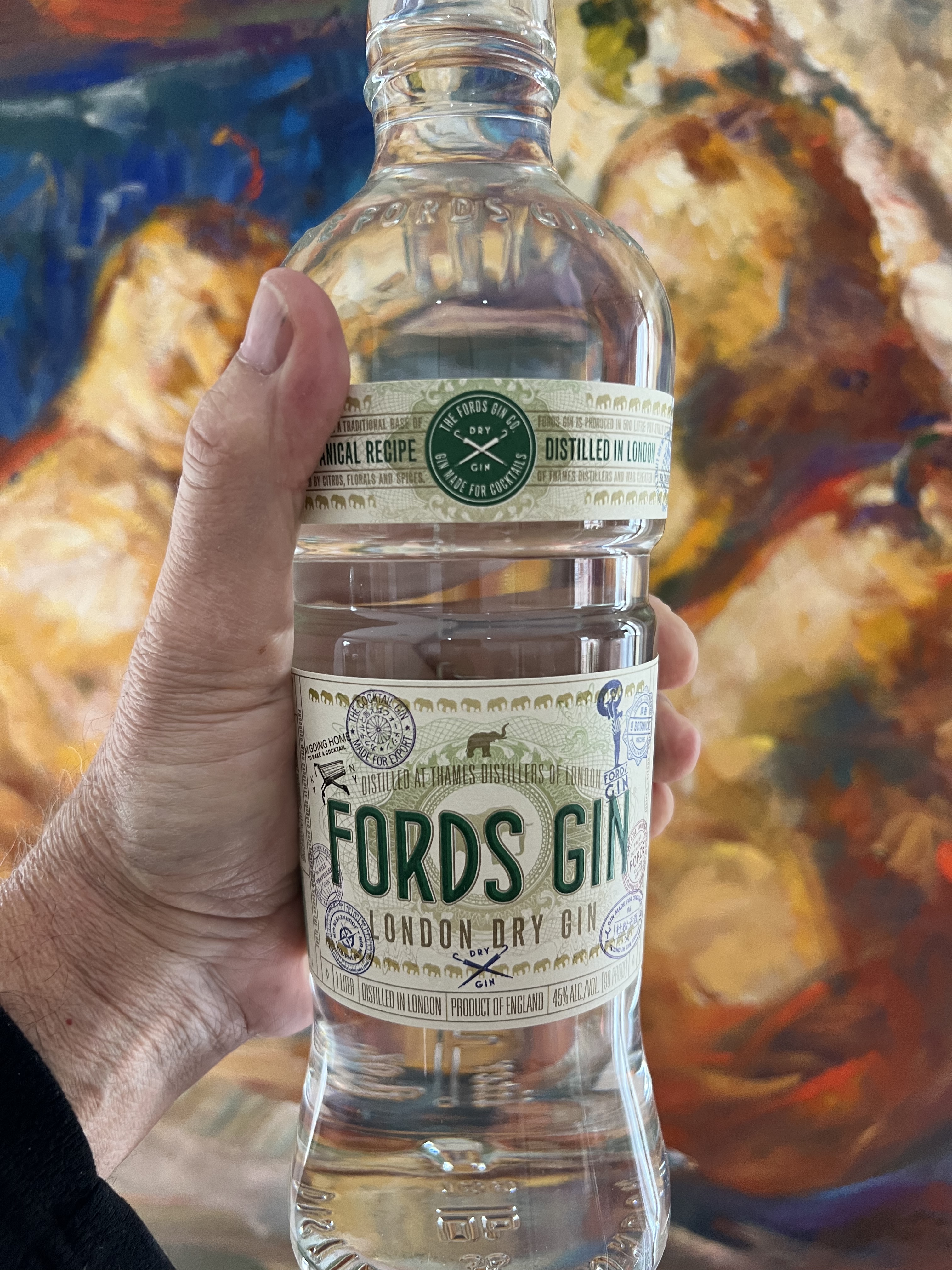
Before my travels, I was looking for a London dry gin to use in my Vesper martini recipe, and had heard about Ford’s gin. It didn’t take much convincing for me to try it when I saw that the price was $28.99 for a full liter!


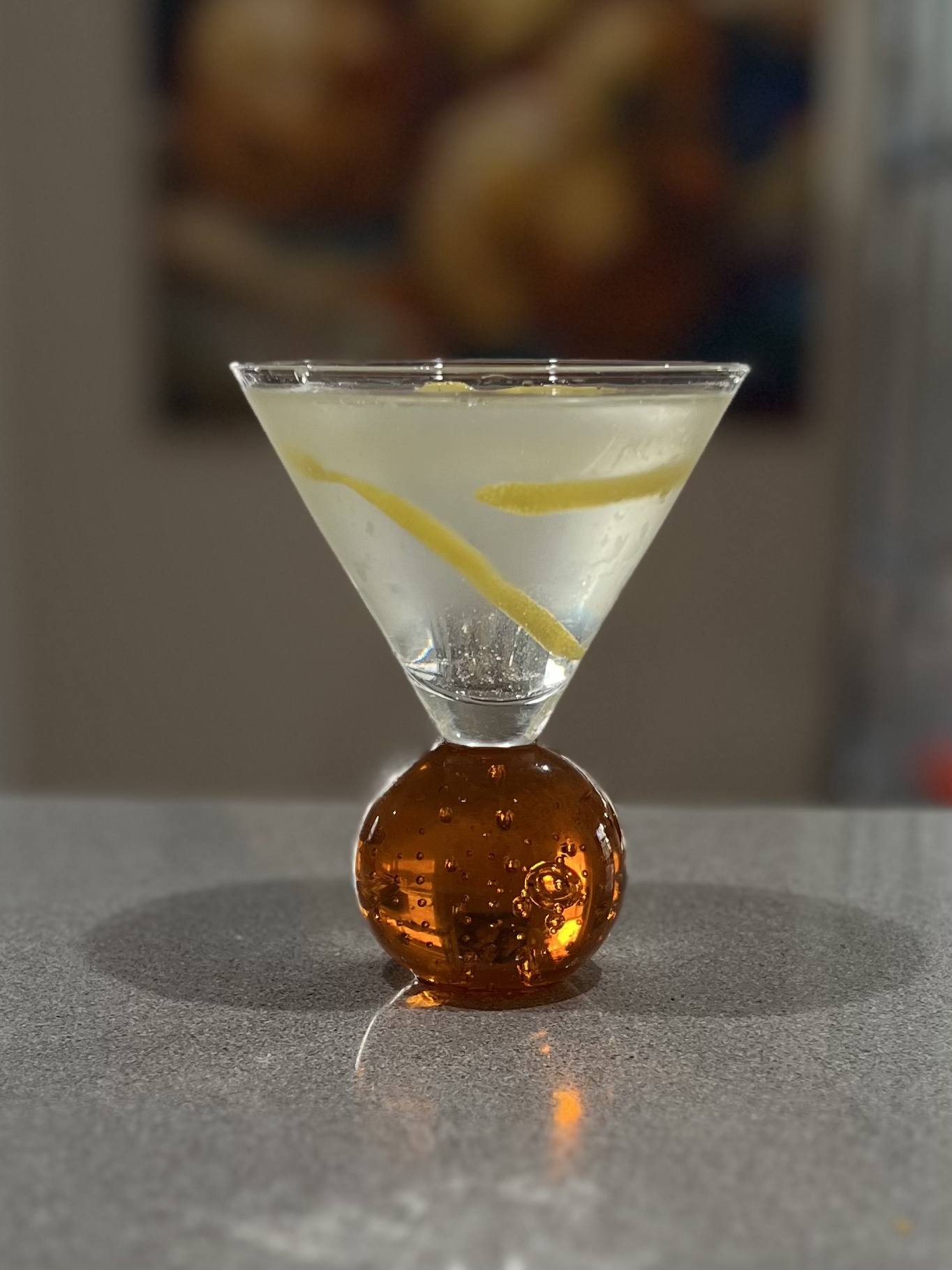
Enjoying a Vesper martini at home.


Ford’s London Dry Gin was created by Simon Ford, a man who was looking for one gin that would work in all of the gin cocktails out there, making it the bartenders’ choice for any gin cocktail. With the help of bartenders, distillers, and avid drinkers, he came up with this London dry gin, featuring nine botanicals. It’s delicious, not overpowering like many gins can be, so it really does work well with any recipe you might use gin for.

In addition to taste, he thought about the bartenders themselves. The bottle is tall and ergonomically shaped, making it very easy to handle. Back when I was considering going to market with my homemade honey liqueur, the shape and size of the bottle was an incredibly important decision. Shorter, wider bottles might be put in the front row of a bar, but they’re more difficult to pour, and small hands can’t hold them properly. A taller bottle is easy to spot, and easier to handle. Ask any bartender, and they will tell you that they will go for the bottle that’s easiest to use if they have to make drinks all night long. 

The bottle also has measurement markings on the side, which allows you to measure out enough for large batches of martinis, say, if you’re having a party.

But the best part of all is the value. And it’s great in a Vesper or a simple gin and tonic.


Perhaps the best-known Scottish gin is Hendrick’s, found at just about any bar in the states. But another good choice is The Botanist, as is a harder-to-find Caorrun and Lind and Lime. They aren’t inexpensive, but they are good.

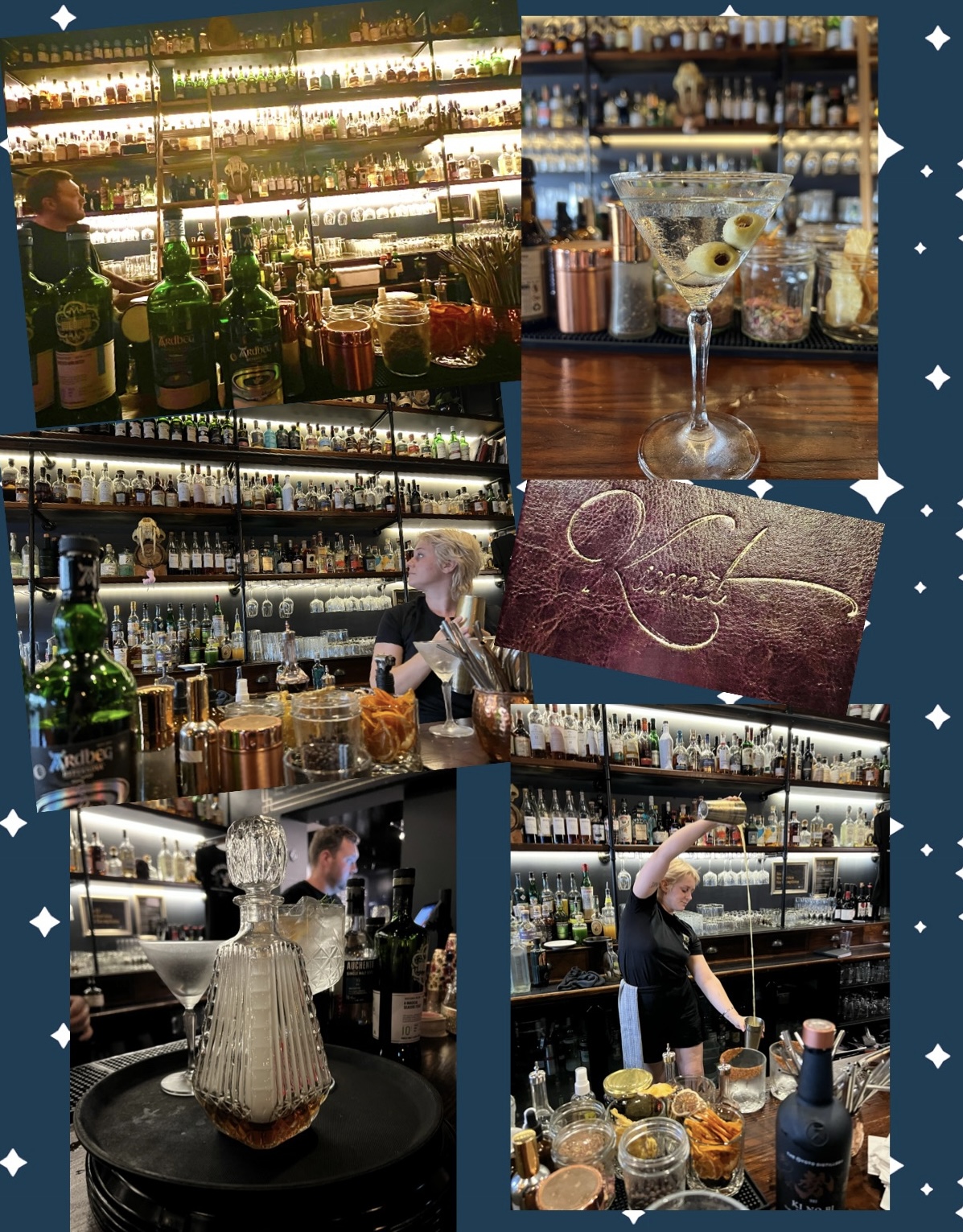
Much of my gin knowledge first came from my recent trip to New Zealand about a year-and-a-half ago. I had some interesting conversations with Nick, the owner of Kismet Cocktail & Whisky Bar in Nelson, NZ, a very well stocked bar with a very enthusiastic and knowledgeable staff. Finding a place like that in your own town is not as easy as it sounds, as many bars stock the same booze from the same suppliers and don ‘t really make an effort to stand out in the crowd. If you find a place like that, consider yourself lucky!


Kismet, in Nelson, NZ.

And that’s a great starting point. If you’re curious about different spirits, go to a well-stocked bar where they won’t mind giving you a taste before you go to a store to invest in a whole bottle. A little “scientific research” is a good thing!

Despite the large Italian community we have here in southern New England, there’s no exceptional pizza to speak of. I suppose you could say “them’s fightin’ words!” but if it’s here, I haven’t found it yet. (Fellini Pizza is about the best in Providence.)

So where is the excellent pizza? New York City, of course. OK…maybe I’m prejudiced because I’m a Brooklyn boy, and worked in a variety of pizzerias in my younger days, but there’s no doubt in my mind that if you want the best pizza–or bagel, for that matter–you’ve got to go to the Big Apple. (Even “Frank Pepe’s” in New Haven, CT is a mere stop on the way to the real deal.)

Pizza in the Big Apple can be confusing, as there are many different varieties to choose from. Brick oven pizzas abound, but there are pizza lovers who won’t settle for anything less than an old-fashioned pizza baked in a coal-fired oven. The extremely high heat of a coal-fired oven cooks the pizza in just a minute, and imparts a crusty, charred flavor you can’t get any other way. There are only about a dozen coal-fired pizzerias left in New York City, and many of them have been around for a hundred years or more, so it’s definitely a matter of making a special trip to enjoy this style of pizza. (Providence now has its own coal-fired pizza, but it just can’t compare.)

There’s plenty of good, basic pizza in New York City, too: the traditional thin, round Neopolitan pie, and the thicker, square Sicilian pie, baked in that Blodgett pizza oven we all knew in our early pizza-making days.

Many years ago, when I heard through the pizza lovers’ grapevine that a “new” pizza was out there, one that was gaining a cult following, I needed to know about it. And more importantly, I needed to taste it!

It’s called Pizza Montanara, and there’s still only a few pizzerias in New York City that serve it. The one I go to without fail is PizzArte, on West 55th, and I have to say it’s the ultimate pizza.


Pizza Montanara, sitting next to me in the car, just waiting to be devoured.


What makes Pizza Montanara so spectacular, quite simply, is that the dough is fried in oil for 30 seconds, flipped and fried another 30 seconds, before they put the sauce and cheese on it, and then they cook it in a wood burning oven. It is not greasy. The frying process puffs the dough up and creates a beautiful pillow-like softness that I’ve never experienced in a pizza before. Imagine a pizza cloud and you’ve got Pizza Montanara.

Where to get Pizza Montanara.


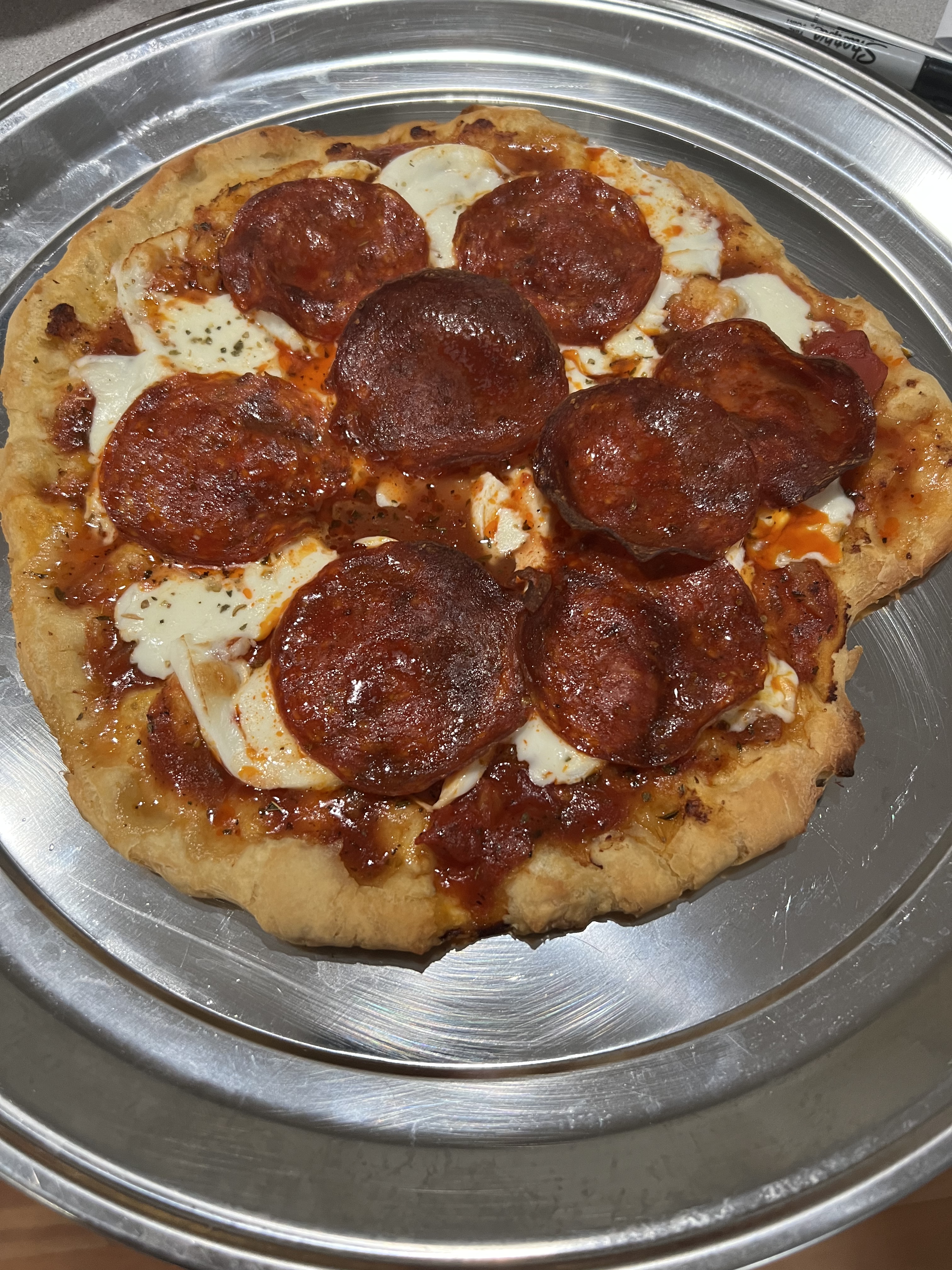
I’ve made Pizza Montanara at home, with limited success. I poured a few inches of olive oil in a large cast iron skillet, stretched my dough into a small pie, and gently floated it into the pan. Using a spatula and tongs, I was able to flip the fried dough over after about 30 seconds, then removed it from the pan after another 30 seconds. It was golden and puffy. I quickly sauced and cheesed it and in the oven it went. But it’s a messy process that doesn’t always come out just right. I need more practice!


Frying the pizza dough. I use olive oil for better flavor, but I have to watch the temperature, because the smoking point is low (about 375 for extra virgin olive oil) and burnt oil is not what anybody wants!


A homemade Pizza Montanara, with buffalo mozzarella and pepperoni.


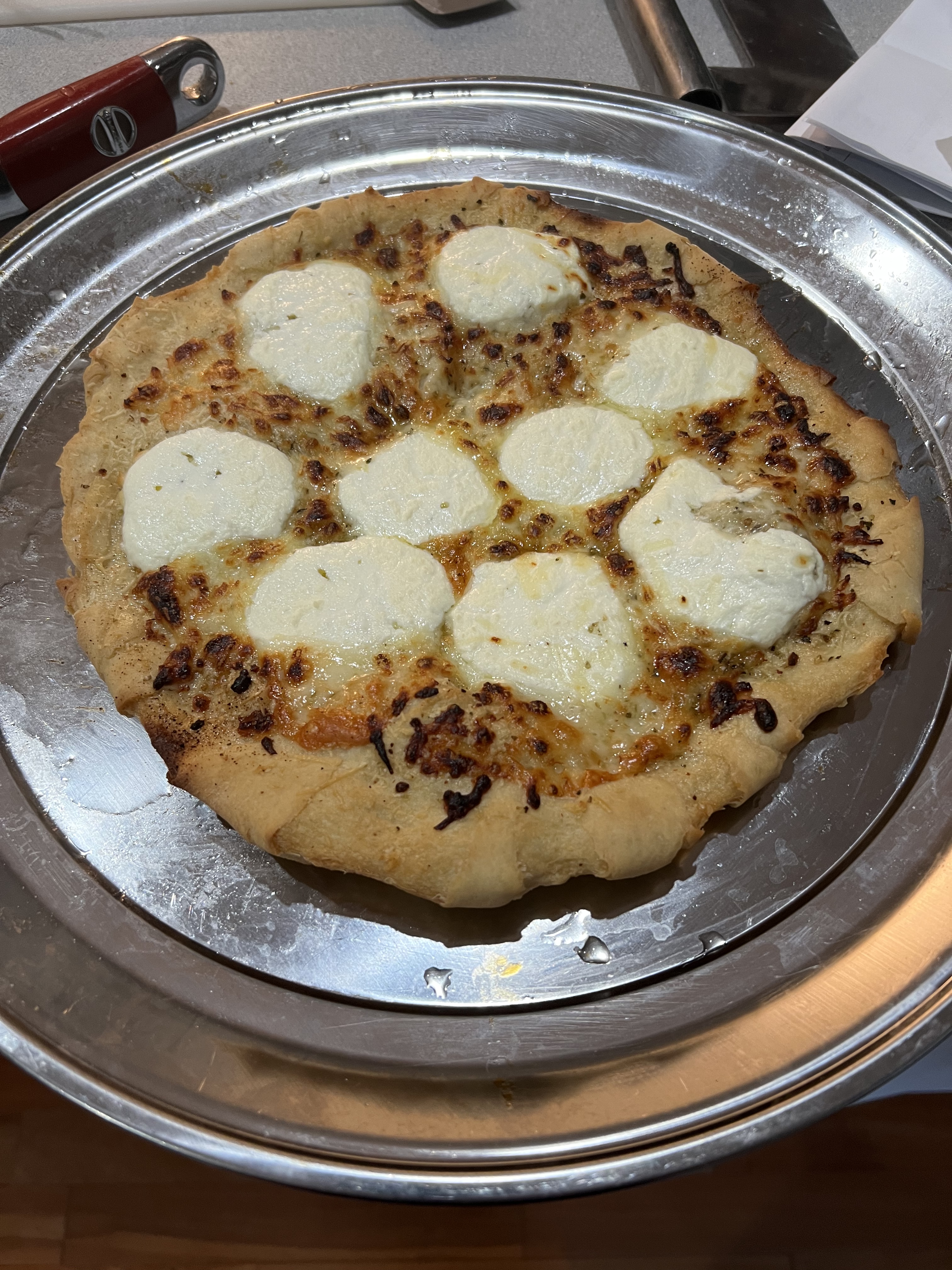
A four-cheese Montanara, with mozzarella, sharp Provolone, Parmiggiano Reggiano, and ricotta…and lots of garlic!


Every time I post a photo of Pizza Montanara on Facebook or Instagram, my friends don’t believe that this could possibly be a life-changing pizza experience. It is. After a trip to Manhattan, we’ll devour 3 pizzas on the ride home. Nothing makes New York traffic easier to bear than a Pizza Montanara in the seat next to you!

Pizza Arte also makes one helluva gluten-free pizza.


GNOCCHI (OR PASTA) ALLA VODKA

Posted: October 18, 2024 in Uncategorized

Not everyone agrees as to the origins of vodka sauce, some claiming it was invented in Italy in the mid-1970s, and others claiming it was created in an Italian restaurant in New York City. But one thing most people can agree on is that it’s absolutely delicious!

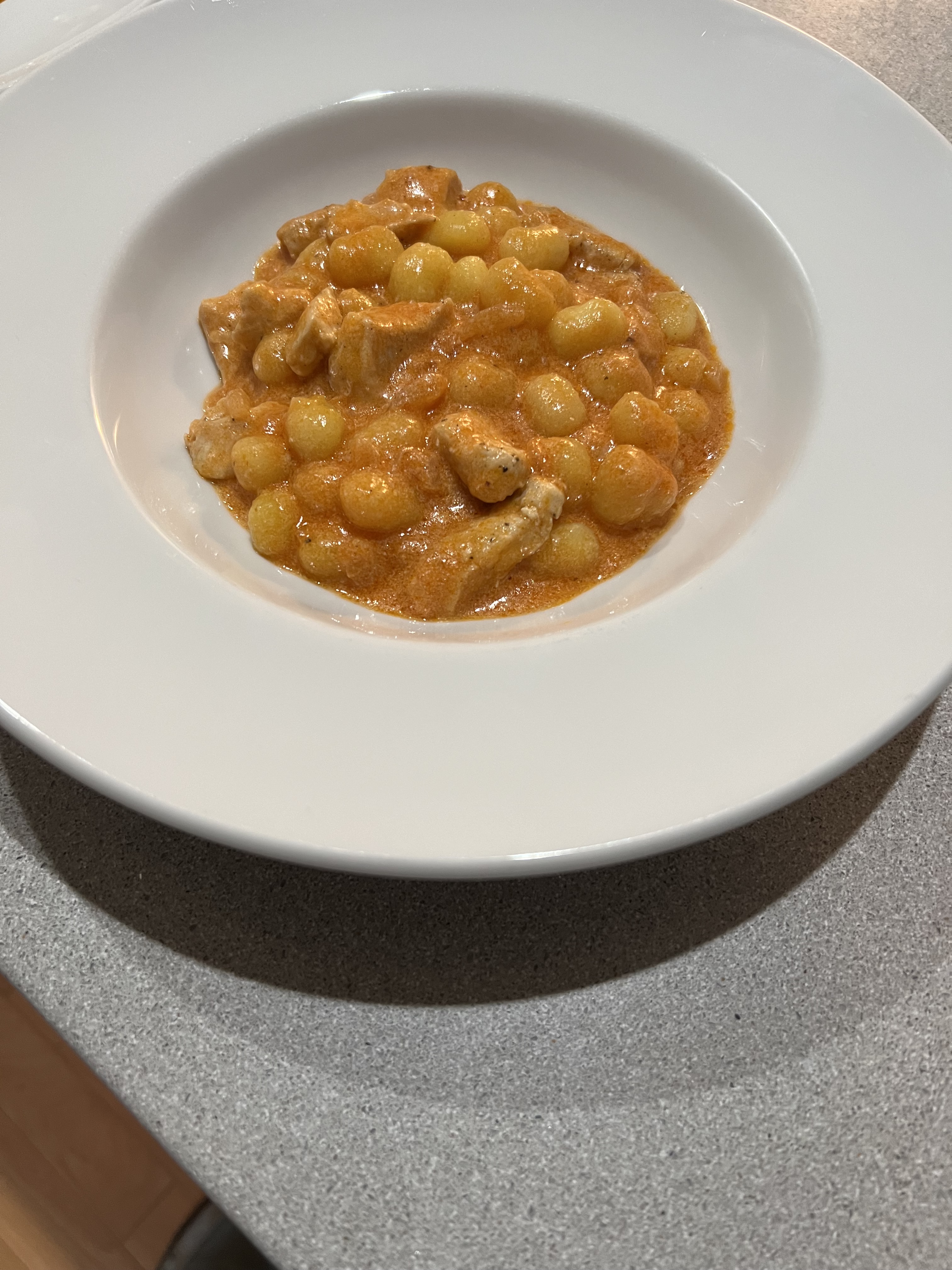
Pasta alla vodka is a favorite of my daughter’s, as are gnocchi (little Italian potato dumplings), so we gave it a shot the other day for dinner, and the results were fantastic.


This is not a low-calorie dish by any stretch of the imagination, but we chose to lower the calories at least a little bit by going with half-and-half instead of heavy cream, which is the standard. We didn’t miss it.

I found it interesting that many of the recipes online don’t warn you about being careful with the vodka. It is, after all, 40% alcohol, so when you add it to the pan later in the recipe, take the pan off the heat, away from any open flame, and then ignite it carefully, letting the alcohol burn off before continuing. Don’t walk away from the stove! Serious fire hazard!

We also added some chicken to this dish. I cut up a couple of chicken breasts into bite-sized pieces, and sautéed them in a bit of olive oil with salt and pepper until they had a nice sear on them. I then removed them from the pan and set them aside. I brought them back to the pan when I heated the gnocchi for a few minutes, then added the sauce. (See below.)

1 lb. pasta (or gnocchi)
2 tablespoons olive oil
2 tablespoons unsalted butter
1 medium onion, finely chopped
2 cloves garlic, minced
3/4 cup vodka (use whatever brand you like)
14 oz. ground tomatoes
1 cup half-and-half
1 pinch red pepper flakes
salt and pepper
1 cup grated Parmigiano Reggiano


In a large skillet over medium heat, I added the olive oil and butter, and then the onion, and sautéed them for a few minutes, until the onions were translucent. Then I added the garlic and cooked a few minutes more.

I removed the pan away from the heat and away from flame, and carefully added the vodka, igniting the alcohol and letting it burn off before returning the pan to the heat. I cooked and stirred for a few minutes.

I added the tomatoes and cooked for a few more minutes. It’s at this point that you can determine just how thick you want your sauce to be. Because we’re using half-and-half later instead of heavy cream, I let the sauce cook down a little bit to thicken it up.


I added the red pepper flakes, and salt and pepper to taste, stirring it in.

I reduced the heat to low and added the half-and-half, stirring and simmering for a few minutes, being careful not to let it overheat or it could curdle.


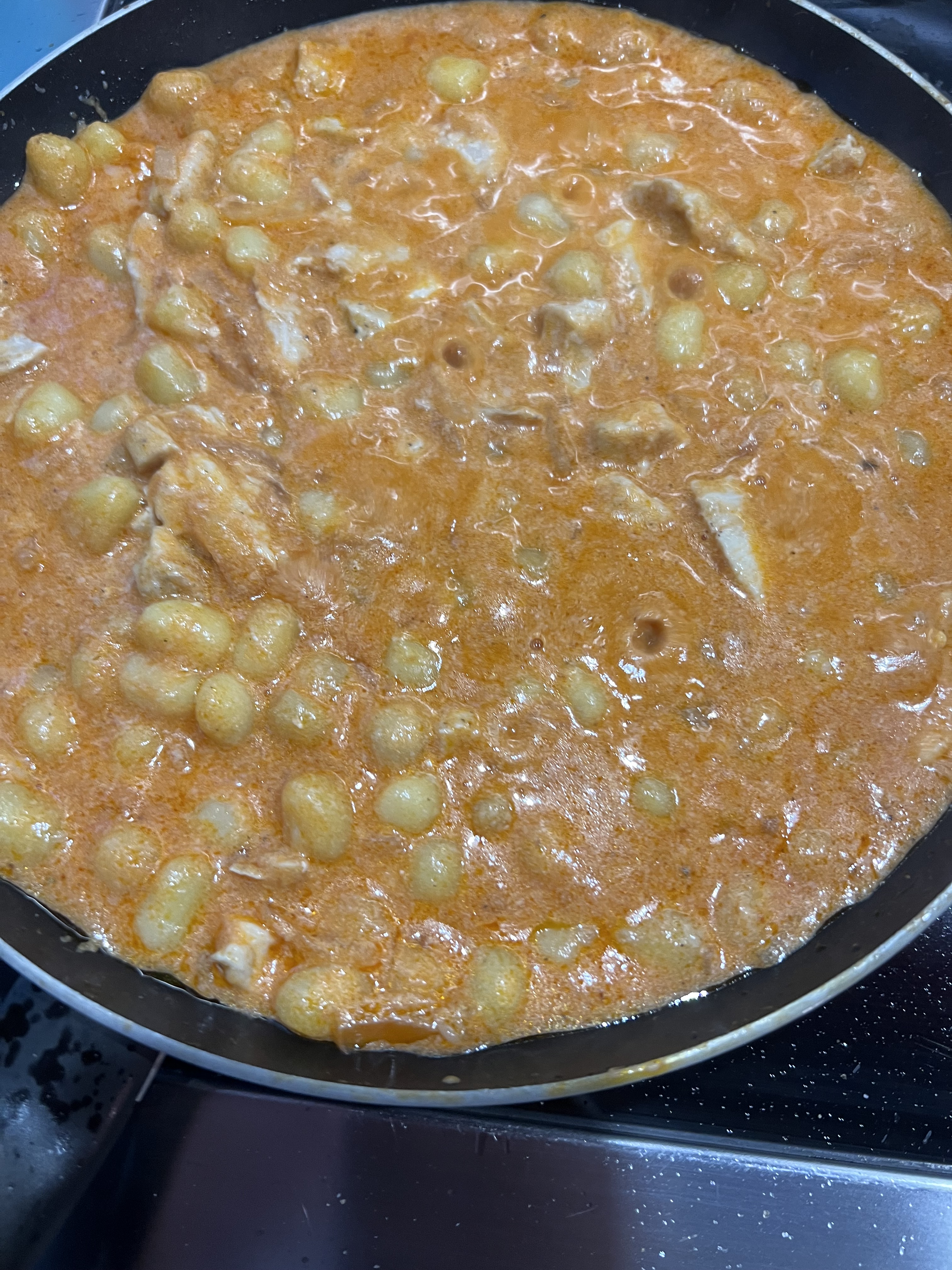
I drained the cooked gnocchi and placed it in the pan I sautéed the chicken pieces in, adding a drop of olive oil. Over medium heat, I just kept tossing the gnocchi in the pan until they got a little bit of color on them. (This is where I added the already seared chicken pieces back to the pan.) Then I added the sauce and Parmigiano Reggiano, mixing well.

If you’re using pasta, place it directly in the pan with the sauce, combining well. If the sauce is a little too thick, add some pasta water. Then add all of the Parmigiano Reggiano, and mix well until the cheese has blended into the sauce. Serve!