The Acropolis Museum in Athens was spectacular! They unearthed ancient ruins while digging the foundation, so they had to completely redesign the museum to stand on poles, so that people could view the ruins underneath. Several areas of the museum floors are glass, so you can see the ruins from above as well. Beautiful, spacious, lots of natural light.
The Daughters of Athens were removed from the original location and replaced with copies. The originals are on display at the Museum of the Acropolis. One daughter is missing, because she is still in England, and the Greeks are fighting to get her back.
I recently saw what I thought was a pretty clever idea of taking a cabbage and slicing it into thick, steak-like pieces, laying them flat in a pan, and then placing marinated chicken on top of them to roast in the oven. The juices from the chicken would flavor the cabbage as it all cooked. I decided I’d try my own version of that recipe.
You can use any part of a chicken you like, even a whole spatchcocked chicken which would lay flat in a larger pan if you’re serving a group of people. But cooking for myself, I choose leg quarters (which are the thigh and drumstick together) or simply chicken thighs. They’re full of flavor, and have the fat content you need to drip down into the veggies below to flavor them as well. Something like chicken breast would simply be too dry.
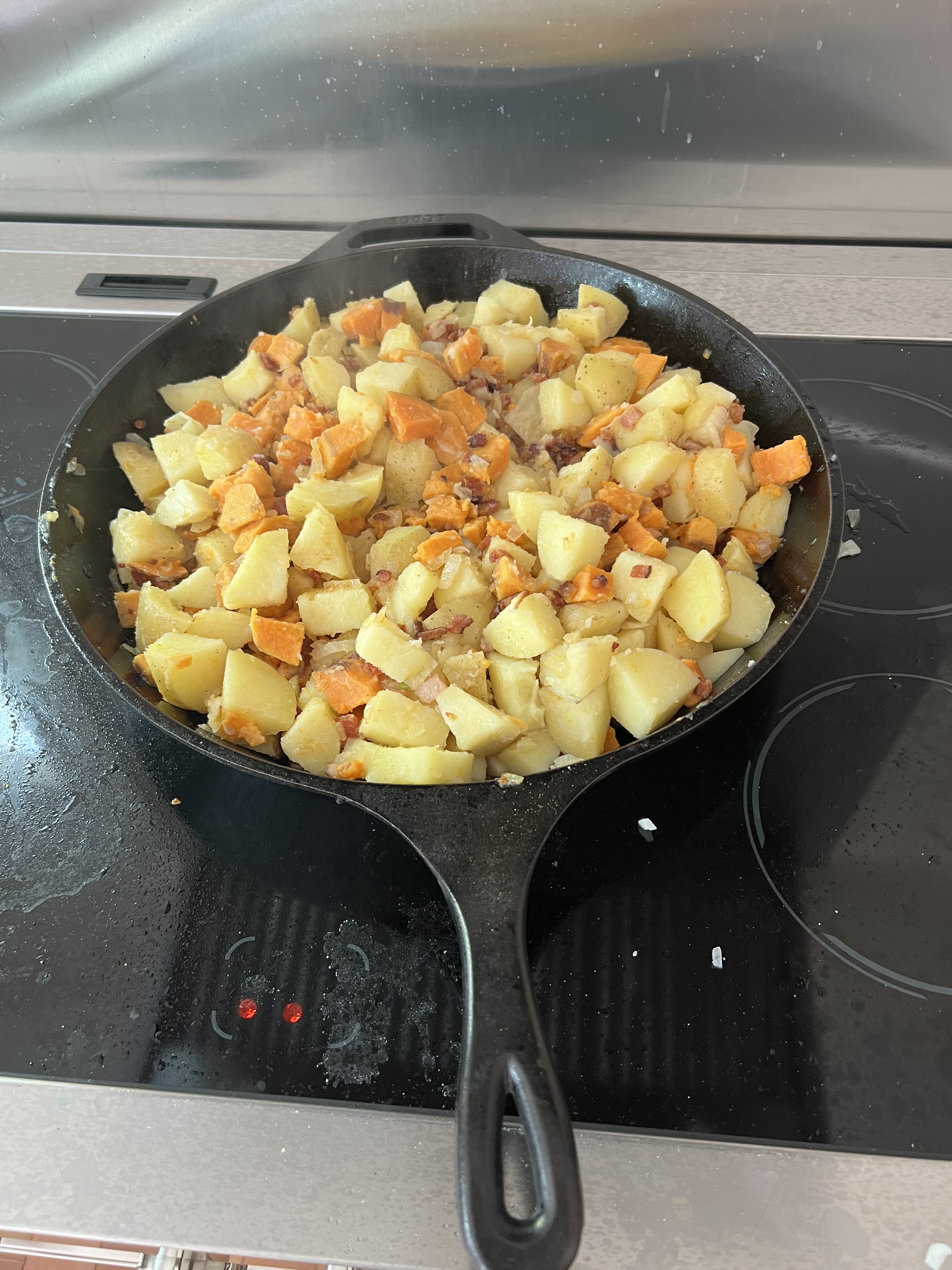
I wanted to use what I had in my fridge, so instead of cabbage, I had Brussels sprouts–baby cabbages, in essence. I cut them in half and layer them flame-side down in a roasting pan covered with non-stick aluminum foil. I wanted more veggies, though, so I sliced up a half-onion I had in the fridge, and I also added a package of frozen organic sweet potatoes I had in my freezer. Now the bottom of my pan was full.
I buy humanely-raised pastured chicken, which means the birds are usually smaller than what you’d find in a supermarket (no steroid monsters here!), so one package contained 5 small chicken thighs. Once thawed, I placed them skin-side down in a glass container. Then it was time to make the marinade.
I chose a marinade that would give a beautiful caramelized color to the dish, using some of my favorite marinade ingredients.
3 oz (6 tablespoons) maple syrup 2 oz (1/4 cup) extra virgin olive oil 2 oz (1/4 cup) balsamic vinegar 1 oz (2 tablespoons) soy sauce 1 oz (2 tablespoons) Worcestershire sauce 1 tablespoon lemon juice 1 tablespoon Dijon mustard 3/4 teaspoon Kosher salt 1 teaspoon powdered rosemary 1 teaspoon granulated garlic 1/2 teaspoon black pepper
I combine all the marinade ingredients in a bowl and whisk well to mix.
I brush the tray of veggies with some of the marinade just to give them a head start on flavor.
I use about a 1/2 cup of the marinade on the chicken thighs, tossing them around in the marinade to make sure they’re well coated. Then I pour the rest of the marinade in a saucepan that I will cook on the stove top.
I like to place the thighs skin-side down and then poke some holes into the meat with a fork to really let the marinade soak in. I let them marinate at room temperature for about an hour. Any longer than that, and they need to go into the fridge.
Once I’m ready to cook, I pre-heat the oven to 325. I place the marinated thighs skin-side up over the veggies in the tray. I discard any leftover marinade in the bowl with the chicken.
While the thighs and veggies are cooking, I take the reserved marinade and heat it over medium heat in a saucepan until it reduces by half to make a nice glaze that I will brush onto the chicken when it’s done cooking.
It’s important to remember that once any of the marinade touches raw chicken, to avoid salmonella, you have to cook it before you can taste it!
Despite the large Italian community we have here in southern New England, there’s no exceptional pizza to speak of. I suppose you could say “them’s fightin’ words!” but if it’s here, I haven’t found it yet. (Fellini Pizza is about the best in Providence.)
So where is the excellent pizza? New York City, of course. OK…maybe I’m prejudiced because I’m a Brooklyn boy, and worked in a variety of pizzerias in my younger days, but there’s no doubt in my mind that if you want the best pizza–or bagel, for that matter–you’ve got to go to the Big Apple. (Even “Frank Pepe’s” in New Haven, CT is a mere stop on the way to the real deal.)
Pizza in the Big Apple can be confusing, as there are many different varieties to choose from. Brick oven pizzas abound, but there are pizza lovers who won’t settle for anything less than an old-fashioned pizza baked in a coal-fired oven. The extremely high heat of a coal-fired oven cooks the pizza in just a minute, and imparts a crusty, charred flavor you can’t get any other way. There are only about a dozen coal-fired pizzerias left in New York City, and many of them have been around for a hundred years or more, so it’s definitely a matter of making a special trip to enjoy this style of pizza. (Providence now has its own coal-fired pizza, but it just can’t compare.)
There’s plenty of good, basic pizza in New York City, too: the traditional thin, round Neopolitan pie, and the thicker, square Sicilian pie, baked in that Blodgett pizza oven we all knew in our early pizza-making days.
Many years ago, when I heard through the pizza lovers’ grapevine that a “new” pizza was out there, one that was gaining a cult following, I needed to know about it. And more importantly, I needed to taste it!
It’s called Pizza Montanara, and there’s still only a few pizzerias in New York City that serve it. The one I go to without fail is PizzArte, on West 55th, and I have to say it’s the ultimate pizza.
Pizza Montanara, sitting next to me in the car, just waiting to be devoured.
What makes Pizza Montanara so spectacular, quite simply, is that the dough is fried in oil for 30 seconds, flipped and fried another 30 seconds, before they put the sauce and cheese on it, and then they cook it in a wood burning oven. It is not greasy. The frying process puffs the dough up and creates a beautiful pillow-like softness that I’ve never experienced in a pizza before. Imagine a pizza cloud and you’ve got Pizza Montanara.
Where to get Pizza Montanara.
I’ve made Pizza Montanara at home, with limited success. I poured a few inches of olive oil in a large cast iron skillet, stretched my dough into a small pie, and gently floated it into the pan. Using a spatula and tongs, I was able to flip the fried dough over after about 30 seconds, then removed it from the pan after another 30 seconds. It was golden and puffy. I quickly sauced and cheesed it and in the oven it went. But it’s a messy process that doesn’t always come out just right. I need more practice!
Frying the pizza dough. I use olive oil for better flavor, but I have to watch the temperature, because the smoking point is low (about 375 for extra virgin olive oil) and burnt oil is not what anybody wants!
A homemade Pizza Montanara, with buffalo mozzarella and pepperoni.
A four-cheese Montanara, with mozzarella, sharp Provolone, Parmiggiano Reggiano, and ricotta…and lots of garlic!
Every time I post a photo of Pizza Montanara on Facebook or Instagram, my friends don’t believe that this could possibly be a life-changing pizza experience. It is. After a trip to Manhattan, we’ll devour 3 pizzas on the ride home. Nothing makes New York traffic easier to bear than a Pizza Montanara in the seat next to you!
Pizza Arte also makes one helluva gluten-free pizza.
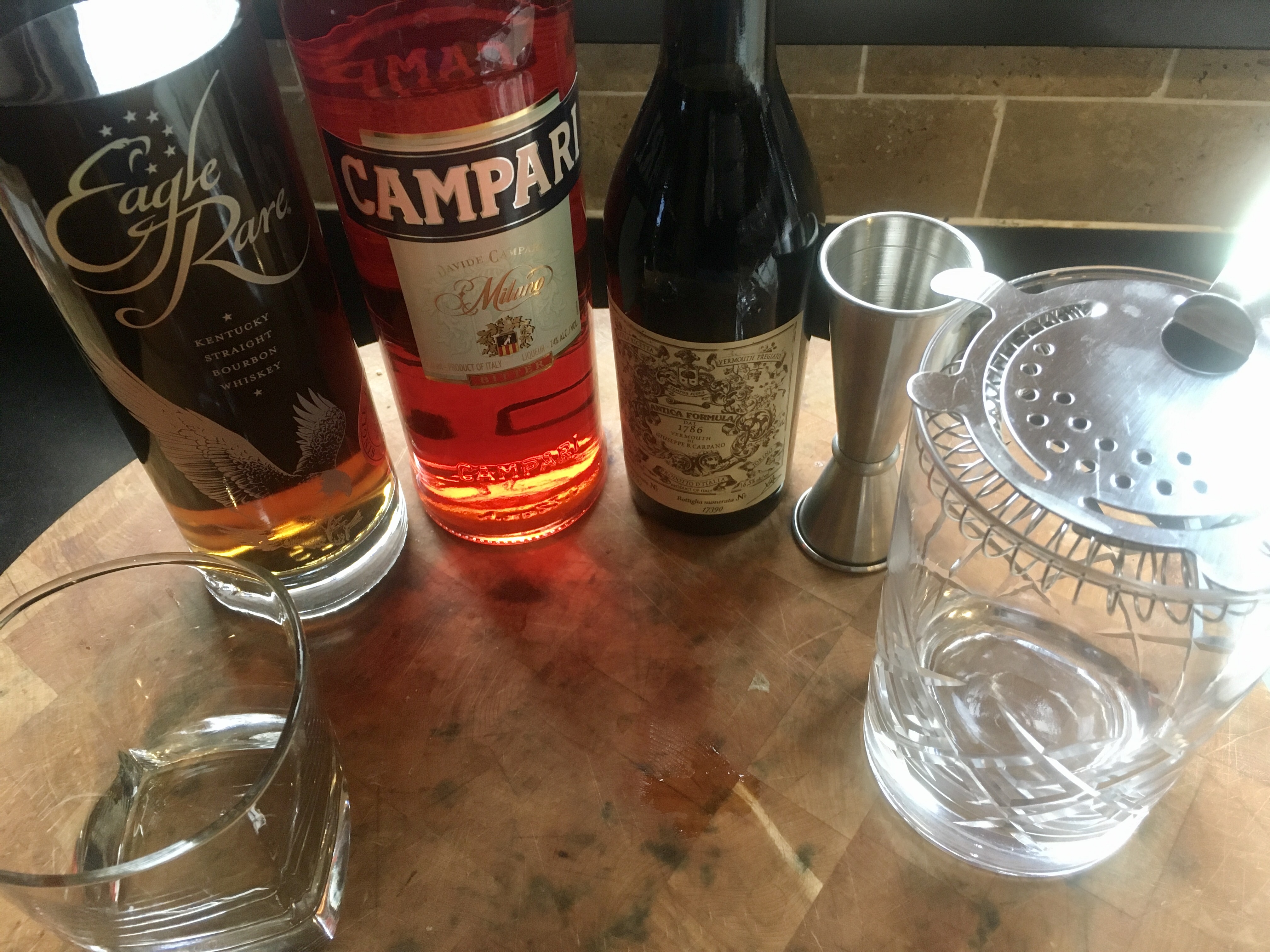
There seems to be no end to the bourbon craze, and until it does end, I’m constantly looking for new bargains. For example, for a long time, my go-to bourbon was Eagle Rare 10 Year Old, which I could get for about $32 a bottle. It’s now up to $70 a bottle in some places. Don’t get me wrong…I’m not complaining. It probably deserves that price, being a 10 year old. But I’m not going to buy it for mixed drinks anymore. A good choice to replace Eagle Rare is Buffalo Trace. Interestingly, both are made by the BuffaloTrace distillery. But I can’t always find Buffalo Trace when I want it, so I needed to find something else. What I found was 1792 Small Batch.
A Manhattan or a Boulevardier, shown here, needs a solid bourbon that doesn’t break the bank. 1792 is a good choice.
1792 Small Batch bourbon is my latest bang-for-the-buck bargain bourbon find. At $28.99 for a 750 ml bottle, you just can’t beat it for mixing or dropping a big cube in it for sipping.
Barton 1792 Distillery makes the 1792 line of bourbons. They were established in 1879, and continue today as the oldest fully operational distillery in Bardstown, Kentucky.
I originally thought the name 1792 came from the year the distillery first created it, but in actuality, 1792 was the year Kentucky, widely recognized as the birthplace of bourbon, became a state.
I wasn’t much of a gin drinker until my recent trip to New Zealand, where I discovered a whole new world of gin.
But before my trip, I was looking for a London dry gin to use in my Vesper martini recipe, and had heard about Ford’s gin. It didn’t take much convincing for me to try it when I saw that the price was $28.99 for a full liter!
Enjoying a Vesper martini at home.
Ford’s London Dry Gin was created by Simon Ford, a man who was looking for one gin that would work in all of the gin cocktails out there, making it the bartenders’ choice for any gin cocktail. With the help of bartenders, distillers, and avid drinkers, he came up with this London dry gin, featuring nine botanicals. It’s delicious, not overpowering like many gins can be, so it really does work well with any recipe you might use gin for.
In addition to taste, he thought about the bartenders themselves. The bottle is tall and ergonomically shaped, making it very easy to handle. Back when I was considering going to market with my homemade honey liqueur, the shape and size of the bottle was an incredibly important decision. Shorter, wider bottles might be put in the front row of a bar, but they’re more difficult to pour, and small hands can’t hold them properly. A taller bottle is easy to spot, and easier to handle. Ask any bartender, and they will tell you that they will go for the bottle that’s easiest to use if they have to make drinks all night long.
The bottle also has measurement markings on the side, which allows you to measure out enough for large batches of martinis, say, if you’re having a party.
But the best part of all is the value. And it’s great in a Vesper or a simple gin and tonic.
Much of my new gin knowledge came from my recent trip to New Zealand. I had some interesting conversations with Nick, the owner of Kismet Cocktail & Whisky Bar in Nelson, NZ, a very well stocked bar with a very enthusiastic and knowledgable staff. Finding a place like that in your own town is not as easy as it sounds, as many bars stock the same booze from the same suppliers and don ‘t really make an effort to stand out in the crowd. If you find a place like that, consider yourself lucky!
Starting in the mid 1700’s, sailors in the British Navy were given a daily ration of rum. They called it a “tot,” and the practice of daily “tot” distribution lasted for almost 200 years, until July 31, 1970. When it ended, not only were there many sad British sailors, but there was also a vast amount of leftover rum. Much of it was sold off at high prices because the taste was excellent and the methods of its distillation were no longer used.
It made sense. In the old days, when liquids were stored in wooden barrels aboard ship, water, beer, and wine would go bad very quickly. Only something with a much higher alcohol content wouldn’t spoil. Rum was the answer. And getting the sailors drunk every day kept them from deserting…it was good for morale!
But while the sailors drank rum, Royal Navy officers drank gin. The use of exotic spices in gin was made possible by imports from Africa and Asia. Gin’s prevalence around the world is largely due to the fact that sailors set foot in many new cities on new continents.
And though the British Navy stopped the practice of issuing alcohol to its sailors in 1970, the Royal New Zealand Navy abolished the practice as late as 1990!
Until my recent trip to New Zealand, I was not a huge fan of gin. I liked it. A gin and tonic was a nice refreshing drink on a hot summer’s day. And my fascination with the Vesper martini, a combination of gin and vodka, made me appreciate gin even more.
But it wasn’t until I went to New Zealand, and tasted their magnificent gins, in combination with delicious tonics only available in that country, did I really start to appreciate the subtle differences between them.
The first thing that caught my eye when I was served a sample of Roots gin, distilled in Marlborough, was the label: “Navy strength dry gin.” I asked what that meant. Well, for one thing, it had more alcohol. And the reason for that was surprising. Since gin, like rum, was stored in wooden barrels on ships, very often next to barrels of gunpowder, the gin had to contain enough alcohol so that if it spilled onto the gunpowder, the gunpowder would still ignite! Not enough alcohol in the gin would waterlog the gunpowder and make it useless. So tests were actually done by pouring gin on gunpowder to see what the minimum percentage of alcohol was required to keep the gunpowder burning. The answer was about 57%. Anything below that and the gunpowder would not burn. They coined the term “Navy strength.”
(Although the bottle of Roots gin above weighs in at 54.5%, it’s properly called “Navy strength.” In 1866, to keep sailors from getting completely hammered, the British Royal Navy reduced the alcohol content of the rum they were distributing to 54.5%. Hence, a new “Navy strength.”)
I was allowed to take only 1 bottle home from New Zealand, but, as you can see, it was not Navy strength. Still delicious!
The other advantage to a Navy strength gin is taste. If you’re not diluting it with water, not only are you getting more alcohol, but you’re also getting more of the herbaceous flavor you want in a gin.
Up until my trip to New Zealand, my experience with gin was limited to the usual list of suspects: Tanqueray,Bombay Sapphire, and Hendrick’s. I also more recently discovered Ford’s, a very nice London dry gin I use in my Vesper martinis.
But in New Zealand, many of the gins were floral and herb-forward, and I found that I like that. I like that a lot. For example, Victor, another Marlborough gin, was like “Hendrick’s on steroids.” I said that to my bartender at the Urban Eatery and Oyster Bar in Nelson, NZ, and she agreed. Delicious.
Although gins may vary in alcohol content, rules about serving liquor in New Zealand are very strict, certainly by US standards. For example, a “double” in New Zealand is 30ml. That’s 1 ounce! And that’s a standard pour for a cocktail. You can, I found out, ask for a “double-double.” And in that case, they would serve you a 1-ounce shot on the side with your drink, and you would have to pour it in yourself.
When I told the bartenders in New Zealand that we have 4-ounce martinis at any decent steakhouse in the US, and they realized that was 120 mls, their jaws pretty much dropped and hit the bar. One bartender gasped: “That’s irresponsible!” I told her that two of those drinks is widely considered the “businessman’s lunch” here in the states. She just shook her head.
Much to choose from at Kismet, my favorite bar in Nelson, NZ.
The phrase “proof” also has a very different meaning.
In the states, it’s pretty simple: it’s double the percentage of alcohol. So a bottle that’s 40% alcohol is 80 proof.
But the phrase “proof” comes from there British Royal Navy’s “proof” test. They would take the gin, pour it onto gunpowder, and if it ignited, that would prove there is sufficient alcohol in the gin. They would say that the gin was “gunpowder proof,” and it would be allowed onboard the ship.
So in the UK, a spirit with 57.15% is 100 degrees proof. A spirit with 40% alcohol is 70 degrees proof.
For me, it’s easier to simply remember to check the percentage of alcohol, and go from there.
One of the reasons I fell in love with New Zealand gin was because it was often served with East Imperial tonic, a New Zealand product not available in the United States. When the amount of alcohol you’re allowed in your glass is limited (by our standards, anyway), what fills the rest of it up becomes incredibly important. East Imperial is the best line of tonics I’ve ever tried.
Made in small batches like craft beers, East Imperial tonics make all the difference. The closest thing we have here in the states is the line of Fever Tree products. Before they came along, tonic was tonic, and we were perfectly happy with whatever we found in the supermarket or what came out of a squirt gun at our local bar.
It stands to reason that a great cocktail is the total sum of its parts: great gin, great tonic, great ice.
I was enjoying a few Roots and tonics at the Bamboo Tiger, a bar inside the D’Urville Hotel in Blenheim, NZ, when we felt earthquake tremors. (My first!) It only lasted a few seconds, and when the chandeliers stopped moving, everyone pretty much went right back to business!
I was in the supermarket the other day, and a pack of pork chops called to me as I walked by the meat department. I hadn’t had pork chops in ages, and it was time to try something new with them.
The balsamic vinegar used in this recipe is not the crazy expensive stuff. It’s the bottle you probably already have in your kitchen cabinet that costs about nine bucks.
The cool thing about this recipe is that you make it all in one pan, and on the stovetop.
4 or 5 bone-in pork chops olive oil Kosher salt and freshly cracked black pepper 2 teaspoons dried thyme 1 large Spanish onion, diced 2 large cloves of garlic, minced 2 cups chicken broth (homemade is always best) 3 tablespoons Dijon mustard 5 tablespoons balsamic vinegar 6 tablespoons brown sugar 2 tablespoons Worcestershire sauce
Season the pork chops with the salt, pepper and thyme.
Add some olive oil to a large pan, and when it’s hot, sear the pork chops on both sides until they’re nice and brown.
Remove the pork chops from the pan and set them aside. Pour out the fat in the pan, add a touch of olive oil, and put it back on the heat. Add the onions, sautéing them for about 10 minutes until they’ve softened, and then add the garlic. Sauté a minute more.
Add the chicken broth, Dijon, balsamic vinegar, brown sugar and Worcestershire sauce. Stir to combine.
Return the pork chops back to the pan, nestling them down into the sauce. Add any of the juices that may have collected when you set the chops aside.
Bring the pan to a boil, then reduce to a simmer and cover the pan. Let it cook for 45 to 60 minutes. I like to flip the chops about halfway through the cooking process.
To serve, remove the chops from the pan, and smother them with the sauce! You may want to reduce or thicken the sauce a bit, but I like it just the way it is!
My daughter wanted something special for breakfast a few Saturdays ago, and she brought a ready-to-mix box of Belgian waffle mix out of the cupboard. I read the instructions, and it required using the entire box, which made 10 gigantic waffles…way too much for us to eat in one sitting!
I figured there had to be a homemade Belgian waffle recipe somewhere online, and using ingredients I already had at home. The Food Network’s Alton Brown is usually my go-to source for recipes like this, and sure enough, he had a waffle recipe. But it used buttermilk and whole wheat pastry flour, neither of which I had in my pantry or fridge. Alton’s recipe would have to wait for another day.
I finally found one that used regular milk instead of buttermilk. I combined organic all-purpose flour with organic whole wheat flour; I like the richness in flavor whole wheat flour brings.
I try to always use organic unbleached flours, because wheat is another one of those crops that gets blasted with pesticides and chemicals in both growing and processing.
The Kitchen Aid might be overkill, but I don’t have a hand mixer!
*Separating eggs* I like to take 2 small bowls and place them on the counter. I take an egg and crack it on a flat surface, which reduces the chance of a shell fragment getting into the egg. Going back and forth between eggshell halves, the yolk stays in the shell while the whites drip down into one of the bowls. The clean yolk goes in the other bowl. Repeat with the other egg.
It’s important to remember that you CAN have a little egg white with your yolk. It won’t hurt anything. BUT…you can NOT have any yolk with your egg whites! The whites will not whip up if there’s even the tiniest bit of yolk in them!
Chicken parmigiana, much like pizza, is a bit more difficult to make than you might think. Sure, there’s plenty of crappy chicken parm out there, made with processed frozen chicken cutlets, bad sauce and cheap cheese. But to make a really fantastic, mind-blowing chicken parm, that takes some practice!
The key to this recipe is simple: don’t skimp on the quality ingredients. And my recipe makes a lot. Trust me: you will want leftovers.
The recipes for my Italian bread crumbs and my “Don’t Call It Gravy” tomato sauce are at the bottom.
Gooey, cheesy, orgasmic.
6 Chicken breasts, the best quality you can get your hands on
Italian bread crumb seasoning (see recipe below)
3 eggs
olive oil for frying
“Don’t Call It Gravy” tomato sauce (see recipe below)
Fresh mozzarella cheese
oregano
Thaw the chicken breasts. Lay them flat on a cutting board, and you’ll see where the chicken tender is on the side of the breast. Cut the tender off and set aside, leaving the breast which is thinner at one end and thicker at the other. Slice the breast in half lengthwise at the thicker end, keeping the knife level, so that you wind up with 2 pieces of breast meat that are the same thickness, but one will be a longer piece (the bottom) and one about half its size (the top part you sliced off.) Do this with all the breasts.
By slicing the breasts lengthwise into evenly thick pieces, it will take the same amount of time for them to cook. (I prefer not to pound the hell out of the chicken breasts until they’re flat as a pancake.)
Pour the olive oil into a large frying pan. Next to the pan, set up two bowls: one with my Italian bread crumb seasoning and in the other: crack the eggs and whisk them.
Now it’s your standard breading procedure: chicken meat in the egg, then in the breadcrumbs, coating well. Shake off the excess and place carefully in the pan of olive oil when the oil comes to temperature for frying.
Fry the chicken in the oil until it’s golden brown. You want it cooked all the way through, but not overcooked. Place the fried chicken pieces on paper towels to absorb the excess oil. Do this with all the chicken. The fried chicken at this point is delicious all by itself: chop it and use it in a salad, or make a chicken sandwich. (By the way, if there’s breading left over, use it on the chicken tenders you cut off. My daughter gets these instead of store-bought chicken tenders, and she loves them.)
Cover a baking sheet with aluminum foil. Ladle out enough sauce to create a thin layer of sauce on the bottom of the sheet. Place the fried chicken breasts on top of the sauce. Cover the breasts with more sauce, then place pieces of sliced fresh mozzarella on top. Sprinkle the top with a little oregano.
Place the baking sheet in a pre-heated 350 degree oven and bake until the cheese has melted and just starts to brown. Serve it with pasta.
MY “DON’T CALL IT GRAVY” TOMATO SAUCE
It’s not hard to make a good tomato sauce. But it takes a little work to make an amazing tomato sauce. Honed from a recipe handed down by a friend-of-a-friend’s Italian grandma, it is one very important part in two of my favorite Italian comfort food recipes: my meatballs…and my chicken parmigiana recipe.
1 medium onion, finely chopped
2 cloves garlic, finely chopped
1/2 cup extra virgin olive oil
10 cups ground and peeled tomatoes…or 3 cans (28 oz) tomatoes (real San Marzanos preferred)
2 teaspoons each: dried oregano, basil and parsley
3/4 teaspoon each anise seed and fennel seed
1 1/2 teaspoons salt
1/2 teaspoon black pepper
2 bay leaves
1 small can (6 oz) tomato paste
1 teaspoon sugar, optional
Heat the olive oil in a large pot and add the onions. Cook until onions are translucent, then add the garlic. Stir for about 10 seconds.
Add the tomatoes and cook until the orange foam disappears, stirring frequently.
Add the oregano, basil, parsley, anise seed, fennel seed, salt, pepper, and bay leaves. Stir to combine. Add the tomato paste, stirring well. Let the sauce just come to a boil (which helps the paste thicken the sauce), then reduce it to a simmer, and cook uncovered for at least an hour, stirring constantly, until the sauce reaches the consistency you like.
MY ITALIAN BREAD CRUMB SEASONING
This is the one part of the recipe (other than the optional pasta) that keeps this dish from being gluten-free. So I use gluten-free breadcrumbs, even if I don’t need to. I buy a loaf of Udi’s frozen gluten-free bread, toast the slices, and them put them in a food processor. I dare you to tell the difference between these and breadcrumbs with gluten!
1 Udi’s loaf, toasted and ground into breadcrumbs
2 teaspoons dried parsley
1 teaspoon dried oregano
1 teaspoon dried basil
1 teaspoon salt
1/2 teaspoon granulated garlic
1/2 teaspoon granulated onion
1/4 teaspoon black pepper