Posts Tagged ‘ITALIAN’

MANLY MEAT SAUCE

Posted: December 16, 2014 in bacon, beef, Food, Italian, pasta, Recipes
Tags: , , , , ,

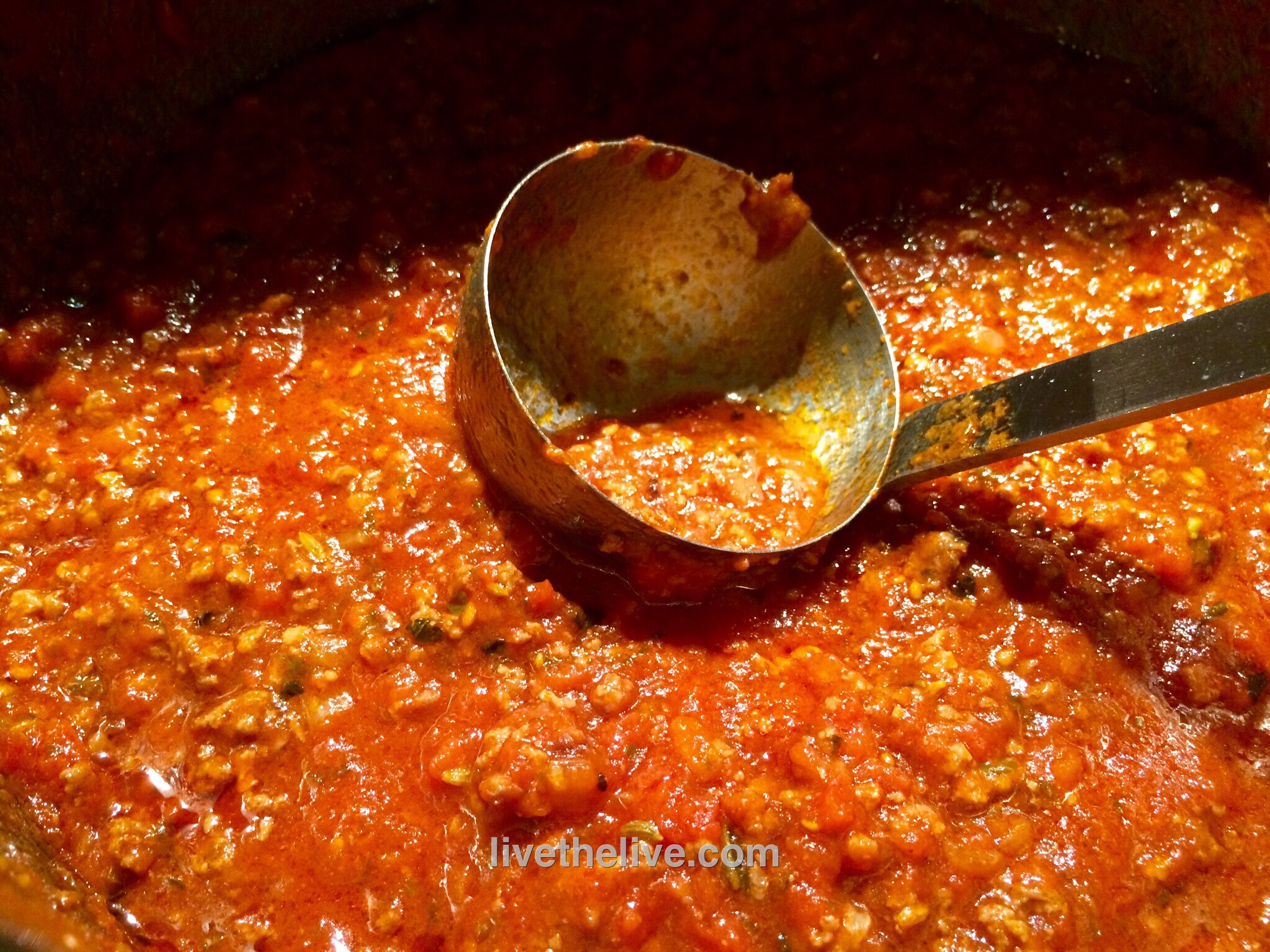
Pasta with meat sauce is one of the easiest things to make, yet few people do it. This sauce is really rich with flavor, and once you put all the ingredients together, it requires nothing more from you than an occasional stir every now and then.

image


Ingredients:


1/4 cup olive oil

3 strips bacon, finely chopped, raw or pre-cooked

1 onion, finely chopped

1 teaspoon garlic salt

2 lbs ground beef (I use grass-fed beef)

2 cans (28 oz each) whole tomatoes

1 tablespoon dried oregano

1 tablespoon dried basil

2 tablespoons dried parsley

2 teaspoon salt

1/2 teaspoon black pepper

1 teaspoon anise seed

1 teaspoon fennel seed

2 bay leaves

1 small can (6 oz)  tomato paste

image


In a large pot, heat the olive oil and add the bacon. Once the bacon is sizzling, add the onions and cook until the onions are translucent. Add the garlic salt and mix. Add the ground beef and cook until it has browned.

Pour the 2 cans of whole tomatoes into a food processor and blend until chunky…or go the old-fashioned route and simply squeeze the tomatoes with your hands, breaking them up. Pour the contents of both cans into the pot and stir well. Cook over medium heat, stirring, until the orange tomato foam disappears.

Add the oregano, basil and parsley and stir. Add the salt and pepper and stir. Add the anise seed and fennel seed and stir. Throw in the 2 bay leaves and stir. (I think you get the idea, there’s a lot of stirring going on!)

When the sauce starts to boil, add the tomato paste and stir well. Let it come up to a boil again–the paste thickens best at high heat–then turn the heat down to a simmer and cover the pot.

Let the sauce simmer for several hours. Whenever you walk by, give the sauce a good stir.

Serve over pasta, with some grated Parmiggiano Reggiano.

image


There’s something magical about a simple plate of spaghetti and meatballs. When my parents took me to an Italian restaurant as a child, a plate of spaghetti and meatballs made me feel like the luckiest kid on the planet. And even now, when I prepare a plate of spaghetti and meatballs for my 7-year-old daughter, she can’t wait to sit down at the dinner table. She’s so busy shoveling the food into her mouth, she can’t even speak. I just get a quick thumbs-up between bites! meatballs


Great meatballs start with great meat. I always use 80/20 grass-fed beef. I don’t use a ton of breadcrumbs as filler. And the tomato sauce is homemade as well, from canned tomatoes. I start with the sauce…


B.F.I.M. SAUCE

Inspired by a lovely but large Italian lady I once knew, my Big Fat Italian Mama sauce is the best tasting sauce I’ve had anywhere.


Ingredients:

1 medium onion, finely chopped

2 cloves garlic, through a press

1/2 cup extra virgin olive oil

10 cups ground and peeled tomatoes…or 3 cans (28 oz.) tomatoes pureed in food processor

2 teaspoons each: dried oregano, basil and parsley

3/4 teaspoon each anise seed and fennel seed

1 1/2 teaspoons salt

1/2 teaspoon black pepper

2 bay leaves

1 small can (6 oz.) tomato paste

1 teaspoon sugar (optional)


Heat olive oil in a large pot and add the onions. Cook until onions are translucent, then add the garlic. Stir for 10 seconds.

Add tomatoes and cook on high until orange foam disappears, stirring frequently. Don’t let it burn.

Add oregano, basil, parsley, anise seed, fennel seed, salt and pepper, bay leaves and tomato paste. Allow sauce to just come to a boil so that the tomato paste reaches optimum thickening power.

Reduce heat to a simmer and cook for at least an hour, until sauce reaches desired thickness. Stir often.


While the sauce is cooking, I start the meatballs…


THE BALLS


Ingredients:

2 lbs grass-fed ground beef

1 cup plain breadcrumbs (homemade are best)

2 tablespoons dried parsley

2 tablespoons dried oregano

1 tablespoon dried basil

1 tablespoon granulated garlic

1 tablespoon onion powder

1 teaspoon black pepper

2 teaspoons salt

2 eggs, cracked and scrambled

1/2 cup extra virgin olive oil


Mix all the ingredients, except the olive oil, thoroughly but gently in a large bowl. Don’t overwork it.

Pour olive oil a medium-hot pan (don’t let it burn), make the meatballs, and sear them on all sides until brown.

When the meatballs are nice and brown, place them into the pot of sauce, making sure they are covered. Pour all the little bits and the olive oil from the pan into the sauce as well! Great flavor there.

Cover the pot and cook the meatballs in the sauce on low for a few hours. Pour over pasta, and sprinkle with freshly grated Parmigiano Reggiano.


My first foray into serious cooking started when I bought “The Classic Italian Cookbook,” written by the legendary Marcella Hazan.

Like many great recipes, Fettuccine Alfredo is not complicated…but few restaurants that offer it get it right. Most of the Alfredo sauces I’ve had were watery, floury, and salty and had nothing in common with the real deal.
To this day, if I want a great Alfredo, I make it like Marcella.

alfredo2

Ingredients:

1 cup heavy cream
3 tablespoons butter
Fleur de Sel or sea salt
1 lb. Fettuccine, fresh or dried
2/3 cup freshly grated Parmesan cheese
Freshly ground pepper
A very tiny grating of nutmeg

Put 2/3 cup of the cream and all the butter in a large saucepan that will later accommodate all the pasta. Simmer over medium heat for less than a minute, until the butter and cream have thickened. Turn off the heat.

Drop the fettuccine in a big pot of boiling salted water. If the pasta is fresh, it will take just seconds. If it’s dry, it will take a few minutes. Cook the fettuccine firmer than usual, because it will finish cooking in the pan with the butter and cream. Drain the pasta immediately and thoroughly when it’s done and transfer to the pan containing the butter and cream.

Turn the heat under the pan on low, and toss the fettuccine, coating them with the sauce. Add the rest of the cream, all the grated cheese, 1/2 teaspoon salt, the pepper and the nutmeg. Toss briefly until the sauce has thickened and the fettuccine are well coated. Taste and correct for salt.

Serve immediately!

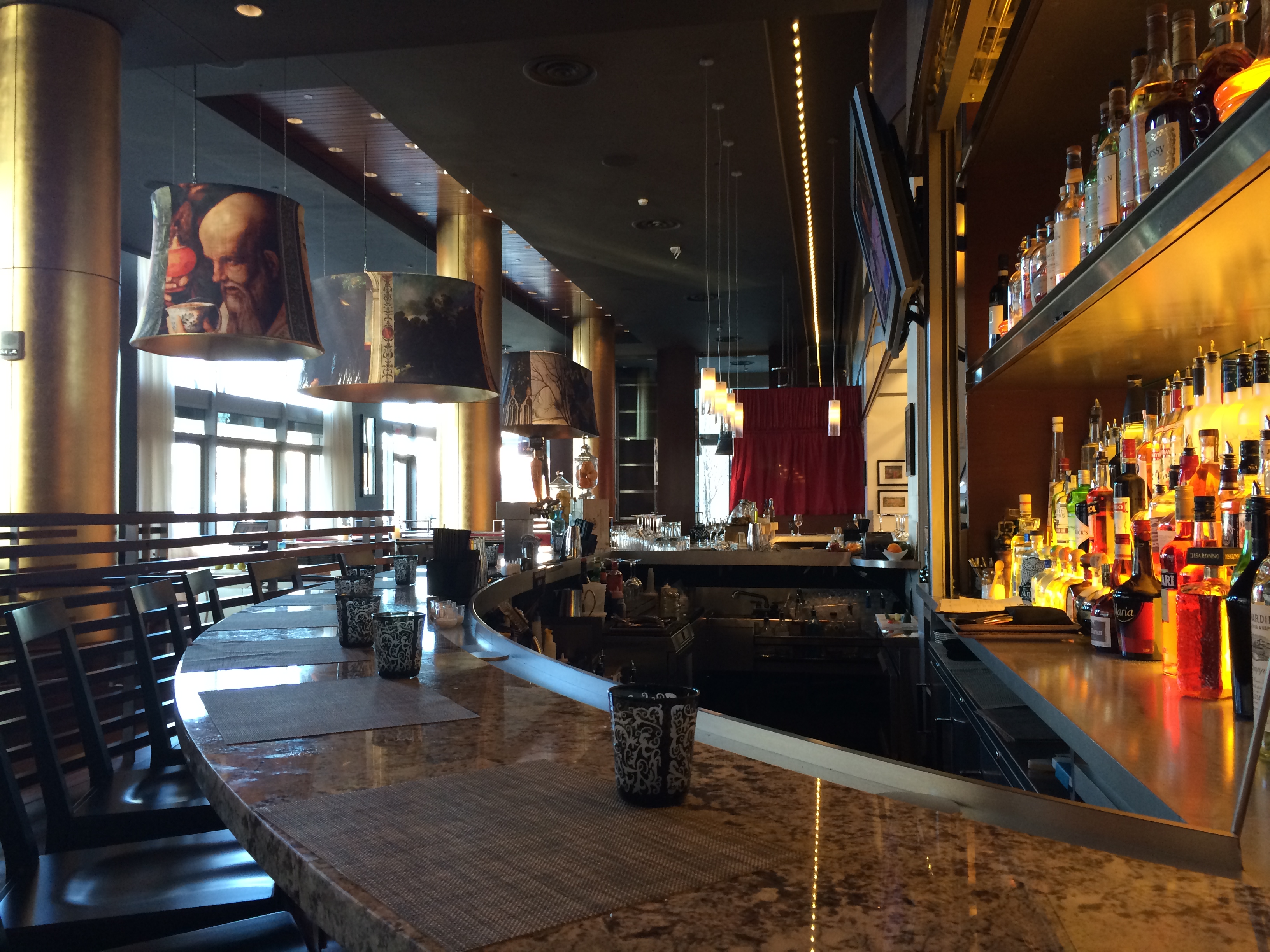
M.C.Spiedo is a new Italian restaurant in the Renaissance Hotel by the Boston waterfront. It’s a massive, over-the-top (as in a bit gaudy) establishment that features rustic food from Italy’s historic past, dating back to the Renaissance period of the 1400’s. You’ll find no tomato dishes here: tomatoes were introduced into Italy in the 1500’s. What you will find are rustic, flavorful spit-roasted meats, pastas with rich sauces, and robust flavors.

MCSpiedo

This is a huge departure for chefs Mark Gaier and Clark Frasier, who come from acclaimed Maine restaurants Arrows (which just celebrated its 25th anniversary)and MC Perkins Cove in Ogunquit. (They just announced that they are selling Arrows for $1.2 million.)

What’s in the name? The M.C. is from Marc and Clark, and Spiedo means a spit or skewer in Italian. Considering this is still a new restaurant, I was surprised that the two chefs were nowhere to be found on a recent Saturday night. Nonetheless, the staff seems to be knowledgeable, and our server, Daniel ,was eager to guide us through the many menu choices.

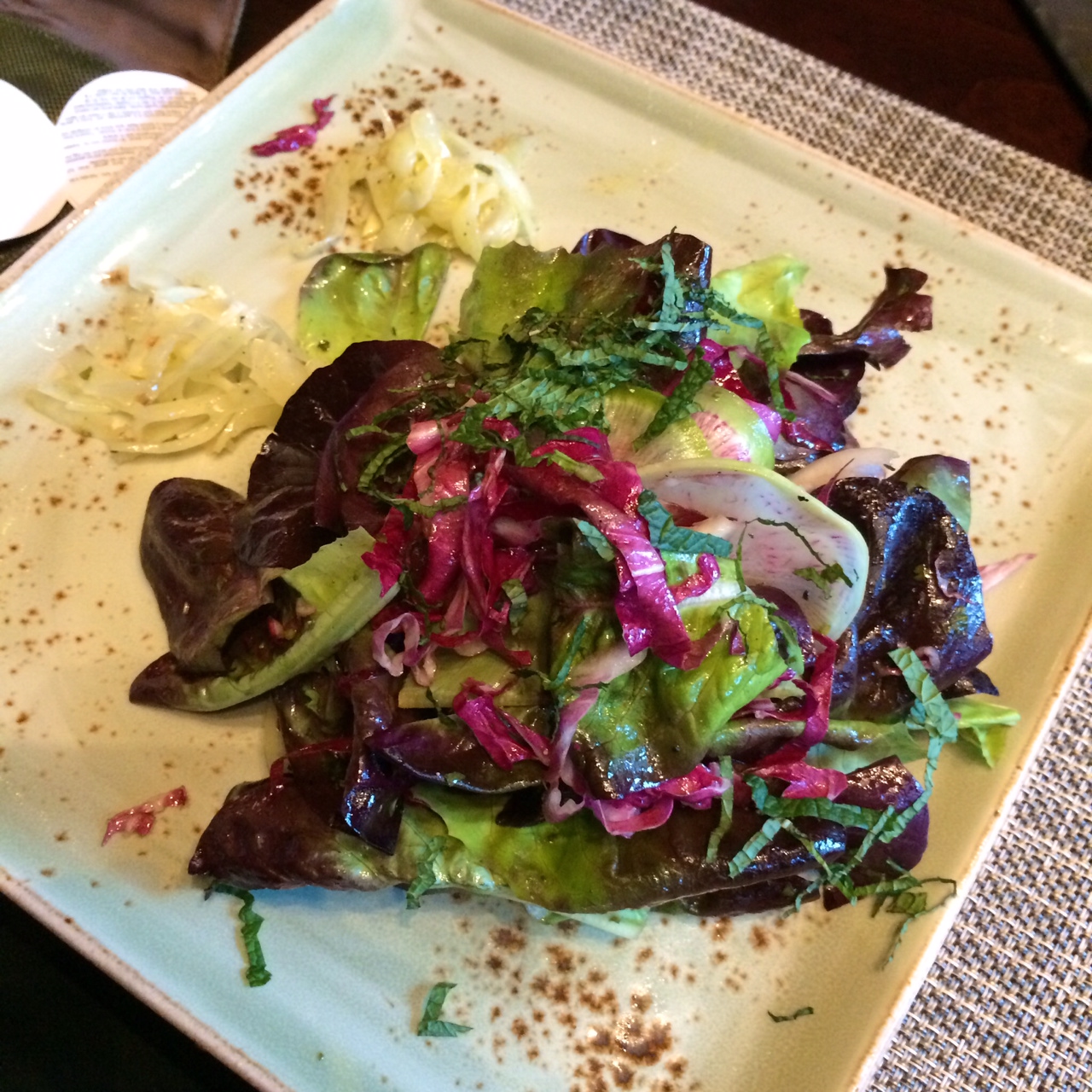
The Leonardo's Notebook Salad

The Leonardo’s Notebook Salad

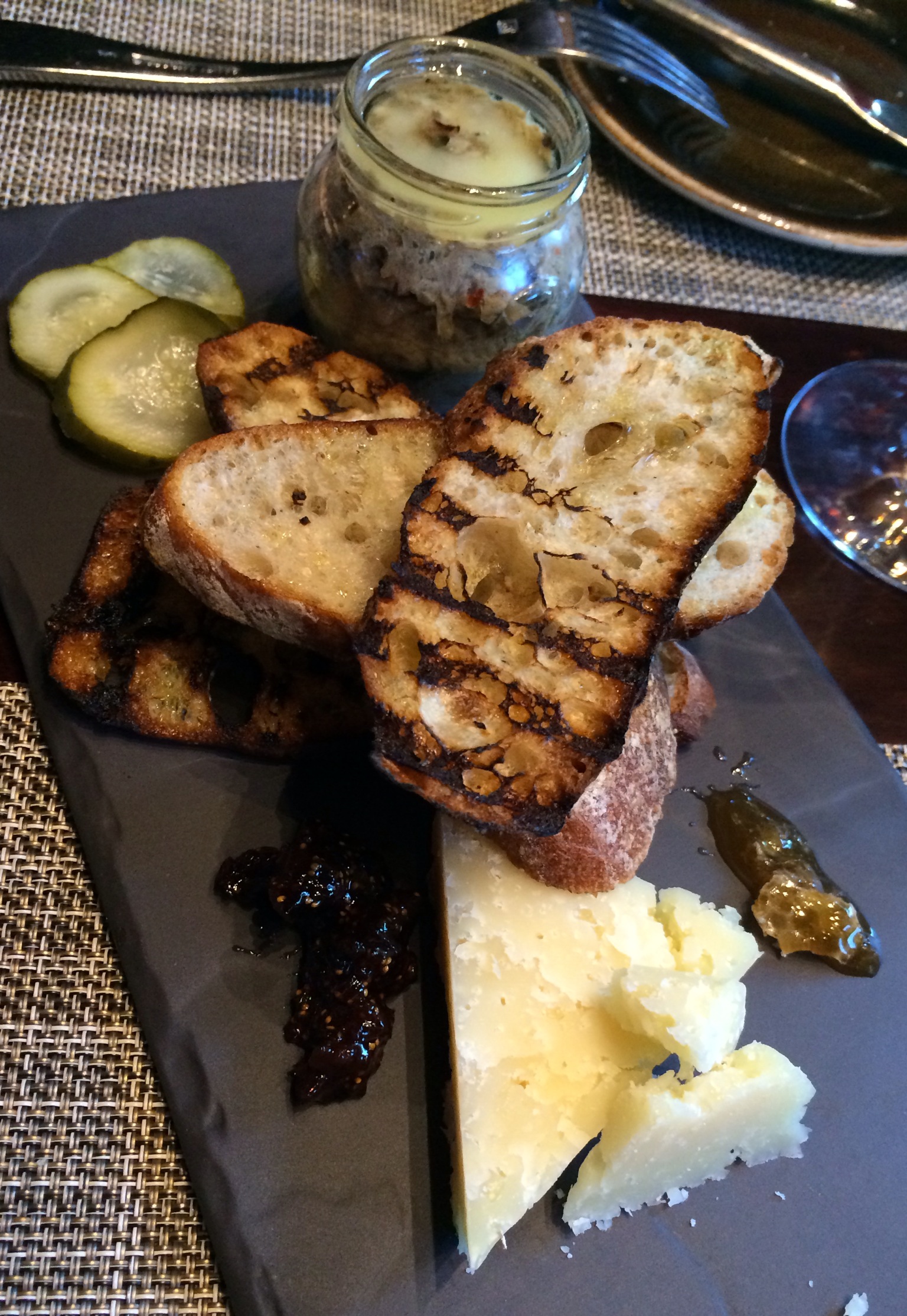
Leonardo’s Notebook Salad, with garlic, fennel, lettuces and herbs was delightfully fresh and thoroughly enjoyable. The house made burrata: fantastic…just not enough of it. The duck rillette was good, but unseasoned. However, the accompanying house made mustard and pickles remedied that. The Grand Tortellini and Meat Torta, a mile-high meat pie featuring more meat than you can imagine, is a must. It sells out every night. The spit-roasted pig with sausage and shelling bean macaroni would have been delicious had it not been for a VERY heavy amount of salt…so much that I had to mention it to our server, who promptly whisked it away, tasted it, agreed with us, consulted management, and returned with an apology and did not charge us for the dish.

Grand Tortellini and Meat Torta

Grand Tortellini and Meat Torta

Thankfully, there are 2 parts of M.C.Spiedo that don’t stick to the rules of only serving ingredients from Italy’s Renaissance period: the bar, where you can find many wonderful house specialty cocktails as well as a wine list with only Italian wines…and the kids menu, which is a welcome surprise to find in this kind of restaurant. My daughter loved the meatballs and the grilled cheese.

Duck rillette with house made pickles, mustard, and Fiore Sardo cheese

Duck rillette with house made pickles, mustard, and Fiore Sardo cheese

There are a few kinks to work out, but that’s to be expected from a new restaurant. And they’ve got to lighten up on the SALT. But I can see myself coming back to M.C. Spiedo for another enjoyable dining experience.

MC4

Chicken parmigiana, much like pizza, is a bit more difficult to make than you might think. Sure, there’s plenty of crappy chicken parm out there, made with processed frozen chicken cutlets, bad sauce and cheap cheese. But to make a really fantastic, mind-blowing chicken parm, that’s a real skill…one that I’ve honed over my many bachelor years. So when it was time to cook something that would impress the hell out of the woman who is now my wife, I have no doubt that is was my chicken parm that won her over.

The key to this recipe is simple: don’t skimp on the quality ingredients. And my recipe makes a lot. Trust me: you will want leftovers.

Gooey, cheesy, orgasmic.

Gooey, cheesy, orgasmic.

Ingredients:

6 Chicken breasts, the best quality you can get your hands on

Alz Italian bread crumb seasoning (see recipe below)

3 eggs

olive oil for frying

Alz “Don’t Call It Gravy” tomato sauce (see recipe below)

Fresh mozzarella cheese

oregano

Thaw the chicken breasts. Lay them flat on a cutting board, and you’ll see where the chicken tender is on the side of the breast. Cut the tender off and set aside, leaving the breast which is thinner at one end and thicker at the other. Slice the breast in half lengthwise at the thicker end, keeping the knife level, so that you wind up with 2 pieces of breast meat that are the same thickness, but one will be a longer piece (the bottom) and one about half its size (the top part you sliced off.) Do this with all the breasts.

By slicing the breasts lengthwise into evenly thick pieces, there is no need to pound the hell out of the chicken breasts.

Pour the olive oil into a large frying pan. Next to the pan, set up two bowls: one with Alz Italian bread crumb mix and in the other: crack the eggs and whisk them.

Now it’s your standard breading procedure: chicken meat in the egg, then in the breadcrumbs, coating well. Shake off the excess and place carefully in the pan of olive oil when the oil comes to temperature for frying.

Fry the chicken in the oil until golden brown. You want it cooked all the way through, but not overcooked. Place fried chicken pieces on paper towels to absorb excess oil. Do this with all the chicken. The fried chicken at this point is delicious all by itself: chop and place in a salad, or make a chicken sandwich. My daughter gets these instead of store-bought chicken tenders, and she loves them.

Cover a baking sheet with aluminum foil. Ladle out enough  sauce to create a thin layer of sauce on the bottom of the sheet. Place fried chicken breasts on top of the sauce. Cover the breasts with more sauce, then place pieces of sliced fresh mozzarella on top. Sprinkle top with a little oregano.

Place the baking sheet in a pre-heated 350 degree oven and bake until the cheese has melted and just starts to brown. Serve with pasta.


ALZ “DON’T CALL IT GRAVY” TOMATO SAUCE

It’s not hard to make a good tomato sauce. But it takes a little work to make an amazing tomato sauce. Honed from a recipe handed down by a friend-of-a-friend’s Italian grandma, it is one very important part in two of my favorite Italian comfort food recipes: my (meat)balls…and my kick-ass chicken parmigiana recipe.

Ingredients:

1 medium onion, finely chopped

2 cloves garlic, finely chopped

1/2 cup extra virgin olive oil

10 cups ground and peeled tomatoes…or 3 cans (28 oz) tomatoes (real San Marzanos preferred)

2 teaspoons each: dried oregano, basil and parsley

3/4 teaspoon each anise seed and fennel seed

1 1/2 teaspoons salt

1/2 teaspoon black pepper

2 bay leaves

1 small can (6 oz) tomato paste

1 teaspoon sugar, optional

Heat olive oil in a large pot and add onions. Cook until onions are translucent, then add garlic. Stir for 10 seconds.

Add tomatoes and cook until orange foam disappears, stirring frequently.

Add oregano, basil, parsley, anise seed, fennel seed, salt, pepper, and bay leaves. Stir to combine. Add tomato paste, stirring well. Let sauce just come to a boil (which helps the paste thicken the sauce), then reduce to a simmer, and cook uncovered for at least an hour, stirring constantly, until sauce reaches desired consistency.


ALZ ITALIAN BREAD CRUMB SEASONING

If I can’t make my own breadcrumbs from old bread, I’m OK with buying store-bought breadcrumbs. But I always buy them plain, and then season them myself. And for this recipe, I don’t use Panko.

Ingredients:

1 cup plain breadcrumbs

2 teaspoons dried parsley

1 teaspoon dried oregano

1 teaspoon dried basil

1 teaspoon salt

1/4 teaspoon black pepper

1/2 teaspoon granulated garlic

1/2 teaspoon onion powder

Combine all ingredients well.
Fast food is a relative term. What we Americans think of as fast food is not what, say, the Italians think of as fast food. We think of drive-thru burger joints serving greasy, salty and fatty food. Swallow a burger, pop a Crestor. The Italians think fast food is something that simply doesn’t take all day to cook! If you can use the freshest of ingredients, and serve it in the time it takes to sip a half a bottle of wine while chatting with a friend, it’s fast food Italian-style.
Years ago, when my wife and I were visiting the island of Capri in Italy, one of the dishes we enjoyed was an incredibly simple pasta and tomato dish called spaghetti sciue-sciue (pronounced “shwee-shwee.”) We were told that sciue-sciue was loosely translated as “quick-quick,” although a check on the web said that it also translates to “improvisation” in Italian. And though quick it was (that is, by Italian standards), it was one of the most memorable dishes we had on our trip. It could be because of our surroundings: the famous Faraglioni rocks all around us at a small seaside restaurant called Da Luigi. We took the small shuttle boat from Marina Piccola, which made its way through those stacks jutting out of the Bay of Naples, and landed at this historic restaurant, built in 1936. People come here not only to dine, but to spend the day sunbathing and swimming.
So the reason Da Luigi’s sciue-sciue was so amazing certainly was, in part, the location…but it was also very much due to the use of the freshest and best possible ingredients…and they didn’t mess around with them too much.
With the growing season coming to a close here in New England, there’s still a chance to get some beautiful ripe tomatoes at local farmstands for this recipe. This version of spaghetti sciue-sciue, our own home-made twist on what we had in Italy, absolutely takes advantage of what’s left of the season!

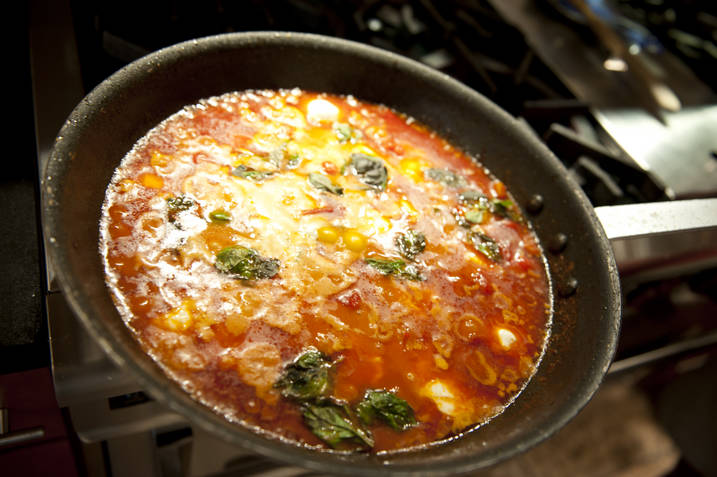
The ingredients. Yes, so I used lo-carb pasta!

OUR PASTA SCIUE-SCIUE
Ingredients:
1 small can (6 oz) tomato paste
½ cup extra virgin olive oil
2 hot Italian dried peppers, finely chopped
¼ cup white wine
8 to 10 chopped plum or cherry tomatoes (as ripe as possible)
12 to 15 torn fresh basil leaves
½ stick (4 oz) unsalted butter
1 ball of fresh mozzarella
1 lb of spaghetti, or better yet, bucatini
Sea salt
Fleur de Sel (optional)
Heat a large pot of salted water to boil the pasta in.
Almost burn—as in “heavily caramelize”—the tomato paste in a large pan with the olive oil, salt, and the dried peppers. Add the white wine to de-glaze, and simmer until reduced by half.
Add the chopped tomatoes and simmer on medium heat until they start to break apart. Hand tear the mozzarella ball into shreds and add to the sauce, stirring gently. Add the basil.
Add the butter, gently stirring until it melts.
When the pasta is slightly firmer than al dente, drain it and add it to the pan with the sauce.
Serve immediately, finishing with a little Fleur de Sel.

Finito!

There are few foods that people take as personally as pizza. Tell someone that your pizza place is better than their pizza place, and chances are you’ll start a fight. Well, my pizza place is better than your pizza place, because I make it at home. Besides, I can run faster than you.

I’m not going to say that much of the pizza that I’ve tried here in Rhode Island is mediocre, but I will say that I was born in Brooklyn and grew up working in many New York pizza places in my youth. So yes, I do have a very strong opinion on what I think makes a good or bad pizza.

My homemade pizza is all about the basics. The better quality my original ingredients are, the better my pizza will be:


The dough…

The key ingredient is 00 flour, and it can be found in specialty stores,  or online. My favorite new source is Central Milling in Logan, Utah. They make a 00 flour that is top notch. I buy it through the Forno Bravo pizza oven website: http://www.fornobravo.com/store/Tipo-00-Pizza-Flour/ It makes a crustier and more flavorful dough. Ratios for this recipe depend on the humidity in my kitchen on any given day, but my basic pizza dough recipe is as follows:

4–5 cups 00 flour

1 cup tepid water

1 Tablespoon salt

1 packet Italian pizza yeast

a squirt of extra virgin olive oil

I mix all the dry ingredients in the bowl of a stand mixer, then slowly add the water as it mixes. After the ingredients are well mixed, and the dough pulls from the side of the bowl, I remove it to a floured board, where I knead the dough by hand for another 5 minutes, until it is smooth and elastic, shaping it into a ball. I rub a little olive oil over the ball of dough, place it in a bowl covered with plastic wrap, and let it rise for 2 hours, punching it down after that, and letting it rise another 2 hours again.

The sauce…

I’ve written a previous blog about real and fake cans of San Marzano tomatoes. I feel that San Marzanos make the best sauce, but not all cans of San Marzanos are created equal. The only way you can be guaranteed you have a real can of these beauties, grown in volcanic Italian soil in the shadow of Mt Vesuvius, is by the D.O.P. designation on the can. (D.O.P. stands for “Denominazione d’Origine Protetta,” and signifies that it’s the real deal.) Anything else that says San Marzano may not be.

San Marzanos are so amazing, that all I do is puree them in a food processor, pour the sauce into a pan, and let it reduce until it has thickened. No spices or additions of any kind.

The cheese…

I don’t need to go super-fancy with mozzarella di bufala (cheese made from the milk of the water buffalo) …but I don’t use the mass-produced supermarket stuff, either. Whole Foods has fresh mozarella from Maplebrook Farms in Vermont, and it is excellent.

The toppings…

A matter of choice. I wrote a while ago about how I make my own guanciale, a cured meat that comes from pork cheeks. Chopped and fried, that is one of my daughter’s favorite pizza toppings.

But my signature pizza that wows my dinner guests is my marinated beef tenderloin and fried chive blossom pizza. I marinate and grill a piece of beef tenderloin, slicing it thin. And in the springtime, when my chive plants are budding like crazy, I snip the blossoms before they open and place them in Ziploc freezer bags to use all year long. When it’s time, I grab a handful of the blossoms and fry them in a little olive oil, salt and pepper, and sprinkle them over the top of the beef tenderloin pizza. A touch of Fleur de Sel on top seals the deal.

My signature marinated beef tenderloin and chive blossom pizza.

The oven…

Many professional pizza ovens reach a temperature of 1000 degrees. My home oven only reaches 500, but it does the trick. I do use a pizza stone, and place it on the center rack of the oven, and let it heat up thoroughly before sliding a pizza onto it for cooking.

Recently, I’ve also started cooking pizzas on my barbecue grill (using a special stone for the grill) to add a smoky component. The grill gets hotter than my home oven, which is great, but it’s obviously a more work to set-up and clean.


My favorite pizza?

There are only a few pizzerias that I know of—all in NYC–that make pizza montanara, and for my money, it’s the best I’ve ever had. It’s a small, rustic pizza margherita using mozzarella di bufala and simple tomato sauce, garnished with a basil leaf. What makes it magical is the fact that after they stretch the dough–but before they put the toppings on it–they fry the dough in deep fryer with olive oil for just a minute. It puffs up like a pillow. Then they put the toppings on and quickly bake it in a very hot oven. The end result is a non-greasy, absolutely heavenly pizza cloud…the most delicious I’ve ever had.

I’ve actually had some great success recreating this pizza at home, frying the dough in a very large skillet of olive oil. The challenge is removing this giant piece of dough out of the skillet and into a pizza pan without dripping olive oil all over my stove and setting my house on fire! So far, so good!

Pork is magical. And though I’ve loved bacon and pork chops all my life, it’s only recently that I’ve started to appreciate other cuts of pork and how they’ve been prepared.
No store-bought bacon for me. I have a favorite website where I’ve bought the best quality bacon on line from Missouri for years: http://www.smokehouse.com/.
My Italian pork sausages and larger cuts of pork (like shoulders, bellies, and big fat pork chops) come from Caw Caw Creek, the only certified humane heritage breed pork farm in North Carolina. http://www.cawcawcreek.com/.
My pork ribs and liverwurst come from my friends at Simmons Farm in Middletown, RI, a certified organic farm. http://www.simmonsorganicfarmri.com/
And sometimes, my pork can come from surprising places, like my rafting guide friend Rob, whose family runs Crabapple Whitewater in the Forks, Maine, where I raft on the kennebec and Dead Rivers every year. Rob decided to raise two pigs this past year, and he’s willing to trade pork jowls for a few bottles of my homemade Lithuanian honey liqueur called Krupnikas.
Pork jowls?
Weighing the jowl pieces
It all started when I wanted to make an authentic spaghetti carbonara. Since I worship at the Italian food altar of chef Mario Batali, I went to his website to look up his recipe. It said that although many people use bacon or pancetta (both from the belly of the pig—the bacon is smoked, pancetta is not)…authentic carbonara is made with guanciale (pronounced gwan-chee-ah-lay).
Guanciale is cured (but not smoked) and made from pork jowls…that would be the cheeks of the pig. According to Batali, you take raw jowls, cure them for about a week in sugar, salt, peppercorns and fresh thyme, then hang the meat to dry. The result is a delicious pork product that you slice and fry and use in carbonara or any other recipe that calls for a tasty addition of porky goodness.
The flavor of pork jowls is subtly different than that of pancetta. There is a very special mouth-feel to the fat that makes guanciale so good. And once I made my first batch, there was no turning back!
But finding raw pork jowls was not easy. Many websites offered smoked jowls. But raw jowls were almost impossible to find, and I just about gave up until I visited my friends Sal and chef Aaron at the Back Eddy in Westport, Massachusetts. I told them of my dilemma and they said: “Pork jowls? Oh, we can order them for you!” I was psyched!
About a week later, I picked up my jowls, individually wrapped in hermetically sealed ¼ pound packages, and my curing began, following Batali’s recipe.
Getting the curing ingredients together: picking thyme leaves.
Finding room in my spare fridge to cure the meat was easy…everything fit snugly in a Ziploc bag. But once it was time to dry the jowls (all 24 of them since I bought 6 pounds,) I had to rig up a special hanging system that used bungy cords, vinyl cable ties, and beer cans…don’t ask. But it worked! And three weeks later, I was frying up my guanciale in a sautee pan and adding it to vegetables, potatoes, and pizza. I even gave guanciale gifts to my foodie friends. And before long, it was time to make more.
Since that first curing effort, some things had changed. My source for heritage pork, Caw Caw Creek, now carried pork jowls, too. And I was able to buy a couple of 3-pound jowls at a time. They were big, thick, and what I originally envisioned when I dreamed of the jowl of a pig that weighed 300 pounds or more. I cut the two big jowls into 1/2–pound, 3-inch thick slabs, and cured them using the same recipe.
A big, beautiful jowl in its native habitat.
Jowls with curing spices.
All was fine until one time, I went away on vacation, and a hurricane hit our neighborhood, knocking the power out. Fortunately, my good neighbors came to my rescue and started up my generator, plugged in the fridge, and saved the guanciale! I was back in business.
Curing and hanging completed (I now used a far more sophisticated system of stereo wire instead of bungy cords and beer cans, as seen in the photo,) I’ve been sharing the goodness of this incredible and little-known pork product with anyone who would listen—and taste.
A year ago, I had never heard of guanciale. Now, I can’t imagine not having a slab at the ready in my fridge. I use it just about anywhere I would use bacon, short of a BLT.
And by the way…I’ve yet to make the spaghetti carbonara recipe!