Archive for the ‘curing’ Category

Pork is magical. And though I’ve loved pork chops and store-bought bacon all my life, it’s only been in the last decade that I’ve learned to appreciate other cuts of pork and how they’re prepared. Guanciale is one of those meats, and it’s a key ingredient to a classic Italian dish: pasta carbonara.

In the beginning, I could only find huge jowls that required cutting and weighing to mix with the right amount of cure.

Looking at carbonara recipes online, many said the same thing: “Though a genuine carbonara uses a cured cut of pork called guanciale, it’s hard to find. So use pancetta or bacon.” Although both pancetta and bacon meats are delicious (both come from the belly of the pig…bacon is smoked, pancetta is not) the flavor and texture is not the same as a pork cheek, or jowl…and that’s what guanciale is made from.
Many years ago, my search for guanciale started with a local restaurant, the Back Eddy in Westport, Massachusetts. Being a buddy of the owner (and bribing him with alcohol), I asked if he’d order me some jowls. He did, and that worked well for a while. But I didn’t want to keep bothering him every time I wanted more, so I eventually found my own source on line that supplied me with massive jowls weighing many pounds each, as in the photo above. They were good, but a pain to work with. Eventually, that company went out of business.
I now shop for jowls online at http://www.heritagefoods.com. They sell a variety of pork products made from  heritage breeds like Berkshire, also called kurobuta. It’s delicious with wonderful fat that’s healthy and full of flavor.

Berkshire pork jowls with fresh thyme from the garden and the dry cure mix.

My curing process is simple: sugar, salt, peppercorns, and fresh thyme. I cure the jowls for about 3 weeks. I rinse them once they’ve cured, and pat them dry. They still need to cook, but they’re ready to use for carbonara, ragu bolognese, topping a pizza, or any other delicious recipe that comes my way…and they freeze really well.
Once I made my first batch, there was no turning back!
2 lbs. raw pork jowls
1/2 cup basic dry cure mix (recipe below)
1/2 cup brown sugar
1 teaspoon whole black peppercorns
a handful of fresh thyme sprigs
Combine the basic dry cure mix, brown sugar, and peppercorns in a bowl. We’ll call this the rub.
On a large work surface, lay down several sheets of plastic wrap, overlapping each other to keep the rub from leaking through to the counter underneath. Sprinkle half of the rub onto the plastic wrap in an area where the jowls will lay. Scatter a half-dozen thyme sprigs on top of the rub. Lay the pieces of pork jowl on top of the rub and the thyme.

I place the rub and sprigs of thyme on a long sheet of plastic wrap.
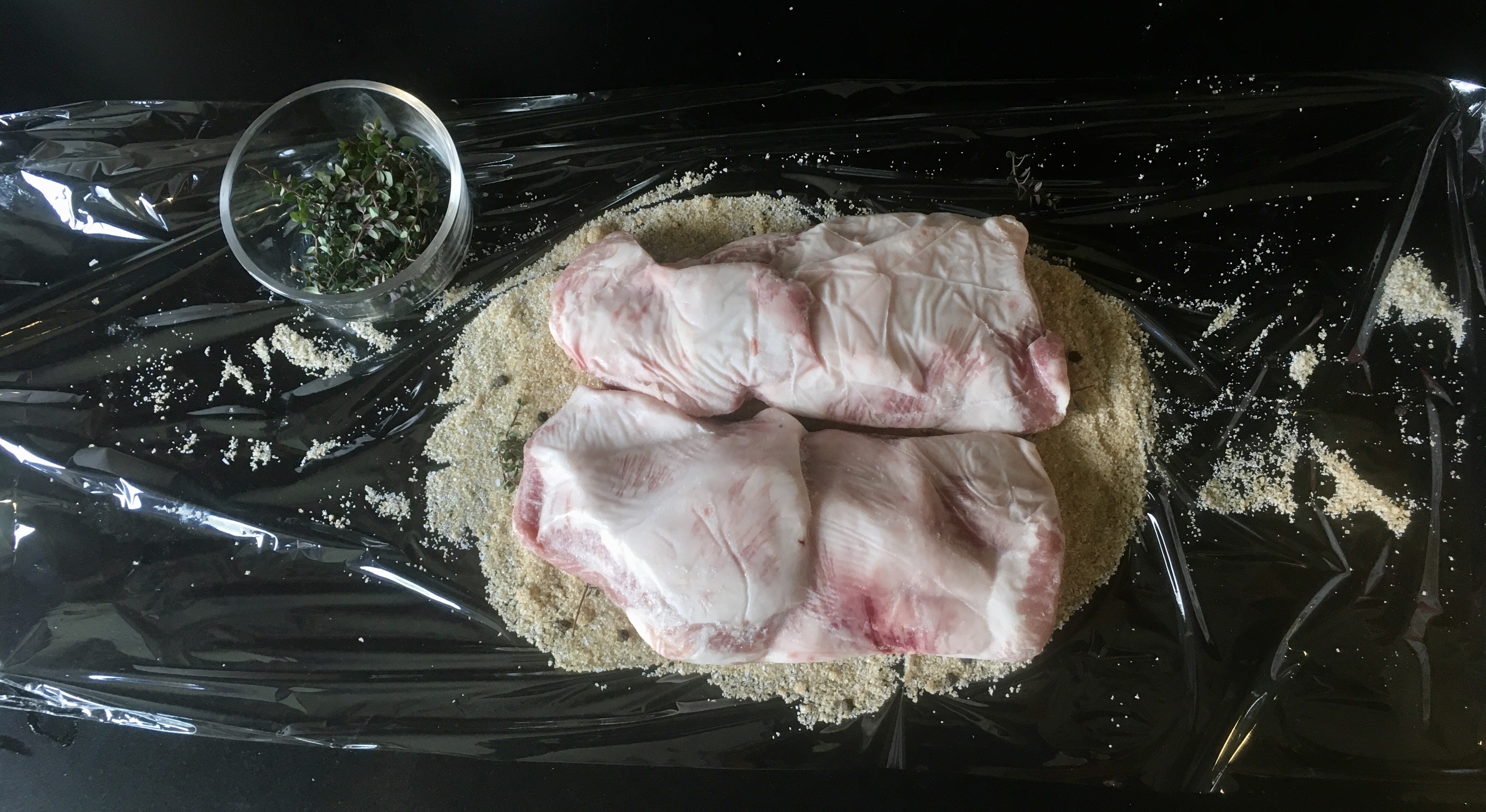
 

The pork jowls go on top.

Then top the jowls with the rest of the rub, covering them evenly, and top with more thyme sprigs.
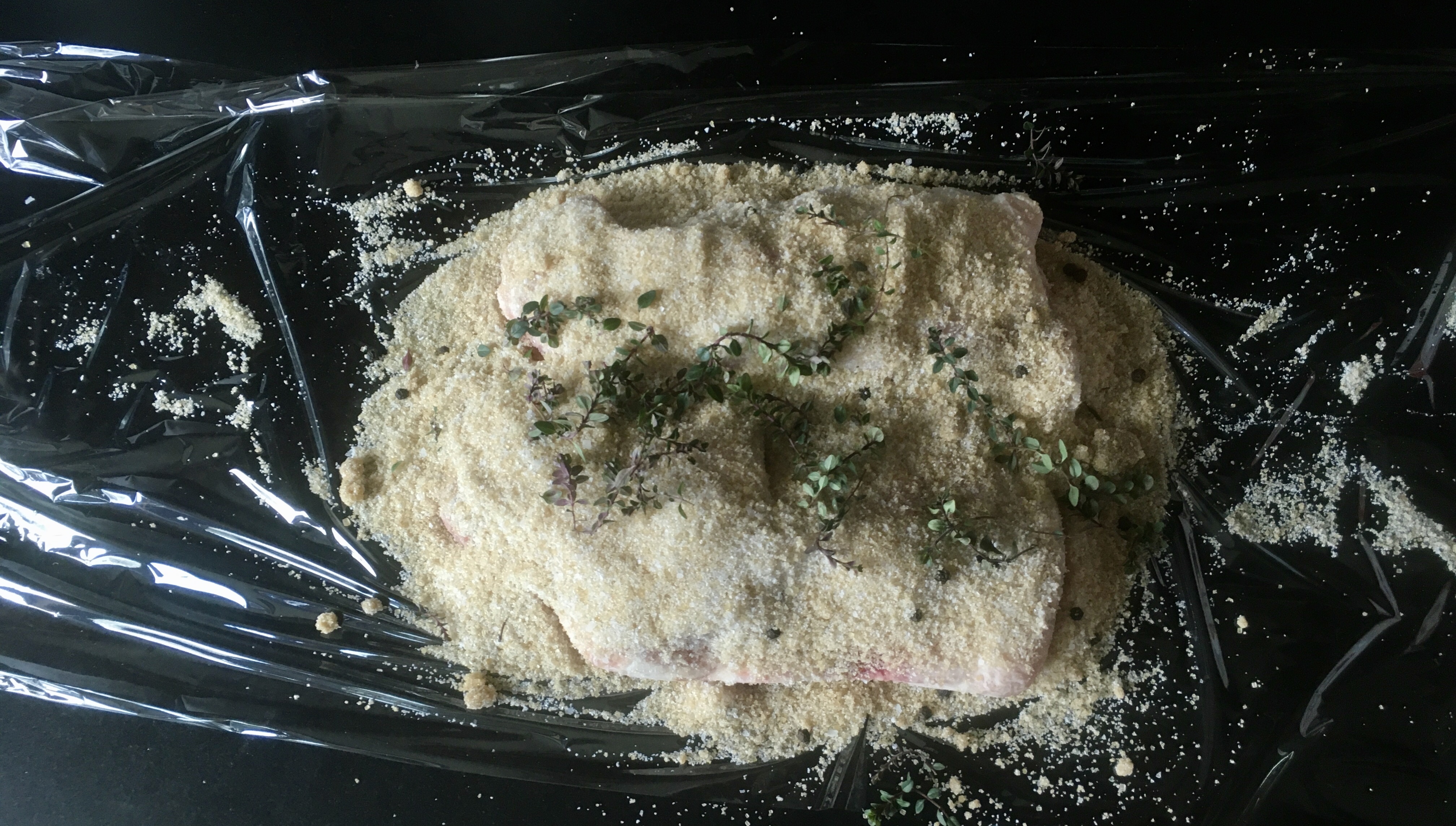
Press down on the jowls to really get the rub to stick.


Fold the plastic wrap over the jowls as tightly as you can, pressing the rub into the meat. If the wrap is loose, use more wrap to really tighten it up. Then place the entire pork-wrapped package in a container that will hold the liquid that will ooze out during the curing process.
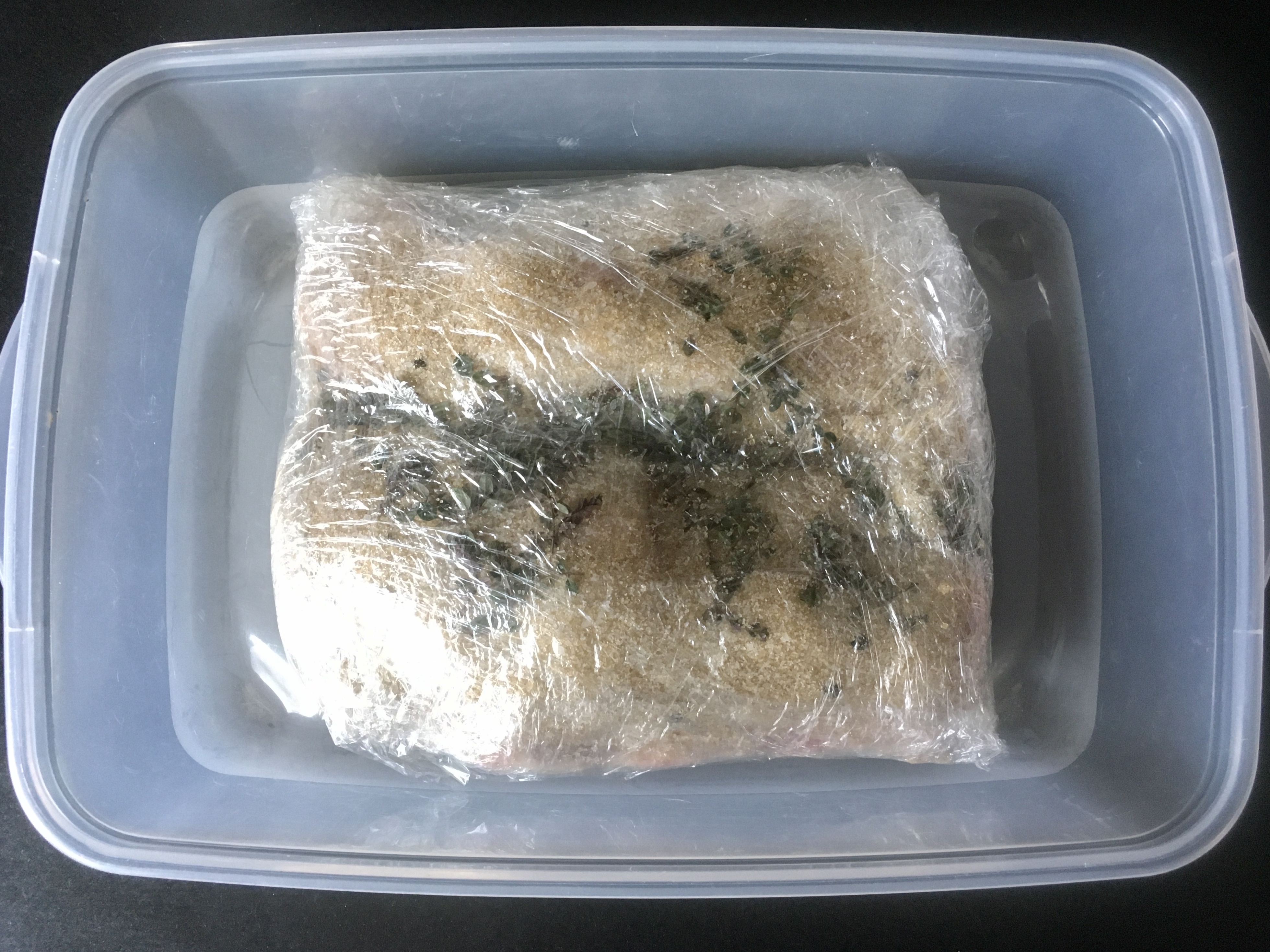
Into a container with a lid and into the fridge.


Place the container in the fridge to cure for 3 weeks.
Every couple of days, flip the plastic wrap package over, so that the top is now the bottom. Then return it to the fridge. You want the rub to get at every part of the pork. Don’t pour off any liquid that forms…it gets kind of gooey, but it will help the curing process.
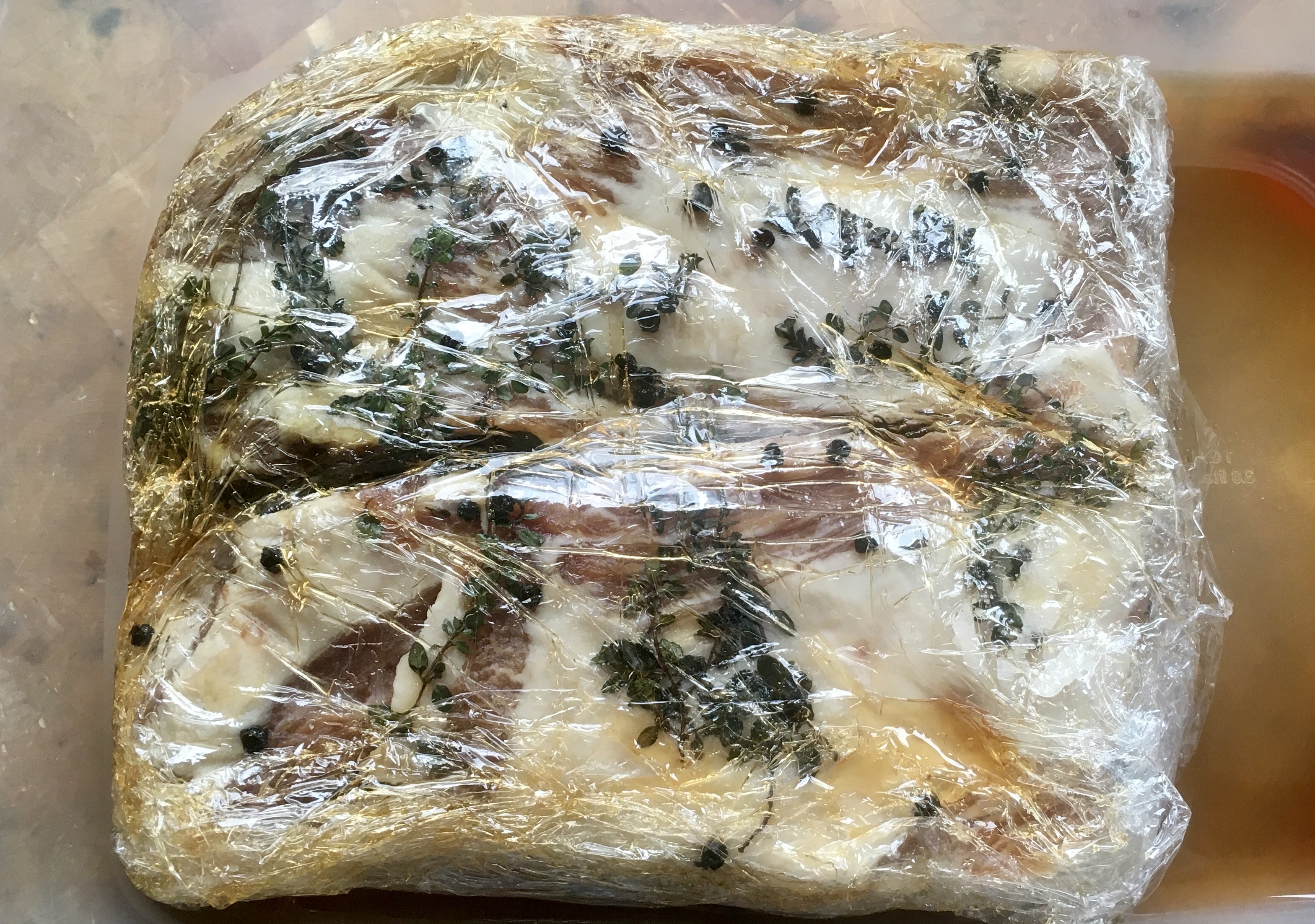
3 weeks later, it has transformed…

In about 3 weeks, the pork jowls will feel firmer. This is a sign they’ve been properly cured. Remove them from the plastic wrap, rinse them thoroughly under cold clean water, then pat them dry with paper towels.

They’re perfect…they just need a rinse.


Cured, rinsed and patted dry. Cut the guanciale into smaller pieces before freezing. A little goes a long way!


At this point, cut the guanciale into smaller pieces, wrapping each well and placing them in freezer bags. They will keep in the freezer for a long time.
Many guanciale recipes tell you to hang the meat in the fridge for at least a week after curing, but I haven’t really found the need to do that if I’m keeping them frozen. The drying process keeps the meat from getting moldy, but that’s only if you keep it at room temperature, which I don’t.

Always slice off a little to fry up a test batch! It’s all about quality control!


The Basic Dry Cure Mix
This basic dry cure mix is extremely simple, and you can cure many meats with it. But it does require a special ingredient: pink salt. This is not pink Himalayan salt. This is a very special curing salt that must be used in small amounts. (You can easily find it online.) It contains nitrites which will help preserve the meat and give it a good color. Many people get bent out of shape over nitrites these days, so you need to decide whether you want to use pink salt or not. I do, because I don’t eat pounds of guanciale like a lab rat. If you don’t use it, the meat will turn a bit gray–nothing wrong with it, just not an appealing color.
1 1/2 cups Diamond Crystal Kosher Salt*
1/2 cup organic turbinado  sugar
5 teaspoons pink curing salt
Combine these ingredients and mix well. Store the basic dry cure mix in a tightly sealed plastic bag in your pantry.
*An important note: the reason I give the brand name for the salt is because all Kosher salt does not weigh the same! A cup-and-a-half of Morton Kosher Salt, for example, weighs more and will throw off the recipe.

I love salmon in all forms. If it’s high quality wild-caught Alaskan salmon, I love it pan-sautéed, raw (as in sashimi), smoked, or cured.

The best smoked salmon uses the gentle process of cold smoking. It’s something that the average homeowner can’t really do successfully, so I simply buy cold-smoked salmon when I crave it. I’ve made hot-smoked salmon at home with some success, but the fish is so delicate, you really have to keep an eye on it. It takes no time for a juicy, perfectly smoked piece of salmon to turn into a dry, overcooked hockey puck.

Curing, which is how you get Gravlax, is really quite simple. You just need to have enough patience to wait a few days before you can eat it.

There are many gravlax recipes out there.  Some use peppercorns, fennel, caraway, even Aquavit in the curing process.  My opinion is: if you’ve got a beautiful piece of fish, why mask the flavor of it? I go with the simplest recipe possible, featuring just 3 ingredients that cure the salmon: salt, sugar and fresh dill.

The first step, of course, is to get the right piece of salmon. What you want is that beautiful, vibrant, orange wild-caught Alaskan or Pacific salmon that costs more than you thought you were going to spend. Wild-caught means the salmon has eaten the foods it loves, a balanced diet consisting of bugs, fish, shrimp, and small invertebrates. A natural diet gives the meat of the fish that beautiful color and incredible flavor. What the salmon eats is very important because you are eating the salmon! Wild-caught salmon is high in Omega-3’s…the good fats.


A beautiful piece of wild-caught salmon laying on a bed of the cure.


I avoid Atlantic salmon at all costs. Unfortunately, most restaurants on the east coast serve Atlantic salmon because it’s less expensive. There’s a reason for that. Atlantic salmon is farmed in the USA, Canada and Europe, which means the fish are kept in crowded underwater pens and are fed food pellets that contain a number of nutrients and additives. Often, farmed fish are treated to prevent sea lice, and are given antibiotics to prevent diseases caused by their tight living quarters. They’re also given pellets to color the meat orange, because the natural color of farmed salmon is actually an unappetizing gray. When you buy Atlantic salmon in the fish store, you can spot it a mile away, because it’s got that weird zebra-striped orange and white, with a tinge of gray, and its flavor is bland and lifeless. Farmed salmon is much lower in Omega-3’s.

If it doesn’t say wild-caught Alaskan or Pacific salmon, it isn’t!

Previously frozen vs. fresh fish matters less than where it came from and how it was raised.


2 lbs. wild-caught salmon, skin on, pin bones removed
1/3 cup (50g) Kosher salt (I use Diamond Crystal)
2/3 cup (160g) sugar
1 large bunch fresh dill, washed

If your fish monger hasn’t removed the pin bones from your salmon filet, you’ll need to get a pair of long-nose pliers and remove them. It’s not the worst thing in the world to leave them in there, but you really don’t want to be spitting bones out later.

The reason I mention that I use Diamond Crystal Kosher salt is because all Kosher salt does not weigh the same. Morton Kosher salt, for example, is much heavier by volume, so it weighs more even though you’re using the same cup measurement. In the case of Diamond Crystal, 1/3 cup weighs 50g. Same rules apply to the sugar.  Go by the weight, not the cup measurement. This is really important point to keep in mind when you’re curing anything, fish or meat.

Get a non-reactive tray long enough to hold the salmon filet. I prefer glass.

Mix the salt and the sugar together, and sprinkle half of it evenly on the bottom of the tray. Lay the piece of salmon down on the cure, skin side down, and cover the top of the salmon with the rest of the cure evenly.

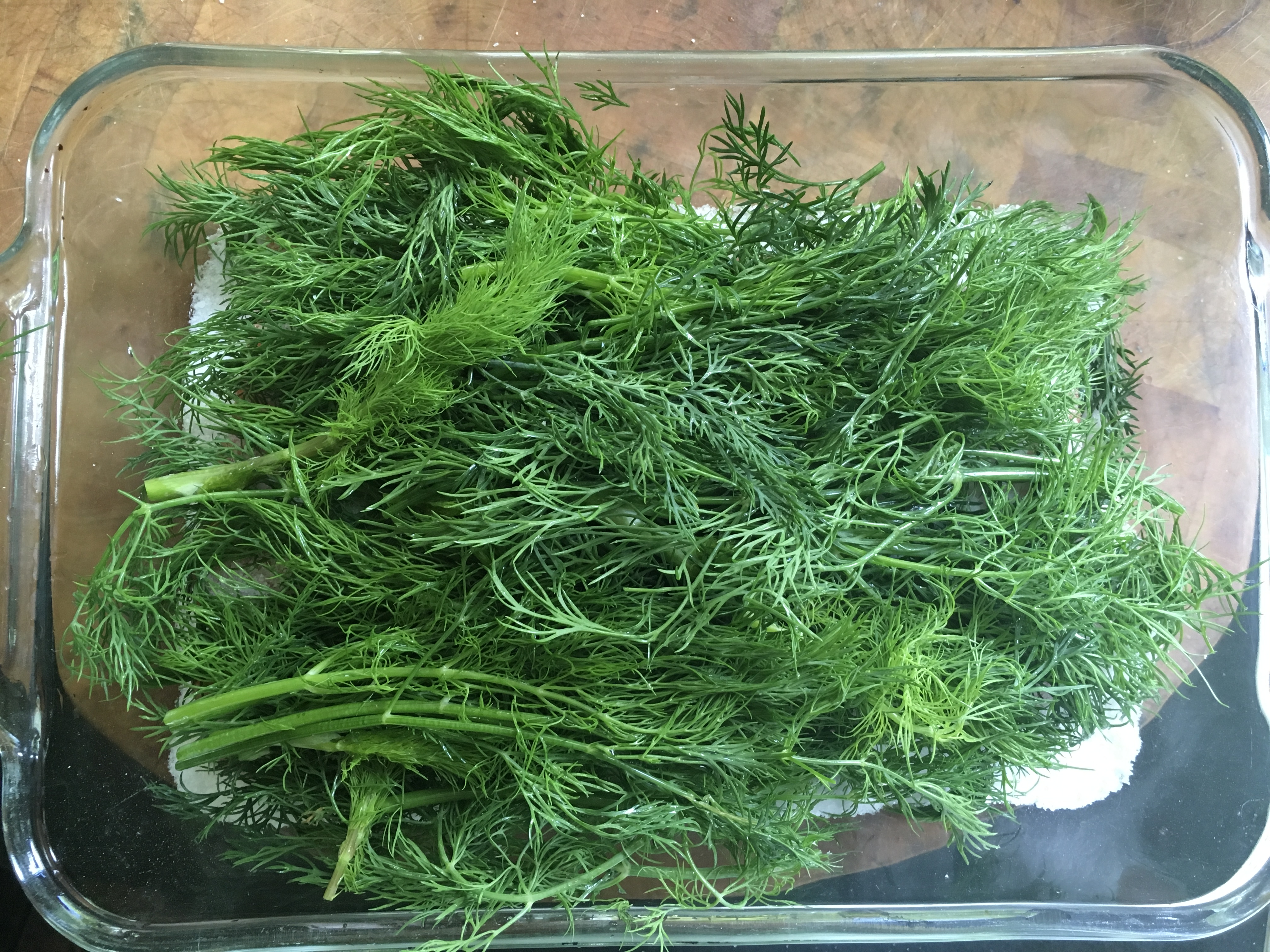
Lay the sprigs of dill on top of the cure, covering the entire piece of fish. It might look like overkill. It’s not.


Cover everything with several layers of plastic wrap, pushing it down and tucking it into the corners for a tight fit.


Find a flat board or something similar (I used a clear plastic tray) and lay it on top of the plastic wrap.


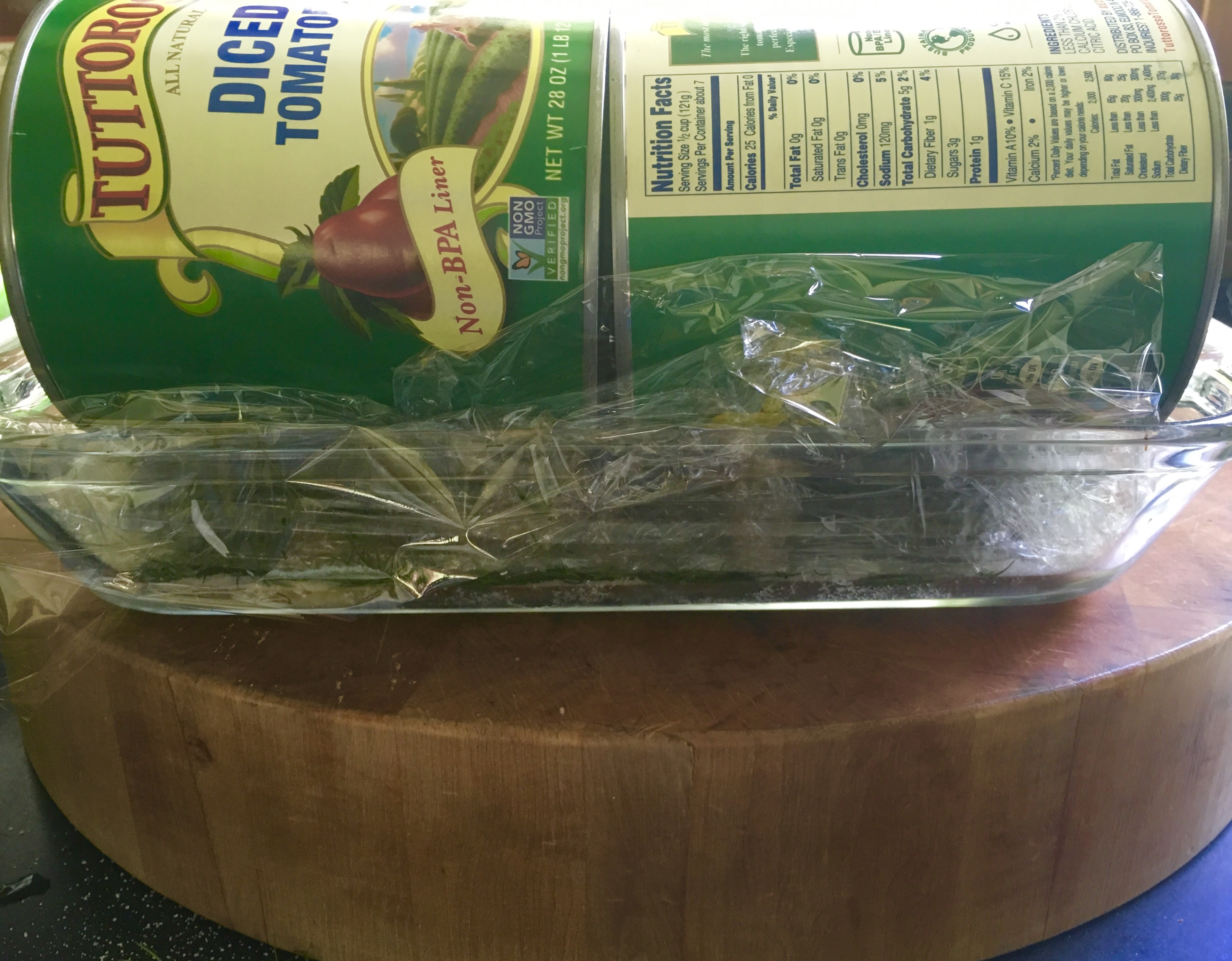
Add heavy weights on top to press down evenly on all surfaces. I used cans of tomatoes.


Side view.


Place the tray in the fridge for 48-72 hours.

After 24 hours, remove the plastic wrap and, tilting the tray, baste the dill-covered salmon with the brine juices that have formed. Put clean plastic wrap on top, add the weights, and put it all back in the fridge for another 24 hours. Repeat that process at the 48-hour mark, if needed. If it’s cured, it’s time to eat!


You’ll know the fish is fully cured when the thickest part of the filet is firm to the touch.

Unwrap the salmon, discarding the salt and sugar brine and the dill. Rinse the filet under cold running water and pat it dry with paper towels.

I don’t like a ton of chopped dill imbedded into my gravlax as some do, but if you do, finely chop a bunch of new fresh dill, spread it out onto a board, and press the salmon into it flesh-side down.

To serve, place the gravlax skin-side down on a board. With a long, sharp narrow-bladed knife, slice the fish against the grain, on the diagonal, into thin slices. Serve with mustard-dill sauce, chopped onion, capers, hard-boiled egg, bread…whatever you like.

Refrigerate any remaining gravlax immediately, wrapped in plastic wrap, for up to 2 weeks.


If you really want to impress your guests for the holidays, try curing your own salmon!

I love salmon in all forms. If it’s high quality wild-caught Alaskan salmon, I love it pan-sautéed, raw (as in sashimi), smoked, or cured.

The best smoked salmon uses the gentle process of cold smoking. It’s something that the average homeowner can’t really do successfully, so I simply buy cold-smoked salmon when I crave it. I’ve made hot-smoked salmon at home with some success, but the fish is so delicate, you really have to keep an eye on it. It takes no time for a juicy, perfectly smoked piece of salmon to turn into a dry, overcooked hockey puck.

Curing, which is how you get Gravlax, is really quite simple. You just need to have enough patience to wait a few days before you can eat it.

There are many gravlax recipes out there.  Some use peppercorns, fennel, caraway, even Aquavit in the curing process.  My opinion is: if you’ve got a beautiful piece of fish, why mask the flavor of it? I go with the simplest recipe possible, featuring just 3 ingredients that cure the salmon: salt, sugar and fresh dill.

The first step, of course, is to get the right piece of salmon. What you want is that beautiful, vibrant, orange wild-caught Alaskan or Pacific salmon that costs more than you thought you were going to spend. Wild-caught means the salmon has eaten the foods it loves, a balanced diet consisting of bugs, fish, shrimp, and small invertebrates. A natural diet gives the meat of the fish that beautiful color and incredible flavor. What the salmon eats is very important because you are eating the salmon! Wild-caught salmon is high in Omega-3’s…the good fats.


A beautiful piece of wild-caught salmon laying on a bed of the cure.


I avoid Atlantic salmon at all costs. Unfortunately, most restaurants on the east coast serve Atlantic salmon because it’s less expensive. There’s a reason for that. Atlantic salmon is farmed in the USA, Canada and Europe, which means the fish are kept in crowded underwater pens and are fed food pellets that contain a number of nutrients and additives. Often, farmed fish are treated to prevent sea lice, and are given antibiotics to prevent diseases caused by their tight living quarters. They’re also given pellets to color the meat orange, because the natural color of farmed salmon is actually an unappetizing gray. When you buy Atlantic salmon in the fish store, you can spot it a mile away, because it’s got that weird zebra-striped orange and white, with a tinge of gray, and its flavor is bland and lifeless. Farmed salmon is much lower in Omega-3’s.

If it doesn’t say wild-caught Alaskan or Pacific salmon, it isn’t!

Previously frozen vs. fresh fish matters less than where it came from and how it was raised.


2 lbs. wild-caught salmon, skin on, pin bones removed
1/3 cup (50g) Kosher salt (I use Diamond Crystal)
2/3 cup (160g) sugar
1 large bunch fresh dill, washed

If your fish monger hasn’t removed the pin bones from your salmon filet, you’ll need to get a pair of long-nose pliers and remove them. It’s not the worst thing in the world to leave them in there, but you really don’t want to be spitting bones out later.

The reason I mention that I use Diamond Crystal Kosher salt is because all Kosher salt does not weigh the same. Morton Kosher salt, for example, is much heavier by volume, so it weighs more even though you’re using the same cup measurement. In the case of Diamond Crystal, 1/3 cup weighs 50g. Same rules apply to the sugar.  Go by the weight, not the cup measurement. This is really important point to keep in mind when you’re curing anything, fish or meat.

Get a non-reactive tray long enough to hold the salmon filet. I prefer glass.

Mix the salt and the sugar together, and sprinkle half of it evenly on the bottom of the tray. Lay the piece of salmon down on the cure, skin side down, and cover the top of the salmon with the rest of the cure evenly.

Lay the sprigs of dill on top of the cure, covering the entire piece of fish. It might look like overkill. It’s not.


Cover everything with several layers of plastic wrap, pushing it down and tucking it into the corners for a tight fit.


Find a flat board or something similar (I used a clear plastic tray) and lay it on top of the plastic wrap.


Add heavy weights on top to press down evenly on all surfaces. I used cans of tomatoes.


Side view.


Place the tray in the fridge for 48-72 hours.

After 24 hours, remove the plastic wrap and, tilting the tray, baste the dill-covered salmon with the brine juices that have formed. Put clean plastic wrap on top, add the weights, and put it all back in the fridge for another 24 hours. Repeat that process at the 48-hour mark, if needed. If it’s cured, it’s time to eat!


You’ll know the fish is fully cured when the thickest part of the filet is firm to the touch.

Unwrap the salmon, discarding the salt and sugar brine and the dill. Rinse the filet under cold running water and pat dry with paper towels.

I don’t like a ton of chopped dill imbedded into my gravlax as some do, but if you do, finely chop a bunch of new fresh dill, spread it out onto a board, and press the salmon into it flesh-side down.

To serve, place the gravlax skin-side down on a board. With a long, sharp narrow-bladed knife, slice the fish against the grain, on the diagonal, into thin slices. Serve with mustard-dill sauce, chopped onion, capers, hard-boiled egg, bread…whatever you like.

Refrigerate any remaining gravlax immediately, wrapped in plastic wrap, for up to 2 weeks.


Pork is magical. And though I’ve loved pork chops and store-bought bacon all my life, it’s only been in the last decade that I’ve learned to appreciate other cuts of pork and how they’re prepared. Guanciale is one of those meats, and it’s a key ingredient to a classic Italian dish: pasta carbonara.


In the beginning, I could only find huge jowls that required cutting and weighing to mix with the right amount of cure.

Looking at carbonara recipes online, many said the same thing: “Though a genuine carbonara uses a cured cut of pork called guanciale, it’s hard to find. So use pancetta or bacon.” Although both pancetta and bacon meats are delicious (both come from the belly of the pig…bacon is smoked, pancetta is not) the flavor and texture is not the same as a pork cheek, or jowl…and that’s what guanciale is made from.
Many years ago, my search for guanciale started with a local restaurant, the Back Eddy in Westport, Massachusetts. Being a buddy of the owner (and bribing him with alcohol), I asked if he’d order me some jowls. He did, and that worked well for a while. But I didn’t want to keep bothering him every time I wanted more, so I eventually found my own source on line that supplied me with massive jowls weighing many pounds each, as in the photo above. They were good, but a pain to work with. Eventually, that company went out of business.
I finally found my go-to pork website: http://www.heritagepork.com. They sell a variety of pork products made from a heritage breed of pig known as Berkshire, also called kurobuta. It’s delicious with wonderful fat that’s healthy and full of flavor. And conveniently, they sell pork jowls in smaller, 2-pound packs.

Berkshire pork jowls with fresh thyme from the garden and the dry cure mix.


My curing process is simple: sugar, salt, peppercorns, and fresh thyme. I cure the jowls for about 3 weeks. I rinse them once they’ve cured, and pat them dry. They still need to cook, but they’re ready to use for carbonara, ragu bolognese, topping a pizza, or any other delicious recipe that comes my way…and they freeze really well.
Once I made my first batch, there was no turning back!
2 lbs. raw pork jowls
1/2 cup basic dry cure mix (recipe below)
1/2 cup brown sugar
1 teaspoon whole black peppercorns
a handful of fresh thyme sprigs
Combine the basic dry cure mix, brown sugar, and peppercorns in a bowl. We’ll call this the cure.
On a large work surface, lay down several sheets of plastic wrap, overlapping each other to keep the cure from leaking through to the counter underneath. Sprinkle half of the cure onto the plastic wrap in an area where the jowls will lay. Scatter a half-dozen thyme sprigs on top of the cure. Lay the pieces of pork jowl on top of the cure and the thyme.

I place the cure and sprigs of thyme on a long sheet of plastic wrap.


The pork jowls go on top.

Then top the jowls with the rest of the cure, covering them evenly, and top with more thyme sprigs.

Press down on the jowls to really get the cure to stick.


Fold the plastic wrap over the jowls as tightly as you can, pressing the cure into the meat. If the wrap is loose, use more wrap to really tighten it up. Then place the entire pork-wrapped package in a container that will hold the liquid that will ooze out during the curing process.

Into a container with a lid and into the fridge.


Place the container in the fridge to cure for 3 weeks.
Every couple of days, flip the plastic wrap package over, so that the top is now the bottom. Then return it to the fridge. You want the cure to get at every part of the pork. Don’t pour off any liquid that forms…it gets kind of gooey, but it will help the curing process.

3 weeks later, it has transformed…

In about 3 weeks, the pork jowls will feel firmer. This is a sign they’ve been properly cured. Remove them from the plastic wrap, rinse them thoroughly under cold clean water, then pat them dry with paper towels.

They’re perfect…they just need a rinse.


Cured, rinsed and patted dry. Cut the guanciale into smaller pieces before freezing. A little goes a long way!


At this point, cut the guanciale into smaller pieces, wrapping each well and placing them in freezer bags. They will keep in the freezer for a long time.
Many guanciale recipes tell you to hang the meat in the fridge for at least a week after curing, but I haven’t really found the need to do that if I’m keeping them frozen. The drying process keeps the meat from getting moldy, but that’s only if you keep it at room temperature, which I don’t.

Always slice off a little to fry up a test batch! It’s all about quality control!


The Basic Dry Cure Mix
This basic dry cure mix is extremely simple, and you can cure many meats with it. But it does require a special ingredient: pink salt. This is not pink Himalayan salt. This is a very special curing salt that must be used in small amounts. (You can easily find it online.) It contains nitrites which will help preserve the meat and give it a good color. Many people get bent out of shape over nitrites these days, so you need to decide whether you want to use pink salt or not. I do, because I don’t eat pounds of guanciale like a lab rat. If you don’t use it, the meat will turn a bit gray–nothing wrong with it, just not an appealing color.
1 1/2 cups Diamond Crystal Kosher Salt
1/2 cup organic turbinado  sugar
5 teaspoons pink curing salt
Combine these ingredients and mix well. Store the basic dry cure mix in a tightly sealed plastic bag in your pantry.
An important note: the reason I give the brand name for the salt is because all Kosher salt does not weigh the same! A cup-and-a-half of Morton Kosher Salt, for example, weighs more and will throw off the recipe.

If you really want to impress your guests for the holidays, try curing your own salmon!

I love salmon in all forms. If it’s high quality wild-caught Alaskan salmon, I love it pan-sautéed, raw (as in sashimi), smoked, and cured.

The best smoked salmon uses the gentle process of cold smoking. It’s something that the average homeowner can’t really do successfully, so I simply buy cold-smoked salmon when I crave it. I’ve made hot-smoked salmon at home with some success, but the fish is so delicate, you really have to keep an eye on it. It takes no time for a juicy, perfectly smoked piece of salmon to turn into a dry, overcooked hockey puck.

Curing, which is how you get Gravlax, is really quite simple. You just need to have enough patience to wait a few days before you can eat it.

There are many gravlax recipes out there.  Some use peppercorns, fennel, caraway, even Aquavit in the curing process.  My opinion is: if you’ve got a beautiful piece of fish, why mask the flavor of it? I go with the simplest recipe possible, featuring just 3 ingredients that cure the salmon: salt, sugar and fresh dill.

The first step, of course, is to get the right piece of salmon. What you want is that beautiful, vibrant, orange wild-caught Alaskan or Pacific salmon that costs more than you thought you were going to spend. Wild-caught means the salmon has eaten the foods it loves, a balanced diet consisting of bugs, fish, shrimp, and small invertebrates. A natural diet gives the meat of the fish that beautiful color and incredible flavor. What the salmon eats is very important because you are eating the salmon! Wild-caught salmon is high in Omega-3’s…the good fats.


A beautiful piece of wild-caught salmon laying on a bed of the cure.


I avoid Atlantic salmon at all costs. Unfortunately, most restaurants on the east coast serve Atlantic salmon because it’s less expensive. There’s a reason for that. Atlantic salmon is farmed in the USA, Canada and Europe, which means the fish are kept in crowded underwater pens and are fed food pellets that contain a number of nutrients and additives. Often, farmed fish are treated to prevent sea lice, and are given antibiotics to prevent diseases caused by their tight living quarters. They’re also given pellets to color the meat orange, because the natural color of farmed salmon is actually an unappetizing gray. When you buy Atlantic salmon in the fish store, you can spot it a mile away, because it’s got that weird zebra-striped orange and white, with a tinge of gray, and its flavor is bland and lifeless. Farmed salmon is much lower in Omega-3’s.

If it doesn’t say wild-caught Alaskan or Pacific salmon, it isn’t!

Previously frozen vs. fresh fish matters less than where it came from and how it was raised.

2 lbs. wild-caught salmon, skin on, pin bones removed
1/3 cup (50g) Kosher salt (I use Diamond Crystal)
2/3 cup (160g) sugar
1 large bunch fresh dill, washed


If your fish monger hasn’t removed the pin bones from your salmon filet, you’ll need to get a pair of long-nose pliers and remove them. It’s not the worst thing in the world to leave them in there, but you really don’t want to be spitting bones out later.

The reason I mention that I use Diamond Crystal Kosher salt is because all Kosher salt does not weigh the same. Morton Kosher salt, for example, is much heavier by volume, so it weighs more even though you’re using the same cup measurement. In the case of Diamond Crystal, 1/3 cup weighs 50g. Same rules apply to the sugar.  Go by the weight, not the cup measurement. This is really important point to keep in mind when you’re curing anything, fish or meat.

Get a non-reactive tray long enough to hold the salmon filet. I prefer glass.

Mix the salt and the sugar together, and sprinkle half of it evenly on the bottom of the tray. Lay the piece of salmon down on the cure, skin side down, and cover the top of the salmon with the rest of the cure evenly.

Lay the sprigs of dill on top of the cure, covering the entire piece of fish. It might look like overkill. It’s not.


Cover everything with several layers of plastic wrap, pushing it down and tucking it into the corners for a tight fit.


Find a flat board or something similar (I used a clear plastic tray) and lay it on top of the plastic wrap.


Add heavy weights on top to press down evenly on all surfaces. I used cans of tomatoes.


Side view.


Place the tray in the fridge for 48-72 hours.

After 24 hours, remove the plastic wrap and, tilting the tray, baste the dill-covered salmon with the brine juices that have formed. Put clean plastic wrap on top, add the weights, and put it all back in the fridge for another 24 hours. Repeat that process at the 48-hour mark, if needed. If it’s cured, it’s time to eat!


You’ll know the fish is fully cured when the thickest part of the filet is firm to the touch.

Unwrap the salmon, discarding the salt and sugar brine and the dill. Rinse the filet under cold running water and pat dry with paper towels.

I don’t like a ton of chopped dill imbedded into my gravlax as some do, but if you do, finely chop a bunch of new fresh dill, spread it out onto a board, and press the salmon into it flesh-side down.

To serve, place the gravlax skin-side down on a board. With a long, sharp narrow-bladed knife, slice the fish against the grain, on the diagonal, into thin slices. Serve with mustard-dill sauce, chopped onion, capers, hard-boiled egg, bread…whatever you like.

Refrigerate any remaining gravlax immediately, wrapped in plastic wrap, for up to 2 weeks.


Pork is magical. And though I’ve loved pork chops and store-bought bacon all my life, it’s only been in the last decade that I’ve learned to appreciate other cuts of pork and how they’re prepared. Guanciale is one of those meats, and it’s a key ingredient to a classic Italian dish: pasta carbonara.


In the beginning, I could only find huge jowls that required them to be cut and weighed to mix with the right amount of cure.

Looking at carbonara recipes online, many said the same thing: “Though a genuine carbonara uses a cured cut of pork called guanciale, it’s hard to find. So use pancetta or bacon.” Although both pancetta and bacon meats are quite tasty (both come from the belly of the pig…bacon is smoked, pancetta is not) the flavor and texture is not the same as a pork cheek, or jowl…and that’s what guanciale is made from.
My search for guanciale started with a local restaurant, the Back Eddy in Westport, Massachusetts. Being a buddy of the owner (and bribing him with alcohol), I asked if he’d order me some jowls. He did, and that worked well for a while. But I didn’t want to keep bothering him every time I wanted more, so I eventually found my own source on line that supplied me with massive jowls weighing many pounds each, as in the photo above. They were good, but a pain to work with. Eventually, that company went out of business.
I finally found my go-to pork website: http://www.heritagepork.com. They sell a variety of pork products made from a heritage breed of pig known as Berkshire, also called kurobuta. It’s delicious with wonderful fat that’s healthy and full of flavor. And conveniently, they sell pork jowls in smaller, 2-pound packs.

Berkshire pork jowls with fresh thyme from the garden and the dry cure mix.


My curing process is simple: sugar, salt, peppercorns, and fresh thyme. I cure the jowls for about 3 weeks. I rinse them once they’ve cured, and pat them dry. They still need to cook, but they’re ready to use for carbonara, ragu bolognese, topping a pizza, or any other delicious recipe that comes my way…and they freeze really well.
Once I made my first batch, there was no turning back!
2 lbs. raw pork jowls
1/2 cup basic dry cure (recipe below)
1/2 cup brown sugar
1 teaspoon whole black peppercorns
a handful of fresh thyme sprigs
Combine the basic dry cure, brown sugar, and peppercorns in a bowl. We’ll call this the cure mix.
On a large work surface, lay down several sheets of plastic wrap, overlapping each other to keep the cure mix from leaking through to the counter underneath. Sprinkle half of the cure mix onto the plastic wrap in an area where the jowls will lay. Scatter a half-dozen thyme sprigs on top of the cure mix. Lay the pieces of pork jowl on top of the cure mix and thyme.

I place the cure mix and sprigs of thyme on a long sheet of plastic wrap.


The pork jowls go on top.

Then top the jowls with the rest of the cure mix, covering them evenly, and top with more thyme sprigs.

Press down on the jowls to really get the cure mix to stick.

Fold the plastic wrap over the jowls as tightly as you can, pressing the salt mix into the meat. If the wrap is loose, use more wrap to really tighten the salt cure around the meat. Then place the entire pork-wrapped package in a container that will hold the liquid that will ooze out during the curing process.

Into a container with a lid and into the fridge.


Place the container in the fridge to cure for 3 weeks.
Every couple of days, flip the plastic wrap package over, so that the top is now the bottom. Then return it to the fridge. You want the cure to get at every part of the pork. Don’t pour off any liquid that forms…it gets kind of gooey, but it will help the curing process.

3 weeks later…

In about 3 weeks, the pork jowls will feel firmer. This is a sign they’ve been properly cured. Remove them from the plastic wrap, rinse them thoroughly under cold clean water, then pat them dry with paper towels.

They’re perfect…they just need a rinse.


Cured, rinsed and dried guanciale. Cut the jowls into smaller pieces before freezing. A little goes a long way!


At this point, you can cut the jowls (now officially guanciale!) into smaller pieces, wrapping each well and placing them in freezer bags. They will keep in the freezer for a long time.
Many guanciale recipes tell you to hang the meat in the fridge for at least a week after curing, but I haven’t really found the need to do that if I’m keeping them frozen. The drying process keeps the meat from getting moldy, but that’s only if you keep it in warmer temperatures.

Always slice off a little to fry up a test batch! It’s all about quality control!


The Basic Dry Cure
This cure’s extremely simple, and you can cure many meats with it. But it does require a special ingredient: pink salt. This is not pink Himalayan salt. This is a very special curing salt that must be used in small amounts. (You can easily find it online.) It contains nitrites which will help preserve the meat and give it a good color. Many people get bent out of shape over nitrites these days, so you need to decide whether you want to use pink salt or not. I do, because I don’t eat pounds of guanciale like a lab rat. If you don’t use it, the meat will turn a bit gray–nothing wrong with it, just not an appealing color.
1 1/2 cups Diamond Crystal Kosher Salt
1/2 cup organic turbinado  sugar
5 teaspoons pink curing salt
Combine these ingredients and mix well. Store it in a tightly sealed plastic bag in your pantry.
An important note: the reason I give the brand name for the salt is because all Kosher salt does not weigh the same! A cup-and-a-half of Morton Kosher Salt, for example, will weigh more and will throw off the recipe.

I like to brine large hunks of meat that I’m going to roast, because brining not only gives it flavor, it adds moisture…so my pork loin, Thanksgiving turkey, or in this case, whole chicken, doesn’t dry out.

Brining usually means you take a lot of water and you add salt and other spices to it, then drop the bird into that liquid for several hours, so the meat can suck up the salty water, releasing it slowly as it cooks, but retaining much of the moisture and flavor.

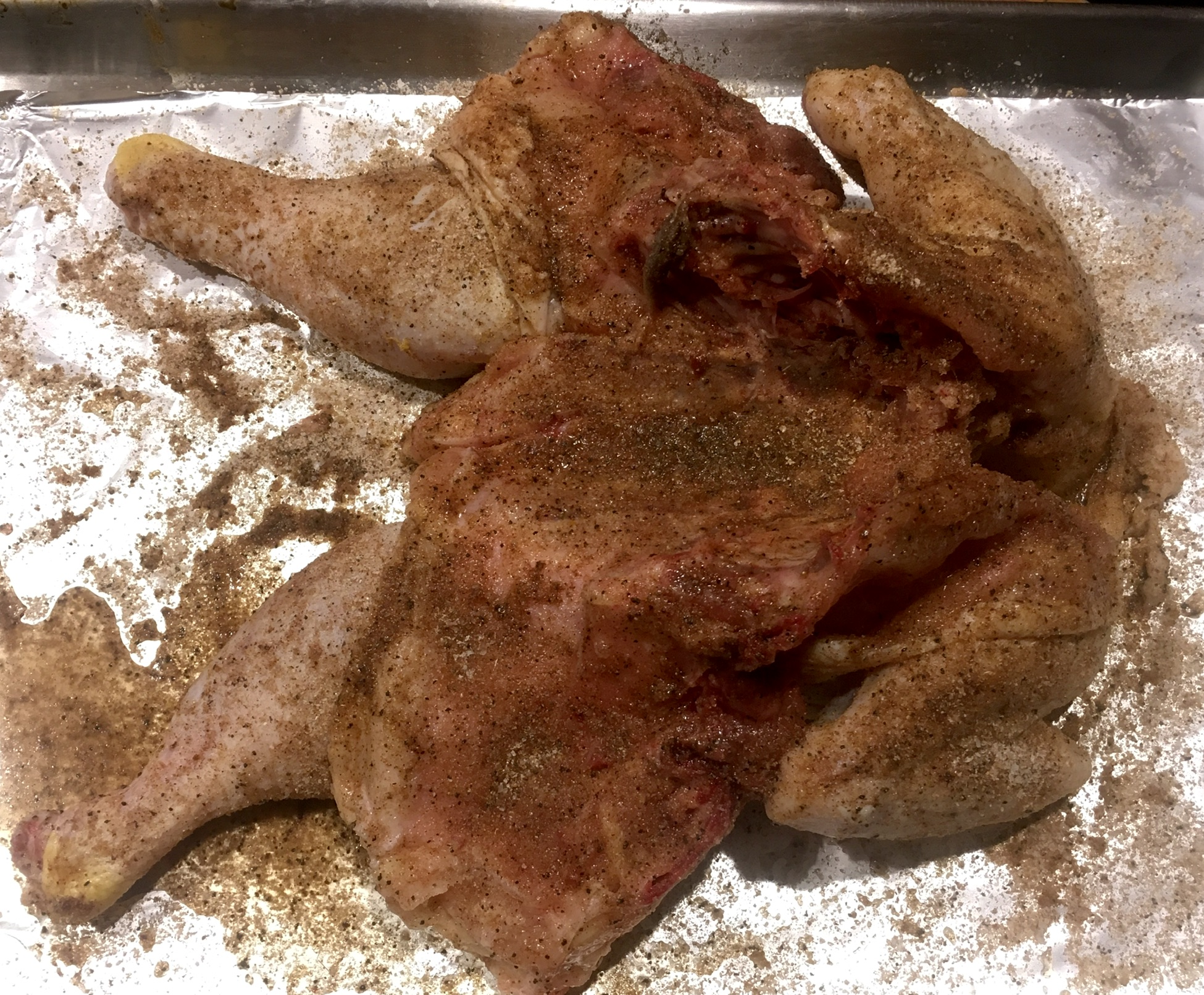
Recently, I started reading about “dry-brining,” (aka curing)…and I thought that would be a fun thing to try. I created a spice rub that I rubbed all over a spatchcocked chicken, placed it on a sheet pan, and popped it in the fridge to dry age for several days before cooking.

Spatchcocked? Sounds like a dirty word, but it means that the backbone of the bird has been removed, allowing the bird to be flattened and cooked more evenly. As you know, very often the breast meat of a bird is overcooked if the dark meat is perfect. Spatchcocking a bird allows all the parts of the bird to cook more evenly.

All you need to spatchcock a chicken is a good pair of poultry scissors. Cut all the way down on either side of the backbone of the bird (saving the backbone for future stock, of course.) Now you can open the bird up, season it on both sides, and lay it flat on a sheet pan to cure.


Spatchcocked and rubbed. I put the bird skin-side down for a day and a half, then flipped it over for another day and a half.


My preferences leaned toward Asian flavors this time, so here’s my dry brine recipe:

3 tablespoons Kosher salt (I use Diamond Crystal…the brand matters. See why below.)
1 1/2 tablespoons (1 tablespoon + 1 1/2 teaspoons) granulated garlic
1 1/2 tablespoons (1 tablespoon + 1 1/2 teaspoons) granulated onion
1 tablespoon brown sugar
1 tablespoon Chinese Five Spice
1 1/2 teaspoons black pepper

I combined all the ingredients in a bowl.


The reason why the brand of Kosher salt matters is the weight. But salt is salt, right? Well…different brands weigh different amounts. For example, Morton Kosher salt is more dense than Diamond Crystal. If you use equal amounts of each, you’ll get different results. That’s why most recipes tell you the weight of the salt, not the volume. In this case, 3 tablespoons of Diamond Crystal Kosher salt (according to my little kitchen scale) weighs 1.09 ounces.

Once I spatchcocked the bird, I rubbed it really well on both sides with the spice rub.

I lined a sheet pan with non-stick aluminum foil (to be used again later), and placed the bird, skin-side down, on it. I didn’t wrap the bird. I simply moved it to a refrigerator just like that, and let it stay there, dry-aging, for 1 1/2 days. I then flipped the bird (pardon my language) skin-side up and let it cure another 1 1/2 days, for a total of 3 days for a 4-pound bird.


Dry-aged after 3 days.


Once the bird dry-aged for 3 days, I removed it from the fridge, and let it sit for an hour, allowing it to reach room temperature. I pre-heated my oven to 400 degrees.

I set my oven up so that the bird would lie flat skin-side up (without the sheet pan) directly on the middle oven rack, and the sheet pan (with the non-stick aluminum foil still on it) on the rack underneath it, to catch the drippings. This allowed air to circulate completely around the bird as it cooked, and the pan caught any splatters. (The foil, still on the pan, made clean-up later much easier.)

Once the oven reached 400, I placed the bird on the middle rack, the sheet pan below it, closed the oven door, and turned the temperature down to 275.


Although it’s 161, that’s the breast meat temp. The thighs were higher. And the temperature will still rise while the bird is resting.


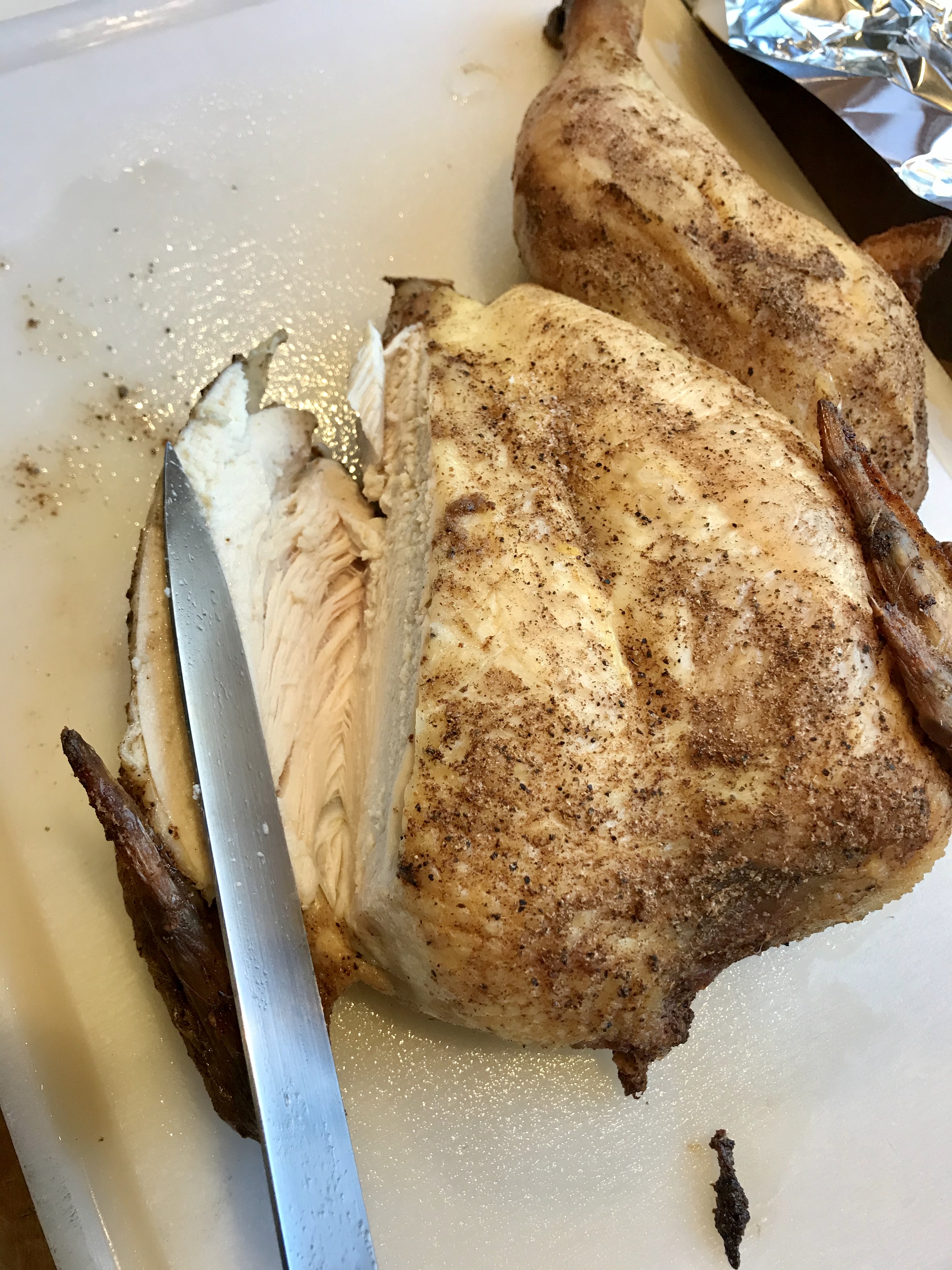
Chicken is done when it reaches an internal temperature of 165. Using an instant-read thermometer, I inserted it into the thigh, without touching the bone. I also inserted into the breast. Although the temperature was just a touch low, it rose a few degrees while resting under the foil.

My 4-pound chicken took about 90 minutes to cook.


Out of the oven to rest. I covered it with foil to rest about 15 minutes before carving.


Juicy and delicious!


Pork is magical. And though I’ve loved pork chops and store-bought bacon all my life, it’s only been in the last decade that I’ve learned to appreciate other cuts of pork and how they’re prepared.

Over the years, I’ve learned to cure and smoke my own bacon, from heritage breeds like Berkshire. I’ll make my own pork sausage on occasion. But the need to make a classic Italian dish, genuine spaghetti carbonara, required that I learn how to cure an unusual cut of pork I’ve never used before.


In the beginning, I could only find huge jowls that required them to be cut and weighed to mix with the right amount of cure.

Looking at carbonara recipes online, everyone said the same thing: “Though the genuine dish uses a cured cut of pork called guanciale, it’s hard to find so use pancetta or bacon.” Although both pancetta and bacon meats are quite tasty (both come from the belly of the pig…bacon is smoked, pancetta is not) the flavor and texture is not the same as a pork cheek, or jowl. That’s what guanciale is made from. So I needed to find a source.
I started with a local restaurant, the Back Eddy in Westport, Massachusetts. Being a buddy of the owner and chef (and bribing them with alcohol), I asked if they’d order me some jowls. They did, and that worked well for a while. But I didn’t want to keep bothering them every time I wanted more, so I eventually found my own source on line that supplied me with massive jowls weighing many pounds each, as in the photo above. They were good, but a pain to work with. Eventually, that company went out of business.
I finally found my go-to pork website: http://www.heritagepork.com. They sell a variety of pork products made from a heritage breed of pig known as Berkshire, also called kurobuta. It’s a delicious breed with wonderful fat that’s healthy and full of flavor. And conveniently, they sell pork jowls in 2-pound packs.
My curing process is simple: sugar, salt, peppercorns, and fresh thyme. I cure the jowls for about 3 weeks. I rinse them once they’ve cured, and pat them dry. Then they’re ready to use for carbonara, ragu bolognese, topping a pizza, or any other delicious recipe that comes my way…and any extra guanciale freezes really well.
Once I made my first batch, there was no turning back!

Pork jowls with a good sprinkling of the cure, ready to be wrapped.

2 lbs. raw pork jowls
1/2 cup basic dry rub (recipe below)
1/2 cup brown sugar
1 teaspoon whole black peppercorns
a handful of fresh thyme sprigs
Combine the dry rub, brown sugar, and peppercorns in a bowl.
On a large work surface, lay down several sheets of plastic wrap, overlapping each other to keep the cure from leaking through to the counter underneath. Sprinkle half of the salt mixture onto the plastic wrap in an area where the jowls will lay. Scatter a half-dozen thyme sprigs on top of the salt mixture. Lay the pieces of pork jowl on top of the salt mix and thyme, then top the jowls with the rest of the salt mix, covering them evenly, and top with more thyme sprigs.
Fold the plastic wrap over the jowls as tightly as you can, pressing the salt mix into the meat. If the wrap is loose, use more wrap to really tighten the salt cure around the meat. Then place the entire pork-wrapped package in a container that will hold the liquid that will ooze out during the curing process. If the plastic wrap still isn’t too tight around the jowls, weigh it down with something heavy to press down on the pork. You really want the salt to make contact with the meat. Place the container in the fridge to cure for 3 weeks.
Every couple of days, remove the weight off the jowls and flip the plastic wrap package over, so that the top is now the bottom. Add the weight and return it to the fridge. You want the cure to get at every part of the pork. Don’t pour off any liquid that forms…it will help the curing process.
In about 3 weeks, the pork jowls will feel firmer. This is a sign they’ve been properly cured. Remove them from the plastic wrap, rinse them thoroughly under cold clean water, then pat them dry with paper towels.

Cured, rinsed and dried guanciale. Cut the jowls into smaller pieces before freezing. A little goes a long way!

At this point, you can cut the jowls (now officially guanciale!) into smaller pieces, wrapping each well and placing them in freezer bags. They will keep in the freezer for a long time.
Many guanciale recipes tell you to hang the meat in the fridge for at least a week after curing, but I haven’t really found the need to do that if I’m keeping them frozen. The drying process keeps the meat from getting moldy, but that’s only if you keep it in warmer temperatures.
The Basic Dry Rub
Every good cure starts with a good dry rub. This one’s extremely simple but requires a special ingredient: pink salt. This is not pink Himalayan salt. This is a very special curing salt that must be used in small amounts. It contains nitrites which will help preserve the meat and give it a good color. Many people get bent out of shape over nitrites these days, so you need to decide whether you want to use pink salt or not. I do, because I don’t eat pounds of guanciale like a lab rat.
1 1/2 cups Diamond Crystal Kosher Salt
1/2 cup organic turbinado  sugar
5 teaspoons pink curing salt
Combine these ingredients and mix well. Store it in a tightly sealed plastic bag in your pantry.
Note: the reason I give the brand name for the salt is because all Kosher salt does not weigh the same! A cup-and-a-half of Morton Kosher Salt, for example, will weigh more and will throw off the recipe.
Pork is magical. And though I’ve loved pork chops and store-bought bacon all my life, it’s only been in the last decade that I’ve learned to appreciate other cuts of pork and how they’re prepared.

Over the years, I’ve learned to cure and smoke my own bacon, from heritage breeds like Berkshire. I’ll make my own pork sausage on occasion. But the desire to make a classic Italian dish, genuine spaghetti carbonara, required that I learn how to cure an unusual cut of pork I’ve never used before.

In the beginning, I could only find huge jowls that required them to be cut and weighed to mix with the right amount of cure.

Looking at carbonara recipes online, everyone said the same thing: “Though the genuine dish uses a cured cut of pork called guanciale, it’s hard to find so use pancetta or bacon.” Although both pancetta and bacon meats are quite tasty (both come from the belly of the pig…bacon is smoked, pancetta is not) the flavor and texture is not the same as a pork cheek, or jowl. That’s what guanciale is made from. So I needed to find a source.
I started with a local restaurant, the Back Eddy in Westport, Massachusetts. Being a buddy of the owner and chef (and bribing them with alcohol), I asked if they’d order me some jowls. They did, and that worked well for a while. But I didn’t want to keep bothering them every time I wanted more howls, so I eventually found my own source on line that supplied me with massive jowls weighing many pounds each. (See the photo above.) They were good, but a pain to work with. Eventually, that company went out of business.
I finally found my go-to pork website: http://www.heritagepork.com. They sell a variety of pork products made from the breed of pig known as Berkshire, also called kurobuta. It’s a delicious breed with wonderful fat that’s healthy and full of flavor. And conveniently, they sell pork jowls in 2-pound packs, with 4 1/2-pound jowls in a pack.
My curing process is simple: sugar, salt, peppercorns, and fresh thyme. I cure the jowls for about 3 weeks. I rinse them once they’ve cured, and pat them dry. Then they’re ready to use and any extra guanciale freezes really well.
Once I made my first batch, there was no turning back!

Pork jowls with a good sprinkling of the cure, ready to be wrapped.

 2 lbs. raw pork jowls
1/2 cup basic dry rub (recipe below)
1/2 cup brown sugar
1 teaspoon whole black peppercorns
a handful of fresh thyme sprigs
Combine the dry rub, brown sugar, and peppercorns in a bowl.
On a large work surface, lay down several sheets of plastic wrap, overlapping each other to keep the cure from leaking through to the counter underneath. Sprinkle half of the salt mixture onto the plastic wrap in an area where the jowls will lay. Scatter a half-dozen thyme sprigs on top of the salt mixture. Lay the pieces of pork jowl on top of the salt mix and thyme, then top the jowls with the rest of the salt mix, covering them evenly, and top with more thyme sprigs.
Fold the plastic wrap over the jowls as tightly as you can, pressing the salt mix into the meat. If the wrap is loose, use more wrap to really tighten the salt cure around the meat. Then place the entire pork-wrapped package in a container that will hold the liquid that will ooze out during the curing process. If the plastic wrap still isn’t too tight around the jowls, weigh it down with something heavy to press down on the pork. You really want the salt to make contact with the meat. Place the container in the fridge to cure for 3 weeks.
Every couple of days, remove the weight off the jowls and flip the plastic wrap package over, so that the top is now the bottom. Add the weight and return it to the fridge. You want the cure to get at every part of the pork. Don’t pour off any liquid that forms…it will help the curing process.
In about 3 weeks, the pork jowls will feel firmer. This is a sign they’ve been properly cured. Remove them from the plastic wrap, rinse them thoroughly under cold clean water, then pat them dry with paper towels.

Cured, rinsed and dried guanciale. Cut the jowls into smaller pieces before freezing. A little goes a long way!

At this point, you can cut the jowls (now officially guanciale!) into smaller pieces, wrapping each well and placing them in freezer bags. They will keep in the freezer for a long time.
Many guanciale recipes tell you to hang the meat in the fridge for at least a week after curing, but I haven’t really found the need to do that if I’m keeping them frozen. The drying process keeps the meat from getting moldy, but that’s only if you keep it in warmer temperatures.
Now that you’ve got guanciale, make that spaghetti carbonara you’ve always dreamed about! It’s also great chopped and fried and sprinkled on pizza, and sautéed with vegetables or mixed with scrambled eggs.
The Basic Dry Rub
Every good cure starts with a good dry rub. This one’s extremely simple but requires a special ingredient: pink salt. This is not pink Himalayan salt. This is a very special curing salt that must be used in small amounts. It contains nitrites which will help preserve the meat and give it a good color. Many people get bent out of shape over nitrites these days, so you need to decide whether you want to use pink salt or not. I do, because I don’t eat pounds of guanciale like a lab rat.
1 1/2 cups Diamond Crystal Kosher Salt
1/2 cup organic turbinado  sugar
5 teaspoons pink curing salt
Combine these ingredients and mix well. Store it in a tightly sealed plastic bag in your pantry.
Note: the reason I give the brand name for the salt is because all salt does not weigh the same! A cup-and-a-half of Morton Kosher Salt, for example, will weigh more and will throw off the recipe.

I love salmon in all forms but cooked. To me, cooking changes the true flavor of this fantastic fish, so I enjoy it raw (as in sashimi), smoked, and cured.

The best smoked salmon uses the gentle process of cold smoking. It’s something that the average homeowner can’t really do successfully, so I simply buy cold-smoked salmon when I crave it. I’ve made hot-smoked salmon at home with some success, but the fish is so delicate, you really have to keep an eye on it. It takes no time for a juicy, perfectly smoked piece of salmon to turn into a dry, overcooked hockey puck.

Curing, which is how you get Gravlax, is really quite simple. You just need to have enough patience to wait a few days before you can eat it.

There are many gravlax recipes out there.  Some use peppercorns, fennel, caraway, even Aquavit in the curing process.  My opinion is: if you’ve got a beautiful piece of fish, why mask the flavor of it? I go with the simplest recipe possible, featuring just 3 ingredients that cure the salmon: salt, sugar and fresh dill,  and I lean toward the salty versus sweet side.

The first step, of course, is to get the right piece of salmon. What you want is that beautiful, vibrant, almost-orange wild-caught Alaskan or Pacific salmon that costs more than you thought you were going to spend. Wild-caught means the salmon has eaten the foods it loves, a balanced diet consisting of bugs, fish, shrimp, and small invertebrates. A natural diet gives the meat of the fish that beautiful color and incredible flavor. What the salmon eats is very important because you are eating the salmon. Wild-caught salmon is high in Omega-3’s…the good fats.

A beautiful piece of wild-caught salmon laying on a bed of the cure.


I avoid Atlantic salmon at all costs. Unfortunately, most restaurants on the east coast serve Atlantic salmon because it’s less expensive. There’s a reason for that. Atlantic salmon is farmed in the USA, Canada and Europe, which means the fish are kept in crowded underwater pens and are fed food pellets that contain a number of nutrients and additives. Often, farmed fish are treated to prevent sea lice, and are given antibiotics to prevent diseases caused by their tight living quarters. When you buy Atlantic salmon in the fish store, you can spot it a mile away, because it’s pale with a tinge of gray, and its flavor is bland and lifeless. Farmed salmon is much lower in Omega-3’s.

If it doesn’t say wild-caught Alaskan or Pacific salmon, it isn’t! Previously frozen vs. fresh fish matters less than where it came from and how it was raised.

2 lbs. wild-caught salmon, skin on, pin bones removed
2/3 cup (100g) Kosher salt (I use Diamond Crystal)
1/3 cup (80g) sugar (I use natural beet sugar)
1 large bunch fresh dill, washed


If your fish monger hasn’t removed the pin bones from your salmon filet, you’ll need to get a pair of long-nose pliers and remove them. It’s not the worst thing in the world to leave them in there, but you really don’t want to be spitting bones out later.

The reason I mention that I use Diamond Crystal Kosher salt is because all Kosher salt does not weigh the same. Morton Kosher salt, for example, is much heavier by volume, so it weighs more even though you’re using the same cup measurement. In the case of Diamond Crystal, 2/3 cup weighs 100g. Same rules apply to the sugar.  This is really important point to keep in mind when you’re curing anything, fish or meat.

Get a non-reactive tray long enough to hold the salmon filet. I prefer glass.

Mix the salt and the sugar together, and sprinkle half of it evenly on the bottom of the glass tray. Lay the piece of salmon down on the cure, skin side down, and cover the top of the salmon with the rest of the cure evenly.

Lay the sprigs of dill on top of the cure, covering the entire piece of fish.

Cover everything with several layers of plastic wrap, pushing it down and tucking it into the corners for a tight fit.

Find a flat board or something similar (I used a clear plastic tray) and lay it on top of the plastic wrap.

Add heavy weights on top to press down evenly on all surfaces. I used cans of tomatoes.

Side view.

Place the tray in the fridge for 48-72 hours.

After 24 hours, remove the plastic wrap and, tilting the tray, baste the dill-covered salmon with the brine juices that have formed. Put clean plastic wrap on top, add the weights, and put it all back in the fridge for another 24 hours. Repeat that process at the 48-hour mark, if needed.


You’ll know the fish is fully cured when the thickest part of the filet is firm to the touch.

Unwrap the salmon, discarding the salt and sugar brine and the dill. Rinse the filet under cold running water and pat dry with paper towels.

I don’t like a ton of chopped dill imbedded into my gravlax as some do, but if you do, simply chop a bunch of dill, spread it out onto a board, and press the salmon into it flesh-side down.

To serve, place the gravlax skin-side down on a board. With a long, sharp narrow-bladed knife, slice the fish against the grain, on the diagonal, into thin pieces. Serve with mustard-dill sauce, chopped onion, capers, hard-boiled egg, bread, whatever you like.

Refrigerate any remaining gravlax immediately, wrapped in plastic wrap, for up to 2 weeks.


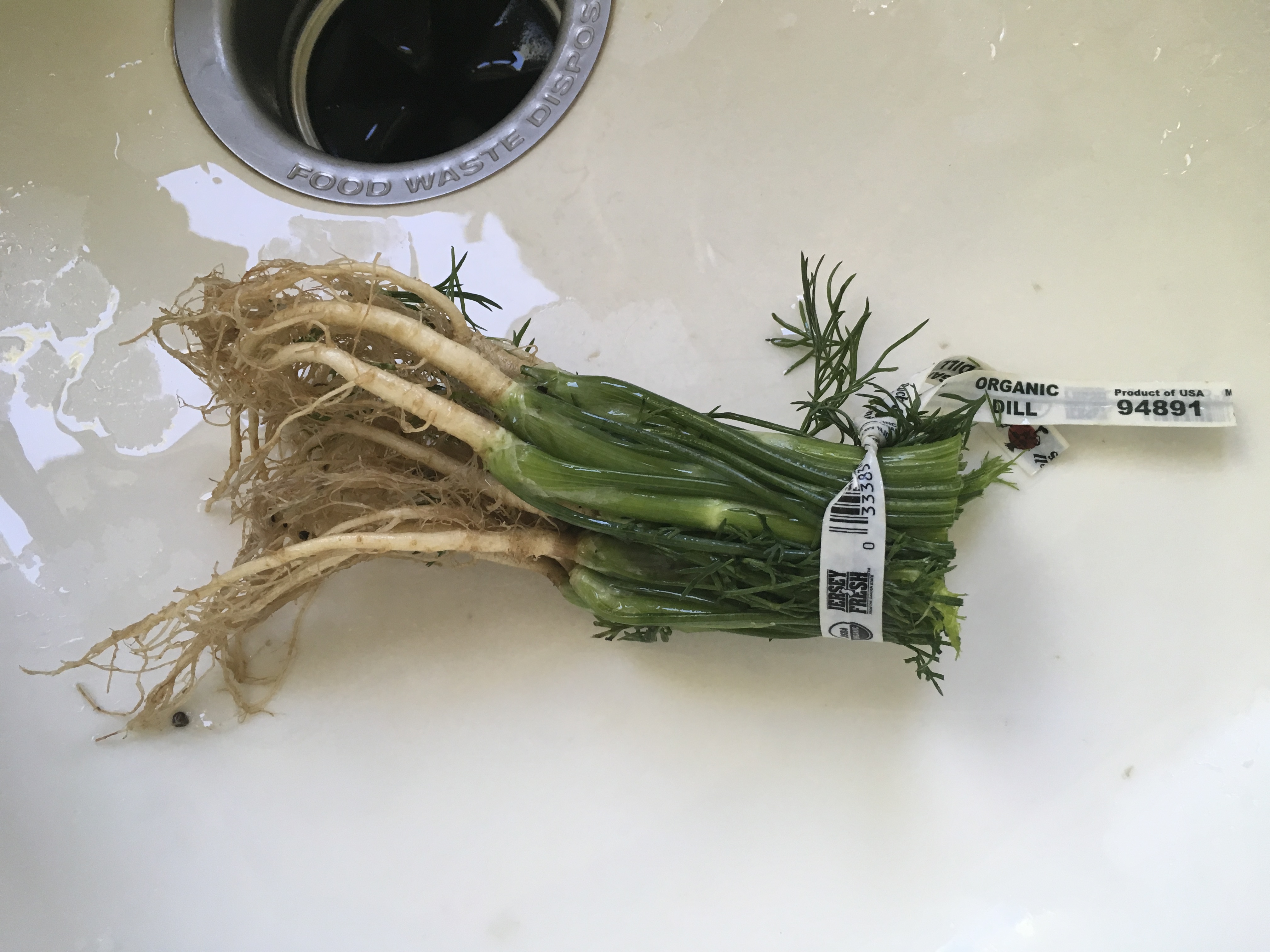
(My fresh dill bunch came with the roots intact, so I cut them off and placed them into the soil in my herb garden. New dill will sprout up quickly!)