Archive for the ‘Uncategorized’ Category

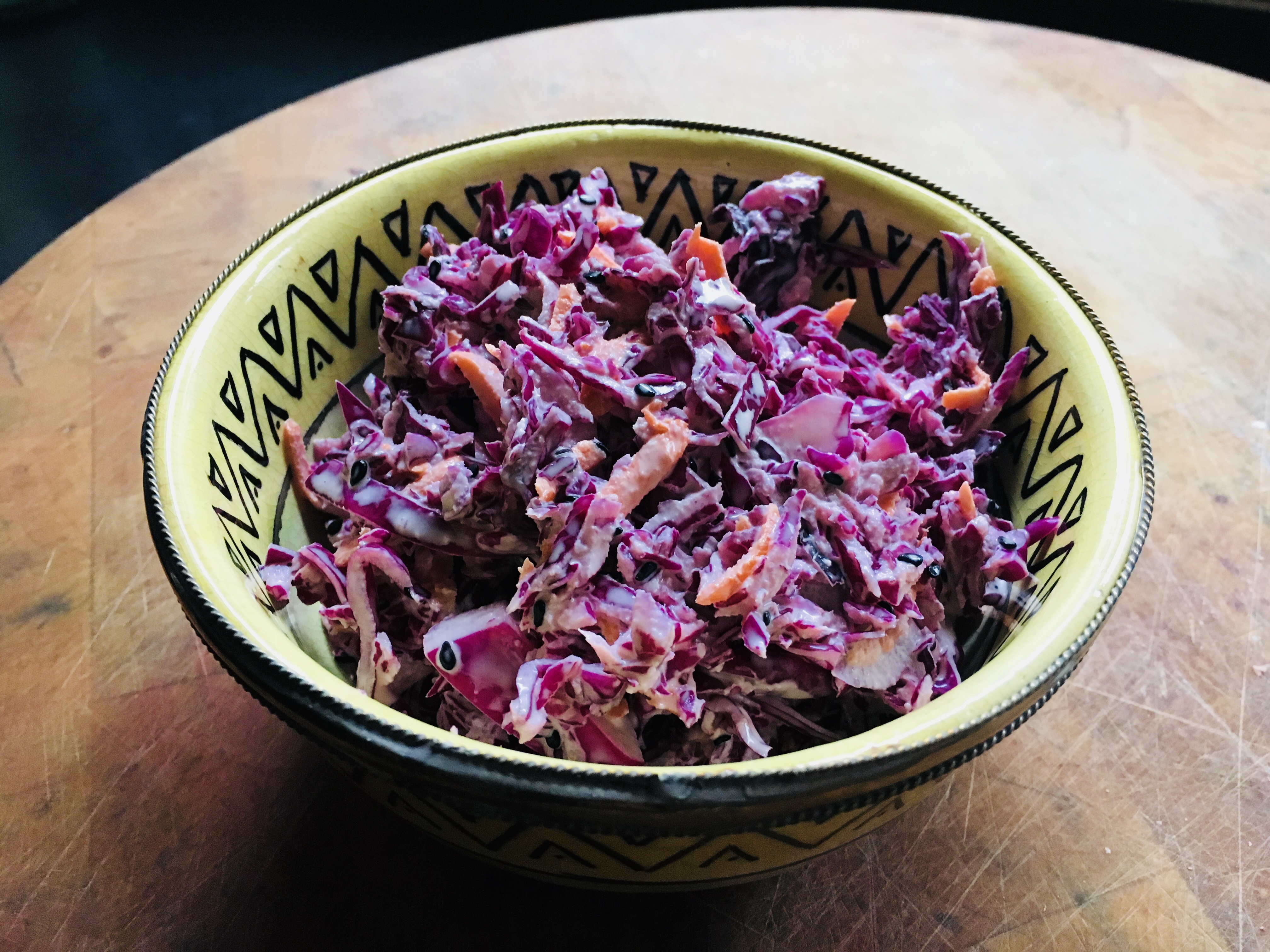
ASIAN SLAW

Posted: January 31, 2022 in Food, garden, Recipes, Uncategorized
Tags: , , , ,

I love cole slaw. It’s awesome with any grilled food, but I especially love the classic pulled pork/cole slaw combo. Stopping by the supermarket the other day, there was a beautiful head of cabbage just sitting there in the produce section, just waiting for me to take it home.

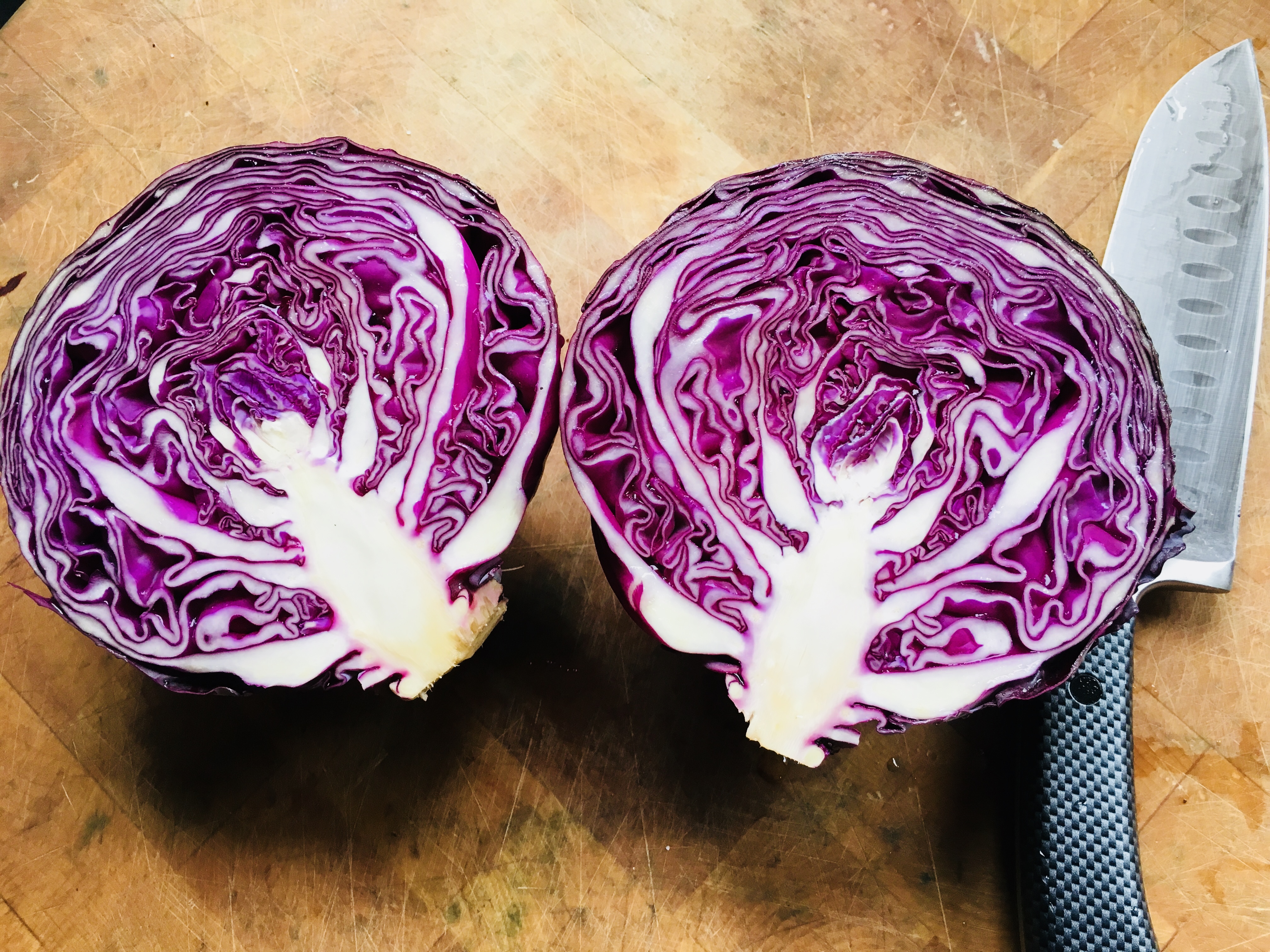
Beautiful purple cabbage, but use green if you like!


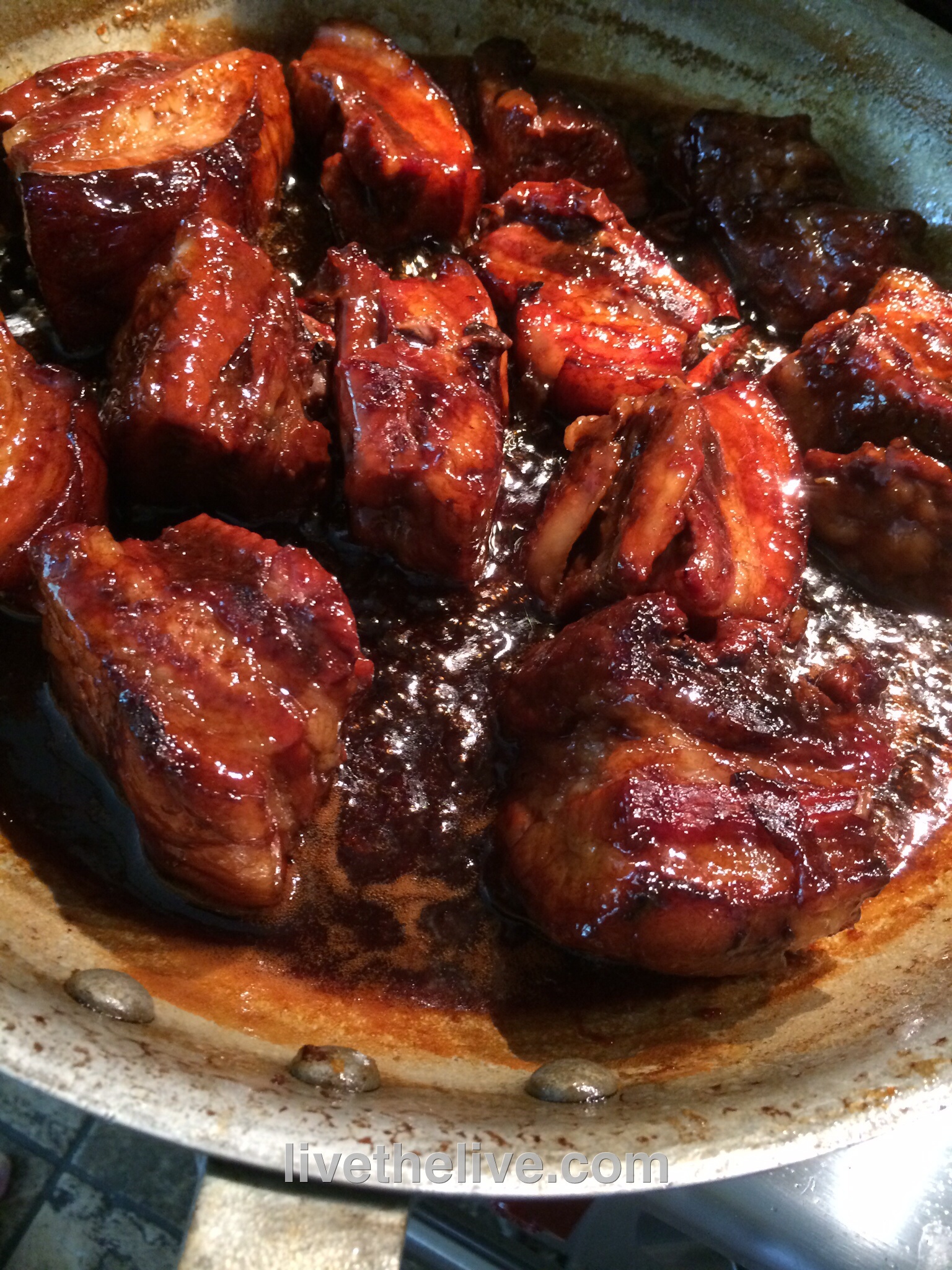
I wanted to try something different from the basic cole slaw recipe I usually make, and so I took my ingredients in an Asian direction. I think I came up with something that really rocks…and it goes great with a plate of Asian-inspired spare ribs!


Shredded veggies, ready for the dressing.


1 medium-sized head of cabbage, cored and shredded
1 carrot, shredded
1 tablespoon sesame seeds
1 cup mayonnaise
2 tablespoons rice vinegar
2 teaspoons sesame oil
2 tablespoons honey
I like to give the cabbage different textures, so I wash and then quarter the cabbage, removing the center core (which is, by the way, totally edible and was given to me by my Mom as a treat when I was a kid. Hey, it’s a Lithuanian thing.) So I hand slice one-quarter of the cabbage as thinly as I can with a knife. The other three-quarters go in a food processor to slice more thinly. I put the carrot through the machine as well. I put the veggies in a large bowl and add the sesame seeds.

Veggies and dressing mixed.


To make the dressing, in a separate bowl, combine the mayo, rice vinegar, sesame oil and honey, whisking to mix thoroughly.

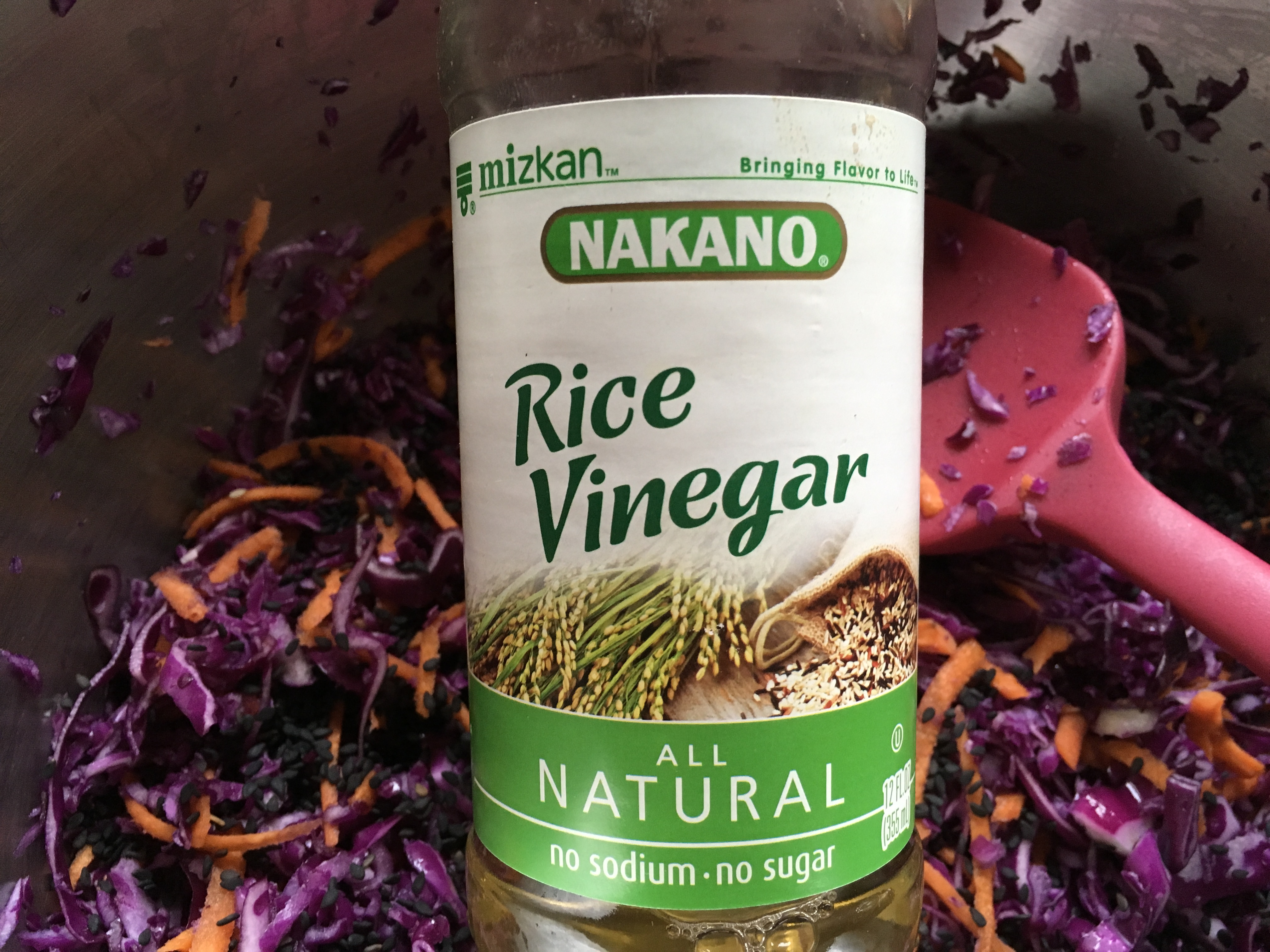
Rice vinegar is not rice wine vinegar. Make sure you use the good stuff. Here’s one brand I use.


Add the dressing to the veggies, and mix well. Refrigerate for a few hours, mixing every hour to combine as the veggies release their juices and make the slaw more flavorful and “wet.”

Here’s the perfect food to make and eat during the big winter storm coming to our area in Southern New England this weekend…


I think I spent half of my childhood in the kitchen, watching my Mom and grandmother make koldūnai (kohl-doo-nayh), the Lithuanian version of a pierogi, by hand, at lightning speed. They would roll a simple dough into a log about 1″ in diameter, then cut it into 1″ pieces, twirling each piece between their fingers to make a flat pancake, filling each with a small spoonful of meat or mushrooms, then fold it over, crimping the edges to make a crescent-shaped dumpling. It blew my mind that they could crank out over a hundred of these little masterpieces in no time, placing them on a cookie sheet and freezing them until it was time to cook.


One of the main reasons why I prefer Lithuanian koldūnai over the basic Polish pierogi is the filling. For me, standard pierogi fillings like potatoes, cheese, and sauerkraut just don’t cut it. My Mom would mix ground beef with chopped onions sautéed in butter, a couple of eggs, and milk crackers soaked in milk. She’d add salt and pepper, then spoon that beautiful beef blend into her koldūnai.

The other delicious stuffing, usually reserved for special holidays like Christmas Eve and Easter, was made from mushrooms. Italy may lay claim to the porcini, but the fact of the matter is, Lithuania is porcini heaven. And when they’re dried and reconstituted, their incredible flavor is so intense, you don’t need many of them to flavor a large amount of regular button mushrooms. We’d get our dried boletes from relatives in Lithuania every year. Mom would place a handful in some boiling water and let them steep until they swelled up and could easily be chopped and added to the other mushrooms. She’d then pour the mushroom liquid into the pan as well, not wasting a bit of that magical porcini flavor. The mushrooms were simply sautéed in butter, cooled, then used to fill the koldūnai.


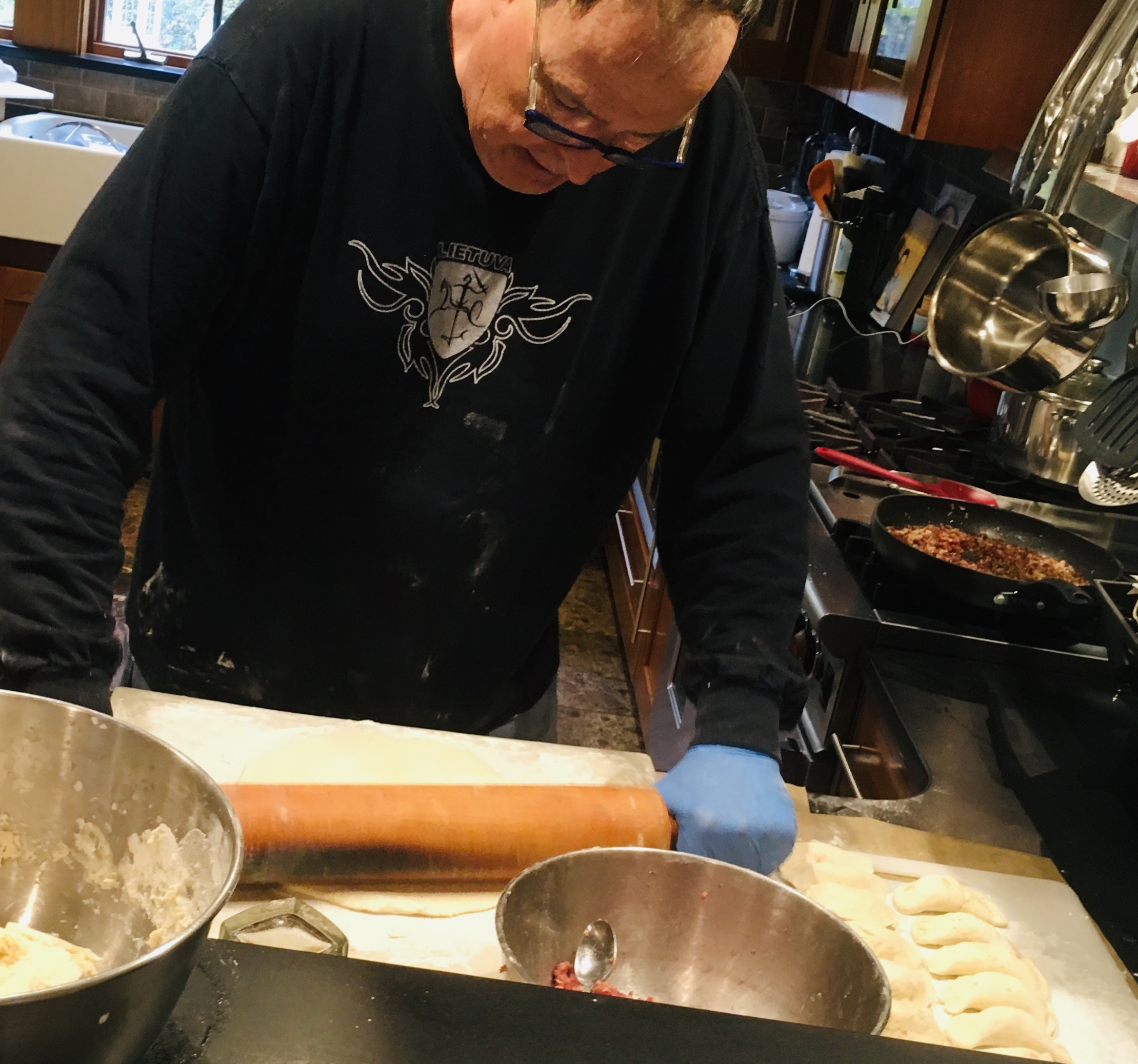
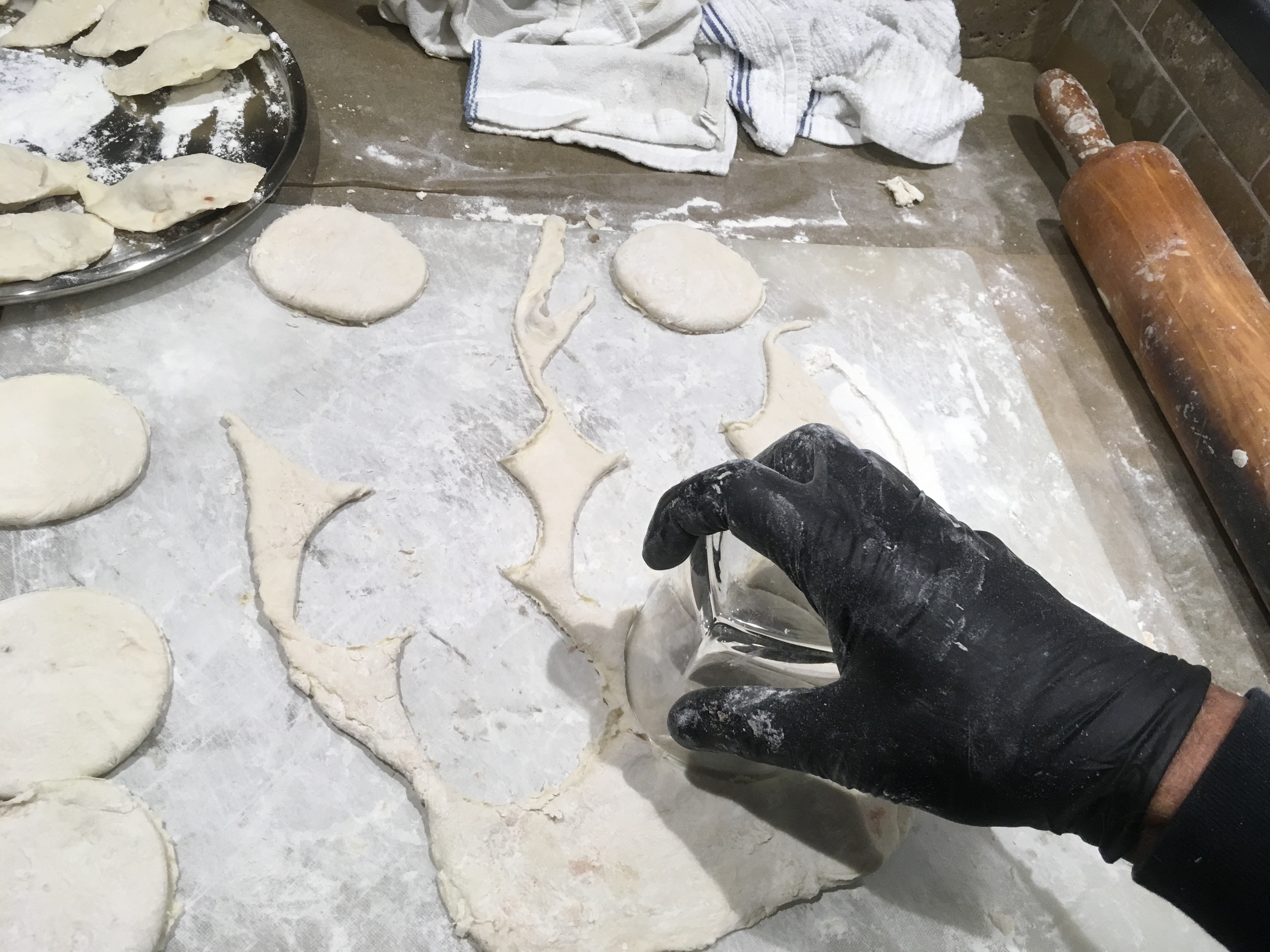
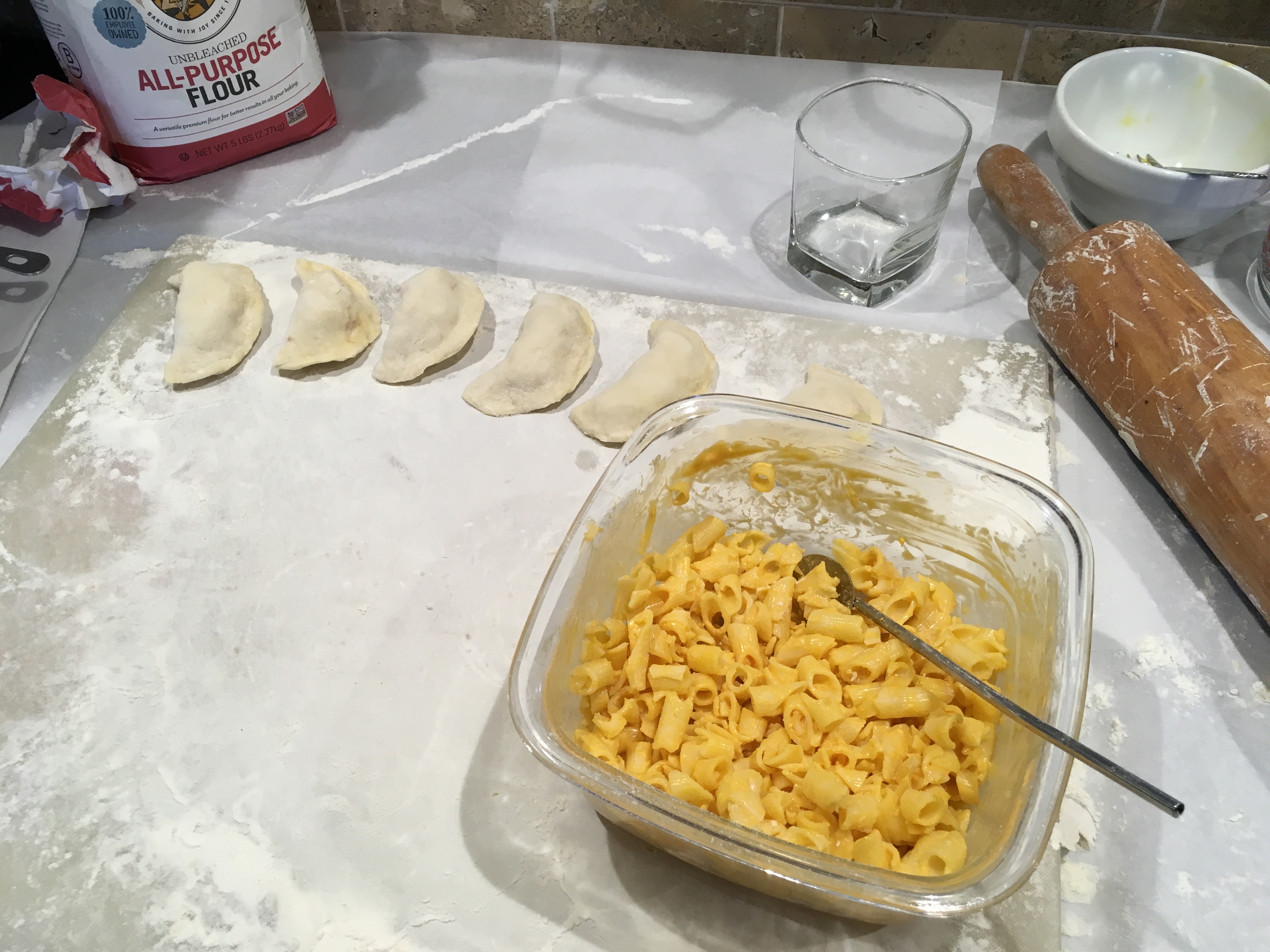
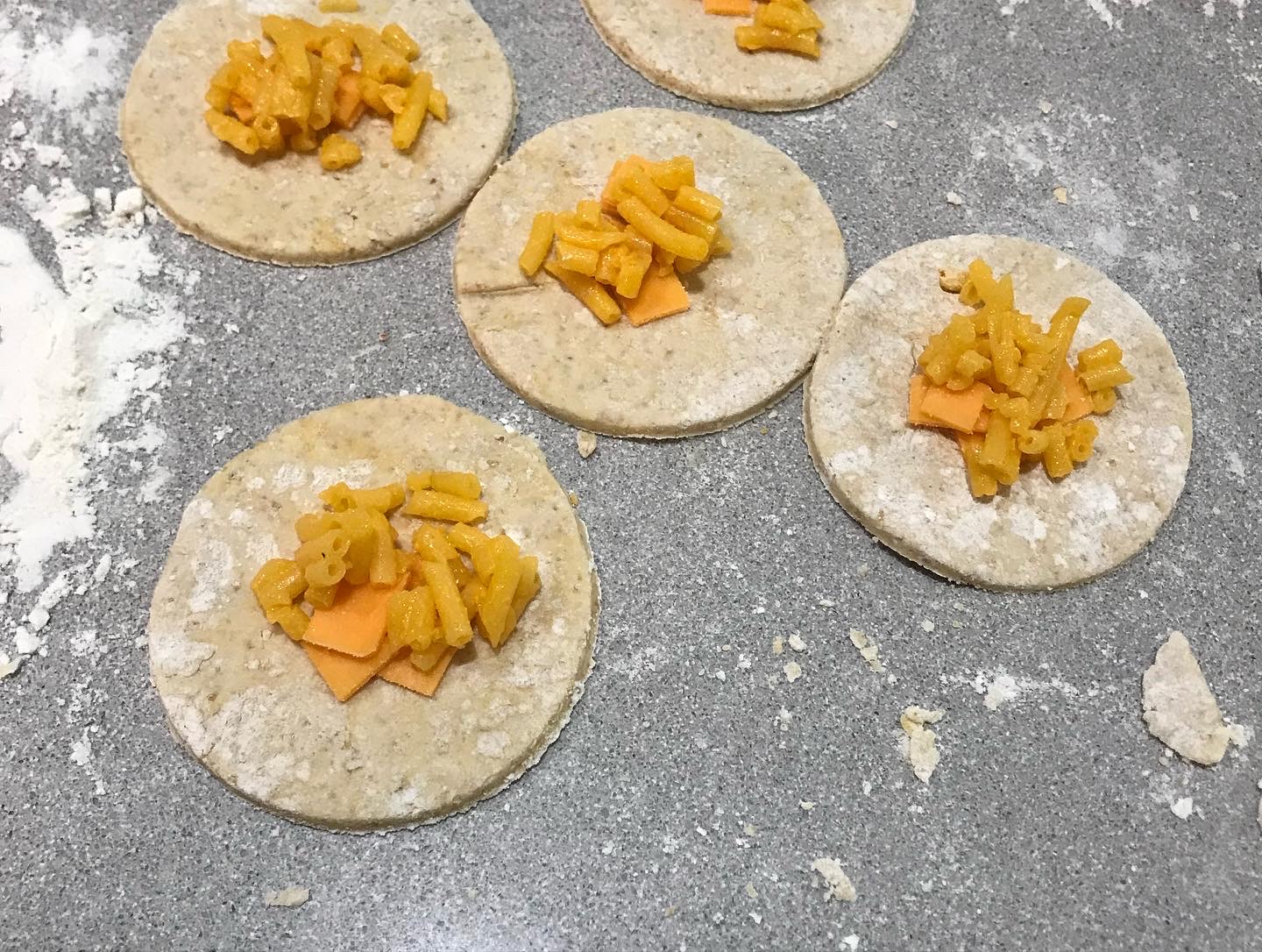
I found that my Mom’s log method was too much work. I roll the dough out into a sheet with a rolling pin, then cut circles with a glass. Yes, that’s mac-and-cheese up front!


A few years ago, I decided it was time to try my hand at making koldūnai. As I recall, my Mom simply mixed water with flour to make the dough, kneaded it into a log, and off she went. I decided to go with the rolling pin and glass cutting method, because I found it to be a bit easier creating more uniform koldūnai.

The biggest challenges I had with making koldūnai was my own clumsiness and lack of experience. Once I got the hang of it, things moved along steadily, and it didn’t take long for me to make a decent batch–not all perfect, but not bad for a first try.

My recipe follows. If you’re on a gluten-free diet, have no fear! That recipe is at the bottom of the blog.


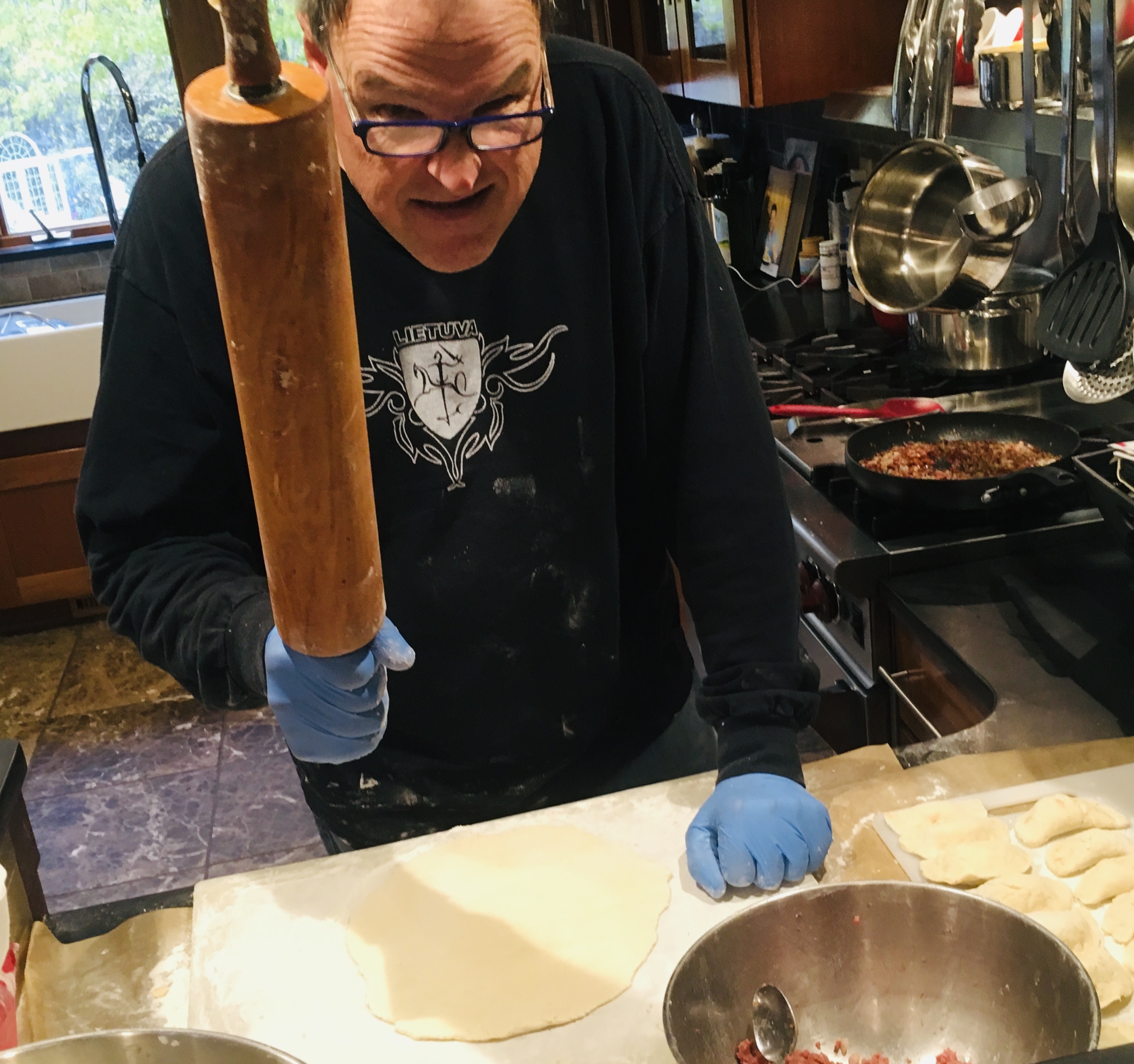
The rolling pin method.


This time around, I made four kinds of koldūnai: traditional (ground beef as well as mushroom) and non-traditional (mac & cheese and pulled pork.)  Patty’s Pierogis, a restaurant in nearby Fall River, Massachusetts, and featured on Food Network’s “Diners, Drive-Ins and Dives,” is where my daughter first had mac & cheese pierogis. She was instantly hooked and begs for them every year.

Here’s my beef recipe…

1/2 onion, finely chopped
1 pat of butter
1 lb. ground beef
1 egg
1/2 cup breadcrumbs

Finely chop the onion and sauté it in the butter until translucent. Let it cool, then add it to 1 lb. of thawed ground beef. Add the egg and the breadcrumbs. Season with salt and pepper. Mix the ingredients thoroughly and keep the meat in the fridge until you’re ready to use it.


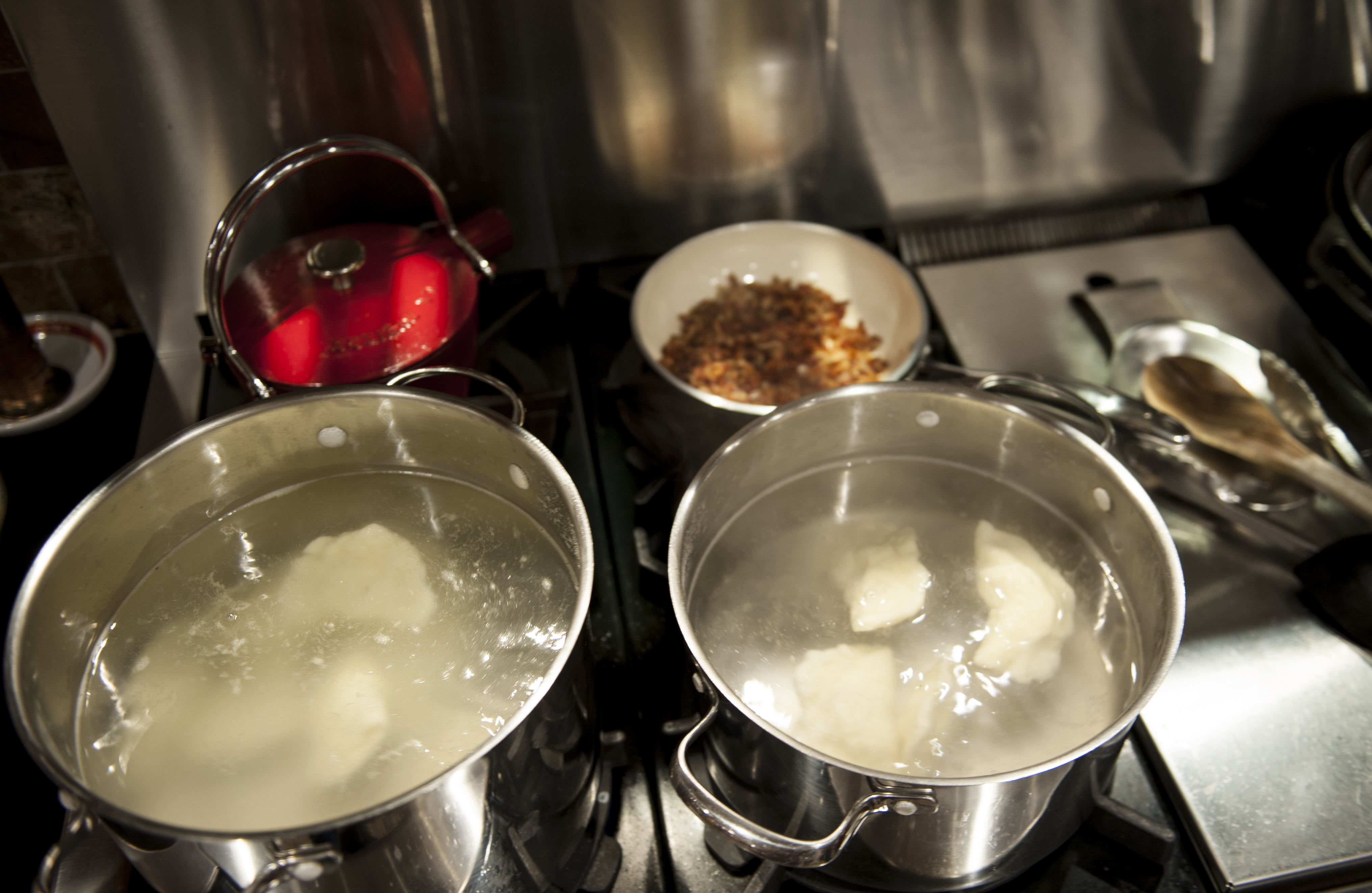
Two pots of boiling salted water: one for the meat-filled koldūnai, and one for the mac-and-cheese filled koldūnai.

Two pots of boiling salted water: one for the meat-filled koldūnai, and one for the mac-and-cheese filled koldūnai…so I don’t get ’em mixed up!


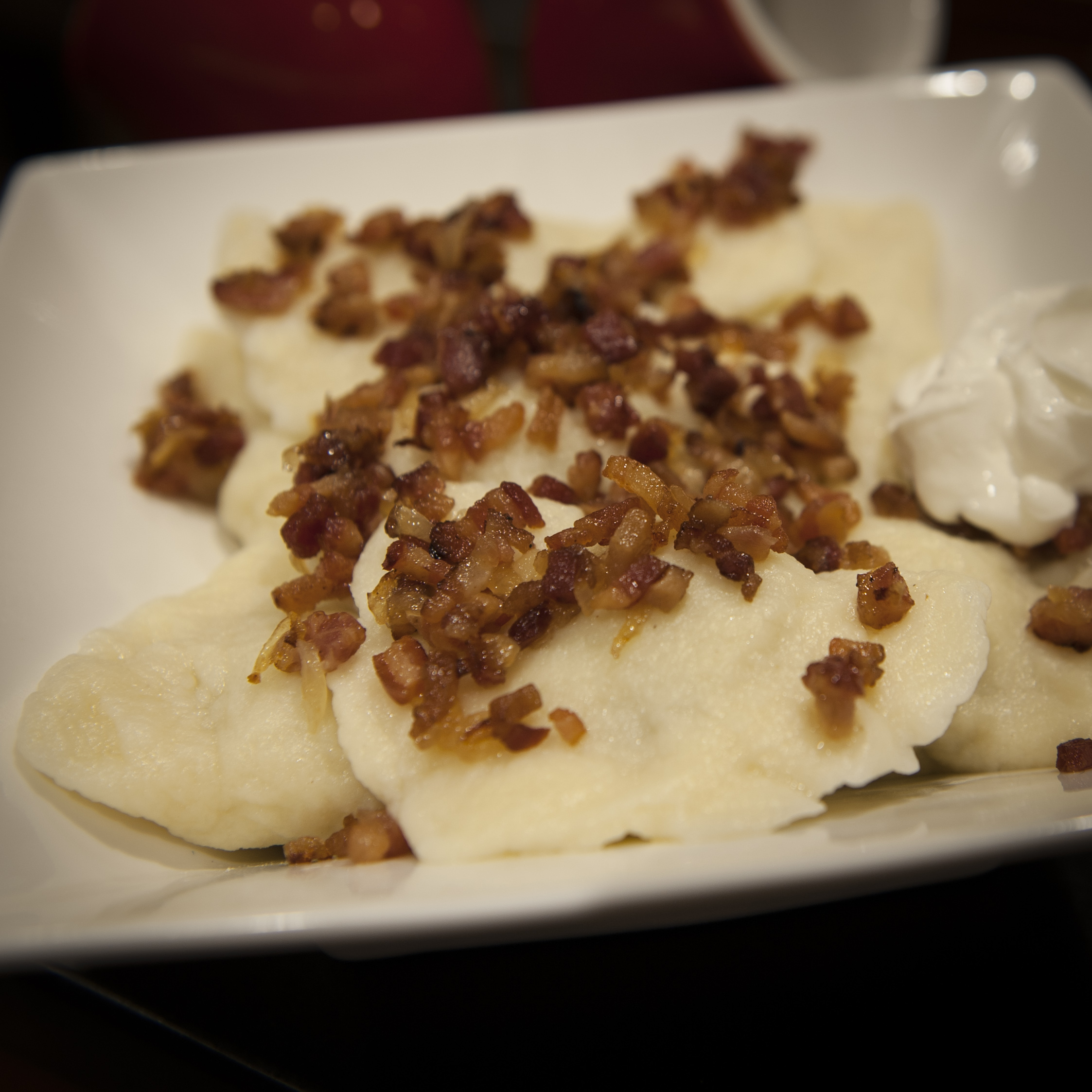
In my childhood home, you cannot possibly serve koldūnai without sour cream on the side and without spirgučiai (spir-guh-chay), chopped and fried bacon and onions, that are sprinkled on top.

1 lb. bacon, finely chopped
1 large onion, finely chopped

In a large pan, fry the chopped bacon until it’s almost crisp. Never drain the fat! Add the chopped onions and cook until they are soft. Set aside.  (My Mom always kept a stash of spirgučiai in a container in the fridge, and sprinkled them on anything and everything.)


duni 4

Making the dough is simple.

2 cups all-purpose flour
1 cup water

I don’t use salt in the dough because I boil the koldūnai in salted water later.

Combine the ingredients in a bowl, mixing with your hands. Keep adding flour in small amounts until the dough isn’t wet and sticky. When it forms a nice ball, remove it from the bowl and place it on a floured surface and knead it a bit more. Cut the ball into quarters, and work with these smaller pieces of dough.

For the rolling-pin method, roll each quarter out until the dough is about 1/8″ thick. Cut circles out of the dough using a cookie cutter, rocks glass, or whatever else you have handy. Add about a teaspoonful of filling in the center of the dough (a melon baller works great), then fold the edges over and pinch them with your fingers. Flip it over and pinch again, making sure none of the filling seeps out. A tight edge means the koldūnai won’t break open when you put them in boiling water.


Who knew a rocks glass had more uses than just to hold a great Manhattan?


Some stuffed with mac and cheese!


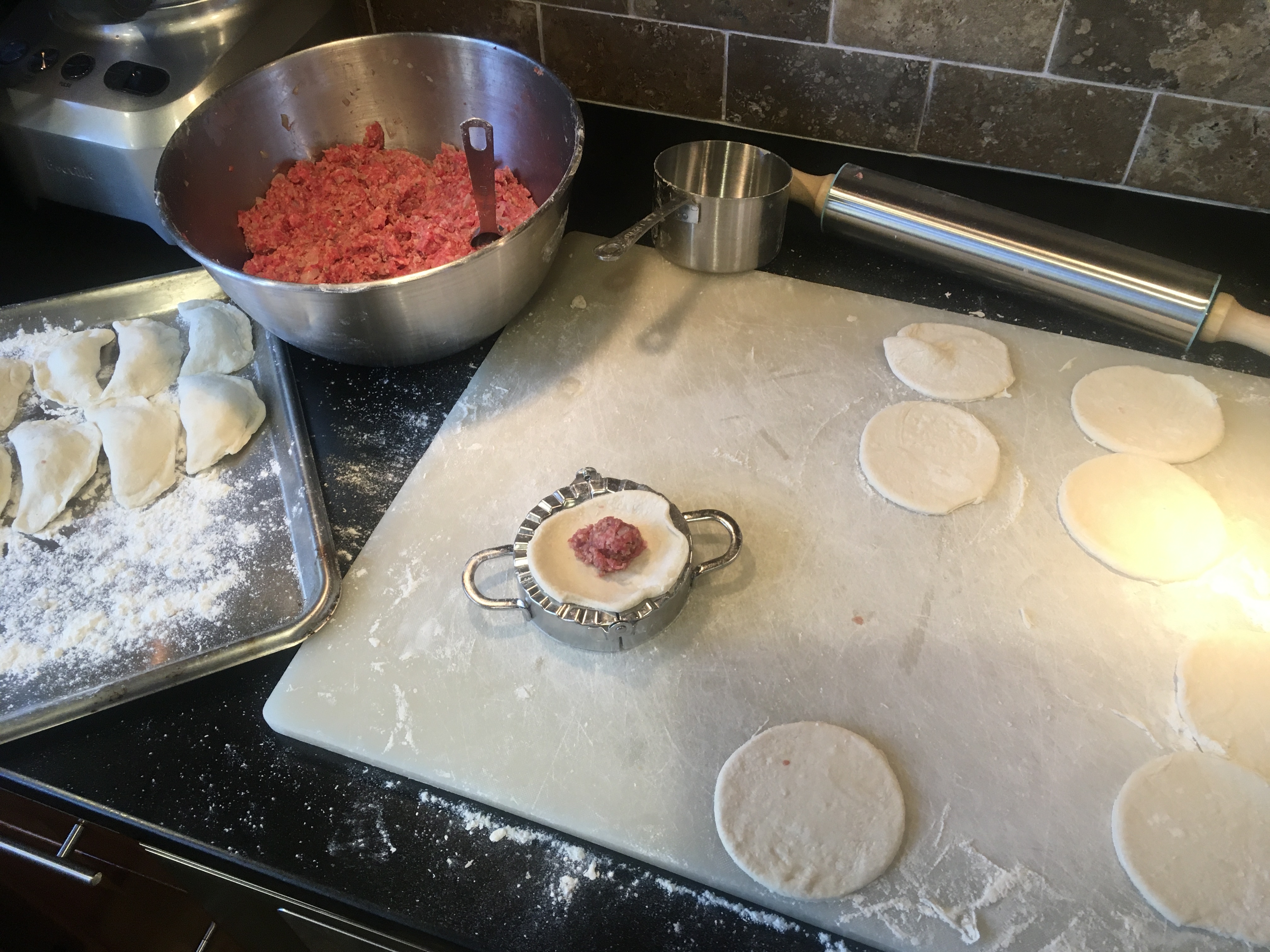
I recently discovered these “pierogi makers.” You lay the dough in them, add your filling, and then close them. They automatically crimp the edges for you. They work pretty well…sometimes.


I always double-check the crimped edges, because your koldūnai will fall apart in the boiling water if you don’t seal them well!


Place the koldūnai on a sheet pan dusted with flour, and when you’re done, place the sheet pan in the freezer.


Ready for the freezer!


Sometimes the chef gets punchy after making koldūnai all day long!


Get a large pot of salted water boiling. Drop the koldūnai in gently, being careful not to overcrowd them. If the dough is thin, the koldūnai will be ready when they float up to the surface. A thicker dough will need longer cooking. The best way to know if they’re done is by taking one out, cutting it open and having a look (and taste!)

When plating, sprinkle generously with spirgučiai, and serve with sour cream on the side.


duni 4


If you need to go gluten-free…good news! You can still have your koldūnai! The mushroom filling is already gluten-free. For the breadcrumbs in the beef filling, I take slices of Udi GF bread, toast them, and zap them in a food processor. Excellent breadcrumbs! And I use store-bought GF mac-and-cheese.


GF Mac and cheese, with a little extra cheddar.


For the dough, this recipe works great. (Thanks to my sister, who shared it with me.)


Excellent GF flours.

1 1/2 cups all-purpose gluten-free flour (I use Cup4Cup)
1 1/2 cups rice flour (I use Cup4Cup Wholesome Flour)
2 eggs
pinch of salt
water

Combine the flour and salt in a bowl. Add the eggs and mix. (I use my hands for this.) Slowly add water to the dough until it pulls from the sides of the bowl and makes a nice ball of dough. I cut the dough in half and use a well-floured rolling pin to roll it flat.


The finished product! The rice flour gives it a darker, grainier texture. A more rustic taste, but still delicious!


MAKING PERFECTLY CLEAR ICE

Posted: January 21, 2022 in Uncategorized

If you’re a cocktail fanatic like I am, you know that every ingredient counts. Most people understand that if you buy cheap booze or use a cheap mixer, the final product won’t taste good. But very few people give thought to the ice.

Bad ice makes a great drink taste bad. Plain and simple.

So the first step in making great ice is using clean water. Most tapwater does not fit the bill. Filtered water, even from your refrigerator, is a much better choice. And if you don’t have a filter at home, then buying bottled water is the best way to go. (You don’t need to buy distilled water.)

Of course, you can just go out and buy a bag of ice, but where’s the fun in that? Besides, we’re talking about making really nice big beautiful ice cubes here.…the kind that transforms your average cocktail into a beautiful work of art, reflecting the surrounding light.

You probably have all the ingredients you need to make a great ice…

A small, clean cooler with a removable top
A serrated knife
A hammer
About a gallon-and-half of clean water

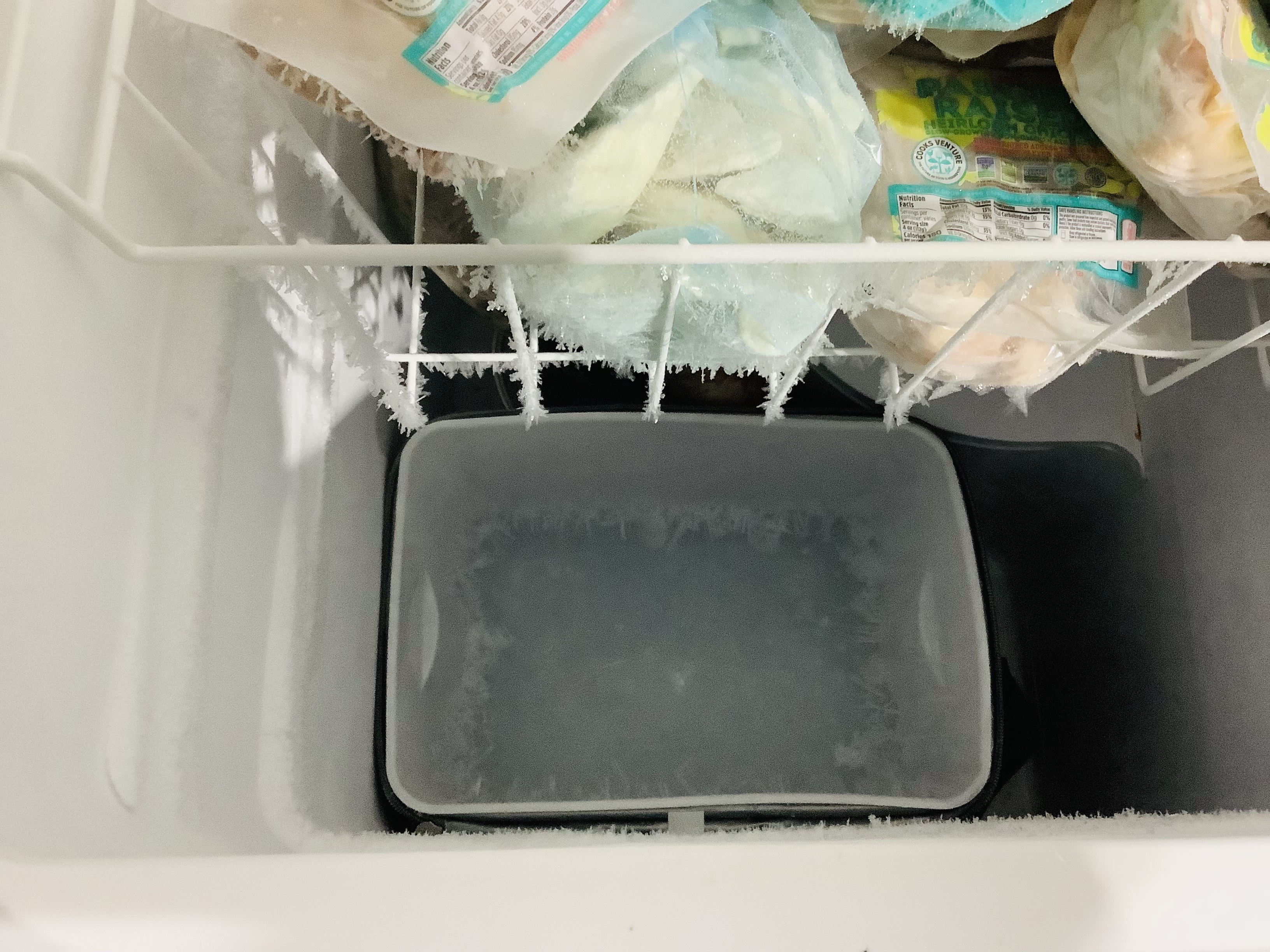
Make sure your cooler is really clean. Pour the gallon of ice water into it. Place it, with the lid off, in a freezer for 24 hours. (It’s probably a good idea to measure the cooler and measure your freezer space so you actually have the room to do this!)

Deep freeze!


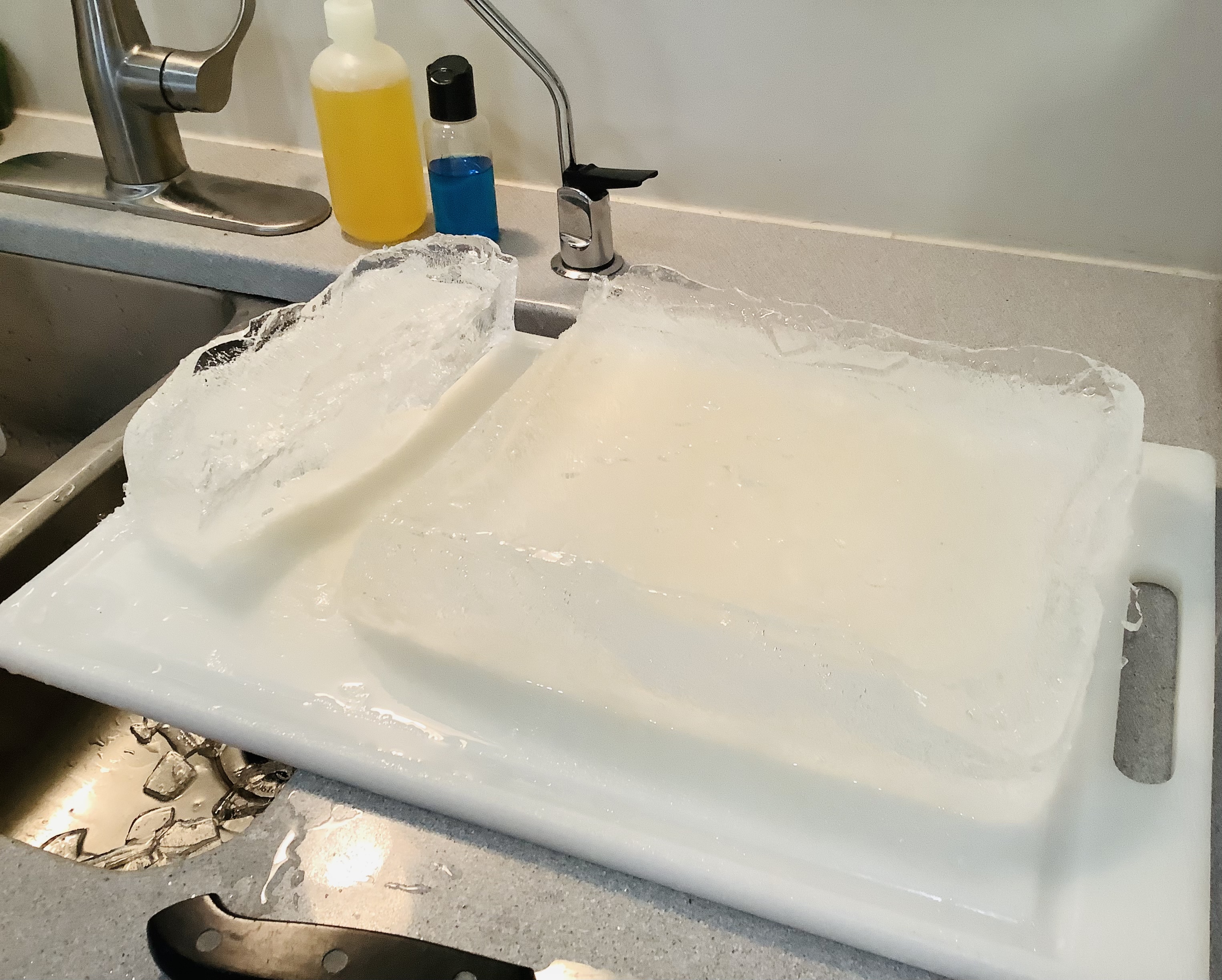
After 24 hours, remove the cooler from the freezer and flip it over onto a clean cutting board that you have placed in or above your sink.

Gravity will start doing the work as the ice slowly slips out of the cooler and lands on the cutting board with a loud clunk!

The inner liner of my cooler slipped out…and then came the ice!

There will be a bunch of unfrozen water that comes pouring out, so make sure you’ve got it positioned over the sink properly or you’ll be cleaning up a mess later on!

You now have a rectangular piece of ice that’s about an inch-and-a-half to 2 inches thick. Wipe off the shards of ice on the top of it, and using the serrated knife, carefully start sawing the ice gently to make a line. It doesn’t have to be deep.

Holding the serrated knife down on that line, get the hammer and tap the top of the knife gently. The ice will break at the line, like you’re cutting a diamond. Now take the newly cut piece of ice, turn it, and saw it with the knife again, this time to make your cubes.

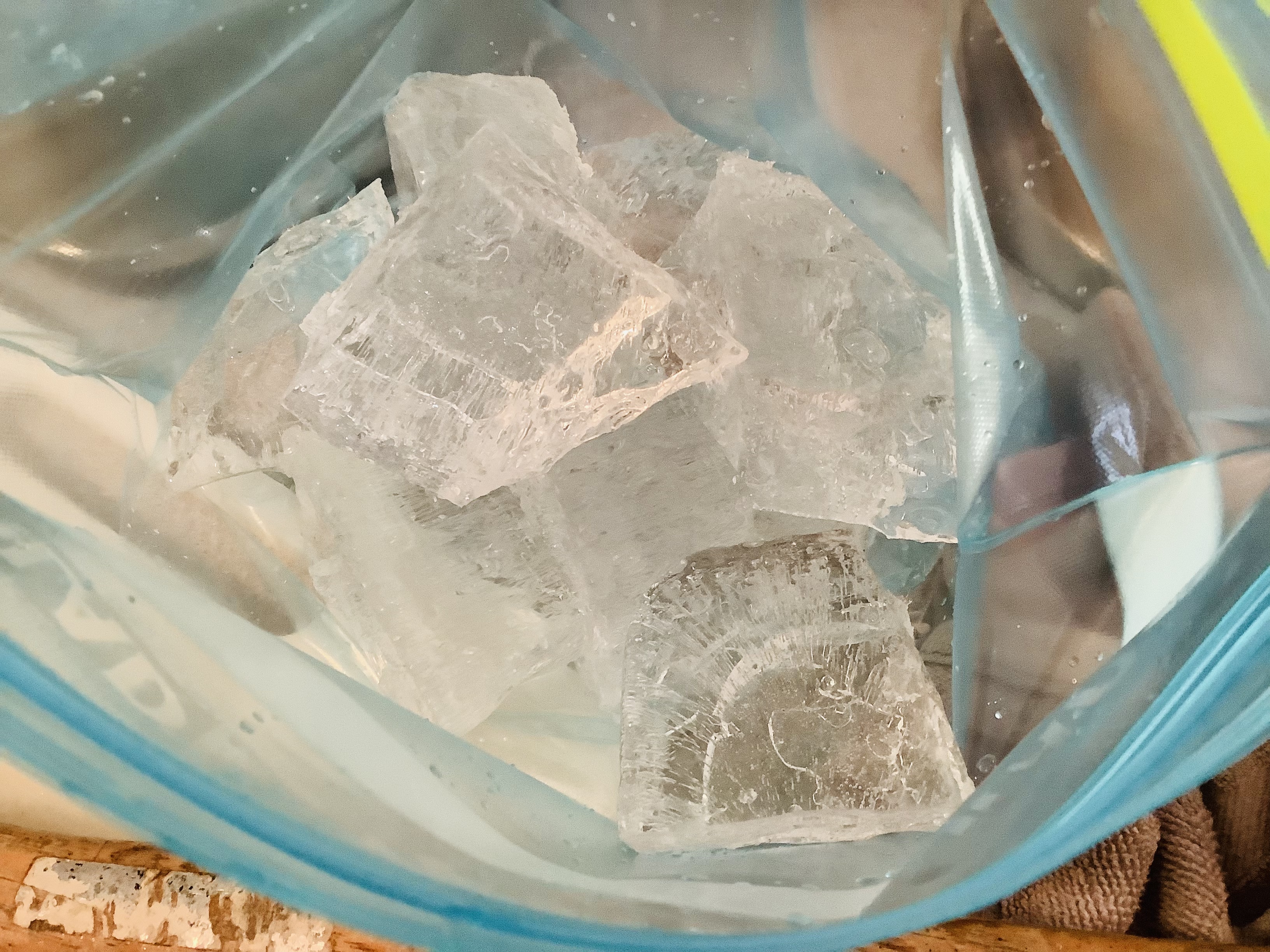
You will see that in no time, you’ve got yourself a nice amount of ice cubes. Place them in a plastic bag and back in the freezer to use whenever you have your next cocktail.

The great thing about these cubes is that they have a rustic look to them, which I find attractive. It’s as if you went out to a frozen lake and cut them yourself.

You can make a lot of ice this way in a very short period of time if you have guests coming over in a few days. Sure, the store-bought bag of ice might still be something you need for the cocktail shaker or frozen margaritas. But when you’re having a drink on the rocks, nothing beats a big gorgeous cube in the middle of it!

MY HOME FRIES

Posted: January 17, 2022 in Uncategorized

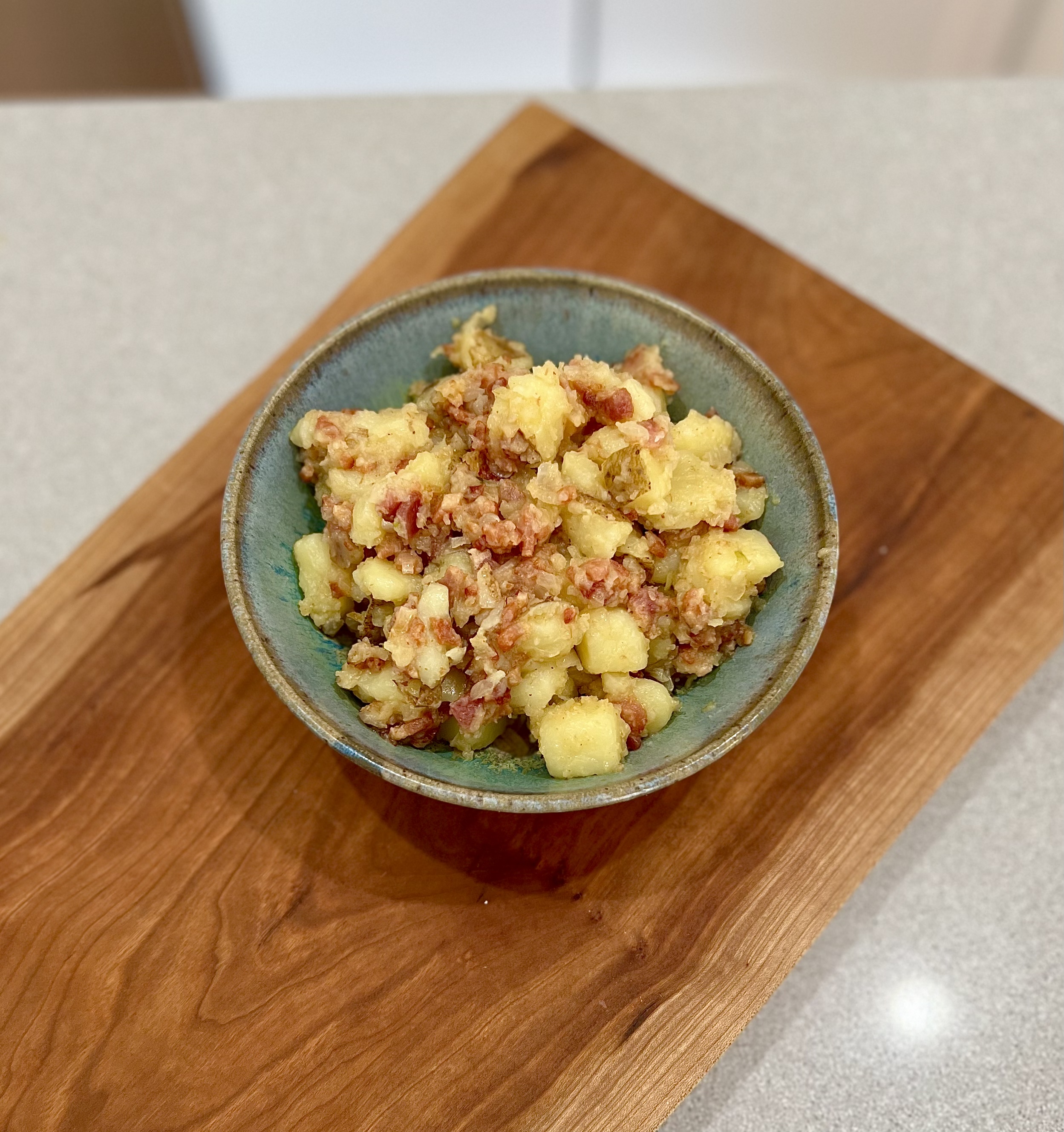
Home fries are a simple thing. But we’ve all been to a diner where the home fries they served tumbled out of a bag of frozen pre-cut potatoes, and tasted like cardboard. It’s time home fries got the respect they deserve.


Let’s get one thing out in the open from the very beginning: home fries were never meant to be low in calories! Mine are definitely not diet food! So, as you read this blog, if you’re shaking your head at the fat and calories, know that I know that you know!


3 lbs. Yukon gold potatoes, cut into approx. 1/2” cubes
1 lb. bacon, chopped
2 Vidalia onions, finely chopped
Lawry’s Seasoned Salt
2 tablespoons unsalted butter


I like my potatoes with the skin on, so I remove any blemishes on the skins, then cut the potatoes in approximately 1/2” cubes. Some can be larger, some smaller, and they don’t have to be perfect squares. The smaller pieces will cook and soften faster, while the larger pieces will retain their shape and texture.

Place the cut potatoes in a pot of clean, cold water over high heat on the stove. Add a little Kosher salt to the water. Let the potatoes cook until they are a bit al dente…a bit underdone. They will cook some more later in the pan. Drain them and set the potatoes aside.


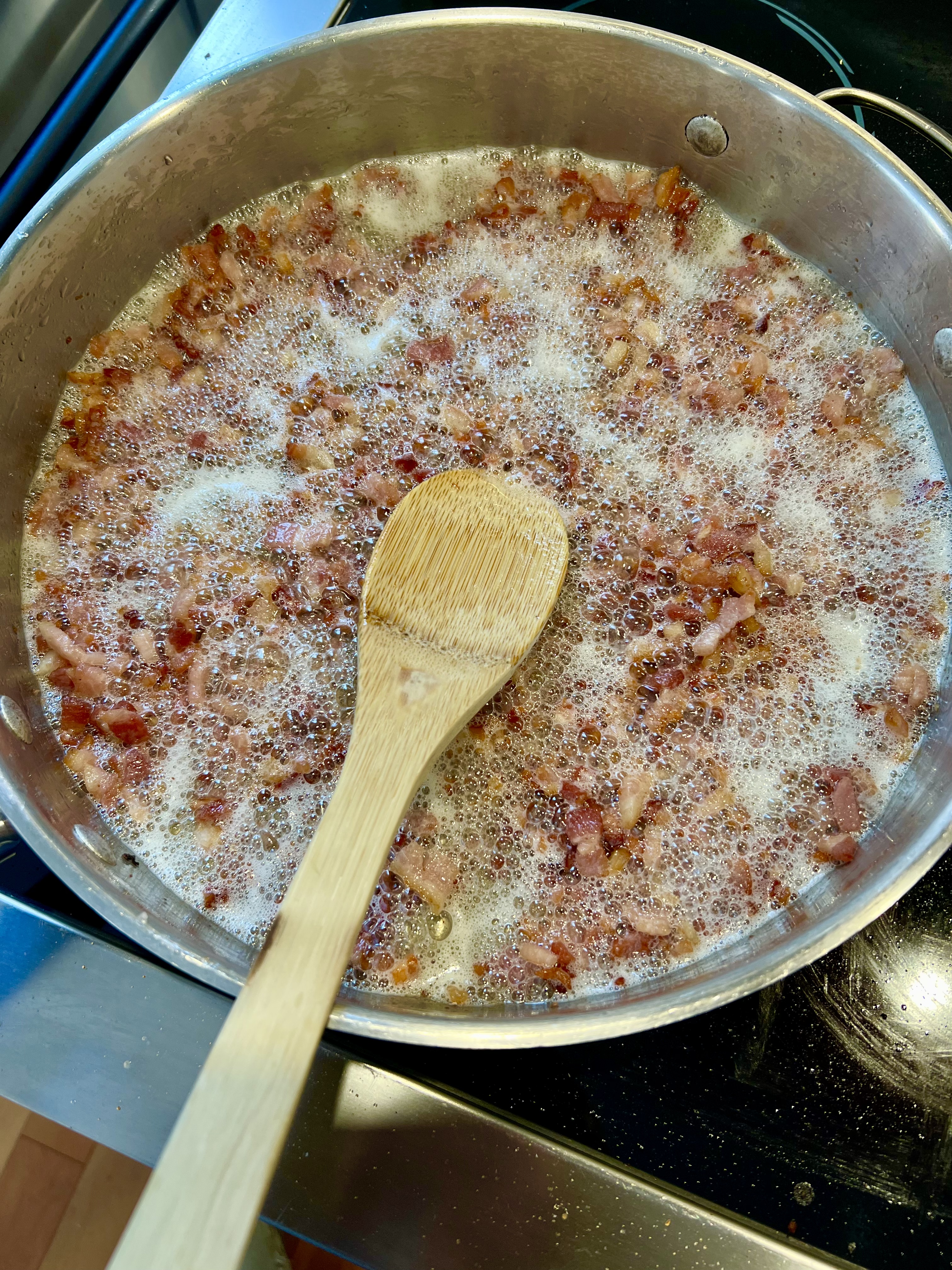
Finely chop the bacon and place it in a large pan that will eventually hold all the potatoes. Turn the heat on high and fry the bacon until it’s browned and completely cooked.

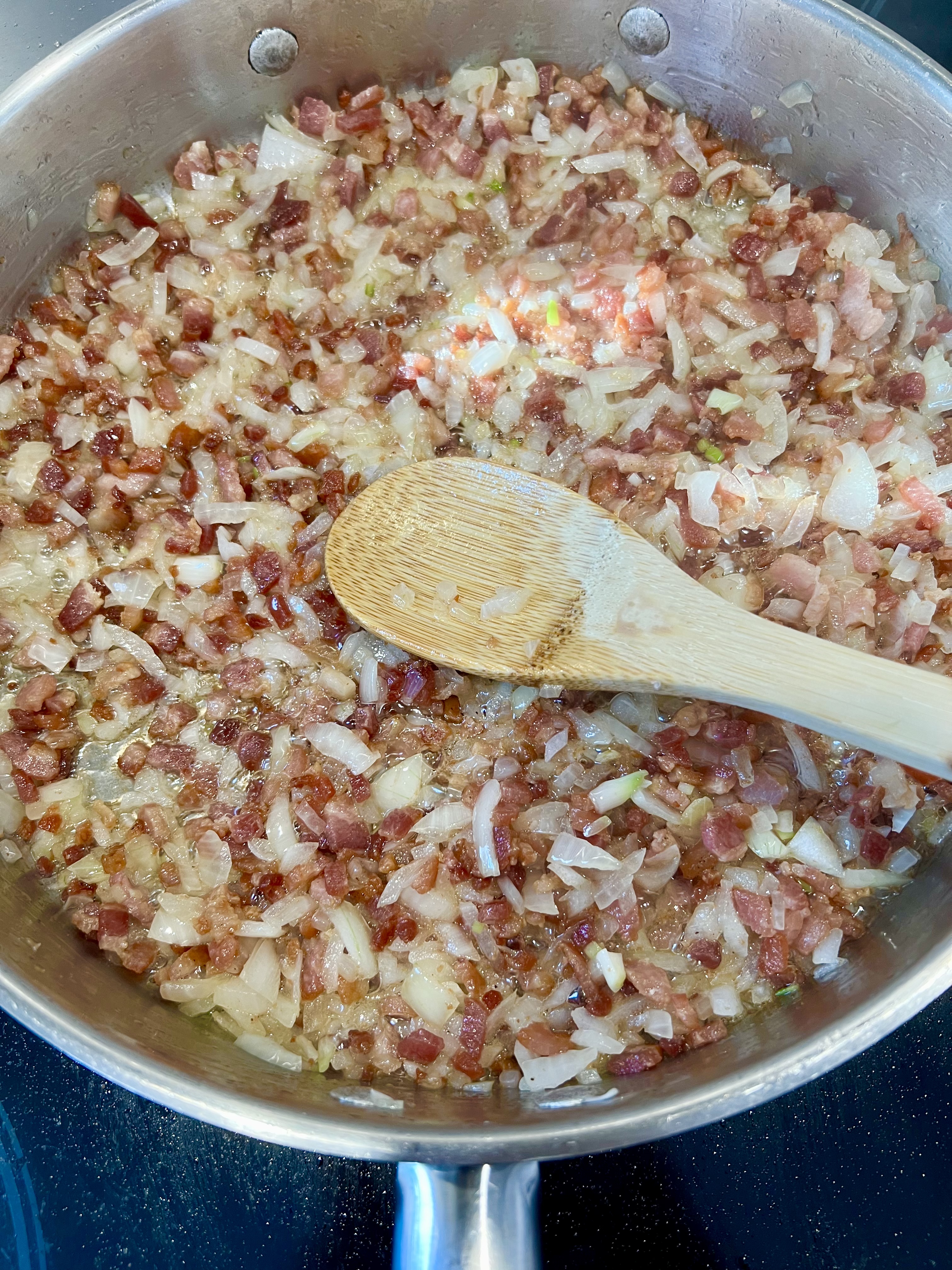
While the bacon is frying, finely chop the two onions. Add the onions to the pan when the bacon has cooked completely. Now, here’s where eyebrows are often raised: Leave all the bacon fat in the pan!


Leave the bacon fat! It’s all about flavor!

Cook the onions until they are soft and translucent.


Now add the drained potatoes to the pan, mixing well, coating the potato pieces in the bacon fat.

Lightly season the potatoes with the Lawry’s Seasoned Salt. Remember: there’s a lot of salt already in the pan from the bacon.

Cook the potatoes, mixing well, and then add the butter in small pieces, scattered around the pan. Keep mixing until the potatoes brown a little.


Awesomely delicious…nothing goes better with some farm-fresh eggs!

This cold weather always has me craving comfort food. and nothing says comfort more than Shepherds Pie!

So we started scanning through the Food Network catalog of recipes when we landed on Alton Brown’s Shepherds pie recipe. I decided to use it simply as a guide, because my daughter isn’t a big fan of lamb. (The original recipe calls for ground lamb. We went with a bottom round beef roast that I trimmed and cubed.)

And, if we’re talking about comfort food, how could adding grated cheddar cheese hurt anything?


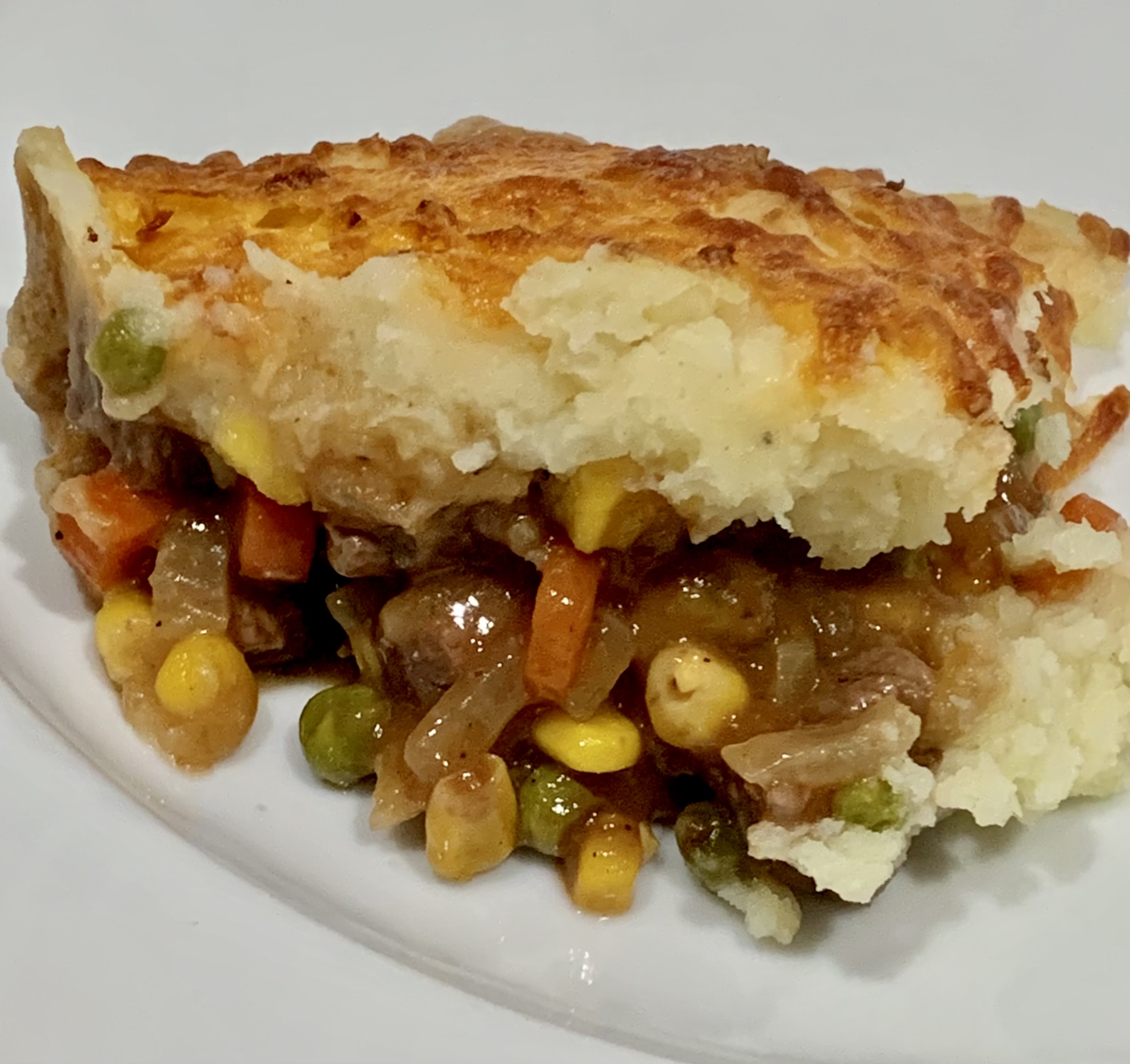
It came out absolutely delicious!

A few notes: I use organic vegetables, organic grass-fed dairy products, grass-fed beef, pastured eggs, and homemade chicken stock. These extra efforts make a difference to me, but use what you are most comfortable with and have easiest access to.

If you’re on a gluten-free diet, the only gluten in this recipe is in the all-purpose flour. Using a GF flour, like Cup4Cup, does a great job of thickening without the gluten. Feel free to substitute it.

2 oz. cheddar cheese

I start by grating the cheddar cheese. I set it aside for later.


Potatoes are the classic ingredient in Shepherds pie, but we found that sweet potatoes are a fantastic substitute. (See the photos at the bottom of the blog.) Give either one a shot yourself, or be really bold and try a combination of the two! The procedure is the same either way…

1 1/2 lbs. Russets, peeled and cubed
1/4 cup half-and-half
2 oz. unsalted butter
3/4 teaspoon Kosher salt
1/4 teaspoon freshly ground black pepper
1 egg yolk
 

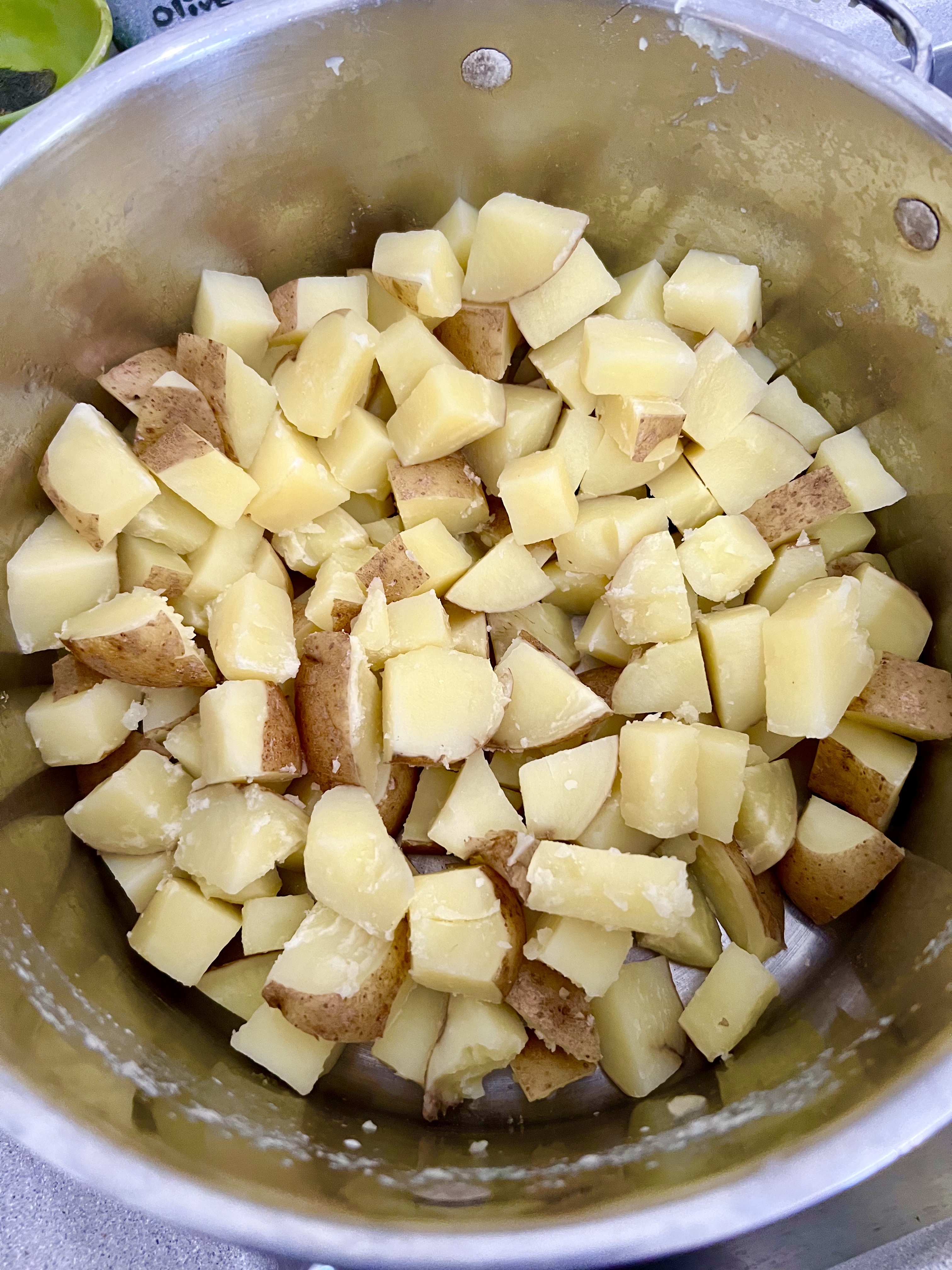
Peel and cube the potatoes and place them in a pot of cold water. Bring it to a boil and cook the potatoes until they are fork-tender.
While they are boiling, place the half-and-half and butter in a microwave safe bowl and zap them for 35 seconds to warm them up.
Once the potatoes are done, drain them and place them back in the pot. Add the half-and-half and butter and mash really well. Add the salt and pepper and continue mashing. Finally, add the egg yolk, mixing quickly and thoroughly. Then set the potatoes aside.

You will need two separate pots if you’re doing a part potato, part sweet potato combination. And, of course, mixing the potato with the sweet potato is also a tasty choice.


The meat filling…

2 tablespoons bacon fat (or your favorite oil)
1 cup chopped onion
2 carrots, peeled and diced small
2 garlic cloves, minced

1 1/2 lbs. beef, cut into 1/2″ cubes
1 teaspoon Kosher salt
1/2 teaspoon freshly ground black pepper
2 tablespoons all-purpose flour
2 teaspoons tomato paste
1 cup chicken broth, preferably homemade
1 teaspoon Worcestershire sauce
2 teaspoons freshly chopped rosemary leaves
1 teaspoon freshly chopped thyme leaves
1/2 cup fresh or frozen corn
1/2 cup of fresh or frozen peas

Preheat the oven to 400°.

While the potatoes are cooking, prepare the meat filling.

Place the bacon fat or oil in a pan and set it on medium high heat. Add the onions and the carrots and cook until the onions are translucent. Add the garlic and stir.
Add the beef and the salt and pepper and cook until the meat has browned nicely.
Sprinkle the meat with the flour, and mix to combine, cooking for another minute.
Add the tomato paste, chicken broth, Worcestershire sauce, rosemary and thyme, and stir to combine.
Bring this to a boil, reduce it to a simmer, and cook it for about 10 minutes, until the sauce has thickened nicely.

Add the corn and the peas to the meat mixture, and then pour it all into a baking pan. ( I used a 9-inch round metal baking pan that was about 3 inches deep.)

Spread the mashed potatoes on top of the meat mixture. If you use the mashed potatoes all around the edges, it seals the meat mixture in, and prevents bubbling over and messing up your oven. A rubber spatula makes this job easy.

Place the pan on a parchment-lined baking sheet (to prevent spills), and in the oven to bake for 15 minutes.

After 15 minutes, remove the pan and sprinkle the grated cheddar cheese on top of the potatoes. Then return the pan to the oven for 10 more minutes, until the cheese has melted and created a beautiful golden crust on top.

Remove the pan from the oven, placed it on a wire rack, and let it cool at least 15 minutes before serving.


As I said earlier, sweet potatoes make a great substitute for regular potatoes. Give them a try!


And if you like both mashed and sweet potatoes…


THE DIET RETURNS!

Posted: January 3, 2022 in Uncategorized
Tags: , , ,
“You’ll never out-exercise a bad diet.”
That’s not my quote…but it’s absolutely true.
I re-started this diet couple of months ago, in early November, to counteract the weight gain that I knew would happen with the upcoming holidays. I decided I would not punish myself for over-eating during Thanksgiving, Christmas, and the new year, if I just stuck to this diet on the days in between. And it really did help.
My weight this morning was exactly what it was in the beginning of November. That may not sound like a success, but had I not dieted in between the holidays, I would easily be 10 to 15 pounds heavier right now.
But now, it’s time to get back to it, and lose some real weight. This diet has been extremely successful for me in the past, and as long as I stay with it, it will succeed for me again this year!
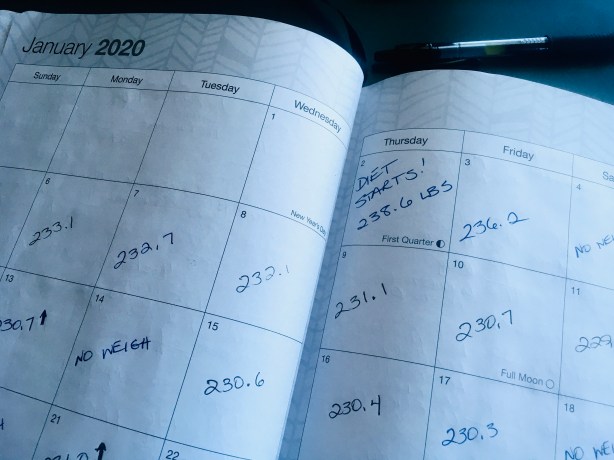
I started in 2020 at 238. I got down to 213! But the key was to write everything down: my weight, and exactly what I ate. It takes determination, but it works.

After seeing my blog posts featuring ribs, pastas with cheese, huge roasts, and cheesecake, I had several friends ask me how I didn’t weigh 500 pounds! My answer was simple: I cook everything. I just don’t eat everything. That’s what this diet is all about. I might cook a large portion, but I eat a small amount of it, portion out the rest of it, and put it in my freezer for another day. I also share it with family and friends, who are more than happy to oblige!
When I was young, I was rail thin and could eat anything I wanted without gaining a pound. When I got older, my metabolism slowed down, but my love of food did not–in fact, it probably increased, as I learned how to cook really well.

OMG…that was one skinny dude!

Now, here I am, writing a food blog. I travel for food. I plan six meals ahead at any given time. I’ll be 64 in March, and I have a 15-year-old daughter. Do the math, and you’ll realize, like I did, that I need to take care of myself to be around for as many of her upcoming life events as possible.
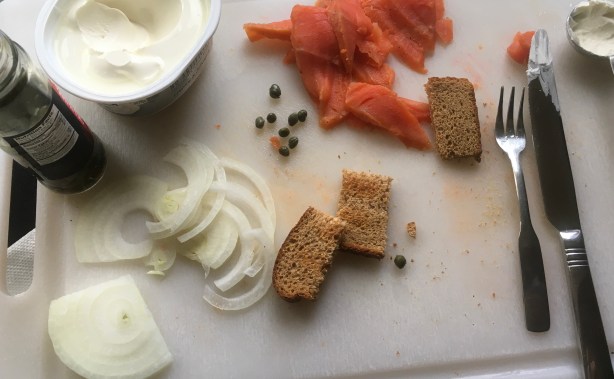
My version of lox and bagels: home-cured wild-caught Alaskan salmon, whipped cream cheese (fewer calories), onions, capers, and toast pieces. Lots of tasty bites here. (A sliced, hard-boiled egg would only add 70 calories.)

There are a million diets out there, and everybody claims they have the secret to weight loss. But no matter what diet you’re on, what it really boils down to is the simple mathematical equation of calories in…versus calories out.
My buddy, Lee, a PhD in chemistry, and someone that dropped 50 pounds a couple of years ago, told me about an article written by an engineer that lays out the basics. You can find it here:
As he states, losing weight is simply thermodynamics: you need to eat less calories than your body burns every day. If you do that, you will lose weight. Those diet pills that claim to burn your body fat, allowing you to lose 17 lbs. in a week, are about as believable as that con man, Dr. Oz, himself. You didn’t gain the weight overnight. So anyone that tells you you can lose it overnight is full of it.
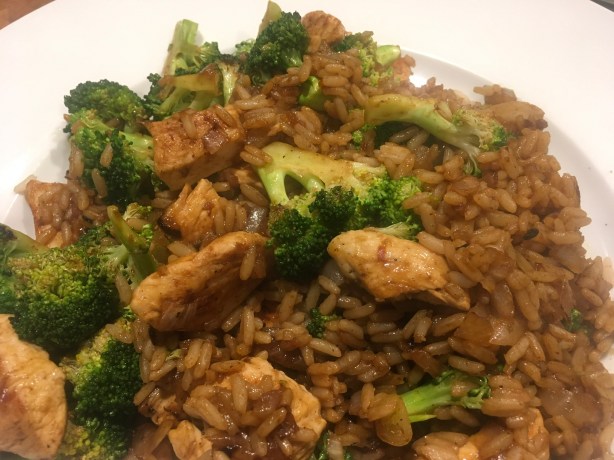
My stir-fry has chicken breast, broccoli, white rice, some onion, and my “Asian Mix” of flavors: soy sauce, hoisin sauce, chili garlic sauce, and sesame oil. My trick to add flavor to the rice without calories is to add homemade chicken broth instead of water when cooking.

There is a way to find out approximately how many calories a day your body uses to maintain its weight. It’s called the basal metabolic rate, or BMR. In my case, I need about 2500 calories per day to maintain my weight. So, like my friend Lee, I chose a diet where I eat no more than 1500 calories daily…a deficit of 1000 calories per day.
At the end of 7 days, I have eaten 7000 fewer calories than my body uses. Since about 3500 calories make 1 pound, I should be losing 2 pounds per week, according to this math.
Now, there are many variables to this, but basically this thought process holds true.
And the best part is: is doesn’t matter what I eat. If I want to eat bean sprouts, great. If I want Taco Bell, fine. As long as I don’t go over 1500 calories a day, it doesn’t matter what I put in my gut. This is really helpful for people like me, who get bored of eating the same old stuff day after day–a sure-fire way to give up on a diet. Carbs, fats, meat, dairy–even alcohol…all OK within those calorie limitations.
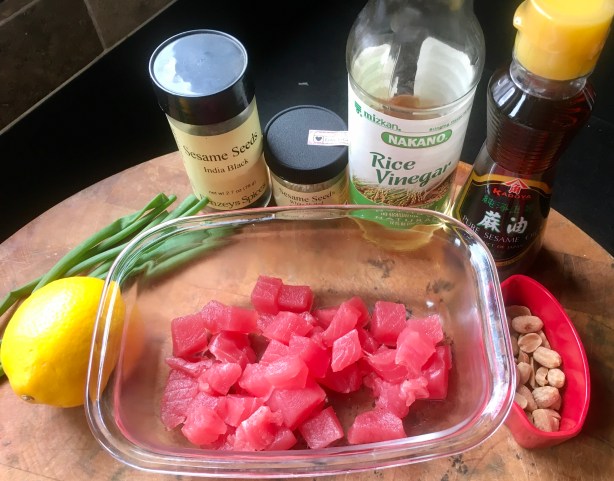
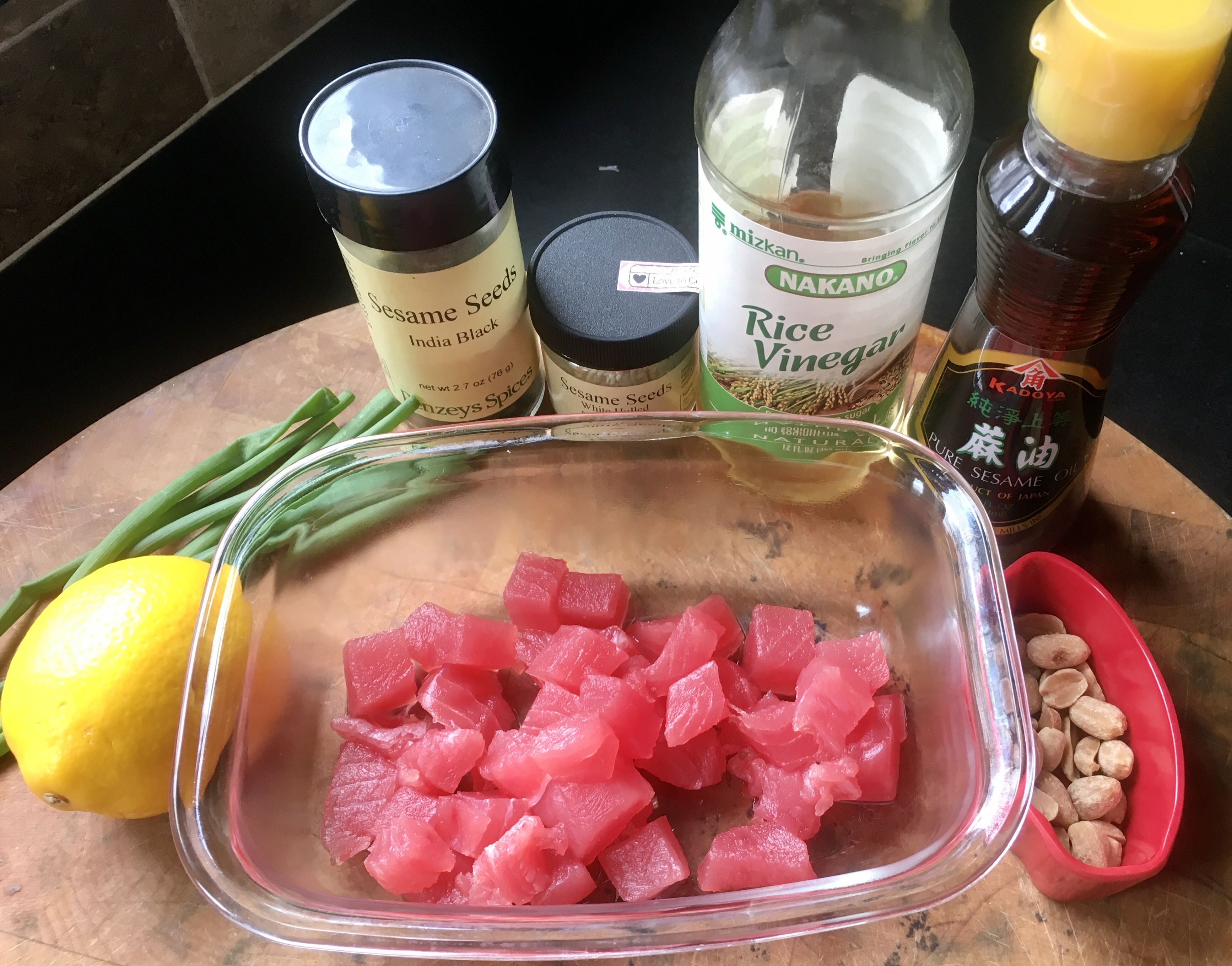
Fish is an excellent source of protein, and I never ate enough of it. Now, I make a bowl of tuna poke pretty often, and it’s absolutely delicious!

My buddy, Lee, is a diabetic, and stays away from carbs. He eats lean meats, seafood, and vegetables. That’s how he lost his 50 pounds. His son, on the other hand, lost weight by eating mostly fast food, but still counting the calories and not eating more than 1500 of them per day. He also lost 50 pounds.
I’m not a big junk food person. I don’t buy cookies, cakes or chips. Ice cream (my kryptonite) is a rare treat. I don’t put sugar in my coffee, and I don’t drink juices or soda. And I don’t like beer! But my biggest weight-gain mistake was thinking I could use unlimited amounts of so-called “healthy fats” in my recipes. I was pouring olive oil over everything…spreading pork leaf lard everywhere…and buttering my butter! Now I measure everything, drastically reducing my fats, and I can’t believe how many calories I’m saving!
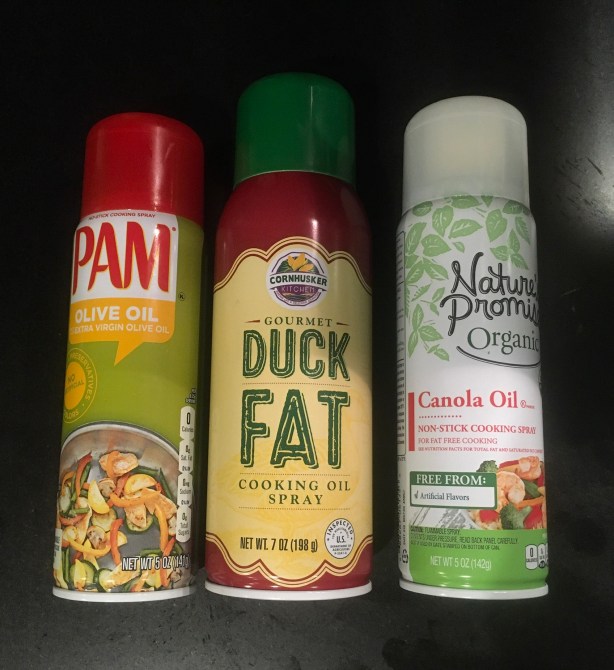
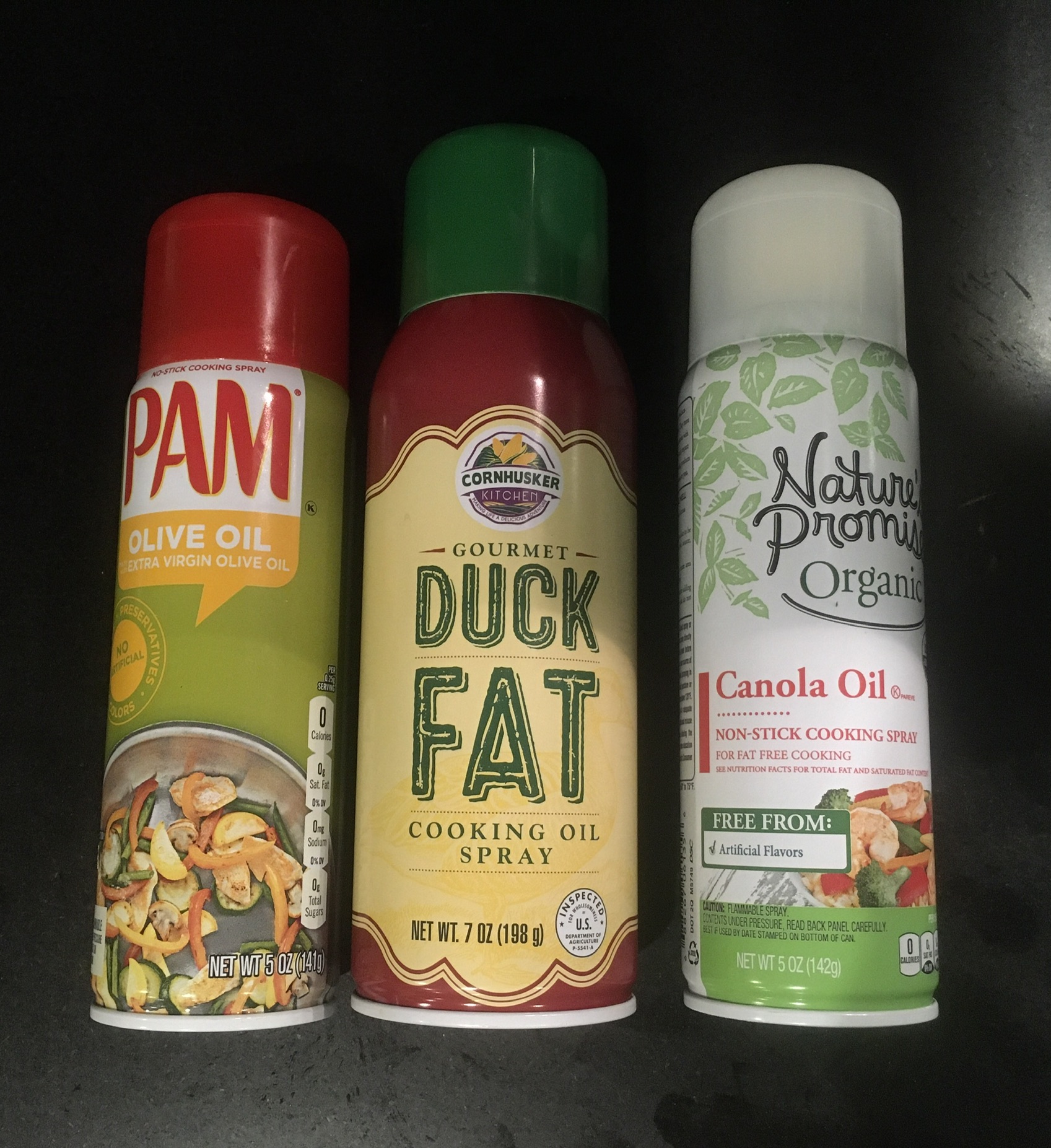
Sprays can be extremely helpful in keeping your calories low. Just be careful: they say “zero calories,” but that doesn’t mean you can spray a ton in your pan! Regulations allow them to say “zero” if a single serving is less than 1 calorie. That’s why a single serving here is a spray of about 1/5 of a second! (Seriously!)

Portion control is essential. I’ve found that I really don’t have to change many of my recipes in this livethelive blog, which is all the food I love. I just have to control my portion sizes. For example, a ribeye may be a delicious source of protein, but it’s also loaded with fat. (That’s why it tastes so good!) So now I only eat a small, 4-ounce serving at mealtime, not the 12-ounce (or larger!) slab I was eating before.
In 2020, when I started my 1500-calorie-a-day diet, I was bloated from alcohol, salt, fat, and simply eating too much rich food. But once the diet really started rolling, I could step on the bathroom scale and see the bloat was diminishing, and rather quickly. At this point, it’s easy to deceive yourself in thinking that this is “real weight,” when it’s not. It’s just your body reaching its natural plateau. But that’s OK. When you see the weight go down, even by a tenth of a pound a day, it gives you the incentive to continue.
After about a week of bloat loss, the real diet and weight loss began.
The human body is full of constant change. So even once I started and steadily maintained my 1500-calorie-a-day diet, Lee told me not to expect to be dropping 2 pounds per week like clockwork. Some weeks, my body will retain more water, perhaps from eating too much salt. Some days, I’ll go to the bathroom more, some less. My bathroom scale itself may be off by a little, too. So what I see when I step on the scale needs to be taken with a grain of salt (pardon the pun.) On any given day, my weight can actually be plus or minus 2 pounds (or more) of what my scale shows.
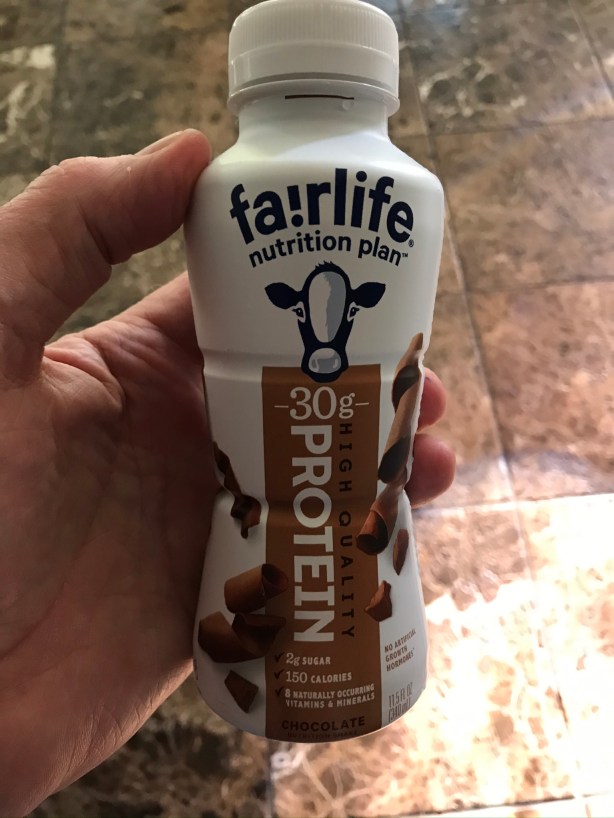
Find a protein drink or bar you like. It can really help when the cravings get bad. But make sure you choose one that is low in sugar!

The secret of this diet (or any other diet for that matter) is persistence. Don’t give up because your scale hasn’t moved. Your body is going through changes–big changes. And if you maintain your diet, you will see results eventually…the keyword being: eventually. Over the course of a month or two, you will see significant results.
The secret for me is to find the food I like and then eat it in reasonable quantities. Variety is also really important, or I’ll get bored and give up. Other than avoiding too much salt, I have few dietary restrictions. So I’m able to eat whatever I want within my calorie guidelines.
So as you read this blog this year, you’ll see that many of my recipes haven’t changed, with the exception, perhaps, of fats used in cooking, because that’s one of the top calorie culprits. It doesn’t matter if you’re using butter, bacon fat, or healthy olive oil, all fats have a lot of calories, whether they’re healthy or not.
Another key to my diet’s success–and this is the one that everybody hates!–I weigh and write down EVERY SINGLE MORSEL OF FOOD I EAT EVERY DAY, and then calculate how many calories that entails. Not everyone can be this anal, but I have no problem with it. Once I set my mind to it, it just comes naturally. I have a date book where I write my morning weight every day, and then everything I eat that day, with individual and total calorie counts. (Counting calories is easy, now that we all carry phones that let us simply Google that information.)
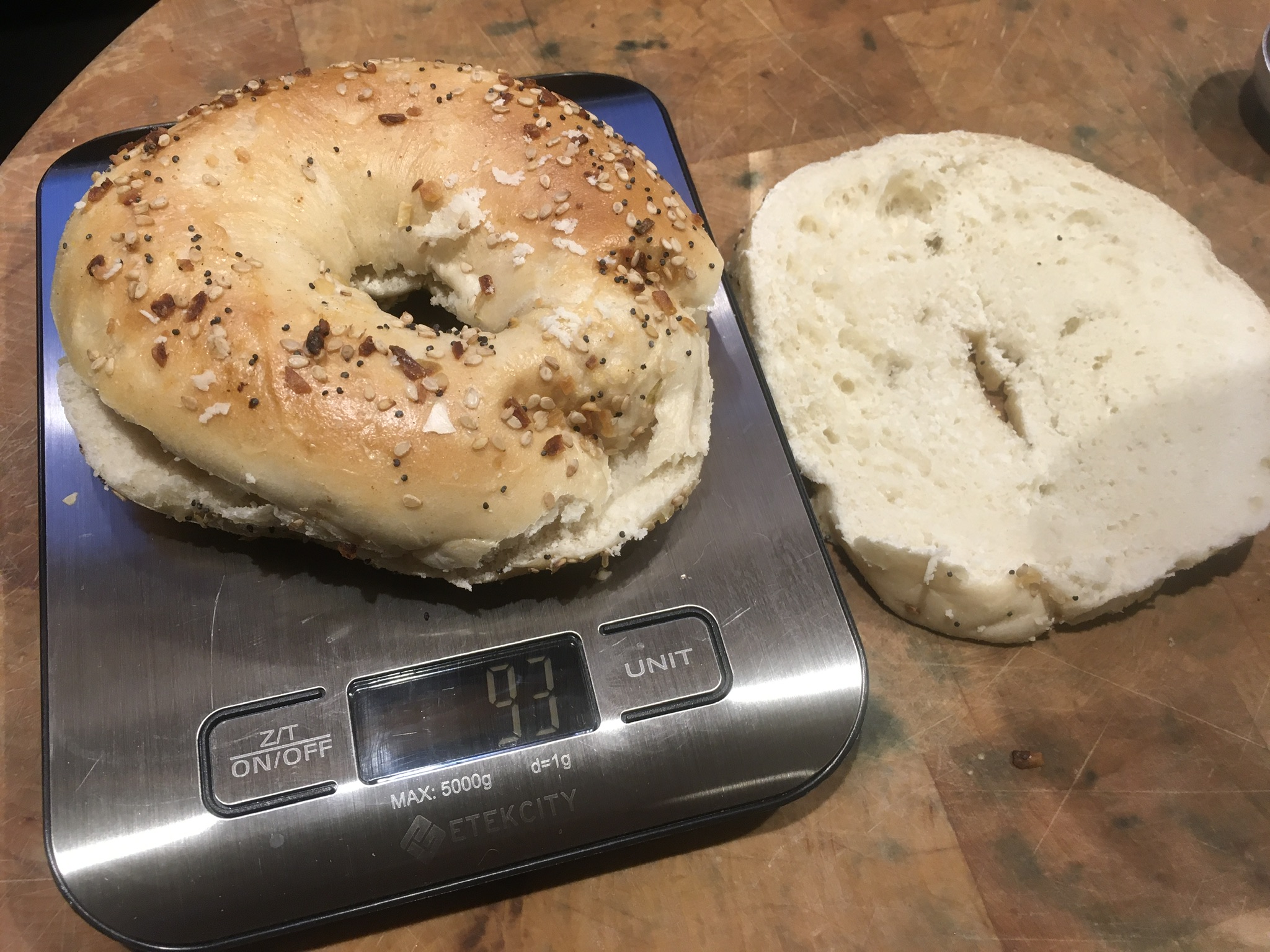
Using a simple digital kitchen scale (one that weighs ounces and grams) is KEY to making sure you’re not overeating. Buy one immediately! If you think you can simply eyeball measurements, you’ll find that you are WAY OFF!
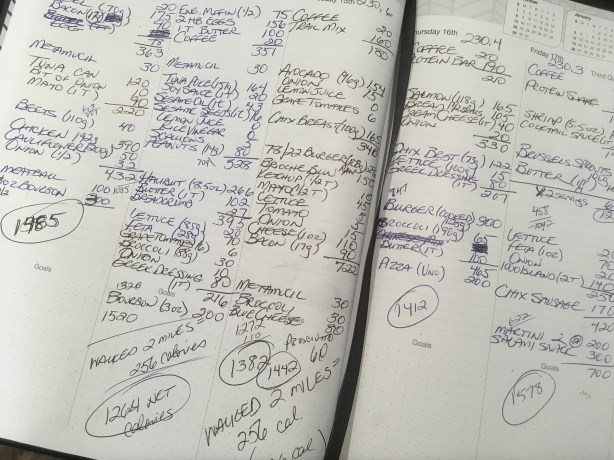
Yes…I write it ALL down!

Fortunately for me, even alcohol can be included in this diet. That’s not to say that I’m boozing it up! I only allow myself alcoholic beverages on Friday and Saturday nights. At 100 calories for a 1.5 ounce shot of 80-proof booze, I can have 2 3-ounce martinis for a total of 400 calories (without olives.) Of course, that still counts in my 1500-calorie-a-day plan. So that means I have to eat less…which can get me a little loopy on weekends! But as long as I’m not driving, that’s not a problem! Drinking alcohol also gives me the munchies…so I have to be very careful with that.

Having a seat at great bars, like the world-famous Bar Hemingway at the Ritz in Paris, is a passion of mine. My diet still allows me to sip a fine cocktail without guilt! I choose drinks that are low in sugar.

Follow this diet and you, too, will succeed. It doesn’t matter if you need to be gluten-free or not. It doesn’t matter if you’re avoiding carbs or not. It doesn’t matter if you’re vegan, vegetarian, or a total carnivore. Keto, Atkins, whatever. What matters is counting your total calories per day…and sticking to the diet every day…no cheating. No business lunch excuses, breakfast buffets, and 48-oz. steaks.
And no “rewarding” yourself with treats because “you did good” for a couple of days. Those things need to happen every few weeks, not every few days.
A great tip is to start by eating everything you love, even if it’s not really good for you, just in smaller quantities. Don’t eat real junk food, but worry about total calories first, not whether what you’re eating is “health food.” (Like my buddy, Lee’s, son who still lost weight eating Taco Bell.) Your first goal should be to limit calories. Get a feel for it. Then, as you get comfortable and progress, start making better and healthier food choices. Let’s be honest: anyone who starts a diet by chewing celery after a lifetime of steak and potatoes is going nowhere!
After I reached my goal weight last year, I went back to my daily intake of 2500 calories to maintain my new weight. (That’s still fewer calories than I was consuming every day before I started the diet, but after 1500 a day, it felt like I was cheating!)
What I learned with this diet, as I cooked healthier, measuring how much fat I put in a pan before frying…cutting my huge steaks into smaller pieces and trimming off the fat…was that I never want to go back to my old way of eating again. I can still eat anything I love…just less of it.
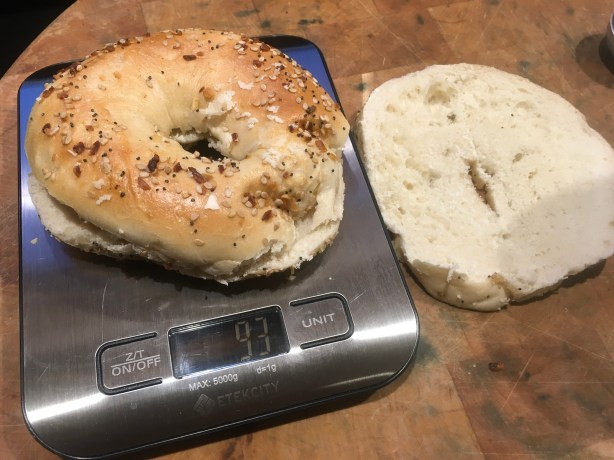
I cut the middle out of my bagel and weigh it!
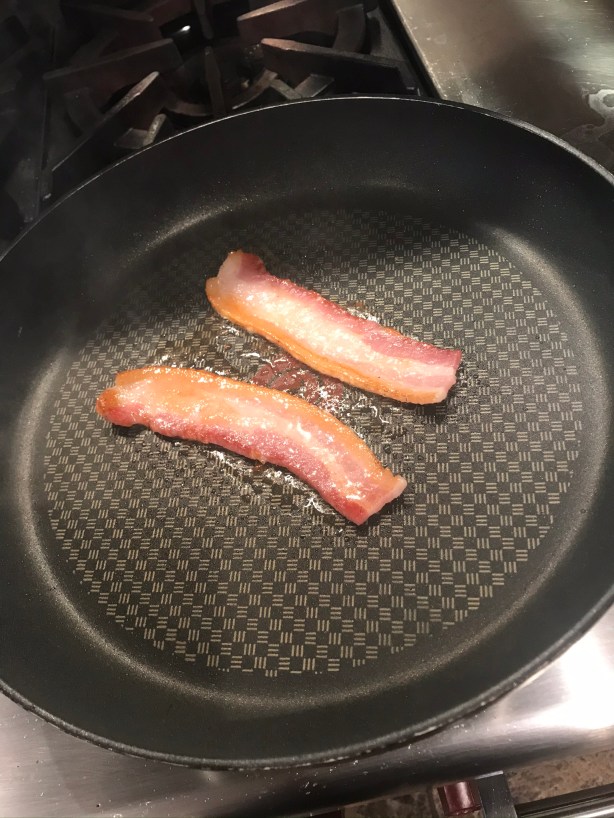
That right there, after cooking, is 90 calories. Nothing brings the flavor like bacon!
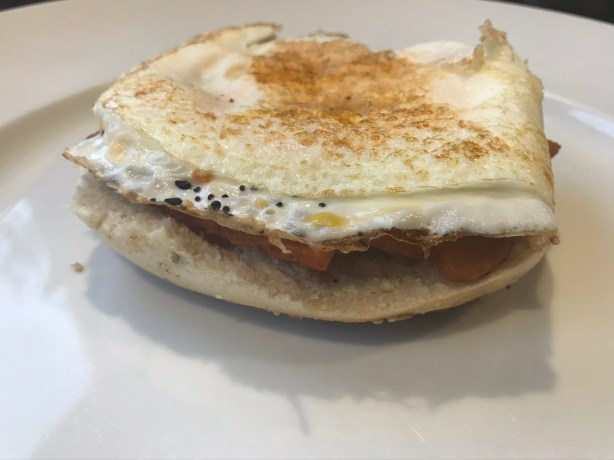
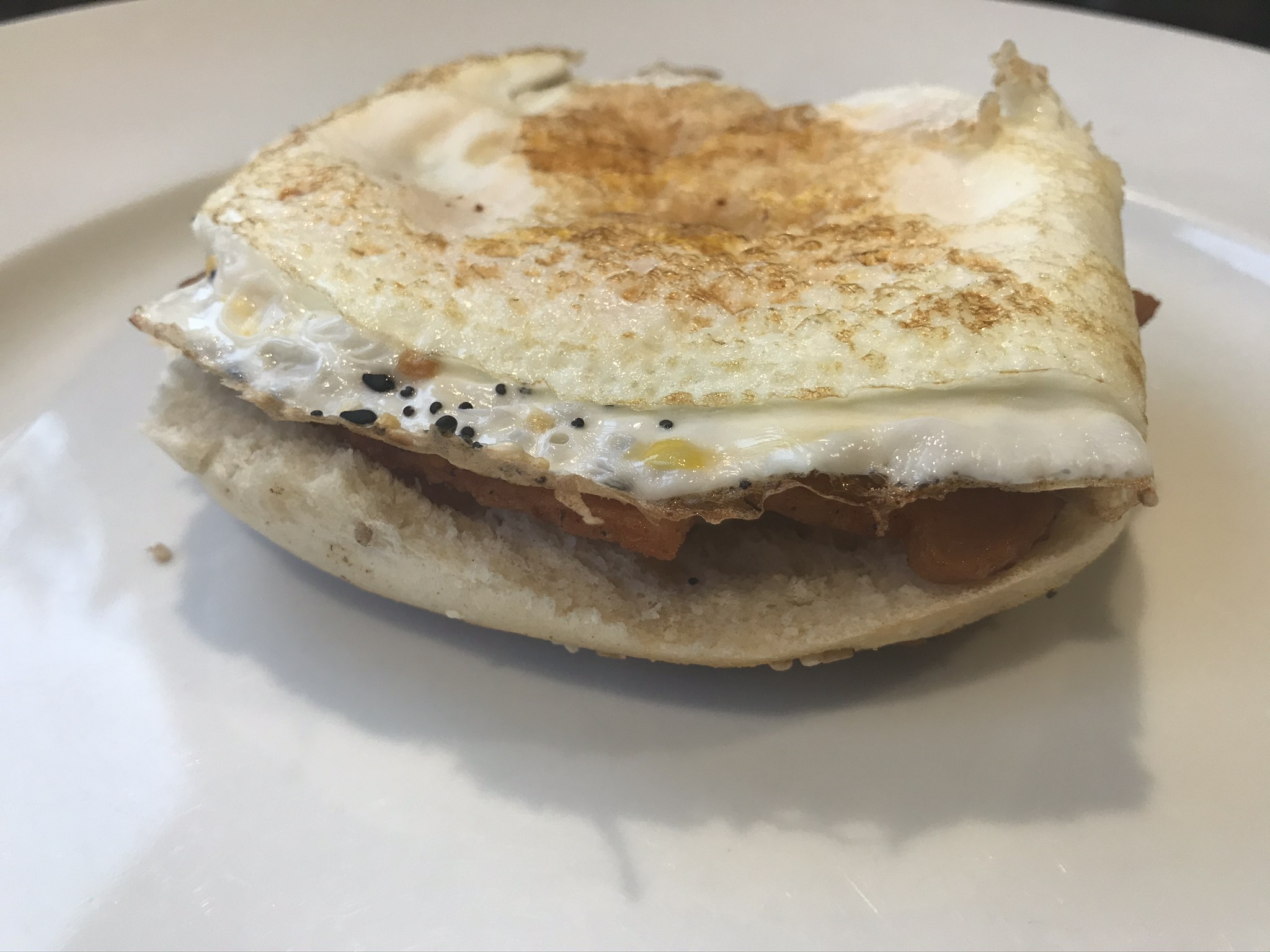
My breakfast sandwich: the bottom of an everything bagel, a strip of bacon, and a fried egg. 349 calories, including a tablespoon of butter! A sprinkle of everything bagel seasoning adds flavor and just a couple of calories.

WHAT I’VE FOUND….
Bad…
1 tablespoon of butter has 100 calories. I used to load my 400-calorie everything bagel with 300 calories of butter…and then I had breakfast! A tablespoon of whipped butter has only 50 calories, so I use that instead.
Same thing with mayonnaise. I love Hellman’s. But it’s got 90 calories per tablespoon. Enter Hellman’s Light: 35 calories and I can still indulge!
Cheese is not a dieter’s friend. It’s a calorie and salt nightmare. And light cheese tastes like crap. So I stick to small amounts of lower calorie cheeses, like feta (70 calories per ounce) or whipped cream cheese (40 calories per tablespoon), and save pizza and pasta dishes for very rare occasions.
Good…
Boiled Shrimp is our friend at just 80 calories for 4 ounces, and lots of protein. Shrimp cocktail makes you feel like you’re splurging, but it’s low in calories if you go easy on the cocktail sauce.
Lobster, too: super-low calorie. Just go easy on the butter!
Raw oysters: packed with protein and a ridiculously low 10 calories, on average, per oyster. Eat all you want, but go easy on the cocktail sauce.
A hard-boiled egg, which I love, is just 70 calories…an excellent protein bomb that fills you up. (And don’t worry about the cholesterol unless you’re eating a dozen a day!)
You can still have bacon! My thick-cut bacon is 90 calories a slice after frying. Now I have one slice for breakfast instead of six! (Read the package.)
A diet saves you money! I can’t believe how much less food I buy at the supermarket! Sure, I’m buying more veggies, but a steak that used to be one meal is now three! As a nation, Americans eat way too much food, and what we eat is mostly unhealthy. A diet that focuses on veggies and lean proteins is good for any body. Michael Pollan’s quote is more valuable now than ever: “Eat food, not too much, mostly plants.”
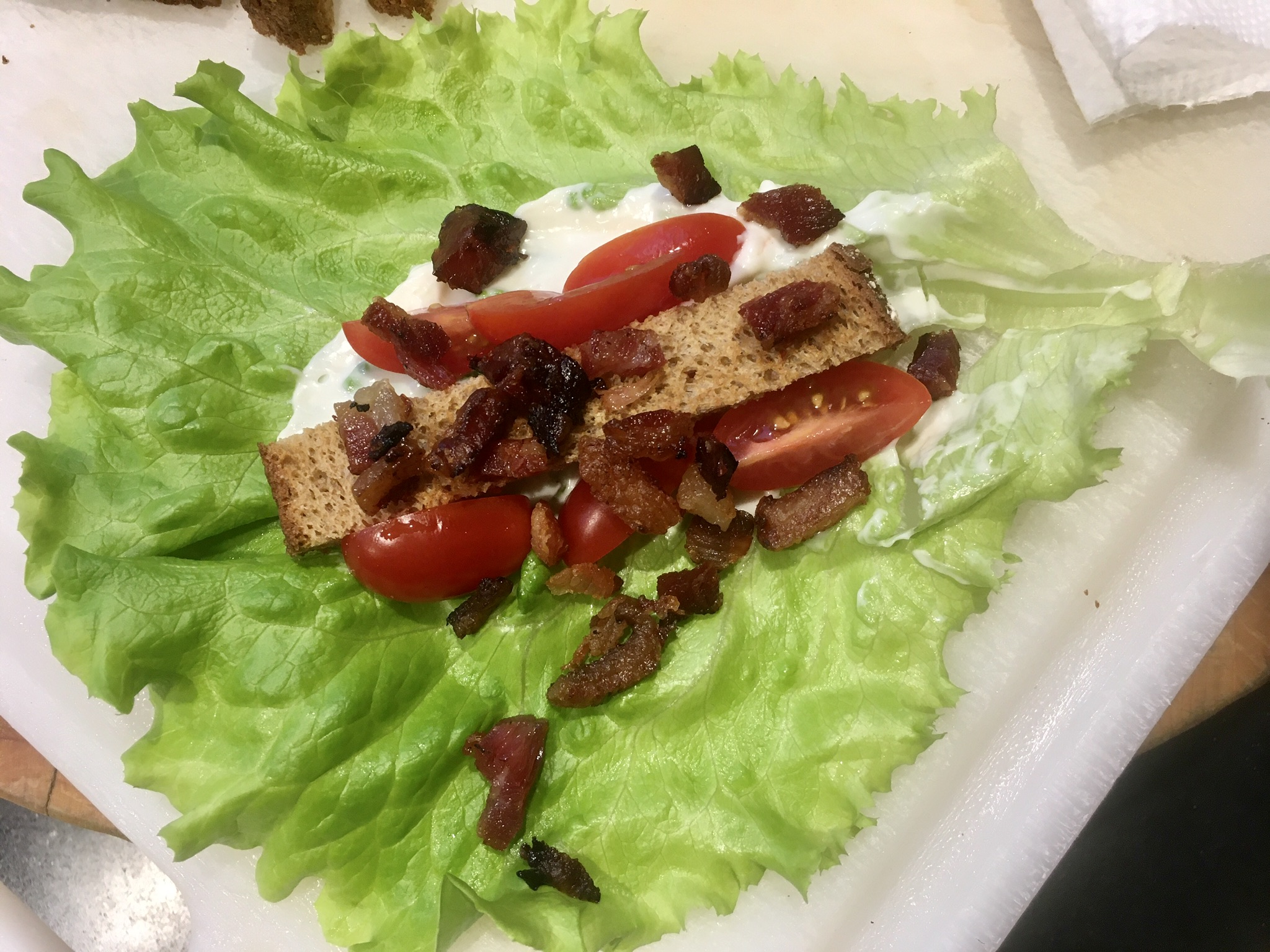
A successful diet is all about being creative. I can’t have a BLT in the usual sense anymore, and that’s my all-time favorite sandwich. But I can have BLT lettuce wraps that drastically cut the calories and still satisfy my cravings.
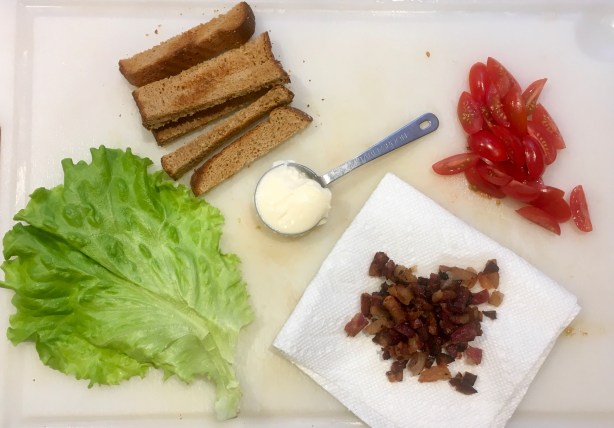
My BLT. Limiting the bacon and mayo makes it diet-friendly.
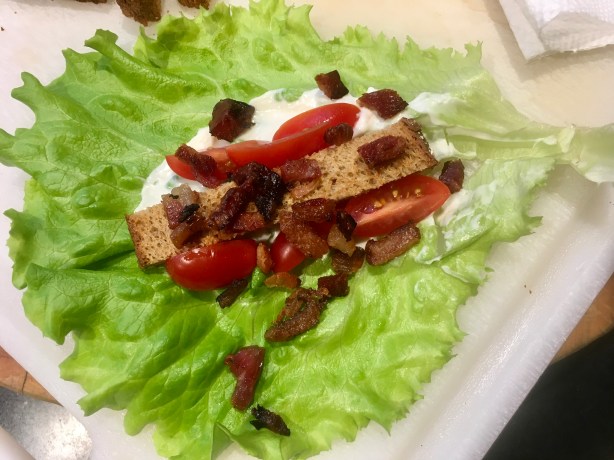
Adding that strip of toasted bread really adds to the flavor and texture!

Of course, any exercise you do in addition to this diet is only a bonus. If you use a treadmill or stationary bike, the digital readout will tell you just how many calories you’ve burned. You can subtract that from your daily calorie count. But, that being said, one of the biggest diet mistakes people make is to over-estimate how many calories they’ve burned during exercise.  If you’re guessing…you’re WRONG! Guaranteed, you burned FAR LESS than you think you did!
I know the health clubs may not want me to say this, but you DON’T have to exercise to lose weight. Reducing your caloric intake alone–if you reduce it enough and for long enough–WILL make you lose weight. Exercise alone WILL NOT.
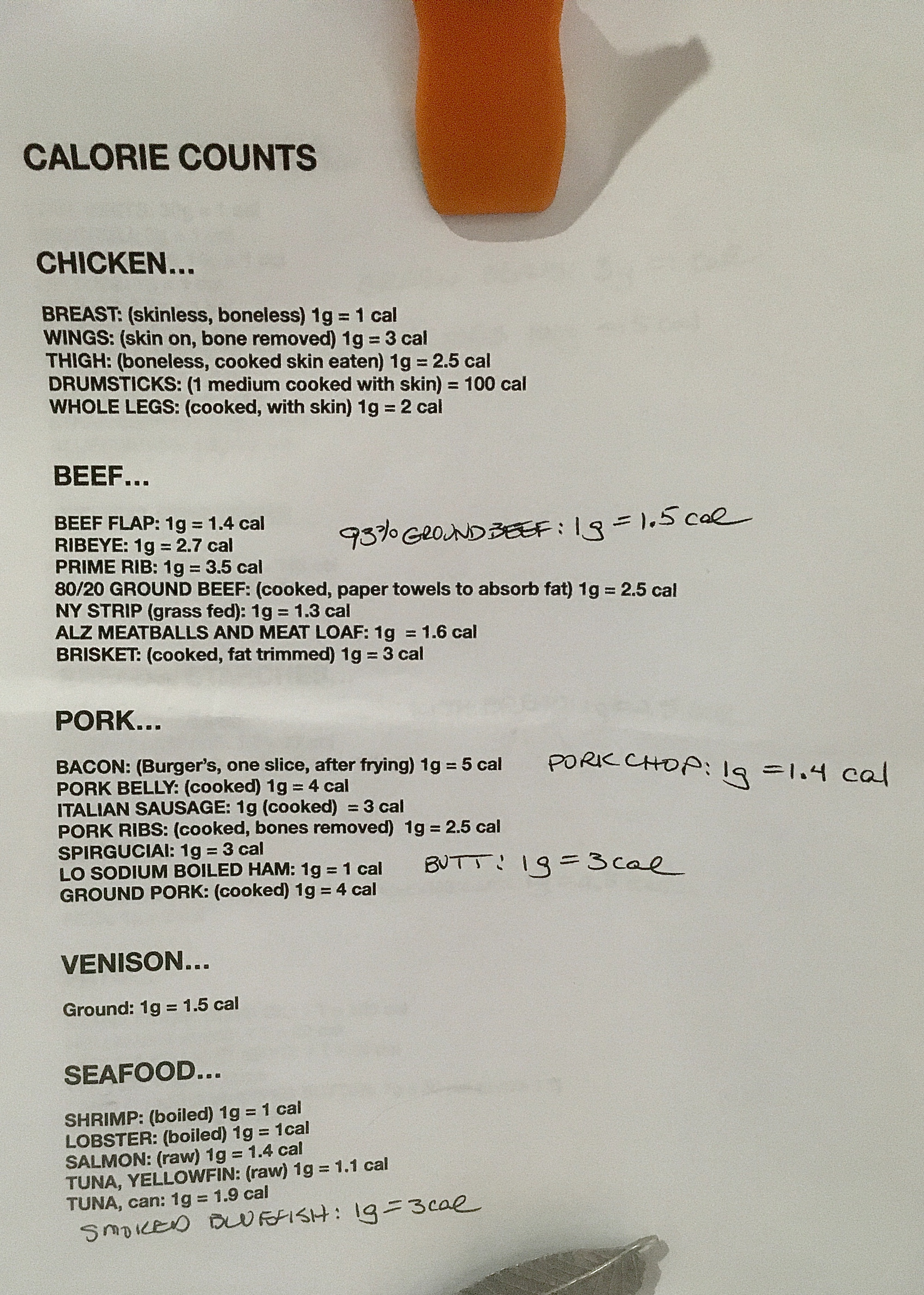
Here are my calorie charts from last year. You may not like all the foods I’ve got listed here, but I think it’s a good start. As I mentioned earlier, you can pretty much Google the calorie count of any food. That’s basically what I did….and I read a lot of labels!
One last tip: There will be times where the bathroom scale will be teasing you, taunting you: where your weight won’t budge for several days at a time. Don’t let this get to you! Your body is still changing for the better! This is where you need to be strong! Keep doing the right thing, and you will see that at the end of a couple of months, when you chart your progress, you really did lose almost 2 pounds a week.
I’ve done it before!  I’m gonna do it again! So can you in 2022!

If you really want to impress your guests for the holidays, try curing your own salmon!
I love salmon in all forms. If it’s high quality wild-caught Alaskan salmon, I love it pan-sautéed, raw (as in sashimi), smoked, and cured.

The best smoked salmon uses the gentle process of cold smoking. It’s something that the average homeowner can’t really do successfully, so I simply buy cold-smoked salmon when I crave it. I’ve made hot-smoked salmon at home with some success, but the fish is so delicate, you really have to keep an eye on it. It takes no time for a juicy, perfectly smoked piece of salmon to turn into a dry, overcooked hockey puck.

Curing, which is how you get Gravlax, is really quite simple. You just need to have enough patience to wait a few days before you can eat it.

There are many gravlax recipes out there.  Some use peppercorns, fennel, caraway, even Aquavit in the curing process.  My opinion is: if you’ve got a beautiful piece of fish, why mask the flavor of it? I go with the simplest recipe possible, featuring just 3 ingredients that cure the salmon: salt, sugar and fresh dill.

The first step, of course, is to get the right piece of salmon. What you want is that beautiful, vibrant, orange wild-caught Alaskan or Pacific salmon that costs more than you thought you were going to spend. Wild-caught means the salmon has eaten the foods it loves, a balanced diet consisting of bugs, fish, shrimp, and small invertebrates. A natural diet gives the meat of the fish that beautiful color and incredible flavor. What the salmon eats is very important because you are eating the salmon! Wild-caught salmon is high in Omega-3’s…the good fats.


A beautiful piece of wild-caught salmon laying on a bed of the cure.


I avoid Atlantic salmon at all costs. Unfortunately, most restaurants on the east coast serve Atlantic salmon because it’s less expensive. There’s a reason for that. Atlantic salmon is farmed in the USA, Canada and Europe, which means the fish are kept in crowded underwater pens and are fed food pellets that contain a number of nutrients and additives. Often, farmed fish are treated to prevent sea lice, and are given antibiotics to prevent diseases caused by their tight living quarters. They’re also given pellets to color the meat orange, because the natural color of farmed salmon is actually an unappetizing gray. When you buy Atlantic salmon in the fish store, you can spot it a mile away, because it’s got that weird zebra-striped orange and white, with a tinge of gray, and its flavor is bland and lifeless. Farmed salmon is much lower in Omega-3’s.

If it doesn’t say wild-caught Alaskan or Pacific salmon, it isn’t!

Previously frozen vs. fresh fish matters less than where it came from and how it was raised.

2 lbs. wild-caught salmon, skin on, pin bones removed
1/3 cup (50g) Kosher salt (I use Diamond Crystal)
2/3 cup (160g) sugar
1 large bunch fresh dill, washed


If your fish monger hasn’t removed the pin bones from your salmon filet, you’ll need to get a pair of long-nose pliers and remove them. It’s not the worst thing in the world to leave them in there, but you really don’t want to be spitting bones out later.

The reason I mention that I use Diamond Crystal Kosher salt is because all Kosher salt does not weigh the same. Morton Kosher salt, for example, is much heavier by volume, so it weighs more even though you’re using the same cup measurement. In the case of Diamond Crystal, 1/3 cup weighs 50g. Same rules apply to the sugar.  Go by the weight, not the cup measurement. This is really important point to keep in mind when you’re curing anything, fish or meat.

Get a non-reactive tray long enough to hold the salmon filet. I prefer glass.

Mix the salt and the sugar together, and sprinkle half of it evenly on the bottom of the tray. Lay the piece of salmon down on the cure, skin side down, and cover the top of the salmon with the rest of the cure evenly.

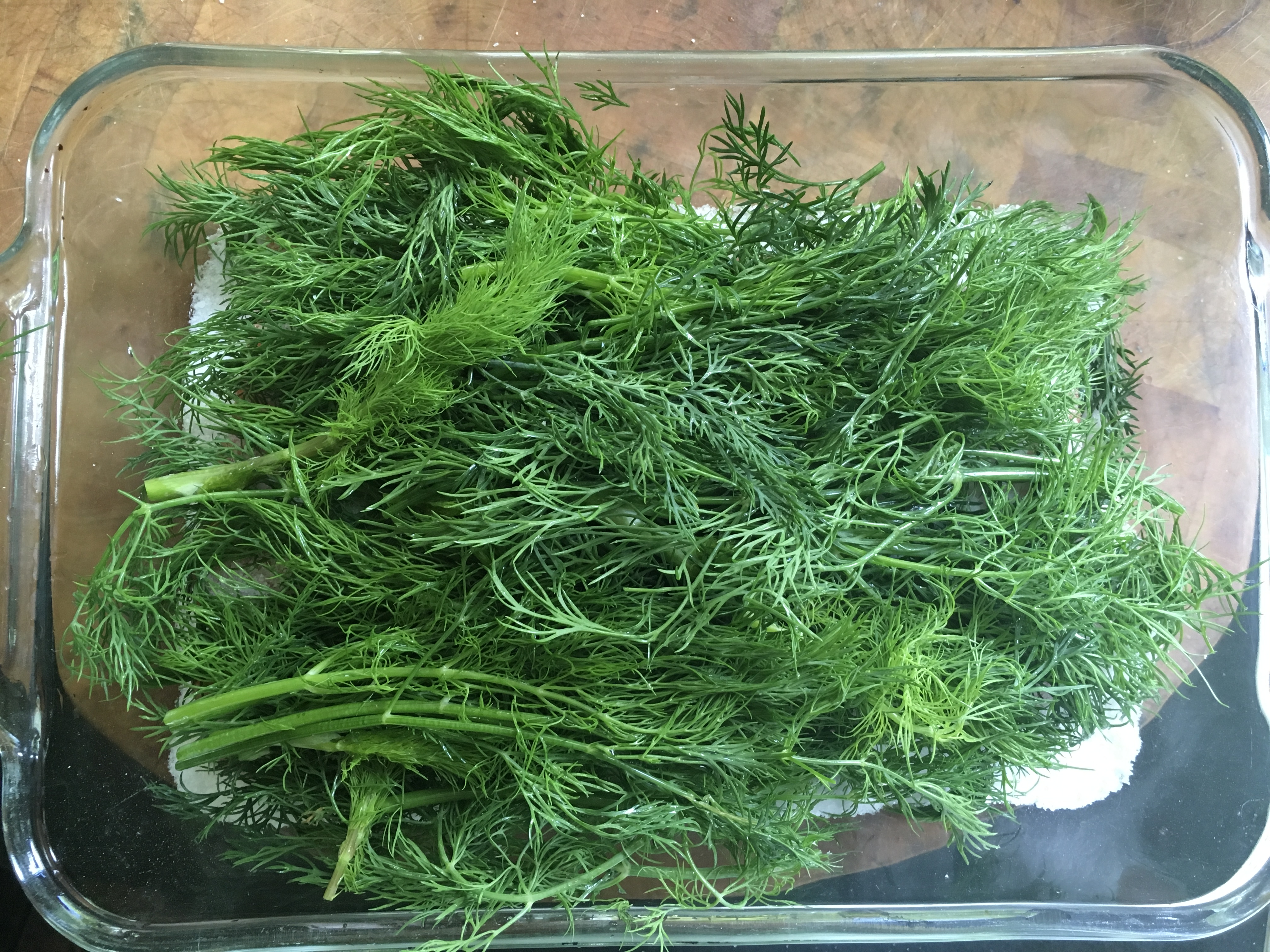
Lay the sprigs of dill on top of the cure, covering the entire piece of fish. It might look like overkill. It’s not.


Cover everything with several layers of plastic wrap, pushing it down and tucking it into the corners for a tight fit.


Find a flat board or something similar (I used a clear plastic tray) and lay it on top of the plastic wrap.


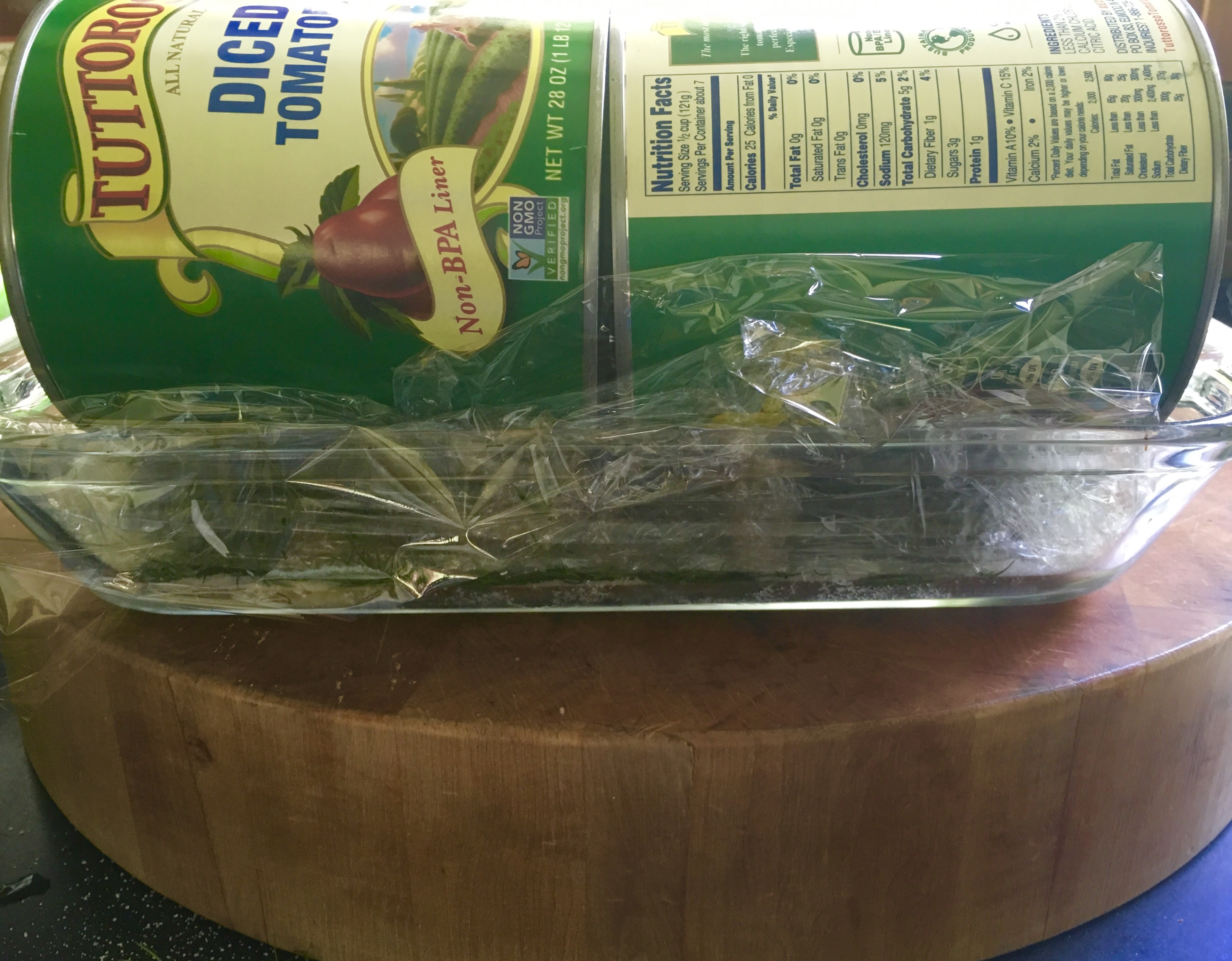
Add heavy weights on top to press down evenly on all surfaces. I used cans of tomatoes.


Side view.


Place the tray in the fridge for 48-72 hours.

After 24 hours, remove the plastic wrap and, tilting the tray, baste the dill-covered salmon with the brine juices that have formed. Put clean plastic wrap on top, add the weights, and put it all back in the fridge for another 24 hours. Repeat that process at the 48-hour mark, if needed. If it’s cured, it’s time to eat!


You’ll know the fish is fully cured when the thickest part of the filet is firm to the touch.

Unwrap the salmon, discarding the salt and sugar brine and the dill. Rinse the filet under cold running water and pat dry with paper towels.

I don’t like a ton of chopped dill imbedded into my gravlax as some do, but if you do, finely chop a bunch of new fresh dill, spread it out onto a board, and press the salmon into it flesh-side down.

To serve, place the gravlax skin-side down on a board. With a long, sharp narrow-bladed knife, slice the fish against the grain, on the diagonal, into thin slices. Serve with mustard-dill sauce, chopped onion, capers, hard-boiled egg, bread…whatever you like.

Refrigerate any remaining gravlax immediately, wrapped in plastic wrap, for up to 2 weeks.


This is my version of a holiday drink I was introduced to by my mother-in-law from the Upper Peninsula of Michigan.

This classic is loaded with sugar. But then…so is everything else around the holidays!

Whiskey slush

9 cups water
2 cups sugar
4 “Constant Comment” tea bags
12 oz. frozen OJ concentrate
12 oz. frozen lemonade concentrate
2 cups whiskey (I use Crown Royal)
7-Up or Sprite

Boil the water and sugar, making sure the sugar dissolves. Turn off the heat and steep the tea bags in the liquid for 10 minutes. Discard the tea bags.

Add the OJ, lemonade and whiskey. Mix well, then pour it all into a freezeable container with a lid. Freeze.

To serve: Scoop the slush out of the container (it doesn’t freeze solid) and mix in a tall glass with 7-Up.

If you’re concerned about all that sugar, you can use a sugar substitute in the mix, and diet soda at the end. Some stores also carry low-sugar juice concentrates. I haven’t tried any of these substitutions, because when it comes to the holidays, I go big or go home!

My Mom’s birthday was a couple of days ago, and even though she’s not with us anymore, I think a lot about the family favorites she used to cook. If there’s one dish that my Mom made all the time but I didn’t appreciate until I got older, this is it. Stuffed cabbage, cabbage rolls, or balandėliai, as we say in Lithuanian, was a staple in our home and one of my Dad’s favorites. 

I had seen my Mom make these beauties so often in my childhood, I didn’t even need to check online recipes out for guidance. That doesn’t mean I make them exactly like Mom, but my version came out pretty good. I think she would’ve been proud.

image

2 full strips of bacon, chopped
1 yellow onion, finely chopped
1 teaspoon salt
1/2 teaspoon pepper
1/2 teaspoon granulated garlic
1 lb. ground grass-fed beef
1 lb. ground pastured pork
1/2 cup breadcrumbs
2 eggs
1 large head cabbage
1 pint homemade chicken, beef or veal stock
750 g diced tomatoes (1 Pomi container)
1 teaspoon thyme
1 teaspoon salt
1/2 teaspoon pepper
1/4 teaspoon granulated garlic
1/4 teaspoon granulated onion

Chop the bacon into small pieces and fry them until crisp. Finely chop the onion, and add it to the bacon and rendered fat in the pan, cooking until the onions are translucent. Add the salt, pepper and garlic. Mix well, and remove from the heat. Let it cool to room temperature.

In a large bowl, combine the beef, pork, breadcrumbs, eggs, and cooled bacon and onion mixture. Place it in the fridge to firm up.

Let a large pot of water come to a boil. Core the cabbage, leaving the leaves whole, and carefully immerse the head of cabbage into the hot water. (I use two sets of tongs to handle the cabbage.)

Little by little, the outermost leaves of the cabbage will come off the head, and you can remove them, setting them aside to cool. Continue doing this until you can no longer remove leaves from the remaining head of cabbage.

Remove the remaining head of cabbage from the hot water, and using your hands or a knife, break it into flat pieces. Line the bottom of a roasting pan with the pieces. These will keep the stuffed cabbage from burning and sticking to the bottom. If you need more to line the pan, use the smaller or torn pieces of cabbage.

Time to roll the stuffed cabbage. Take the meat out of the fridge. Lay a cabbage leaf flat on the counter, and add some of the meat mixture (about 1/4 cup, depending on the size of the cabbage leaf) inside. Roll the cabbage around the meat, folding the sides in as you go, much like a burrito. You might need to slice away the thickest part of the leaf stem to make rolling easier. Lay the stuffed cabbage in the roasting pan on top of the leftover cabbage pieces. (Unlike Mom, I don’t use toothpicks to hold the stuffed cabbage rolls together.)

Continue stuffing and rolling the cabbage leaves until you’ve got a pan full of them, shoulder-to-shoulder.

In a blender, food processor, or whisked in a bowl, combine the stock, diced tomatoes, thyme, salt, pepper, garlic and onion. Pour this mixture over the top of the cabbage rolls in the roasting pan, covering them.

If you have leftover cabbage, you can place another layer of them on top. Otherwise, cover the roasting pan with foil and place in a pre-heated 350 degree oven. Cook for an hour.

After an hour, remove the foil and cook further for another 45–60 minutes.

image

Really delicious and an instant flashback to great memories of dinner at home….thanks to Mom.

I’m a wuss. I can’t do heat. But I’ve always been fascinated by jerk chicken: it looks amazing and smells fantastic. So I decided to try making a kinder, gentler version by eliminating the number one high-heat ingredient: Scotch bonnet peppers.

On the scale of hotness known as the Scoville scale, Scotch bonnets reach anywhere between 100,000 to 350,000 Scoville units. To give you an idea how hot that is, jalapenos only reach 2,500 to a maximum of 8,000 Scoville units! That means those suckers are 40 times hotter than jalapenos! And that’s why I leave them out of my recipe.

I found that when I left the Scotch bonnets out, there was still plenty of fragrant, hot and smoky flavor in my jerk chicken.


Jerkalicious.


1 medium onion, coarsely chopped
3 medium scallions, chopped
2 garlic cloves, chopped
1 tablespoon Chinese five-spice powder
1 tablespoon allspice berries, coarsely ground
1 tablespoon black pepper, coarsely ground
1 teaspoon dried thyme
1 teaspoon freshly grated nutmeg
1 teaspoon salt
1/2 cup soy sauce
1 tablespoon olive oil
8 lbs. chicken, parts or whole birds quartered


In a food processor, combine the onion, scallions, garlic, five-spice powder, allspice, pepper, thyme, nutmeg and salt. Process it into a coarse paste.

With the machine on, add the soy sauce and olive oil in a steady stream.

Place the chicken pieces in a large Ziploc bag, and pour the marinade in. Zip the bag up and squish it around to make sure the marinade touches all parts of the chicken. Place the bag in a bowl (to prevent accidental leaks) and place the bowl in the fridge overnight.

Bring the chicken to room temperature before cooking.

Indoors: Place the chicken on a baking sheet and bake in a 350-degree oven for about 30 minutes. At the end, move the baking sheet under the broiler and cook a few minutes more, to get some caramelization going.

Outdoors: Light a grill and cook the chicken over a medium fire, turning it so it doesn’t burn. Cover the grill if you like, for smokier flavor. Make sure the chicken is cooked through before serving.