Archive for the ‘Food’ Category

Making spinach pizza dough, as featured in a previous blog, was a fun and tasty recipe idea. But I still had some spinach left over. So I decided to add it to my Chicken Rollatini recipe, and it was delicious!

Chicken Rollatini was one of the first dishes I learned how to make back in my teenage days on Long Island, working at a local Italian restaurant called Pizza City East. (The original Pizza City was in Ozone Park, Queens.) It was a simple dish: a chicken breast rolled up with prosciutto and mozzarella, and baked in a mushroom cream sauce. My version these days substitutes ham for the prosciutto, provolone for the mozzarella, and an Alfredo-like sauce instead of  the mushroom cream sauce.

This time I added the frozen spinach to the mix, and I have to say, I think I’ll always cook it this way from now on.

4 chicken breasts cut lengthwise to make 8 thin breasts, about 2 pounds
8 slices sliced ham
8 slices of provolone cheese
6 oz. frozen spinach, finely chopped

Place the chopped spinach in a bowl and add granulated garlic and oregano to taste. Set it aside.

Remove the chicken tender portion of the chicken breasts and set those aside for another day.
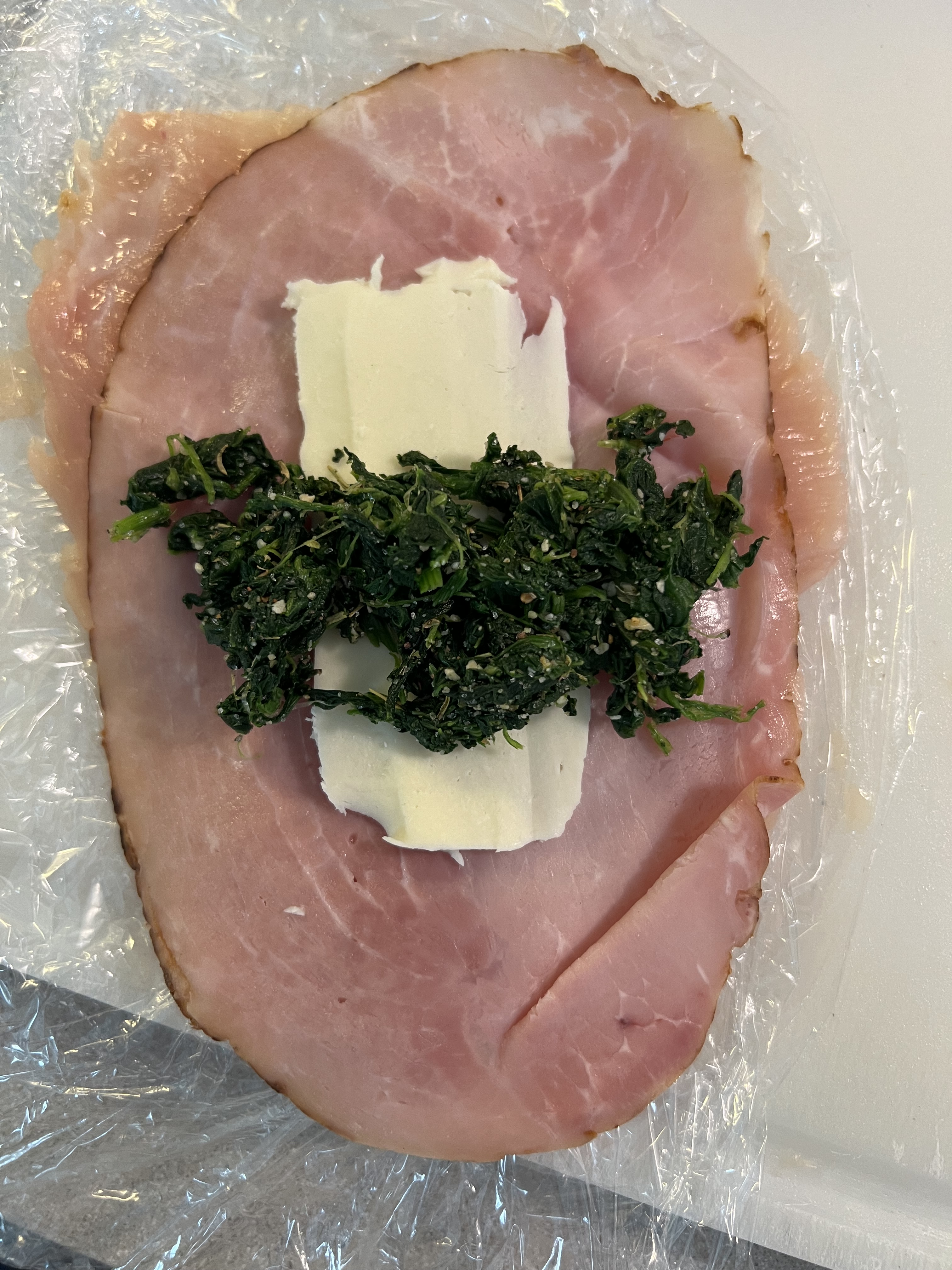
I usually don’t like to pound out my chicken breasts. I like the texture of “real meat.” So I take a large breast, and slice it lengthwise to make 2 thinner breasts. I lay the breast down on the cutting board, add a slice of ham, then a slice of provolone, (and this time, some of the spinach mix), and carefully roll it up, securing it with toothpicks, if necessary. Place the rollatinis on a baking sheet. Set aside, preferably in the fridge, until ready to cook.

The addition of spinach, this time, to the old recipe.

Rolled and ready!

1/2 cup breadcrumbs
1 teaspoon parsley
1/2 teaspoon oregano
1/2 teaspoon salt
1/4 teaspoon pepper
1/4 teaspoon granulated onion
1/4 teaspoon granulated garlic
Combine these ingredients in a bowl. Set it aside.
2 carrots
2 celery stalks
1/2 medium onion
Olive oil
Peel and chop the carrots into quarters. Peel and chop the onion in half. Chop the celery into quarters as well. Place all the vegetables on a sheet pan and drizzle olive oil over the top, tossing them in the oil. Roast the vegetables in a 400° oven until caramelized, and the carrots are fork-tender, about 20 minutes. Remove the sheet pan from the oven and let the vegetables cool. Once the veggies have cooled, chop them finely with a knife or food processor. Set them aside.
3 cups your favorite rice, cooked
Cook the rice according to package directions. Once the rice is cooked, mix it with the chopped carrots, parsnips, celery and onion. Set it aside.
1 cup cream or half-and-half
3 tablespoons butter
1/2 cup freshly grated Parmigiano Reggiano
salt and pepper
For the Alfredo-like sauce, heat a saucepan over medium heat, melting the butter and then adding the cream or half-and-half. Once it’s warmed through, add the cheese and whisk until it has melted and the sauce is smooth. Season with salt and pepper. Set it aside, to re-warm later.
Take the pan of rollatinis out of the fridge to warm to room temperature, and reduce the heat of the oven to 350°.
Drizzle a little olive oil over the top of the rollatinis and rub it in. Sprinkle the breadcrumb mixture over the top, pressing them into the chicken, and bake them for 30-45 minutes, until the chicken has cooked through.
To serve, remove the chicken rollatinis from the pan and plate them on a bed of arugula (optional) with the rice on the side. (Be sure to remove the toothpicks.) Serve with the sauce.

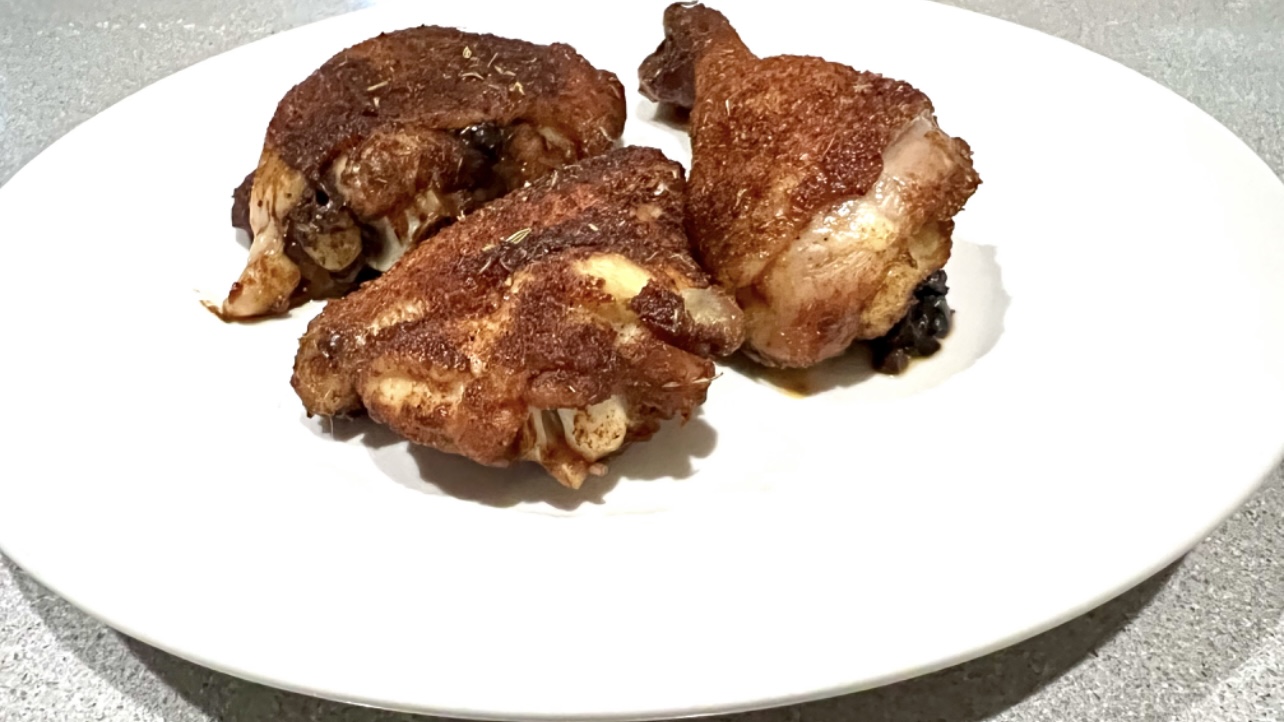
Brining, the process of letting a hunk of protein soak in a salt solution for a few hours, is a great way to add flavor and moisture to any cut of meat. I brine these wings for 3 hours before using a sweet and spicy rub. They can be grilled or roasted in the oven.


image

The brine…

1/2 cup Kosher salt
3 tablespoons light brown sugar
1 teaspoon whole black peppercorns
1 whole bay leaf
2 quarts water

Combine all ingredients in a saucepan and heat until the sugar and salt dissolve. Remove it from the heat, and let it cool to room temperature.

The rub…

1/4 cup light brown sugar
1/4 cup granulated sugar
1/4 cup sweet paprika
1 tablespoon Kosher salt
1 tablespoon granulated onion
2 teaspoons black pepper
1 teaspoon dried thyme
1 teaspoon dry mustard
1 teaspoon ground ginger
1 teaspoon cayenne pepper

Combine all the ingredients in a bowl.

Place 3 lbs. of chicken wings in a Ziploc bag and pour the cooled brine into the bag. Place the bag in a bowl to prevent leaks and keep it at room temp for 3 hours. I wouldn’t brine it longer than that, or it will get really salty.


After 3 hours, remove the chicken from the brine and dry the wings with paper towels. Discard the brine.

Place the chicken pieces in a large bowl and sprinkle them with 1/3 cup of the rub, tossing to coat the chicken well. Place the bowl with the chicken in the fridge until you’re ready to cook.


About 30 minutes before cooking, remove the bowl from the fridge and let the chicken come to room temperature.

Pre-heat the oven to 350 or light a grill.

Toss the chicken with some more of the rub, if you like, then place the pieces on a sheet pan lined with non-stick aluminum foil.

Bake at 350 for 30 minutes or until done. Lower the oven temperature if it starts to burn.

If you’re grilling, cook the wings over medium heat, turning them frequently to prevent burning. Cook until the wings are done.


BURGER HACK

Posted: April 26, 2024 in barbecue, beef, Carnivore!, Food
Tags: , , ,

I’ve bought many burger presses in my day, and I’ve found that the meat gets stuck inside them after pressing, making removal somewhat difficult. Some presses have so many parts to them, they get lost in my cabinet or jam up the dishwasher. Frankly, every one that I’ve bought over the years was a waste of money.

Chances are, somewhere in your storage area, you’ve got a wide mouth Mason jar with a metal top, composed of a flat lid and the band that goes around it and screws onto the jar top. As long as they’re not rusty, you can use them to make perfect quarter-pound burgers. If they are rusty, you can buy a half-dozen lids and bands for just a few bucks in any supermarket.

image

I get my burger meat in 1-lb. packs. If they’re frozen, I let them thaw wrapped. Then I cut the meat into quarters, simply eyeballing it. Each quarter-pound of meat fits quite nicely into the Mason jar top. I flip the top over and press down to compact it, then push the flat lid through the band, and out pops a perfect quarter-pound burger.

Once I’ve got all my burgers made, I place them on a small sheet pan lined with non-stick aluminum foil and keep them in the fridge until I’m ready to cook.

The lid and band go in the dishwasher, and can be used over and over.


Fast food is a relative term.
What we Americans think of as fast food is not what, say, the Italians think of as fast food. We think of drive-thru burger joints serving greasy, salty and fatty food. The Italians think fast food is something that simply doesn’t take all day to cook! If you can use the freshest of ingredients, and serve it in the time it takes to sip a half a bottle of wine while chatting with a friend, it’s fast food Italian-style.
Years ago, we visited the island of Capri in Italy, and one of the dishes we enjoyed was an incredibly simple pasta and tomato dish called spaghetti sciue-sciue (pronounced “shwee-shwee.”) We were told that sciue-sciue was loosely translated as “quick-quick,” although a check on the web said that it also translates to “improvisation” in Italian. And though quick it was (that is, by Italian standards), it was one of the most memorable dishes we had on our trip. It could be because of our surroundings: the famous Faraglioni rocks all around us at a small seaside restaurant called Da Luigi ai Faraglioni. We took the small shuttle boat from Marina Piccola, which made its way through those stacks jutting out of the Bay of Naples, and landed at this historic restaurant, built in 1936. People come here not only to dine, but to spend the day sunbathing and swimming.
So the reason Da Luigi’s sciue-sciue was so amazing certainly was, in part, the location…but it was also very much due to the use of the freshest and best possible ingredients…and they didn’t mess around with them too much.
The best time to make this dish is when tomatoes are at their absolute best in your area. But if you can get your hands on some beautiful cherry tomatoes off-season (they seem to be tastier than larger tomatoes in the winter months), it’s worth having a go at it as well.

 1 small can (6 oz.) tomato paste
½ cup extra virgin olive oil
2 hot Italian dried peppers, finely chopped
¼ cup white wine
8 to 10 chopped plum or cherry tomatoes (as ripe as possible)
12 to 15 torn fresh basil leaves
½ stick (4 oz.) unsalted butter
1 ball of fresh mozzarella (about 12 oz.)
1 lb. of spaghetti, or better yet, bucatini
Sea salt
Fleur de Sel (optional)
Heat a large pot of salted water to a boil and toss the pasta in.
“Heavily caramelize”–but don’t burn–the tomato paste in a large pan with the olive oil, salt, and the dried peppers. Add the white wine to deglaze, and simmer until it’s reduced by half.
Add the chopped tomatoes and simmer on medium heat until they start to break apart. Hand tear the mozzarella ball into shreds and add it to the sauce, stirring gently. Add the basil.
Add the butter, gently stirring until it melts.
When the pasta is slightly firmer than al dente, drain it and add it to the pan with the sauce, stirring gently.
Serve this dish immediately, finishing with a little Fleur de Sel.

Finito!

HOMEMADE MUSTARD

Posted: April 17, 2024 in Food, mustard, Recipes, spicy
Tags: , , ,

It’s so easy to make your own mustard. And really good mustard. Mustard that hasn’t been sitting on the store shelf for a year. Mustard with real flavor.

Once the mustard is made, you’re supposed to wait a few weeks before using, letting its heat mellow a bit. But I enjoy it right from the start. Feel the burn!


mustard

The great thing about this recipe is that you make it with your favorite beer, so use what you drink and you’ll have a mustard like no one else. I used Samuel Adams Boston Ale for this recipe.

1/4 cup yellow mustard seeds
1/4 cup brown mustard seeds
3/4 cup Sam Adams Boston Ale
1/4 cup apple cider vinegar
2 tbsp. honey
2 tbsp. brown sugar, firmly packed
2 garlc cloves, smashed
1 bay leaf
2 tsp. sea salt
1/8 tsp. freshly ground pepper

Put the yellow and brown mustard seeds in a bowl and pour in 1/2 cup of the beer. Push the mustard seeds down to submerge them in the beer. (I lay a sheet of plastic wrap down on top to keep them submerged.) Cover and refrigerate them for 24 hours.

Combine the remaining 1/4 cup of beer, the vinegar, honey, brown sugar, garlic, bay leaf, salt and pepper in a small saucepan. Bring the mixture to a boil over medium-high heat, stirring to dissolve the honey and the sugar. Boil for 1 minute, the immediately remove the pan from the heat and let it cool to room temperature.

Toss the garlic and the bay leaf in the trash and pour the liquid into a blender.

Pour off any remaining beer left in the bowl with the mustard seeds. Add 3/4’s of the plumped mustard seeds to the blender and blend them to break the seeds. Add the remaining 1/4 of the mustard seeds and pulse just once to mix. You want the mustard thick, with some whole seeds remaining.

Put the mustard in an airtight container in the fridge for at least 3 days and up to a week, depending on how mellow you want it and how much waiting you can tolerate! After about 3 weeks, the mustard will be at its peak…but it will keep in the fridge for several months. (I can’t imagine it will last that long.)

This is the most amazing fish sandwich I ever made.


There’s no other way to describe this sandwich, something that shouldn’t work in some ways and yet is absolutely perfectly crunchy and delicious. It starts with the cole slaw, ideally made a day in advance…

1 medium cabbage, sliced thinly
2 medium carrots, peeled, and finely chopped
1/2 cup mayonnaise
1 tablespoon Kosher dill pickle juice
1 teaspoon celery seed (not salt)

You can use a machine, but I like to finely slice my cabbage with a chef’s knife, cutting as thin as possible. Place the chopped cabbage in a large bowl.

For the carrots, peel them to remove the outer skin, and throw that away. Continue to peel the carrots into paper-thin slivers until there’s no carrots left. Finely chop those slivers and add them to the cabbage.

Add the mayonnaise, pickle juice, and celery seed, mixing thoroughly. Keep it in the fridge, covered with plastic, until ready to use.  The next day, before using, taste it and decide whether you want more mayo or pickle juice, salt or pepper. Mix it well before using.

Like a classic pulled pork sandwich, the slaw will go inside! But it needs a sauce to tie it all together. Make this a day ahead as well.

1/2 cup ketchup
1/2 cup mayonnaise
1 tablespoon dill pickle relish
1/4 teaspoon Tony Cacherre’s Original Creole Seasoning (optional)
1/4 teaspoon salt (skip if using Creole seasoning)
1/8 teaspoon pepper (skip if using Creole seasoning)

Tony Cacherre’s Original Creole Seasoning is a personal favorite, and it works well in this sandwich. You can find it in many stores, and online. But if you don’t have it handy, salt and pepper do the job.

Combine all the ingredients in a bowl, mixing well. Keep it in the fridge, covered, until ready to use.


Cod or other white fish, preferably fresh, cut into sandwich-sized pieces (about 4″ square)
1 cup all-purpose flour (or Cup4Cup gluten-free flour, see below)
1 teaspoon celery seed (not salt)
1 teaspoon salt
1/2 teaspoon black pepper
1/8 teaspoon cayenne (optional)
2 eggs
1 cup corn flakes, crumbled (or Corn Chex for gluten-free, see below)
avocado oil or other oil for frying

I had some grouper the last time I made this sandwich, and the results were fantastic. I suggest you use whatever white fish is your favorite.

Cut the fish into pieces that will fit the bread you’re using, and make sure the filets are the same thickness. Don’t make them thicker than 1/2″ or they’ll stay raw in the middle when you fry them. Set them aside.

In a bowl, combine the flour, celery seed, salt and pepper and cayenne (if you’re using it). Mix well.

In another bowl, crack the eggs and scramble them.

Put the corn flakes (or Corn Chex) in a plastic bag, squeezing the air out of it. Crush them into oatmeal-sized pieces, then pour them into a third bowl.

Heat a heavy pan with a couple of inches of oil. One by one, take the fish pieces and dredge them in the flour mixture, then into the egg, and then into the corn flakes, pressing into the corn flakes to make sure they stick to the fish.

When the oil in the pan is hot enough, fry the fish pieces on both sides, until cooked through and golden brown. Place them on paper towels to drain.


Pepperidge Farm Marble Swirl Rye Bread (or gluten-free bread)
Swiss cheese, sliced
Melted butter

Pre-heat an oven to 350 degrees.

To assemble the sandwiches, take a slice of the rye bread and spread some of the sauce on it. Place a piece of the fried fish on top, then cover it with some of the cole slaw. Place a few thin slices of Swiss cheese on top of the cole slaw. Take another slice of rye, slather it with the sauce, and place it on top of the slaw, sauce-side down.

Brush the top of the sandwich with the melted butter, and place the sandwich on a sheet pan. Do the same with the rest of the sandwiches.

Place the sandwiches in the oven and bake them until the cheese melts. Cut the sandwiches in half and serve.


The gluten-free sandwich in the front.


What I changed to make this sandwich gluten-free…


My go-to all-purpose gluten-free flour is Cup4Cup. It works really well in any dish that requires all-purpose flour.


Not all corn flakes are gluten-free, and the ones that are can be hard to find. I found that Corn Chex cereal is a good substitute. It’s gluten-free, and has a nice crunch.


The Pepperidge Farm Marble Swirl Rye Bread is the ideal bread to use for this sandwich. But I made a pretty darn tasty gluten-free version using this Schar bread, found in many supermarkets.


Our 5th annual BOYZ weekend has just come to an end, and it’s always a big deal. Three of us live in Rhode Island, two in New Jersey, and one in Florida, so getting together is no easy task, and it seems to get tougher every year.

So we celebrate our friendship every year with excellent food and drink.

This is a rich, delicious, and unusual surf-and-turf I cooked as the featured dinner, using heritage Berkshire pork belly and beautiful sea scallops. Berkshire pork is usually only found online, so substituting a regular pork belly from your local butcher will do. But the fat and flavor of Berkshire pork is the stuff of legends! I buy my Berkshire pork from heritage pork.com, and the belly comes in an 8-lb. slab that I cut in half. I was cooking for 6 hungry dudes, and so a 4-lb. piece was needed. (The other 4-lb. piece will become amazing bacon later on.)


FullSizeRender (9)

For the pork belly…
3–4 lbs. fresh pork belly
salt and pepper
1–2 tablespoons leaf lard or olive oil
1 carrot, coarsely chopped
1 celery stalk, coarsely chopped
1 onion, roughly chopped
1 fennel bulb, quartered
2 sprigs fresh thyme
1 teaspoon black peppercorns
4 cups beef stock
1 cup hard cider or apple juice

I cook the pork belly a couple of days ahead of time.

Pre-heat the oven to 350.

Season the belly with salt and pepper. On medium-high heat, melt the leaf lard, then sear the meat on all sides in an oven-proof pot big enough to hold it in one layer. Add the carrot, celery, onion, fennel, thyme and peppercorns and continue cooking for another 5 minutes, until caramelized.

Add the beef stock and the cider. Cover the pot with a lid or seal it with aluminum foil, and braise the belly in the oven for 3 hours, until tender.

Remove the pot from the oven, carefully remove the pork belly, and put it on a plate. Cover it with foil, ;eating it cool. When it has cooled completely, wrap it well in plastic and place it in the fridge.

Strain the leftover braising liquid from the pot and discard the vegetables and thyme. Place the liquid in a container in the fridge. The fat will float to the top and harden, making it easier to remove. (I save the fat and use it for cooking later–not only for this dish, but others, as well. Berkshire pork fat is too valuable to just throw away!)

But now that the fat has been removed, the braising liquid is all flavor, and no fat.


FullSizeRender (8)

For the glaze…
braising liquid, strained
1 tablespoon espresso
1 tablespoon honey

When you’re ready to cook for your guests, reduce the brazing liquid by half in a small saucepan, then add the espresso and honey. (Feel free to substitute maple syrup for the honey. This time around, I used some shagbark hickory syrup that I bought in Vermont earlier in the year.) Cook a few more minutes until the sauce thickens. When it coats the back of a spoon, it’s ready. Set it aside.

For the scallops…
Fresh scallops
salt and pepper

About an hour before cooking the scallops, remove the pork belly from the fridge to let it come to room temperature.

When you’re ready to serve, heat a large pan on high heat, using leaf lard or the fat from the braising liquid. Cut the belly into equal pieces and sear them on all sides for about a minute, making sure it’s warmed through. Place the scallops in the same pan, seasoning with salt and pepper, and sear them on both sides, being careful not to overcook them.

To serve, place the belly on a plate. Top it with a scallop or two. Drizzle the glaze over the top. Season with Fleur de Sel or other finishing salt and serve it immediately.


The boyz were happy!

Years ago, at Le Saint-Amour, a restaurant in Quebec City, the dish I ordered had these small strange-looking root vegetables sitting next to my roasted duck entrée. They resembled tiny twisted parsnips…or caterpillars! I needed to know what these things were, and so I asked my French waiter, who came back with a piece of paper that had the word “crosne” written on it. He said: “I don’t know how they say it in English.”
Back at the hotel room, I went right to the laptop and started a search online and discovered that crosnes (pronounced crones) are also known as Chinese artichokes, and although they are somewhat common in European gardens, they’re really difficult to find in the states.
The leaves look like mint, but don't have a fragrance.

The leaves look like mint, but don’t have a fragrance.


The plant is a relative of mint (though the leaves have no aroma), a perennial, is easy to grow, spreads on its own, and has those small, convoluted and delicious root clumps (known as tubers to gardeners.) So what’s not to like? Well, apparently, it’s not the gardeners that don’t want to deal with them…it’s the chefs! The tubers are very small and need a little extra effort to make sure they’re washed clean before cooking. They don’t need to be peeled (now that would be a pain) but to many chefs, even the washing is too much of a hassle.
image
As a Master Gardener and food nerd, I found all of this pretty interesting so I searched for sources to buy crosnes plants. It took a while (most growers were in Europe or Great Britain), but I finally found a source in Oregon that sold the plants and I bought a few for my home garden.
image

Much like mint, crosnes are pretty hardy and are tough to remove once well established, so they need to be planted in an area where you don’t mind if they take over. The tubers are ready to harvest October through November, and as long as I leave some in the ground over the winter, the crosnes will be back again the next year. Seems pretty low-maintenance for such a unique and delicious treat!


image

As for preparation, a light saute in olive oil and butter (or lard), and a little salt and pepper, is all they need. They also go well with a deep, rich demi glace reduction like I had with my duck at Le Saint-Amour.

This is not only our family’s favorite pancake recipe, but it’s the one I always make when guests are spending the night. They are absolutely delicious–the pancakes, not the guests–and unlike any other pancakes you’ve had.
If you need to go with a gluten-free diet, no worries: my favorite all-purpose GF flour, “Cup 4 Cup,” worked so well in this recipe, there was no difference in taste or texture. Now this is the only way I make ’em and no one notices the difference!
I use organic lemons, if I can find them, because all the nasty sprays used with non-organics are absorbed by the skin, which is used in this recipe. (They don’t wash off.)
 image
1 cup all-purpose flour (or Cup 4 Cup original multi-purpose flour)
1 1/2 cups stone-ground yellow cornmeal
2 tablespoons organic cane sugar
2 teaspoons baking powder
1/2 teaspoon baking soda
1/2 teaspoon salt
2 cups buttermilk (or 1 1/2 cups milk and the juice of 1 large organic lemon)
zest of 1 organic lemon
1 large egg
3 tablespoons melted unsalted butter, slightly cooled
1–2 teaspoons avocado oil
1 cup fresh or frozen blueberries, preferably wild, rinsed and dried
Whisk the flour, corn meal, sugar, baking powder, baking soda, and salt in a medium bowl to combine.
In a separate bowl, whisk the egg, lemon zest, and melted butter into the buttermilk (or milk and lemon mixture) to combine. (Hint: zest the lemon first, then juice it.)
Make a well in the center of the dry ingredients in the bowl. Pour in the milk mixture and whisk very gently until just combined. Do not over-mix. A few lumps are OK.
Heat a non-stick skillet over medium heat. Add 1 teaspoon of oil and use a brush to coat the skillet bottom evenly. Pour 1/4 cup of the batter into 3 spots on the skillet. Sprinkle 1 tablespoon of the blueberries over each pancake.
Cook the pancakes until large bubbles begin to appear, about 1 1/2 to 2 minutes. Using a thin, wide spatula, flip the pancakes and cook until they’re golden brown on the other side, 1 to 1 1/2 minutes longer.
Chow down immediately!
image
Our 5th annual BOYZ weekend happens next weekend, and so I’m sure we’ll have intellectual conversations as we sample my collection of bourbons and whiskeys, especially after we taste a few bottles!
There seems to be a lot of confusion about the spelling of whiskey and/or whisky, but the use of the letter “e” (or the lack thereof) is not random. Here’s the best explanation I’ve found…
whiskeywhisky
The spelling whisky (plural whiskies) is generally used for those distilled in Scotland , Wales , Canada , and Japan. Whiskey (with an e; plural whiskeys) is used for the spirits distilled in Ireland and in the United States as well. The BATF (Bureau of Alcohol, Tobacco and Firearms) in 1968 specified “whisky” as the official U.S. spelling, but allowed labeling as “whiskey” in deference to tradition.  Most U.S. producers still use the “whiskey” spelling, though as you can see, Maker’s Mark chooses not to.
International law reserves the term “Scotch whisky” to those whiskies produced in Scotland. Scottish law specifies that the whisky must be aged for a minimum of three years, in oak casks. Whiskies produced in other countries in the Scotch style must use another name. Similar conventions exist for “Irish whiskey,” “Canadian whisky,” and “Bourbon whiskey.” In North America, as well as in Continental Europe, the abbreviated term “Scotch” is usually used for “Scotch Whisky.” In England, Scotland, and Wales, the term “whisky” almost always refers to “Scotch Whisky”, and the term “Scotch” is rarely used by itself.
And while we’re on the topic, what is bourbon?
Bourbon is a type of whiskey.
Today, ‘bourbon’ has a specific legal meaning that has little to do with its geographic origins.That definition, now federal law, has existed in its present form only since about the end of the 19th century. According to federal law, bourbon must be at least 51% corn, distilled at less than 160 proof, and aged for at least two years in new, charred oak barrels. (There are some other requirements, but those are the main ones.) Bourbon also must be made within the borders of the United States. In other words, a foreign product that meets all the other requirements still cannot be sold in the U.S. as bourbon.
Contrary to popular belief, there has never been a legal requirement that bourbon be made in Kentucky, which is why most Kentucky producers call their product “Kentucky Bourbon.” Today there are very few examples of non-Kentucky bourbon left: Virginia Gentleman, Bowman’s, and Woodstone Creek Straight Bourbon are a few.
Still confused? My advice is to sit back with your favorite glass of whisky, whiskey or bourbon…and just enjoy. Cheers!