Archive for the ‘Uncategorized’ Category

TIME TO DIET AGAIN!

Posted: January 5, 2021 in Uncategorized
Tags: , , ,
“You’ll never out-exercise a bad diet.”
That’s not my quote…but it’s absolutely true.
For me, the start of a new year usually means the start of a diet. I cook more and allow myself to eat more over the holidays, knowing that I’ll be going on a diet in the new year, so I probably make it even worse for myself! In any case, this is a diet that I stuck with last year, and lost a total of 25 pounds. I gained a few back over the holidays, but if I hunker down again like I did last year, I have no doubt I will once again achieve my goals.
My incentive last year was a planned trip to St. John in the USVI in April with my daughter. Although I reached my target weight, the trip was postponed due to Covid until November. And then in November, with the virus raging as much as ever, we had to completely cancel our trip. Here’s hoping that we get a chance to travel in 2021.

I started last year at 238. I got down to 213! But the key was to write everything down: my weight, and exactly what I ate. It takes determination, but it works.


After seeing my blog posts featuring ribs, pastas with cheese, huge roasts, and cheesecake, I had several friends ask me how I didn’t weigh 500 pounds! My answer was simple: I cook everything. I just don’t eat everything. That’s what this diet is all about. I might cook a large portion, but I eat a small amount of it, portion out the rest of it, and put it in my freezer for another day. I also share it with family and friends, who are more than happy to oblige!
When I was young, I was rail thin and could eat anything I wanted without gaining a pound. When I got older, my metabolism slowed down, but my love of food did not–in fact, it probably increased, as I learned how to cook really well.

OMG…that was one skinny dude!


Now, here I am, writing a food blog. I travel for food. I plan six meals ahead at any given time. I’ll be 63 in March, and I have a 14-year-old daughter. Do the math, and you’ll realize, like I did, that I need to take care of myself to be around for as many of her upcoming life events as possible.

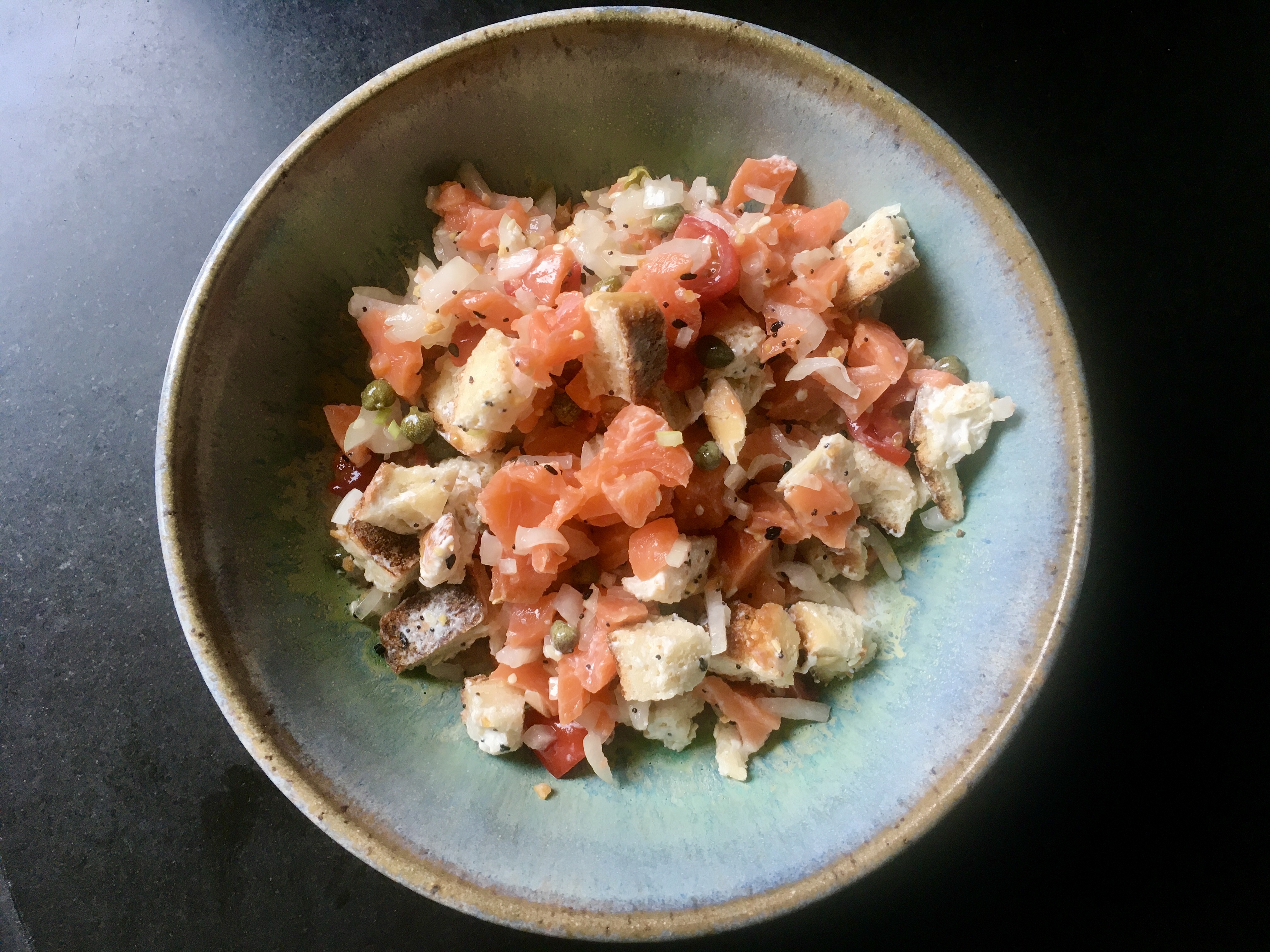
My version of lox and bagels: home-cured wild-caught Alaskan salmon, whipped cream cheese (fewer calories), onions, capers, and toast pieces. Lots of tasty bites here. (A sliced, hard-boiled egg would only add 78 calories.)
There are a million diets out there, and everybody claims they have the secret to weight loss. But no matter what diet you’re on, what it really boils down to is the simple mathematical equation of calories in…versus calories out.
My buddy, Lee, a PhD in chemistry, and someone that dropped 50 pounds a couple of years ago, told me about an article written by an engineer that lays out the basics. You can find it here:
As he states, losing weight is simply thermodynamics: you need to eat less calories than your body burns every day. If you do that, you will lose weight.

My stir-fry has chicken breast, broccoli, white rice (Uncle Ben’s), some onion, and my “Chinese Mix” of flavors: soy sauce, hoisin sauce, chili garlic sauce, and sesame oil. My trick to add flavor to the rice without calories is to add beef bouillon when I cook it. (I use Better Than Bouillon.)
 

There is a way to find out approximately how many calories a day your body uses to maintain its weight. It’s called the basal metabolic rate, or BMR. In my case, I need about 2500 calories per day to maintain my weight. So, like my friend Lee, I chose a diet where I eat no more than 1500 calories daily…a deficit of 1000 calories per day.
At the end of 7 days, I have eaten 7000 fewer calories than my body uses. Since about 3500 calories make 1 pound, I should be losing 2 pounds per week, according to this math.
Now, there are many variables to this, but basically this thought process holds true.
And the best part is: is doesn’t matter what I eat. If I want to eat bean sprouts, great. If I want Taco Bell, fine. As long as I don’t go over 1500 calories a day, it doesn’t matter what I put in my gut. This is really helpful for people like me, who get bored of eating the same old stuff day after day–a sure-fire way to give up on a diet. Carbs, fats, meat, dairy–even alcohol…all OK within reason.

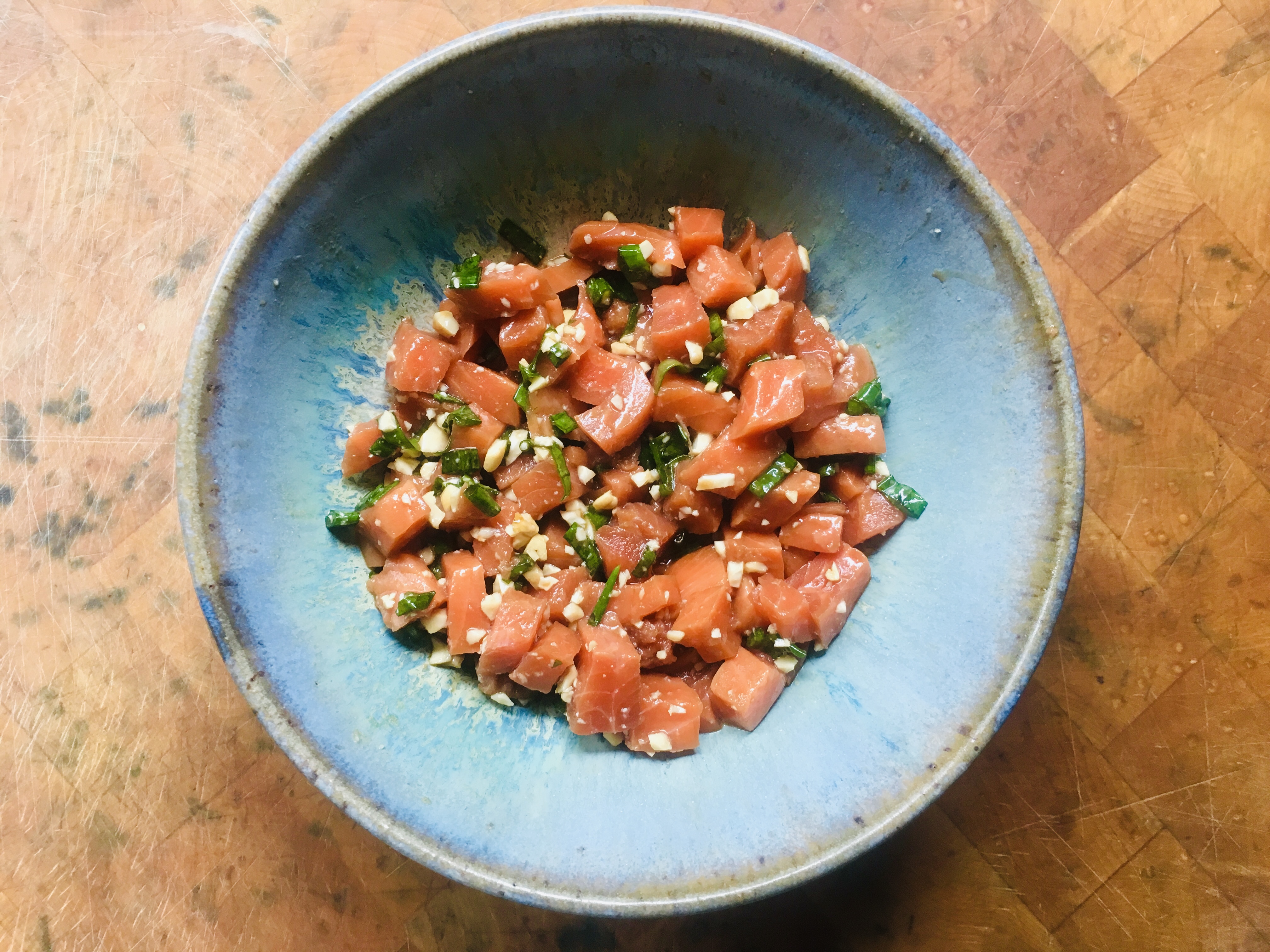
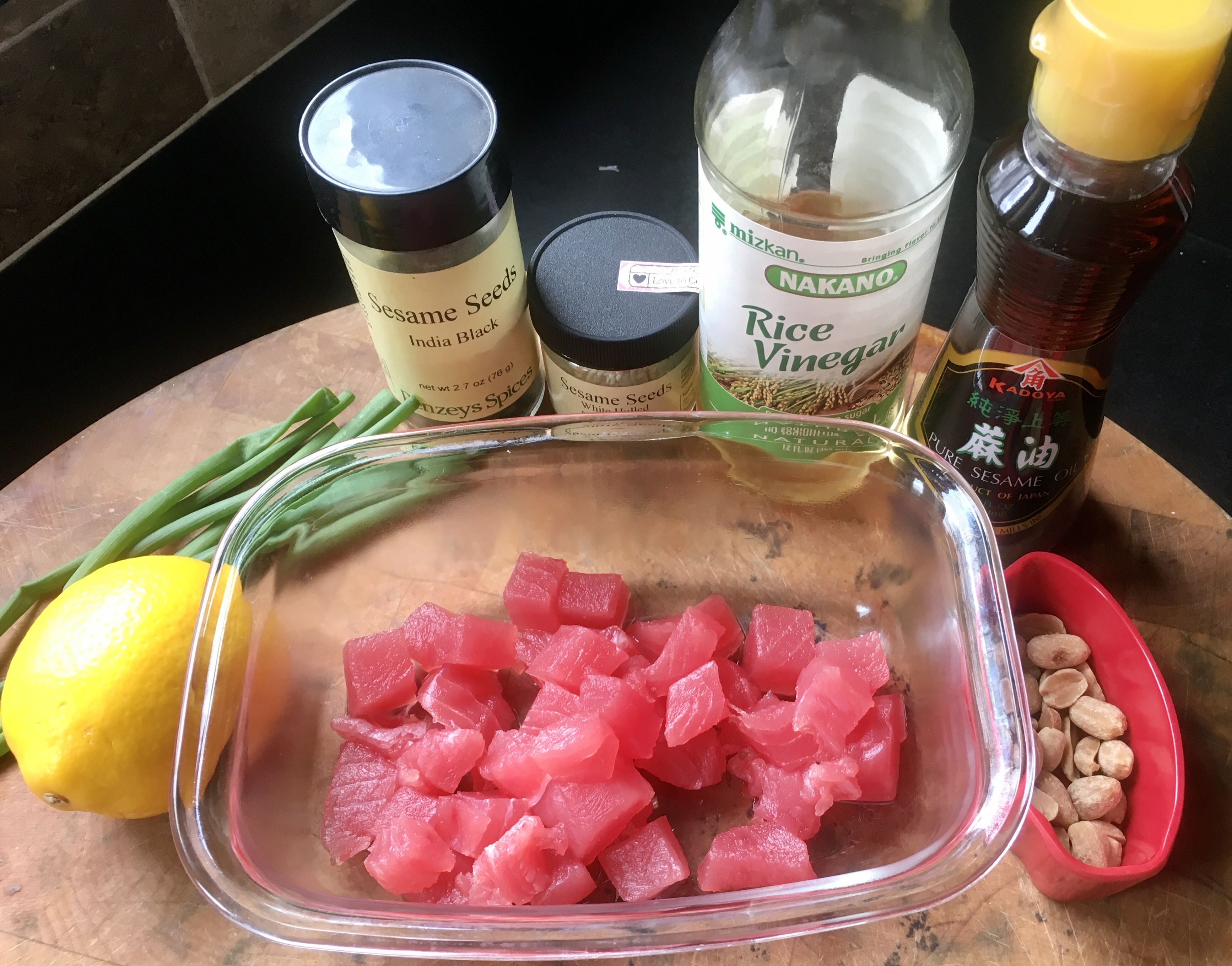
Fish is an excellent source of protein, and I never ate enough of it. Now, I make a bowl of tuna poke pretty often, and it’s absolutely delicious!


My buddy, Lee, is a diabetic, and stays away from carbs. He eats lean meats, seafood, and vegetables. That’s how he lost his 50 pounds. His son, on the other hand, lost weight by eating mostly fast food, but still counting the calories and not eating more than 1500 of them per day. He also lost 50 pounds.
I’m not a big junk food person. I don’t buy cookies, cakes or chips. Ice cream (my kryptonite) is a rare treat. I don’t put sugar in my coffee, and I don’t drink juices or soda. And I don’t like beer! But my biggest weight-gain mistake was thinking I could use unlimited amounts of so-called “healthy fats” in my recipes. I was pouring olive oil over everything…spreading pork leaf lard everywhere…and buttering my butter! Now I measure everything, drastically reducing my fats, and I can’t believe how many calories I’m saving!

Sprays can be extremely helpful in keeping your calories low. Just be careful: they say “zero calories,” but that doesn’t mean you can spray a ton in your pan! Regulations allow them to say “zero” if a single serving is less than 1 calorie. That’s why a single serving here is a spray of about 1/5 of a second! (Seriously!)


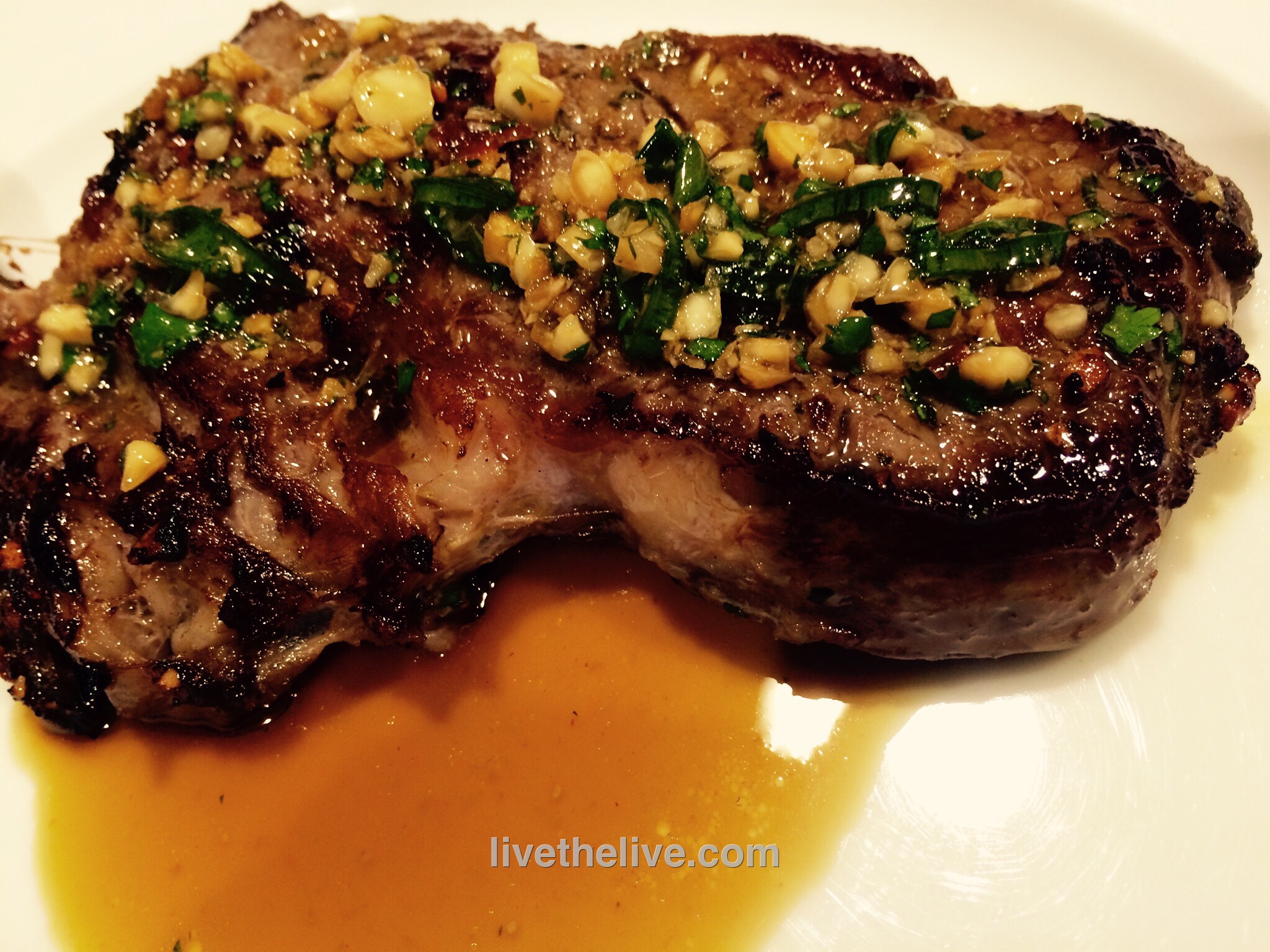
Portion control is essential. I’ve found that I really don’t have to change many of my recipes in this livethelive blog, which is all the food I love. I just have to control my portion sizes. For example, a ribeye may be a delicious source of protein, but it’s also loaded with fat. (That’s why it tastes so good!) So now I only eat a small, 4-ounce serving at mealtime, not the 12-ounce (or larger!) slab I was eating before.
Last year, when I started my 1500-calorie-a-day diet, I was bloated from alcohol, salt, fat, and simply eating too much rich food. But once the diet really started rolling, I could step on the bathroom scale and see the bloat was diminishing, and rather quickly. At this point, it’s easy to deceive yourself in thinking that this is “real weight,” when it’s not. It’s just your body reaching its natural plateau. But that’s OK. When you see the weight go down, even by a tenth of a pound a day, it gives you the incentive to continue.
After about a week of bloat loss, the real diet and weight loss began.
The human body is full of constant change. So even once I started and steadily maintained my 1500-calorie-a-day diet, Lee told me not to expect to be dropping 2 pounds per week like clockwork. Some weeks, my body will retain more water, perhaps from eating too much salt. Some days, I’ll go to the bathroom more, some less. My bathroom scale itself may be off by a little, too. So what I see when I step on the scale needs to be taken with a grain of salt (pardon the pun.) On any given day, my weight can actually be plus or minus 2 pounds (or more) of what my scale shows.

Find a protein drink or bar you like. It can really help when the cravings get bad. But make sure you choose one that is low in sugar!

The secret of this diet (or any other diet for that matter) is persistence. Don’t give up because your scale hasn’t moved. Your body is going through changes–big changes. And if you maintain your diet, you will see results eventually…the keyword being: eventually. Over the course of a month or two, you will see significant results.
The secret for me is to find the food I like and then eat it in reasonable quantities. Variety is also really important, or I’ll get bored and give up. Other than avoiding too much salt, I have few dietary restrictions. So I’m able to eat whatever I want within my calorie guidelines.
So as you read this blog this year, you’ll see that many of my recipes haven’t changed, with the exception, perhaps, of fats used in cooking, because that’s one of the top calorie culprits. It doesn’t matter if you’re using butter, bacon fat, or healthy olive oil, all fats have a lot of calories, whether they’re healthy or not.
Another key to my diet’s success–and this is the one that everybody hates!–I write down every single morsel of food I eat every day, and then calculate how many calories that entails. Not everyone can be this anal, but I have no problem with it. Once I set my mind to it, it just comes naturally. I have a date book where I write my morning weight every day, and then everything I eat that day, with individual and total calorie counts. (Counting calories is easy, now that we all carry phones that let us simply Google that information.)
Using a simple digital kitchen scale (one that weighs ounces and grams) is KEY to making sure you’re not overeating. Buy one immediately! If you think you can simply eyeball measurements, you’ll find that you are WAY OFF!

Yes…I write it ALL down!


Fortunately for me, even alcohol can be included in this diet. That’s not to say that I’m boozing it up! I only allow myself alcoholic beverages on Friday and Saturday nights. At 100 calories for a 1.5 ounce shot of 80-proof booze, I can have 2 3-ounce martinis for a total of 400 calories (without olives.) Of course, that still counts in my 1500-calorie-a-day plan. So that means I have to eat less…which can get me a little loopy on weekends! But as long as I’m not driving, that’s not a problem! Drinking alcohol gives me the munchies…so I have to be very careful with that.

Having a seat at great bars, like the world-famous Bar Hemingway at the Ritz in Paris, is a passion of mine. My diet still allows me to sip a fine cocktail without guilt! I choose drinks that are low in sugar.

Follow this diet and you, too, will succeed. It doesn’t matter if you need to be gluten-free or not. It doesn’t matter if you’re avoiding carbs or not. It doesn’t matter if you’re vegan, vegetarian, or a total carnivore. Keto, Atkins, whatever. What matters is counting your total calories per day…and sticking to the diet every day…no cheating. No business lunch excuses, breakfast buffets, and 48-oz. steaks.
And no “rewarding” yourself with treats because “you did good” for a couple of days. Those things need to happen every few weeks, not every few days.
A great tip is to start by eating everything you love, even if it’s not really good for you, just in smaller quantities. Don’t eat real junk food, but worry about total calories first, not whether what you’re eating is “health food.” (Like my buddy, Lee’s, son who still lost weight eating Taco Bell.) Your first goal should be to limit calories. Get a feel for it. Then, as you get comfortable and progress, start making better and healthier food choices. Let’s be honest: anyone who starts a diet by chewing celery after a lifetime of steak and potatoes is going nowhere!
After I reached my goal weight last year, I went back to my daily intake of 2500 calories to maintain my new weight. (That’s still fewer calories than I was consuming every day before I started the diet, but after 1500 a day, it felt like I was cheating!)
What I learned with this diet, as I cooked healthier, measuring how much fat I put in a pan before frying…cutting my huge steaks into smaller pieces and trimming off the fat…was that I never want to go back to my old way of eating again. I can still eat anything I love…just less of it.

I cut the middle out of my bagel and weigh it!


That right there, after cooking, is 90 calories. Nothing brings the flavor like bacon!


My breakfast sandwich: the bottom of an everything bagel, a strip of bacon, and a fried egg. 349 calories, including a tablespoon of butter! A sprinkle of everything bagel seasoning adds flavor and just a couple of calories.


WHAT I’VE FOUND….
Bad…
1 tablespoon of butter has 100 calories. I used to load my 400-calorie everything bagel with 300 calories of butter…and then I had breakfast! A tablespoon of whipped butter has only 50 calories, so I use that instead.
Same thing with mayonnaise. I love Hellman’s. But it’s got 90 calories per tablespoon. Enter Hellman’s Light: 35 calories and I can still indulge!
Cheese is not a dieter’s friend. It’s a calorie and salt nightmare. And light cheese tastes like crap. So I stick to small amounts of lower calorie cheeses, like feta (70 calories per ounce) or whipped cream cheese (40 calories per tablespoon), and save pizza and pasta dishes for very rare occasions.
Good…
Boiled Shrimp is our friend at just 80 calories for 4 ounces, and lots of protein. Shrimp cocktail makes you feel like you’re splurging, but it’s low in calories if you go easy on the cocktail sauce.
Lobster, too: super-low calorie. Just go easy on the butter!
Raw oysters: packed with protein and a ridiculously low amount of calories. Eat all you want!
A hard-boiled egg, which I love, is just 78 calories…an excellent protein bomb that fills you up. (And don’t worry about the cholesterol unless you’re eating a dozen a day!)
You can still have bacon! My thick-cut bacon is 90 calories a slice after frying. Now I have one slice for breakfast instead of six! (Read the package.)
A diet saves you money! I can’t believe how much less food I buy at the supermarket! Sure, I’m buying more veggies, but a steak that used to be one meal is now three! As a nation, Americans eat way too much food, and what we eat is mostly unhealthy. A diet that focuses on veggies and lean proteins is good for any body. Michael Pollan’s quote is more valuable now than ever: “Eat food, not too much, mostly plants.”
A successful diet is all about being creative. I can’t have a BLT in the usual sense anymore, and that’s my all-time favorite sandwich. But I can have BLT lettuce wraps that drastically cut the calories and still satisfy my cravings.

My BLT. Limiting the bacon and mayo makes it diet-friendly.


Adding that strip of toasted bread really adds to the flavor and texture!

Of course, any exercise you do in addition to this diet is only a bonus. If you use a treadmill or stationary bike, the digital readout will accurately tell you just how many calories you’ve burned. You can subtract that from your daily calorie count. But, that being said, one of the biggest diet mistakes people make is to over-estimate how many calories they’ve burned during exercise.  If you’re guessing…you’re WRONG! Guaranteed, you burned FAR LESS than you think you did!
I know the health clubs may not want me to say this, but you DON’T have to exercise to lose weight. Reducing your caloric intake alone–if you reduce it enough and for long enough–WILL make you lose weight. Exercise alone WILL NOT.
Here are my calorie charts from last year. You may not like all the foods I’ve got listed here, but I think it’s a good start. As I mentioned earlier, you can pretty much Google the calorie count of any food. That’s basically what I did….and I read a lot of labels!
One last tip: There will be times where the bathroom scale will be teasing you, taunting you: where your weight won’t budge for several days at a time. Don’t let this get to you! Your body is still changing for the better! This is where you need to be strong! Keep doing the right thing, and you will see that at the end of a couple of months, when you chart your progress, you really did lose almost 2 pounds a week.
I did it last year! I’m gonna do it again! So can you!

Al Forno in Providence, RI, is a legendary Italian restaurant that was established in 1980 and has graced the pages of many a food magazine ever since. Chefs Johanne Killeen and George Germon made it a culinary destination, creating dishes that many have copied, but never equaled. 

One of those creations was the grilled pizza. These days, you can find grilled pizzas just about anywhere in the country, but it was Al Forno that started it all.

Sadly, George Germon passed away in 2015, but the restaurant continues, despite only being open for takeout these days, due to the pandemic. And although the menu offers a wide variety of dishes for takeout, the one my daughter and I crave–that isn’t on the menu–is their 5-cheese pasta dish. It’s not baked ziti. It’s not lasagna. It’s something way beyond.


Taking the recipe from one of Johanne and George’s cookbooks, my daughter and I decided that we would re-create this magical dish at home as best we could.

One element obviously missing in our home is a wood-fired oven, something Al Forno uses with every dish. (I’ll be able to tackle that end of the recipe in a few months, when my Ooni wood-burning pizza oven arrives.)

And looking at their list of 5 cheeses (mozzarella, Pecorino Romano, fontina, ricotta and gorgonzola), I found that gorgonzola was a bit of a surprise. Having had the 5-cheese pasta dish at least 4 times at Al Forno, I never detected even a hint of blue cheese. In fact, if I would have, I don’t think I would’ve ordered it again. So we chose to remove the gorgonzola and add another favorite, sharp provolone, instead. It turned out to be an excellent choice.

Other than that, we stayed true to the recipe, using shell pasta because that’s what we always got at the restaurant.

2 cups heavy cream
1 cup chopped canned tomatoes in heavy puree (San Marzano’s, if you can get ’em)
4 oz. thinly sliced mozzarella cheese
1.5 oz. grated Pecorino Romano cheese
1.5 oz. coarsely shredded Fontina cheese
1.5 oz. grated Provolone cheese
2 tablespoons ricotta cheese
3/4 teaspoon Kosher salt, plus more for the pasta water
6 fresh basil leaves, coarsely chopped
1 lb. conchiglie (medium shell) pasta
4 tablespoons unsalted butter, sliced thinly
Shavings of raw scallion for garnish (optional)


Preheat the oven to 500°, or as close to it as your oven will get.

Bring a large pot of salted water to a boil.

In a mixing bowl, combine all the ingredients except the pasta and the butter. Stir well to combine.


Drop the pasta in the boiling water and parboil it for about 4 minutes. Drain it in a colander and add it to the ingredients in the mixing bowl. Combine it well.


Divide the pasta mixture into small ceramic dishes, or just use one large baking dish. You want it to sit in a relatively shallow 1-inch layer.


Dot the top of the dish with the butter, and bake it until it’s bubbly and brown, about 7 to 10 minutes at 500…a little longer at lower temperatures.


Funny how help arrives when it’s all about pasta and cheese!


It’s the creamiest, cheesiest pasta dish you’ll ever have…and everyone will fight over those little charred pasta shells!


Optional: When I ordered this dish at Al Forno, they would top it with thin shavings of raw scallion on top. I loved that touch and do that at home as well.


If you watch as much Food Network and Cooking Channel as I do, you’ve probably heard of Big Bob Gibson’s Bar-B-Q in Decatur, Alabama. Smokin’ and grillin’ since 1925, they put the now-famous Alabama white sauce on the map. They would smoke whole birds, then dunk the entire bird in a bucket of white sauce before returning them to the smoker to cook some more. And then they’d serve more of the precious white sauce on the side as you tore into the most amazing chicken you’ve ever had.


I lived in Mobile, Alabama about 30 years ago. Never made it to Decatur. Probably never will. So it was time for me to try to recreate the magic at home. I think I did pretty well.

If you Google “Alabama white sauce,” you’ll get dozens of versions, each, I’m sure, pretty similar and pretty good. I did just that, and then tweaked it to make it my own.

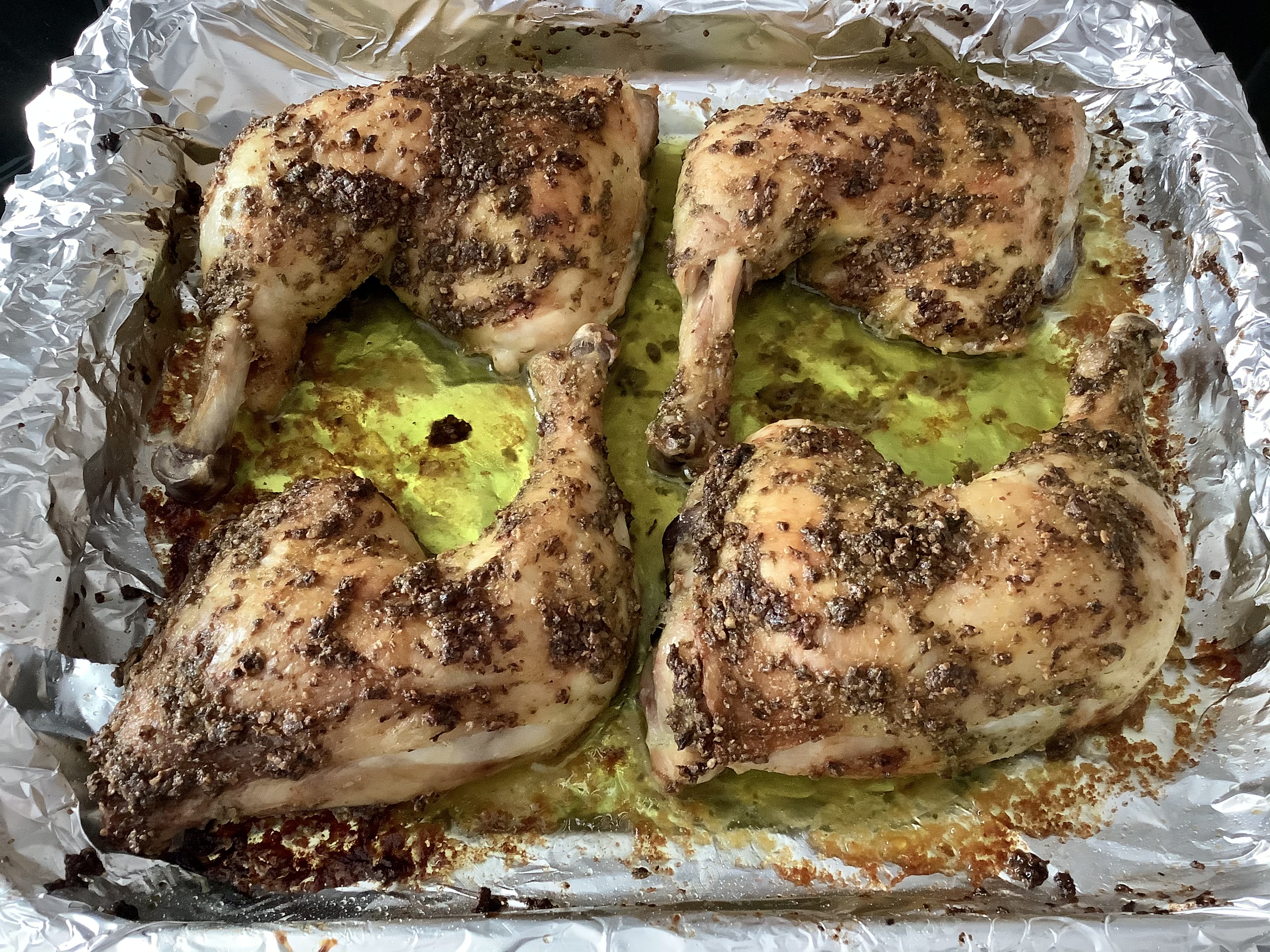
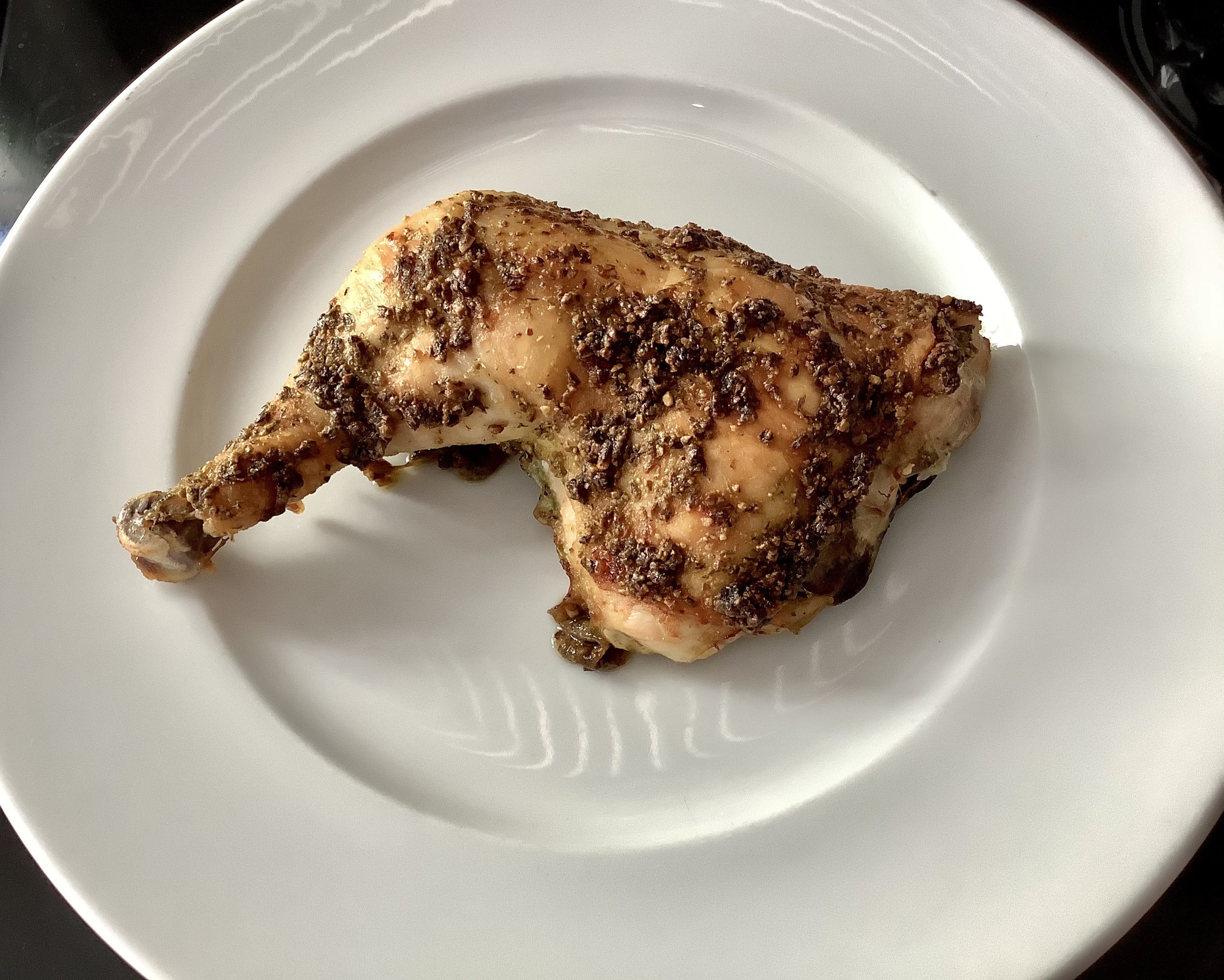
I don’t smoke the birds. I simply season them with salt and pepper, and roast them in a convection oven at 350. When they’re almost done, I brush the chicken all over very liberally with my white sauce…bottom of the bird, too. Then it goes back in the oven for a little bit more.


Parts work as well as whole birds. I love using leg quarters for this recipe.


1 cup mayonnaise
4 tablespoons buttermilk
4 tablespoons white vinegar
2 teaspoons Dijon mustard
1 teaspoon ground black pepper
1 teaspoon granulated garlic
1 teaspoon granulated onion
1/2 teaspoon salt
1/2 teaspoon sugar

Combine all the ingredients and mix well. I like to keep it in a container with a lid so I can shake it up before using it.

Preheat the oven to 350.

I like to roast a whole bird, though parts work just as well. If I’m roasting a whole bird, I like to spatchcock the bird so that it cooks evenly. 

(Aside from the fact that it sounds dirty, spatchcocking simply means removing the back bone of the bird so you can open it up and press it flat onto the roasting pan.)


A spatchcocked bird.


It’s relatively easy to do, especially if you have poultry shears. You just flip the bird upside down, and cut all the way up on either side of the back bone.

Be sure to save the backbone for chicken stock. If you’re like me and you pay extra for really good quality humanely raised chicken, every little bit needs to be saved and utilized to get the most bang for your buck.

I recently discovered a brand called Cook’s Venture. They sell an uncommon variety of bird that is pasture-raised and grows slowly, producing delicious meat. The TLC required to raise these birds comes with a price, but to me they are worth it.


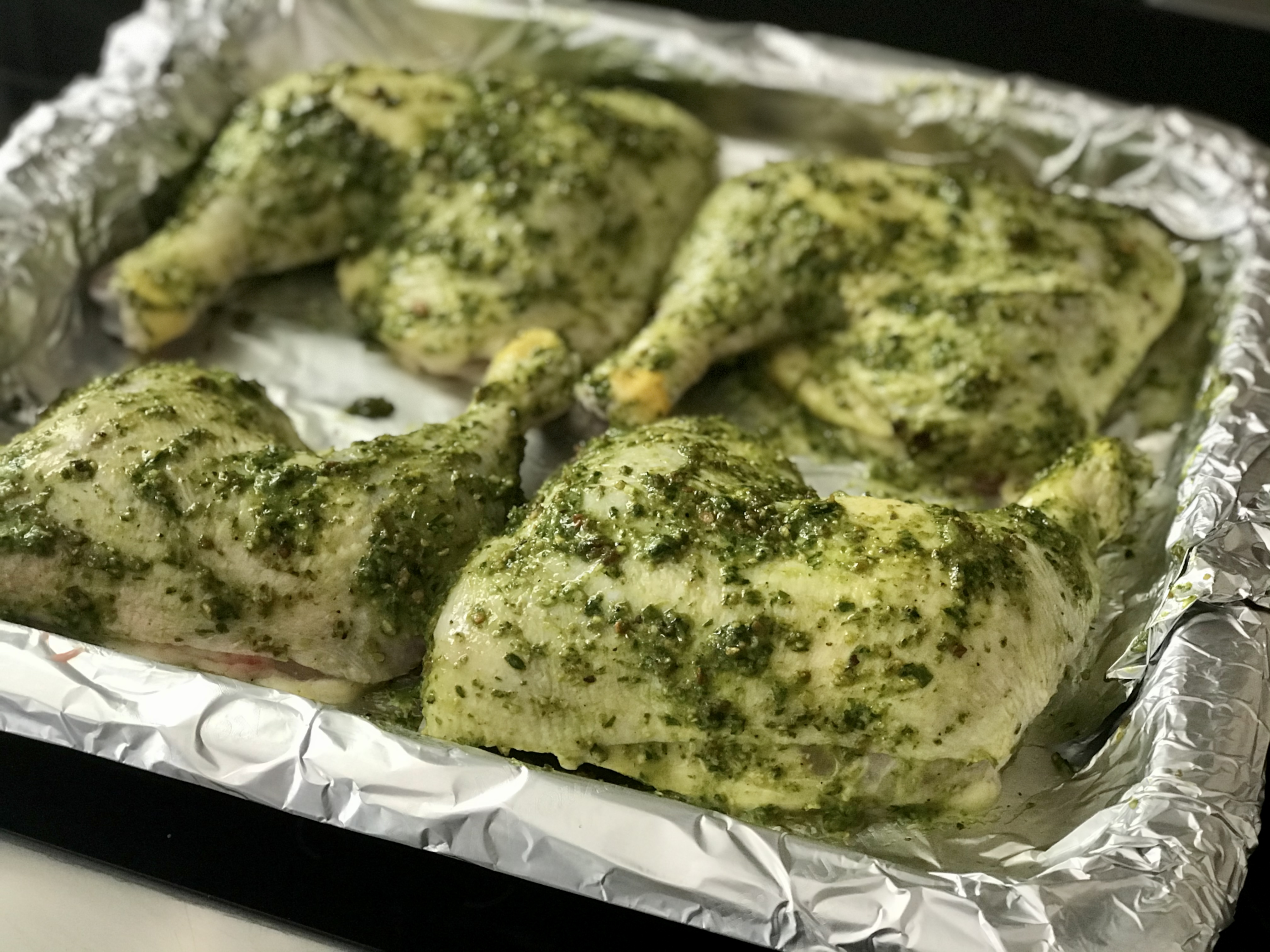
I line a baking tray with foil, salt and pepper my bird all over, and place it on the baking tray and into the 350-degree oven. It takes a little less than an hour for a 4-lb. bird, but before it’s completely cooked through, I pull it out of the oven and brush on all sides with my Alabama white sauce.


Then it goes back into the oven for about 10 minutes.

The result is a tender and juicy bird, unlike any you’ve had before.


And save some of that white sauce to dip in while you’re eating!


This is my version of a holiday drink I was introduced to by my mother-in-law from the Upper Peninsula of Michigan.

This classic is loaded with sugar. But then…so is everything else around the holidays!

Whiskey slush

9 cups water
2 cups sugar
4 “Constant Comment” tea bags
12 oz. frozen OJ concentrate
12 oz. frozen lemonade concentrate
2 cups whiskey (I use Crown Royal)
7-Up or Sprite

Boil the water and sugar, making sure the sugar dissolves. Turn off the heat and steep the tea bags in the liquid for 10 minutes. Discard the tea bags.

Add the OJ, lemonade and whiskey. Mix well, then pour it all into a freezeable container with a lid. Freeze.

To serve: Scoop the slush out of the container (it doesn’t freeze solid) and mix in a tall glass with 7-Up.

Let’s face it: there’s no such thing as healthy eggnog. This recipe is delicious but is also a heart attack in a glass. I post it every year because my friends just love it.

My buddy, Rick Sammarco, a wicked talented bartender, credits his father, Al, for this eggnog. The original recipe calls for a lot more of everything. I’ve cut it down to a “more reasonable” size.

A word about salmonella: If you’re concerned about it, you need to decide what works for you. Some recipes tell you to make your eggnog weeks in advance to “sterilize” the drink with all the booze you’ve added to it. I’m not sure that really works. As for me, I use raw eggs in my Caesar salad dressing and in other recipes, so I’m willing to risk it here.

If you’re lucky, some stores–(though very few of them, and none near me)–sell pasteurized eggs. They say the taste is a bit funky, but that it does remove the salmonella.


eggnog


1.5 quarts vanilla ice cream (I use Breyer’s)
1 pint half & half
15 whole eggs (raw)
½ teaspoon vanilla extract
1/4 teaspoon cinnamon
1/4 teaspoon nutmeg
At least 3/8 cup of each:
spiced rum (I use Captain Morgan)
whiskey (I use Crown Royal)
brandy (I use E&J)


Let the ice cream soften 1 day in the fridge. Mix the ice cream, eggs, vanilla, half-and-half in a blender.

Add the spices and liquor. Blend until it’s frothy.

Taste, and add more cinnamon and nutmeg if you like.

After it’s fully blended, let it sit in the fridge, covered, for at least 12-24 hours for the flavors to blend. Even longer is better.


NEW YORK STYLE CHEESECAKE

Posted: December 12, 2020 in Uncategorized
Tags: , , ,

Cheesecake is one of my guiltiest pleasures, but that also means it has be the best I’ve ever had if I’m going to allow that many calories into my belly!

This recipe is not only delicious, but it results in a perfectly cooked cheesecake with no cracking!

One of the keys to a great cheesecake right is placing it in a water bath while baking. But if the springform pan allows water in (and they all do), it creates problems. The solution is to foil-wrap the springform pan really well.

But first, the crust…

1-1/2 cups graham cracker crumbs, from 12 whole crackers
5 tablespoons unsalted butter, melted
2 tablespoons sugar
1/8 teaspoon salt


Preheat the oven to 375° and set an oven rack in the lower middle position.

Here’s the crucial part: Wrap a 9- or 10-inch springform pan with one large piece of heavy-duty aluminum foil, covering the underside and extending all the way to the top so there are no seams on the bottom or sides of the pan. Just to make sure, repeat this process with another sheet of foil for insurance. This keeps the water bath out of your cheesecake, so do a thorough job of it!

Then spray the inside of the pan with nonstick cooking spray.

In a medium bowl, combine the graham cracker crumbs, melted butter, sugar, and salt. Stir until it’s well combined. Press the crumbs into an even layer on the the bottom of the prepared pan. Bake the crust for 10 minutes, until set. Remove the pan from the oven and set it aside.


32 oz. (four 8-oz. blocks) cream cheese, at room temperature
2 cups sugar 
3 tablespoons all-purpose flour
4 teaspoons vanilla extract
1 teaspoon packed lemon zest, from 1 lemon
2 teaspoons fresh lemon juice, from 1 lemon 
1/4 teaspoon salt
6 large eggs
1/2 cup sour cream


Reduce the oven temperature to 325°F. Boil some water.

In the bowl of an electric mixer fitted with the paddle attachment, beat the cream cheese, sugar, and flour together on medium speed until just smooth, about 1 minute. Scrape the bottom and sides of the bowl to be sure the mixture is evenly combined.

Add the vanilla, lemon zest, lemon juice, and salt. Beat on low speed until it’s all just combined. Add the eggs, one at a time, mixing on low speed until incorporated, scraping the bowl as necessary. Mix in the sour cream. Make sure the batter is uniform but don’t over-mix it.

By now, the oven should be cooled to 325°.

Set the cheesecake pan in a large roasting pan. Pour the batter on top of the crust. Pour the boiling water into the large roasting pan to come about 1 inch up the side of the cake pan.


Bake until the cake is just set, 1 hour and 30 minutes to 1 hour and 45 minutes (the cake should wobble just a bit when the pan is nudged). Remember: the cake will continue to cook outside of the oven before it cools!

Carefully remove the roasting pan from the oven and set it on a wire rack. Cool the cheesecake in the water bath until the water is just warm, about 45 minutes.


Remove the springform pan from the water bath and discard the foil. If necessary, run a thin-bladed knife around the edge of the cake to make sure it’s not sticking to the sides (which can cause cracks as it cools), then cover it with plastic wrap and put it in the fridge to cool for at least 8 hours or overnight.


After 8 hours, remove the sides of the springform pan. I like to serve the cheesecake right from the base of the pan. I’ve found that trying to remove the pan base only messes up the crust.

The secret to slicing beautiful pieces of cheesecake is to slice with a sharp knife, rinsing it in warm water and wiping it dry between every slice. 


Nothing goes better with cheesecake than a simple berry sauce. I avoid the common strawberry and go for these organic berries instead…


1 small container fresh raspberries
1 small container fresh blueberries
1 small container fresh blackberries
1 tablespoon fresh lemon juice
3/4 cup sugar


Combine all of the berries in a large bowl and stir gently to combine. Spoon about 2/3 of the mixed berries into a medium saucepan. Transfer the remaining berries to a small bowl and refrigerate until ready to serve. 

Add the lemon juice and sugar to the berries in the sauce pan. Bring to a gentle boil over medium heat and cook until the fruit is syrupy, about 5 minutes.


Move the hot berry mixture to a blender and purée it until it’s smooth. Set a fine mesh strainer over a bowl. Pour the sauce into the strainer and use the back of a large spoon soup to force the sauce through the strainer and into the bowl. Discard the seeds that remain in the strainer. Refrigerate the berry sauce until it’s cold. 

Before serving, simply add the reserved berries to the sauce and stir them to combine.


Parker House rolls are one of my all-time favorite treats. They’re so light and delicious because milk and melted butter are used to make the dough. I’d make and eat them every weekend if it wasn’t for the fact that I’d gain a ton of weight in the process! So…I save them for special occasions.


There really is a Parker House. It’s a hotel in Boston where the rolls originated in the 1870’s. Legend has it that a disgruntled hotel baker threw a batch of unfinished rolls in the oven, and when they came out, they had a folded pocketbook shape that made them light on the inside, and crisp and buttery on the outside. A legend was born.


There are hundreds of Parkerhouse Roll recipes out there, but this is the one I swear by. It’s a great excuse to get out my old Kitchenaid standing mixer.


1 stick unsalted butter, melted and cooled, plus softened butter for brushing
1 tablespoon active dry yeast
1/4 cup lukewarm water (100 to 110 degrees)
1/4 cup sugar
1 cup whole milk, warmed
2 large eggs, at room temperature
4 cups all-purpose flour, plus more for dusting
2 1/2 teaspoons Kosher salt


Brush a large bowl with butter.

In the bowl of a stand mixer fitted with a paddle, combine the yeast with the water and a pinch of sugar. Let it stand until it gets foamy, about 10 minutes. This gets the yeast happy.


Add the milk, melted butter, eggs and remaining sugar and mix until it’s all combined.

Now switch to the dough hook and add the flour and salt. Knead at low speed until a smooth ball forms, about 2 minutes.

Scrape the dough onto a lightly floured board and knead it gently into a ball. Then place the ball in the buttered bowl, covering it with plastic wrap, and placing the bowl in a warm place. Let the dough double in volume. It’ll take about 1 1/2 hours.


Pre-heat the oven to 350.

Grease a 9-by-13 baking dish with more butter.

Turn the dough out onto a lightly floured board again, punching out the air bubbles, and forming it into a ball again. Cut the ball in half, then each half into 8 pieces.


You can either leave the pieces in their wedge shape, placing them in the baking dish top side up. Or you can roll the wedges into balls, placing them into the baking dish, spacing them out evenly.


Cover the baking dish with plastic wrap and let the dough rise again for about 30 minutes. By then, your oven will be nice and warm.


Bake the rolls for 20 to 25minutes, until they’re a beautiful golden color.


Serve them warm or at room temperature. If you bake the rolls earlier in the day, you can cover them in plastic wrap, and the re-heat gently before serving.


I live one town over from Fall River, Massachusetts, and just down the road from New Bedford, Massachusetts, two thriving proud Portuguese communities. My daughter is in middle school, and she had to take mandatory Portuguese language classes. We’ve got dozens of authentic Portuguese restaurants in the area, and even a well-stocked supermarket with its own bacalhau (salt cod) room: Portugalia Marketplace, in Fall River.

So when I first posted my recipe of Portuguese kale soup, I was told by many Portuguese friends that my soup wasn’t authentic so I couldn’t call it that. Fair enough. After all, my soup has far less carbs (no potatoes or pasta), fewer spices, and it uses homemade stock instead of water. It may not be Portuguese, but it’s full of flavor.

My version of the classic Portuguese kale soup.

My version of the classic Portuguese kale soup.

4 cups home-made chicken or beef stock
4 cups water
1 cup lentils, rinsed in cold water
1 onion, finely chopped
1 carrot, finely chopped
2 stalks celery, finely chopped
1 clove garlic, through a press
1 lb. chourico, peeled and chopped into small cubes (I use Mello’s, out of Fall River, Mass.)
1 large bunch organic kale
salt and pepper

Add the stock and water to a large pot. Heat until boiling. Add the lentils.

In a saucepan with a little olive oil or bacon fat, sauté the onions, carrots, celery, and garlic for a few minutes. Add the chopped chourico and sauté a few minutes more. Add the contents of the sauté pan in the pot.

Wash and de-stem the kale, tearing the leaves into smaller pieces. Add the leaves to the pot and stir. The stems go in your compost pile. (You can also use them in a juicer.) Kale is always on the “dirty dozen” list of vegetables with large amounts of pesticides, so I always buy organic.

Cook the soup until the lentils are al dente. Taste and season for salt and pepper before serving.

THE BURRATA BURGER

Posted: November 2, 2020 in Uncategorized

Some of my favorite recipes happen when I’ve got a few leftover ingredients in the fridge that I really want to use up. The challenge is to make them work together.

Burgers are easy solutions to this dilemma, because, let’s face it: just about anything can go on a burger!

My thoughts behind this recipe went to a combination of things: a little garlic bread, a little Caprese salad, and, of course, a burger.

I had some burrata in the fridge. If you thought you couldn’t improve on mozzarella cheese, get yourself some burrata. The outer shell of the burrata is mozzarella, while the inside generally contains stracciatella and cream. It can be made from milk, or if it’s really decadent: Italian buffalo milk.

I use burrata instead of mozzarella when I make my Caprese salads…a combination of the cheese, fresh basil, and ripe tomatoes, drizzle with a high-quality balsamic vinegar.

I had kaiser rolls in the freezer. I wanted to go one step further, so I slathered them with my garlic bread smear, and toasted them.

And my burgers are always grass-fed beef, seasoned with salt and pepper, and pan-seared before finishing them in the oven.

I started with the garlic bread spread first.

Pre-heat the oven to 350.

1 stick (4 oz.) unsalted butter, softened
1 large clove garlic, squeezed through a press
1/2 teaspoon granulated garlic
1/2 teaspoon salt
1/2 teaspoon oregano
1/2 teaspoon parsley

I combined these ingredients in a bowl, mixing well, then smeared them on my kaiser roll halves, toasting them in the oven.

I got a pan very hot on the stovetop (cast iron is always best) and added a little fat. I use bacon grease if I have it. Otherwise I go with a high smoke point oil like avocado oil.

I seasoned the burger with salt and pepper, and placed it in the hot pan, searing it on one side, then flipping it to the other. I just want to sear the meat. I don’t want to cook the burger in the pan or it will overcook when I place it in the oven to finish.

I cut the burrata in half (it gets a little messy), and placed half of it (cut-side-down) onto the burger.

I placed the pan in the oven to finish cooking the burger and to melt the cheese. (If your pan isn’t oven-proof, get a tray that is, and just move the burger onto it and into the oven.)

I cooked the burger until it was medium-rare and the cheese had melted.

I placed the burger on the toasted roll and added a nice slice of farm-fresh heirloom tomato.(Fresh basil is optional.) And I drizzled over the top with some good balsamic.

That took a cheeseburger to a whole new level!

This is a story about something that is near and dear to my heart…and liver.

I’ve been making Krupnikas for over 40 years. (And no, I won’t be posting my secret recipe here.) It’s a honey-based liqueur that is popular in eastern Europe, especially in countries like Lithuania, where my parents were born. Though most of the Krupnikas that I’ve tasted is similar, no two recipes are exactly alike…and that’s where the arguments begin!

I have many friends that make Krupnikas. Some use a leaner approach (like me)…others go for the everything-in-one-basket approach. I’m not sure that more is necessarily better. Some friends claim that it isn’t real Krupnikas if you don’t use black pepper. But I’ve been to many pubs and restaurants in Lithuania and have never been served Krupnikas with black pepper in it. Other recipes include ginger, turmeric, and saffron. I don’t include any of these ingredients in my recipe.

krupnikas

If you Google “Krupnikas,” you’ll find many different recipes…some pretty good, some incredibly awful…(but none as good as mine!) I use grain alcohol…there’s no distilling involved. There were times in the last 40 years when grain alcohol was not readily available to me, and my Krupnikas production came to a screeching halt for a while. But these days, I find it easily. (Here in New England, it’s sold in Rhode Island and Massachusetts.) Desperate times without grain alcohol forced me to try vodka instead, but I never liked the final result.

There’s a version of Krupnikas that dates back to the early 1900’s in the coal region of northeastern and east central Pennsylvania, where Lithuanian immigrants created their own version, using moonshine as a base. They named it “Boilo,” and many people make this recipe every year during the Christmas holidays even today. But it’s more like a cousin of Krupnikas, if there can be such a thing.

Traditional Krupnikas uses a variety of unusual spices, none of which have their origins in Lithuania, so it’s interesting to hear how these exotic ingredients made their way via various trade routes to eastern Europe.

The story goes that Krupnikas was created by Benedictine monks in the 1500’s, and that it became popular in both Lithuania and Poland for celebrations like birthdays, weddings, and holidays. But when the Soviets shut down all Krupnikas production, the recipes went “underground,” passed down from generation to generation through closely guarded family recipes. That’s why everyone thinks their family recipe is the best!

One pot for honey, one pot for the various spices I use…to be combined later.

My own Krupnikas making story started with my uncle, who would make large batches of the stuff in his tiny Richmond Hill, Queens, NY, kitchen. Because I am the godfather of my cousin, his son, I received a bottle as a gift from my uncle every Christmas. By New Year’s, that bottle would be gone. It wasn’t long before I got very tired of waiting 51 weeks for another bottle and I asked my uncle if he would share his recipe with me. He never did that exactly, but he did let me sit in on a brewing session and take notes in a cramped corner of his kitchen.

I took my notes home from my uncle’s house and tried to decipher what I wrote. Since there was no such thing as the internet back then (what we call “the dark ages,” kids), I drove all over New York City in search of some of the more exotic spices used in making my uncle’s Krupnikas recipe. I became a regular at several Asian and Indian stores, where, at first, they looked at this tall, geeky white dude somewhat suspiciously as I brought my spices to the counter for purchase.

Over the decades, through trial and error, I changed my uncle’s original recipe to the one that I proudly call my own today. You can’t buy it in a store, but if you have tons of money and want to go into business with me, I’m sure we can work something out! Or become my best friend and you’ll get a bottle at the end of every year…and then you’ll be the one waiting 51 weeks for another!

krup glasses

Versions of Krupnikas are available in liquor stores: Old Krupnik is a Polish liqueur, and the German brand Barenjager is another. And many whiskies, like Dewar’s and Jack Daniels, now have honey-flavored spirits as well.

Though quite different from my own recipe, there are two authentic Lithuanian-style Krupnikas liqueurs made in the United States by acquaintances of mine.

Based out of Durham, North Carolina, the Brothers Vilgalys Spirits Company (www.brothersvilgalys.com) has a pepperier version that uses local North Carolina wildflower honey. President of the company, Rim Vilgalys, the son of my good childhood friend from New York, has done what I never got around to do: make this fabulous elixir available to the public. You’ll find it at ABC stores throughout the state of North Carolina.

bvsco-krupnikas

The second brand, made by a childhood friend, is made and sold in the New York area and goes by the name of KAS Krupnikas. (www.kasspirits.com)

kas_krupnikas_new

Both are pretty darn good. But are they as good as mine? I think you already know my answer to that question!

Sveiks! (Cheers!)