It’s been over a year since I posted this. Inspired by a recent conversation I had with a friend, I decided to share it again…

It’s never a healthy option to eat fast food. Michael Pollan said it best: “It’s not food if it arrived through the window of your car.”

A few years ago, a guy who claimed to be the nephew of Colonel Sanders, revealed the 11 secret herbs and spices that made KFC‘s original recipe chicken a worldwide success. He said he worked for his uncle for many years and had to make huge batches of the seasoning mix.

For me, KFC is like crack. Although I’m a big proponent of grass-fed this and pastured that, my kryptonite is KFC‘s original recipe chicken. There’s a KFC right next door to a local Home Depot in my area and my car literally drives itself to the pick-up window…I can’t help it. I justify the consumption of this heavenly grease by asking for no sides–no biscuit, no nothing. I get one breast and one thigh, and I drive off, steering my car with my knees as I indulge in my dirty secret, the hot grease dripping down my chin, a roll of paper towels at my side.

Making the KFC chicken recipe at home means I do have some control over product quality. I can use pastured or organic chicken. I can use clean oil. I don’t have the fancy pressure fryer they use at KFC, but I can use the healthier option of oven-frying. That means I fry my chicken in oil until golden brown, then finish the cooking process in the oven.

I have to say, the recipe really works! Maybe if I placed the real KFC side-by-side with my home-made chicken, I’d notice a big difference. But my brain said it was pretty damn close and absolutely delicious! If I could change one thing, I would use smaller chicken pieces next time. I used large pieces and the meat-to-breading ratio was off. Though it was mighty tasty, I was craving more breading per bite.

The recipe calls for all-purpose flour, but if you follow a gluten-free lifestyle, using Cup4Cup GF flour works just as well.

2 cups all-purpose flour
3 tablespoons paprika
1 tablespoon celery salt
1 tablespoon dried mustard
1 tablespoon garlic salt
1 tablespoon ground ginger
2 teaspoons black pepper
1/2 teaspoon white pepper
1 1/2 teaspoons thyme
1 1/2 teaspoons basil
1 1/2 teaspoons oregano
1 teaspoon salt
1 cup milk
1 egg
5 lbs. chicken pieces…your choice
oil, for frying

Combine the flour and the “11 herbs and spices” in a bowl. Mix well.

In another bowl, whisk together the milk and the egg. Add the chicken pieces to this bowl and let the chicken soak in it for 10 minutes.

Pre-heat the oven to 350 degrees.

Pour a couple of inches of the oil into a pan with high sides and heat it to 340 degrees, using a thermometer. Don’t fill it with too much oil, because oil expands when hot and it could spill over.

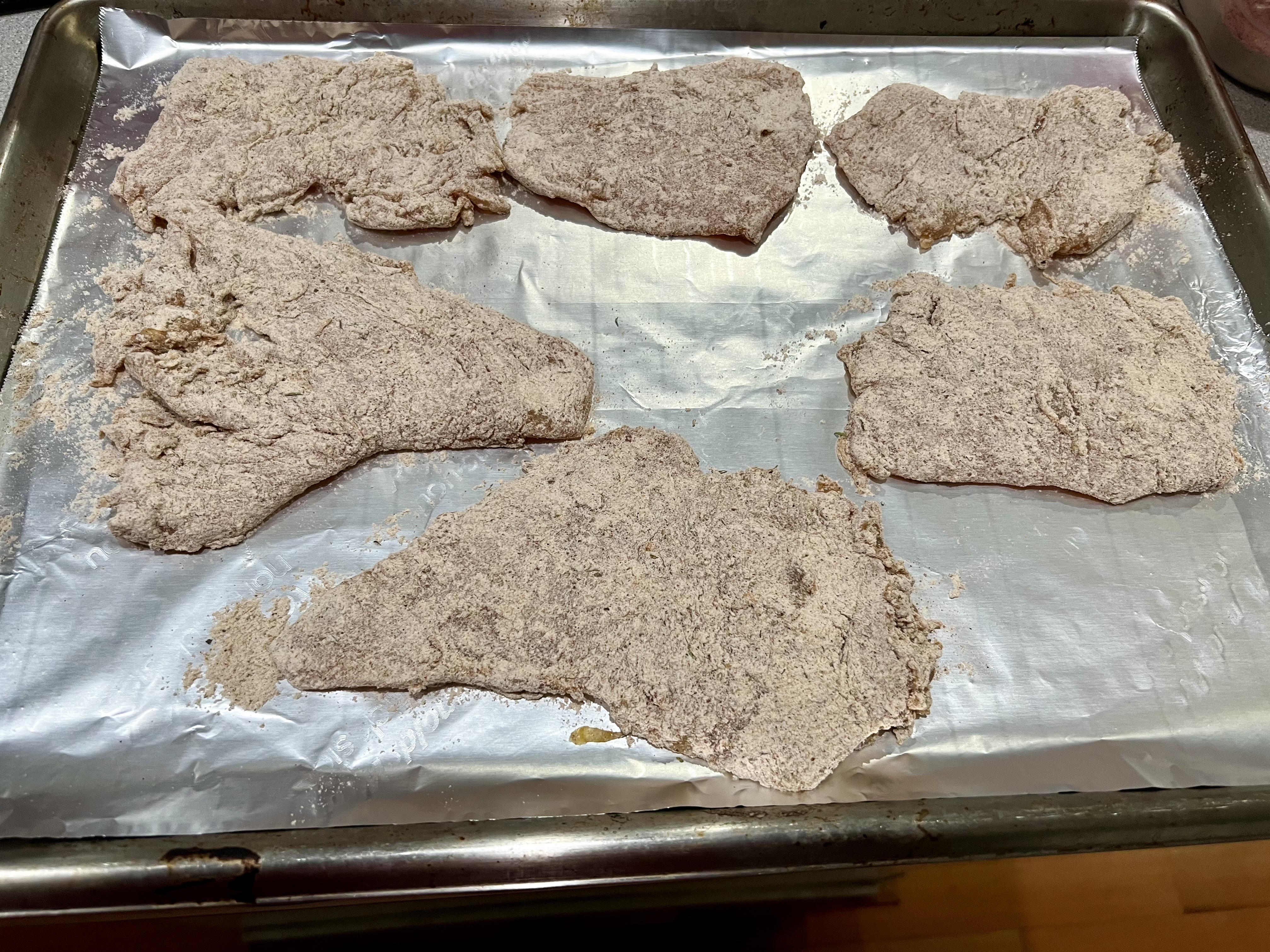
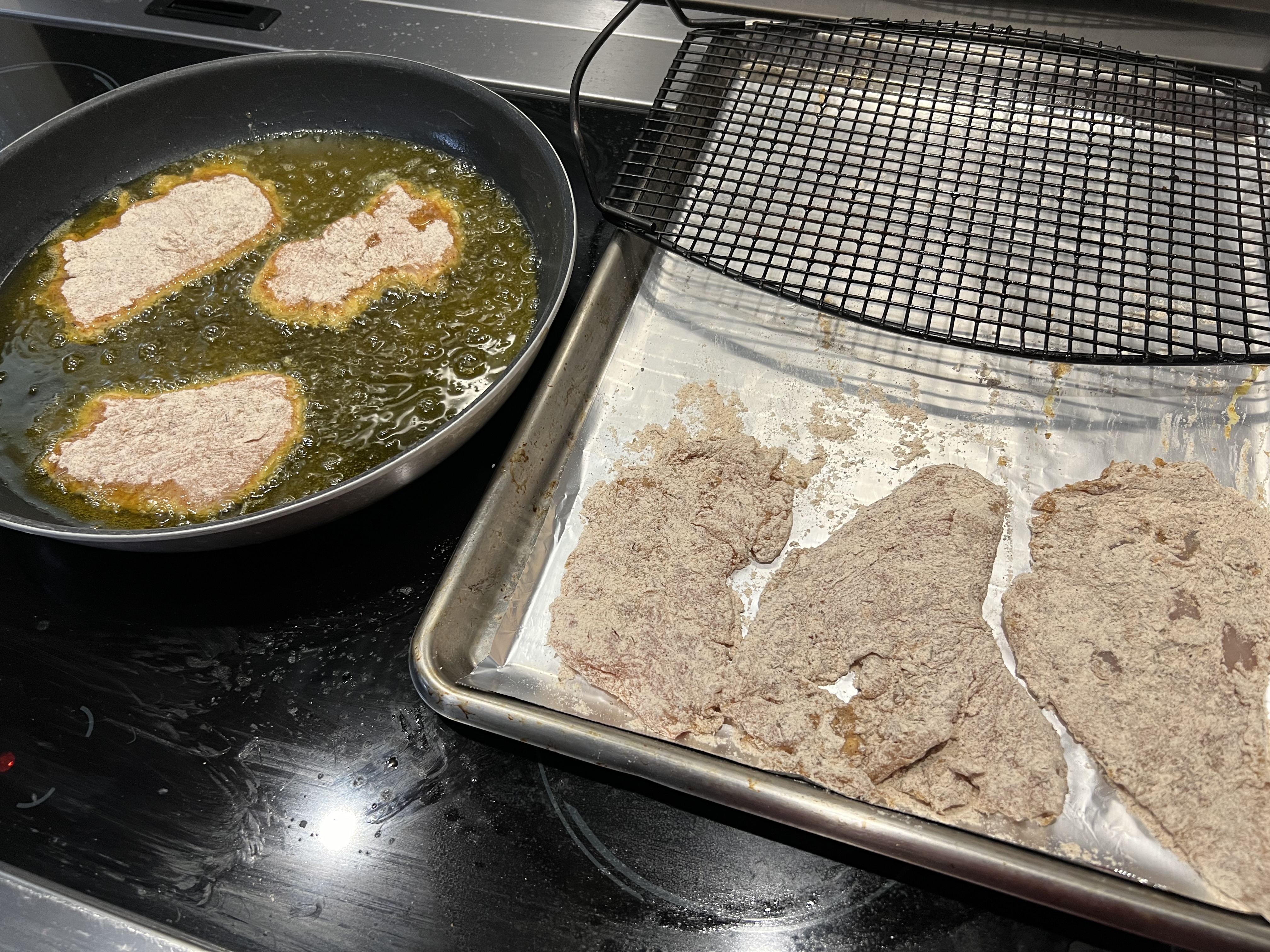
Take the chicken pieces out of the milk and egg mixture and coat them with the seasoning mix one at a time, making sure you coat them well. Carefully place the chicken in the hot oil. Don’t overcrowd the pan…work in small batches. Too much chicken could cause the oil to spill over the top.

Fry the chicken pieces just until golden…no need to cook them all the way through. Place the pieces on a baking sheet lined with non-stick aluminum foil. When all the chicken has been fried, place the baking sheet in the oven and cook until the chicken pieces reach an internal temperature of at least 160 degrees.

Make a lot! Leftovers are great, and they re-heat really well in the oven! (Don’t use a microwave…the oven is best.)


I love these ribs. They’re one of the the first recipes I ever tried, and still one of my favorites. I’ll be making them again this weekend!
 
I like making these because you don’t need a grill or a smoker. They’re gooey, sweet and absolutely delicious!
 
 
 image
 
¾ cup soy sauce
 1/4 cup hoisin sauce
5 lbs. pork ribs
Zest and juice of 1 lemon
2 whole star anise
2 cinnamon sticks (3”)
1/2 cup honey
4 cups chicken broth
 
Mix the soy sauce and the hoisin in a bowl, and set it aside. These are the marinade ingredients.
 
If the ribs are large, cut them into individual pieces. If they’re smaller, cluster 2 or 3 ribs together. Place them in a large pot. Cover them with water and bring it to a boil. Boil for 5 minutes. Drain the water.
 
Place the warm ribs on a baking sheet lined with non-stick aluminum foil or with a rack and brush them with the marinade. Let them sit for 10 minutes.
 
Pre-heat the oven to 350 degrees. Bake the ribs on the baking sheet for 30 minutes.
 
While the ribs are baking, start the sauce in a large non-stick pan or pot that will hold all the ribs: combine the lemon zest and juice, star anise, cinnamon sticks, honey and chicken broth. Bring it to a boil, then reduce it to a simmer.
 
When the ribs have finished baking, add them to the sauce pot and simmer on low (covered) for at least 15 minutes or until the rib meat is tender.
 
Turn the heat on high, uncover the pot and cook until the sauce is reduced to a glaze that coats the ribs. Be sure to reduce the heat as the sauce thickens or the sugars in the honey will burn! When the ribs are sticky and gooey, they’re ready.
 
Substituting grapefruit for the lemon works really well. And I like to switch the honey for maple syrup! 


I missed posting my annual corned beef prep for St. Patty’s Day, but who says you have to only eat corned beef once a year? After all, corned beef isn’t really an authentic Irish dish.

The phrase “corned beef” was coined by the British. Although the Irish were known for their corned beef throughout Europe in the 17th century, beef was far too expensive for the Irish themselves to eat and all of it was exported to other countries. Owning a cow in Ireland was a sign of wealth, and the Irish used theirs for dairy products, not beef.

The Irish ate pork, and a lot of it, because it was cheap to raise pigs, and they traditionally prepared something like Canadian bacon to celebrate St. Patrick’s Day in Ireland.

In the 1900’s, when the Irish came to America, both beef and salt were more affordable, and the Irish, who lived in poor, tight-knit communities, often next to Jewish communities, bought much of their beef from Kosher butchers. And so many of the Irish learned how to corn their beef using Jewish techniques, but adding cabbage and potatoes to the mix. That’s what we have today.

It takes about 3 weeks to make corned beef. Doing it yourself is not difficult. It just takes time.

Corned beef has nothing to do with corn. ‘Corning’ is a technique for preserving raw meats for long periods by soaking it in a salt brine. This method was used in England before the days of commercial refrigeration. Back then, the large salt kernels used in the brine were called “corns.”

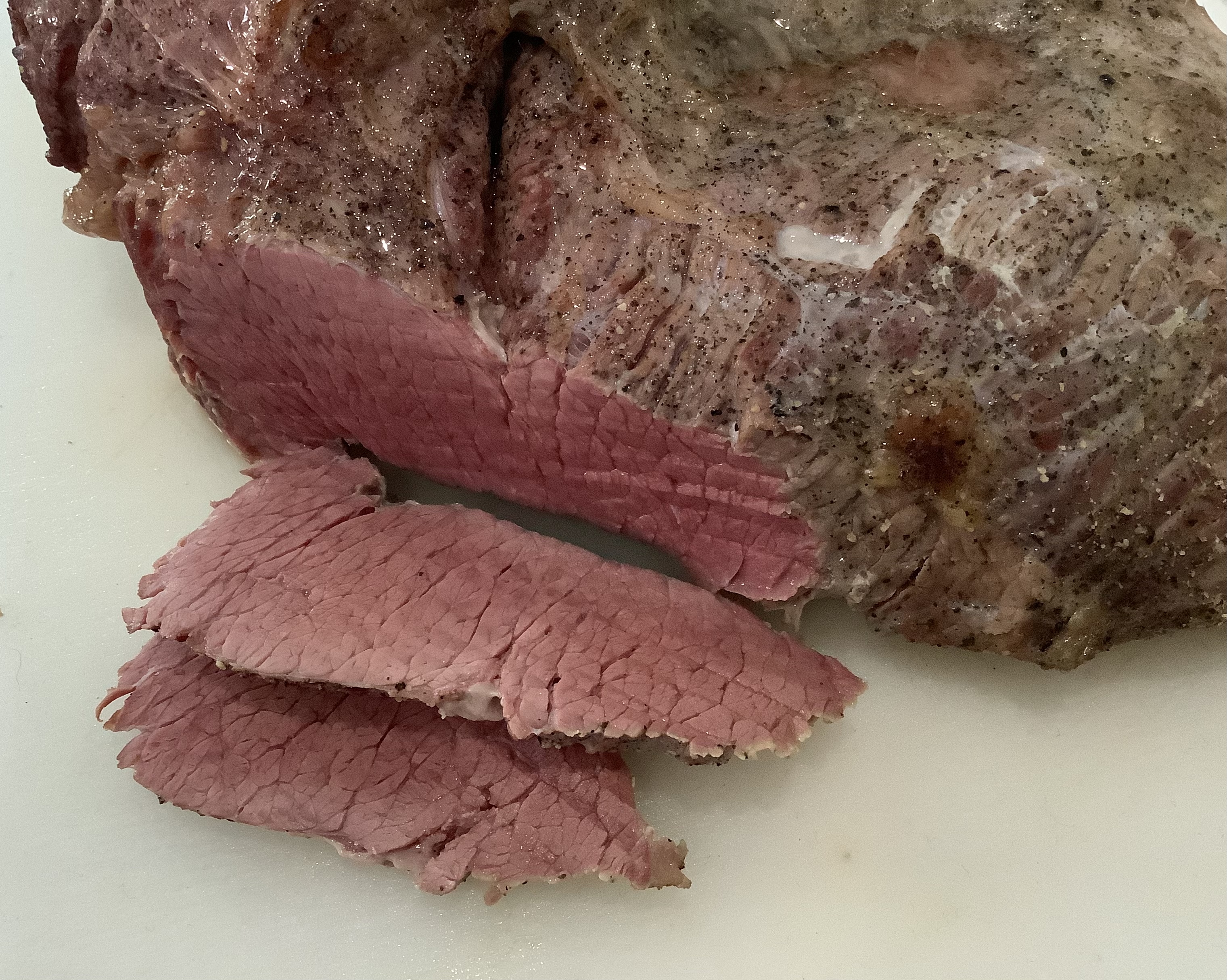
Brining is a time-honored way of preserving meat and it prevents bacteria from growing. Both pastrami and corned beef are made by this method. Both start with a brisket of beef. Corned beef is then cooked–usually boiled–and served. Pastrami is made when the brined meat is rubbed with more spices and then smoked to add extra flavor. So corned beef and pastrami are the same meat, just treated differently.

Saltpeter is an ingredient that has been used in brining beef for years. It adds the traditional pink coloring to the corned beef and pastrami meat, a bit more appetizing than the gray color it tends to have if you don’t use it.

Saltpeter can also contain carcinogens, so there’s always talk of avoiding it. It’s found in pink curing salt, which is used in small amounts during the curing process. (Not to be confused with Himalayan pink salt, which is just plain salt.) Since I only make my corned beef once a year, I’m OK with it either way. The general rule of thumb is only 1 teaspoon pink curing salt per 5 pounds of meat.

I get grass-fed brisket in 10-pound slabs, but use whatever size you find comfortable. Just don’t go too small, or the brine will make that tiny piece of meat extremely salty.


Brining the beef brisket

Brining the beef brisket

Step one: corned beef…

beef brisket (about 8-10 pounds)
2 teaspoons paprika
1/4 cup warm water
3 cloves of minced garlic
2 tablespoons sugar
1 tablespoon mixed pickling spices
3/4 cup salt
1 teaspoon pink curing salt (optional)
2 quarts water

Place the brisket in a large container made of non-reactive material, like glass or plastic.

In the 1/4 cup of warm water, dissolve the sugar, minced cloves, paprika and pickling spices.

Dissolve the 3/4 cup of salt (and optional teaspoon of pink curing salt) in the 2 quarts of water. Pour in the sugar/garlic/paprika/pickling spices mix and stir everything together. Pour the mixture over the meat in the container. Make sure the meat is totally beneath the surface of the liquid. (You may need to weigh it down to do this. I place a couple of plates on top, which pushes the meat down into the brine.) If there’s just not enough liquid, double the recipe, leaving out the pink salt the second time. Cover the container.

Refrigerate the container and its contents for 3 weeks, turning the meat once or twice per week. At the end of the third week, remove the container from the refrigerator and take out the meat. Soak the meat in several changes of fresh cold water over a period of 12 hours to remove the excess salt. I add ice to the water to keep the meat cold.

At this point, if you want corned beef, most people boil it.

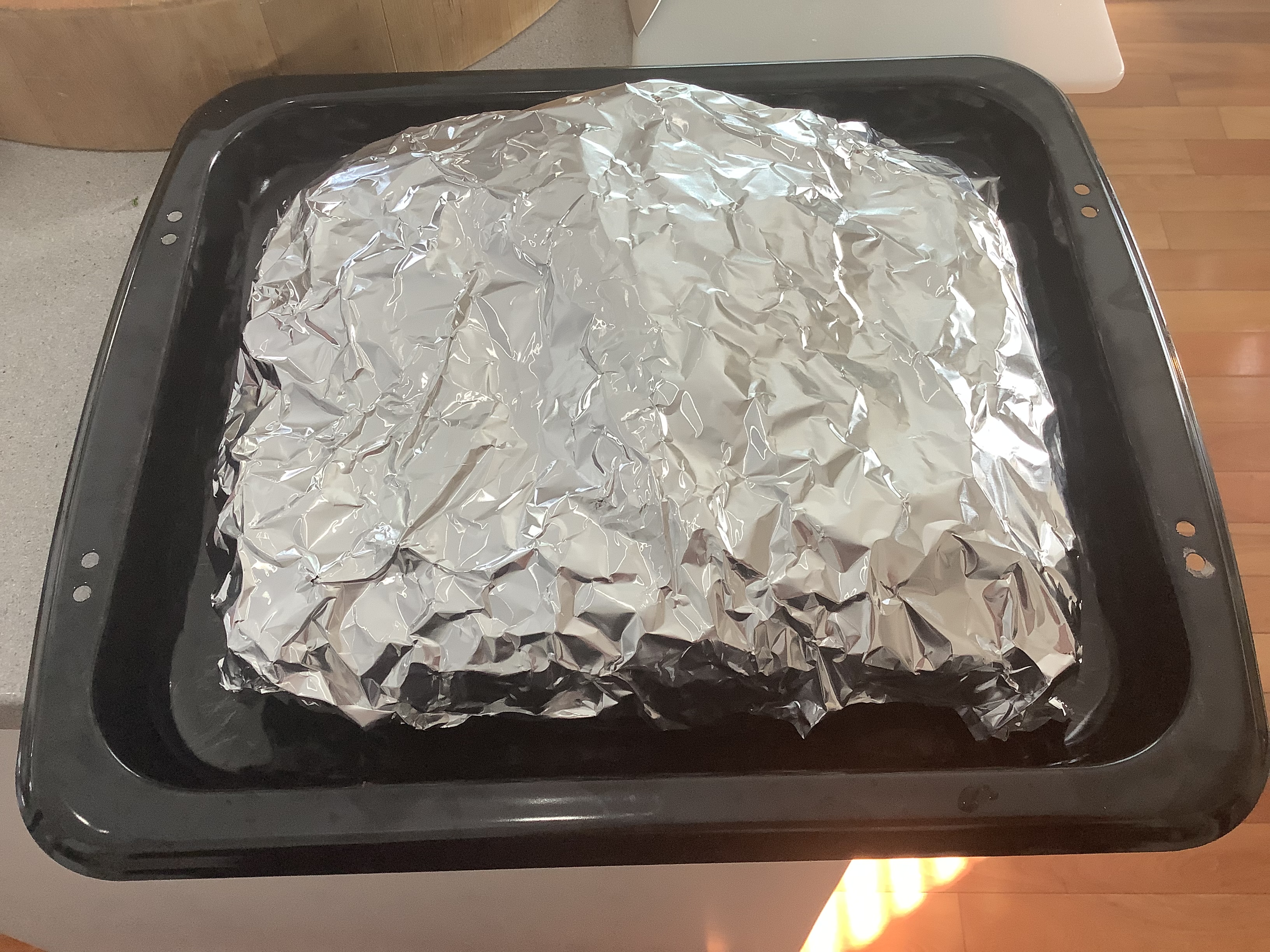
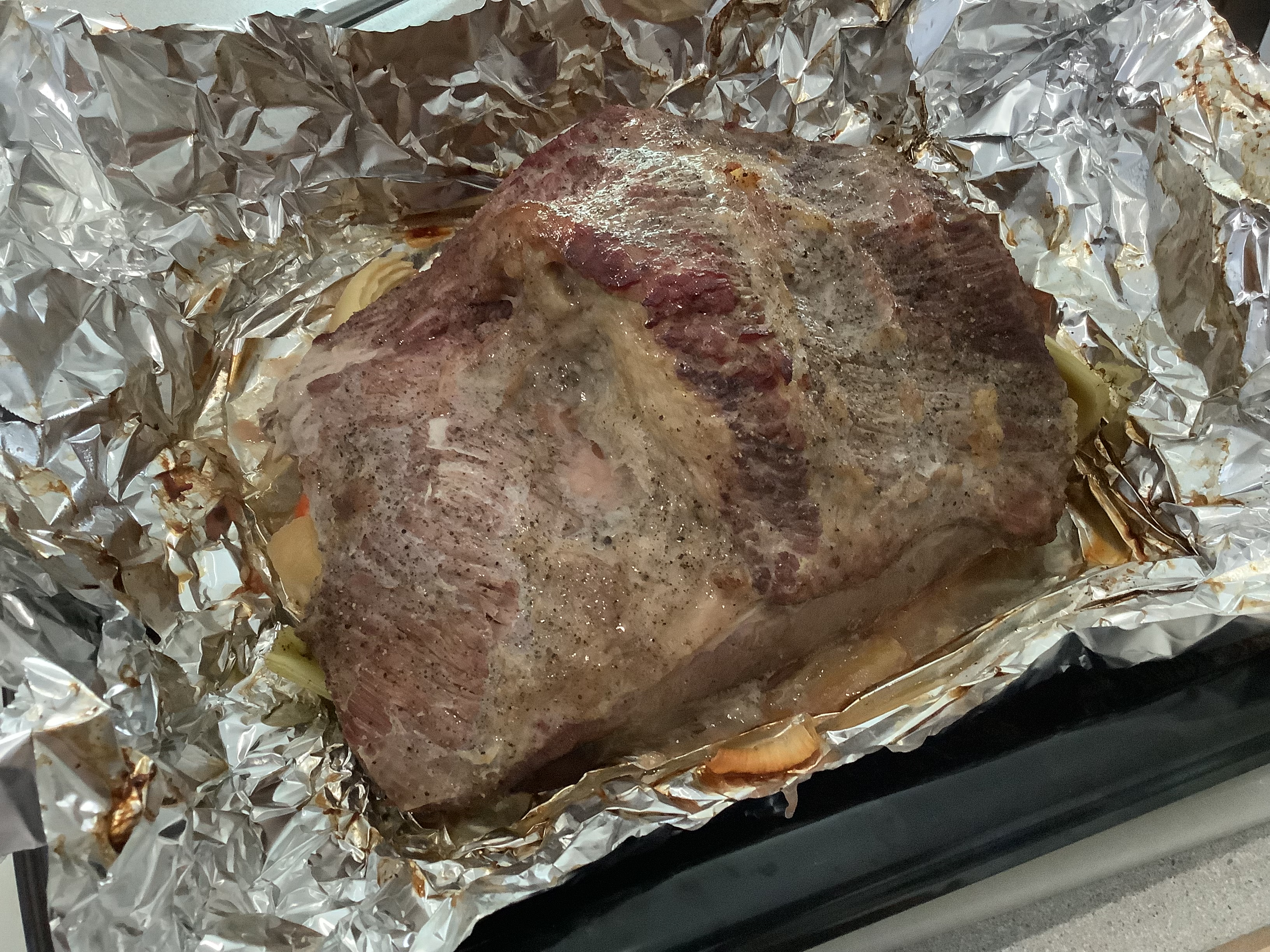
I prefer to lay some aluminum foil down on a sheet pan. Then I coarsely chop carrots, onions, and celery, placing them in a single layer on the foil. Then I lay my brisket on top of the veggies, and wrap the meat tightly in the foil. I place the baking pan in a pre-heated 350 degree oven and cook for about 3 1/2 hours. (That’s for an 8-pound slab of meat. The cooking time will be less for a smaller cut.)

If you want to make pastrami, there are more steps to take…

Step two: making Pastrami…

pastrami

Brined and rinsed corned beef brisket from above recipe, patted dry with paper towels
1/4 cup Kosher salt
1/4 cup paprika
3 tablespoons coriander seeds
2 tablespoons black peppercorns
2 tablespoons yellow mustard seeds
1 tablespoon white peppercorns
3 tablespoons brown sugar
1 tablespoon granulated garlic

Combine the coriander seeds, black and white peppercorns and mustard seeds in a spice grinder and grind them coarsely. Place them in a bowl. Add the salt, paprika, brown sugar and granulated garlic. Mix well.

Rub the mix into the corned beef well, covering all sides.

Heat your smoker to 225 degrees and smoke the meat for several hours. (My wood of choice is always hickory.) When the internal temperature of the meat has reached 165 degrees, it’s done. It isn’t necessary to smoke pastrami as long as you would a regular brisket because the long brining time makes the meat more tender, and you’ll be steaming it next.

It is very important that absolutely everything that comes in contact with the meat is very clean. (This includes your hands.) Also, make very sure that every inch of the meat reaches the 165 degrees before it is removed from the smoker. The corned beef is now pastrami.

Delis that serve pastrami go one step further: they steam the meat so that it becomes incredibly tender and easy to slice. I place a baking pan with boiling water in the center of a 350° oven. I put a grate on top of it, placing the pastrami on top of the grate. Then I invert a bowl over the pastrami to keep the steam in. I will cook it this way for at least an hour to steam the meat before slicing and serving.

I love cocktails that are full of herbaceousness. (Got that right without spell check!)

So whenever I’m dining in a higher-end restaurant, where I see that mixology matters to them as much as the food, I take advantage of their knowledgeable bartenders and have them create something special for me to try.

Coppa and Toro are two Boston restaurants that often have cocktails that inspire. This drink, named “Hey Neon,” is from Coppa, and is a favorite that I regularly re-create at home for myself.

Aquavit is a favorite in many a Scandinavian bar. Imagine vodka infused with caraway seeds, and you have a pretty good idea of what it’s all about, though there are other flavored aquavits as well.

Punt e Mes is a sweet vermouth from Italy, from the house of Carpano, the folks that also make the king of all vermouths: Antica Formula.

Cynar is a fascinating artichoke-flavored bitter liqueur from the folks that bring you Campari.

Chartreuse is naturally green in color, and they claim it’s made by Carthusian monks since 1737, from a secret recipe of 130 plants. There’s also a milder yellow Chartreuse. Both are now very hard to find, and very expensive if you do, but you only need a tiny amount.


The Coppa finished drink:


HEY NEON
1.5 oz. Aalborg aquavit
.75 oz. Punt e Mes
.5 oz. Cynar
.5 oz. green Chartreuse
Finely minced, dehydrated kalamata olives


Combine the liquid ingredients in a cocktail shaker with some ice. Stir briskly and strain into a rocks glass rimmed with the minced kalamata olives.


My home version:


I tried mincing and dehydrating the kalamata olives, like they do at Coppa. But the oils in the olives kept them from drying out enough, even in a dehydrator. Maybe I was just too impatient for a drink! And I couldn’t get the minced olives to stick to the rim of my glass.

My solution was pretty simple: pour the drink into a martini glass and serve with a skewer of kalamatas. Works for me!


RISOTTO

Posted: March 15, 2024 in Uncategorized

Good things come to those who wait. Risotto makes you wait!


When I recently made my slow-cooked braised beef short ribs, my daughter requested more than just a simple starch to go with it. One of her favorite dishes in the whole wide world is risotto, and though I’ve never made it before, I knew it wasn’t difficult…just time consuming. Well, a recent rainy Saturday was the perfect day to give it a try.

Like many great Italians dishes, risotto requires love. It requires patience. And it requires few ingredients, but they need to be the best quality ingredients you can get your hands on.

This dish is gluten-free, and vegetarian if you use vegetable stock. (It’s not vegan because of the butter and Parmigiano Reggiano.)


1 tablespoon unsalted butter
1 tablespoon olive oil
1/2 medium onion, chopped finely
4 cloves garlic, minced
1 cup Arborio rice (basmati is a good substitute)
1/4 cup dry white wine
4 cups chicken or vegetable stock, kept warm on the stove top (homemade is best)
3 tablespoons chopped fresh parsley 
1 cup frozen peas
1 cup freshly grated Parmigiano Reggiano 


In a large pan, heat the butter and olive oil over medium heat. 


Add the onions and sauté them until they’re translucent.
Add the garlic and sauté for 10 seconds.

Add the rice and stir really well, so that every bit of the rice gets coated with the butter and oil mixture.
Add the wine, and stir gently, letting the rice absorb it.


Homemade chicken stock really brings the flavor!


Add a ladle of the stock to the rice, stirring gently, letting it absorb all the stock. Only once the stock has been absorbed do you add another ladle of stock. Repeat this process until all the stock has been used and the rice has softened. This should take about 25 minutes, and you need to be standing there, stirring gently, the entire time.


Just before the last bit of stock has been absorbed, add the parsley and the peas.


Stir for a bit and then add the grated cheese.


Serve immediately!


BRAISED BEEF SHORT RIBS

Posted: March 13, 2024 in Uncategorized

Although beef short ribs can be an expensive dish at many a fine restaurant, the expense is not in the ingredients, but in the time it takes to prepare it. But it is definitely worth the effort!


I used grass-fed beef short ribs for my recipe, and I think it made a huge difference in taste. But use what you like, and can easily find. Short ribs can be extremely fatty. Although you want to keep some of the fat, remove any excess fat that will only make the final braising liquid taste greasy.

I didn’t have a Dutch oven, which is really the right tool for this recipe, so I seared my beef and cooked the veggies in a pan, and then transferred everything to a deeper oven-safe pot with a lid when it was time to cook.

In doing my research for this recipe, I found dozens of variations. I wound up going with a hybrid of two, both from Food Network chefs: Ann Burrell, and Robert Irvine. Burrell’s recipe was heavy on the wine, and used water. Irvine’s was heavy on stock, a little wine, and no water.


3 to 5 lbs. grass-fed beef short ribs, trimmed
3 large carrots (200g)
3 stalks celery (200g)
1 medium onion (200g)
3 cloves garlic
Olive oil
Bacon fat (optional)
1 can (6 oz.) tomato paste
2 cups red wine, like a Cabernet Sauvignon
3 cups chicken or beef stock (homemade is best)
Kosher salt and pepper

About an hour before cooking, trim the beef short ribs and season them all over with Kosher salt. Set them aside.


Pre-heat the oven to 325.


Place the carrots, celery, onion and garlic in a food processor and process until you get something that resembles a paste.
Right before searing the short ribs, re-season them with salt and pepper.

Heat a large pan on high, and when hot, add enough olive oil to coat the bottom. Sear the beef short ribs in the oil, making sure they’re nice and brown on all sides.


Set the beef aside in a bowl, pour out the fat in the pan, and replenish with new olive oil, (and some bacon fat if you have it and want to use it), just enough to coat the bottom of the pan.


Pour in the veggies from the food processor, season them with salt and pepper, and sauté them until they really caramelize. You want them to start taking on a brown color. 


If the veggies start sticking to the pan, turn down the heat, but the stuff that sticks to the pan is full of flavor. Let that happen! It will all come off later when you deglaze with the wine.


You want those sticky brown bits!


Add the tomato paste and let it cook down for 5 minutes or so.


Add the red wine, and you’ll see how it deglazes the pan and cleans all those tasty brown bits off the bottom. Add the stock and continue stirring.


See how the wine cleans the bottom of the pan? It’s all about flavor!


Place the beef short ribs (and any juices that may be in the bowl) into a Dutch oven or large oven-safe pot. Pour the pan with the veggie-wine-stock mix over the top. Add water if needed to cover the beef.


Cover the pot and place it in the middle of the oven. Cook for 3 hours, flipping the beef ribs once halfway through. Add water at the halfway point if it looks like the meat is exposed.


After 3 hours, remove the lid off the pot and cook for another 45 minutes to an hour. This allows the braising liquid to reduce and concentrate its flavors.
You can turn the oven off at this point and just leave the pot in it until you’re ready to serve.


Serve with the braising liquid.

The risotto I made to go with it will be posted in another blog.

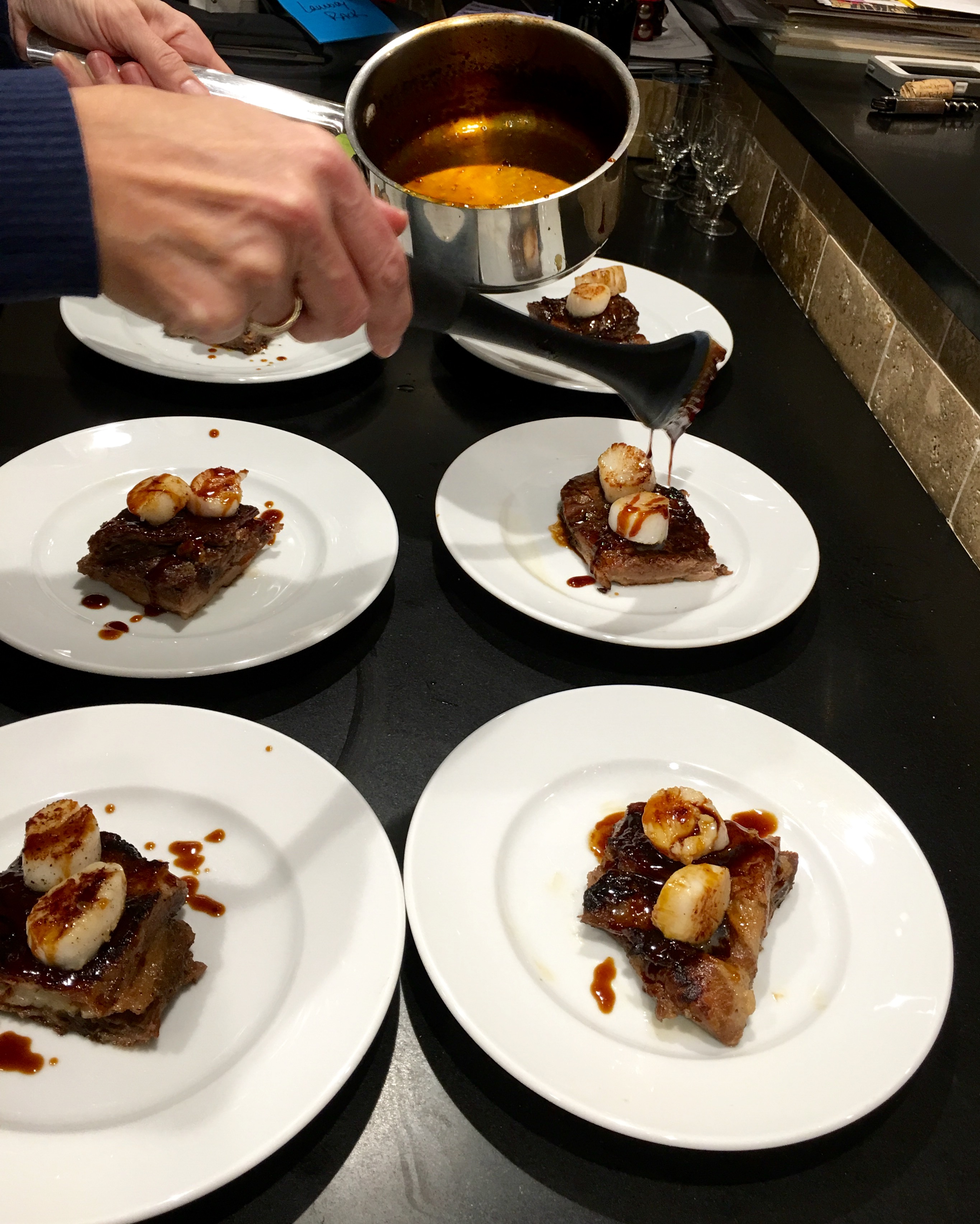
What can I say? I was craving both dishes, so I combined them. I figured: if I love each one of them, I’d be crazy over both together!


image


Pasta
1/4 lb. bacon, finely chopped
1 onion, finely chopped
18 small clams, washed and purged*
1 teaspoon fresh oregano, finely chopped
1/4 cup white wine
Good quality olive oil
6 large garlic cloves, finely chopped
1/4 cup fresh parsley, finely chopped


In a large pot, salt some water and bring it to a boil. Cook the pasta until al dente.

In the bottom of another large pot on medium-high heat, fry the bacon until it’s crisp. Add the onions and sauté them until they’re translucent. Add the clams, oregano and wine, and cover the pot with a lid. Reduce the heat to medium. The clams are cooked when they open. Discard any unopened clams.

In a frying pan, heat the olive oil to medium. Add the chopped garlic and fry it until just crispy. Toss in the parsley and stir it to combine.

Place the pasta in a bowl or plate. Pour the clams and juice over the pasta. Pour the fried garlic and oil all over the clams.


*Purging clams: Clams can be pretty sandy and gritty, so it’s important not only to scrub the outside of the shell, but to purge them as well. Clams should be stored in a bowl in the fridge with a wet dish towel over them, never in water. Once you’re ready to use them, fill a bowl with water and add salt (think salty like ocean water) and a tablespoon of corn meal. Mix this around, then add the clams and let them sit in this solution in the fridge for a couple of hours. The clams will purge (clean themselves) out. Discard the liquid and rinse the clams before cooking.

THE LUCKY GROUPER

Posted: March 2, 2024 in Uncategorized
Tags: , , , ,

I’m on a Caribbean vacation, so I decided to get inspired.

I was craving a Boulevardier the other day, a favorite cocktail which is a twist on the classic Negroni. A Negroni features gin, Campari, and sweet vermouth. The Boulevardier substitutes whiskey or bourbon for the gin.

I thought that rum would work just as well as whiskey, so I googled “Rum Negroni.” Many listings called it just that: a Rum Negroni, but then I read a story about a bartender in New York City by the name of Joaquin Simo. In 2009, Simo worked at Pouring Ribbons, a well known cocktail bar, and he used Jamaican rum instead of gin in his Negroni. He called it a Kingston Negroni.

Well, I wanted to give the drink a cooler name than that, and besides, my recipe was ever so slightly different. It was time for me to come up with my own cocktail.


The standard Negroni is equal parts gin, Campari, and sweet vermouth…1:1:1. I like to make mine with a 2:1:1 ratio, doubling the amount of gin or whiskey—or in this case—rum. So, maybe, then, my drink isn’t a Negroni at all by definition, and it deserves a new name.

Since I’m using rum in my drink, my rum of choice being Mount Gay Eclipse from Barbados, I thought a Carribbean-based name would be appropriate.

And since the drink is red, my daughter suggested I look up a red fish native to the Caribbean and, lo and behold, the name “lucky grouper” popped up. Its real name is Red Hind, something I suppose you could get if you drank too many of these, but its nickname was “lucky grouper.”

There was also a red fan fish that went by the name of “Gorgonian flabellum,” but I think most people would have trouble pronouncing that even before they started drinking!

So The Lucky Grouper it is! And here’s how I make it. My sweet vermouth of choice is the legendary Antica Formula.


2 oz Mount Gay Eclipse rum
1 oz Campari
1 oz Carpano Antica Formula 

Combine these over ice in a mixing glass and stir well. Strain into a rocks glass with a large cube. Garnish with an Amarena Fabbri cherry!

It’s a Leap Year! This weekend, have a sip of the infamous Leap Year Cocktail.

This special drink was created in 1928 by Harry Craddock, who worked at the American Bar in London at that time.

FullSizeRender (2)


2 oz. gin (I use Hendrick’s)
1/2 oz. Grand Marnier
1/2 oz. sweet vermouth (I use Antica Formula)
1/4 oz. fresh lemon juice


Combine all the ingredients with ice in a cocktail shaker and shake vigorously for 30 seconds. Pour into a chilled martini glass and garnish with a twist of lemon.

Cheers!

I was on a mission to find fresh mussels the other day, and in the process, stumbled upon fresh bay scallops, piled high on ice at a local farmers’ market. Unlike like the larger sea scallops or bomster scallops, bay scallops are small and sweet, about the size of a mini-marshmallow…hard to find and my absolute favorites.
 image
As far as I’m concerned, there is no better way to eat a fresh scallop than right out of the shell with just a little marinade on top, popping these beauties into my mouth literally as they’re still pulsing on the shell.
Scallops are a bit trickier to open and clean than clams or oysters (at least for me) but all it took was a little practice while sipping a Stoli Elit martini and I got the hang of it in no time.
There are two marinades that I use when serving up raw scallops. The acidity in these marinades will cook the scallop a little, like in ceviche, though eating them raw is perfectly fine if they’re super-fresh.
“MILLS TAVERN” MARINADE
The first place I ever had a raw scallop was at Mills Tavern, a highly rated restaurant in Providence, RI. Freshly shucked scallops (in large flat shells) were served on ice with a tangy red marinade. I never got the recipe from the restaurant, but this is my version of that marinade.
3 tablespoons rice vinegar
2 tablespoons Grenadine
1/2 teaspoon fresh finely grated ginger
2 teaspoons finely chopped scallions
 Combine all the ingredients and chill before using.
A trick I learned from the folks at Wishing Stone Farm, where they grow their own ginger roots: keep the ginger stored in the freezer in a tightly sealed bag. Most of us don’t use ginger all that much, but we want fresh ginger when the recipe calls for it. By wrapping it tightly in plastic and storing it in the freezer, it’s ready to use any time. Simply take the ginger root out, and grate it finely–no need to peel the skin–while it’s still frozen. It will be almost powder like, and it will blend beautifully into any recipe you’re using. Then just put the rest back in the freezer.
 image
ALZ CEVICHE MARINADE
My marinade is closer to a basic ceviche, using 3 kinds of citrus and some Asian flavors.
1/4 cup freshly squeezed orange juice
1 1/2 tablespoons freshly squeezed lemon juice
1 1/2 tablespoons freshly squeezed lime juice
2 tablespoons soy sauce
1 tablespoon + 1 teaspoon peanut oil
1/2 teaspoon honey
1 1/2 teaspoons fresh finely grated ginger
2 tablespoons finely chopped scallion
2 small dried chili peppers, finely chopped
 Combine all the ingredients and chill before using.

image


Both marinades are gluten-free, as long as you use GF soy sauce. La Choy is an easy-to-find gluten-free brand.