What did a girl from Michigan, with family in the Upper Peninsula, have in common with a guy who grew up on Long Island in a mostly Jewish community? Well…smoked whitefish, for one thing!

Growing up in NY, I was introduced to smoked whitefish, herring, and lox at an amazing deli just down the road from my parents’ house. My wife’s family from the Upper Peninsula of Michigan, meanwhile, caught the whitefish, herring and salmon and smoked it themselves.

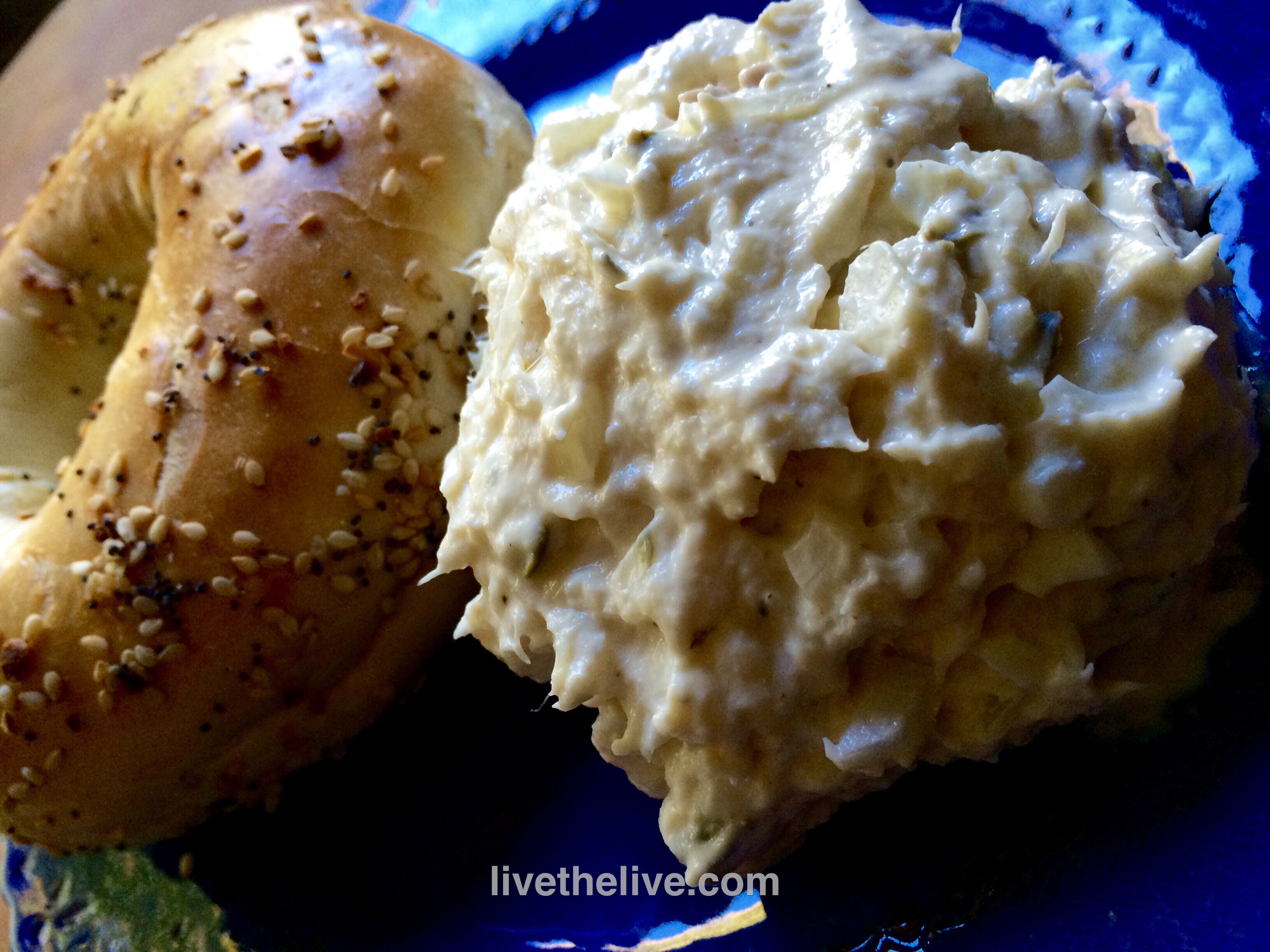
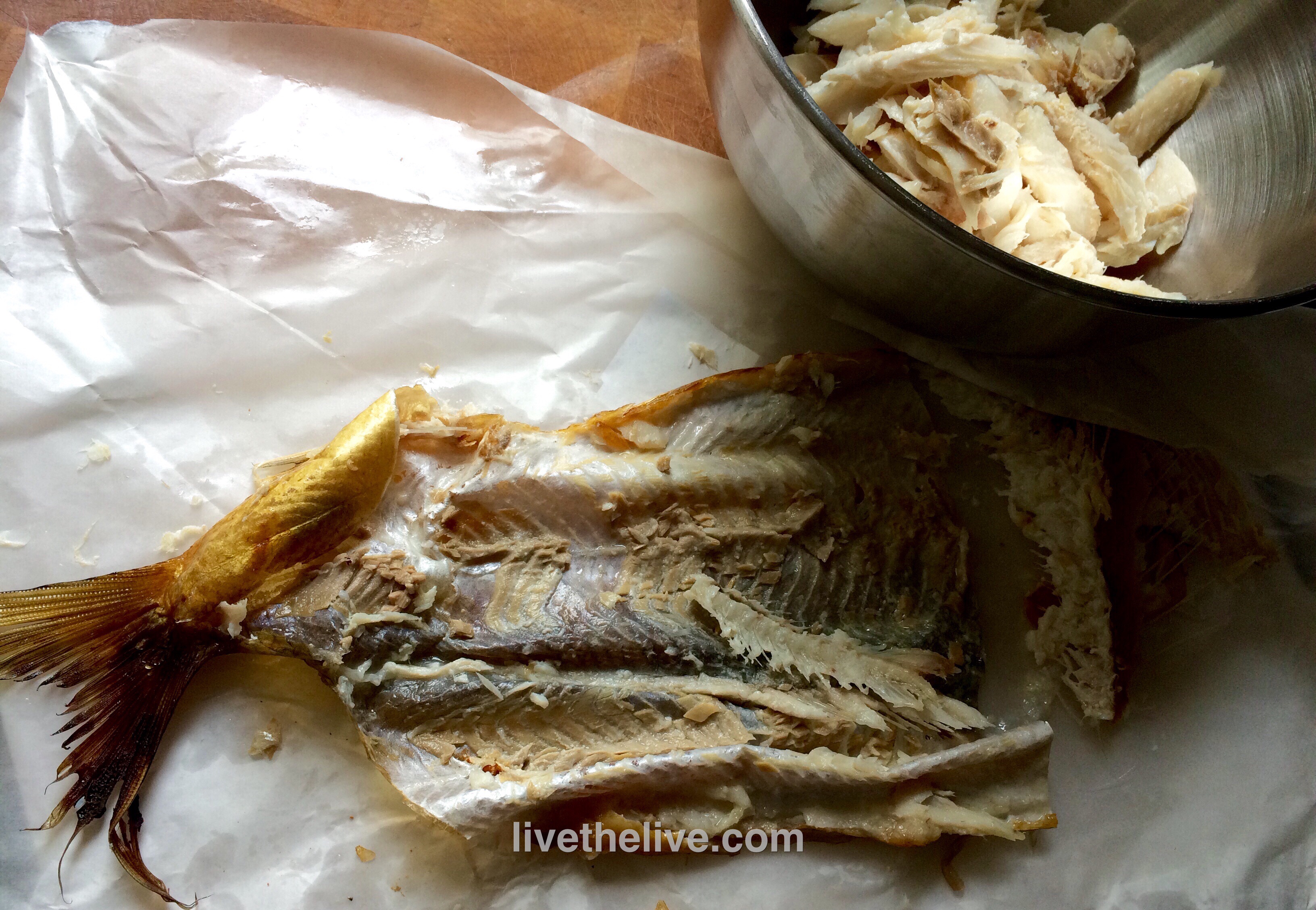
My Yooper father-in-law showed me how to properly remove the meat cleanly from the smoked whitefish, and then, when he wasn’t looking, I took his recipe for smoked whitefish salad and I tweaked it.

Smoked whitefish may be a bit hard to find, and it could get expensive if you buy it from your local deli. But sometimes big membership stores like BJ’s will sell whole smoked whitefish. (They also sell already-made whitefish salad, but don’t buy that…it’s all mayonnaise and fish leftovers.)


Remove every bit of meat. Double-check for bones!

Remove every bit of meat. Double-check for bones!


1/2 whole smoked whitefish, meat removed
1/2 cup mayonnaise
1/4 cup finely chopped Vidalia onion
1 tablespoon capers, finely chopped
1 tablespoon freshly squeezed lemon juice
1 hard-boiled egg, finely chopped
Freshly ground pepper
Pinch of sea salt (I like Fleur de Sel)


Remove the meat from the smoked whitefish carefully, making sure all the small bones have been removed. Double-check to make sure you’ve done this really well. Place all the whitefish meat in a bowl.

Combine all the other ingredients with the fish, mixing thoroughly using a fork. (Try not to mush it up too much!)
Serve with crackers, or my favorite: a toasted everything bagel from New York!
image
Here’s a shot of the real deal straight out of the smoker, at a fish store in Mackinaw City, Michigan, on the way to the in-laws’ house in the Upper Peninsula. Man, that was some good eatin’!
image

I have to give credit for this recipe where it’s due. A couple of years ago, we traveled to Washington, DC, and one of our best dining experiences was at the Blue Duck Tavern, a stunning restaurant matched by its unique and beautifully prepared plates. (Along with Chef Jose Andres’ restaurant Jaleo, it is the restaurant I recommend to any friends in the DC area, and one I would go back to in a heartbeat.)

One of the most memorable appetizers I enjoyed was the roasted beef bone marrow, which had a delicious pretzel crumble on top. The moment I had a taste, I knew that I would have to recreate this for myself at home.


The bone marrow plate at the Blue Duck Tavern in Washington, DC. (Enough garlic for ya?)


Bone marrow played an important role in the evolution of early man. Perhaps that’s why some of us still have that primitive craving for it.

Early man had small teeth and ate anything he could lay his hands on, especially meat. But he was no hunter. Attracted by circling vultures, he probably scavenged the leftovers from a big kill such as an antelope left in a tree by a leopard, or a large animal such as a wildebeest that had been slaughtered by lions.

Because meat is relatively easy to digest and rich in calories and nutrients, early man lost the need for the big intestines of apes and earlier hominids. This freed up energy for use by other organs. This surplus of energy seems to have been diverted to one organ in particular – the brain. But scavenging meat from under the noses of big cats is a risky business, so good scavengers needed to be smart. At this stage in our evolution, a big brain was associated with greater intellect. Big brains require lots of energy to operate: the human brain uses 20% of the body’s total energy production. The concentrated calories and nutrition found in meat was responsible for an increase in the brain size of early humans.

But around two million years ago, telltale cut marks on the surface of animal bones reveal that early humans were using crude stone tools to smash open the bones and extract the marrow. Stone tools allowed early man to get at a food source that no other creature was able to obtain – bone marrow. Bone marrow contains long chain fatty acids that are vital for brain growth and development. This helped further fuel the increase in brain size, allowing our ancestors to make more complex tools. Many historians believe that the blunt force required to break bones with tools to extract the bone marrow was a crucial ingredient in the development of the human hand, and the unique dexterity it has over that of apes.

Of course, these days, we can simply go to our butcher and ask them to slice some beef bones for us so that we can enjoy the marrow like our ancestors did. It’s much more civilized.


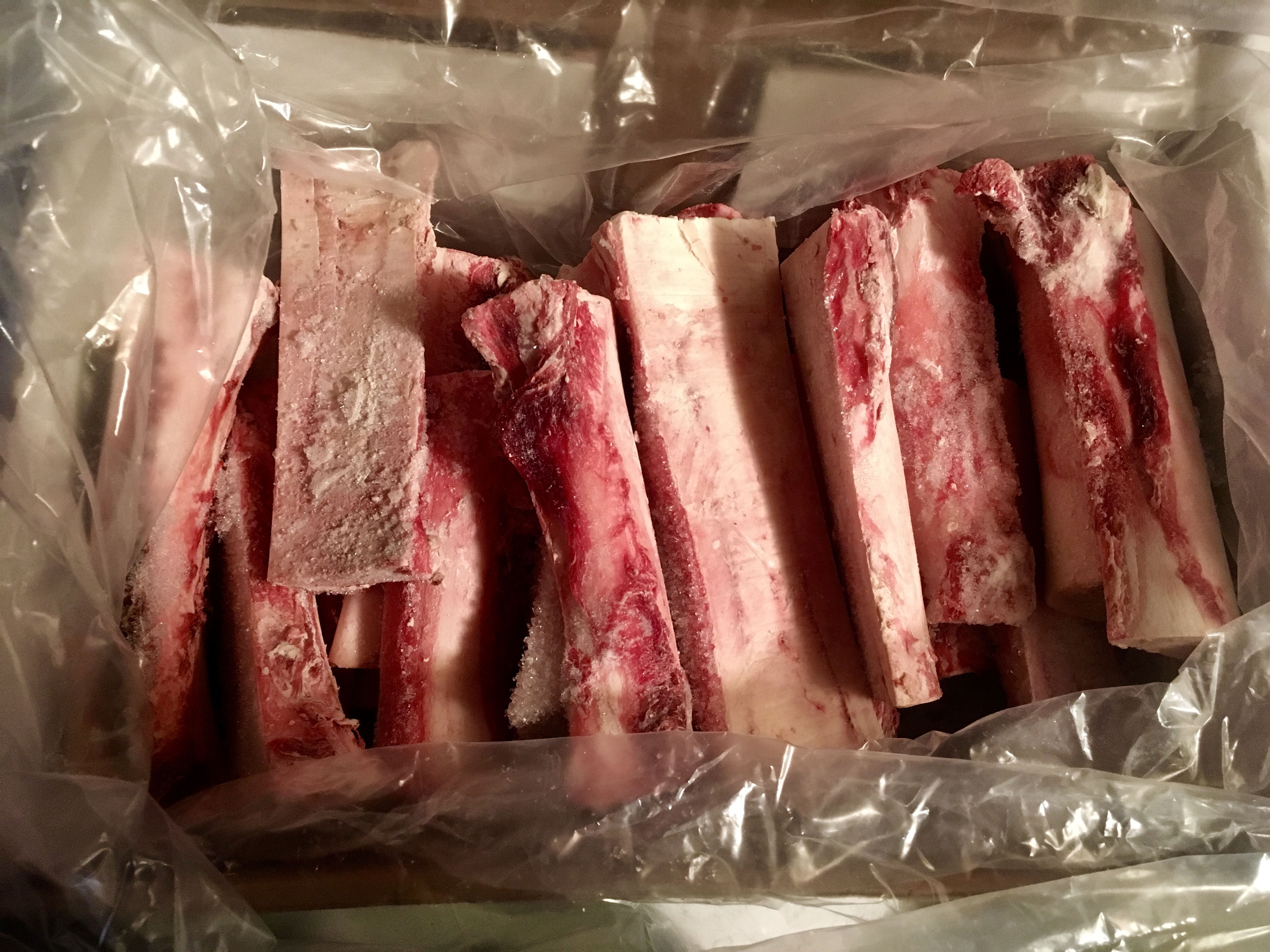
My box o’ frozen bones. I ordered about 25 lbs. of marrow bones from Slanker’s, a grass-fed beef farm in Texas.


They key to roasting marrow bones properly is to keep an eye on them. The bones can go from frozen solid to blazing hot in no time, and that means the marrow can go beyond its rich, gelatinous perfection into a puddle of fat at the bottom of your pan in mere moments.


3 lbs. beef marrow bones (I like them sliced lengthwise)
3/4 cup finely ground salted pretzel sticks
1 teaspoon dried parsley flakes
1 teaspoon granulated onion
1/2 teaspoon granulated garlic
1/4 teaspoon black pepper
olive oil


I keep the beef bones frozen, moving them to the fridge until I’m ready to roast them.

Pre-heat the oven to 450 degrees.


Grind them up!

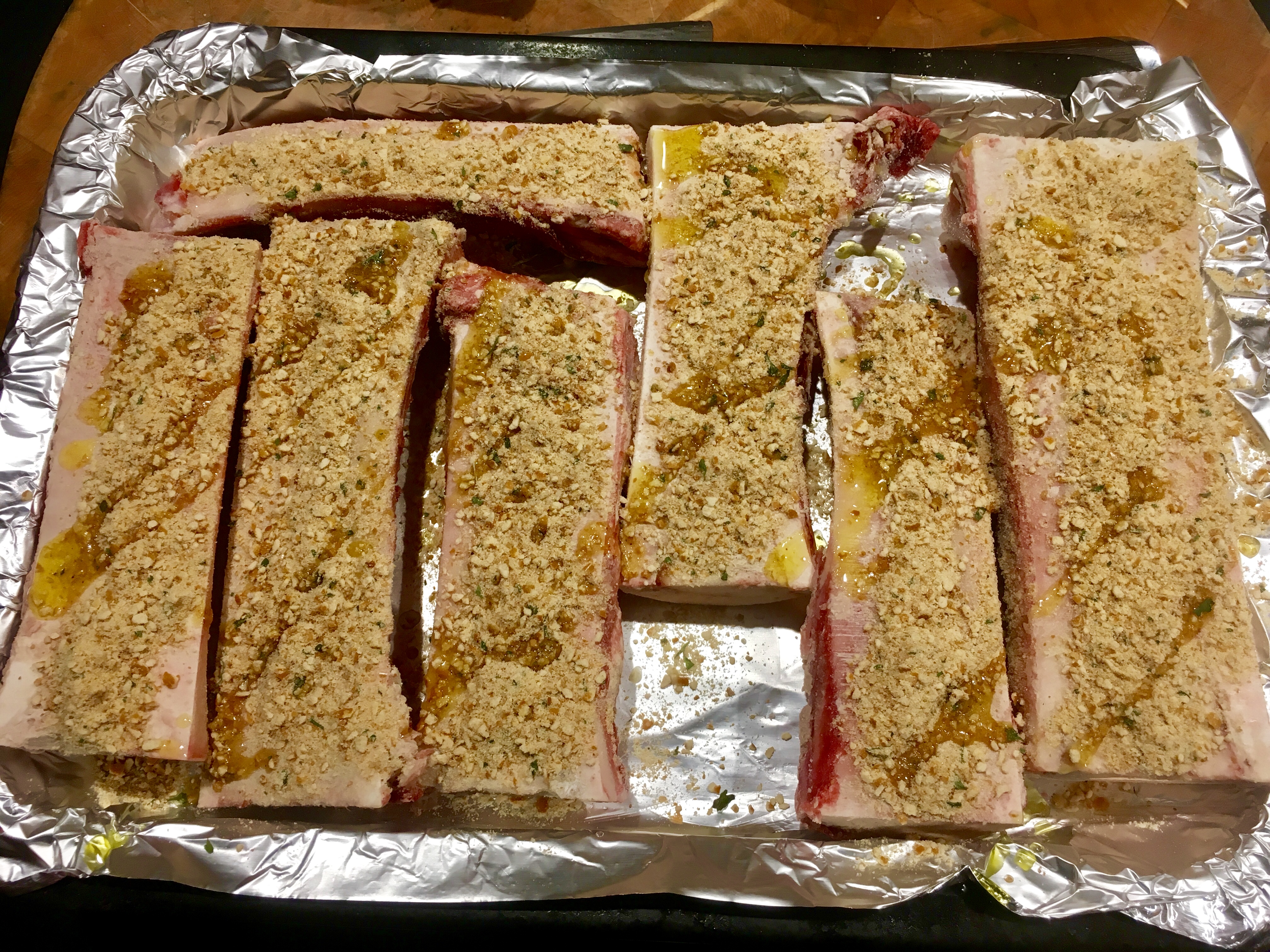
Place a handful of salted pretzel sticks in a food processor, and pulse them until the pretzels are ground fine. When you’ve got 3/4 cup of ground pretzel powder, move it to a bowl and add the parsley, onion, garlic and black pepper. No salt is needed if the pretzels are salted.


Lay the bones flat on a baking pan. If they wobble, place them on a layer of coarse salt to hold them steady. Sprinkle the pretzel mix on the bones, a little drizzle of olive oil on top, and place them in the oven.


Now you watch…there’s that one point where they go from “not quite yet” to perfection to “Oops! Too much!” …so be careful!


Perfection!


Some toasted bread on the side is all you need!


If you’re cooking gluten-free, try Snyder’s of Hanover GF pretzels. They are awesome…you’ll never know the difference.


I love tequila. I love Pimm’s. And I love Dark & Stormies. I’m a lush. This cocktail has an interesting nod to all three.

tequila cup


3 oz. Patron silver tequila
1.5 oz Pimm’s No. 1
good squeeze of fresh lime juice
Chilled ginger beer
Ice cubes
Fresh mint
Cucumber slices (optional)

Combine the tequila, Pimm’s and lime juice in a highball glass filled with ice.
Place slices of cucumber in the glass, if desired.
Top it with your favorite ginger beer and stir gently.
Garnish with a mint sprig.

It’s #NationalFrenchFryDay so what better way to celebrate than to talk about the Parmesan truffle fries we recently had at The Capital Grille?


The best.


My daughter and I have been going to The Capital Grille in Providence, RI, every few months for what we call a “fodder-dodder dinner” for several years now. It’s a great opportunity for us to chat, have a few laughs, and enjoy a great meal.

But with the pandemic, a lot has changed…

No valet parking. (It’s one of the great deals in Providence because it’s always free at The Capital Grille.) It meant we had to drive around the corner to a parking lot. No big deal…there were spaces reserved for Capital Grille customers.

Here in Rhode Island, indoor dining is a somewhat recent event. And even though the state says it’s OK, and even though I really want to support my local restaurants, I still hesitate dining indoors everywhere. But certain restaurants, like The Capital Grille, I know will do things right.

Wearing masks. Social distancing. Extra diligence with cleanliness, although this place has always been spotless. And hey, what a surprise, not a single customer complaining about the extra measures taken for everyone’s safety. No one’s “rights” were threatened.

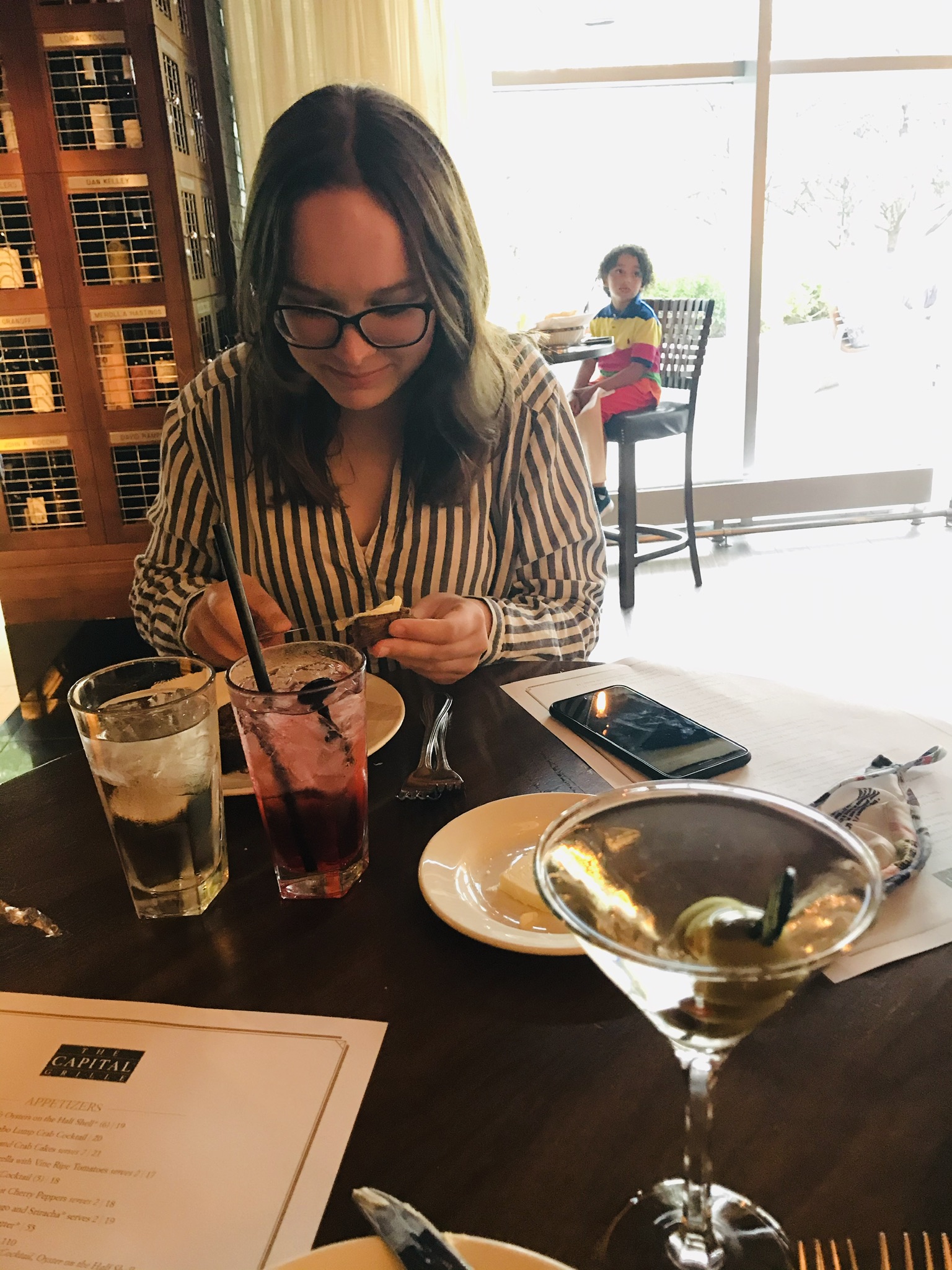
All the employees wore masks, and we took ours off only once we got seated at our “usual” table. (We sit in the bar area at one of the small high-top tables. The bar seats were all removed, and the few tables that were left in the bar area were spread far apart.) If we needed to use the restrooms, the masks went back on while walking through the restaurant.

The menu was limited. The bar menu, my personal favorite, was gone. Some of the small bar plates were listed under appetizers, but a few items, like the tenderloin sliders, lamb lollipops, and most significantly, the burgers, were not.

Since my daughter always ordered a wedge salad, and a cheeseburger with bacon and Parmesan truffle fries, she was a bit bummed that no burgers were on the menu. But it only took her a second to decide that a filet mignon was a good choice, and it came out a perfect medium-rare, and was devoured in minutes.

Although I very often order seafood at the Capital Grille, I went for the gusto a had the 22-oz. bone-in ribeye…also cooked perfectly.

Always a great time at The Capital Grille!


We split a wedge salad to start (there’s never a problem with them dividing the salad and bringing it to the table on 2 separate plates), and then we discussed what sides we should order. For my daughter, the much-loved Parmesan truffle fries were a no-brainer. I tried to go for something green and healthier, but let’s face it: a huge dish of creamed spinach or brussels sprouts with chunks of bacon is hardly low-calorie. So I decided to one-up her order of fries by getting the larger serving for the table. Steak and fries…what could be better?

A Shirley Temple for her and a Stoli Elit martini for me made the meal complete. Despite being really full, we ordered the amazing cheesecake to go, to enjoy the next day.

We may never completely return to “normal,” whatever that is. But it looks like The Capital Grille is rising to the challenge, and we’ll be back!


Bulgogi is the name given to the most common form of Korean barbecue. Unlike the daeji bulgogi that I cooked in a previous blog, this one is not based on a chili sauce that can take the roof of your mouth right off.

I used chicken, though this would work with pork as well, and for the best flavor, it’s best to marinate the meat in the fridge overnight.

FullSizeRender (12)

2/3 cup soy sauce
1/2 cup chopped scallions
6 tablespoons sugar (I use organic cane sugar)
5 tablespoons fresh garlic, grated or through a garlic press
5 tablespoons sesame oil
1 tablespoon sesame seeds
1 teaspoon black pepper
5 lbs. chicken pieces (skin-on thighs work best)


Combine all the ingredients except for the chicken in a bowl and mix well.

Place the chicken pieces in a large Ziploc bag and pour the marinade in. Seal the bag well and squish it around to make sure the marinade makes contact with the chicken. Place the bag in a bowl (to prevent accidental leakage) and keep it in the fridge overnight. Squish the bag around every few hours to make sure the marinade does its job.

When you’re ready to cook the next day, pre-heat the oven to 350 and remove the bag from the fridge and let it come to room temperature. Place the chicken on a sheet pan (discard the remaining marinade) and bake it for an hour.

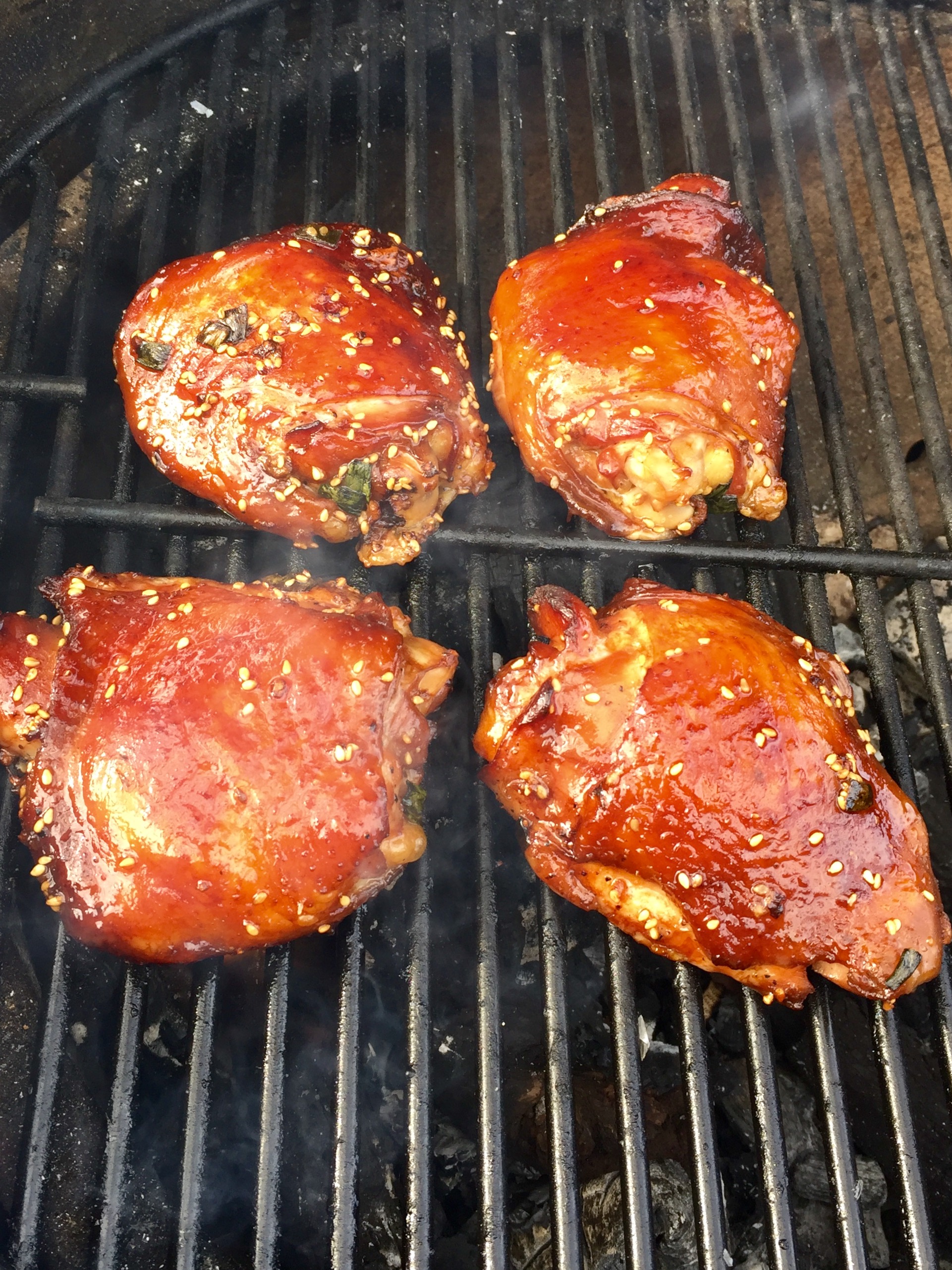
Light a hot grill and push the coals to one side of the grill. Place the chicken pieces on the cool side of the grill and close the lid, opening the vents. Every few minutes, turn the chicken pieces over so they get nice grill marks but
don’t burn.


FullSizeRender (11)

What do you do when the hot weather kicks in and the cucumbers start taking over your garden? Make soup!

The original cucumber soup recipe comes from Ikies Traditional Houses, a wonderful hotel in the beautiful town of Oia in Santorini, Greece. After a long, hot day of exploring the island, we would settle down to a refreshing bowl of cucumber soup. They were nice enough to share the recipe with us, and a few tweaks later, it’s my definition of perfect.


cuke soup


3 English cucumbers or 5 regular cucumbers, peeled, seeded and roughly chopped
1 clove garlic, crushed
1 cup vegetable stock, preferably home-made
4 cups plain Greek yogurt
1/2 cup fresh mint leaves
Juice of 1 lemon
Sea salt and pepper


Peel, seed and chop the cucumbers and place them in a blender with the garlic, stock, 2 cups of the yogurt, mint leaves, lemon juice, 2 teaspoons of sea salt, and a grating of fresh black pepper.

Turn on the blender and mix well. Stop the blender and then add remaining 2 cups of yogurt and mix it by hand.

Pour the cucumber soup in bowls. Garnish with diced cucumber or radish.


To make the vegetable stock: rough-chop a few carrots, a few stalks of celery, and an onion, and put them in a pot with 4 cups of water. Boil until the liquid has reduced by half. by half. Strain the veggies before using the stock. You can also roast the veggies on a sheet pan in a hot oven for a bit before adding them to the water for a more robust flavor.


I’ve always been fascinated by Korean barbecue. Every time I see it on TV or catch a recipe on an e-mail blast, my mouth waters and I say to myself that I’ve got to experience it some day. But the painful reality is: Korean barbecue can be really spicy…and I’m a total wuss.

Korean barbecue 101: Gogigui means “meat roast” in Korean, and it refers to the method of roasting beef, pork, chicken, and other meats. Meats can be marinated or not. Bulgogi is the name of the most common Korean barbecue. Meat is marinated with soy sauce, sugar, sesame oil, garlic and pepper, and then grilled. Galbi uses beef short ribs, and adds onions to the marinade. And the hot stuff is daeji bulgogi, because the marinade isn’t soy sauce-based, but based on the hot-n-spicy Korean chili paste known as gochujang.

All of the marinades looked delicious, but the hot one with gochujang would be my biggest challenge, so I decided to start there. I found a great recipe, and quickly realized that I would have to turn the heat way down if I was actually going to try to eat it! For example, the original recipe called for 2 tablespoons of white pepper. I totally left it out. And it called for a full cup of gochujang. Not only did I cut that part in half, I doubled many of the other non-spicy ingredients.

So is it authentic Korean barbecue? Probably not. But it’s my version of it. It’s got lots a flavor and still carries a bit of heat.

For gluten-free diets: finding GF hoisin and soy sauce is easy. Look for the La Choy brand. But I haven’t been able to find gochujang that has a GF label.


image


3/4 cup ketchup
1/2 cup gochujang
1/2 cup hoisin sauce
1/2 cup honey
1/2 cup soy sauce
1/4 cup brown sugar
2 tablespoons freshly grated ginger
1 tablespoon freshly grated garlic (I use a garlic press)
1 tablespoon unseasoned rice vinegar
4 lbs. chicken pieces


Pre-heat the oven to 500 or its top temperature.

In a bowl, mix everything but the chicken pieces. Brush the sauce onto the chicken pieces, then wrap them in aluminum foil. (I like to tear a long piece of aluminum foil and lay it on top of a sheet pan. I place the chicken pieces on the foil, brush them with sauce on all sides, then fold the foil over the chicken, making one large pouch that holds all the meat.) Leave the pouch on the sheet pan and place it in the oven, then lower the oven temp to 350.

Cook the chicken for about an hour at 350, making sure it’s almost completely cooked. Juices should run clear, not bloody, when you poke it with a fork.

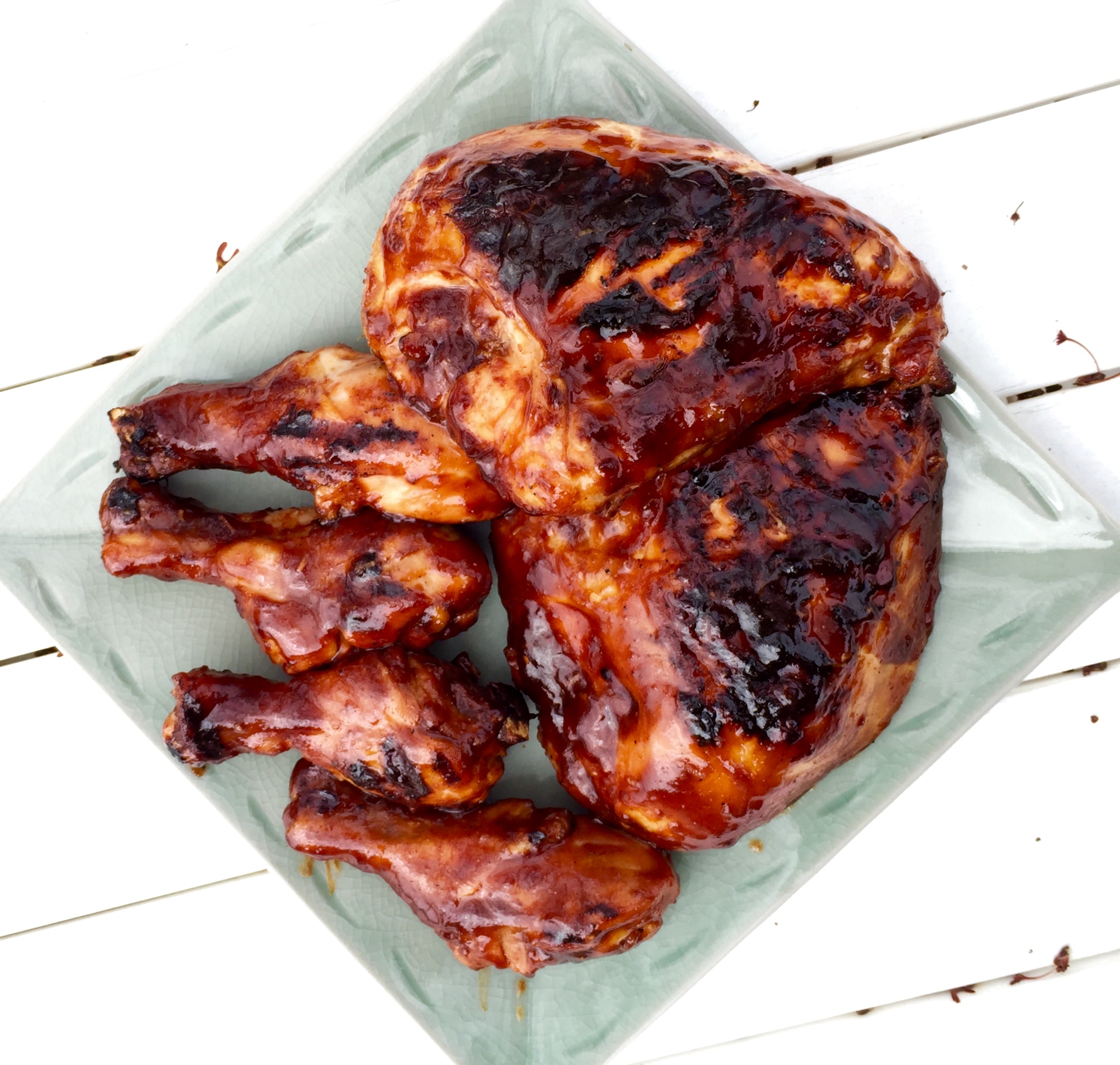
Start a hardwood fire on your grill. Push the coals to one side of the grill so you have a hot side and a cooler side with no coals underneath it. Place the chicken pieces on the cool side of the grill (if you put it on the hot side, it will stick and burn), brush with more sauce, and put the lid on the grill, making sure you have the vents open for air circulation.

image

See those 2 black bits in the foreground? That’s where the chicken stuck to the grill because I placed them over the hot coals. Don’t do that.

After a few minutes, lift the lid, flip the chicken pieces over, brush them with sauce again, and close the lid. Keep doing this until the chicken is nice and caramelized, with tasty grill marks.

If you want to serve some of the sauce on the side, it’s important to pour some of the sauce off and set it aside in the very beginning, so you’re not using the same sauce that the basting brush touched the raw chicken with.


Just because I’ve got a garden full of fresh veggies, it doesn’t mean I have to gorge on nothing but salads! Sometimes, a refreshing cocktail is just what I need after a long day of yard work. This one fits the bill!

Imagine a vodka mojito, using cucumbers….


4 fresh cucumbers, peeled and seeded
Small ice cubes
1 cup loosely packed fresh mint leaves
2 teaspoons granulated organic cane sugar
3 tablespoons fresh lime juice
4 oz. vodka (I like Tito’s)
1 oz. orange liqueur (I like Cointreau)


Peel and seed the cucumbers. Coarsely chop them and then purée them in a food processor until smooth. Strain them through a fine sieve, pressing the solids to extract as much liquid as possible. Or, if you have one, use a juicer. Set the extracted cucumber juice aside.

To a large glass pitcher, add the mint leaves, sugar and lime juice. Muddle the ingredients so that the mint leaves release their oils. Add 3/4 cup (at least) of the cucumber juice. Add the vodka and Cointreau. Muddle again briefly.

Fill tall drinking glasses with ice cubes. Strain the cocktail into the glasses. Garnish with a cucumber spear or peel…or mint.

During quarantine, I like to think back to the days when I could go to a restaurant or invite a few friends over for dinner. The following recipe is one that I prepared a while ago, and although I could make it for myself now, it takes a bit of preparation, as you’ll see…something you’d rather do for a group of friends. Maybe someday soon…


Sometimes a small bite can take a lot of preparation, and you just don’t appreciate it until you decide to make it yourself. That’s especially true with the classic Danish open sandwich called Smørrebrød. The ingredients can vary, but one of my favorite versions is with smoked salmon, on the brunch menu at the best restaurant in Rhode Island: Persimmon, in Providence. (They’re just starting their al fresco dining, by the way.)

The Salmon Smørrebrød at Persimmon.


With some very special friends coming over for dinner, I decided this would be the event where I debut my own version of Salmon Smørrebrød. I had my work cut out for me…

It starts with the salmon. One of the finest sources of wild-caught Alaskan sockeye salmon is Vital Choice, a purveyor of extremely high-quality wild-caught seafood. I ordered several large fillets and had them shipped frozen to my home. I thawed a couple of the fillets in the fridge, and then cured them for several days.


Make sure you get your salmon from a reliable source, and always get wild-caught, never farmed.


The recipe for the cure mix is simple:

1 cup Kosher salt
1/2 cup cane sugar
1/2 cup brown sugar
1 tablespoon crushed black peppercorns

Combine these ingredients in a bowl. Mix well.

Use a container that will hold the fillets without bending them. It also needs to be watertight, because the salt extracts moisture from the fish, and you don’t want spills from the liquids released during the curing process.


First, the plastic. Then, a layer of the cure mix. Then the salmon fillet, skin-side-down. More cure mix on top. Then the second fillet, with more cure mix on top of that.


Lay a few sheets of plastic wrap on the bottom, allowing them to fall over the sides of the container. Sprinkle a good, even layer of the cure mix on the bottom. Lay down the first salmon fillet, skin side down, on top of the cure mix. add more cure mix on top of the fillet to cover it completely. Lay the second fillet on top of that, then cover it completely with more of the cure mix. Fold the plastic wrap tightly over the top, pressing out as much air as you can.


Finally, wrapping the whole thing up tightly in plastic.


Pressure on the salmon helps the curing process, so the cure mix makes good contact with the flesh. I weigh it down with a few cans of tomato sauce.


Even pressure on the salmon fillets helps the curing process.


Put the salmon in the fridge for at least 48 hours, until the fillets are firm to the touch.
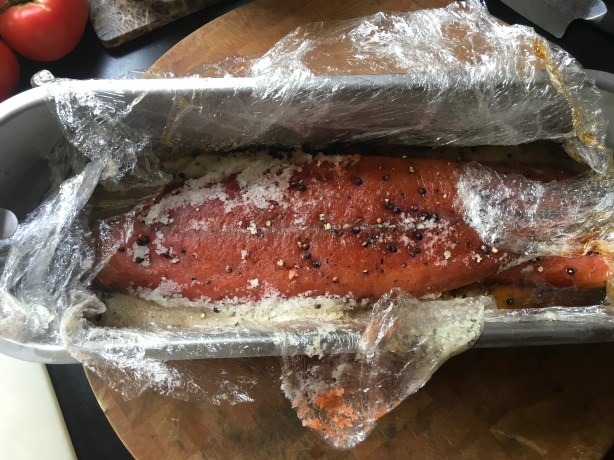
 

The fillets have changed color and are firmer to the touch once cured.


Once the salmon has cured, remove it from the plastic wrap and wash it thoroughly with clean, cold water to remove as much of the salt as possible. Some of the peppercorns will imbed themselves in the fish…remove those, too. Pat the fillets dry with paper towels.


The salmon is ready to eat just like this, but…


At this point, you’ve got Gravlax, and it’s delicious just the way it is. But I chose to go one step further and smoke the salmon, so I put the fillets on a metal rack in my fridge, skin side down, and let them dry out a bit for an hour or so. When the salmon dries, the flesh gets a bit tacky. That’s called the pellicle, and the sticky surface of the fish helps the smoke molecules adhere better. It’s a good thing.
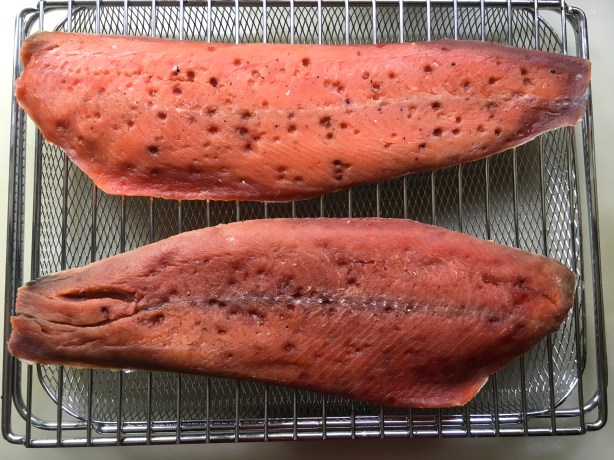
 

The salmon fillets, drying in the fridge.


While the salmon is drying in the fridge, I get my smoking gear ready.

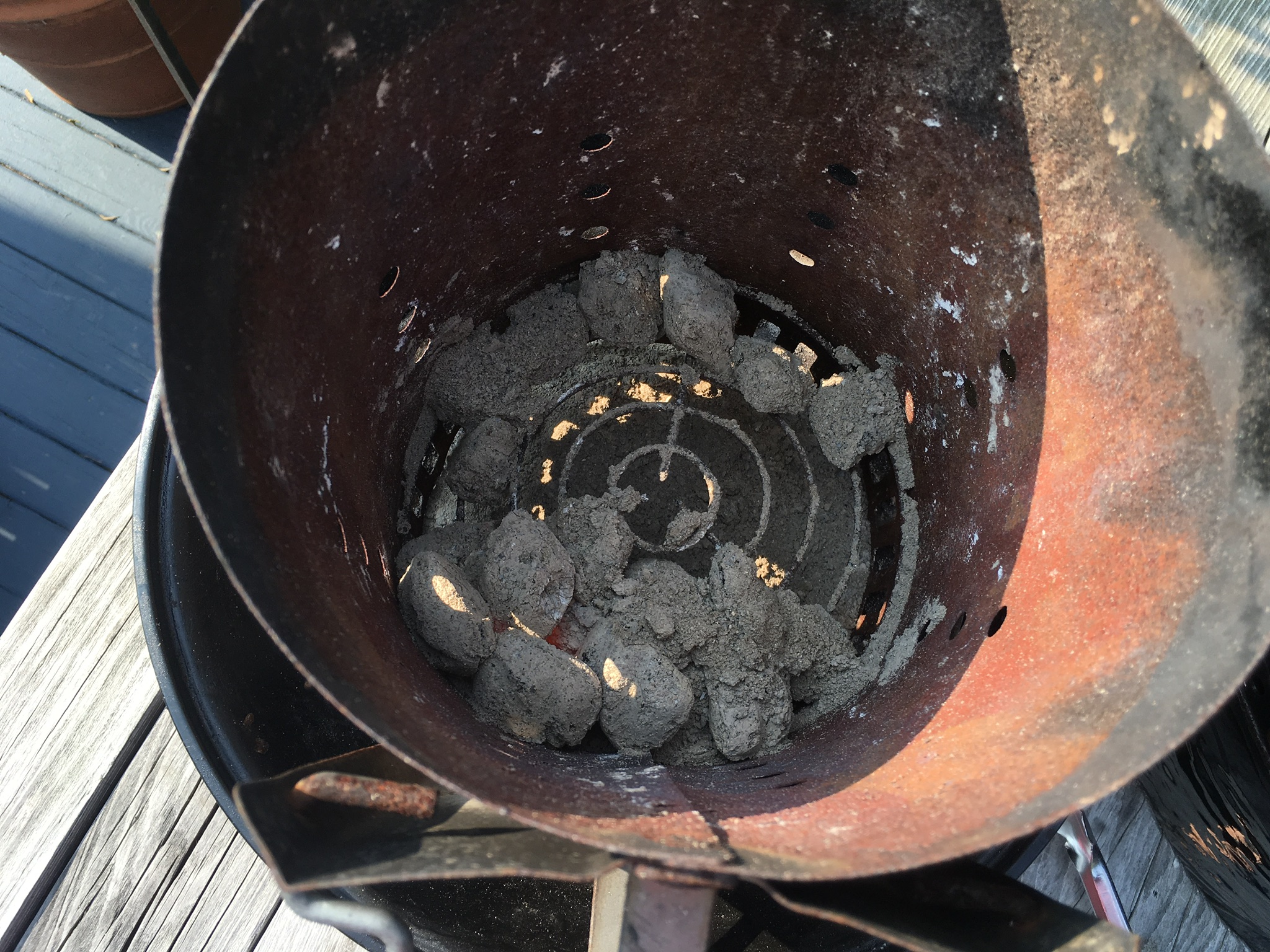
I like to use charcoal briquets and hickory chips for the smoking process. I bring my small camping grill next to my larger home grill. Using my charcoal chimney, I light the briquets and let them burn until they’re ashed over. Using a small smoking box, I place some hickory chips inside, then add a couple of hot briquets to it, making sure they burn the chips and the smoking starts. I place the smoking box inside my large grill with the vents open, laying my salmon fillets (skin-side-down) next to the smoking box. I close the lid of the grill, and let the smoking begin.


Lighting briquets in the camping grill before moving them to the larger grill.


Ashed-over coals in the chimney.

This is as close to a cold-smoking process as you can get at home. There is no heat actually cooking the salmon, just a smoke-filled grill that needs to be replenished every once in a while with hot coals and more hickory chips. I smoke the salmon for a couple of hours.


Let the smoking begin!


Once the salmon has smoked, you’ve got yourself a really special treat. You must eat some at this point, just to reward yourself for a job well done! Then, wrap the rest of the salmon tightly in plastic wrap, and keep it refrigerated until you’re ready to serve it. It will stay fresh in the fridge for several days.

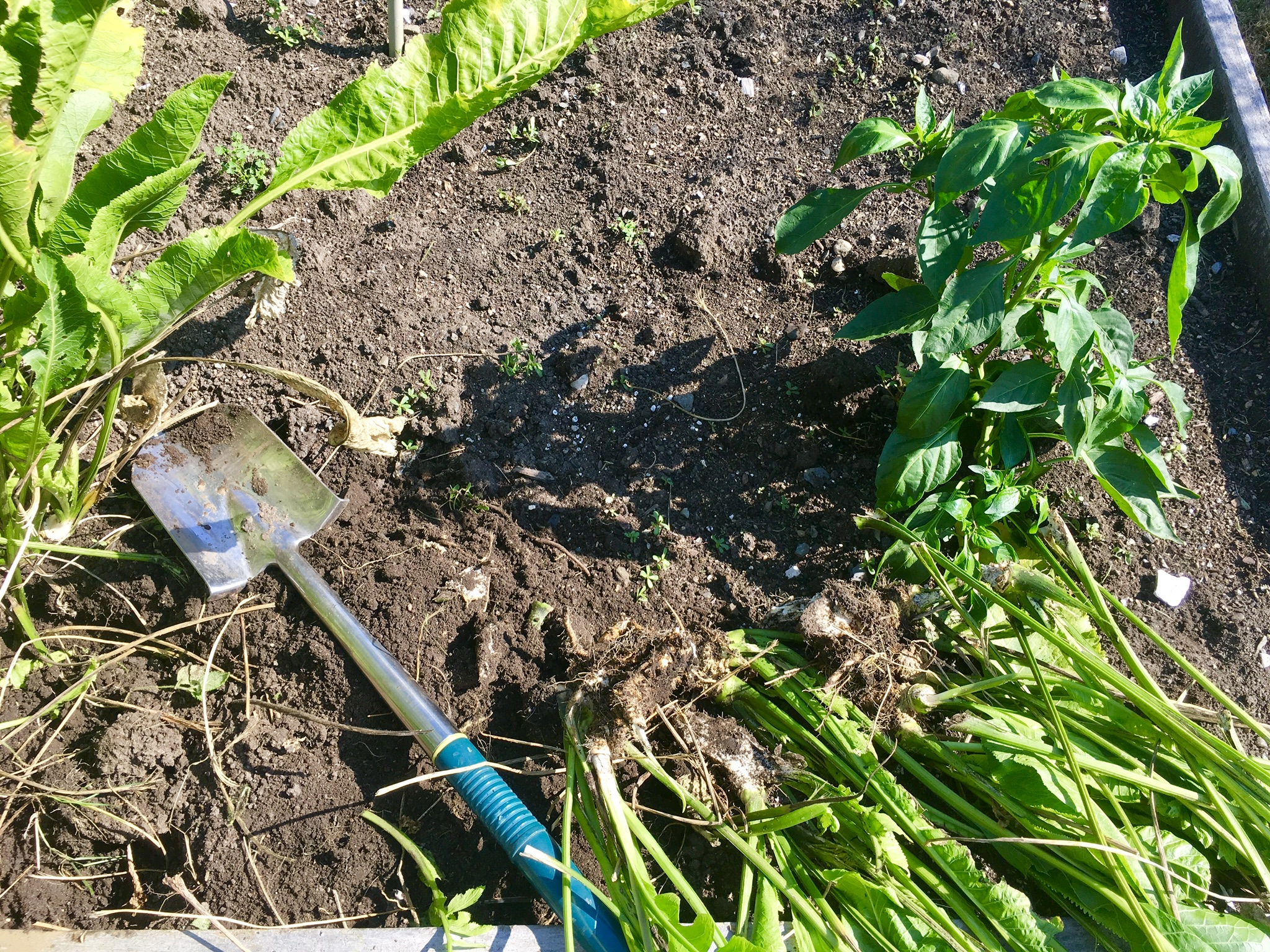
My research for Salmon Smørrebrød resulted in many variations, but I ultimately chose one that used a horseradish cream on the fish. Just so happened that I have a giant horseradish plant growing in my garden, so it was time to dig some of the roots up!


Digging up horseradish.

Once I dug the roots out and washed them clean, they needed to be peeled down to their white center. Then they were ready to be grated. I used the same system my grandfather did, many years ago: a simple hand grater for the job. If you thought you cry when you slice onions, you ain’t seen nuthin’ until you’ve grated horseradish! But it’s worth the effort.


Cleaned horseradish roots, before peeling and grating.


You need freshly grated horseradish, not the prepared stuff you find in the supermarket for the cream…


12 tablespoons sour cream
6 tablespoons plain Greek yogurt
4 tablespoons freshly grated horseradish
8 teaspoons freshly squeezed lemon juice
4 pinches of sugar
Kosher salt to taste

Combine these ingredients in a bowl and mix well. It keeps for at least a day, so you can make it the night before serving. This is a lot of horseradish cream, but I was making enough to serve 12 people.


The horseradish cream…delicious on a lot of things!


1 fennel bulb
2 Granny Smith apples
1 tablespoon freshly squeezed lemon juice

A few hours before serving, thinly slice a fennel bulb–paper-thin if you can–and place the slices in a bowl of ice water. Peel and core 2 Granny Smith apples and slice them as thinly as you can, placing them in the ice bath as well. After an hour, remove the fennel and apple slices from the ice water, pat them dry with paper towels, and place them in a bowl, sprinkling them with the lemon juice. Toss, mixing well, and then place the bowl in the fridge until you’re ready to use it.
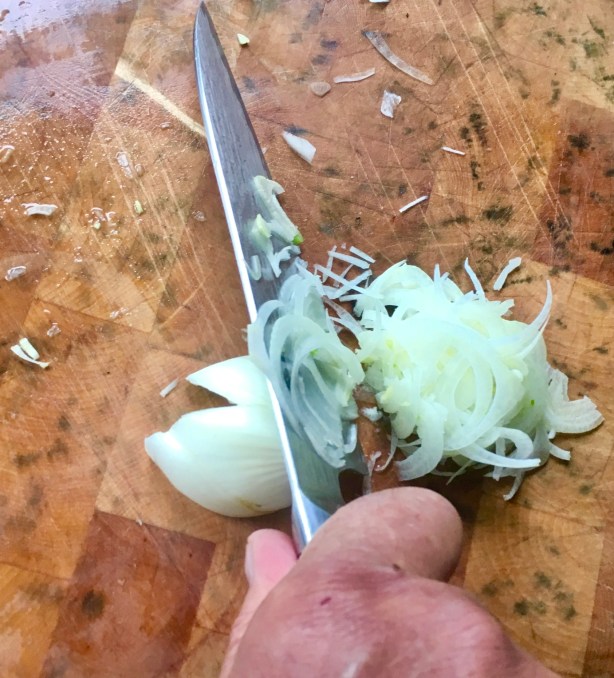
 

Slicing the fennel as thinly as possible.


A few last ingredients…

Sliced bread
Softened unsalted butter
Fresh dill sprigs

Smørrebrød is a sandwich, so of course, I needed some bread. I chose something from my heritage: Lithuanian bread, a combination of rye and pumpernickel that I find when I go back home to New York. I keep it in the freezer until I need it, and for this recipe, I sliced it thin.


Getting the ingredients together. The Lithuanian bread is the brown bread. We also had a couple of slices of gluten-free bread.


Now we’re finally ready to build this thing!


Slicing the salmon as thinly as possible.


Rather than making all the sandwiches myself, I decided I’d teach a Master Class of Smørrebrød-making with my fabulous guests. So I brought all the ingredients out, and we started building our sandwiches as I sliced the salmon as thinly as possible.


First, you take your slice of Lithuanian bread and spread some of the butter on it.

Then, layer the fabulous salmon on top.

Next, a healthy spread of the horseradish cream.

Top with some of the sliced fennel and apple.

Garnish with just a few fresh sprigs of dill.

And then top it all off with a friendly sprinkling of Fleur de Sel, or your favorite sea salt.


Fleur de Sel at the end makes all the difference!


And that’s my Salmon Smørrebrød…a labor of love. But that’s what you do for friends, right?


Time to eat!


Leftover ingredients make a great sandwich on an everything bagel the next day!


If you look online, there are a  million ways to make onion rings. So, in doing my research, my first step was to decide how I wanted them. Did I want a big, thick batter? Or something extremely light? Or something somewhere in the middle?
I’m not a fan of onion rings that have more batter than onion. After all, my nickname is “Ponas Svogunas,” which means ”Mr. Onion” in Lithuanian.
So, after looking through dozens of recipes, I finally came up with one on my own that really satisfied my craving for onion and also a craving for a great crunch.
The set-up requires four trays, and lots of messy dunking before it goes into the oil. But it’s all worth it in the end!
I have a deep fryer, but the basket in it is small, so I can’t fry as many onion rings at one time as I’d like. So using a larger pan with a shallow pool of oil was the answer: it allowed for more onion rings to be fried in a single batch.
Yellow onions, sliced abut 1/4″ wide


In the first pan..
2 raw eggs, scrambled
In the second pan…
1 cup whole wheat flour
1 teaspoon baking powder
In the third pan…
2 more raw eggs, scrambled
In the fourth pan…
2 cups Panko breadcrumbs
1 teaspoon salt
1 teaspoon granulated onion
1 teaspoon granulated garlic
I like to fry with peanut oil, so I pour an inch or two into a large pan and heat it to 340°, using a thermometer.
I peel the onions and cut them into quarter-inch wide slices, breaking them up into rings. (If a couple of rings of onion stick together to form a thicker ring, I don’t have a problem with that!)
Once that’s done, the procedure is really simple: dunk the onion rings in the first pan with the egg, coating them well. Then dunk them into the second tray with the whole wheat flour, shaking off any excess. Then dunk them into the third tray with the egg, making sure it’s completely coated. And finally, dunk them into the fourth tray with the seasoned Panko breadcrumbs, again, shaking off any excess.
Drop the onion rings into the hot oil and be sure to flip them so they cook on both sides. Cook until they’re golden brown. Place them on a sheet pan with a metal rack to cool.