Posts Tagged ‘pasta’

Pasta is not something I’m currently eating on my low-carb diet. But it’s a great recipe I wanted to pass on to others.

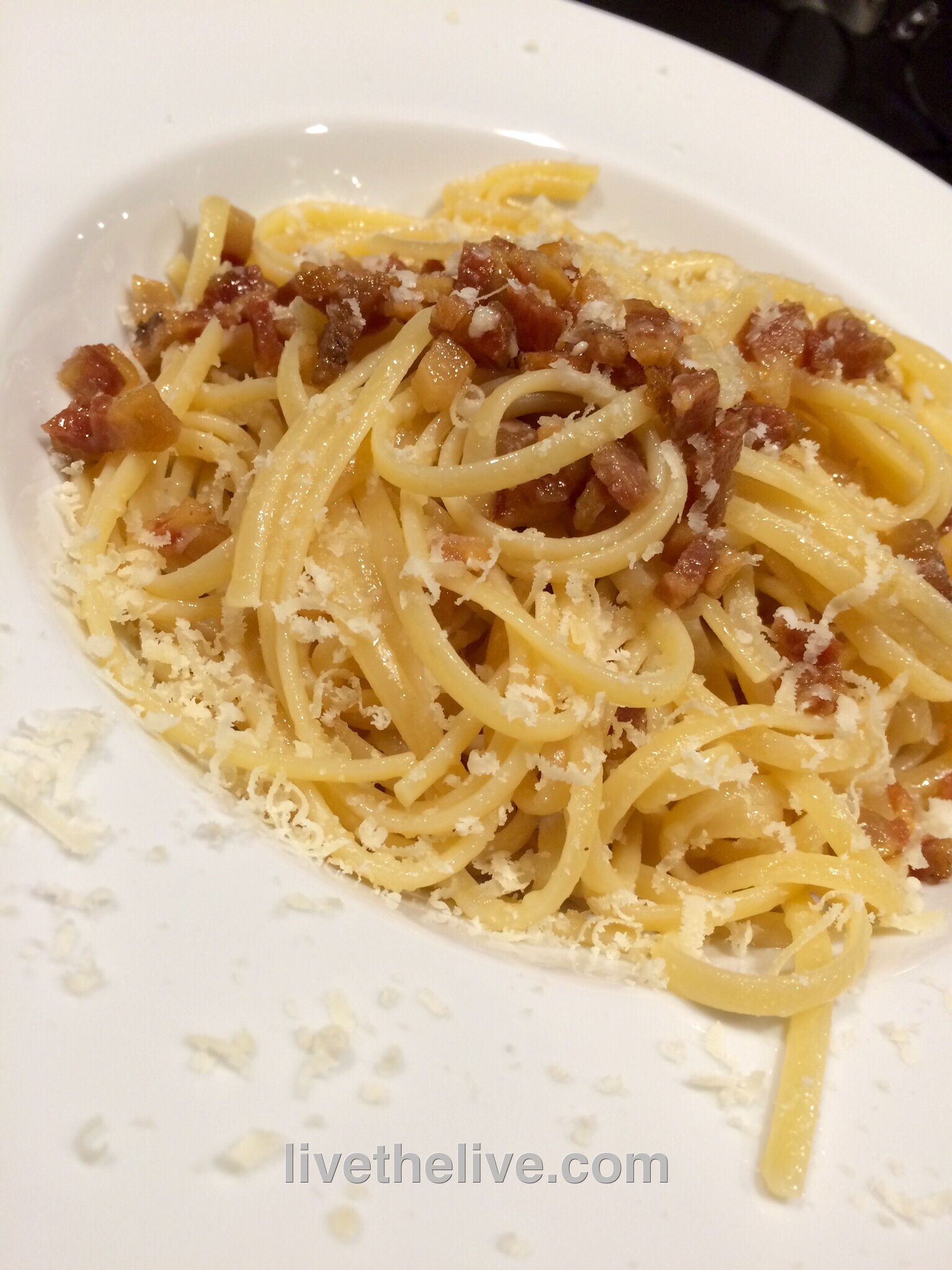
Sometimes the simplest dishes are the toughest to execute well. Spaghetti alla Carbonara is one of those dishes. All you need is pasta, olive oil, raw eggs (separated), guanciale, grated Parmigiano-Reggiano and pepper. (Real carbonara doesn’t use cream.)

You boil the pasta. Chop the guanciale (cured pork cheeks or jowls) and saute in a pan with the olive oil. Do not drain the fat. Drain the pasta and drop it into the pan with the guanciale, adding about 1/4 cup of the pasta water. Shake it around for a minute and remove from the heat. Add some of the cheese and the egg whites, season with pepper, and mix the pasta well. Separate into bowls, making a nest with the pasta. Add an egg yolk to each, sprinkling more cheese on top. What could go wrong, right?

There’s a lot to be said for finesse!

I make my own guanciale. I buy Berkshire pork jowls and cure them. Then they go through a drying phase for a few weeks before I wrap and freeze them in chunks. Whenever a dish calls for guanciale (my daughter loves it on pizza), I simply unwrap some, let it thaw, then chop it up and saute it. The fat in the pork jowls is very different from other parts of the pig, and there’s no replacing that flavor. When making Spaghetti all Carbonara, some cooks replace the guanciale with pancetta or bacon, but that’s not for me.

It’s also important to note that this dish relies a lot on fat, so good fat is really important. Berkshire pork fat has good fat. Organic butter has good fat. And the cheese? Parmigiano-Reggiano isn’t called “The King of Cheeses” for no reason!

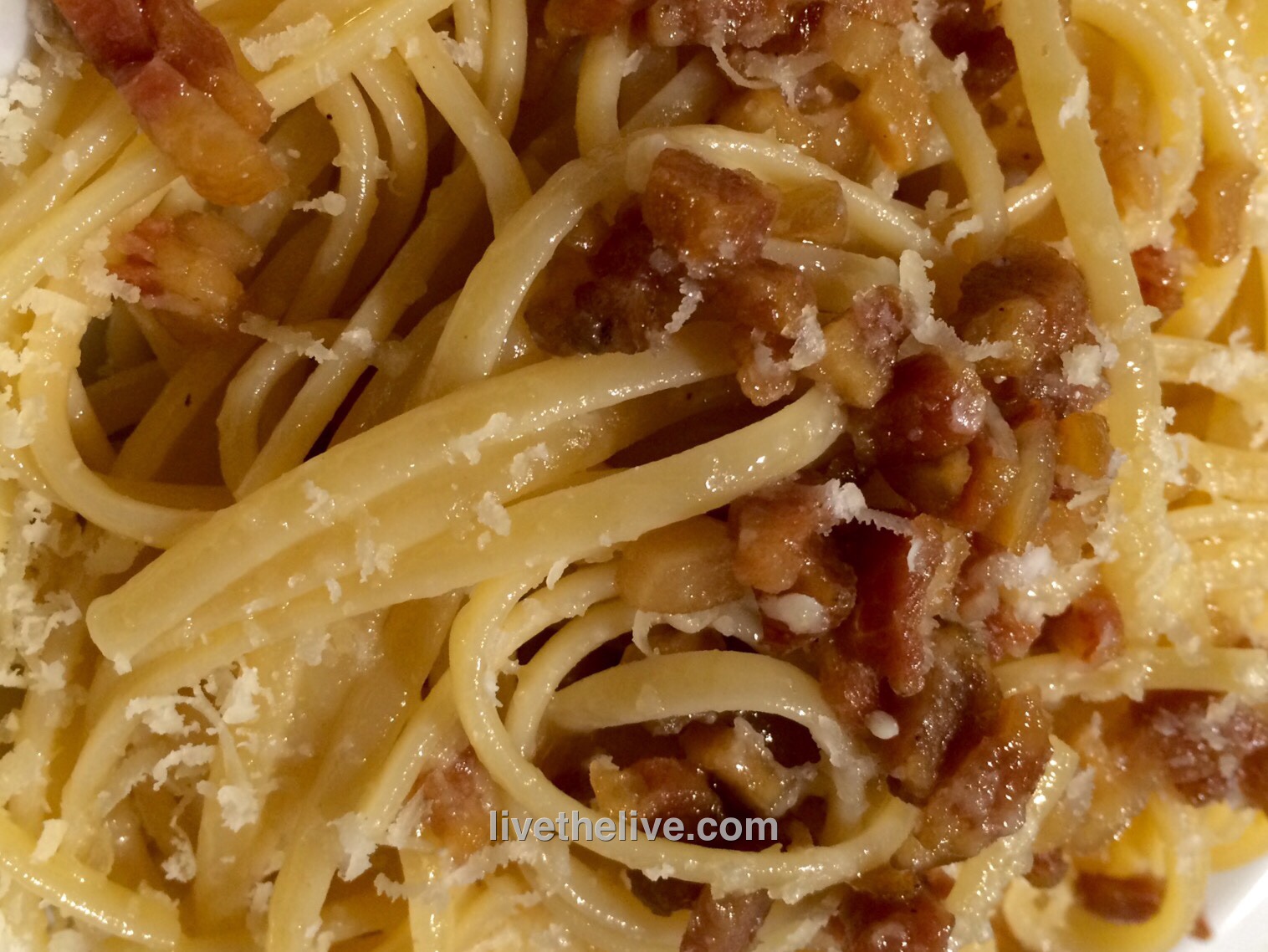
I decided to make a Not-Quite-Carbonara dish. I say “not quite” because I left out the eggs, which my daughter doesn’t like. It still came out pretty damn good…

image


1 lb. pasta (we like bucatini over spaghetti)

1 lb. Berkshire pork guanciale, chopped into small (1/4″) cubes

olive oil

2 tablespoons unsalted organic butter

1/2 cup freshly grated Parmigiano-Reggiano

black pepper


Boil the pasta to the just-before-al dente stage.

In a large saucepan, heat the guanciale and olive oil until the fat has rendered. Do not drain the fat. Turn the heat off, add the butter and let it melt.

Drain the pasta and drop it into the pan with the guanciale, stirring the pasta around to coat with the ingredients. Sprinkle in 1/4 cup of the Parmigiano-Reggiano and season with pepper, still mixing.

Distribute the pasta into individual bowls, making sure everyone gets the tasty bits of guanciale. Sprinkle some more of the Parmigiano-Reggiano on top. Serve immediately.

image


We’re home in Rhode Island for Christmas this year. Usually, we go to New York and my Lithuanian family celebrates Christmas Eve with loads of herring, smoked eel, smelts, potato pancakes, and a family favorite: porcini mushroom pierogis or grybiniai koldunai. The table is loaded with food, and we feast.

This year, it’s a bit simpler here in Rhode Island: one main dish. For one thing, I don’t know anyone that supplies quality herring or smoked eel around here. And secondly, the one dish I’m making is simply fantastic.

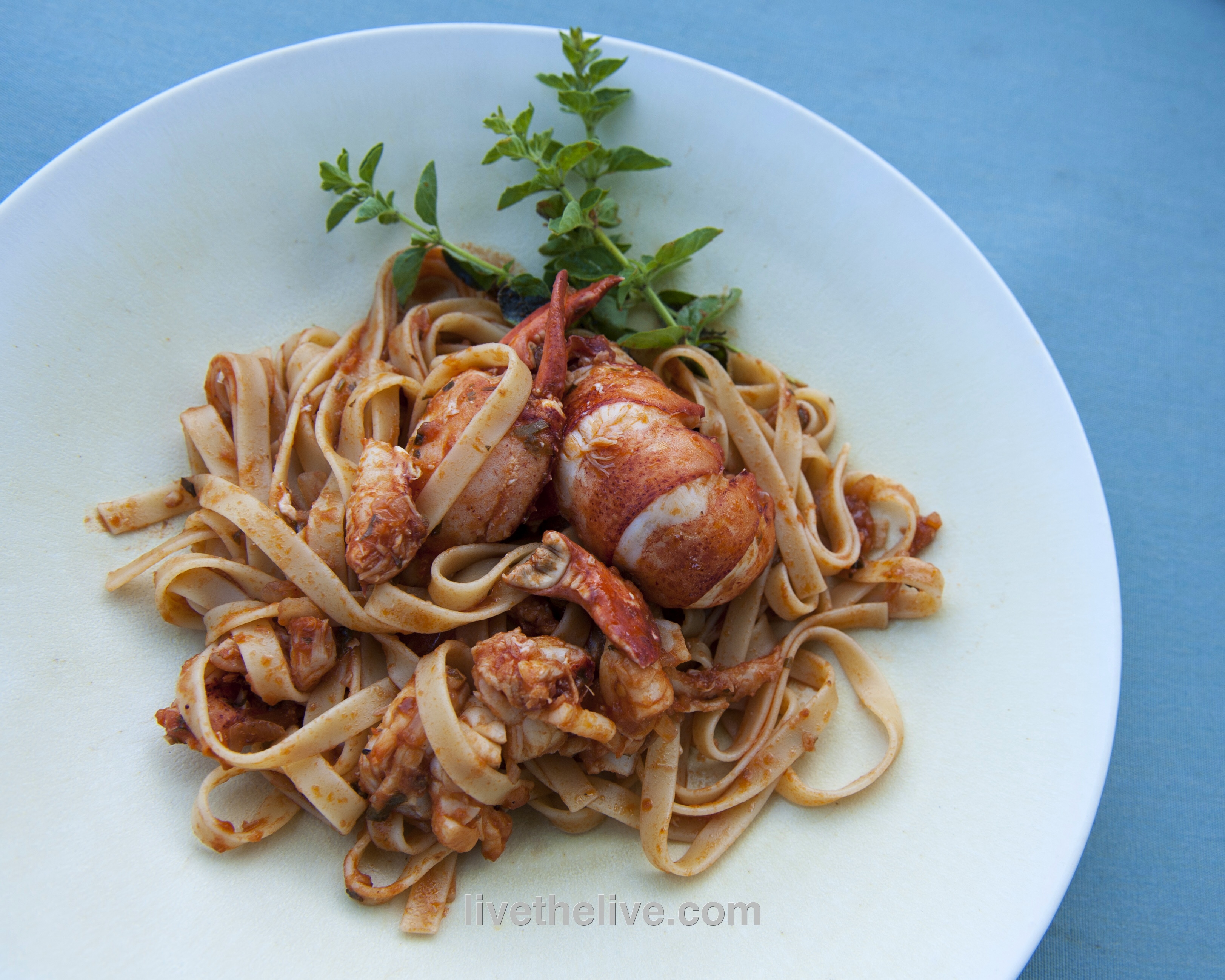
One of the best dishes we’ve ever had on the beautiful island of Santorini, Greece, is lobster with pasta. It sounds so simple, bit it’s one of those dishes that takes time to prepare, because the lobster sauce they make is made to order…time consuming but so spectacular.

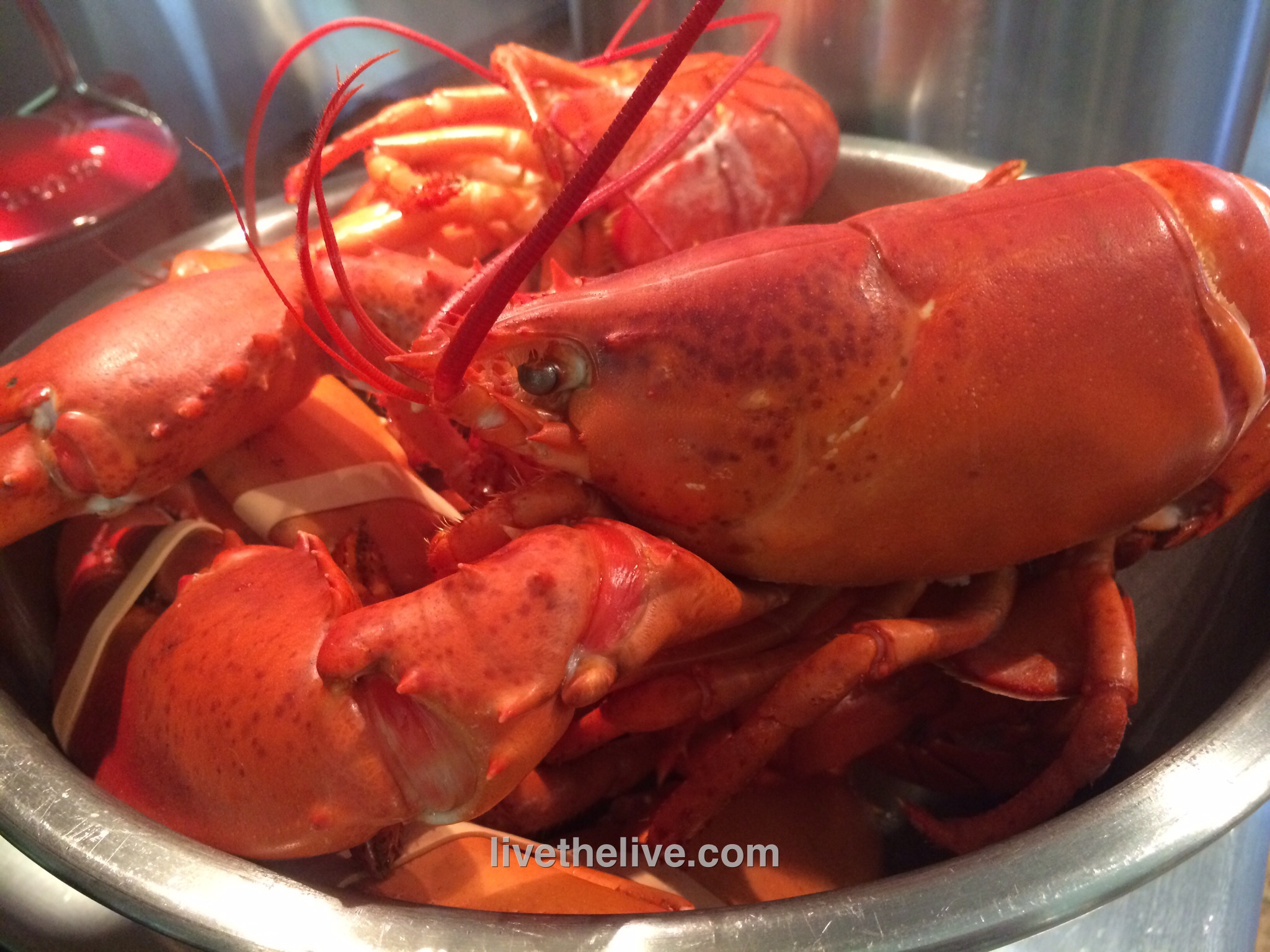
Cooked lobster LTL

To try to recreate that lobster sauce we had in Santorini, I start with a kick-ass lobster stock. It’s simple but flavorful:


Stock ingredients:


2 1-1/2 lb. lobsters, slightly under-cooked

12 cups water

1/2 onion, chopped into quarters

3 celery stalks, chopped into quarters

1 carrot, chopped into quarters


Under-cook (steam or boil, whatever your favorite method) the lobsters, less than the usual 8 minutes, or so. Remove the lobster meat from the shells and set aside.

Place the cleaned lobster shells, claws, tails, legs and bodies in a large pot. (You don’t want any of the internal organs or tommaley.) Add the water, onion, celery and carrot. Set heat on high. Crush the lobster shells with potato masher as it cooks. Cook until it is reduced by half.

Strain the stock, discarding the lobster shells and veggies. Bring the stock back to the heat and reduce until all you have left is 1 cup of intense stock.


Pasta with lobster sauce

Lobster sauce ingredients:


1/2 onion, finely chopped

1 garlic clove, finely chopped

pinch of Italian red pepper flakes

teaspoon parsley

extra virgin olive oil

1/2 cup lobster stock

1/4 cup San Marzano tomato sauce (see below)

splash of white wine (I use Alice white Chardonnay)

salt and pepper


 Also:


reserved lobster meat

1/2 lb. cooked pasta


Add some olive oil to a large pan and saute the onions until translucent. Season with salt and pepper. Add the garlic and cook for 10 seconds. Add the red pepper flakes and parsley.

Add 1/4 cup of the lobster stock and let it cook, reducing by half. Add the other 1/4 cup of lobster stock and the tomato sauce. Let it cook for a couple of minutes and add the white wine. Cook for a few minutes more.

Cook the pasta and drain it even before it reaches the al dente stage. Place the pasta in the pan with the sauce, heating and coating thoroughly. Add the reserved lobster pieces and warm them through, tossing in the sauce. Serve immediately.

For the San Marzano tomato sauce: I take a can of San Marzano tomatoes and place it in a food processor or Vita-Mix and blend. Pour into a pan and reduce over medium heat by half, until sauce has thickened.

MANLY MEAT SAUCE

Posted: December 16, 2014 in bacon, beef, Food, Italian, pasta, Recipes
Tags: , , , , ,

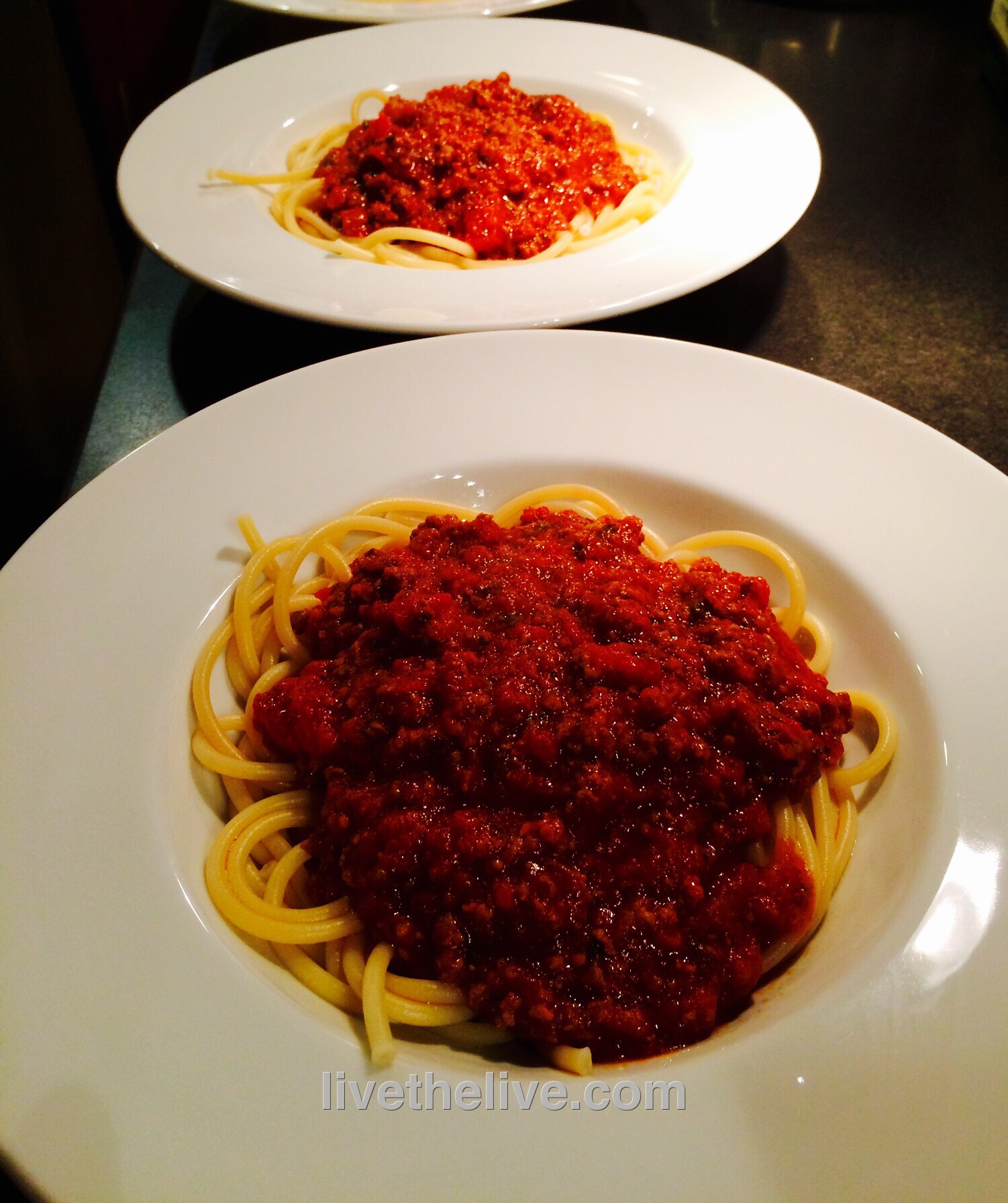
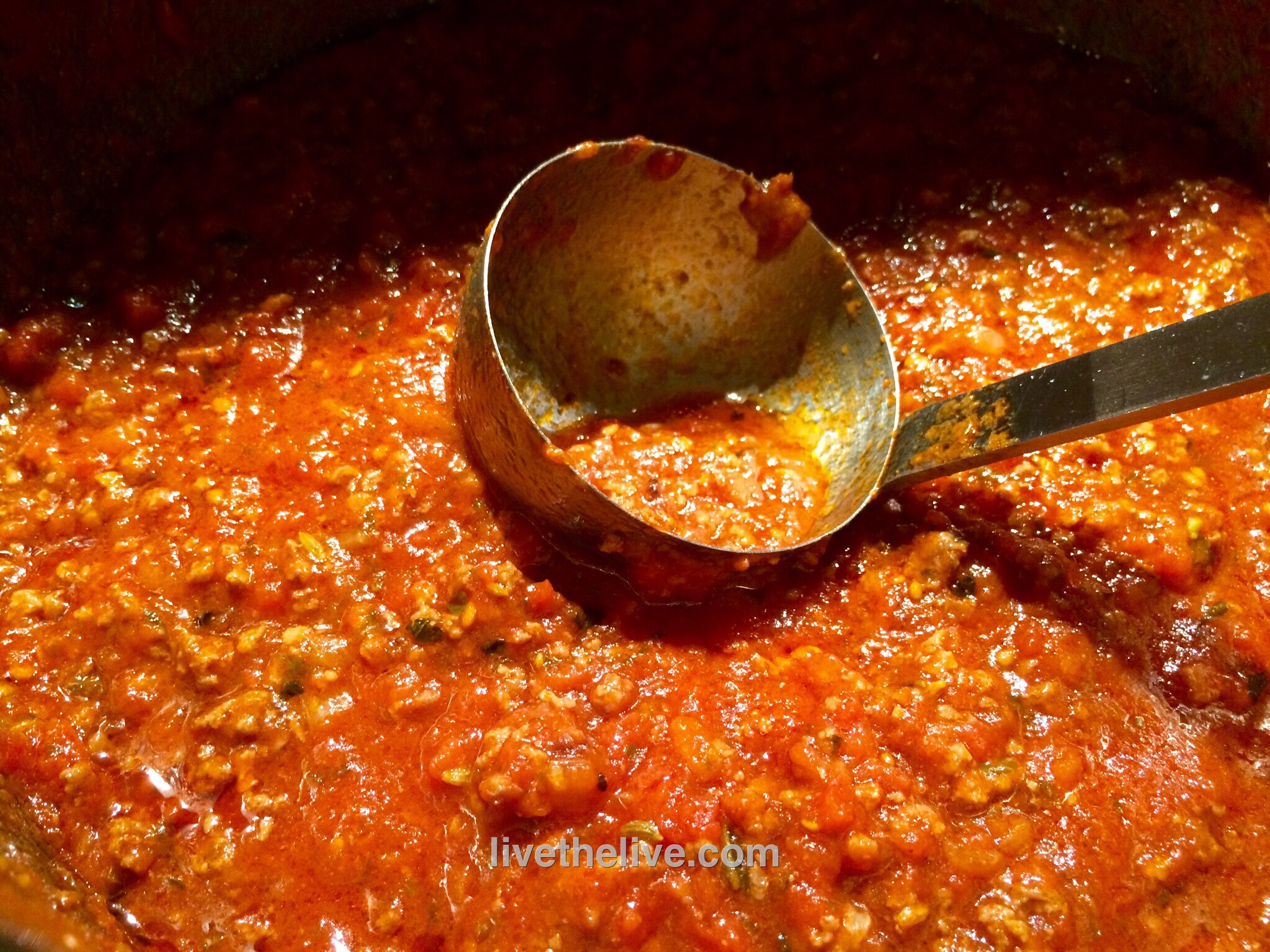
Pasta with meat sauce is one of the easiest things to make, yet few people do it. This sauce is really rich with flavor, and once you put all the ingredients together, it requires nothing more from you than an occasional stir every now and then.

image


Ingredients:


1/4 cup olive oil

3 strips bacon, finely chopped, raw or pre-cooked

1 onion, finely chopped

1 teaspoon garlic salt

2 lbs ground beef (I use grass-fed beef)

2 cans (28 oz each) whole tomatoes

1 tablespoon dried oregano

1 tablespoon dried basil

2 tablespoons dried parsley

2 teaspoon salt

1/2 teaspoon black pepper

1 teaspoon anise seed

1 teaspoon fennel seed

2 bay leaves

1 small can (6 oz)  tomato paste

image


In a large pot, heat the olive oil and add the bacon. Once the bacon is sizzling, add the onions and cook until the onions are translucent. Add the garlic salt and mix. Add the ground beef and cook until it has browned.

Pour the 2 cans of whole tomatoes into a food processor and blend until chunky…or go the old-fashioned route and simply squeeze the tomatoes with your hands, breaking them up. Pour the contents of both cans into the pot and stir well. Cook over medium heat, stirring, until the orange tomato foam disappears.

Add the oregano, basil and parsley and stir. Add the salt and pepper and stir. Add the anise seed and fennel seed and stir. Throw in the 2 bay leaves and stir. (I think you get the idea, there’s a lot of stirring going on!)

When the sauce starts to boil, add the tomato paste and stir well. Let it come up to a boil again–the paste thickens best at high heat–then turn the heat down to a simmer and cover the pot.

Let the sauce simmer for several hours. Whenever you walk by, give the sauce a good stir.

Serve over pasta, with some grated Parmiggiano Reggiano.

image


One of the most incredible dishes I’ve had on the beautiful island of Santorini, Greece, is lobster with pasta. It’s one of those dishes that takes time to prepare, because the pasta lobster sauce they make is a labor of love…time consuming but so spectacular.

Cooked lobster LTL

I often have friends over for dinner, but when I prepared this dish for them recently, it was the first time they all licked their plates clean!

To try to replicate that lobster sauce we had in Santorini, I started with a kick-ass lobster stock. It’s simple but flavorful:

Stock ingredients:

clean, empty claws, tails and bodies from two 1-1/2 lb. lobsters (use the legs, too)

12 cups water

1/2 onion

3 celery stalks

1 carrot

Place all ingredients in a large pot and set on high heat. Crush lobster shells with potato masher. Cook until it is reduced by half.

Strain the stock, discarding the lobster shells and veggies. Bring the stock back to the heat and reduce until all you have left is 1 cup of intense stock.

Now that you have the stock, you can make the sauce!

Pasta with lobster sauce

Sauce ingredients:

1/2 onion, finely chopped

1 garlic clove, finely chopped

pinch of Italian red pepper flakes

teaspoon parsley

extra virgin olive oil

1/2 cup lobster stock

1/4 cup San Marzano tomato sauce (see below)

splash of white wine (I use Alice white Chardonnay)

salt and pepper

1/2 lb. cooked pasta

Add some olive oil to a pan and saute the onions until translucent. Season with salt and pepper. Add the garlic and cook for 10 seconds. Add the red pepper flakes and parsley.

Add 1/4 cup of the lobster stock and let it cook, reducing by half. Add the other 1/4 cup of lobster stock and the tomato sauce. Let it cook for a couple of minutes and add the white wine. Cook for a few minutes more.

Cook pasta and drain even before it reaches the al dente stage. Place the pasta in the pan with the sauce, heating and coating thoroughly. Serve immediately.

For the San Marzano tomato sauce: I take a can of San Marzano tomatoes and place it in a food processor or Vita-Mix and blend until I get sauce. Pour into a pan and reduce over medium heat by half, until sauce has thickened.

asparagus pastaAsparagus season has arrived in my garden. This is one of my favorite ways to enjoy it.
Ingredients:
4 mild Italian sausages, sliced into pieces 1/2″ thick
1 lb penne pasta
1/2 onion, finely chopped
1 cup chopped fresh trumpet mushrooms (white button mushrooms work, too)
2 cups fresh asparagus, sliced into 1-inch pieces
1 clove garlic, passed through a garlic press
1 cup homemade chicken broth
6 fresh sage leaves, finely chopped
1/2 cup freshly grated Parmigiano Reggiano cheese
extra virgin olive oil
salt and pepper
Have the pasta water boiling, and add pasta, cooking until just a bit more undercooked than al dente.
Heat a large pan, and drizzle in some olive oil. Sautee sausage pieces until browned and cooked through, but not over cooked. Remove sausages from the pan and place in a separate bowl. Remove all but 2 tablespoons of the fat left behind in the pan.
Place pan back on stove and saute onions until translucent. Add garlic, and saute for 10 seconds. Add sage, and saute for 10 seconds, stirring. Add chopped mushrooms and saute for a few minutes, then add chicken broth, and simmer until almost all the liquid has evaporated. Pour contents of the pan into the bowl with the sausages.
Return pan to the stove, add a little more olive oil, and on medium heat, saute the asparagus pieces. Cook until they are al dente, not too soft. Once the asparagus has reached this stage, return all the contents of the sausage/mushroom bowl to the pan to heat through. Drain the pasta, and add it to the pan as well, combining all the ingredients. If it looks too dry, add a little pasta water to the pan. Season with salt and pepper.
Make sure you serve this hot, with grated Parmigiano Reggiano on top, and drizzle lightly over the top with extra virgin olive oil.


There’s something magical about a simple plate of spaghetti and meatballs. When my parents took me to an Italian restaurant as a child, a plate of spaghetti and meatballs made me feel like the luckiest kid on the planet. And even now, when I prepare a plate of spaghetti and meatballs for my 7-year-old daughter, she can’t wait to sit down at the dinner table. She’s so busy shoveling the food into her mouth, she can’t even speak. I just get a quick thumbs-up between bites! meatballs


Great meatballs start with great meat. I always use 80/20 grass-fed beef. I don’t use a ton of breadcrumbs as filler. And the tomato sauce is homemade as well, from canned tomatoes. I start with the sauce…


B.F.I.M. SAUCE

Inspired by a lovely but large Italian lady I once knew, my Big Fat Italian Mama sauce is the best tasting sauce I’ve had anywhere.


Ingredients:

1 medium onion, finely chopped

2 cloves garlic, through a press

1/2 cup extra virgin olive oil

10 cups ground and peeled tomatoes…or 3 cans (28 oz.) tomatoes pureed in food processor

2 teaspoons each: dried oregano, basil and parsley

3/4 teaspoon each anise seed and fennel seed

1 1/2 teaspoons salt

1/2 teaspoon black pepper

2 bay leaves

1 small can (6 oz.) tomato paste

1 teaspoon sugar (optional)


Heat olive oil in a large pot and add the onions. Cook until onions are translucent, then add the garlic. Stir for 10 seconds.

Add tomatoes and cook on high until orange foam disappears, stirring frequently. Don’t let it burn.

Add oregano, basil, parsley, anise seed, fennel seed, salt and pepper, bay leaves and tomato paste. Allow sauce to just come to a boil so that the tomato paste reaches optimum thickening power.

Reduce heat to a simmer and cook for at least an hour, until sauce reaches desired thickness. Stir often.


While the sauce is cooking, I start the meatballs…


THE BALLS


Ingredients:

2 lbs grass-fed ground beef

1 cup plain breadcrumbs (homemade are best)

2 tablespoons dried parsley

2 tablespoons dried oregano

1 tablespoon dried basil

1 tablespoon granulated garlic

1 tablespoon onion powder

1 teaspoon black pepper

2 teaspoons salt

2 eggs, cracked and scrambled

1/2 cup extra virgin olive oil


Mix all the ingredients, except the olive oil, thoroughly but gently in a large bowl. Don’t overwork it.

Pour olive oil a medium-hot pan (don’t let it burn), make the meatballs, and sear them on all sides until brown.

When the meatballs are nice and brown, place them into the pot of sauce, making sure they are covered. Pour all the little bits and the olive oil from the pan into the sauce as well! Great flavor there.

Cover the pot and cook the meatballs in the sauce on low for a few hours. Pour over pasta, and sprinkle with freshly grated Parmigiano Reggiano.


My first foray into serious cooking started when I bought “The Classic Italian Cookbook,” written by the legendary Marcella Hazan.

Like many great recipes, Fettuccine Alfredo is not complicated…but few restaurants that offer it get it right. Most of the Alfredo sauces I’ve had were watery, floury, and salty and had nothing in common with the real deal.
To this day, if I want a great Alfredo, I make it like Marcella.

alfredo2

Ingredients:

1 cup heavy cream
3 tablespoons butter
Fleur de Sel or sea salt
1 lb. Fettuccine, fresh or dried
2/3 cup freshly grated Parmesan cheese
Freshly ground pepper
A very tiny grating of nutmeg

Put 2/3 cup of the cream and all the butter in a large saucepan that will later accommodate all the pasta. Simmer over medium heat for less than a minute, until the butter and cream have thickened. Turn off the heat.

Drop the fettuccine in a big pot of boiling salted water. If the pasta is fresh, it will take just seconds. If it’s dry, it will take a few minutes. Cook the fettuccine firmer than usual, because it will finish cooking in the pan with the butter and cream. Drain the pasta immediately and thoroughly when it’s done and transfer to the pan containing the butter and cream.

Turn the heat under the pan on low, and toss the fettuccine, coating them with the sauce. Add the rest of the cream, all the grated cheese, 1/2 teaspoon salt, the pepper and the nutmeg. Toss briefly until the sauce has thickened and the fettuccine are well coated. Taste and correct for salt.

Serve immediately!

One of the most incredible dishes I’ve had on the beautiful island of Santorini, Greece, is lobster with pasta. It’s one of those dishes that takes time to prepare, because the pasta lobster sauce they make is a labor of love…time consuming and so spectacular.

To try to replicate that lobster sauce we had in Santorini, I started with a kick-ass lobster stock. It’s simple but flavorful:

Stock ingredients:

clean, empty claws, tails and bodies from two 1-1/2 lb. lobsters

12 cups water

1/2 onion

3 celery stalks

1 carrot

Place all ingredients in a large pot and set on high heat. Crush lobster shells with potato masher. Cook until it is reduced by half.

Strain the stock, discarding the lobster shells and veggies. Bring the stock back to the heat and reduce until all you have left is 1 cup of intense stock.

Cooking the stock

Cooking the stock

Now that I have the stock, I can make the sauce!

Sauce ingredients:

1/2 onion, finely chopped

1 garlic clove, finely chopped

pinch of Italian red pepper flakes

teaspoon parsley

extra virgin olive oil

1/2 cup lobster stock

1/4 cup San Marzano tomato sauce (see below)

splash of white wine (I use Alice white Chardonnay)

salt and pepper

1/2 lb. cooked pasta

Add some olive oil to a pan and saute the onions until translucent. Season with salt and pepper. Add the garlic and cook for 10 seconds. Add the red pepper flakes and parsley.

Add 1/4 cup of the lobster stock and let it cook, reducing by half. Add the other 1/4 cup of lobster stock and the tomato sauce. Let it cook for a couple of minutes and add the white wine. Cook for a few minutes more.

Cook pasta and drain even before it reaches the al dente stage. Place the pasta in the pan with the sauce, heating and coating thoroughly. Serve immediately.

For the San Marzano tomato sauce: I take a can of San Marzano tomatoes and place it in a food processor or Vita-Mix and blend until I get sauce. Pour into a pan and reduce over medium heat by half, until sauce has thickened.

This is not your average shrimp! Found in the Pacific, from Southern California all the way up to Alaska, as well as Japan and Korea, these beauties, identified by the white spots on the sides of their first and fifth abdominal segments, live up to 11 years. And here’s the crazy part: each spot prawn (or spot shrimp) spawns once as a male and one or more time as a female!

prawns 1

Having read so much about them, I ordered a pound and decided that I would get full use of the shrimp by peeling them and making an intensely flavored sauce out of the shells.

Peeling and deveining was easy: the shells slipped right off the shrimp, and they were so beautifully clean, their were no veins to remove!

If you can’t get  hold of Wild Pacific spot prawns, shrimp or lobster will certainly do. Just remember to ask your fishmonger for wild caught American shrimp, and not that horrible farmed stuff from Asia. If he doesn’t have it, shop elsewhere.

prawns 2

INGREDIENTS…

1 lb pasta

For the stock:

1 lb. wild Pacific spot prawns, thawed, peeled, and deveined. Save shells and container water, if any.

1 Tablespoon extra virgin olive oil

1/2 carrot

1/2 celery stalk

1/4 onion

1 smashed clove garlic

4 whole peppercorns

2 teaspoons ketchup

1/2 sprig rosemary

1/2 sprig thyme

6 cups water


For the shrimp:

1/4 teaspoon salt

1/4 teaspoon freshly ground black pepper

1/4 teaspoon sugar

4 Tablespoons butter, room temperature

1 Tablespoon extra virgin olive oil


The final touch:

1 Tablespoon extra virgin olive oil

1 shallot, finely chopped

2 garlic cloves, pushed through a garlic press

2 Tablespoons butter, room temperature

1/8 cup fresh chives or scallions, finely chopped


COOKING INSTRUCTIONS…


For the stock:

Peel and devein shrimp. Keep peeled shrimp in the fridge, covered.

In a pot, heat the olive oil and add the carrot, celery, onion, garlic, peppercorns, ketchup, rosemary, thyme and shrimp shells. Saute for a few minutes to get the flavors going. Add container water, if any, and 6 cups water. Bring to a boil and let simmer for 2 hours.

Strain solids out and discard. Place stock in a smaller pot, and continue reducing until about 1 cup of the stock remains.

Boil pasta and remove from water before al dente stage. (It will cook more later.) Strain and set aside.


For the shrimp:

Combine salt, pepper and sugar with the prawns in a bowl and toss to coat them evenly.

In a large saute pan, heat the butter and olive oil on medium-high heat. Add the shrimp and cook until lightly caramelized and almost cooked all the way through. Do not overcook! set aside.


The final touch:

In the same large saute pan, heat 1 Tablespoon of olive oil and add the shallot. Saute for 1 minute, then add the garlic. Saute for 2 more minutes, then add some of the stock, the shrimp, the pasta, and the butter, and mix well. If dry, add more of the stock until the pasta is coated, but not dripping. Salt and pepper to taste. Garnish with the chives.

prawns 3

Serve immediately!


Almost 95% of all shrimp sold in the United States comes from farmed shrimp in countries like China, Thailand, Vietnam and India…as well as Latin America. The stuff you buy at the supermarket comes frozen (since shrimp is highly perishable) and then is thawed out and placed on ice to make the display look nice. But the shrimp you’re getting is not “fresh” (unless you’re lucky enough to get some wild caught local shrimp) and it’s from countries where the methods of farming are questionable at best.
Shrimp farming in Asia and Latin America is destroying mangrove forests and because of that, coastal villages as well. Disease is commonplace in shrimp farms, so they’re pumped full of antibiotics and pesticides.
Imported wild shrimp are also a problem because of bycatch. For every pound of wild shrimp caught, several pounds of other animals such as turtles die needlessly in the trawler nets.
Wild American shrimp is the best way to go for your health and the environment. American shrimp fishermen are required by law to reduce bycatch. For example, they’re required to use Turtle Exclusion Devices to stop turtles from being caught in their nets.
I stopped eating tiger shrimp and other farmed shrimp from foreign countries a long time ago because I found a source of shrimp that not only delivers to my door, but offers me that shrimp at competetive pricing even with the shipping! And best of all, it is wild caught in American waters. I’m supporting the lives of shrimp men along the Gulf of Mexico, not some foreign country that doesn’t give a rat’s ass about the environment, the shrimp they raise in it, or my family’s well-being.

The real deal, usually sold in 5 lb boxes.

And on top of everything else, wild caught American shrimp tastes better. And why shouldn’t it? The shrimp are eating their natural foods found in the wild…not some pellets thrown at them that contaminate the water around them, not to mention the shrimp themselves.
My favorite website for wild caught American gulf shrimp is www.cajungrocer.com. I have been ordering my favorite Cajun foods, like Turduckens and alligator sausage, from these people for many years, but they also sell shrimp and live crawfish (in season.)
Don’t cheat yourself, your friends or your family out of something really special. Wild caught American gulf shrimp costs the same, supports our economy, is better for you and tastes better.
The basics of this recipe come from my friend, Lee, a chemist in New Jersey who also enjoys creating in the kitchen. What I found interesting about his recipe was the touch of sugar that doesn’t really add sweetness but rather helps create the light, tasty caramelized crust that forms on the shrimp when you sear it. I tweaked a few things in this recipe, but the essence of it remains the same.

Seasoned shrtimp.

Ingredients:
1 pound large peeled and deveined wild-caught American shrimp
Salt
Freshly ground pepper
Sugar
4 Tablespoons softened butter
1 clove of garlic, squeezed through a press
1 Tablespoon freshly squeezed lemon juice
2 Tablespoons chopped parsley
1 teaspoon oregano
Extra Virgin olive oil
Toss shrimp, 1/4 teaspoon salt, 1/4 teaspoon pepper, and 1/4 teaspoon sugar in a bowl.
In a separate bowl, mash butter with a fork, folding in the garlic. Add the lemon juice, parsley, oregano, and 1/4 teaspoon salt.
Heat a Tablespoon of olive oil in a large skillet over high heat. Add half the shrimp in a single layer to the pan and cook at high heat until caramelized on one side, about 1 minute. Flip shrimp over with tongs and cook for another 30 seconds. Do not overcook.
Remove cooked shrimp to a covered bowl and similarly sear the other half of the shrimp, then return other half of the shrimp back to the skillet. Turn down the heat to medium and add the butter/garlic/lemon/parsley/oregano/salt mixture, occasionally tossing shrimp around in the pan to evenly coat them with the glaze.
If serving over pasta, increase the amount of butter and olive oil to just lightly coat the pasta. Toss cooked pasta into the pan of shrimp to combine.
I like to season lightly at the end with a tiny pinch of Fleur de Sel. Serve immediately.