Archive for the ‘Uncategorized’ Category

PRETZEL BREAD

Posted: November 12, 2013 in Food, Recipes, Uncategorized
Tags: , , , ,

Pretzel bread has become a foodie phenomenon in a very short period: not just the bun of choice at your favorite fast-food burger joint, but the go-to bread in any upscale restaurant.

Making pretzel bread at home had one major stumbling block for me: the need for lye,  which has nasty corrosive qualities that I don’t want to deal with in my kitchen. Even special baker’s lye was not an option. So when I found a pretzel bread recipe that used baking soda, a much milder and safer alkaline ingredient that I could simply pour down my drain after using, I knew it was time to bake.

pretzel bread

Ingredients:

½ cup water

½ cup milk

2 tablespoons butter, softened

3 cups all-purpose flour

2 tablespoons brown sugar

1 tablespoon yeast

2 teaspoons salt

1 egg, separated

Cooking spray

¾ baking soda

Kosher salt for sprinkling

Combine the water, milk and butter in a glass container and microwave about 45 seconds to melt the butter and warm the milk. Set aside.

I a mixing bowl, combine flour, brown sugar, yeast, salt and egg yolk. Slowly add the milk mixture and mix until the dough comes together. If it seems too dry, add small amounts of water. Knead the dough until it is smooth and springy, about 5 minutes.

Place the dough in a bowl sprayed with cooking spray. Flip it over so all sides get oiled, and then wrap the bowl with plastic wrap. Place in a warm place until the dough has doubled in size, about an hour.

Preheat oven to 375 degrees.

Turn out risen dough on a floured surface and divide into equal pieces. You can make 15 small slider-sized buns, 8 burger buns, 8 hot dog buns or any other shape you like. Once all the pieces have been rolled, cover them with a clean dish towel and set aside to rest.

While the dough is resting heat about 12 cups of water in a large pot. When it comes to a gentle boil, carefully pour the baking soda into it. It will foam and bubble vigorously.

Add the rested pieces of dough to the simmering water and poach them for about 30 seconds and then flipping them over for another 30 seconds. You may need to do this in batches.

With a slotted spoon or spatula, lift the poached buns onto a Silpat baking sheet (or a baking sheet sprayed with oil, then sprinkled with cornmeal.)  Froth egg white with a fork, then brush each bun with egg white. Using a sharp knife, make a few slits on the top of the buns, about ¼-inch deep. Sprinkle with Kosher salt, then bake for 20 minutes until golden brown.

As a kid, I used to read the side of a cereal box as I ate my breakfast. Nowadays, I tend to read the back label from my booze bottle as I take a sip.
There seems to be a lot of confusion about the spelling of whiskey and/or whisky, but the use of the letter “e” (or the lack thereof) is not random. Here’s the best explanation I’ve found…
whiskeywhisky
The spelling whisky (plural whiskies) is generally used for those distilled in Scotland , Wales , Canada , and Japan. Whiskey (with an e; plural whiskeys) is used for the spirits distilled in Ireland and in the United States as well. The BATF (Bureau of Alcohol, Tobacco and Firearms) in 1968 specified “whisky” as the official U.S. spelling, but allowed labeling as “whiskey” in deference to tradition.  Most U.S. producers still use the “whiskey” spelling, though as you can see, Maker’s Mark chooses not to.
International law reserves the term “Scotch whisky” to those whiskies produced in Scotland. Scottish law specifies that the whisky must be aged for a minimum of three years, in oak casks. Whiskies produced in other countries in the Scotch style must use another name. Similar conventions exist for “Irish whiskey,” “Canadian whisky,” and “Bourbon whiskey.” In North America, as well as in Continental Europe, the abbreviated term “Scotch” is usually used for “Scotch Whisky.” In England, Scotland, and Wales, the term “whisky” almost always refers to “Scotch Whisky”, and the term “Scotch” is rarely used by itself.
And while we’re on the topic, what is bourbon?
Bourbon is a type of whiskey.
Today, ‘bourbon’ has a specific legal meaning that has little to do with its geographic origins.That definition, now federal law, has existed in its present form only since about the end of the 19th century. According to federal law, bourbon must be at least 51% corn, distilled at less than 160 proof, and aged for at least two years in new, charred oak barrels. (There are some other requirements, but those are the main ones.) Bourbon also must be made within the United States. In other words, a foreign product that meets all the other requirements still cannot be sold in the U.S. as bourbon.
Contrary to popular belief, there has never been a legal requirement that bourbon be made in Kentucky, which is why most Kentucky producers call their product “Kentucky Bourbon.” Today there are very few examples of non-Kentucky bourbon left: Virginia Gentleman, Bowman’s, and Woodstone Creek Straight Bourbon are a few.
Still confused? My advice is to sit back with your favorite glass of whisky, whiskey or bourbon…and just enjoy. Cheers!

SALMONELLA…SOLVED

Posted: November 2, 2013 in chicken, Food, Uncategorized
Tags: , ,

I devour chicken at least three times week…fried, broiled, grilled, barbecued, smoked…it’s all good. But because of that, salmonella paranoia looms over my head, in part, because of the media hype: watch any cooking show and you’ll see the camera zooming in on the host, lathering up their hands, scrubbing them until they’re raw because they even glanced at a piece of chicken. It’s all to satisfy the panicky corporate lawyers so that nobody gets sued for something that can easily be avoided.

I use these steps to avoid salmonella worries in my kitchen…

photo(2)

I open the plastic wrapper of the chicken in the sink. You won’t believe how much stuff splatters around when you simply unwrap the chicken. Do it in the sink and it won’t fly onto your countertop, windows, or fruit bowl.

I buy a set of very sharp and very cheap kitchen knives. These are the ones that are usually around 12 bucks for 3 knives. Unlike my expensive prized chef knife, I sanitize them by throwing them in the dishwasher and not washing them by hand. When they get dull, I toss them out and buy new ones. They’re not for every job in the kitchen, but they are perfect for any questionable food product like raw chicken.

While I’m at the store, I also buy a couple of acrylic cutting boards. The size and shape are a personal preference, but the idea is to use these boards when slicing and dicing chicken or any other nasty gooey thing. The muck stays on the board, which is easily sanitized by tossing it in the dishwasher. The last thing I want to be doing with my deluxe wooden butcher block is bleaching and scrubbing that sucker because I cut up a couple of chicken breasts on it.

Finally, I buy myself a box of cheap disposable gloves. I like the lunch lady style gloves. What? The main thing is to make sure they don’t slip off your hands while handling a sharp knife. When I’m done prepping the chicken, I just toss the gloves.

To be safe, I still rinse my hands with soap and water afterwards. But I don’t feel like I need to dip them in a vat of sulfuric acid to get them clean, and my kitchen workspace remains spotless.

Salmonella solved.

It takes about 3 weeks to make corned beef, but it’s not difficult to do. Doing it yourself gives you a better quality product than that nasty slab from the supermarket that is full of chemicals and preservatives.

Corned beef has nothing to do with corn. ‘Corning’ is a technique for preserving raw meats for long periods by soaking it in salt brine. This method was used before the days of commercial refrigeration. Back then, the large salt kernels used in the brine were called “corns.”

Brining is a time-honored way of preserving and it prevents bacteria from growing. Both pastrami and corned beef are made by this method. Both corned beef and pastrami usually start with a brisket of beef. Corned beef is then cooked–usually boiled–and served. Pastrami is made when the brined meat is rubbed  with more spices and smoked to add extra flavor. So corned beef and pastrami are the same meat, just treated differently.

Saltpeter is an ingredient that has been used in brining beef for years. It adds the traditional red coloring to the corned beef and pastrami meat. But since saltpeter can also contain carcinogens, I leave it out. The meat may not be the usual bright red color, but the flavor and texture of the meat will not be affected.

Brining the beef brisket

Brining the beef brisket

Step one: corned beef…

Ingredients:
beef brisket (about 8-10 pounds)
2 tsp. paprika
1/4 cup warm water
3 cloves of minced garlic
2 tablespoons sugar
1 tablespoon mixed pickling spices
3/4 cup salt
2 quarts water

Place the brisket in a large container made of non-reactive material, like glass or plastic.

In the 1/4 cup of warm water, dissolve the sugar, minced cloves, paprika and pickling spices.

Dissolve the 3/4 cup of salt in the 2 quarts of water. Pour in the sugar/garlic/paprika/pickling spices mix and stir everything together. Pour the mixture over the meat in the container. Make sure the meat is totally beneath the surface of the liquid. (You may need to weigh it down to do this.) Cover the container.

Refrigerate the container and contents for 3 weeks, turning the meat once or twice per week. At the end of the third week, remove the container from the refrigerator and take out the meat. Soak the meat in several changes of fresh cold water over a period of 24 hours to remove the excess salt.

At this point, if you want corned beef, prepare and cook it using your favorite recipe. But I’m all about the pastrami!

Step two: making Pastrami…

pastrami

Ingredients:

Brined and rinsed corned beef brisket from above recipe, patted dry with paper towels

1/4 cup Kosher salt

1/4 cup paprika

3 tablespoons coriander seeds

2 tablespoons black peppercorns

2 tablespoons yellow mustard seeds

1 tablespoon white peppercorns

3 tablespoons brown sugar

1 tablespoon granulated garlic

Combine coriander seeds, black and white peppercorns and mustard seeds in a spice grinder and grind coarsely. Place in a bowl. Add salt, paprika, brown sugar and granulated garlic. Mix well.

Rub the mix into the brisket well, covering all sides.

Heat smoker to 225 degrees and smoke for several hours using a less intense wood, like oak. When the internal temperature of the meat has reached 165 degrees, it’s done. It isn’t necessary to smoke pastrami as long as you would a regular brisket because the long brining time makes the meat tender.

It is very important that absolutely everything that comes in contact with the meat is very clean. (This includes your hands.) Also, make very sure that every inch of the meat reaches the 165 degrees before it is removed from the smoker. The corned beef is now pastrami.

TAVERNAS OF SANTORINI

Posted: October 17, 2013 in Food, travel, Uncategorized
Tags: , , ,

There’s a reason why the Greek island of Santorini constantly wins the “most beautiful island” awards in travel magazines. It is stunning. But the awards have also lured cruise ships and all that is wrong with them. To fully appreciate Santorini, and the many wonderful restaurants and tavernas that dot this island, you need to get away from the crowds, and away from Fira in particular, where cruise ships drop off clueless tourists by the thousands.

The best way to get to most of these places is with a rental car, so make it part of your plan to see a few nearby sights and to stop at these eateries along the way…

METAXY MAS

Trip: Explore the central region of Santorini. Go to the ancient city of Thira, high atop a mountain. A fascinating trip through time. Go to the island’s best winery, Hatzitakis in Pyrgos, and taste some of their wines. The place is not fancy, but the wine is amazing. Santos is certainly a more popular and prettier winery, with breathtaking views of the island, but  their wines are just OK. We go to the beaches of Kamari in the late afternoon, when the throngs of tourists have left for the day. The water’s warm, and the beaches are quiet.

What a fun food adventure! Metaxy Mas is a taverna located in Exo Gonia, behind a church, down a steep cobblestone driveway. From the road, you can barely see the small “Metaxy Mas” sign. But you do see a hand-painted sign with an arrow saying “taverna.” You follow it past the church courtyard, past a kids’ playground, and suddenly, it opens up to a view that overlooks Santorini. The restaurant is small, but they’ve got some kind of deal going on with an office building next door that allows them to places a bunch of tables outdoors on the patio.
Wherever you sit, the food, the hassle and the crowds are worth it.
It was our first try at Cretan food and it was wonderful. Do not miss the pan-fried crusted feta cheese….or the asparagus swimming in a cheese sauce that begs to have the plate licked clean…or a fried cheese that rivals the best Saganaki. The pork chops with orange sauce were tender and not overpowered by the tanginess of the citrus.
The dining begins with a shot of a local spirit called Raki, a kind of grappa, that will get your digestive juices going. And it ends with a warm, citrusy liqueur and a bite of homemade cheesecake that simply rounds out an amazing meal.
Get a reservation. don’t expect to walk in and find a table. It’s that good.

Metaxy Mas wine


GIORGAROS TAVERNA

Trip: Visit the incredible ruins at Akrotiri, worth a visit even on the hottest of days, since it’s all indoors. Explore the red beach nearby. Drive to the lighthouse, just to say you’ve been to the very tip of Santorini. And then stop in Faros for a great meal at Giorgaros.

We first stumbled upon Giorgaros Taverna five years ago, while exploring the very end of Santorini, near the lighthouse. The fish was incredibly fresh and the view breathtaking, all run by a hard-working friendly family that took pride in their establishment.
We returned this year, and fortunately, little has changed. Our server, who was a young girl five years ago, has grown up, and once again, she led us to the kitchen, where all the fresh seafood was stored in refrigerated drawers: sea bream, red mullet, lobsters, and several critters we didn’t recognize.
The pan-fried fish was like candy. And our special order of lobster with pasta came with a sauce that was so magnificent, it’s hard to even describe the fantastic flavors that only an intense homemade fish stock can bring. It took extra time to cook, and it was worth every bit of the wait.
Rent a car, get away from the annoying touristy crowds, visit the amazing ruins at Akrotiri, then head toward the lighthouse and eat at Giorgaros. You will not regret it.

Giorgaros

ROKA

Trip: A visit to Santorini is not complete without a visit to Oia, and not just for the sunset when everybody else goes. Oia is the most strikingly beautiful corner of the island, and it’s worth at least a couple of days to explore the shops, the art galleries, to walk down the steps to Amoudi Bay, and to ride a donkey back up, Get your best walking shoes on and be prepared to climb a lot of steps! Whenever we visit Santorini, we always stay at a hotel in Oia…our favorite: Esperas. No reason to stay anywhere else.

To use the cliche, Roka is “where the locals go.” This is not a sunset destination. If you’re lucky enough to get a reservation, and then be told how to get there (it’s a little tricky, but not impossible), you get to eat at one of Oia’s best food restaurants. In our one-week stay, we ate there twice. Sure, the outdoor terrace overlooks the local neighborhood, barking dogs included. But the food more than makes up for the real estate.
You must have the fava: light as a cloud and topped with caper berry leaves and olive oil. Great salads. The Manouri cheese, fried then drizzled with honey and sesame seeds: fantastic. Tomato fritters: a Santorini classic. Marinated anchovies in vinegar and rosemary: the best I’ve had anywhere.
Our server, Dimitri, realized he had a couple of foodies on his hands, so we left our main course one night up to him: the ravioli stuffed with anthotiro cheese and a dried cherry basil sauce was terrific. On our second night, we enjoyed a very rich and comforting lamb hock in a lemon sauce. And don’t miss the panacotta for dessert!
The wine list was not mind-blowing, but there are enough good choices to make your meal enjoyable.

Dimitris


DIMITRIS AMOUDI TAVERNA

Trip: While you’re day-tripping in Oia, have lunch in Amoudi. Or better yet…make reservations for the sunset here.

We discovered Dimitri’s ten years ago, on our first trip, re-visited five years ago, then again this year. It has never disappointed us.
Dimitri is the fisherman. His wife, Joy, a Vancouver native, runs the restaurant 7 days a week for the entire 6 month season. No language issues here. And though we never order our food “American style,” if you have food hang-ups (like you can’t stand the sight of a fish head, ya big wuss), Joy can calm your fears.
The local fava dish is rustic and a classic. Saganaki: the best on the island. A delightful beet salad. Great wilted wild greens called Vlita, a kind of amaranth. The seafood menu totally depends on what they’ve caught, and Joy will escort you into the kitchen where you can see all of the day’s catch on ice to make your selections. Never pass up on the (hardwood charcoal) grilled octopus or the fried black cod if they have it. Red mullet is equally fantastic. Deep-fried shrimp are like candy, but beware: you eat them heads, shells, whiskers and all!
Dimitris also has Hatzitakis wine on their menu, our clear choice for best wine in Santorini. And the all-new local Donkey beers are great, too.
Your table is literally on the water: two more inches and you’d fall into Amoudi Bay. The walk down from Oia along the very long stairway that winds down the side of the cliff: absolutely worth it, despite dodging some donkeys and donkey poop. (But take a taxi back up. Joy will call one for you.)
Make a reservation for sunset! Check out the beautiful, brightly colored fishing boats moored in the bay. Share a bottle of wine…or two.

AlKelly Dimitris

The fava at Dimitris Amoudi Taverna

The fava at Dimitris Amoudi Taverna

KASTRO

Trip: Another place to drink or dine while in Oia…

Located Cliffside in Oia, overlooking Amoudi Bay, this is another excellent location for drinks at sunset (reservations a must!) or a really enjoyable meal. Two dishes really knocked our socks off at Kastro. The first: rolled eggplant, with feta cheese and tomato sauce, using the local eggplant that is so much milder than what we’re used to at home–doesn’t even need to be peeled–with local feta cheese and an intense tomato sauce from Santorini tomatoes grown in volcanic soil.

Kastro eggplant

The second amazing dish was what we labeled “an olive donut:” olives stuffed with cream cheese, then dunked in a batter that was then fried and drizzled with honey. Unbelievably good! We came back to Kastro a second time just for those two dishes.

Olive donuts

The salads at Kastro are fresh, inventive and very large…good to share. And the lamb was the best I had on our visit. (How can you not have lamb when in Greece?)

Cliffside view of Kastro

Cliffside view of Kastro

Many years ago, my wife and I visited the Amalfi coast, and we spent several nights on the beautiful island of Capri. On our last night, we dined at the legendary Grand Hotel Quisisana, and our incredible meal ended with a glass of the most delicious limoncello I had ever had.

I asked the waiter if it was possible to get the recipe of the limoncello, and he made a big deal about the fact that the recipe was a “secret.” Though disappointed, I understood, and I left Capri thinking that I would never taste that limoncello again.

Two weeks later, now back at home, I was reading the latest issue of Conde Nast Traveler, and there in black and white, was the Quisisana limoncello recipe! WTF?

My twist on the recipe: instead of lemons, use grapefruit. I’ve tried other citrus, too, like oranges, but grapefruit-cello is fantastic!

Sampling vintage limoncello and grapefruit-cello,  aged 2 years or more

Sampling vintage limoncello and grapefruit-cello, aged 2 years or more

Four ingredients, easy to make. The toughest part is waiting for it to mellow a bit.

Ingredients:

4 lbs lemons, zest only

2 750-ml bottles 100 proof vodka (I prefer Absolut)

5 1/2 cups sugar

6 cups filtered water

Peel the zest off all the lemons, making sure you don’t get any of the white pith that could make the limoncello bitter. Place all the zest in the bottom of a glass jar with a lid that can hold all the vodka.

Pour the vodka on top of the lemon zest pieces, seal the container, and keep at room temperature for a week, swirling the jar around gently once a day.

On the sixth day, combine the sugar and water in a pot over medium-high heat, and stir until all the sugar completely dissolves. Remove from the heat, cover, and let it thoroughly cool to room temperature (overnight is best.)

On day seven, strain the lemon zest, pouring the infused vodka into a clean glass jar. Discard the lemon zest.

Pour the sugar/water mixture into the vodka and mix well.

At this point, you can pour the finished product into individual bottles, but let it mellow for about a month before drinking.

I keep my limoncello refrigerated.

When I used to go to my favorite barbecue place and asked for a pulled pork sandwich, I didn’t realize just how much work went into making it. But now that I make my own, I have a whole lotta respect for those barbecue guys…

pulled pork

First, I get a hunka pork. The kind of pig I get matters to me, and so I buy a heritage breed, like Berkshire (also known as Kurobuta), from a farm that humanely raises them in an environment that is not only better for the pig, but ultimately better for my family and me as a result.

Going to a supermarket for pork is certainly what most people do, but the names of the cuts of meat can be a bit confusing. Despite its name, pork butt is not from the back-end of the pig. It’s the shoulder. And the pork butt (or pork shoulder) picnic is a lower cut of the same area. These cuts can also go by the following names: Boston shoulder roast, Boston butt, Boston roast, shoulder butt, and shoulder-blade roast. Whatever the name, these are all nicely marbled hunks of pork that usually weigh in anywhere from 6 to 8 lbs, and are easy to find. Bone in or boneless doesn’t matter.

Once I’ve got my slab, I need to season it. I’ve found that a simple rub is the best way to go for the sauce I’m going to use later. Here are the ingredients for the basic rub I use when roasting pork:

BASIC DRY RUB

Ingredients:

1/4 cup kosher salt

1/4 cup black pepper

1/4 cup paprika

¼ cup brown sugar

1 tablespoon granulated garlic

1 tablespoon onion powder

Place all the ingredients in a jar with a lid and shake it up to blend.

Once I’ve made the rub, I generously sprinkle it all over the pork, and rub it in really well. I have a digital smoker at home, which allows me to cook and smoke my pork butt all in one place. I place the pork butt on a rack, put a drip tray underneath it to catch the grease, and set the smoker for 200 degrees. I cook the pork at 200 degrees for about 6 to 8 hours, and then I add hickory chips to the smoker and smoke the butt at 200 degrees for at least another 2 hours. The marbled fat in the pork butt slowly melts over time and the pork becomes incredibly tender and flavorful.

I remove the pork butt from the smoker and let it rest, covered with aluminum foil, for at least 20 minutes before pulling the meat apart with a couple of forks, shredding it into beautiful meaty bits.

While the pork is cooking and smoking, there’s plenty of time to make two other very important parts of this recipe: a vinegar-based barbecue sauce, and the cole slaw.


BARBECUE SAUCE


Ingredients:

1 1/2 cups cider vinegar

1/2 cup ketchup

1 teaspoon salt

1/2 teaspoon cayenne pepper

1/8 teaspoon red pepper flakes

1 tablespoon granulated sugar

1/2 cup water

Combine all the ingredients in a saucepan. Bring to a boil, then simmer and stir until sugar is dissolved. Cool to room temp.


COLE SLAW

My unusual cole slaw recipe uses an interesting ingredient: pickle juice! Just a splash of juice from your favorite jar of pickles is all you need.


Ingredients:

1 package of cole slaw veggies

splash of pickle juice

1/4 cup mayonnaise (more to taste)

teaspoon celery seed (not salt)

salt and pepper

There are no real specific measurements for cole slaw, because I’ve found that some people like it dry, others wet…some peppery, some not. Play around with it and make it your own. I prefer a more mayonnaise-y cole slaw, and usually err on the wet side.

In a bowl, combine all the ingredients. Cover with plastic wrap and chill. When ready to use, re-mix, and taste for seasoning before using.


OK…time to make that sandwich!

I drizzle the barbecue sauce on the pulled pork and mix well…trying not to oversauce the pork! Then I take a nice amount of pork and place it on a freshly baked bun and then add the cole slaw on top. Yes…right on top of the pork! (That’s the way they do it in the Carolinas.)

Whether you go through all this trouble yourself or not, just remember that if you’re at a barbecue joint, someone else did. Whatever you pay for that pulled pork sandwich… it’s a bargain!

It’s been 45 years since I watched my grandfather dig the long, dirty, gnarled horseradish roots out of his garden with a sharp spade, lunging at the ground with all of his strength to cut through the thick fibers of the plant.
After harvesting a large piece, he would wash the dirt from it and then peel it, leaving behind a beautifully smooth white root.
He had a large bowl set under a grater, and he would hand grate the horseradish root with incredible speed. But no matter how fast he went, the potent vapors released by the root would make their way to his eyes, and he was forced to stop several times to wipe the tears away with his old handkerchief and regain his composure before returning to grate the root again.
Onions were child’s play compared to horseradish, and I understood why he did all the preparation just outside of the kitchen door of his Queens, NY home.
Once grated, he would add some water, vinegar, and salt, and his prepared horseradish was complete. He’d store it in tightly sealed glass jars in the fridge, and when it was time to sample the goods, he would carefully open a jar, poke his knife in, and spread the prepared horseradish over beef, beets, twice-smoked bacon, or anything else he desired.
I’d watch his face slowly turn red, small beads of perspiration developing on his forehead, and he’d turn and smile at me and tell me: “Labai skanu!” (Very tasty!)

At the age of 10, I couldn’t figure out what he saw in horseradish, but it didn’t take long before I was hooked myself, as it was a staple at any Lithuanian dinner table.

Opting for the stuff that came in a jar in the supermarket, I never made my own prepared horseradish, however, until just last week, a full 45 years later.

I’ve had a huge horseradish plant growing in my garden for years, and I just never got around to doing anything with it. But the other night, as I was preparing my cocktail sauce recipe and I realized that I was out of prepared horseradish, it became clear that the time of reckoning had arrived. It was time, in the finest tradition of my grandfather, to make my own prepared horseradish.

Freshly harvested horseradish roots

Freshly harvested horseradish roots

I went out to the yard with a sharp shovel and lunged at the horseradish plant, splitting a few roots off of the main crown. I pulled them out of the ground, detached the long leaves, and headed back to the kitchen.
Today’s kitchen technology gave me a distinct advantage over my grandfather, and after washing and peeling the root, I chopped it into smaller pieces and tossed them into a food processor. No hand grating necessary!
The processor pulverized the root in no time, and I added water, vinegar and salt as my grandfather did, being very careful not to stick my face too close to the opening of the processor where the vapors were their most powerful.
A small taste on my tongue just about had my eyeballs shoot out of my head, and I muttered silently to myself: “Labai skanu!”

My grandfather would be proud.

Horseradish is a member of the Brassicaceae family, which includes mustard, cabbage, wasabi, and broccoli. The horseradish root itself hardly has any aroma. But when you crush it, enzymes from the broken plant cells produce mustard oil, which irritates the mucous membranes of the sinuses and eyes. To keep the horseradish from losing its pungency and freshness, vinegar must be added immediately.

Prepared Horseradish

Ingredients:

6 oz fresh horseradish root, peeled
6 tablespoons water
3 tablespoons white vinegar
3 pinches of salt

Chop the horseradish root into small pieces and add water, vinegar and salt. Process until proper consistency is reached.
Careful! Use proper ventilation or the vapors will blow your eyeballs and sinuses out!

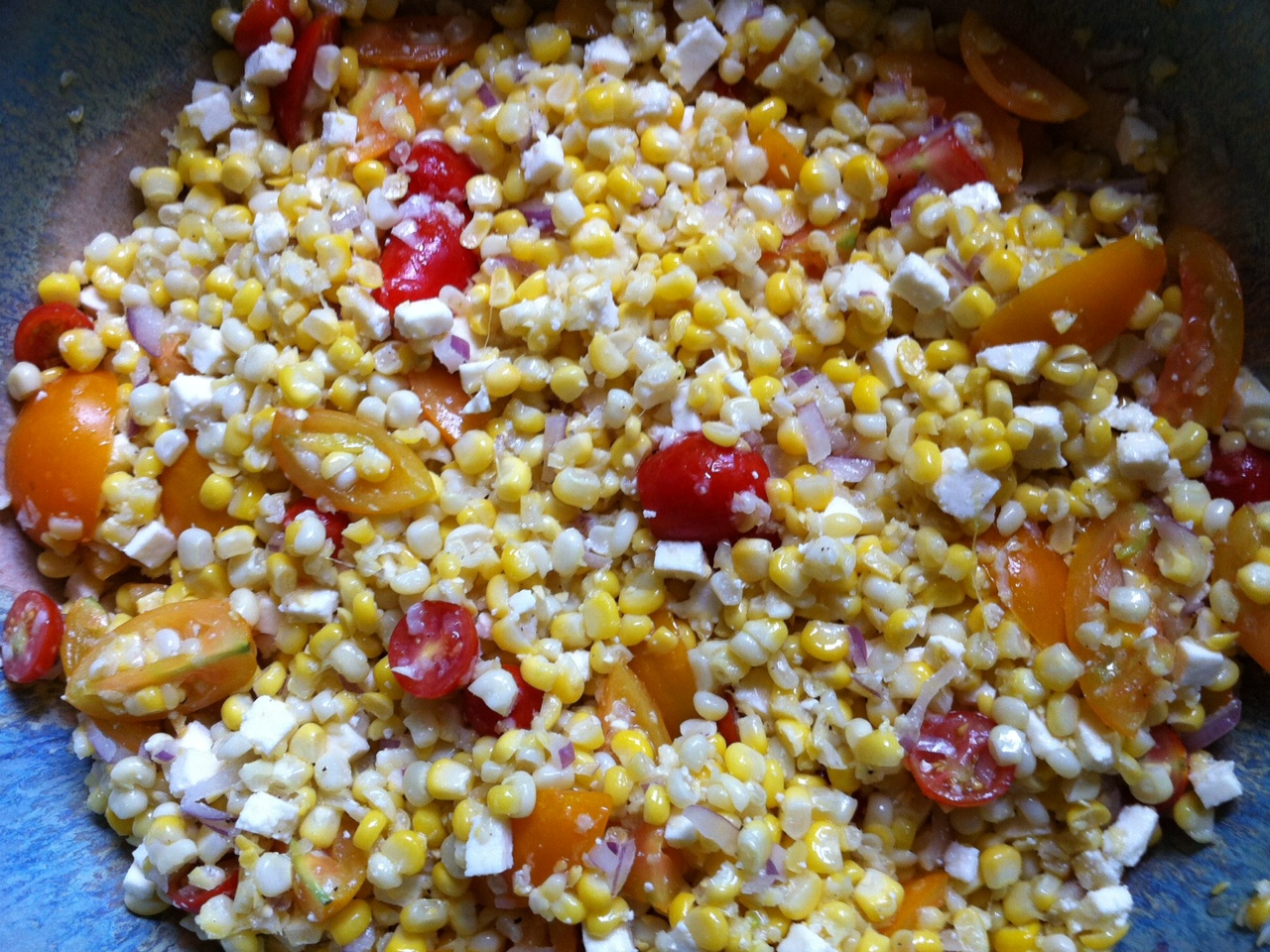
Corn and tomatoes…when they’re in season, you just can’t beat the combination! This is a very simple salsa that takes advantage of their natural sweetness and is easy to make.

salsa


Ingredients:


1 lb frozen organic corn or equivalent fresh

2 ripe tomatoes, seeded and chopped

1/4 small red onion, finely chopped

6 oz mild crumbled cheese, like feta, cotija, or queso fresco

1 teaspoon Fleur de Sel

A pinch of black pepper

2 teaspoons white vinegar

2 tablespoons extra virgin olive oil


If using fresh corn, remove it from the ears, then pan saute  in a little olive oil, but leave it nice and crisp. If you can roast the ears of corn over some coals, even better. Let it cool.

Mix corn with all the other ingredients in a bowl. Cover and refrigerate.

SANTORINI, GREECE

Posted: August 26, 2013 in Food, Santorini, travel, Uncategorized
Tags: , ,

santorini1 santorini2 santorini3Back for our third visit on this incredible legendary island. Though many things have changed in the last five years–larger crowds, more humungous tour buses squeezing through very narrow streets, more high-end hotel construction–the essence of the this island, and of the magical town of Oia, where we always stay, (pronounced Ee-yah) has remained intact. The people are as friendly as ever, and more than happy to share their heritage with you.

As I write this, I can hear the jingling of the bells on the donkeys that carry people up the long and steep winding stairway that connects the waterfront town of Amoudi below to the cliffside village of Oia above.

In future posts, I’ll discuss where to go, what to do, where to eat, and what to avoid.

No elevators here. Get your sturdiest walking shoes on and get ready to rock!