Posts Tagged ‘food’

PICKLED BEETS

Posted: January 11, 2023 in beets, Food, pickling, Recipes
Tags: , , ,

Growing up in a Lithuanian family, there was a small group of foods that I had to love to survive, since they constantly appeared on the dinner table: potatoes, cabbage, mushrooms, herring, and beets. Fortunately for me, I loved them all, despite my Mom’s desire to boil everything to death.

One of the many uses for beets, besides a cold summer soup and a hot winter soup, was pickling. Pickled beets are an excellent side dish for any hearty meat dish. (I love ’em with kielbasa!)  Store-bought pickled beets pack way too much sugar in every jar, so it was time to make my own.

A real time saver is a product called Love Beets, which you can find in any supermarket. If you use them, you can skip the roasting and messy peeling of the beets altogether.

This recipe makes one large Mason jar’s worth of pickled veggies.


beets


4 to 8 beets, scrubbed (your favorite variety)
1 cup apple cider vinegar
1 cup water
3 garlic cloves, crushed
3 tablespoons sugar
2 teaspoons whole black peppercorns
1 tablespoon Kosher salt
1 onion, sliced (or more, if you love ’em like I do!)
cauliflower pieces (optional)
fresh dill (optional)


Pre-heat the oven to 450. Wrap the beets in foil and roast them for about an hour, until tender. When they’re cool enough, carefully peel and quarter them. (If you’re using Love Beets, no cooking is necessary. Just open the package, and halve them if they’re small…quarter them if they’re larger.)

In a medium saucepan, combine the vinegar, water, garlic, sugar, peppercorns and salt. Bring it to a boil and simmer over moderately high heat, stirring until the sugar has dissolved. Let the pickling liquid cool to warm, about 15 minutes.

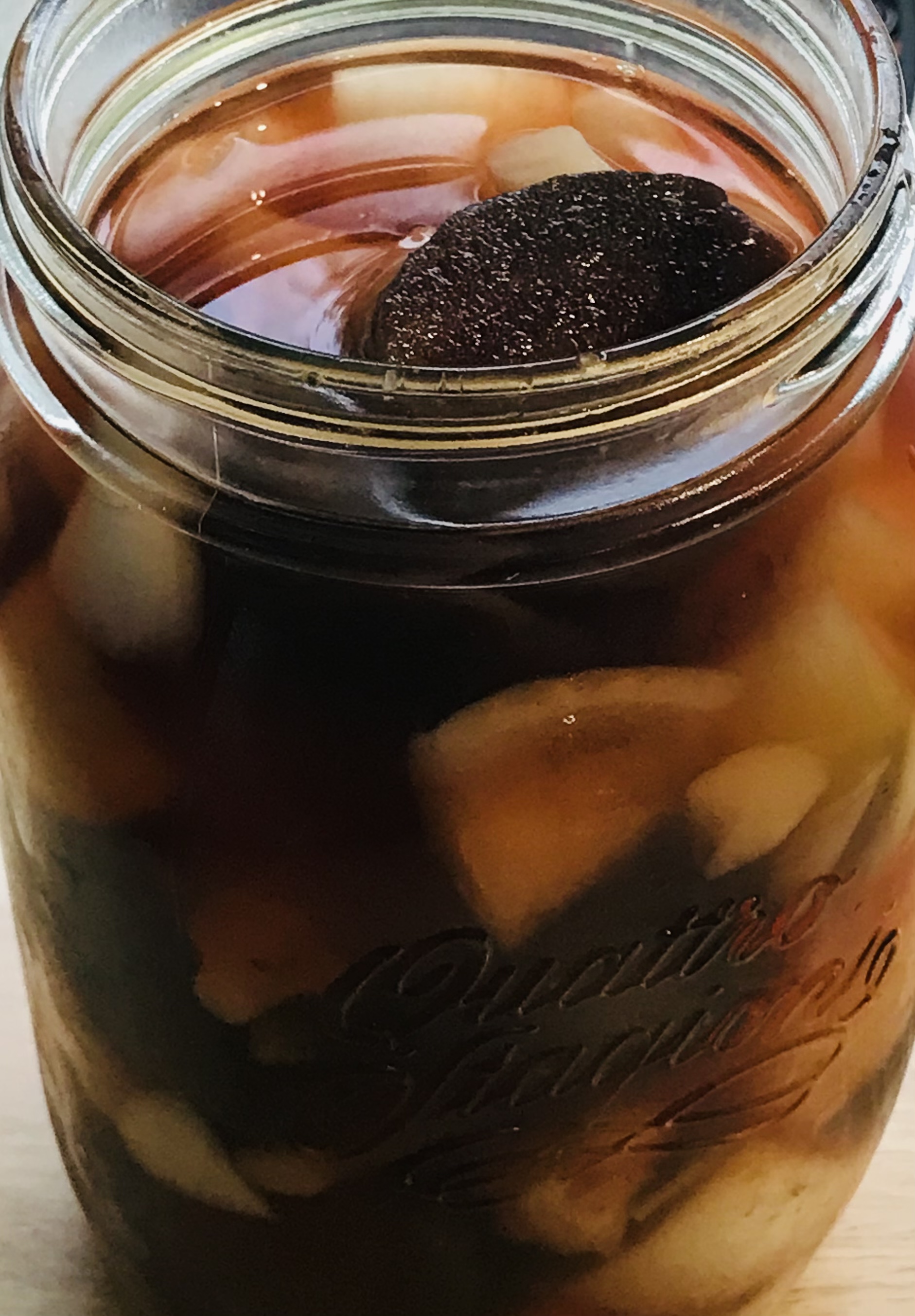
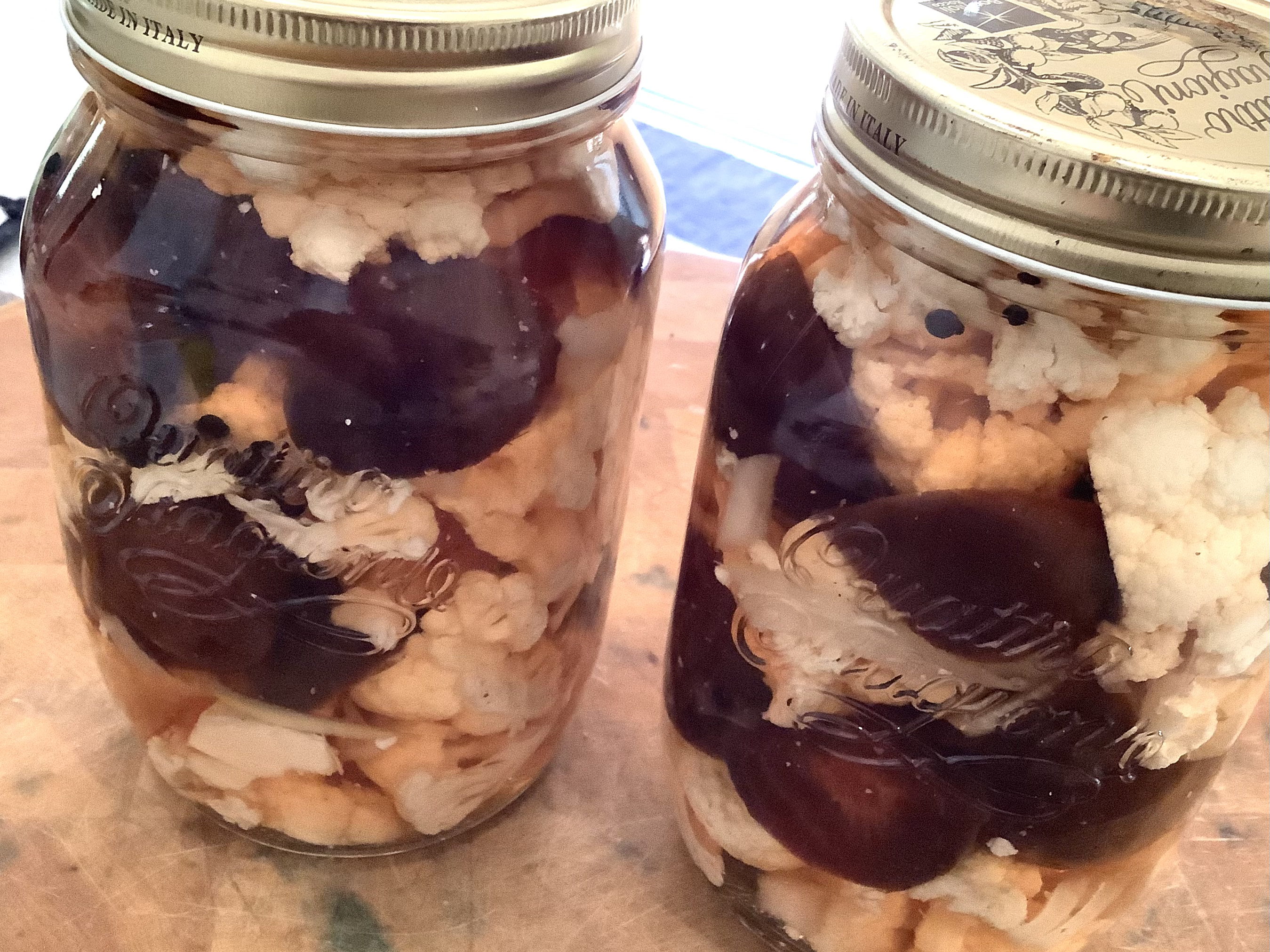
In a heat-proof glass jar or container, layer the beets, onions, and optional cauliflower. Pack them down a bit so there’s not a lot of air between them. Pour the pickling liquid in the jar, covering the veggies. Seal the jar tightly. Let it stand at room temp for 2 hours, then place it in the fridge overnight.


They stay fresh for a week, but they won’t last that long!


My daughter and I love any foods that are heavy on the garlic, so this is a special treat we make when diets don’t matter! It’s buttery, it’s garlicky, it’s carby, and it’s absolutely delicious!

I use 2 kinds of garlic in my garlic bread: fresh and granulated. I think it packs a garlicky punch even better than either one alone. And passing the fresh garlic through a press ensures that it will cook quickly and not leave you with that raw garlic taste in your mouth.

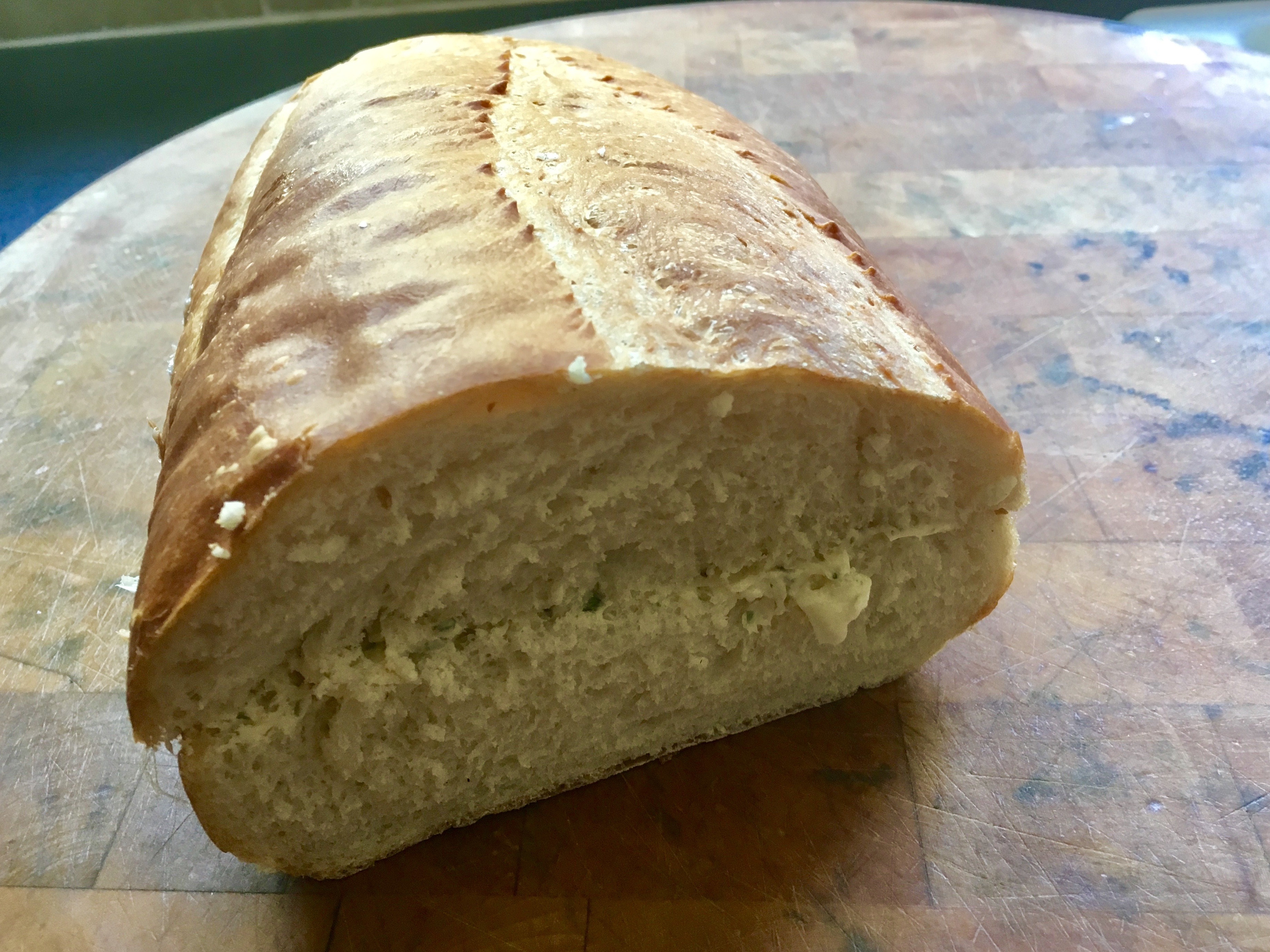
Although I love French baguettes, they’re too thin and crisp for garlic bread. I buy that long, soft, Italian loaf you can find in just about any supermarket bakery. When it bakes, the outside edges are nice and crispy, while the inside of the loaf stays soft…exactly what you want! The Italian loaf is big, so not only do I cut it lengthwise, I then cut each piece in half. This will make enough for us to enjoy one evening, and still store some in the freezer for a future craving.

This recipe makes enough for 1 garlic bread, 1 cheesy garlic bread, and also the bread you’ll be putting in the freezer for another time.

The delicious final product…but I digress…

2 sticks (8 oz.) unsalted butter
2 (or more!) large cloves garlic, squeezed through a press
1 teaspoon granulated garlic
1 teaspoon sea salt
1 teaspoon oregano
1 teaspoon parsley
grated mozzarella cheese…a few ounces

In a bowl, let the butter soften to room temperature. Once it’s soft, squeeze the fresh garlic cloves through a garlic press and add them to the butter. Then add the granulated garlic, salt, oregano and parsley. Using a fork, mix the ingredients really well until you have a beautiful garlic and herb butter. (Once it’s mixed, I find it’s easier to spread with a spatula or the back of a large spoon.)

Spread the garlic butter evenly on all 4 pieces of bread you’ve cut. Use it all up! Going thin on the butter serves no purpose here!

Place one of the loaves on a baking sheet. Add the grated mozzarella to one of the other loaves, and place it on the baking sheet as well.

Regular garlic bread on the left, cheesy garlic bread on the right…ready to go into the oven.

Pre-heat the oven to 400 degrees.

With the other two pieces of bread, I simply put them together…with cheese inside or not…

…and wrap them in aluminum foil. I place that in a freezer bag and keep it frozen until we have another craving. When it’s time to cook, I pre-heat the oven to 350, and bake the loaf in the foil for about 25 minutes. I take it out of the foil at the very end and bake another 5 minutes to get it to crisp up.

Ready to be devoured!

With the oven at 400, I bake my garlic bread and cheesy garlic bread for about 10 minutes, or until the edges of the bread start to turn a golden brown and the cheese on the cheesy side starts to melt.

I cut each piece in half so my daughter and I share in the 2 breads. There’s never any leftovers!

I live one town over from Fall River, Massachusetts, and just down the road from New Bedford, Massachusetts, two thriving proud Portuguese communities. In middle school, my daughter had to take mandatory Portuguese language classes. We’ve got dozens of authentic Portuguese restaurants in the area, and even a well-stocked supermarket with its own bacalhau (salt cod) room: Portugalia Marketplace, in Fall River.

So when I first posted my recipe of Portuguese kale soup, I was told by many Portuguese friends that my soup wasn’t authentic so I couldn’t call it that. Fair enough. After all, my soup has far less carbs (no potatoes or pasta), fewer spices, and it uses homemade stock instead of water. It may not be Portuguese, but it’s full of flavor.


My version of the classic Portuguese kale soup.

My version of the classic Portuguese kale soup.


4 cups home-made chicken or beef stock
4 cups water
1 cup lentils, rinsed in cold water
1 onion, finely chopped
1 carrot, finely chopped
2 stalks celery, finely chopped
1 clove garlic, through a press
1 lb. Portuguese chourico, peeled and chopped into small cubes 
1 large bunch organic kale
salt and pepper

Add the stock and water to a large pot. Heat until boiling. Add the lentils.

In a saucepan with a little olive oil or bacon fat, sauté the onions, carrots, celery, and garlic for a few minutes. Add the chopped chourico and sauté a few minutes more. Add the contents of the sauté pan to the pot.

Wash and de-stem the kale, tearing the leaves into smaller pieces. Add the leaves to the pot and stir. The stems go in your compost pile. (You can also use them in a juicer.) Kale is always on the “dirty dozen” list of vegetables with large amounts of pesticides, so I always buy organic.

Cook the soup until the lentils are al dente. Taste and season for salt and pepper before serving.


I’ve got dozens of chicken wing recipes, but even so, sometimes I just want something different. I decided to take my favorite taco seasonings recipe and adapt it to chicken wings. Caramba! One of the tastiest wings I’ve made in a long time!

This is such an easy and delicious recipe to make, even for a crowd. At your next party, just double or triple the recipe, as needed. And it works with a whole chicken as well.


2 teaspoons salt
2 teaspoons cumin
2 teaspoons oregano
1 teaspoon paprika
1 teaspoon granulated onion
1/2 teaspoon granulated garlic
1/2 teaspoon pepper
avocado oil
4–5 lbs. chicken wings

Preheat the oven to 375.

Combine the salt, cumin, oregano, paprika, onion, garlic, and pepper in a bowl. Mix well.

Cover a baking sheet with aluminum foil and spread the wings out on the sheet. Sprinkle the wings with the avocado oil and rub the oil all over the wings. This will help the wings cook evenly,  and it’ll help the seasonings stick to the wings.

Turn the wings bottom-side-up and sprinkle with the seasoning mix. Flip the wings over and sprinkle them again, coating them evenly.

Place the baking sheet in the oven and bake for about 45 minutes.

This is my version of a holiday drink I was introduced to me by my mother-in-law from the Upper Peninsula of Michigan.

This classic is loaded with sugar. But then…so is everything else around the holidays!

Whiskey slush

9 cups water
2 cups sugar
4 “Constant Comment” tea bags
12 oz. frozen OJ concentrate
12 oz. frozen lemonade concentrate
2 cups whiskey (I use Crown Royal)
7-Up or Sprite

Boil the water and sugar, making sure the sugar dissolves. Turn off the heat and steep the tea bags in the liquid for 10 minutes. Discard the tea bags.

Add the OJ, lemonade and whiskey. Mix well, then pour it all into a freezeable container with a lid. Freeze.

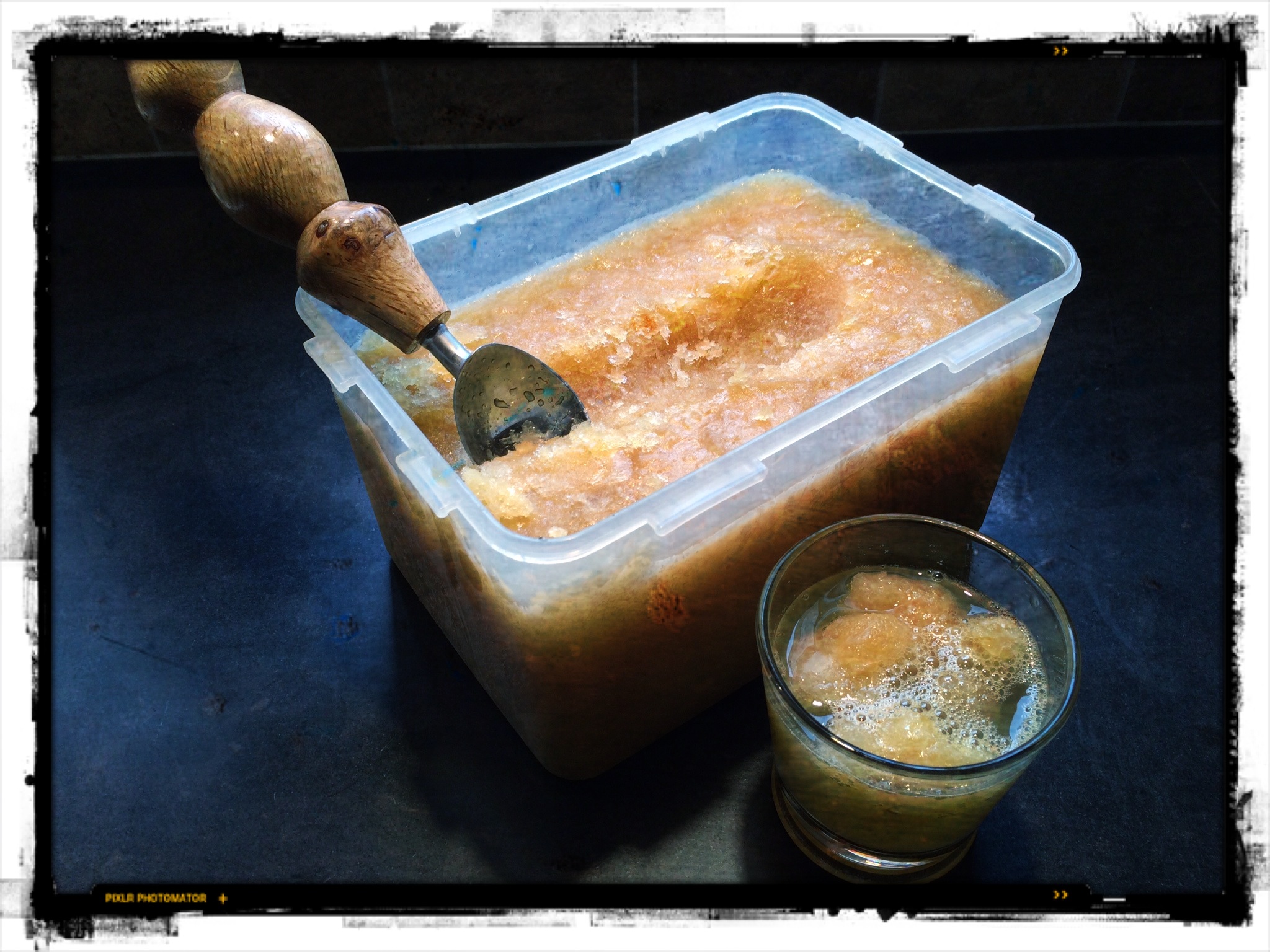
To serve: Scoop the slush out of the container (it doesn’t freeze solid) and mix it in a tall glass with 7-Up.

If you’re concerned about all that sugar, you can use a sugar substitute in the mix, and diet soda at the end. Some stores also carry low-sugar juice concentrates. I haven’t tried any of these substitutions, because when it comes to the holidays, I go big or go home!

Pork is magical. And though I’ve loved pork chops and store-bought bacon all my life, it’s only been in the last decade that I’ve learned to appreciate other cuts of pork and how they’re prepared. Guanciale is one of those meats, and it’s a key ingredient to a classic Italian dish: pasta carbonara.


In the beginning, I could only find huge jowls that required cutting and weighing to mix with the right amount of cure.

Looking at carbonara recipes online, many said the same thing: “Though a genuine carbonara uses a cured cut of pork called guanciale, it’s hard to find. So use pancetta or bacon.” Although both pancetta and bacon meats are delicious (both come from the belly of the pig…bacon is smoked, pancetta is not) the flavor and texture is not the same as a pork cheek, or jowl…and that’s what guanciale is made from.
Many years ago, my search for guanciale started with a local restaurant, the Back Eddy in Westport, Massachusetts. Being a buddy of the owner (and bribing him with alcohol), I asked if he’d order me some jowls. He did, and that worked well for a while. But I didn’t want to keep bothering him every time I wanted more, so I eventually found my own source on line that supplied me with massive jowls weighing many pounds each, as in the photo above. They were good, but a pain to work with. Eventually, that company went out of business.
I finally found my go-to pork website: http://www.heritagepork.com. They sell a variety of pork products made from a heritage breed of pig known as Berkshire, also called kurobuta. It’s delicious with wonderful fat that’s healthy and full of flavor. And conveniently, they sell pork jowls in smaller, 2-pound packs.

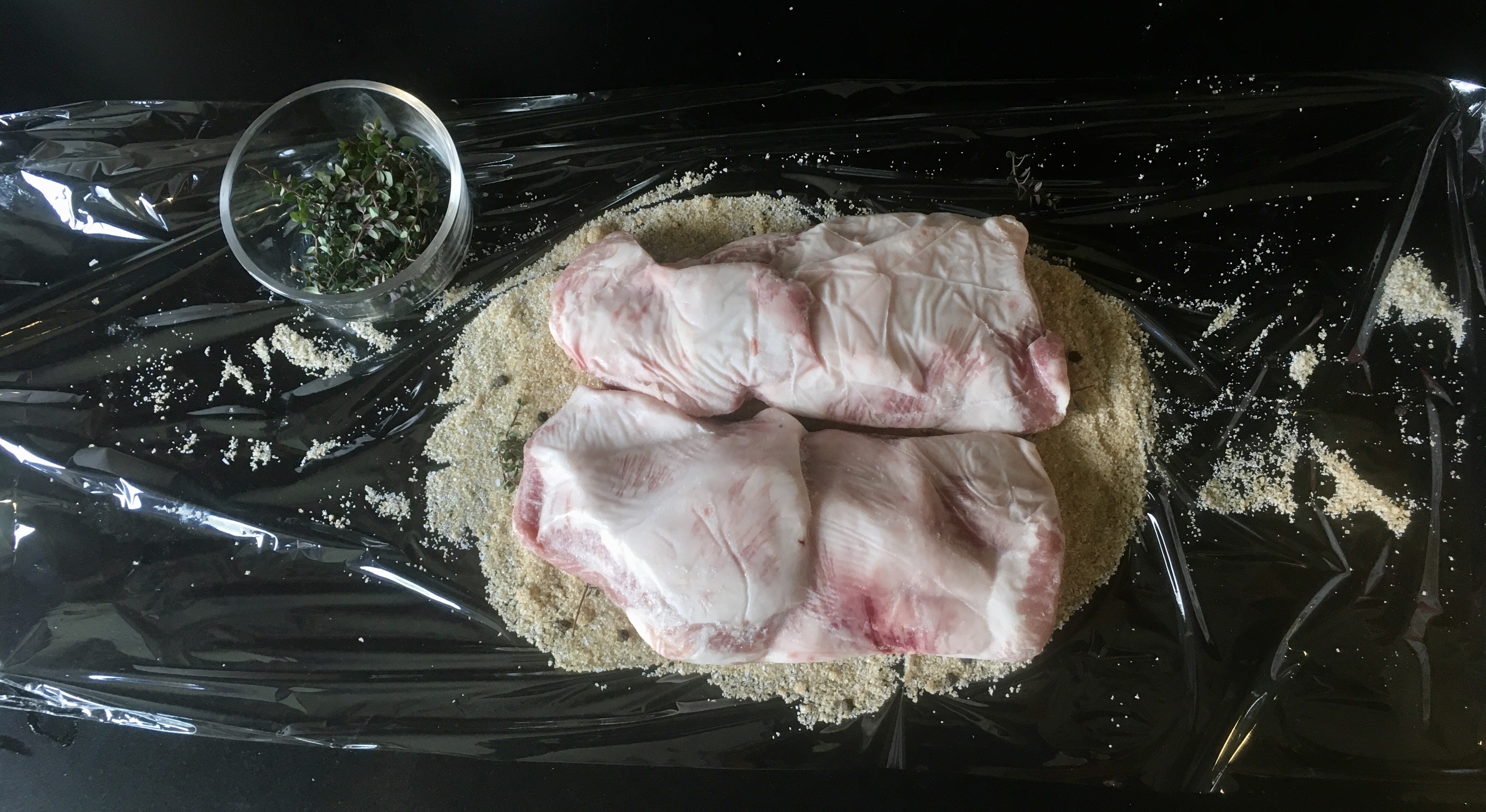
Berkshire pork jowls with fresh thyme from the garden and the dry cure mix.


My curing process is simple: sugar, salt, peppercorns, and fresh thyme. I cure the jowls for about 3 weeks. I rinse them once they’ve cured, and pat them dry. They still need to cook, but they’re ready to use for carbonara, ragu bolognese, topping a pizza, or any other delicious recipe that comes my way…and they freeze really well.
Once I made my first batch, there was no turning back!
2 lbs. raw pork jowls
1/2 cup basic dry cure mix (recipe below)
1/2 cup brown sugar
1 teaspoon whole black peppercorns
a handful of fresh thyme sprigs
Combine the basic dry cure mix, brown sugar, and peppercorns in a bowl. We’ll call this the cure.
On a large work surface, lay down several sheets of plastic wrap, overlapping each other to keep the cure from leaking through to the counter underneath. Sprinkle half of the cure onto the plastic wrap in an area where the jowls will lay. Scatter a half-dozen thyme sprigs on top of the cure. Lay the pieces of pork jowl on top of the cure and the thyme.

I place the cure and sprigs of thyme on a long sheet of plastic wrap.


The pork jowls go on top.

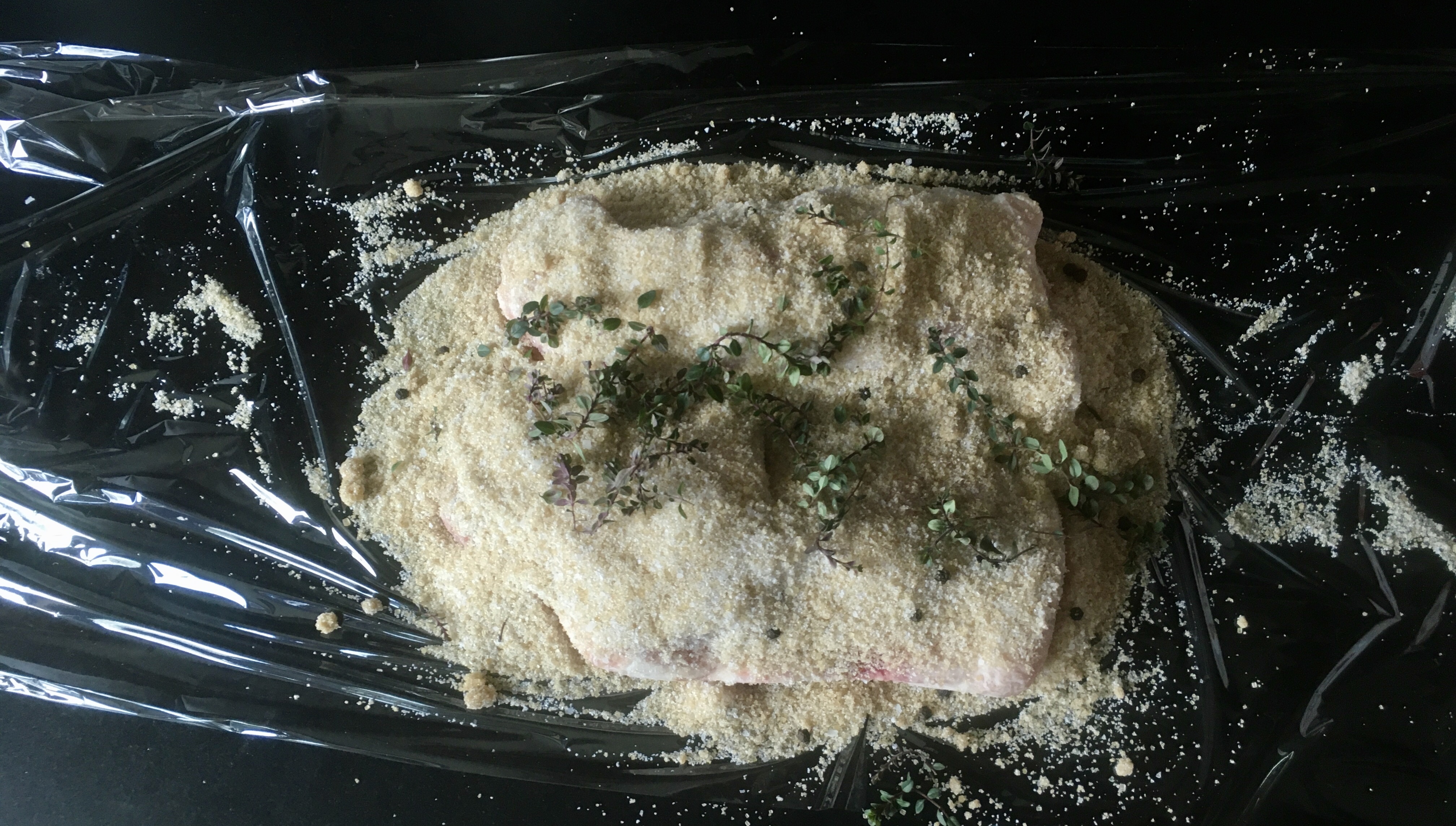
Then top the jowls with the rest of the cure, covering them evenly, and top with more thyme sprigs.

Press down on the jowls to really get the cure to stick.


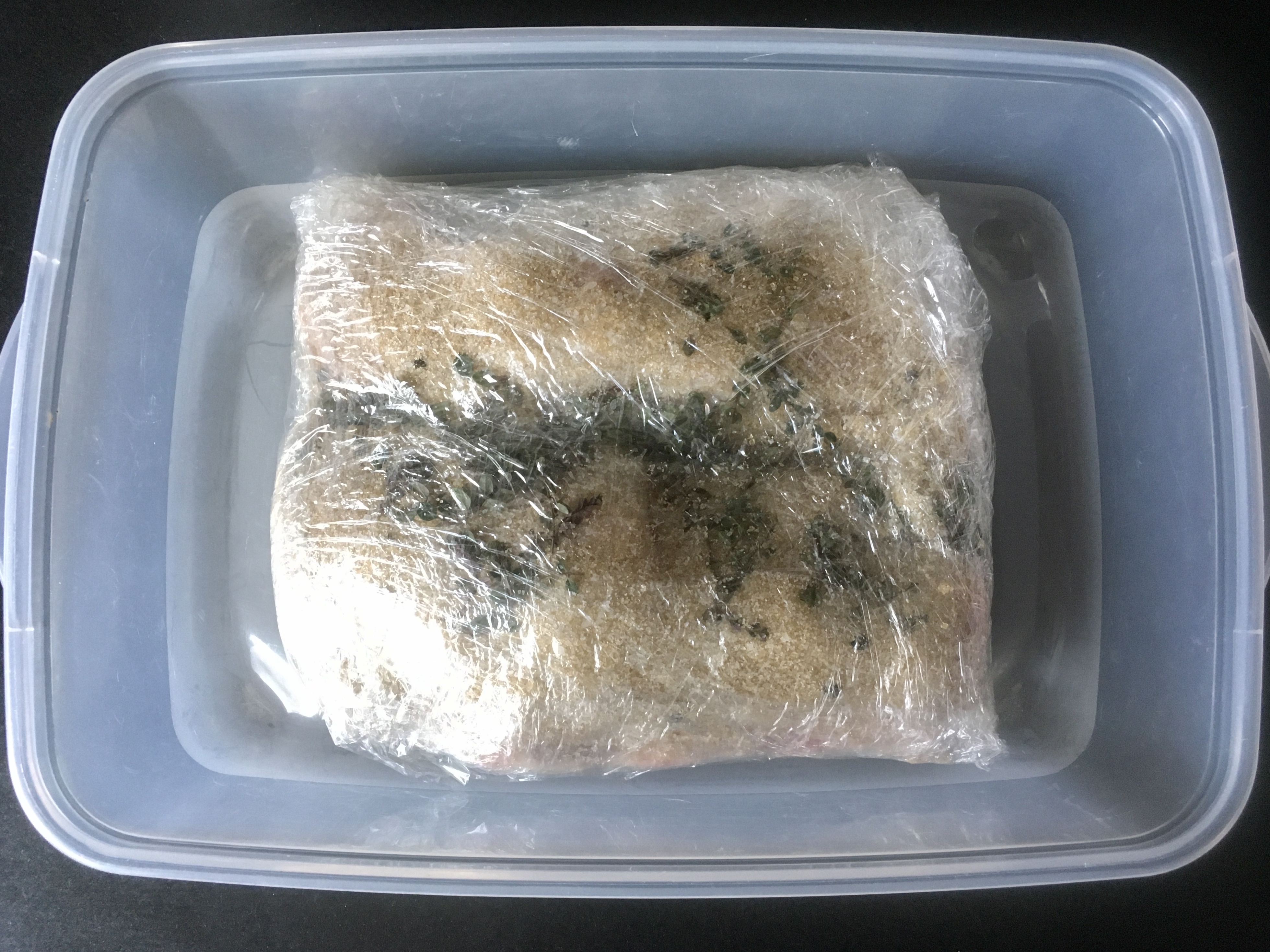
Fold the plastic wrap over the jowls as tightly as you can, pressing the cure into the meat. If the wrap is loose, use more wrap to really tighten it up. Then place the entire pork-wrapped package in a container that will hold the liquid that will ooze out during the curing process.

Into a container with a lid and into the fridge.


Place the container in the fridge to cure for 3 weeks.
Every couple of days, flip the plastic wrap package over, so that the top is now the bottom. Then return it to the fridge. You want the cure to get at every part of the pork. Don’t pour off any liquid that forms…it gets kind of gooey, but it will help the curing process.

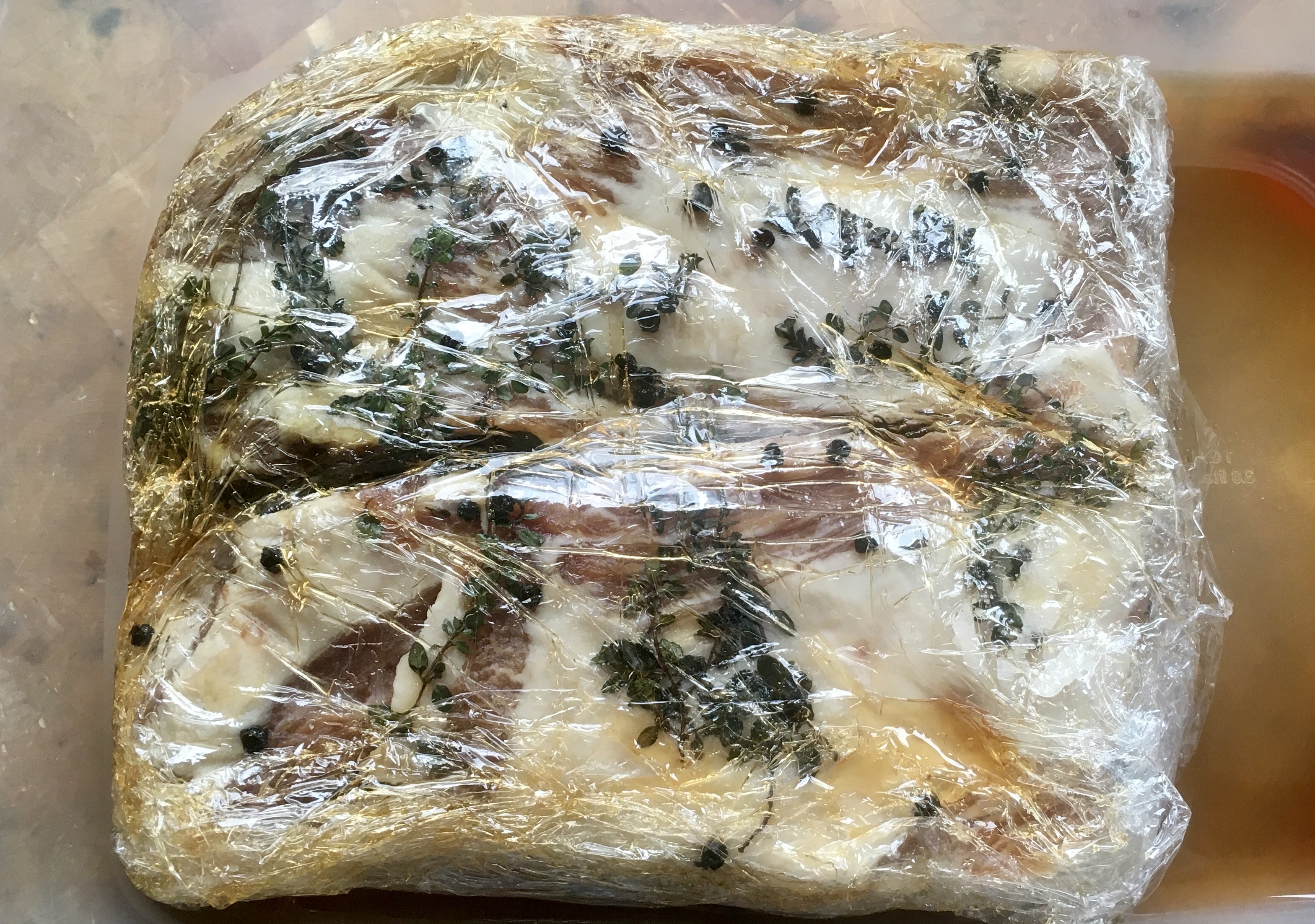
3 weeks later, it has transformed…

In about 3 weeks, the pork jowls will feel firmer. This is a sign they’ve been properly cured. Remove them from the plastic wrap, rinse them thoroughly under cold clean water, then pat them dry with paper towels.

They’re perfect…they just need a rinse.


Cured, rinsed and patted dry. Cut the guanciale into smaller pieces before freezing. A little goes a long way!


At this point, cut the guanciale into smaller pieces, wrapping each well and placing them in freezer bags. They will keep in the freezer for a long time.
Many guanciale recipes tell you to hang the meat in the fridge for at least a week after curing, but I haven’t really found the need to do that if I’m keeping them frozen. The drying process keeps the meat from getting moldy, but that’s only if you keep it at room temperature, which I don’t.

Always slice off a little to fry up a test batch! It’s all about quality control!


The Basic Dry Cure Mix
This basic dry cure mix is extremely simple, and you can cure many meats with it. But it does require a special ingredient: pink salt. This is not pink Himalayan salt. This is a very special curing salt that must be used in small amounts. (You can easily find it online.) It contains nitrites which will help preserve the meat and give it a good color. Many people get bent out of shape over nitrites these days, so you need to decide whether you want to use pink salt or not. I do, because I don’t eat pounds of guanciale like a lab rat. If you don’t use it, the meat will turn a bit gray–nothing wrong with it, just not an appealing color.
1 1/2 cups Diamond Crystal Kosher Salt
1/2 cup organic turbinado  sugar
5 teaspoons pink curing salt
Combine these ingredients and mix well. Store the basic dry cure mix in a tightly sealed plastic bag in your pantry.
An important note: the reason I give the brand name for the salt is because all Kosher salt does not weigh the same! A cup-and-a-half of Morton Kosher Salt, for example, weighs more and will throw off the recipe.

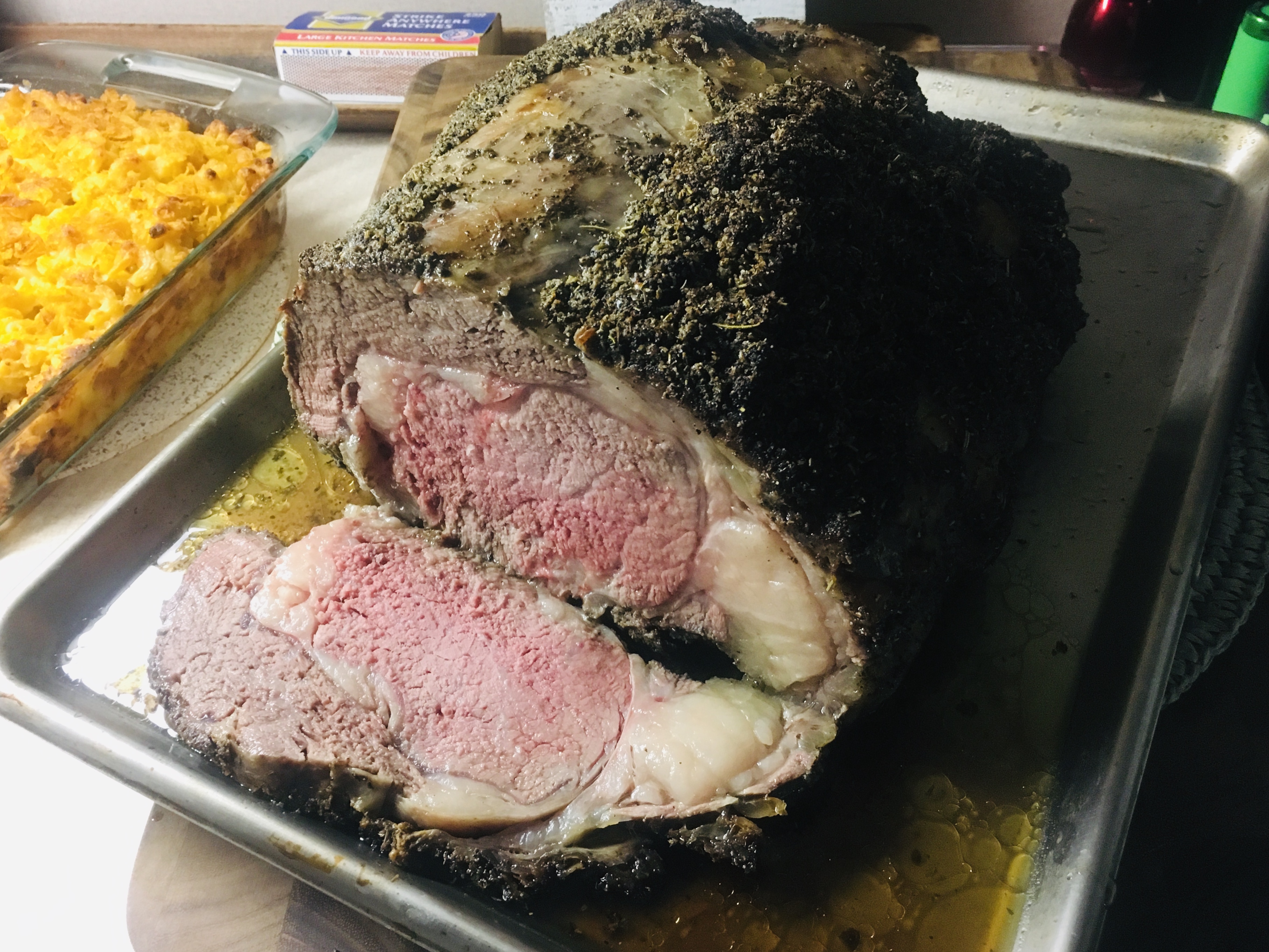
This is a great way to impress your guests at a holiday dinner or any big celebration.

Buying a large roast is not an inexpensive proposition, so I wanted to be as sure as possible that it was going to come out right. I got to work, researching recipes online and watching every You Tube video I could find. Every chef and home cook had their own ideas of spices and rubs, but the basic methodology was the same: start the roast at very high heat to form a delicious crust on the meat, then bring the oven temperature down and cook it more slowly to bring the roast to a perfect medium rare.

A big 10-lb. roast is going to cost around 150 bucks, so the first step is simple: don’t skimp by buying a cheap cut of meat. You will absolutely regret it. Get the best meat you can afford. The reward you’ll get when you slice it in front of the family, with all those “oohs and ahhhs” will totally be worth it!
 

A perfectly cooked, perfectly delicious roast!

The second step is simple but very important: make sure the roast is at room temperature before cooking, and make sure the oven is really pre-heated properly to the right temperature before you put the roast in it. A cold roast will cook unevenly, and you won’t get that beautiful pink all the way through the meat when you slice it. It’ll be raw on the inside and overcooked on the outside. Take the roast out of the fridge for a good 2 hours before cooking…and if it’s frozen, back-time the heck out of it so that it’s truly thawed!

You can already see that back-timing is going to play an important part in a perfect roast. So, for example, if you want to be serving at 7PM, you need a half-hour (at least) for the meat to rest after cooking…about 2 hours of cooking time…and about 2 hours of bringing the roast to room temperature….give or take. Oven temperature settings vary, and roasts can be uneven. You’ll have to keep an eye on this thing.

That brings us to monitoring the temperature. If you have a basic meat thermometer, you’ll need to jab the roast a couple of times during the cooking process to know what temperature you’re at. I don’t like this method, because it means you’re pulling the roast out of the oven, dropping the oven temperature each time, and jabbing the meat, which releases juices every time you pull the thermometer out. I suggest investing in a probe that goes in the roast from the very beginning, and stays in the roast through the whole cooking process, monitoring the temperature the entire time. When the roast hits the perfect temperature of about 115 degrees, it beeps and lets you know it’s time to remove it from the oven. It’s practically foolproof.

The monitor I have is old school, as you can see, but it does the job. These days, you can get a wireless model that calls your phone when you’ve reached the ideal temperature.
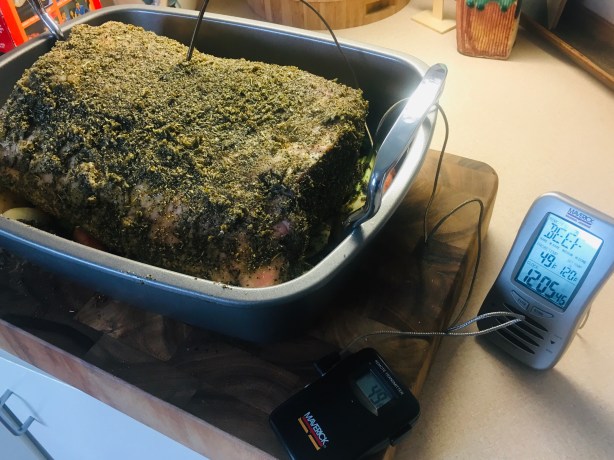
 

My old-school monitoring system. I had it set for 120 degrees, but actually pulled the roast out at 115.


My old monitor still works like a charm. I use it at Thanksgiving to get perfectly roasted turkeys on a Weber grill, and it works great here as well. The probe goes into the meat, and it’s connected to a transmitter. It also has a receiver that can be as far away as 100 feet from the roast, and it will signal you when the desired temperature has been reached. That means you don’t have to stare at the roast all the time. You don’t have to open the oven door all the time. You can actually enjoy a cocktail in the company of your guests or family while the meat cooks.

2 onions
3 carrots
3 stalks of celery

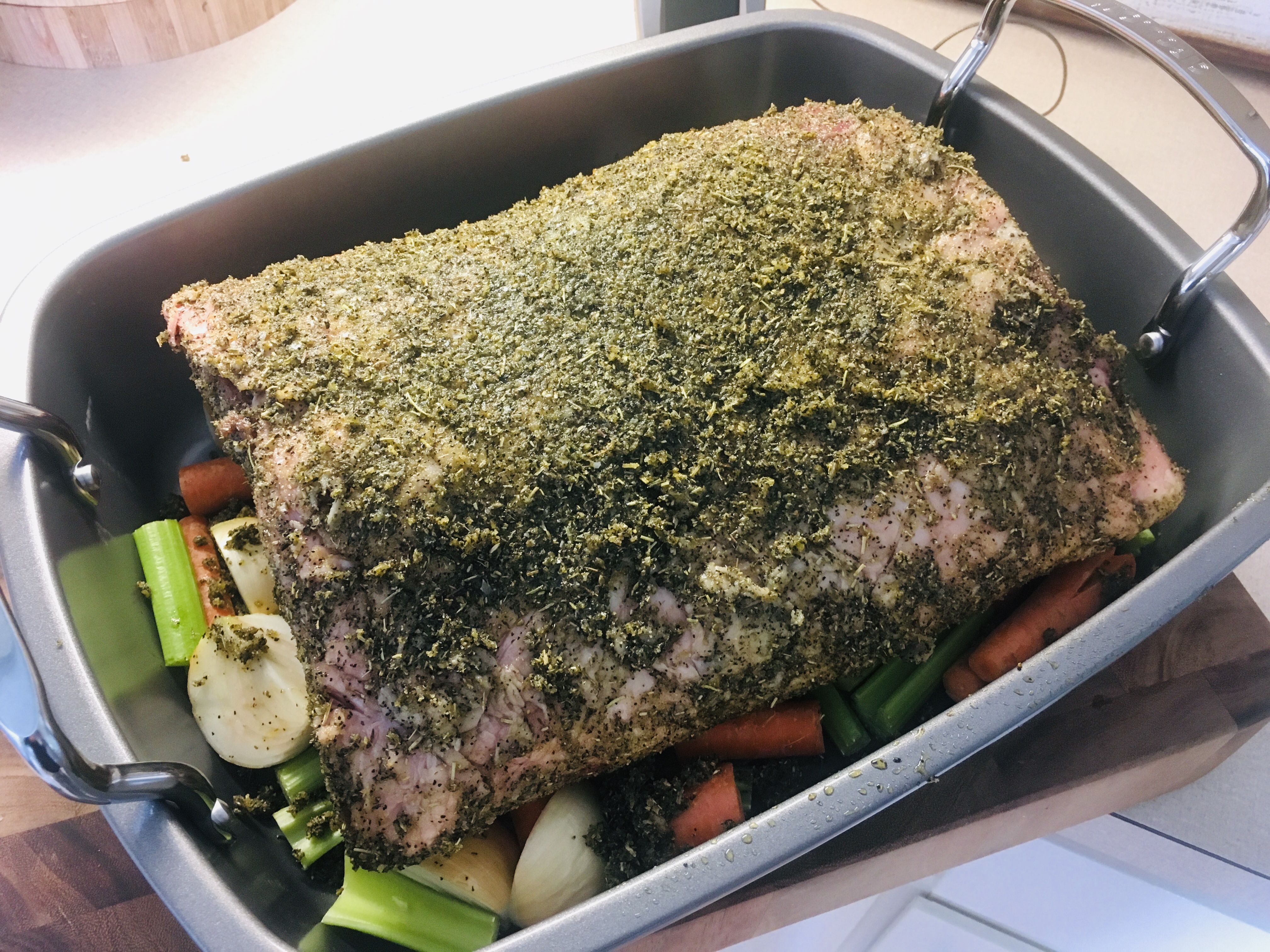
When it’s time to remove the roast from the fridge to bring it to room temperature, roughly chop the onions, carrots and celery and place them on the bottom of a roasting pan. Lay the roast on top.

The rub that you use on your roast is really a matter of what you like. Use the herbs and seasonings you love, and you can’t go wrong. Here’s my recipe for a 10 to 12-pound roast…

1/2 cup olive oil
1/4 cup Kosher salt
1 tablespoon black pepper
1 tablespoon granulated garlic
2 tablespoons granulated onion
2 tablespoons dried oregano
2 tablespoons dried thyme
2 tablespoons fresh rosemary, finely chopped

Combine these ingredients in a bowl. You want it to be like a paste or wet sand. If it’s too dry, add a little more olive oil. Dried oregano and thyme are usually fine the way they are, but fresh rosemary from the supermarket can be hard like pine needles. I either chop them really fine or I put them in a spice grinder. I have a small rosemary plant growing indoors by my window, so the needles are usually soft and wonderfully fragrant when I chop them up.
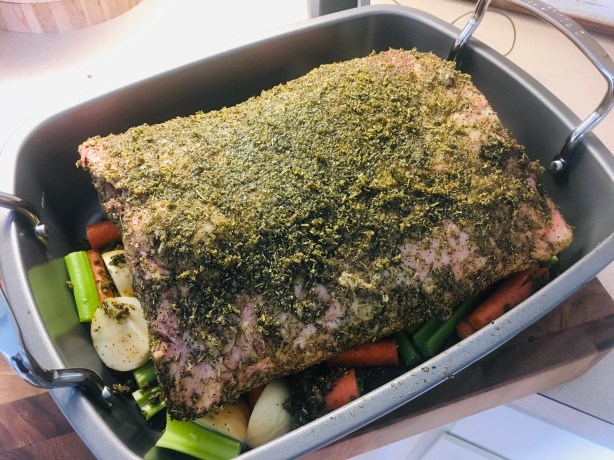
 

Seasoned and ready to cook!


Rub the seasonings all over the roast, making sure you get the bottom and the sides as well. Use it all up! You might think it’s too much salt, but remember: it’s a big hunka meat. Some of the seasonings will fall off. Be fearless!

To flavor the meat while cooking, I add a cup of red wine (optional) and 2 cups of beef or chicken stock in the pan with the vegetables. (In some cases, after the roast is cooked, you can use the juices at the bottom of the pan to make gravy. But give it a taste first. If you use a lot of salt on your roast, the juices could be too salty to use in your gravy. Gravy or not, a classic horseradish cream sauce on the side is a great choice. (The recipe is below.)

At least a half-hour before you want to start cooking, pre-heat the oven to 450 degrees. You really want it hot to start. Roast the meat at 450 for 20 minutes, then turn down the heat to 325 degrees.

This is where many recipes tell you to calculate how much more to cook based on the size of the roast, etc. If you’ve got a probe in the roast, you can see exactly how the temperature changes over time. If you decide that you’re going to “wing it,” you can go by the general math of 15 minutes per pound of meat, including that first 20 minutes. So, if you have a 10-pound roast, multiply that by 15 and you get 150 minutes. Subtract the first 20 minutes from that, and you need to cook the roast another 130 minutes at 325 degrees. This is by no means a guarantee of success, but a very general guideline.

If you have a standard meat thermometer, you know that you can safely leave the roast in the oven at least an hour before taking the first temperature reading. Then play it by ear. (Like I said, you don’t want to be opening the oven door and poking the meat all the time.)

Although I had my probe set at 120 degrees, I took the meat out at 115, removing the roast from the pan, and placing it on a cutting board (or another clean pan.) Then I wrapped the roast with foil, and covered the foil with a clean bath towel, keeping all the heat in, letting the meat rest for AT LEAST 30 minutes. The meat inside continued to cook and reached a temperature of 130 degrees before it started to slowly cool down. (If you leave the probe in while the meat is wrapped, you’ll actually see the temperature rise.)

After at least 30 minutes of resting, I unwrapped the roast and started slicing!

This is where you can pour off all the pan drippings and make a sauce if your spice mix wasn’t too salty or strong. As I mentioned, the classic horseradish cream sauce is great to serve with it…

1 cup sour cream
1/2 cup mayonnaise
6 tablespoons prepared horseradish (more if you like it!)
the juice of 2 lemons
1 tablespoon Worcestershire sauce

Combine all the ingredients, mixing well. Keep this refrigerated until it’s ready to serve.
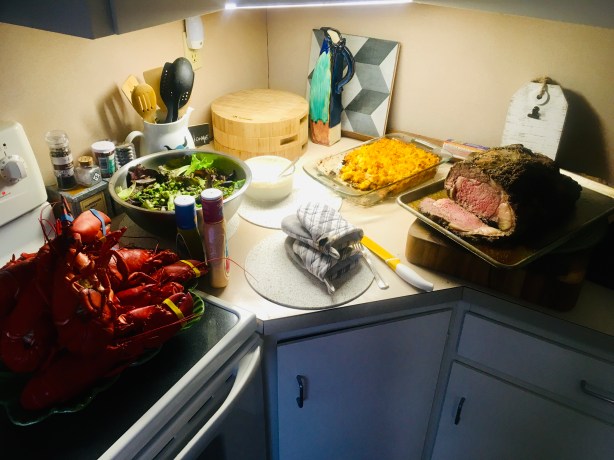
 

A previous family dinner with mac & cheese, salad, the amazing rib roast and lobsters from Sakonnet Lobster in Little Compton, RI!


Pork tenderloin is a lean cut of meat that can dry out easily when roasted. It’s usually just a couple of inches around, and over a foot long…a shape that can easily go from juicy to overdone in just a few minutes if you’re not watching it carefully.

This recipe really is based on what I had in the fridge and pantry at the time, and it just rocked!

I chose chickpeas as my starch. I don’t worry too much about carbs, as long as they’re good ones and in moderation.

I always use organic kale. Kale is one of the most heavily sprayed veggies out there. You don’t need pesticides in your soup!

The soup is gluten-free if you use gluten-free flour instead of regular all purpose flour.


soup1


1 1/2 lb. pork tenderloin, cut into 1/4″ thick medallions, then cut in half
1 cup all-purpose flour
1/2 onion, finely chopped
3 carrots, peeled and sliced
3 stalks celery, sliced
1 teaspoon garlic salt
1/2 teaspoon pepper
1 pint veal stock or chicken stock (homemade is best)
1/2 cup white wine (I like an un-oaked Australian chardonnay)
1 pint water
large pinch of bouquet garni
1 15-oz. can chickpeas, rinsed and drained
1 head organic kale, cleaned, stems removed, and chopped


Slice the pork tenderloin into 1/4″ medallions, then cut each medallion in half. Set aside.

In a bowl, add the flour (unseasoned). Set it next to the pork.

Heat a heavy skillet big enough to hold all the pork. Add a few tablespoons of olive oil or pork lard. Drop the pork pieces in the flour, coating them well, then shaking off the excess. (No egg wash needed.) Place them carefully in the pan and brown them on both sides. They don’t need to cook all the way through.

Leaving the pork in the pan, add the onions and stir, cooking for a couple of minutes. Then add the carrot and celery slices, stirring again. Sprinkle in the garlic salt and pepper, stirring again.

Add the stock, the wine, and the pint of water. Bring it to a boil and let it simmer for a few minutes, stirring gently.

Add the chick peas. Then add the kale, a handful at a time, waiting for the greens to wilt into the soup before adding another handful. Do this until all the kale is in the pan. Add the pinch of bouquet garni. Bring the soup to a boil again, then reduce it to a medium-low simmer, uncovered.

The soup is ready when the veggies are tender, about 15 minutes. Keep an eye on it, and if the liquid has evaporated and it looks too thick, add more water, bringing to a boil with each addition, then reducing the heat.

Taste for seasoning before serving.


soup2


I love these ribs. They’re one of the the first recipes I ever tried, and still one of my favorites. I’ll be making them again this weekend!
 
I like making these because you don’t need a grill or a smoker. They’re gooey, sweet and absolutely delicious!
 
 
 image
 
¾ cup soy sauce
 1/4 cup hoisin sauce
5 lbs. pork ribs
Zest and juice of 1 lemon
2 whole star anise
2 cinnamon sticks (3”)
1/2 cup honey
4 cups chicken broth
 
Mix the soy sauce and the hoisin in a bowl, and set it aside. These are the marinade ingredients.
 
If the ribs are large, cut them into individual pieces. If smaller, cluster 2 or 3 ribs together. Place them in a large pot. Cover them with water and bring it to a boil. Boil for 5 minutes. Drain.
 
Place the ribs on a baking sheet lined with non-stick aluminum foil or with a rack and coat them with the marinade. Let them sit for 10 minutes.
 
Pre-heat the oven to 350 degrees. Bake the ribs on the baking sheet for 30 minutes.
 
While the ribs are baking, start the sauce in a large non-stick pan or pot that will hold all the ribs: combine the lemon zest and juice, star anise, cinnamon sticks, honey and chicken broth. Bring it to a boil, then reduce it to a simmer.
 
When the ribs have finished baking, add them to the sauce pot and simmer (covered) for at least 15 minutes or until the rib meat is tender.
 
Turn the heat on high, uncover the pot and cook until the sauce is reduced to a glaze that coats the ribs. Be sure to reduce the heat as the sauce thickens or the sugars in the honey will burn! When the ribs are sticky and gooey, they’re ready.
 
Substituting grapefruit for the lemon works really well. And I like to switch the honey for maple syrup! Yum!


REUBEN SOUP

Posted: November 29, 2022 in bacon, cheese, Food, Recipes, sauerkraut
Tags: , , , ,

This is a great recipe for a cold day, and you can buy most of the ingredients at your supermarket.

Why have soup and a sandwich when your soup can be your sandwich? I had all the ingredients to make a Reuben sandwich. But I wanted soup. So I made Reuben Seup…I mean Soup!

Think French onion soup, but using Reuben ingredients…


Rye bread slices
Sauerkraut, drained and rinsed
Chicken stock
Pastrami, sliced thinly
Swiss cheese, sliced thinly


I like to take the sauerkraut, rinse it under cold water, then toss it in a pot that already has some finely chopped bacon and onions cooking in it. Once the ingredients have cooked down, set it aside. (If you prefer not to use bacon and onions, that’s fine, too.)

Find a source for great pastrami, like a good deli in your neighborhood.

Heat the chicken stock in a pot. Take the thinly sliced pastrami and chop it up into bite-sized pieces. Place the pastrami in the chicken stock to warm through. Keep the stock warm on low heat.

Now you’re ready to assemble…

rye

Take an oven-proof soup bowl. Line the bottom with some rye bread.


kraut

On top of that, place a nice helping of the sauerkraut.


stock

Pour the warm chicken stock with the pastrami over the sauerkraut.


swiss

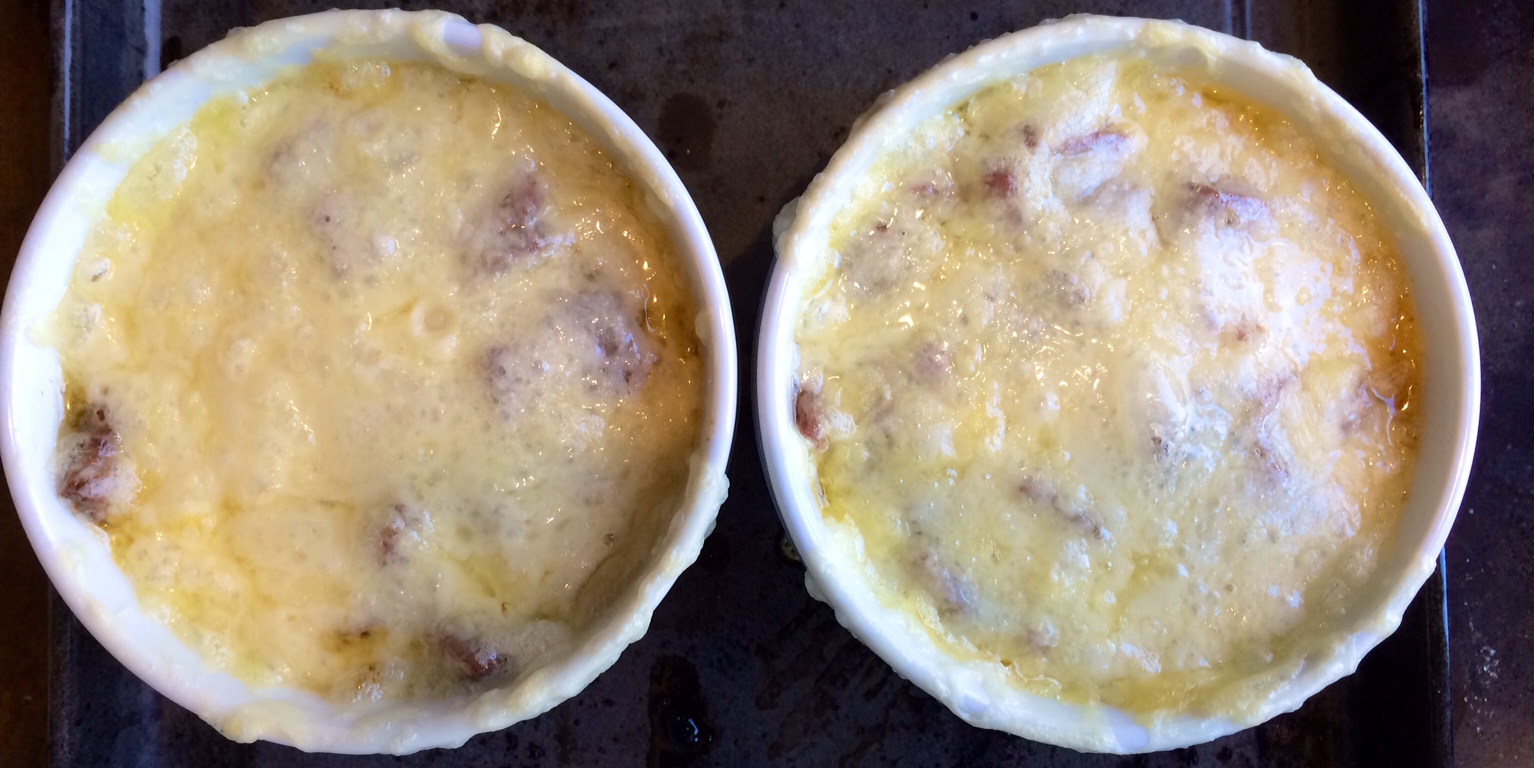
Layer slices of Swiss cheese over the top of the bowl. Place it under the broiler until melted.


melty

Eat!


eat

It satisfied my soup and sandwich craving!