Posts Tagged ‘food’

This dish is absolutely delicious and worth the effort. Despite the fact that we first had it in the middle of summer on a vacation to the beautiful island of Santorini, Greece, we always cook it around the holidays in wintertime. We don’t have access to that unusual Mediterranean lobster, but our cold water New England lobsters are a fine substitute!

Santorini gets a bad rap these days, because they’ve allowed the cruise ships to take over, and they just can’t support the massive crowds that invade this small, beautiful island every summer. Once you’ve opened the floodgates, it’s hard to suddenly turn around and tell tourists not to come. Santorini’s tourism industry drives the entire country of Greece. Sadly, it seems that many beautiful places in the world, once discovered by the masses, have to deal with this issues. (My beloved island of St. John in the USVI, is another example.)

But despite the hoards of tourists that swarm the island every summer, Santorini remains one of the most amazing places I’ve been to in my life. Having traveled there at least 4 times now, I know all the cruise ship tour bus routes and stops to avoid, and where I can still go to experience the real Santorini.

It was in one of those out-of-the-way places that we first had this dish. Taverna Giorgaros is a simple family-run restaurant that is on the road leading to the lighthouse, past the ancient ruins of Akrotiri. We’ve gone there every time we’ve visited Santorini, and only once did they have the freshly caught lobster that allowed us to enjoy this dish.


Where we first had our pasta with lobster sauce in Santorini.
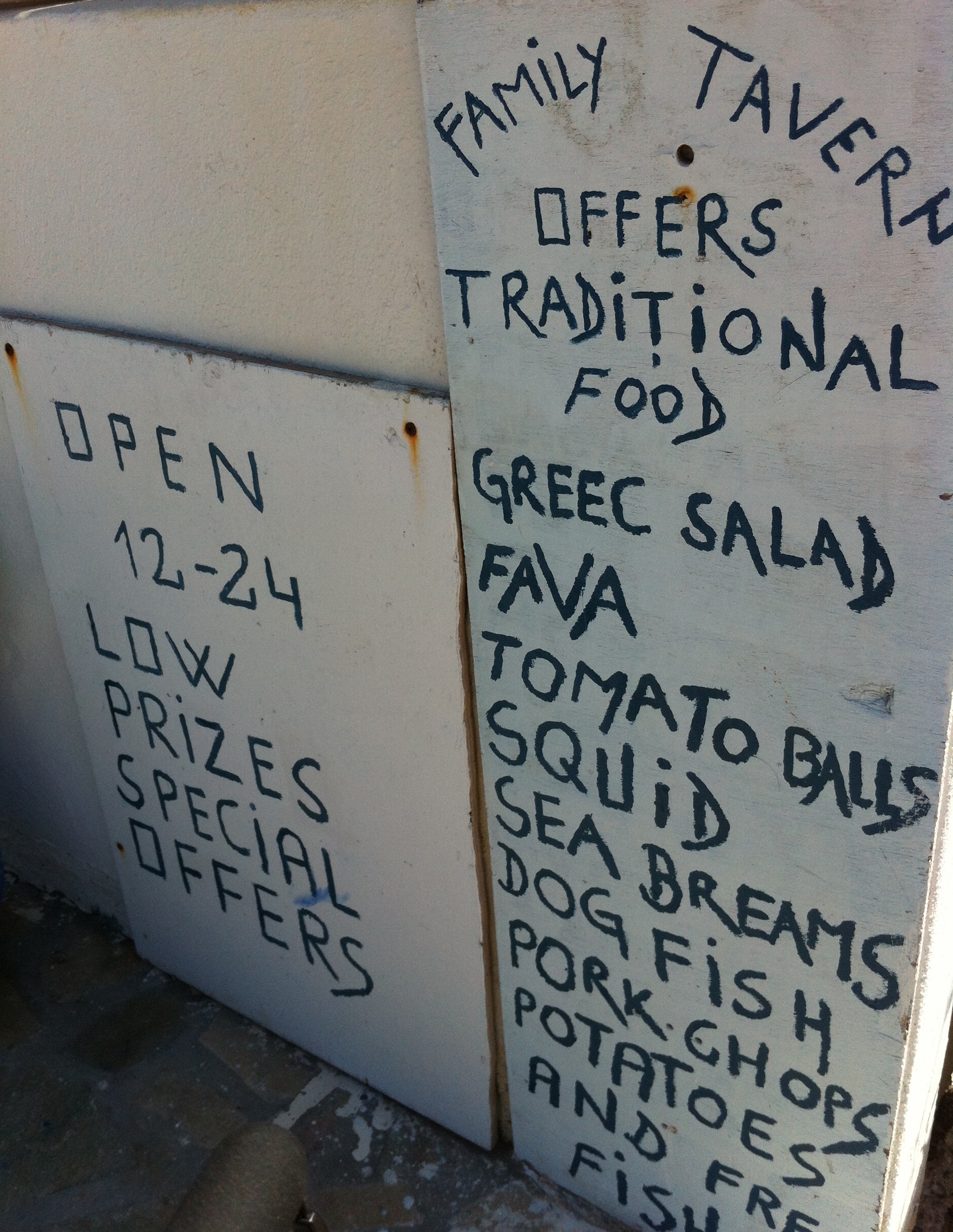
Where we first had our pasta with lobster sauce in Santorini.


Love the signs!

Love the signs!


First, it’s absolutely important to make a good stock: the base for all the other flavors to follow.

 

Cooked lobster LTL


For the stock…
2 1-1/2 lb. lobsters, slightly under-cooked
12 cups water
1/2 onion, chopped into quarters
3 celery stalks, chopped into quarters
1 carrot, chopped into quarters


Under-cook (steam or boil, whatever your favorite method) the lobsters. (You’ll be cooking the meat again later.) Remove the lobster meat from the shells and set it aside.

Place the cleaned lobster shells, claws, tails, legs and bodies in a large pot. (You don’t want any of the internal organs or tommaley.) Crush the shells, if needed, so they fit in the pot. Add the water, onion, celery and carrot. Set the heat on high. Cook it until it’s reduced by half.

Strain the stock, discarding the lobster shells and veggies. Bring the stock back to the heat and reduce it until all you have left is 1 cup of intense stock.
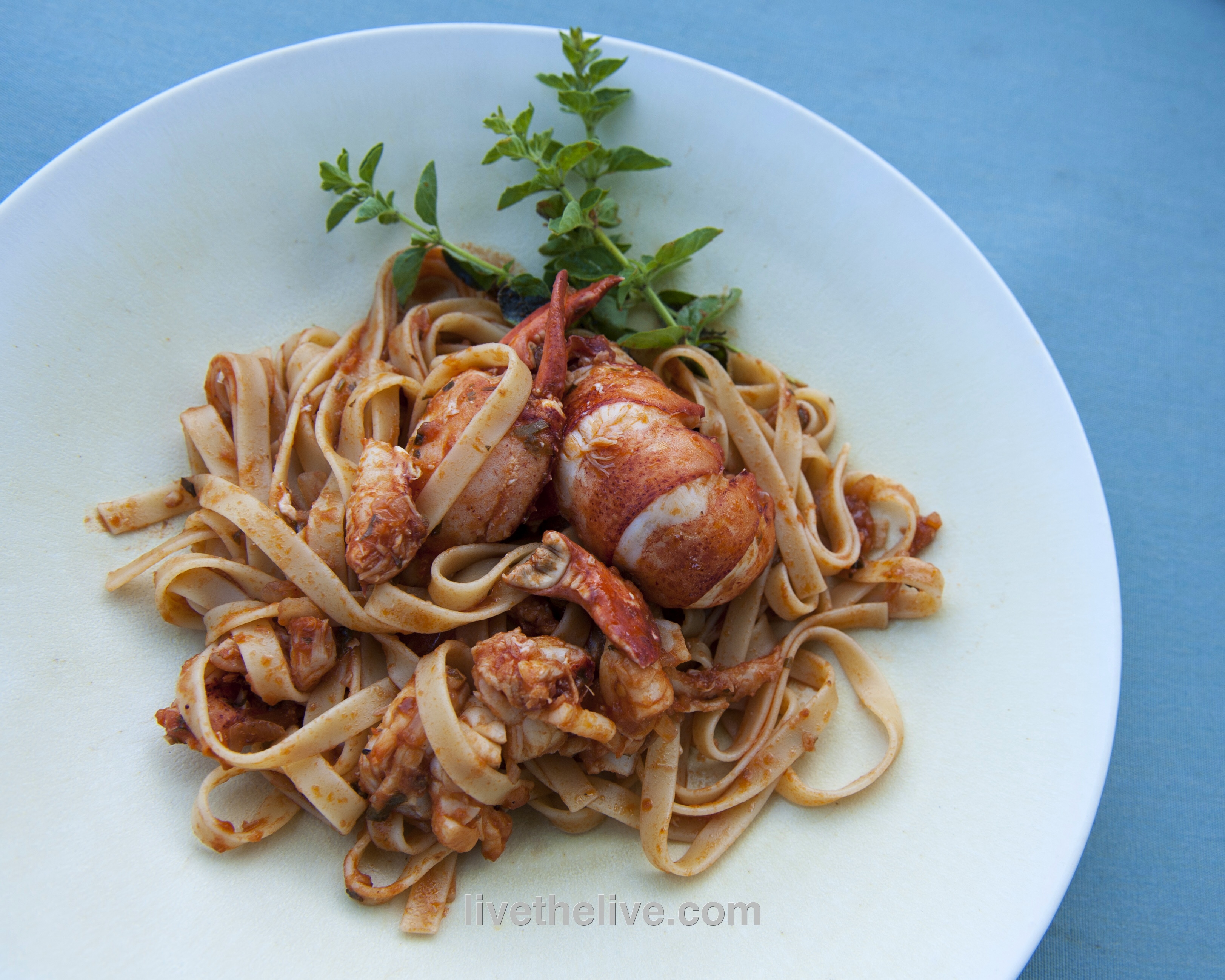
 

Pasta with lobster sauce

For the lobster sauce…
1/2 onion, finely chopped
1 garlic clove, finely chopped
pinch of Italian red pepper flakes
teaspoon fresh chopped parsley
extra virgin olive oil
1/2 cup lobster stock
1/4 cup San Marzano tomato sauce (see below)
splash of dry un-oaked white wine (I use an Australian Chardonnay)
salt and pepper


Final ingredients…
reserved lobster meat
1/2 lb. cooked pasta


Add some olive oil to a large pan and sauté the onions until they’re translucent. Season them with salt and pepper. Add the garlic and cook for 10 seconds. Add the red pepper flakes and parsley.

Add 1/4 cup of the lobster stock and let it cook, reducing by half. Add the other 1/4 cup of lobster stock and the tomato sauce. Let it cook for a couple of minutes and add the white wine. Cook for a few minutes more.

Cook the pasta and drain it before it reaches the al dente stage. Place the pasta in the pan with the sauce, heating and coating thoroughly. Add the reserved lobster pieces and warm them through, tossing in the sauce. Serve immediately.

For the San Marzano tomato sauce: Pour a can of whole San Marzano tomatoes in a food processor and blend. Pour the sauce into a pan and reduce it over medium heat by half, until the sauce has thickened. Use this sauce in the recipe.
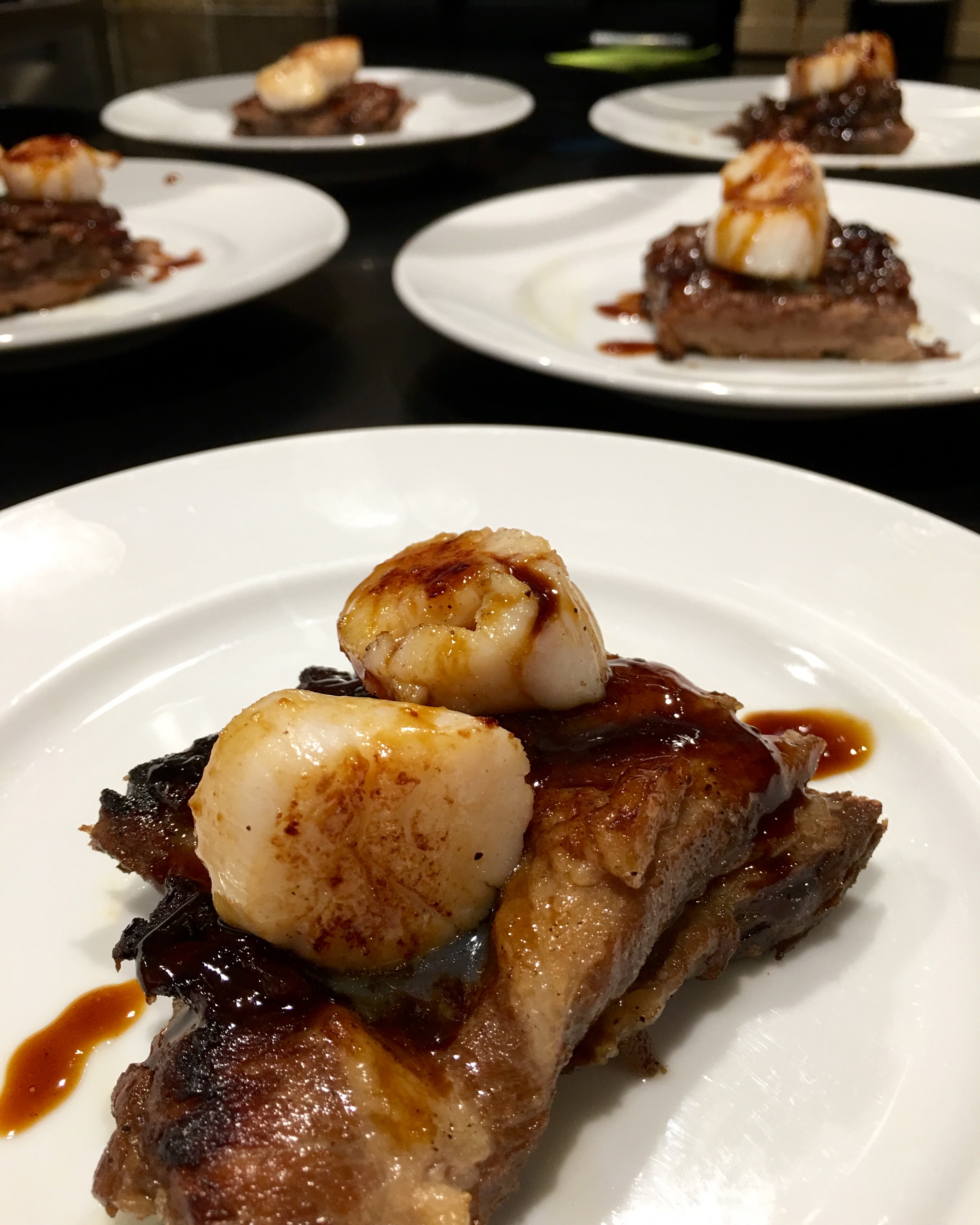
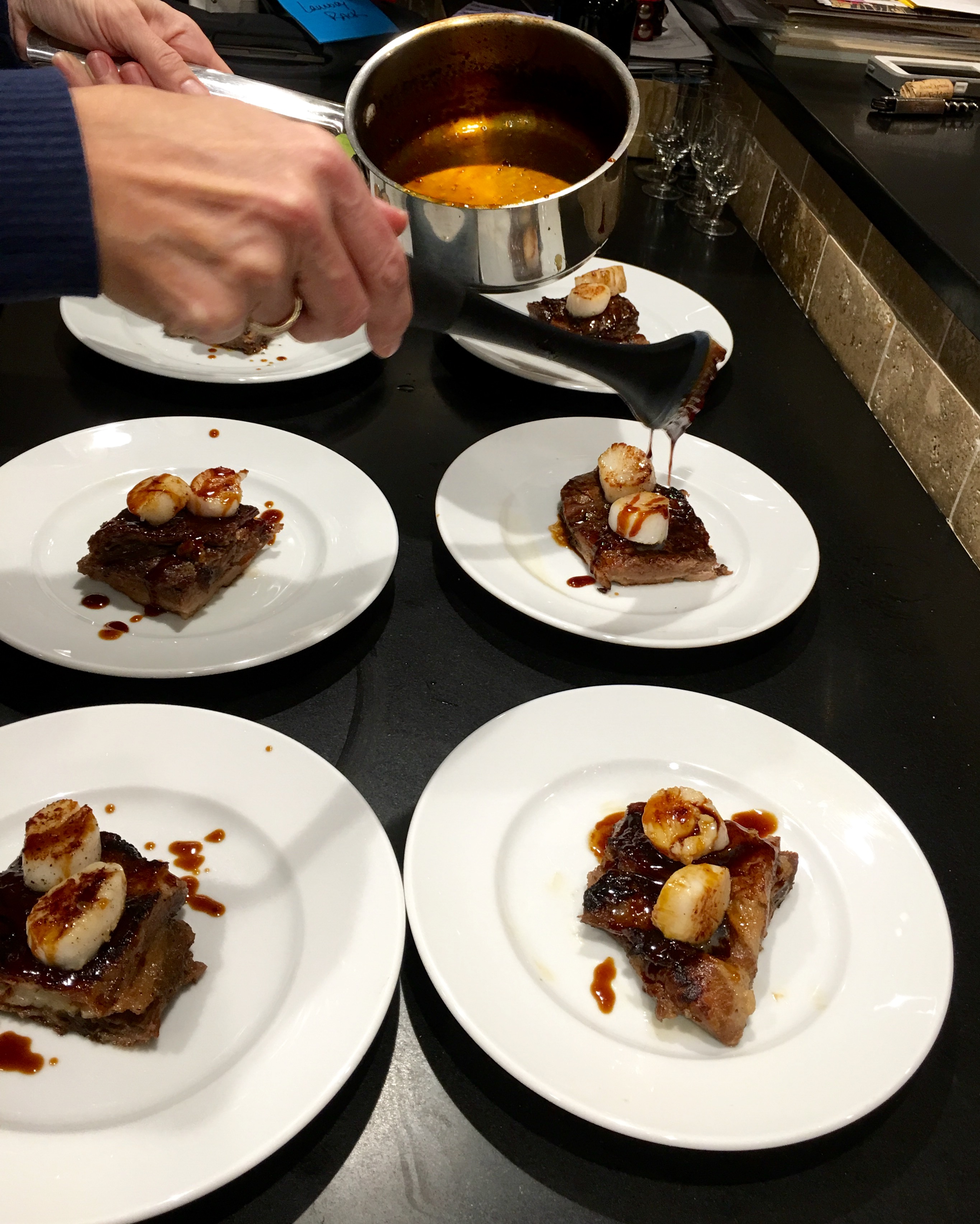
This is what I’m serving my guests at Christmas dinner. It’s a rich and delicious surf-and-turf, using wild Texas boar and locally caught Rhode Island scallops, that beats steak and lobster hands-down! Wild boar isn’t an ingredient you can find everywhere, but pork belly is, and it works just fine.


FullSizeRender (9)

For the pork belly…
3 lbs. fresh pork belly (I used wild boar belly)
salt and pepper
1–2 tablespoons leaf lard or olive oil
1 carrot, coarsely chopped
1 celery stalk, coarsely chopped
1 onion, roughly chopped
1 fennel bulb, quartered
2 sprigs fresh thyme
1 teaspoon black peppercorns
4 cups beef stock
1 cup hard cider or apple juice

Pre-heat the oven to 350.

Season the belly with salt and pepper. On medium-high heat, melt the leaf lard, then sear the meat on all sides in an oven-proof pot big enough to hold it in one layer. Add the carrot, celery, onion, fennel, thyme and peppercorns and continue cooking for another 5 minutes, until caramelized.

Add the beef stock and the cider. Cover the pot with a lid or seal with aluminum foil, and braise the belly in the oven for 3 hours, until tender.

Remove the pot from the oven, carefully remove the pork belly, and put it on a plate. Cover it with foil. If you’re cooking earlier in the day, you can place the belly in the fridge at this point.

Strain the leftover braising liquid from the pot and discard the vegetables and thyme. Skim off the excess fat. If starting this dish earlier in the day, you can put this liquid in the fridge and the fat will harden, making it easier to remove.

FullSizeRender (8)

For the glaze…
braising liquid, strained
1 tablespoon espresso
1 tablespoon honey

In a small saucepan, reduce the brazing liquid by half, then add the espresso and honey. Cook a few more minutes until the sauce thickens. When it coats the back of a spoon, it’s ready. Set aside.

For the scallops…
Fresh scallops
salt and pepper

When you’re ready to serve, heat a pan on high heat with a little more leaf lard. Cut the belly into equal pieces and sear on all sides for about a minute. Place the scallops in the same pan, season with salt and pepper, and sear them on both sides, being careful not to overcook them.

To serve, place the belly on a plate. Top with a scallop or two. Drizzle glaze over the top. Season with Fleur de Sel or sea salt and serve immediately.

Recently, I received a wonderful surprise delivery of fresh venison and bear meat from my buddy, Bruce, a hunter.
Bruce was fortunate enough to get two deer this year, and was nice enough to share some of that meat with me. I save the tenderloins to cook very simply: I slice them into medallions and dust them with a little bit of flour before sautéing them in a pan with butter, onions, and mushrooms. Those medallions, along with some farm fresh fried eggs, are truly the breakfast of champions! I learned all about that from my father-in-law, born and raised in the Upper Peninsula of Michigan, a hunter from a very young age out of necessity: he was 1 of 17 children! Hunting with his father was simply the only way they could feed his large, poor family.
I also make jerky with the venison backstrap, which I think is superior to beef jerky. Wonderful flavor. I bring bags of it to work and it’s quickly devoured by my co-workers.

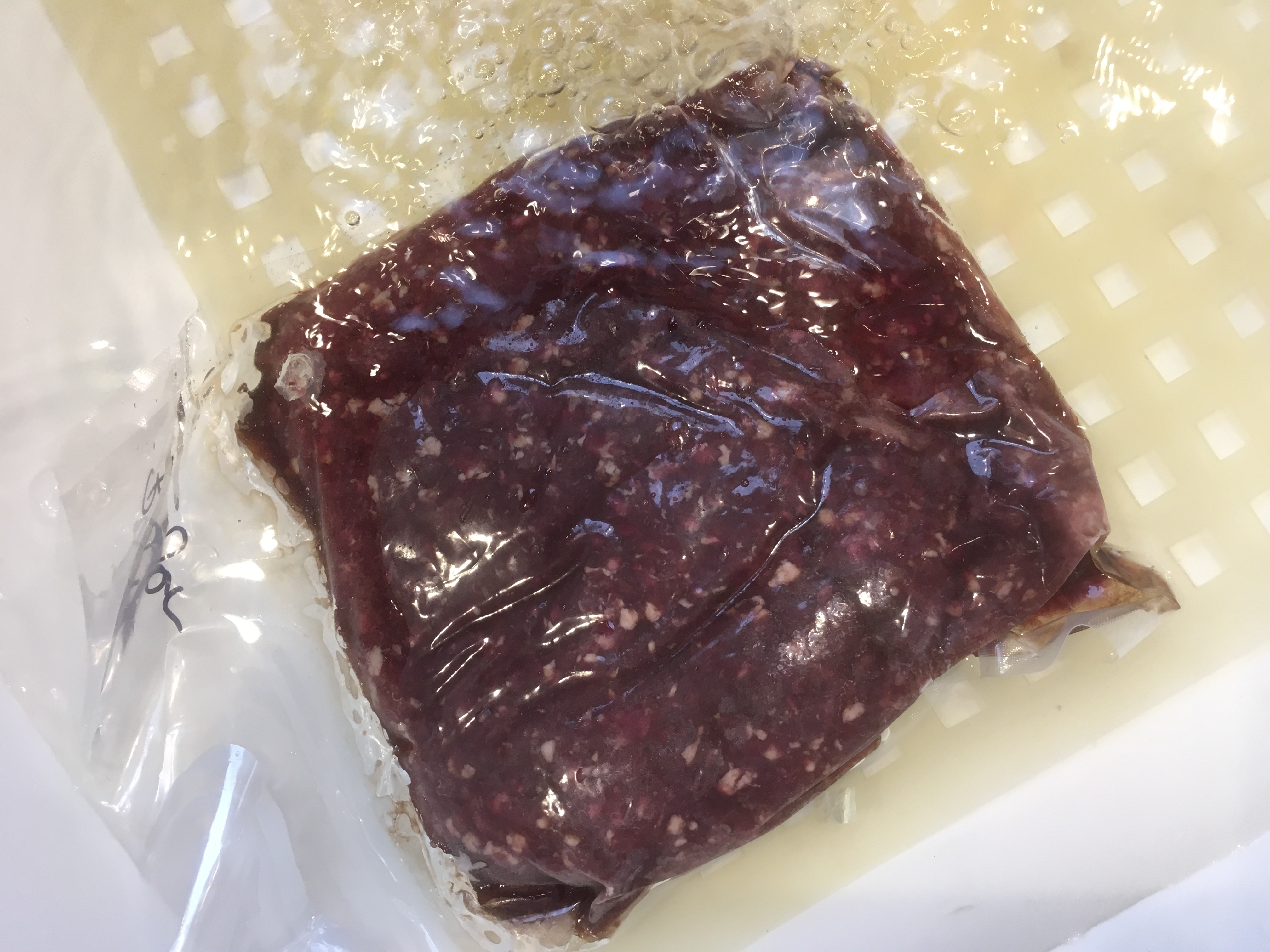
Bear meat is very dark, almost like liver.

I’ve only had bear meat once before, and again, that came from my father-in-law, who made summer sausage out of it. It was pretty tasty, but somewhat gamy…nothing a swipe of mustard couldn’t fix!
So when Bruce brought me some ground bear meat, I wasn’t sure what to do with it. He suggested that it’s best used in a recipe where you add seasonings to it…we’re talking meatballs, tacos, etc….or a chili or stew, where you cook it low and slow. Either  way, the meat needs to be cooked thoroughly, as it’s common to find a parasite in bear that can cause trichinosis. The general rule is “season it like beef, cook it like pork.”
I did some research and found that bears are omnivores, so the meat tends to taste like whatever they ate last. If that happens to be salmon, the meat can have a fishy, unpleasant taste. If he last ate berries, it could be really good. Bear fat can ruin the taste of the meat, so it tends to be butchered very lean, which also makes it somewhat dry and flavorless.
I figured the tacos were the way to go, since I use a lot of seasonings. Here’s my basic taco seasoning recipe…
1 teaspoon granulated garlic
1 teaspoon onion powder
1/4 teaspoon crushed pepper flakes
1 teaspoon dried Mexican oregano
1 teaspoon paprika
2 teaspoons ground cumin
1 teaspoon sea salt
1 teaspoon black pepper
1 Spanish onion, finely chopped
olive oil

Sauteing it well!


I start with some olive oil or bacon fat in a pan, and saute onions until they’re translucent. Then I add the bear meat, and cook it well, adding the seasonings at the end.

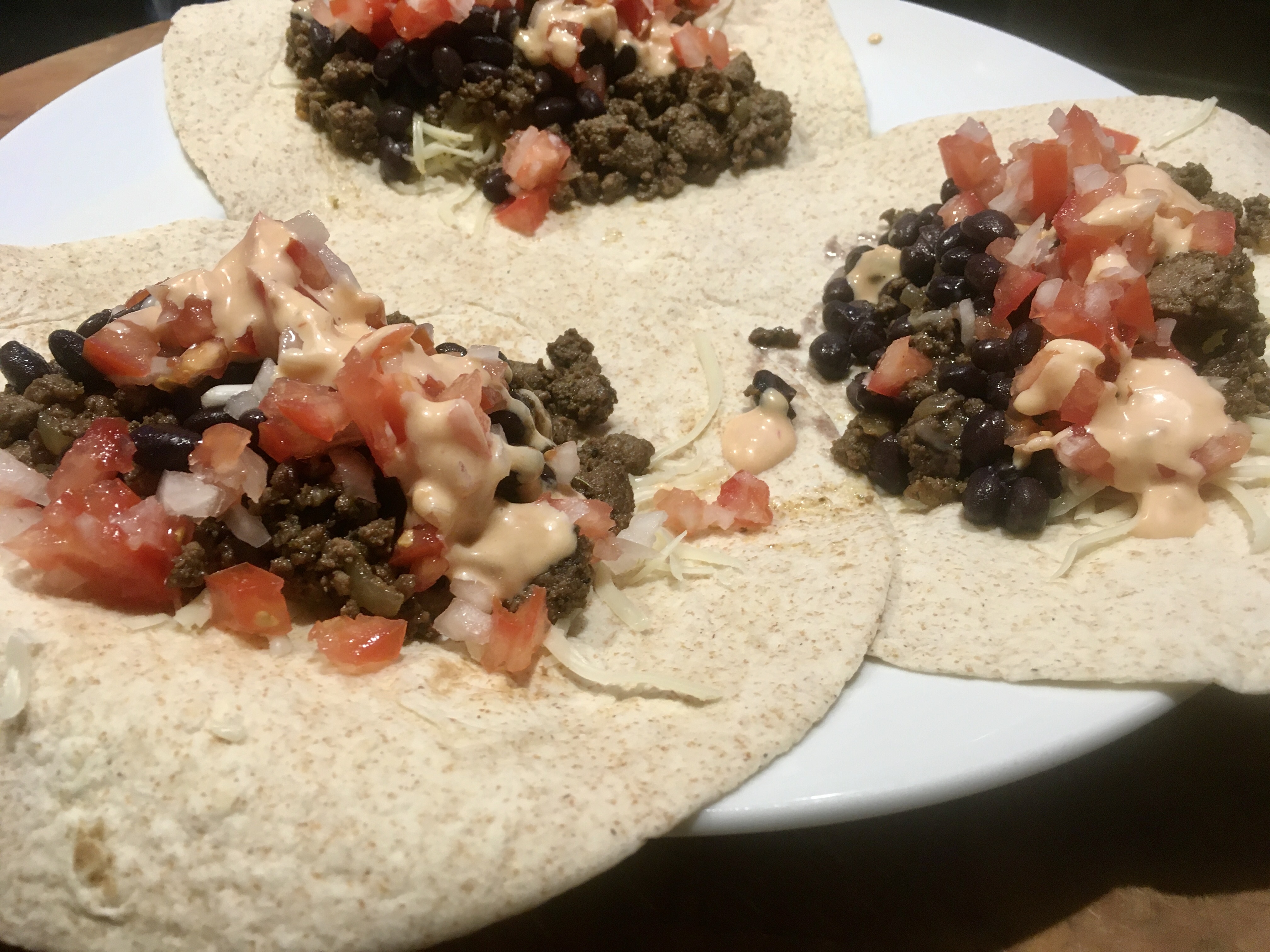
I topped the seasoned bear meat with cheese, beans, and a tomato and onion salsa. I also drizzled a little bit of Thousand Island dressing on the top. (Personal preference) I used flour tortillas and the tacos were actually pretty tasty!
These days, when black bear populations get out of control in some areas of the northeast, hunters are allowed to step in and reduce the population. But back in the early 1900’s, bear meat was commonly hunted and cooked. We can thank Teddy Roosevelt for saving the bear when, ironically on a bear hunt, he refused to shoot a bear that was tied to a willow tree. A toy company marketed a stuffed bear to commemorate the incident, and the teddy bear was born. After that, bears had a cuddly image (think Smokey and Yogi), that kept people from eating it.

Fettucini alla Bolognese is my daughter’s go-to dish when we visit one of her favorite Italian restaurants,  Il Corso, on W 55th St. in New York. But we only go there once a year, so it was about time I tried my hand at Bolognese at home. The dish isn’t difficult, but like many great dishes, it depends on the best quality ingredients you can get your hands on.

Much like meat loaf, I like to use a combination of ground beef, ground veal and ground pork. But I don’t sweat it too much if I don’t have all three, substituting a little more of one or the other, depending on what’s in my freezer at the time.

I use humanely raised grass-fed ground veal that I get down the road from a local dairy farm: Sweet & Salty Farm in Little Compton, RI. I use ground Berkshire pork, full of “good fat.” And I use grass-fed beef from local farms. Guanciale, a cured pork product that comes from the cheek (jowl) of the pig, is something that I prepare myself. I buy the Berkshire pork jowls raw and cure them at home. (That’s another blog!) If you can’t get your hands on guanciale, a nice slab of bacon will do the trick.

The rest of the ingredients are organic, when available.

This recipe probably feeds a dozen people. I make a lot at once because it takes time to put it together and let it cook on the stove, and it freezes really well. I place leftovers in tightly sealed single-portion containers in the freezer and then re-heat them when my daughter gets the craving, adding it to freshly cooked pasta.

How much pasta you make with this dish depends on how many people you’re going to serve.


5 tablespoons extra virgin olive oil
3 tablespoons butter
1/2 cup finely chopped guanciale or bacon
1 lb. ground veal, 1 lb. ground pork, 1 lb. beef (or any combination to make 3 lbs.)
1 large onion, finely chopped
2 carrots, finely chopped
3 stalks celery, finely chopped
2 cloves of garlic, squeezed through a garlic press or thinly sliced
1 small can (6 oz.) tomato paste
6 cups ground tomatoes
2 cups whole milk
2 cups white wine (I use an un-oaked Australian chardonnay, like Yellow Tail)
salt and pepper
pasta, cooked (regular or gluten-free )
Freshly grated Parmigiano Reggiano


Place the olive oil and butter in a large sauce pan with a heavy bottom over high heat. Once the butter has melted, add the guanciale or bacon, letting the fat render out. When it’s almost brown, add the veal, pork, and beef, stirring constantly. Make sure the meat is broken down into small pieces and completely browned.

Add the finely chopped onion, carrots, celery and garlic, stirring well. Sweat the veggies for a few minutes, letting them get nice and soft.

Add the tomato paste, the ground tomatoes, milk and wine, stirring well. Allowing it to come to a boil will activate the tomato paste’s thickening power. Let it boil for a minute, then reduce the heat to medium-low, and let it simmer for at least 90 minutes, stirring occasionally.


Add the ingredients one step at a time until the sauce comes together: 1) guanciale, 2) meat, 3) veggies), 4) tomatoes.


You don’t want the sauce to be runny, and you definitely want to give it enough time on the stove top for the flavors to blend and for the alcohol in the wine to evaporate.

Carefully give the sauce a taste, and season it with salt and pepper.

Traditionally, ragu Bolognese is served by placing a part of the cooked pasta in a pan, and adding just enough sauce to have it cling to, not drip from, the pasta. It’s not soup!

Top it with freshly grated Parmigiano Reggiano cheese.


I like to brine large hunks of meat that I’m going to roast, because brining not only gives it flavor, it adds moisture…so my pork loin, Thanksgiving turkey, or in this case, whole chicken, doesn’t dry out.

Brining usually means you take a lot of water and you add salt and other spices to it, then drop the bird into that liquid for several hours, so the meat can suck up the salty water, releasing it slowly as it cooks, but retaining much of the moisture and flavor.

Recently, I started reading about “dry-brining,” (aka curing)…and I thought that would be a fun thing to try. I created a spice rub that I rubbed all over a spatchcocked chicken, placed it on a sheet pan, and popped it in the fridge to dry age for several days before cooking.

Spatchcocked? Sounds like a dirty word, but it means that the backbone of the bird has been removed, allowing the bird to be flattened and cooked more evenly. As you know, very often the breast meat of a bird is overcooked if the dark meat is perfect. Spatchcocking a bird allows all the parts of the bird to cook more evenly.

All you need to spatchcock a chicken is a good pair of poultry scissors. Cut all the way down on either side of the backbone of the bird (saving the backbone for future stock, of course.) Now you can open the bird up, season it on both sides, and lay it flat on a sheet pan to cure.


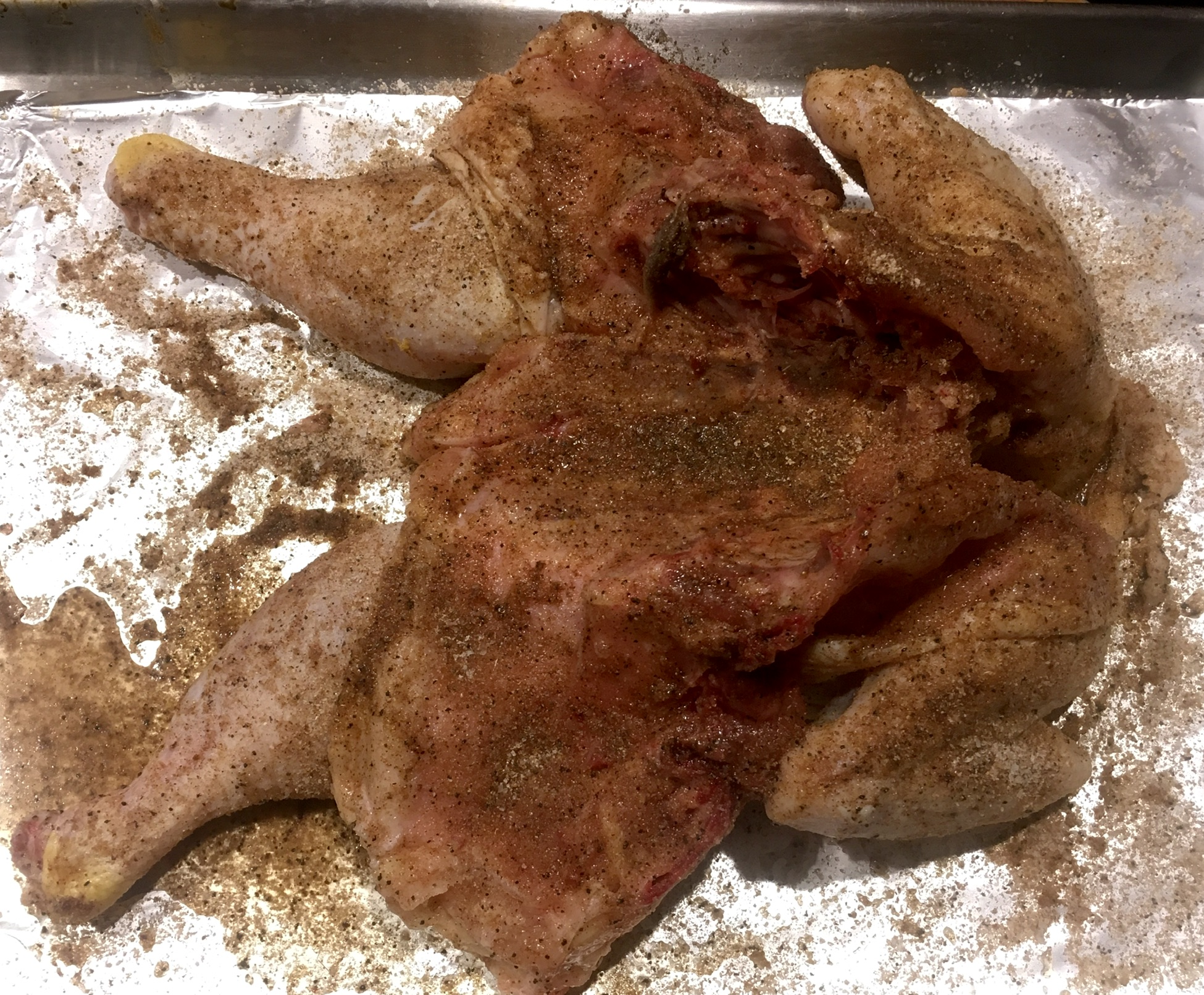
Spatchcocked and rubbed. I put the bird skin-side down for a day and a half, then flipped it over for another day and a half.


My preferences leaned toward Asian flavors this time, so here’s my dry brine recipe:

3 tablespoons Kosher salt (I use Diamond Crystal…the brand matters. See why below.)
1 1/2 tablespoons (1 tablespoon + 1 1/2 teaspoons) granulated garlic
1 1/2 tablespoons (1 tablespoon + 1 1/2 teaspoons) granulated onion
1 tablespoon brown sugar
1 tablespoon Chinese Five Spice
1 1/2 teaspoons black pepper

I combined all the ingredients in a bowl.


The reason why the brand of Kosher salt matters is the weight. But salt is salt, right? Well…different brands weigh different amounts. For example, Morton Kosher salt is more dense than Diamond Crystal. If you use equal amounts of each, you’ll get different results. That’s why most recipes tell you the weight of the salt, not the volume. In this case, 3 tablespoons of Diamond Crystal Kosher salt (according to my little kitchen scale) weighs 1.09 ounces.

Once I spatchcocked the bird, I rubbed it really well on both sides with the spice rub.

I lined a sheet pan with non-stick aluminum foil (to be used again later), and placed the bird, skin-side down, on it. I didn’t wrap the bird. I simply moved it to a refrigerator just like that, and let it stay there, dry-aging, for 1 1/2 days. I then flipped the bird (pardon my language) skin-side up and let it cure another 1 1/2 days, for a total of 3 days for a 4-pound bird.


Dry-aged after 3 days.


Once the bird dry-aged for 3 days, I removed it from the fridge, and let it sit for an hour, allowing it to reach room temperature. I pre-heated my oven to 400 degrees.

I set my oven up so that the bird would lie flat skin-side up (without the sheet pan) directly on the middle oven rack, and the sheet pan (with the non-stick aluminum foil still on it) on the rack underneath it, to catch the drippings. This allowed air to circulate completely around the bird as it cooked, and the pan caught any splatters. (The foil, still on the pan, made clean-up later much easier.)

Once the oven reached 400, I placed the bird on the middle rack, the sheet pan below it, closed the oven door, and turned the temperature down to 275.


Although it’s 161, that’s the breast meat temp. The thighs were higher. And the temperature will still rise while the bird is resting.


Chicken is done when it reaches an internal temperature of 165. Using an instant-read thermometer, I inserted it into the thigh, without touching the bone. I also inserted into the breast. Although the temperature was just a touch low, it rose a few degrees while resting under the foil.

My 4-pound chicken took about 90 minutes to cook.


Out of the oven to rest. I covered it with foil to rest about 15 minutes before carving.


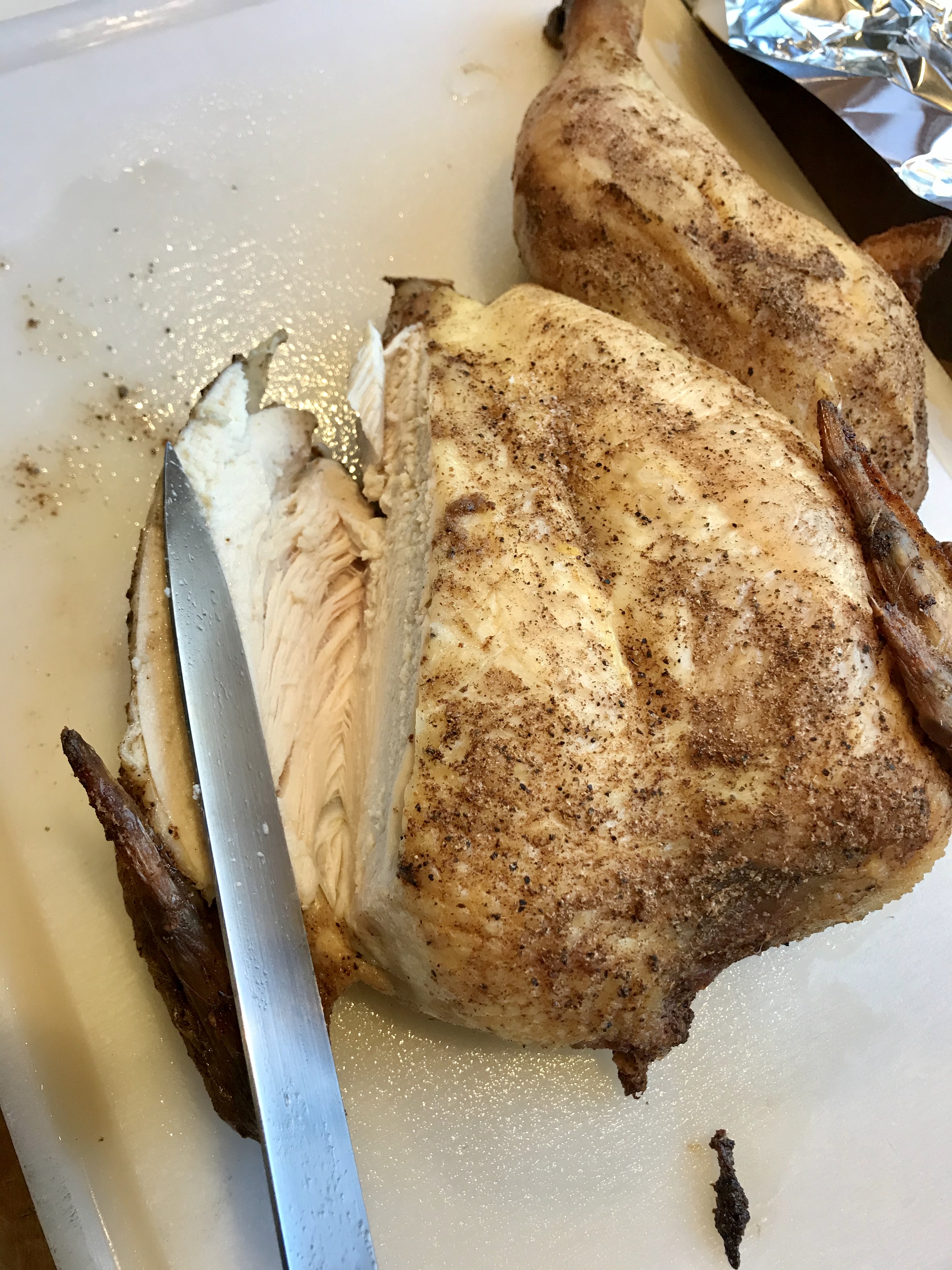
Juicy and delicious!


Let’s face it: there’s no such thing as healthy eggnog. This recipe is delicious but is also a heart attack in a glass. I post it every year because my friends just love it.

My buddy, Rick Sammarco, a wicked talented bartender, credits his father, Al, for this eggnog. The original recipe calls for a lot more of everything. I’ve cut it down to a “more reasonable” size.

A word about salmonella: If you’re concerned about it, you need to decide what works for you. Some recipes tell you to make your eggnog weeks in advance to “sterilize” the drink with all the booze you’ve added to it. I’m not sure that really works. As for me, I use raw eggs in my Caesar salad dressing and in other recipes, so I’m willing to risk it here.

If you’re lucky, some stores–(though very few of them, and none near me)–sell pasteurized eggs. They say the taste is a bit funky, but that it does remove the salmonella.


eggnog


1.5 quarts vanilla ice cream (I use Breyer’s)
1 pint half & half
15 whole eggs (raw)
½ teaspoon vanilla extract
1/4 teaspoon cinnamon
1/4 teaspoon nutmeg
At least 3/8 cup of each:
spiced rum (I use Captain Morgan)
whiskey (I use Crown Royal)
brandy (I use E&J)


Let the ice cream soften 1 day in the fridge. Mix the ice cream, eggs, vanilla, half-and-half in a blender.

Add the spices and liquor. Blend until it’s frothy.

Taste, and add more cinnamon and nutmeg if you like.

After it’s fully blended, let it sit in the fridge, covered, for at least 12-24 hours for the flavors to blend. Even longer is better.


I love onions! Raw, sautéed, caramelized, yellow, Spanish, Bermuda, Vidalia, Texas Sweets, scallion, pearl, Crimini, Walla Walla…they can do no wrong. In fact, my family gave me the Lithuanian nickname: “Ponas Svogūnas.” (“Mr. Onion.”) I answer to it proudly.

I also love vodka martinis! So if I’m going to buy a top shelf vodka like Stoli Elit or Belvedere, I’m not going to ruin it with jarred cocktail onions, brined with cheap vermouth, found in the bar mixers section of my local supermarket. Who knows how long those nasty things have been sitting on the shelf?

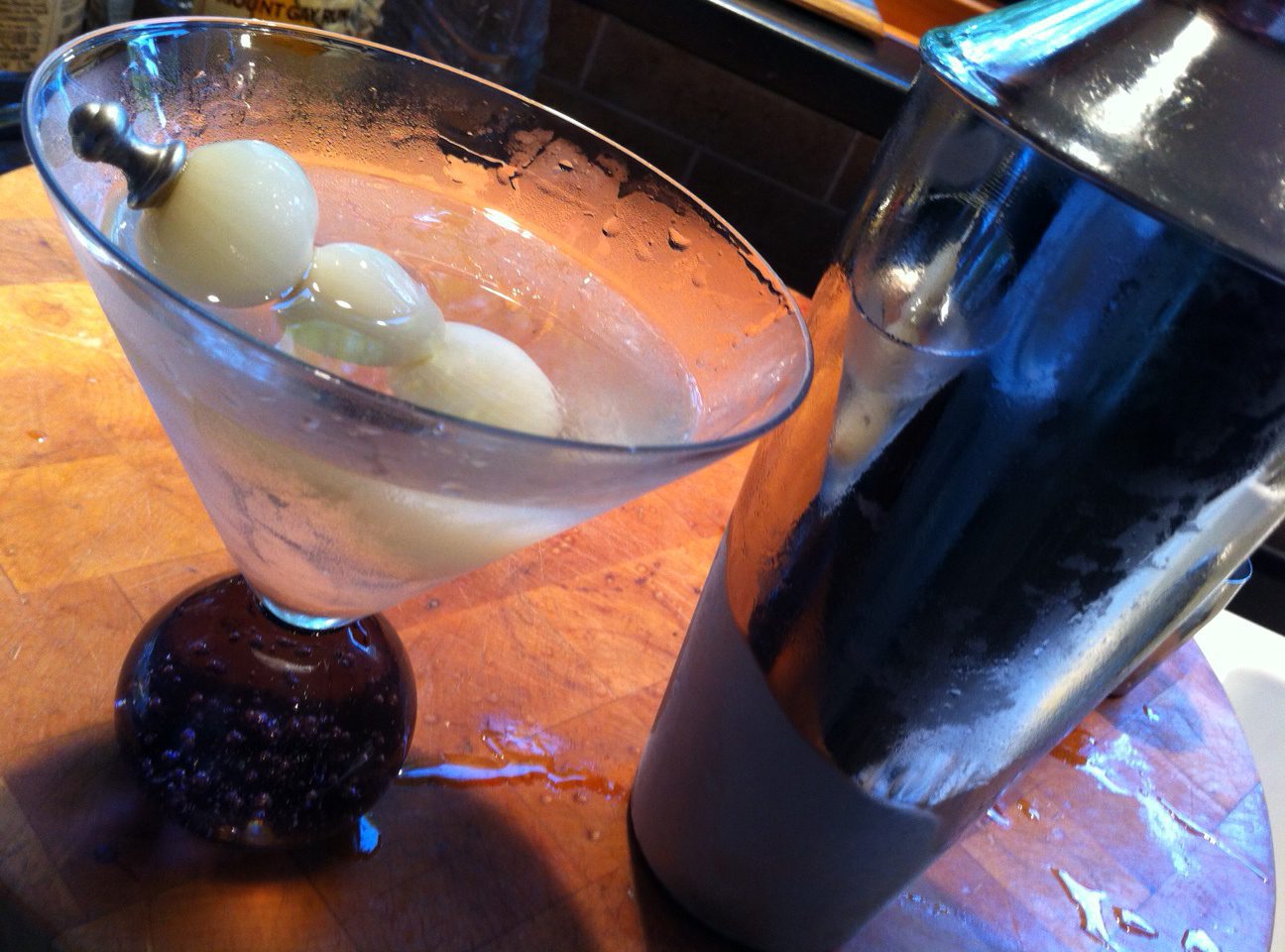
No, I’m going to make my own cocktail onions to enjoy a proper Gibson!

The Gibson martini is simply one with onions instead of olives, and the story of its origin is somewhat unclear. According to one story, it was invented by Charles Dana Gibson, who created the popular Gibson Girl illustrations. Supposedly, he challenged Charley Connolly, the bartender of the private club, The Players, in New York City, to improve on a martini. Connolly simply substituted an onion for the olive and named it after Gibson.

Another story claims a man named Gibson dropped an onion in his water-filled martini glass to differentiate between his own drink and that of his colleagues, who were imbibing heavily.

Some stories about the Gibson don’t even mention an onion. (?)

And yet another story, now considered the more probable one, is that the Gibson martini was invented at the Bohemian Club in San Francisco in the 1890’s by Walter D. K. Gibson. There is documentation as early as 1898 to back that up.

Whatever story you want to believe, the Gibson martini was originally made with gin, not vodka, but that’s strictly a personal preference–and I don’t use any vermouth.


My first attempt at homemade cocktail onions was not a success. I bought pearl onions and did what the package instructions said: I dropped them in boiling water for a couple of minutes, then moved them to ice water to let them cool. Then a gentle squeeze on one end of the onion would make it pop right out of its skin. Easy, right?

Well, it didn’t work out that way. For one thing, the onions got soft…not what I wanted. I had to cut one end of the bulb with a knife. And even then, when I squeezed the onion, the part that popped out was about half the size of the original onion…there was a lot of waste.


After brining, they tasted OK, but they never had that crisp bite I wanted. They were mushy. I realized that boiling was not the way to go.


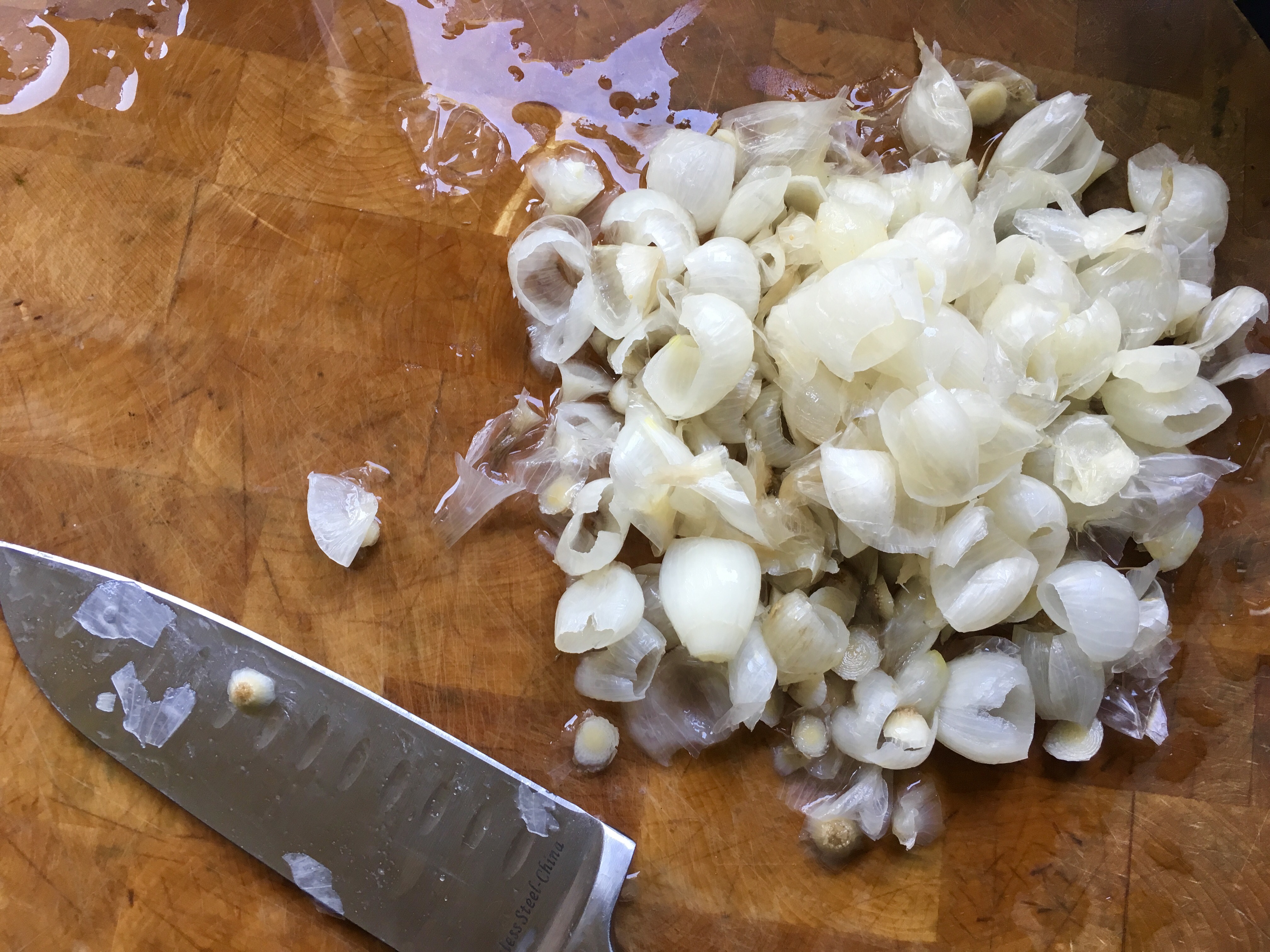
A lot of waste.

I knew there had to be a better way. Then I discovered already peeled pearl onions at Whole Foods. I have to be honest…I won’t use any other onions now. They’re big, plump, and exactly what I want.


Sure, these are much larger than the onions you find in a jar. But tell me how that’s a problem!


1 lb. pearl onions, peeled, ends cut off
1 cup white vinegar
1/2 cup apple cider vinegar
1 1/2  cups water
3/4 cup sugar (I like turbinado sugar)
10 peppercorns
1 teaspoon salt (per quart-sized Mason jar)
2 cloves garlic


Combine the white vinegar, apple cider vinegar, water, sugar, and peppercorns in a medium-sized saucepan. Bring it to a boil, making sure the sugar dissolves completely. Remove it from the heat.


Slice the ends off the onions.

I’ve found that if I allow the brining liquid to get inside the onions, especially these larger ones, they’ll get tastier faster…and who doesn’t want that? So I take a thin metal or bamboo barbecue skewer and push it through the center of the top of the onions, all the way through the center of the bottom of the onions. Now there’s a little “tunnel” for that brine to get in, and it can work its magic from the inside out!

Not skewering the onions simply means it’ll take longer for that brine to seep in…but that’s perfectly fine if you want a not-so-briny onion.


In a quart-sized Mason jar, add the teaspoon of salt and garlic cloves. Pour a little of the hot vinegar liquid in the Mason jar to dissolve the salt. Add the onions to the jar, as tightly as you can, then fill the jar to the top with the vinegar liquid.

Screw the top of the jar on tightly, and turn it upside-down a couple of times to mix everything together. If it looks like the level of the liquid has gone down a bit, open the jar and top it off with the vinegar liquid, then re-seal it.

Let the jar cool to room temperature, then move it to the fridge. You can use the onions as soon as the craving hits you, but they’ll taste better if you give them a few days to a week.


Many thanks to my friend, Arthur Shapiro, who suggested I write a bit about the origins of the Gibson. Follow Arthur’s blog, “Booze Business,” on Instagram and Facebook. http://www.boozebusiness.com


Cheers!

Although we’re about as far away from picking fresh asparagus from my garden as we can be here in Southern New England, once in awhile I give in and buy some at the supermarket. As long as the stalks are nice, green, and thin–I don’t like the fat ones–I’ll buy some to prepare this simple but delicious recipe.
Prepping asparagus is easy, and you don’t need a knife to cut off the woody bottoms of the stalks. Simply bend the stalks at the bottom and they will naturally snap off at the right point.
My daughter loves this dish, and as any parent will tell you, if your kid is craving a dish that has vegetables in it, count yourself lucky–and make it!!
4 mild Italian sausages, sliced into pieces 1/2″ thick
1 lb. penne pasta
1/2 onion, finely chopped
1 cup chopped fresh trumpet mushrooms (white button mushrooms work, too)
2 cups fresh asparagus, sliced into 1-inch pieces
1 clove garlic, passed through a garlic press
1 cup homemade chicken broth
6 fresh sage leaves, finely chopped
1/2 cup freshly grated Parmigiano Reggiano cheese
extra virgin olive oil
salt and pepper
Have the pasta water boiling, and add the pasta, cooking until just a bit more undercooked than al dente.
Heat a large pan, and drizzle in some olive oil. Sauté the sausage pieces until browned and cooked through, but not over cooked. Remove the sausages from the pan and place them in a separate bowl. Remove all but 2 tablespoons of the fat left behind in the pan.
Place the pan back on stove and sauté the onion until translucent. Add the garlic, and sauté for 10 seconds. Add the sage, and saute for 10 seconds, stirring. Add the chopped mushrooms and saute for a few minutes, then add the chicken broth, and simmer until almost all the liquid has evaporated. Pour the contents of the pan into the bowl with the sausages.
Return the pan to the stove, add a little more olive oil, and on medium heat, sauté the asparagus pieces. Cook them until they are al dente, not too soft. Once the asparagus has reached this stage, return all the contents of the sausage/mushroom bowl to the pan to heat through. Drain the pasta, and add it to the pan as well, combining all the ingredients. If it looks too dry, add a little pasta water to the pan. Season with salt and pepper.
Make sure you serve this hot, with grated Parmigiano Reggiano on top, and drizzle lightly over the top with extra virgin olive oil.


I’ve had Clams Casino in many different forms. Back when I worked in Italian restaurants in New York, we would make a breadcrumb mixture, press it onto a freshly opened whole clam, and then place a small piece of bacon on top before it went into the oven. It was good, but the clam often stuck to the shell, and many people didn’t want to gulp down a whole clam like that.


Oyster knife (left) and a clam knife (right.) Different tools for different jobs.


When it was time for me to make my own recipe, I decided that I would chop the clams and mix them into the breadcrumb mix, so that every bite was the same.


2 tablespoons olive oil
1/3 cup finely chopped Vidalia or other sweet onion (about a 1/2 an onion)
2 garlic cloves, squeezed through a garlic press
1/3 cup dry white wine
1/3 cup unflavored bread crumbs
1 tablespoon fresh Italian parsley, finely chopped
1/2 teaspoon dried oregano
Freshly cracked black pepper
2 dozen medium neck clams
1/3 lb. bacon, cut in small squares to fit the clam shells
Heat the olive oil in a pan over medium heat. Add the onions, and sauté them until they’re translucent. Add the garlic, and cook for 10 seconds. Add the wine and simmer for a minute. Add the bread crumbs, and stir the mixture until it becomes thicker, like a paste. Add the parsley and oregano. Season with pepper. (There’s going to be plenty of salt in the clam juice and bacon, so no salt is needed.)

The bread crumb mixture.

Remove the pan from the heat and let it cool.
It’s time to open the clams. If you know how to do that, open them over a sieve with a bowl underneath so that the clam meats and juices are captured. Discard any broken shells, but save the good ones.
If you struggle with opening clams, this method makes it a little easier: Bring a large pot of water to boil, and drop the clams into it, about 10 at a time, for 30 seconds. Don’t let them open! Remove the clams with a slotted spoon and place them in a bowl to cool. Continue doing this in small batches until all the clams have been in the water. You’ll find this makes opening the clams much easier. Then proceed as above.
Once you’ve shucked all the clams, let the clam juice sit for a bit, so that any grit settles to the bottom of the bowl. Then pour off the clean clam juice and add it to your bread crumb mixture. (Don’t worry if it looks soggy at this point.)

Looking a little soggy, but that’s OK.

I like to hand chop the clam meats instead of using a food processor. You want tasty clam chunks, not too big but not mush. Add the clams to the the bread crumb mix.
At this point, if the clam mix looks very soggy, simply add a little more bread crumb to dry it out.
Preheat the oven to 350 degrees.
Line a large baking sheet with foil. Separate the clam shell halves and wash them, making sure you don’t have any shell fragments left in the clam shell.  Fill them with the clam mixture, mounding them slightly, and placing each one on the baking sheet.

Clams and bacon…delicious!

Cut the bacon in small squares to fit the clam shells. Place a small piece of raw bacon on the top of each clam.
Bake until the clams are just cooked through, the topping is golden, and the bacon is cooked, about 30 minutes.

This makes a great appetizer, but it’s hard to just eat a few!

I’m a fan of Berkshire pork, also known as kurobuta pork. It’s a heritage breed with wonderful, tasty “good” fat, which gives the meat fantastic flavor any way you cook it. I get it on line, and keep a stash of cuts (pork belly, pork chops, ribs, etc.) in my freezer.

But I was craving a pork loin the other day, and not having one of those in my arsenal, I searched for one in my local store. I found one that was humanely raised and organic, with a nice layer of fat on top ideal for low-and-slow cooking…certainly worth a try.

There are as many pork rubs out there as there are barbecue fanatics, and nobody has “the best” rub. The best rub is the one you make with the ingredients that you like. So, go with your favorite flavors, and you won’t go wrong.

This time around, I used this combination…


2 tablespoons Kosher salt (I use Diamond Crystal. See note below.)
2 tablespoons brown sugar
1 tablespoon granulated garlic
1 tablespoon granulated onion
1 tablespoon black pepper
1 teaspoon paprika


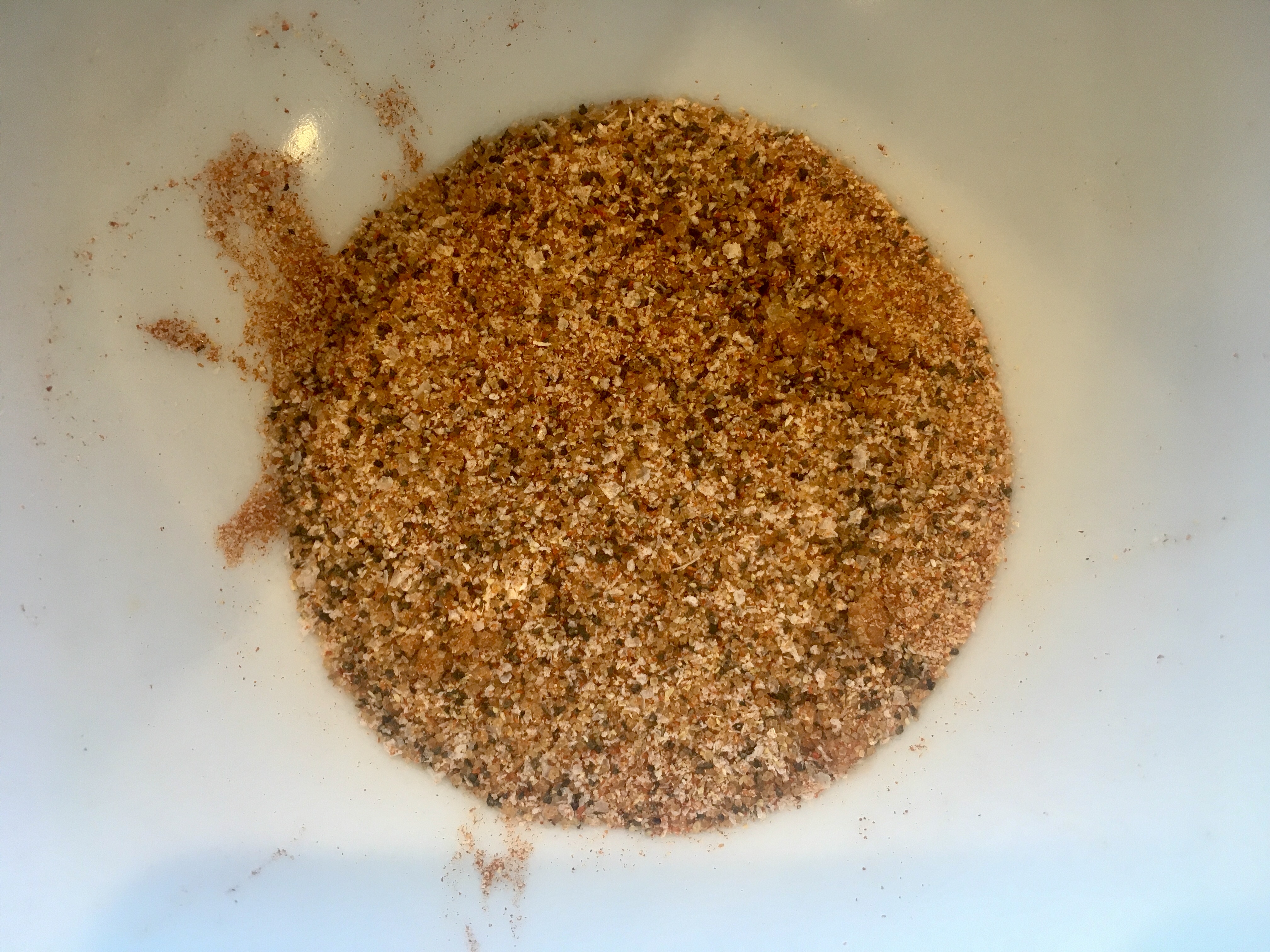
Combine these in a bowl and set it aside.


Not all Kosher salt weighs the same, so equal measurements of different brands will give you different levels of saltiness and different results. The two biggest brands are Morton’s and Diamond Crystal, but Diamond Crystal is less dense…it weighs less than Morton’s. Keep that in mind as you salt your food. That’s why you’ll see Kosher salt measured by weight, not by volume, in many recipes.

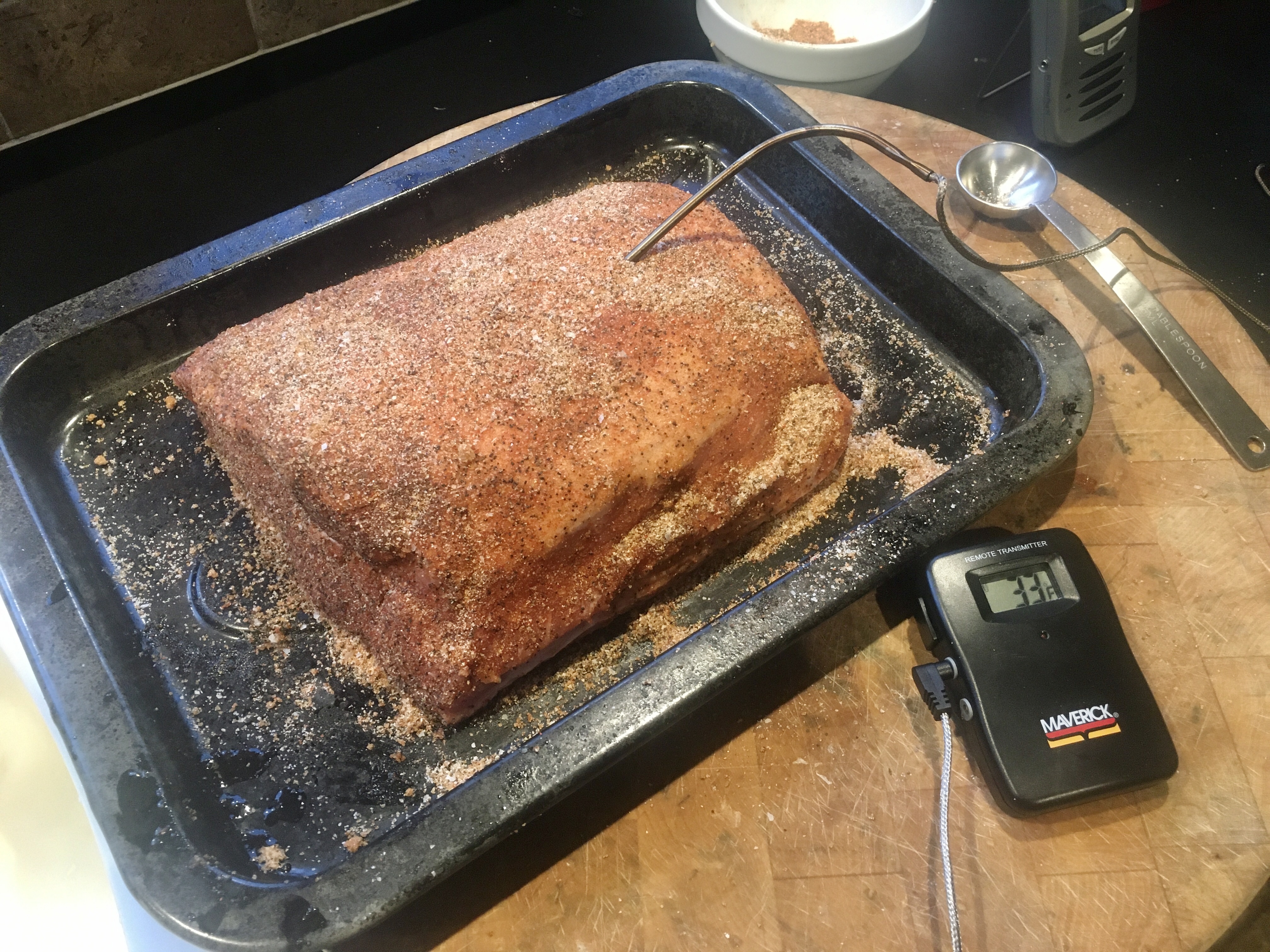
I had a 4-lb. pork loin this time. I removed it from its wrapper and placed it in a tray for seasoning. I gently scored the fat cap with a sharp knife so the fat melt while cooking, and so that I could really rub my spice blend into every bit of the meat.

I inserted a meat probe in the deepest part of the loin, so that it would notify me when my pork loin reaches its optimum temperature.


The pork loin, probed and ready.


I let the meat sit at room temperature for at least an hour, bringing the internal temperature of the meat from 33 to 68 degrees.

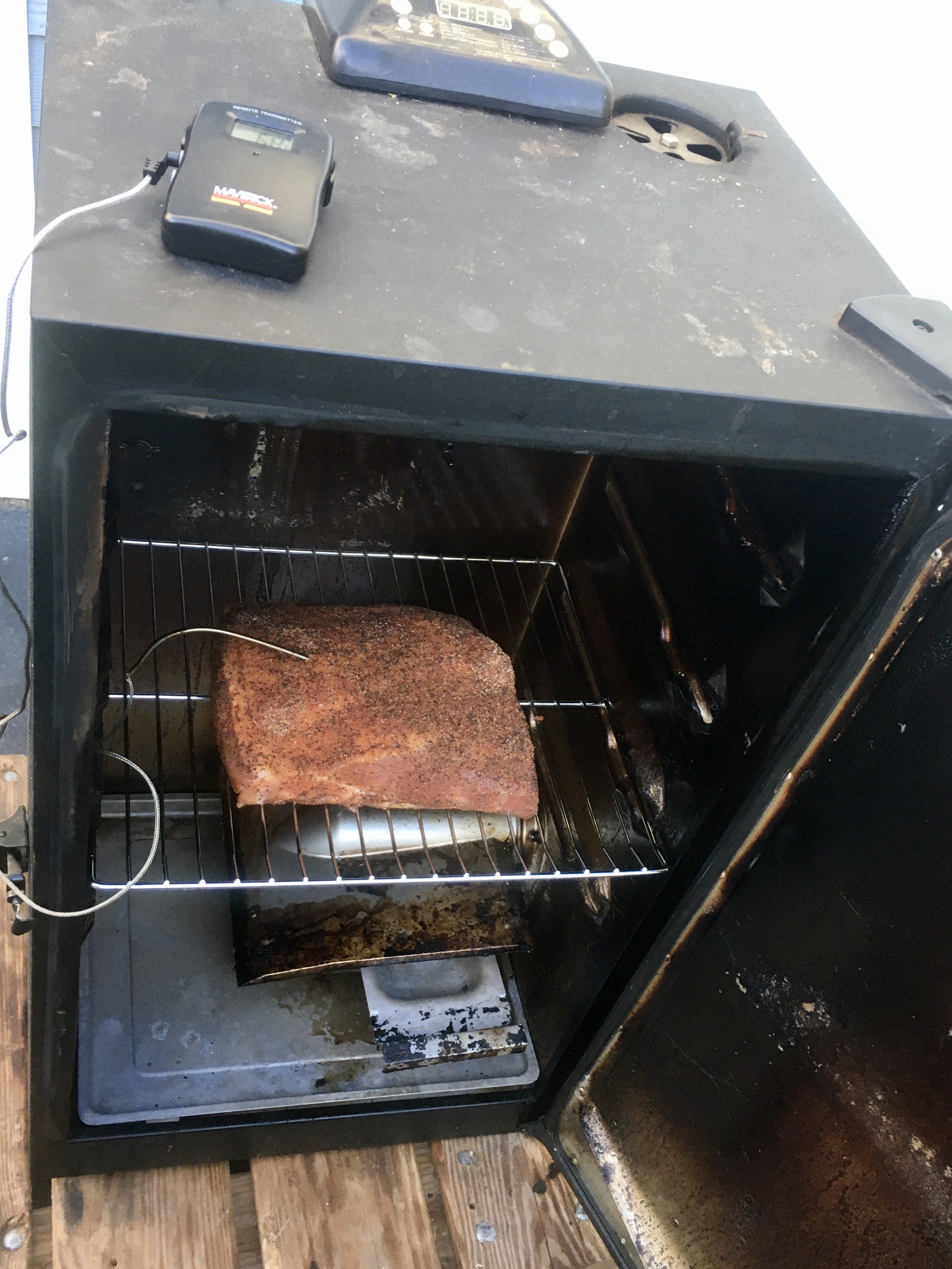
I use an electric smoker, so I plugged it in and set the temperature for 250 degrees. I added hickory chips through a side chute, so it smokes the meat while it cooks.


In the smoker…


It used to be that the recommended minimum cooking temperature for pork was 160 degrees. But today’s pork is different than our mama’s pork, and the current recommended temperature is 145 degrees. Personally, I don’t want to eat pink pork, but I also don’t want to dry it out…so I split the difference: I cook the pork until the thermometer reads 145, then I remove it from the smoker, cover it in foil, and let it rest for 20-30 minutes. In that time, the temperature of the meat still rises a few degrees, and that’s when I’m OK to serve it.


I’m notified when the pork reaches the desired temperature.


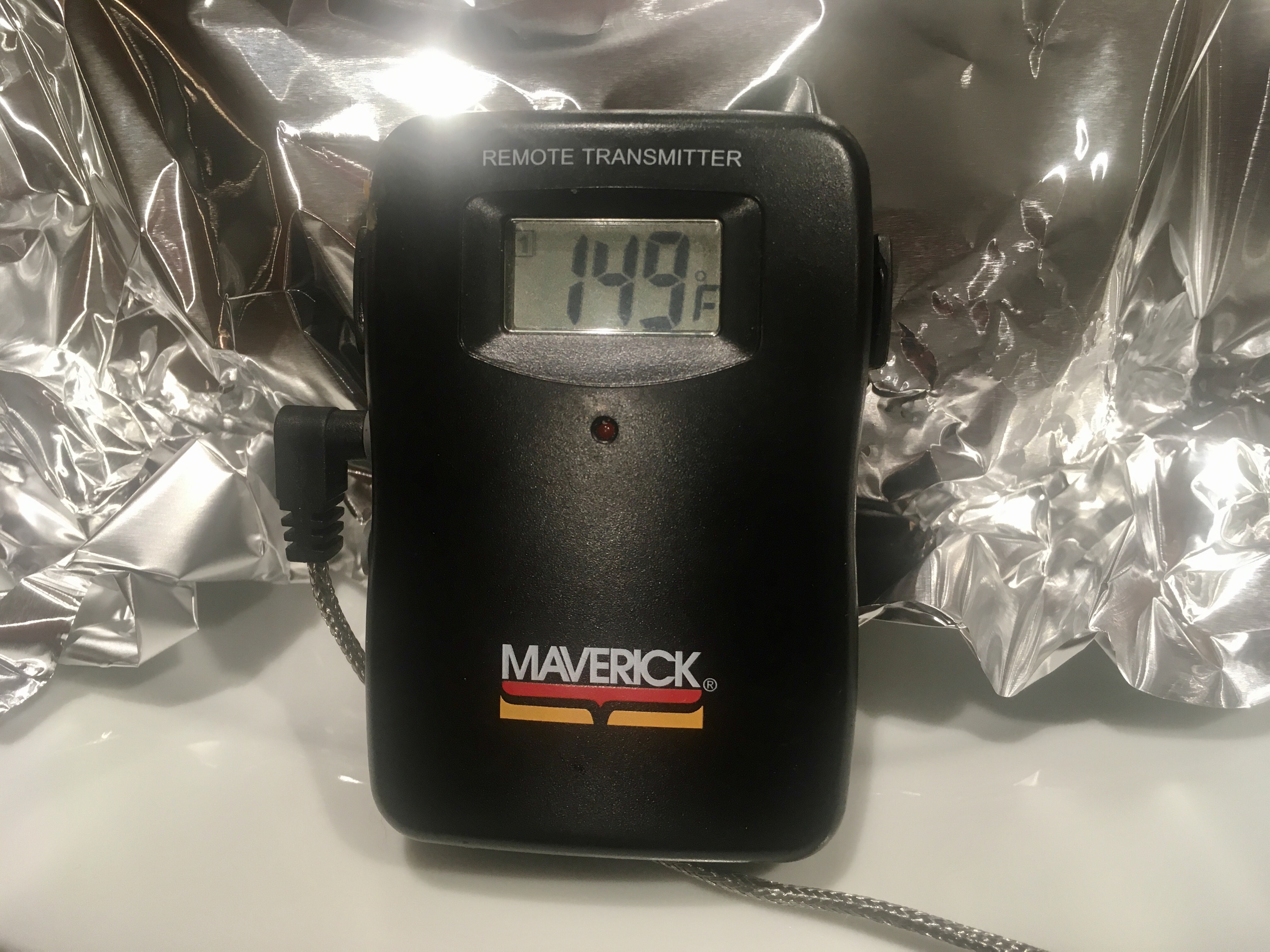
I leave the probe in the pork so I can monitor the temperature while it’s resting. Jumped 1 degree by the time I brought it into the kitchen!


Resting, wrapped in foil. My small pork loin went up a total of 4 degrees, to 149. But larger cuts of meat will experience an even bigger temperature jump.


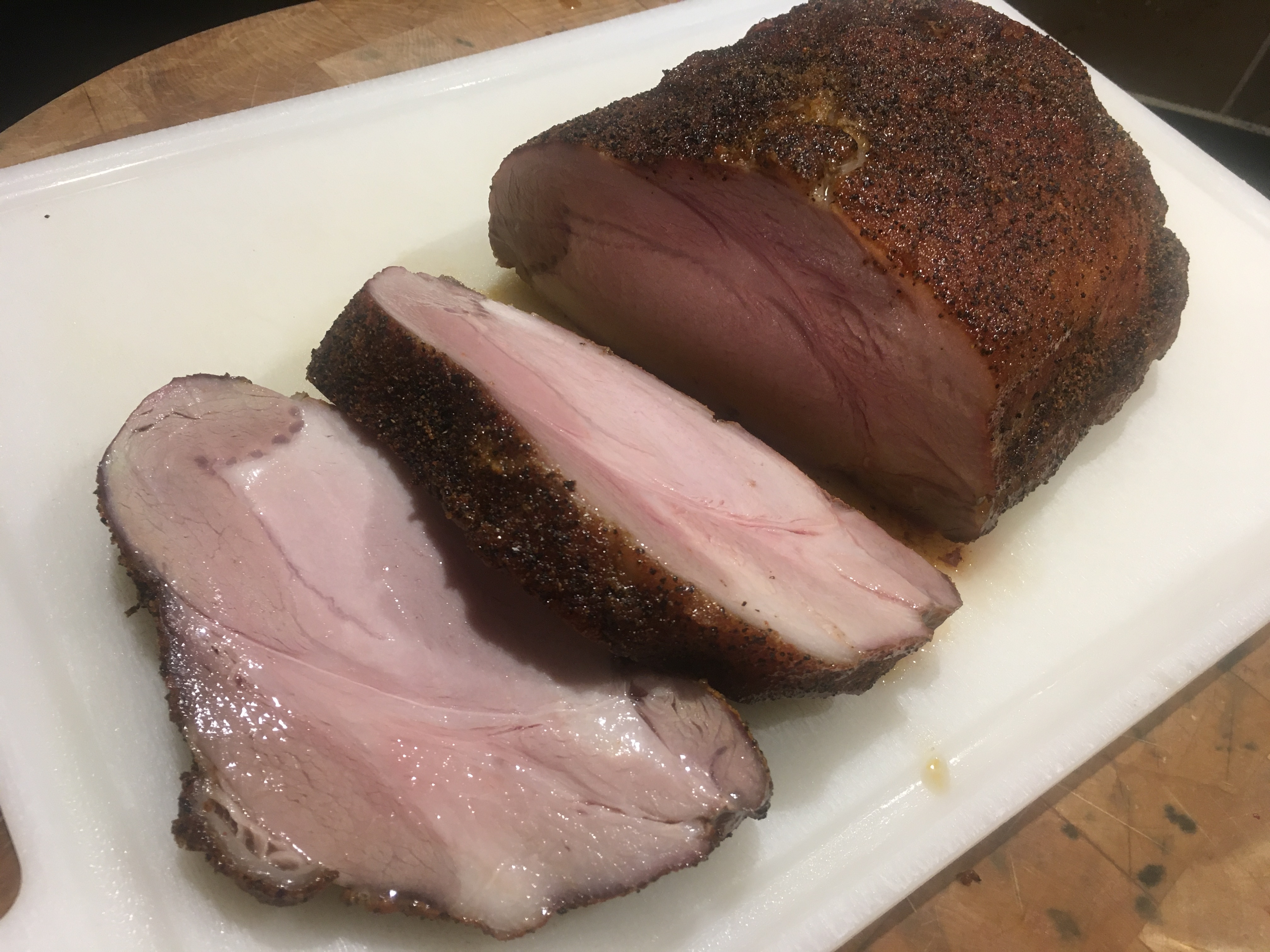
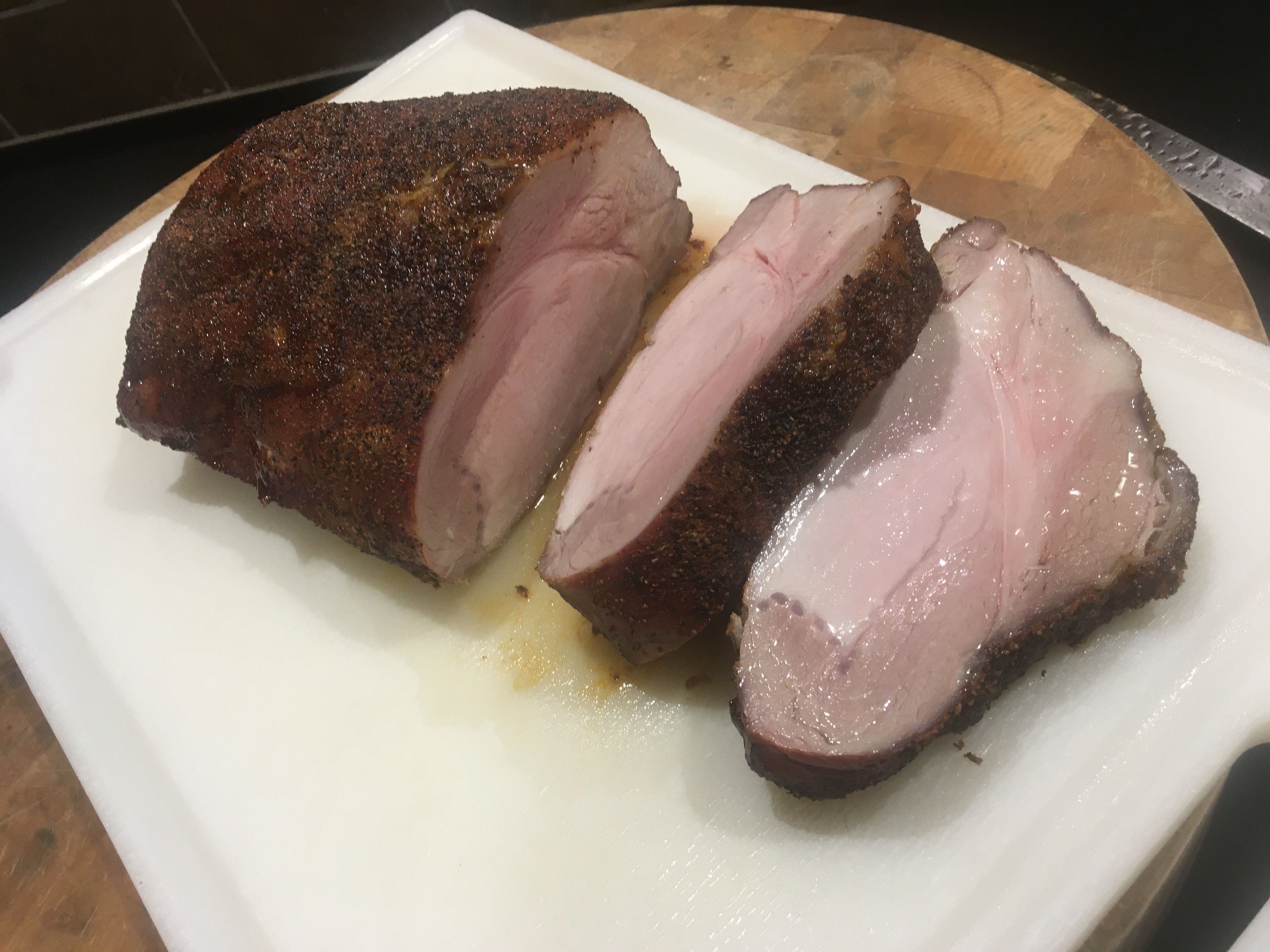
Delicious and perfectly smoked!


The relatively flat pork loin actually tightened up and became rounder during the smoking/cooking process.