Posts Tagged ‘recipes’

1


I was recently asked by the Providence Art Club to come up with a cocktail for their first Founders Day celebration. One hundred glasses were raised to honor the founding fathers of the second oldest art club in the United States. (Founded in 1880.) The oldest art club is the Salmagundi Club in NYC, founded in 1871. However, the Providence Art Club holds the distinction of being the oldest art club in the United States that was founded by both men and women. (The Salmagundi Club started as an all-male club.)

 Silhouette cocktail
My cocktail, The Silhouette, is a twist on the Boulevardier, which is a twist on the classic Negroni.

In a cocktail shaker with ice:

2 oz bourbon (I use Eagle Rare)
1 oz sweet vermouth (I use Antica Formula)
1/2 oz Campari
2 shakes orange bitters

Stir the ingredients with ice and then strain into a rocks glass with one large ice cube.

Garnish with an orange twist.

Despite that corned beef is not an authentic Irish dish, it seems that everyone thinks they should eat it on St. Patrick’s Day. The phrase “corned beef” was actually coined by the British, and although the Irish were known for their corned beef throughout Europe in the 17th century, beef was far too expensive for the Irish themselves to eat and all of it was exported to other countries. Owning a cow in Ireland was a sign of wealth, and the Irish used theirs for dairy products, not beef. The Irish ate pork, and a lot of it, because it was cheap to raise pigs, and they traditionally prepared something like Canadian bacon to celebrate St. Patrick’s Day in Ireland.

In the 1900’s, when the Irish came to America, both beef and salt were more affordable, and the Irish, who lived in poor, tight-knit communities, often next to Jewish communities, bought much of their beef from Kosher butchers. And so many of the Irish learned how to corn their beef using Jewish techniques, but added cabbage and potatoes to the mix.

It takes about 3 weeks to make corned beef, so you won’t have it ready for this St. Patrick’s Day. But now that you know it’s not Irish anyway, that’s OK! Doing it yourself is not difficult, and you get a better quality product than that nasty slab from the supermarket that’s full of chemicals and preservatives.

Corned beef has nothing to do with corn. ‘Corning’ is a technique for preserving raw meats for long periods by soaking it in salt brine. This method was used in England before the days of commercial refrigeration. Back then, the large salt kernels used in the brine were called “corns.”

Brining is a time-honored way of preserving and it prevents bacteria from growing. Both pastrami and corned beef are made by this method. Both corned beef and pastrami usually start with a brisket of beef. Corned beef is then cooked–usually boiled–and served. Pastrami is made when the brined meat is rubbed with more spices and smoked to add extra flavor. So corned beef and pastrami are the same meat, just treated differently.

Saltpeter is an ingredient that has been used in brining beef for years. It adds the traditional red coloring to the corned beef and pastrami meat. But since saltpeter can also contain carcinogens, I leave it out. The meat may not be the usual bright red color, but the flavor and texture of the meat will not be affected.

Brining the beef brisket

Brining the beef brisket

Step one: corned beef…

beef brisket (about 8-10 pounds)
2 tsp. paprika
1/4 cup warm water
3 cloves of minced garlic
2 tablespoons sugar
1 tablespoon mixed pickling spices
3/4 cup salt
2 quarts water

Place the brisket in a large container made of non-reactive material, like glass or plastic.

In the 1/4 cup of warm water, dissolve the sugar, minced cloves, paprika and pickling spices.

Dissolve the 3/4 cup of salt in the 2 quarts of water. Pour in the sugar/garlic/paprika/pickling spices mix and stir everything together. Pour the mixture over the meat in the container. Make sure the meat is totally beneath the surface of the liquid. (You may need to weigh it down to do this.) Cover the container.

Refrigerate the container and contents for 3 weeks, turning the meat once or twice per week. At the end of the third week, remove the container from the refrigerator and take out the meat. Soak the meat in several changes of fresh cold water over a period of 24 hours to remove the excess salt.

At this point, if you want corned beef, prepare and cook it using your favorite recipe. But I’m all about the pastrami!

Step two: making Pastrami…

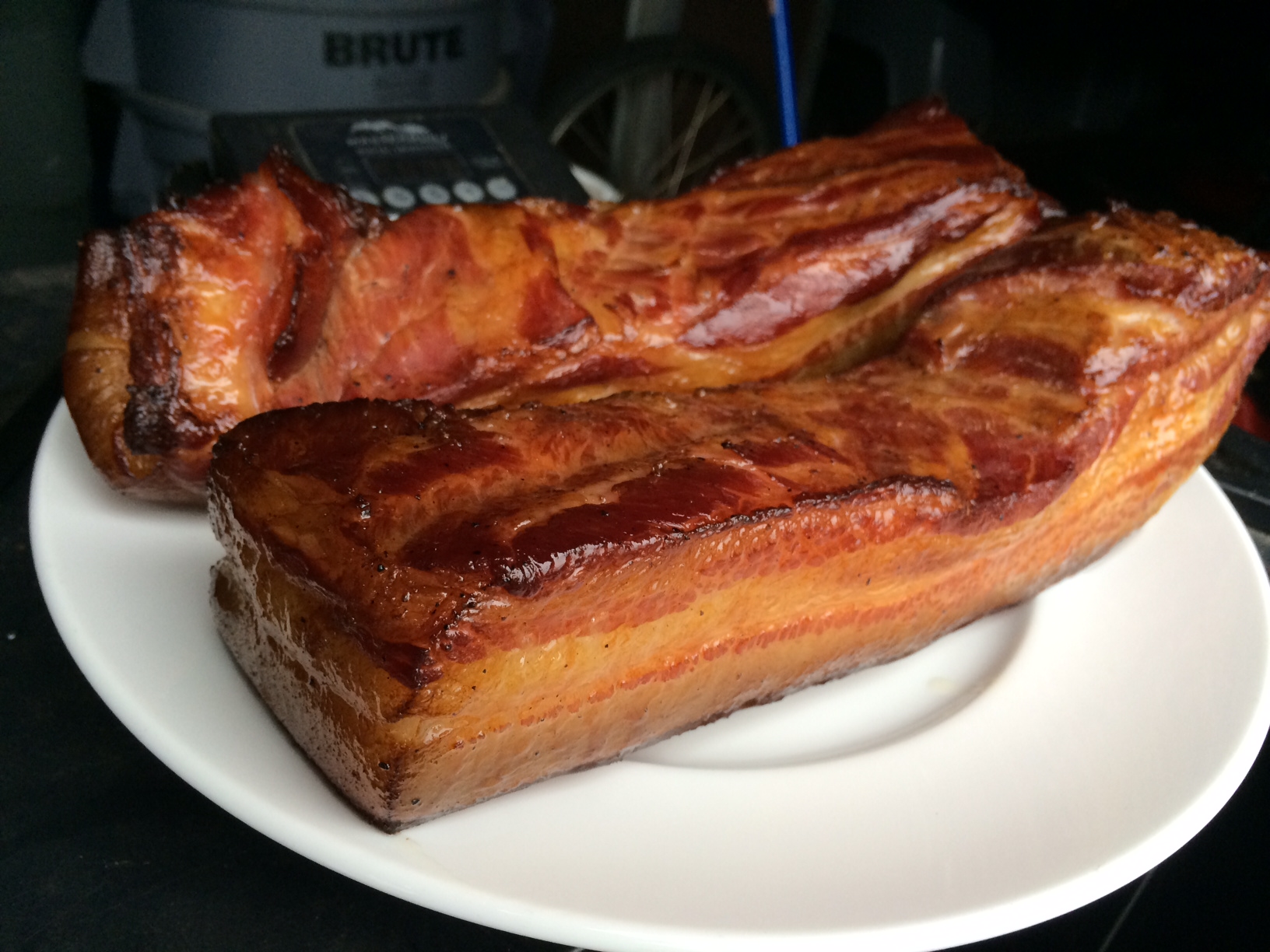
pastrami


Brined and rinsed corned beef brisket from above recipe, patted dry with paper towels

1/4 cup Kosher salt

1/4 cup paprika

3 tablespoons coriander seeds

2 tablespoons black peppercorns

2 tablespoons yellow mustard seeds

1 tablespoon white peppercorns

3 tablespoons brown sugar

1 tablespoon granulated garlic

Combine coriander seeds, black and white peppercorns and mustard seeds in a spice grinder and grind coarsely. Place in a bowl. Add salt, paprika, brown sugar and granulated garlic. Mix well.

Rub the mix into the brisket well, covering all sides.

Heat smoker to 225 degrees and smoke for several hours using a less intense wood, like oak. When the internal temperature of the meat has reached 165 degrees, it’s done. It isn’t necessary to smoke pastrami as long as you would a regular brisket because the long brining time makes the meat tender.

It is very important that absolutely everything that comes in contact with the meat is very clean. (This includes your hands.) Also, make very sure that every inch of the meat reaches the 165 degrees before it is removed from the smoker. The corned beef is now pastrami.

Calamari is the official appetizer of the state of Rhode Island. And for good reason. Squid means big business, and what we catch in Rhode Island accounts for up to 50% of the east coast’s quota every year! Squid have a lifespan of 12 to 18 months, reproduce twice a year, and can be caught year-round, with very few catch limitations, making it lucrative for fishermen.

Great fried calamari is an art form. It may seem like a simple dish, but to make it light and crispy, you need to be on your game. That’s why it can be a real hit-or-miss item on most restaurant menus. And there’s nothing worse than getting what would have been a great plate of calamari had the chef not decided to pour sauce all over it, turning the crispy cephalopod into mush.

What makes great fried calamari are three basic elements: it needs to be wild caught in the US (preferably Rhode Island!) and properly cleaned…it needs to be fried at the right temperature for the right amount of time so that it’s perfectly cooked and not greasy…and the coating needs to be light and crispy.

calamari


1 lb. wild caught cleaned squid (thaw if frozen)

1 cup flour (I use gluten-free these days)

1 teaspoon dried oregano

1  teaspoon paprika

1 teaspoon dried parsley

1/2 teaspoon granulated garlic

1 1/2 teaspoons salt

1/2 teaspoon black pepper

1 cup milk

1 large egg

oil, for frying (I use avocado oil)

Thaw the squid and slice into bite-sized rings. In a bowl, whisk the milk and the egg together. Toss in all the squid pieces into the bowl to coat. Place the bowl in the fridge for at least 15 minutes.

In another bowl, combine flour, oregano, paprika, parsley, garlic, salt and pepper. Set aside.

Fill a large pan halfway with oil…or use a deep fryer if you have one. Heat the oil to 350 degrees.

Working in small batches, remove the squid from the milk and egg mixture, let some of it drip off, then place the squid in the flour mixture and toss to coat. Shake off any excess flour and place immediately into the hot oil. Fry until golden brown, about 4 minutes. Serve immediately with tartare sauce, tomato sauce, hot peppers, whatever you like. (But keep the sauces on the side for dipping.)

About the oil: I cook almost exclusively with olive oil. But for hot frying like this recipe requires, I go with avocado oil, which can take higher temperatures.

Not a very complex idea. I just put the stuff that’s usually on the outside, on the inside of my burgers. Why? Why not?

If I’m making bacon cheeseburgers to bring to a barbecue, even if it’s on my back deck, instead of bringing a package of bacon and a package of cheese and a stack of burgers, I’ve got all the ingredients conveniently in the patties. And as the burgers cook, the fat from the bacon and the gooey cheese melt and combine with the burger meat to make a really tasty and moist burger.

I make 2 lbs. of burgers at a time, using 1 lb. of ground grass-fed beef and 1 lb. of pastured ground veal. For the sake of this recipe, we’ll just call it beef.

image

2 lbs. ground beef

1/2 cup sharp cheddar cheese, cut into 1/4″ cubes

1/2 lb. bacon, cooked crisp, cooled and crumbled

garlic salt

avocado oil or pork fat


In a bowl, combine the beef, the cheese and the bacon, mixing well so that all the ingredients are evenly incorporated.

Form the beef into 1/4 lb. patties. Refrigerate them until you’re ready to cook to firm them up.

Heat a cast iron skillet and add a drop of oil or pork fat. Place the burgers in the hot skillet to sear and sprinkle with the garlic salt. When browned, flip the burgers and place the skillet in a 350-degree oven to finish cooking.

image


It’s not a Leap Year this year (next year is), but that doesn’t mean we should wait another year for a taste of a Leap Year Cocktail.

This special drink was created in 1928 by Harry Craddock, who worked at the American Bar in London at that time.

FullSizeRender (2)


2 oz. gin

1/2 oz. Grand Marnier

1/2 oz. sweet vermouth

1/4 oz. fresh lemon juice


Combine all the ingredients with ice in a cocktail shaker and shake vigorously for 30 seconds. Pour into a chilled martini glass and garnish with a twist of lemon.

Cheers!

I learned most of my Cajun dishes from the cookbooks of one of the masters: chef Paul Prudhomme. Sometimes, I’d use some of his great seasoning ideas in my own dishes. This was one of them. I would cook huge batches of these chicken breasts for my Mardi Gras parties and there would never be any leftovers! Don’t wait for Fat Tuesday to come around again to make these yourself.

Double-dipping in the seasoning mix is a messy step, but it makes them extra crunchy and flavorful.

Single-dipped breasts are at the top. The extra crunchy double-dipped are at the bottom.

Single-dipped breasts are at the top. The extra crunchy double-dipped are at the bottom.


1 cup all-purpose flour

1 tablespoon salt

1 1/2 teaspoons sweet paprika

1 teaspoon granulated onion

1 teaspoon granulated garlic

1 teaspoon basil

1/2 teaspoon white pepper

1/2 teaspoon cayenne pepper

1/2 teaspoon black pepper

1/2 teaspoon dried thyme

1/2 teaspoon gumbo file (file powder), optional


2 pounds boneless, skinless chicken tenders or breasts

3 eggs

oil for frying (I like using avocado oil and some pork fat for flavor)


Cut the chicken breasts into manageable pieces. If they’re thick, slice them horizontally to make two thinner breasts. A thick piece of chicken won’t cook all the way through.

Combine the flour, salt, paprika, onion, garlic, basil, white pepper, cayenne, black pepper, thyme and gumbo file in a bowl. Mix well.

In another bowl, crack and scramble the eggs.

Single dip: Dip the chicken in the egg and then the flour mixture. Shake off an excess and place in a pan with oil that has been heated to 350 degrees on a thermometer.  Fry until it’s cooked all the way through. Drain on paper towels.

Double-dip: Dip the chicken pieces in the egg, then the seasoning mix, then the egg, then back in the seasoning mix and place directly in a pan with oil heated to 350 degrees on a thermometer. Fry the chicken until it’s cooked all the way through and golden brown. Drain on paper towels.


If you need to feed a crowd, just double or triple the recipe. I used to make a 10x batch for my Mardi Gras parties!

This recipe is gluten-free if you substitute GF flour for the all-purpose flour.


You’d think it would be Cinco de Mayo, but February 22nd is National Margarita Day! My personal recipe, called the Algarita, uses no sour mix…just 4 basic ingredients. I still have a small stash of the Honeybells mentioned here, but the original recipe, below, uses pineapple juice. Cheers!
My wife’s aunt in Florida sends us an awesome gift every year. It’s a box of Cushman’s HoneyBells. They look like fiery red bell-shaped oranges, but they’re not really oranges at all.
 image
HoneyBells are a unique natural hybrid of Dancy Tangerine and Duncan Grapefruit. The plants are grafted to a sour orange root-stock, and when the tree reaches maturity, it looks just like a grapefruit tree…but with oranges growing on it. They’re available for a very short time in the winter.
I usually make my signature margarita, the Algarita, with pineapple juice. But when I get those HoneyBells in the mail, my recipe takes on a new twist:
 image
HONEYBELL ALGARITAS
2 oz. Patron silver tequila (3 oz. is even better!)
1/2 oz. Cointreau orange liqueur
4 oz. pineapple juice (or fresh-squeezed HoneyBell juice, when in season)
1/2 oz. fresh-squeezed lime juice
Fill a cocktail shaker or tall glass with ice and add all the ingredients. Stir vigorously. Pour into a large margarita glass. Garnish with a lime wedge. Salt optional.
 image

Back in the 80’s, I worked at a radio station in Mobile, Alabama. My New York buddies thought I was crazy to move to the South, but that’s where the job was. When they realized that I was only a 2-hour ride from New Orleans, I wasn’t so crazy after all! What a great town. I spent every possible weekend there: the food, the music, the people…

When I moved to Rhode Island, I really missed all the fun of the Big Easy. So I decided to have a Mardi Gras party every year. I’d invite 80+ people, and I cooked all of the dishes myself. (Not bad for a single guy!) I made all the classics: red beans and rice, crawfish etouffe, gumbo, and jambalaya.

I still can’t imagine a Fat Tuesday without it.


image

For the seasoning mix:

2 bay leaves

1 teaspoon salt

1/2 teaspoon white pepper

1 teaspoon granulated garlic

1/4 teaspoon cayenne pepper

1/4 teaspoon black pepper

I find it easier to measure and chop all the ingredients before I start cooking.

I find it easier to measure and chop all the ingredients before I start cooking.


4 tablespoons olive oil

1 1/2 cups finely chopped onions, in all

1 1/2 cups finely chopped celery, in all

1 1/2 cups good quality chopped ham

1 1/2 cups chopped andouille sausage (Here in RI, I use local Portuguese chourico from Mello’s in Fall River, MA)

1 teaspoon cayenne pepper sauce (I use Frank’s Red Hot)

3/4 cup tomato sauce made from pureed whole tomatoes

2 cups uncooked rice (I like Texmati brown basmati rice)

3 cups chicken stock

1 lb. peeled and de-veined wild-caught American shrimp


image

Over medium-high heat, heat the olive oil in a large sauce pan. Add 3/4 cup of the onions and 3/4 cup of the celery. Cook until the onions are translucent.

Stir in the seasoning mix, then the chopped ham and the chourico, and then the cayenne pepper sauce. Cook until the onions are a dark brown, about 20 minutes, stirring constantly.

Add the remaining 3/4 cup of the onions and celery. Cook about 5 minutes.

Open a can (28 oz.) of tomatoes and puree in a food processor to make sauce. Add 3/4 cup of this and cook for about 5 minutes.

Stir in the rice, mixing well. Reduce the heat and simmer for about 12 minutes.

Add the chicken stock, stir well, and bring to a boil. Then reduce the heat and simmer covered over very low heat until the rice is tender but firm, about 15 minutes.

Remove the cover, toss in the shrimp, stir, then put the cover back on and cook for 5 minutes more.


Sometimes it’s hard to get wild-caught American shrimp at my local seafood store or supermarket. But for me, buying tiger shrimp or other Asian products is not an option. Once I learned about how they are farmed, I decided I’d never eat those shrimp again! Now I get my wild-caught Louisiana shrimp from a company I’ve been buying all my Cajun foods from for over 2 decades: http://www.cajungrocer.com. Not only will you find shrimp there, you’ll find many other Cajun classics: King cakes, Turduckens, andouille and alligator sausage, even live crawfish. And the price of their shrimp, even with shipping, is the same as the Asian shrimp you buy in the store. Make some room in your freezer, order large to save, and stock up on the real deal!


Julia Child was my first guide for many of the go-to dishes that I still make today. My Mom and I would watch “The French Chef” on WNET, Channel 13, our PBS station back home in New York.  Later, I’d start buying Julia’s cookbooks, and I was lucky enough to not only interview her, but meet her just a few years before she passed away. She was a lovely, down-to-earth lady, and someone I’ll never forget.

The classic rustic galette was the first dessert I learned how to bake, straight from the pages of “Baking with Julia.” I generally stayed away from desserts because cooking them required a lot of exact measurements, and that just wasn’t my style of cooking. So when I saw that this rustic galette required none of those things, and yet tasted absolutely delicious, I realized I had found my dessert! And the galette was versatile: I could use whatever ripe fruit I could get my hands on, so it became a dessert that changed with the seasons.

With my wife’s dietary needs changing, I decided I’d attempt a gluten-free version of the classic galette. The original recipe for the galette dough was one that I could make a couple of days ahead of time, wrap in plastic and keep in the fridge. Then it was simply a matter of bringing the dough back to room temperature before I rolled it out, added the filling, and put it in the oven.

Gluten-free doughs, however, are a bit more high-maintenance. I found that making the dough ahead of time was not an option. I’d remove the dough from the fridge, only to have it fall apart in my hands, with the consistency of Play-Doh. I was still able to form it into a round shape, but it had no elasticity and it just crumbled in my hands.

I used apples, and couldn't even fold the dough over the sides because it kept crumbling. Despite the fact that it wasn't too pretty, it tasted great!

I used apples, and couldn’t even fold the dough over the sides because it kept crumbling. Despite the fact that it wasn’t too pretty, it tasted great!

So now I make the dough right before I want to use it. You can make the dough by hand, but I use a food processor.


For the dough:

3 tablespoons sour cream

1/3 cup ice water

1 cup all-purpose flour (I use gluten-free)

1/4 cup yellow cornmeal

1 teaspoon sugar

1/2 teaspoon salt

7 tablespoons cold unsalted butter, cut into about 8 pieces


Everything looks better when you cover it with whipped cream!

Everything looks better when you cover it with whipped cream!

For the berries: (per galette)

1 1/2 cups mixed fresh berries or cut-up peeled fruit (I used apples)

1 tablespoon plus 1 teaspoon sugar

1 tablespoon cold, unsalted butter


Stir the sour cream and 1/3 cup ice water together in a bowl and set aside.

Put the flour, cornmeal, sugar, and salt in the work bowl of the food processor fitted with the metal blade and pulse to combine.

Drop the butter pieces into the processor and pulse 8 to 10 times, or until the mixture is speckled with pieces of butter about the size of a pea. With the machine running, add the sour cream mixture and process just until the dough forms soft, moist curds. Don’t overdo it!

Remove the dough from the processor, divide it in half, and press each half into a disk. If you’re not using gluten-free flour, wrap the discs in plastic and chill for at least 2 hours.

If you’re  going gluten-free, line a baking sheet with parchment paper for each disc of dough. Put the dough on a lightly (GF) floured work surface and roll it into an 11-inch circle that’s about 1/8″ thick. Carefully transfer it to the prepared baking sheet. If it falls apart, just press it back together on the parchment. (It’ll still taste great!)


Position a rack in the lower third of the oven and pre-heat to 400.


Spread the berries over the dough, leaving a 2 to 3-inch border. Sprinkle 1 tablespoon of the sugar over the fruit. Cut the butter into slivers and scatter it onto the fruit. Fold the uncovered border of the dough over the filling, allowing it to fold naturally onto itself as you lift it and work around the galette. It’s supposed to look rustic, so don’t sweat it. Dip a pastry brush in water, lightly brush the edge of the crust with it, then sprinkle the remaining teaspoon of sugar onto the crust.

Bake the galette for 35 to 40 minutes, until it’s golden and crisp. Move the baking sheet to a cooling rack and let the galette cool for 10 minutes. Serve warm or at room temp. Use a pizza wheel or sharp knife to cut into slices.


A little whipped cream never hurts!


The “paste” used in this dish is really more like a citrusy pesto that you smear all over the meat before cooking, preferably the day before. The citrus flavors work really well with the pork, and the initial high-heat cooking really gets the fat crispy and delicious.

image

Ingredients:

1 pork loin, about 8 lbs. (I use Berkshire pork)


zest of 2 oranges

zest of 1 lemon

1 tablespoon fresh rosemary, chopped

1 tablespoon fresh sage, chopped

1 tablespoon Kosher salt

2 teaspoons black pepper

3 cloves garlic, through a press

1/4 cup olive oil


In a food processor bowl, combine the orange and lemon zest, the rosemary, sage, salt and pepper, and garlic. Pulse the processor just to mix, then turn it on and add the olive oil slowly, in a stream, until you get what resembles an oily pesto.

Score the fatty side of the pork loin with a knife in a diamond pattern. Rub the paste on all sides of the pork, but especially into the cracks of the fatty side.

Lay the loin down on a rack, raised off a sheet pan, fatty side up. Place it in the fridge, unwrapped, overnight.

The next day, about an hour before cooking, remove the loin from the fridge and let it come back to room temperature.

Pre-heat the oven to 450 degrees.

Bake the pork loin at 450 for 20 minutes, then cut the heat to 350 and cook until the pork reaches a temperature of 140 degrees (light pink). Let it rest for 15 minutes before serving.

image

There are few carbs in this preparation, because I use just the zest of the citrus and not the juice.