Archive for the ‘bacon’ Category

Well, that’s what I call it. Sometimes the most interesting creations happen by accident, and this is one of them.

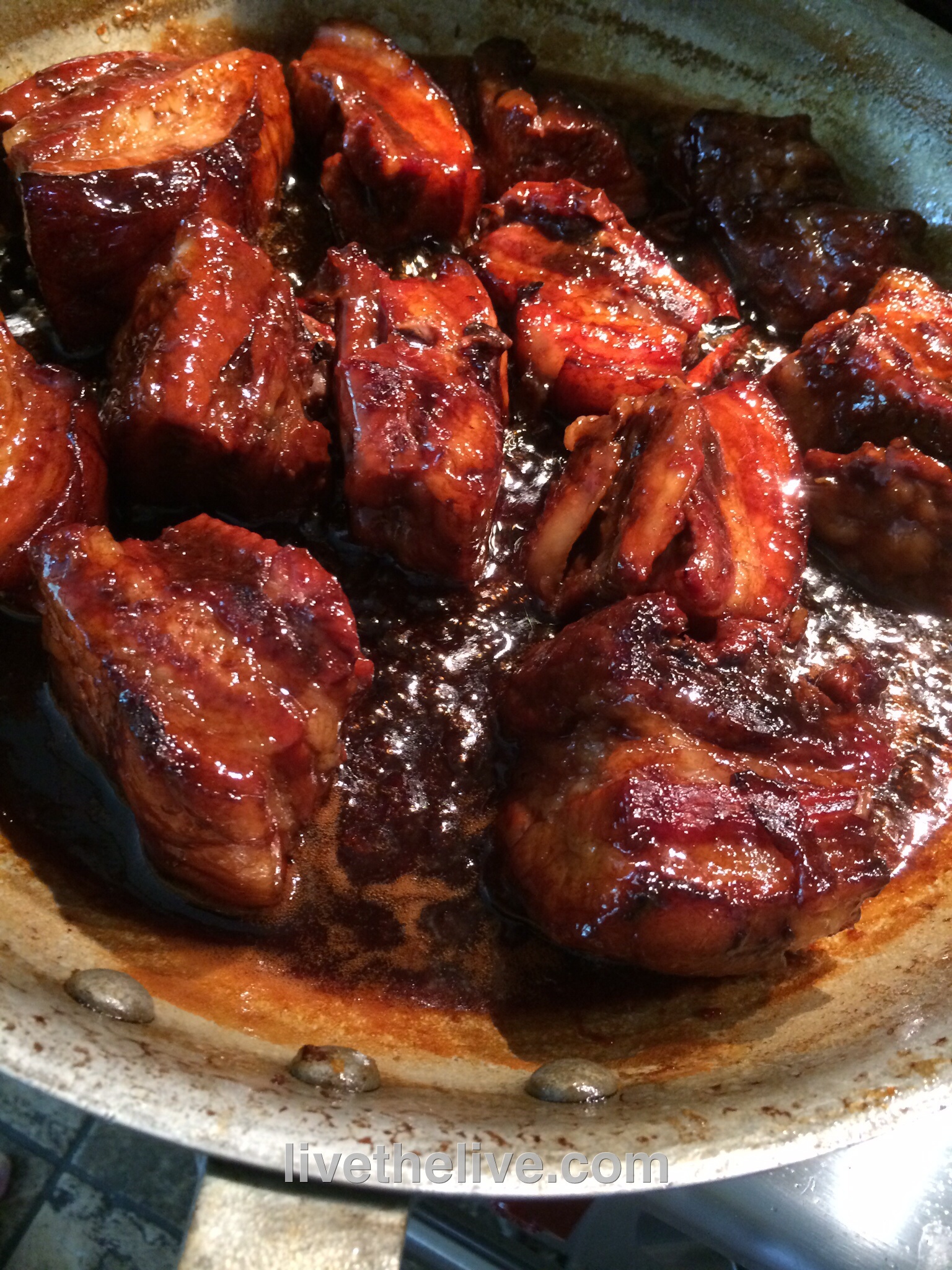
My plan was to make my Chinese Style Honey Ribs (http://wp.me/p1c1Nl-i7) for dinner. But I accidentally took a slab of pork belly out of the freezer instead. I only realized my mistake when I thawed it and started cooking it, so I decided to continue the process with the pork belly instead. The results were pretty damn tasty.

image


 Ingredients:
Marinade: ¾ cup light soy sauce
                     6 Tablespoons hoisin sauce
5 lbs pork belly
Zest and juice of 1 lemon
2 whole star anise
2 cinnamon sticks (3”)
1/2 cup honey
4 cups chicken broth
image
Mix marinade ingredients. Set aside.
Cut the pork belly into pieces that are about 3 inches square. Place in a large pot. Cover with water and bring to a boil. Boil for 5 minutes. Drain.
Place pork belly on a sheet pan with a rack and coat with marinade. Let sit for 10 minutes.
Pre-heat oven to 350 degrees. Bake pork belly pieces on foil-lined sheet pan for 30 minutes.
While the pork belly is baking, start sauce in a large non-stick pan or pot: combine lemon zest and juice, star anise, cinnamon sticks, honey and chicken broth. Bring to a boil, then reduce to a simmer.
When the pork belly pieces have finished baking, add them to the sauce pot and simmer (covered) for at least 15 minutes or until meat is tender.
Turn heat on high, uncover pot and cook until the sauce is reduced to a glaze that coats the ribs. Reduce heat as sauce thickens to avoid sugars in honey from burning. When the pieces are sticky and gooey, they are ready!
Let a piece of pork belly cool…then slice to desired thickness and fry like regular bacon. Makes an amazing omelet!
image

REUBEN SEUP

Posted: April 24, 2014 in bacon, cheese, Food, Recipes, sauerkraut
Tags: , , , ,

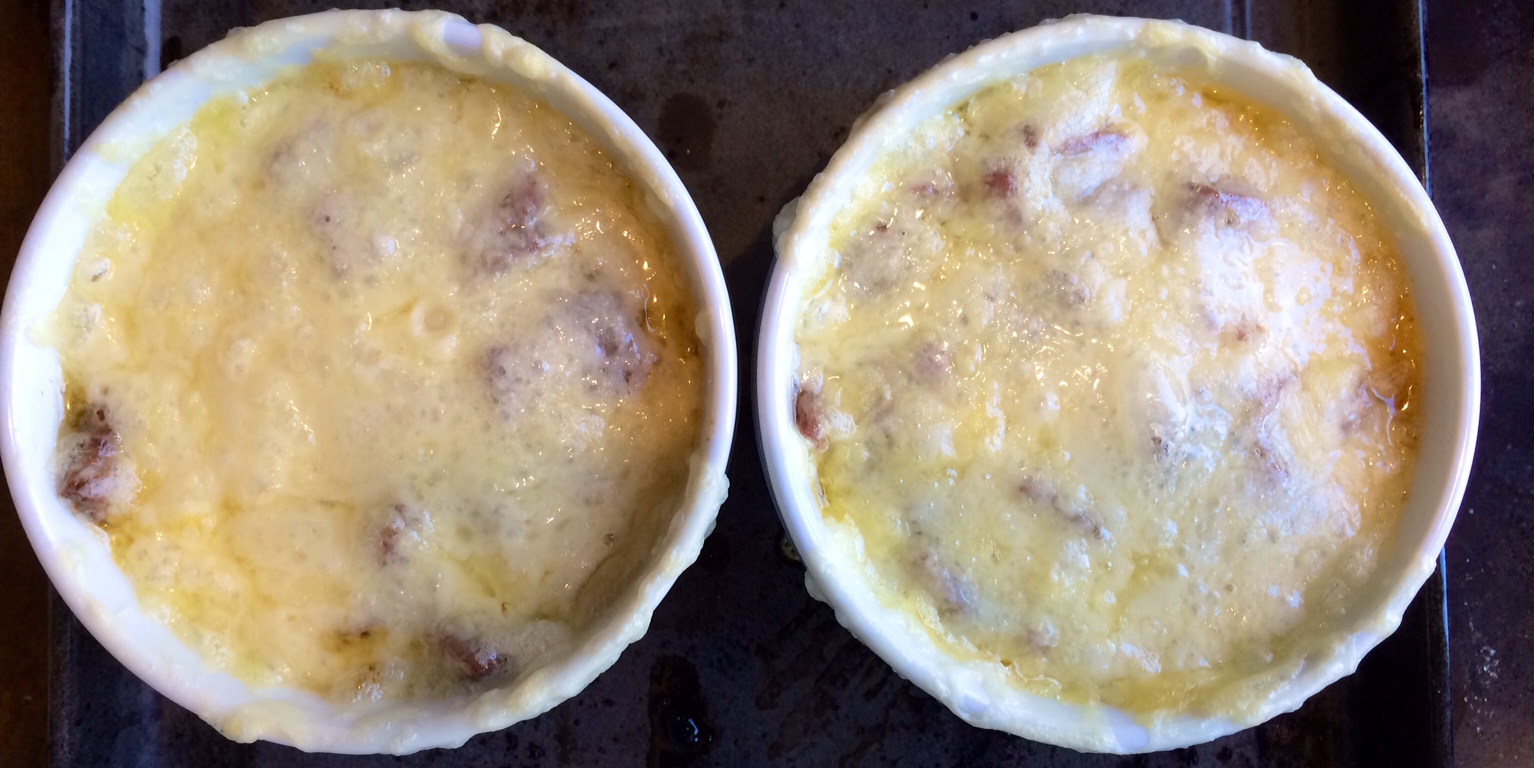
Why have soup and a sandwich when your soup can be your sandwich? I had all the ingredients to make a Reuben sandwich. But I wanted soup. So I made Reuben Seup…I mean Soup!

Think French onion soup, but using Reuben ingredients…

rye

Take an oven-proof soup bowl. Line the bottom with some rye bread.

kraut

On top of that, place a nice helping of sauerkraut. I use sauerkraut that’s been rinsed and drained, then sauteed with some onions and bacon until lightly caramelized.

stock

Slice pastrami as thinly as possible, and simmer it in a pot of homemade chicken stock until tender. Season stock with salt and pepper, if needed. Pour the stock and pastrami over the sauerkraut.

swiss

Layer slices of Swiss cheese over the top of the bowl. Place under broiler until melted.

melty

Eat!

eat

It satisfied my soup and sandwich craving!


I love avocado, but I never thought of cooking with it until I saw this recipe. It was a very simple burger that had only a handful of ingredients, and so I thought: “Oh, I don’t need to write this down!” After I made the burger patties and put them in the fridge to chill, I took a look at the recipe on line and realized I forgot one of the ingredients! The original recipe called for a 1/2 cup of Panko breadcrumbs mixed in. My burger tastes fantastic without it…plus now it’s low or no carb. So I will leave it out.

chicken2

Ingredients:

1 lb ground chicken

1 ripe avocado, sliced into small cubes

1/2 teaspoon salt

1/4 teaspoon black pepper

pinch granulated garlic

chicken1

Combine the ingredients in a bowl and mix thoroughly but carefully so that you don’t squash the cubes of avocado. Form the meat into burger patties. It will be a bit sticky, but just make sure you get the avocado evenly distributed. Chill the patties in the freezer for about 10 minutes before cooking to firm them up.

Pre-heat the oven to 350 degrees.

Heat a little oil in an ovenproof pan, and place burgers in it when hot. Let the burgers sear on one side, then flip them. Place the pan in the oven to finish cooking.

Serve with a slice of bacon and Awesomesauce! (http://wp.me/p1c1Nl-gT)

I’ve been asked to list my sources for the organic, pastured, wild-caught or grass-fed foods I use in my recipes. I’ve had many successes as well as many failures with purveyors of foods over the years, but I’ve been able to find a handful of websites that deliver what they promise.

Of course, I support my local farmers. And if they’ve got the product I’m looking for, I will buy from them first. But the convenience of ordering from home is unbeatable…and sometimes you don’t live anywhere near a farm that can supply you with what you’re looking for.

My philosophy is simple: I will pay top dollar if the quality is there. I would rather eat exceptional quality meat and seafood rarely than antibiotic-laced, hormone-injected crap every day.

When it comes to seafood, I buy wild-caught (line-caught in the case of fish) American products. I’m OK with some farmed fish, like USA catfish and trout, which are of high quality. I buy Pacific cod, not Atlantic cod, which has been depleted in its numbers. I don’t buy orange roughy or Chilean sea bass because of overfishing. Same with swordfish unless it’s local and line-caught. I never buy farmed shrimp from Asia or South America, where there are no rules about what they feed them and how badly they crowd them in nets. I don’t buy Atlantic salmon, which is farmed and comes from Norway, Canada or South America. I buy wild-caught Alaskan salmon and halibut. Farmed oysters and mussels are fine, because their habitat is about the same as in the wild, and we have great sources for them here in Rhode Island.

It’s expensive to eat well. My family is worth it. I cut corners elsewhere.

TALLGRASS

www.tallgrassbeef.com: Owned by TV journalist Bill Curtis, they sell a variety of 100% grass-fed beef steaks, burgers and dogs. Just recently, they started selling my favorite cut: the porterhouse. But more than anything, this is my go-to website for grass-fed hamburger. They sell them in 1 lb. bricks, and I’ll buy about 24 lbs. at a time. I prefer the bricks over the pre-formed burger patties, because I use them for meatballs and tacos…not just burgers. Best burger I’ve had.

pork

www.heritagepork.com: A great website for Berkshire heritage pork. This is not the pale, flavorless stuff you get in a supermarket. Berkshire pork is known in Japan as Kurobuta pork, and is considered the “Kobe” of pork. Excellent quality, beautifully marbled fat, and delicious. I’ve bought the pork chops, the ribs, pork loin and the pork belly, and none of them has disappointed. Excellent service.

salmon

www.vitalchoice.com: If you’re looking for incredible wild-caught Alaskan seafood, this is the site. Wild salmon, tuna and shellfish. Frozen right after it’s caught. Rare treats like wild Pacific spot prawns, some of the tastiest shrimp you’ll ever eat. Hard-to-find organic grass-fed Wagyu beef. (Wagyu is American Kobe beef.)


www.westwindfarms.com: Without a doubt, some of the best chicken I have ever had in my life comes from this family run farm in Tennessee. Delicious not-too-big (about 4 lb.) birds. And their chicken wings are the best ever–period. No scrawny wings here: they come with breast meat attached, making them a real treat. They also sell grass-fed beef, lamb, pork, organic products and more. I’ve tried their other products, but for me, it’s all about the chicken. If you’re in Tennessee or Georgia, they have many pick-up locations to choose from. I go the mail-order route, and I think I might be their only online customer! But their service is top-notch.


www.cajungrocer.com: My trusted go-to place for any Cajun food you could want, from Turduckens (excellent quality) to alligator sausage, to live crawfish (in season.) This is where I get all of my wild-caught American gulf shrimp. Even with shipping costs, their prices are so much better than any local seafood store. Excellent service.

Burgerssswww.smokehouse.com Burgers’ Smokehouse has been around since 1952 and they’ve got it down to a science. You won’t find grass-fed or organic products here, but you will find great bacon, ham, turkey and other smoked products. Their Thick Original Country Bacon Steak is what I always buy…12 lbs. at a time. Their cooked and spiral sliced country ham is a real treat. Not only is their service awesome, but unlike other websites that surprise you with crazy shipping costs after you’ve spent an hour getting your order together, all of Burger’s price include shipping. That rocks!

http://www.mcallenranchbeef.com: Beef of the highest quality and outstanding flavor, although not grass-fed. This historic Texas ranch, established in 1791, has been dealing with droughts which have limited their supply of beef, and their website says their beef supplies will be back to full speed by June of this year.

www.grassfedbeef.org: This is the website of Tendergrass Farms, a supplier of grass-fed beef, pastured pork, and organic meats. We’ve had some success with the beef, and we also purchased a very tasty turkey from them for Thanksgiving last year.

www.drinkupny.com: It’s time for as drink! And these guys, based in Brooklyn, NY, have just about anything you could want. It may seem silly to order your spirits online instead of going to your local liquor store, but these guys have the high-end things my local guy doesn’t…and they’ve got better prices on the stuff he does have. Shipping is fast and reasonably priced.

www.empirewine.com: Need wine? These guys are based in upstate NY and they’ve got a huge choice of excellent wines at great prices. Shipping is FAST, but make sure they ship to your state to avoid disappointment.

Coming in a future blog: my sources for the gardening season: seeds, plants and more.

I’ve made some changes to my bacon blog of over a year ago, taking many more steps toward true bacon greatness. Scroll down for my updates…

There are few foods as magical as bacon. Add bacon to just about any dish you’re preparing, and it elevates it to incredible new heights of flavor. The BLT is possibly the greatest sandwich ever invented: just a few simple, fresh ingredients, when placed together, transforming into one of the most amazing treats on planet Earth.

And it all depends on the bacon.

For many years, I’ve bought my bacon on-line from Burger’s Smokehouse, a family run business in Missouri that not only sells some great bacon (get the thick-sliced country bacon—my favorite), but also smoked turkeys, ham and more. The prices are excellent and they include shipping.

But it was time to take the next step: I had to make my own bacon!

Bacon comes from the pork belly. So I bought a few slabs of insanely good pork from my friends at Fire Fly Farms in Stonington, CT (www.fireflyfarmsllc.com), and followed the simple curing techniques outlined in a great book about making all kinds of prepared meats (sausages, salamis, and of course, bacon): “Charcuterie,” by Michael Ruhlman and Brian Polcyn.

To cure bacon, all you really need is some salt and some sugar, and what they in the curing biz call “pink salt,” which is not to be confused with salt that happens to be pink, like Himalayan salt you would find in a spice catalog. Pink salt is bright pink—to let you know that this is special salt that should only be used in small quantities for curing. And the reason for that is because it has nitrites. Nitrites delay the spoilage of the meat, and help keep the flavors of spices and smoke. That’s good. But nitrites can break down into nitrosamines, which have been known to cause cancer in lab animals. But let’s face it: you would need to eat a ton of cured meat to really worry about this.

To make the basic dry cure:

1/2 lb. kosher salt

4 oz sugar

1 ounce (5 teaspoons) pink salt

Combine these ingredients well. You won’t need all of it unless you’ve got a lot of pork belly. An important note: kosher salts do not all weigh the same, so that’s why I go by the weight and not a cup measurement.

Once you rub the pork belly with the basic dry cure, place it in a Ziploc bag, squeeze the air out of it, and seal it well. Place in the fridge for about a week, flipping it over a few times to let gravity do its work. You’ll see that the salt will draw moisture out of the meat and form a brine. This brine will continue to cure your pork belly, so leave it in there.
Once the pork belly has been cured, wash the brine off the meat, pat dry with paper towels. Now it’s time to cook. You can simply cook the pork belly at 200 degrees for about 2 hours, until the internal temperature reaches 160 degrees, or do what I did: place the pork belly in a digital smoker, cooking it at 250 degrees for 1 hour, then adding hickory chips and smoking it at 250 degrees for another hour.

That’s it. You have achieved bacon!

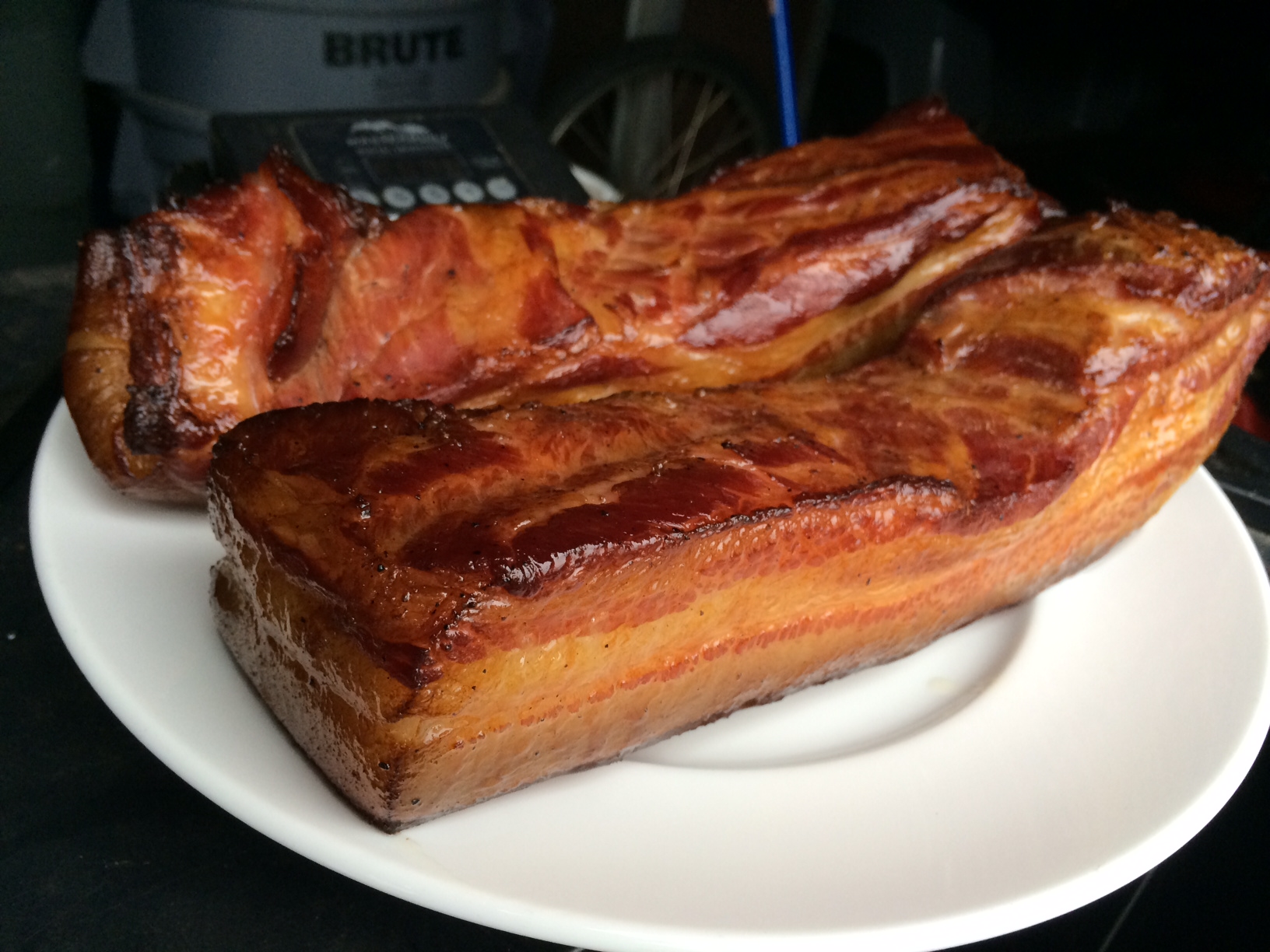
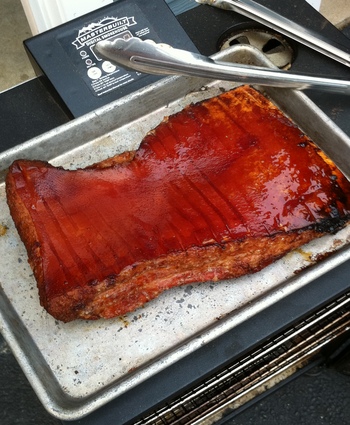
Bacon, straight out of the smoker.

Bacon, straight out of the smoker.

Let me tell you…that first slice you cut off that bacon and toss in a pan to lightly fry for a few moments will be the best bite of bacon you have ever had in your life!
The reward is so worth the effort. If you don’t want to bother going online or if you don’t have a local farm to buy your pork, simply go to your favorite butcher and ask for pork belly. It’s usually available. And if you’re making one slab of bacon, why not make it three or four? It freezes well. And…you will eat it. You know you will!

Sliced, and ready for frying.

Sliced, and ready for frying.

Since I posted the above information, I’ve had the opportunity to tweak my bacon curing recipe. The result was a more balanced, less salty bacon with tons of flavor…

Ingredients:

1/4 cup of the basic dry rub (recipe above)

1/2 cup light brown sugar

1/2 teaspoon ground black pepper

Combine these ingredients and rub on all sides of the pork belly. Place in Ziploc bags and squeeze all the air out of them. Place in a container in the fridge and turn them over every day to let gravity do its work. A brine will form inside the bag…this is good. It will cure the pork belly. After about a week, remove the pork bellies and rinse them with cold water. Pat them dry with paper towels and then proceed to the smoker.

Bellies in the smoker

Bellies in the smoker

I use a digital smoker, so I set the temp for 250 degrees and cook the pork bellies at this temperature for one hour. I then add hickory chips and smoke the bellies at 25o degrees for one more hour.

Smoked bacon

Smoked bacon

At this point, you have achieved bacon! While the bellies are still warm, you can easily slice off the pork skin off the belly. I discard it. Slice the bacon into whatever thickness you like, and fry some up immediately! Once the rest of the bacon has cooled to room temp, cut them into chunks, wrap individually, and freeze until ready to use.

Frying in the pan!

Frying in the pan!

Why does bacon taste “off” when it’s infused, mixed with chocolate, or even on a fast food burger? And Bakon, the bacon infused vodka you can buy at your local liquor store, is another example of “it’s better when you do it yourself.”

To make bacon infused vodka, I use the bacon I love to eat: my own homemade stuff. But your favorite store-bought bacon will work just as well.

bacon vodka

Some bacon infused vodka recipes have you cook the bacon and soak the strips in vodka for a week or so. But I like this idea better:

Cook your favorite bacon in a pan. Eat the bacon. Set the fat aside. For a 750 ml bottle of vodka, use 2 tablespoons bacon fat. Place both in  a mason jar, shake well, and let it sit at room temperature for about 6 hours, shaking occasionally. After 6 hours, place the mason jar in the freezer. The alcohol will not freeze, but the fat will. After 30 minutes, strain through paper coffee filters and you’ve got bacon infused vodka!

Cheers!

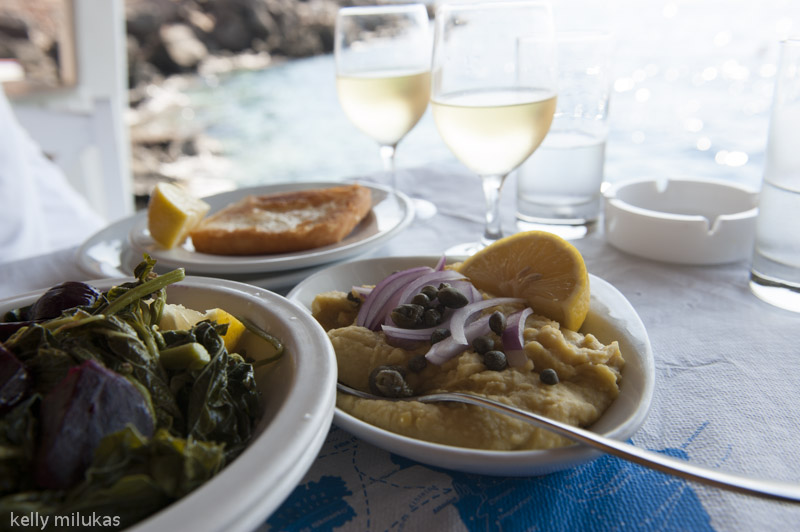
They call it fava, but it’s not the bean we usually associate with that name. Originally, broad beans were used in this dish, but quickly it changed to a type of yellow shelled lentil that is much smaller and flavorful than its American counterpart, the yellow split pea, no doubt due in part to the dry, volcanic Santorini soil it grows in. The lentil is smaller and the art of turning this simple gem into a sublime porridge is worth learning.
The fava at Dimitris Amoudi Taverna

The fava at Dimitris Amoudi Taverna

As common in Santorini as pasta is in Italy, grains of fava have been found in archaeological sites in the ancient city of Akrotiri (on the southern side of Santorini) dating as far back as 3500 years ago. Every taverna on the island offers their own version of fava, and though the differences are subtle, they can be significant.
Most recipes start with the dried lentils, which are washed thoroughly. They are added to a pot of fresh water and then boiled until the water reduces and the lentils slowly absorb the liquid and soften into a porridge. Often chopped onion is added to the pot of water in the very beginning, so that it completely dissolves and flavors the fava. Some recipes call for a subtle mixture of local dried herbs, similar to oregano and thyme, to be wrapped in cheesecloth and added to the pot to infuse flavor.
Like making a great Italian tomato sauce, cooking fava is a labor love. It requires low heat and constant stirring to make it perfectly smooth. Often it is pureed in a blender at the end.
When the fava is ready to serve, the toppings can vary. Thin slices of red onion and a liberal drizzle of Greek olive oil are common. Sometimes it is topped with locally harvested and brined caper berries or caper berry leaves, or a few kalamata olives.
Proud of his fava

Proud of his fava

On our recent trip to Santorini, our most memorable fava dishes were a simple, rustic version with onion, capers, olive oil and a side of lemon at Dimitris in Amoudi, and a light-as-a-cloud creamy fava topped with caper berry leaves and olive oil at Roka in Oia.
Finding real Santorini fava can be difficult and expensive on line, but it is possible. You can easily find dried yellow split peas in local US supermarkets, but it’s not quite the same.
My personal touch–no surprise here–bacon! I finely chop and then fry a small amount of bacon and sauté it with the chopped onion, then add it (with the bacon fat) to the boiling pot of fava and water in the beginning.

Don’t let the innocent photo fool you. This stuff is addictive, thanks to the addition of bacon and bacon fat! And the food processor makes this aioli light as a cloud. Spread it on burgers. Use it on a BLT. Goes great with tuna. Or just get some chips and use it as a dip. Inhale!

avocado

Ingredients:

3 avocados

6 strips of bacon, fried crisp, chopped and cooled…bacon fat reserved

juice of 1 lemon

1 teaspoon lemon zest

2 eggs, room temperature

1 clove garlic

1 cup extra virgin olive oil

salt, preferably Fleur de Sel

Freshly grated black pepper

In a food processor, blend avocados, bacon pieces, lemon juice and zest, eggs, and garlic. With processor still running, add bacon fat slowly, then add the olive oil. Add a good pinch of salt and a few grinds of pepper.

You can substitute vegetable oil for the olive oil if you feel it’s too strong.

A BLT EPIPHANY

Posted: March 23, 2013 in bacon, beef, Food, Recipes, tomatoes, Uncategorized

There are very few sandwiches more perfect than the BLT, and I would be a fool to try to improve on it. Freshly toasted bread, a slathering of mayo (Hellman’s only, of course), crisp lettuce, juicy sliced tomato, and my own homemade bacon (https://livethelive.com/2012/12/01/makin-bacon/). What could be better?

I recently tried my hand at smoking and slow-roasting a huge slab of grass-fed beef brisket, and it came out beautifully. Rich and smoky, there was far too much of it for a mere mortal like myself to polish it off, even if I ate it for days in a row. So I cut the brisket into more manageable sized slabs, wrapped them and placed them in the freezer.

beef brisket

I took one of those slabs out of the freezer the other day, and noticed that, with the grain of the meat and fat, it resembled bacon. And then it dawned on me: I could slice it like thick-cut bacon, fry it in a pan, and make my own BLT with it: a Brisket, Lettuce and Tomato Sandwich!

steakon!

The end result was fantastic. Quite different than the infamous BLT, but a winner in its own right.

Alz BLT: Brisket, Lettuce and Tomato

Alz BLT: Brisket, Lettuce and Tomato

MAKIN’ BACON!

Posted: December 1, 2012 in bacon, Food, pork, smoking, Uncategorized
Tags: , , , , ,

There are few foods as magical as bacon. Add bacon to just about any dish you’re preparing, and it elevates it to incredible new heights of flavor. The BLT is possibly the greatest sandwich ever invented: just a few simple, fresh ingredients, when placed together, transforming into one of the most amazing treats on planet Earth.

And it all depends on the bacon.

For so many years, I’ve bought my bacon on line from Burger’s Smokehouse, a family run business in Missouri that not only sells some of the best bacon I’ve ever had (get the thick-sliced country bacon—my favorite), but also smoked turkeys, pork, beef, chicken and more. The prices are very fair and they include shipping, so you know exactly what it’s going to cost you right from the start. (www.smokehouse.com)

But it was time to take the next step: I had to make my own bacon!

My favorite source of heritage breeds of pork, pasture-raised with tender loving care, is Caw Caw Creek, based out of North Carolina. They raise only a handful of pigs in an area that other pig farms would jam in hundreds. The pigs are allowed to roam freely and forage for their food. And as a result, the pork is some of the most flavorful you will find anywhere. (www.cawcawcreek.com) Tell Emile I sent you.

Bacon comes from the pork belly. So I bought a couple slabs from Caw Caw Creek, and followed the simple curing techniques outlined in a great book about making all kinds of prepared meats (sausages, salamis, and of course, bacon): “Charcuterie,” by Michael Ruhlman and Brian Polcyn.

If there is a skin on the belly, I choose to remove it before curing, but that’s a personal preference. I don’t eat it, so why have it? And it’s so thick, it blocks the cure.

To cure bacon, all you really need is some salt, some sugar, a little pepper, and what they in the curing biz call “pink salt,” which is not to be confused with salt that happens to be pink, like you would find in a basic spice catalog. Pink salt is bright pink—to let you know that this is special salt that should only be used in small quantities for curing. And the reason for that is because it contains nitrites. Nitrites delay the spoilage of the meat, and help preserve the flavors of spices and smoke. That’s good. But nitrites can break down into nitrosamines, which have been known to cause cancer in lab animals. But let’s face it: you would need to eat a ton of cured meat to really worry about this.

Once you rub the pork belly with the salt and sugar mixture, place it in a Ziploc bag, squeeze the air out of it, and seal it well. Place in the fridge for about a week, flipping it over a few times to let gravity do its work. You’ll see that the salt will draw moisture out of the meat and form a brine. This brine will continue to cure your pork belly, so leave it in there.
Once the pork belly has been cured, wash the brine off the meat, pat dry with paper towels. Now it’s time to cook. You can simply cook the pork belly at 200 degrees for about 2 hours, until the internal temperature reaches 160 degrees, or do what I did: place the pork belly in a digital smoker, cooking it at 200 degrees for 1 hour, then adding hickory chips and smoking it at 200 degrees for another hour.

That’s it. You have achieved bacon!

Bacon, straight out of the smoker.

Bacon, straight out of the smoker.

Let me tell you…that first slice you cut off that bacon and toss in a pan to lightly fry for a few moments will be the best bite of bacon you have ever had in your life!
The reward is so worth the effort. If you don’t want to bother going online to buy your pork, simply go to your favorite butcher and ask for pork belly. It’s usually available. And if you’re making one slab of bacon, why not make it three or four? It freezes well. And…you will eat it. You know you will!


Sliced, and ready for frying.

Sliced, and ready for frying.