Archive for the ‘Uncategorized’ Category

The inspiration for this sauce was my attempt to replicate the “Shack Sauce” they use at Shake Shack , a high-end burger joint owned by restaurateur Danny Meyer. Since it opened in New York City’s Madison Square Park in 2004, Shake Shack has expanded to many other locations around the world.

I don’t know if I captured the Shack Sauce secret. But I do know that my Awesomesauce makes every burger I grill taste amazing. It’s also fantastic for shrimp, crab or lobster salad…a dip for veggies or boiled shrimp…a dressing for tacos…and great on salads.

Awesomesauce

1/2 cup mayonnaise
1 tablespoon ketchup
1 tablespoon yellow mustard
1 tablespoon dill pickle relish
1/4 teaspoon garlic powder
1/4 teaspoon paprika
Pinch cayenne pepper

Combine all the ingredients in a bowl. Mix well. Refrigerate covered for a few hours to blend the flavors.

image

San Sebastian, Spain is one of the major food meccas of the world: wonderful shops, pintxos (tapas) bars, and some of the top restaurants On earth, all on the north coast of Spain in Basque country, off the Bay of Biscay, just a stone’s throw from the French border.

image

image

Pintxo bars are everywhere, especially in the old part of town where the narrow streets are for pedestrians only, and many bars specialize in just a few prepared foods, like the beautiful sautéed fresh mushrooms, above.

imageimage

Some joints, like Cuchara de San Telmo, jam every night until they literally run out of food.

imageimage

Clearly, we couldn’t get enough of the mushrooms!

imageimageimageimageimageimage

No shortage of fantastic Basque cheeses and charcuterie in local San Sebastian shops, either.

image

image

Not all the best pintxo bars are in old town. This one, Restaurante Ni Neu,  is just across the waterway from the classic Hotel Maria Christina.

imageimage

Need a break from all that rich food? Craving a burger, a salad and a beer? Head down the boardwalk on La Concha Beach for the Wimbledon, a tennis club that has a great pub open to the public.

imageimage

imageimage

Many great family-run restaurants. Often, like with Munto and Egosari, you’ll find the first floor is all about the pintxos, and the second floor has a more formal dining area where you can sit down to a wonderful meal. Others, like Astelena, are finer dining experiences. And Narru has indoor dining as well as al fresco dining with a view of La Concha beach.

image


imageimage


image


San Sebastian is home to many of the world’s finest restaurants, including Arzak, rated the #8 restaurant in the world. Here’s the gazpacho at Arzak…

image

And an incredible plate of fish, served on a clear dish so you can see the video of ocean waves crashing on the shore on the iPad the dish is served on!

image

The talented Elena Arzak was named best female chef in the world in 2012.

image

At the #3 spot on the top restaurants of the world, there’s Mugaritz, another amazing dining experience.

imageimage

One incredible dish after another. An experience hard to put into words, but I tried. Read about it here: http://wp.me/p1c1Nl-vn

image

The “Linking Dish,” one of the most memorable moments of the evening at Mugaritz.

And no evening was complete without a tour of the kitchen…

image


Just a short drive from San Sebastian, we visited the Guggenheim Museum in Bilbao, a day trip I highly recommend. Even if you’re not an art fan, the architecture of this building is out of this world.

IMG_9454IMG_9456IMG_9458

And the bistro at the museum, where we had a wonderful lunch, was worth the price of admission.

On the way back from Bilbao, we stopped at the small village of Getaria, where we visited the hard-to-find mountaintop vineyard of Bodega Elkano. The Zimmerman family has made the wonderful wine known as Txakoli here since 1830, and we visited with Mr. and Mrs. Zimmerman, neither of whom spoke any English. Fortunately, my Spanish was up to the task! (They do have a son and daughter, both of whom do speak English, but they weren’t in the area at the time of our visit.)

image

They welcomed us with open arms, and it was one of the most awesome experiences I’ve had in my travels.

We had dinner back down by the waterfront, at the port of Getaria, at Restaurante Kaia-Kaipe. Excellent seafood.

Back at San Sebastian, we spent our days burning calories at La Concha beach…IMG_9451

…and visiting what is considered the oldest hilltop water ride in the world at the park at Monte Igueldo, just a short and fun funicular ride up the mountain.

IMG_9452IMG_3143


Of course, the view doesn’t suck, either.IMG_9453

Amazing food and drink, a beautiful beach, wonderful friendly people, world-class dining, down-and-dirty bar hopping, art appreciation, a world-class aquarium…San Sebastian has it all. This was our second trip in 10 years. And one of the very few places I’ve ever been to where I started talking about coming back while I was on the plane going home.


If there’s a dish that my Mom made all the time, but I didn’t appreciate until I got older, this is it. Stuffed cabbage, cabbage rolls, or balandėliai, as we say in Lithuanian, was a staple in our home and one of my Dad’s favorite foods. 

I had seen my Mom make these beauties so often in my childhood, I didn’t even need to check online recipes out for guidance. That doesn’t mean I make them exactly like Mom, but my version came out pretty damn good. I think Mom would be proud.

image

4 strips of bacon, chopped
1 yellow onion, finely chopped
1 teaspoon salt
1/2 teaspoon pepper
1/2 teaspoon granulated garlic
1 lb. ground grass-fed beef
1 lb. ground pastured pork
1/2 cup breadcrumbs
2 eggs
1 large head cabbage
1 pint homemade chicken stock
750 mg diced tomatoes (1 Pomi container)
1 teaspoon thyme
1 teaspoon salt
1/2 teaspoon pepper
1/4 teaspoon granulated garlic
1/4 teaspoon granulated onion

Chop the bacon into small pieces and fry them until crisp. Finely chop the onion, and add it to the bacon in the pan, cooking until the onions are translucent. Add the salt, pepper and garlic. Mix well, and remove from the heat. Let it cool to room temperature.

In a large bowl, combine the beef, pork, breadcrumbs, eggs, and cooled bacon and onion mixture. Place in the fridge to firm up.

Let a large pot of salted water come to a boil. Core the cabbage, leaving the leaves whole, and carefully immerse the head of cabbage into the hot water. Little by little, the outermost leaves of the cabbage will come off the head, and you can remove them with tongs, so you don’t burn yourself with the hot water. Set the leaves aside to cool, and continue doing this until you can no longer remove leaves from the remaining head of cabbage.

Remove the remaining head of cabbage from the hot water, and using your hands or a knife, break it into flat pieces. Line the bottom of a roasting pan with the pieces. These will keep the stuffed cabbage from burning and sticking to the bottom.

Time to roll the stuffed cabbage. Take the meat out of the fridge. Lay a cabbage leaf flat on the counter, and add some of the meat mixture inside. Roll the cabbage around the meat, folding the sides in as you go, much like a burrito. You might need to slice away the thickest part of the leaf stem to make rolling easier. Lay the stuffed cabbage in the roasting pan on top of the leftover cabbage pieces. (Unlike Mom, I don’t use toothpicks to hold the stuffed cabbage rolls together.)

image

Continue stuffing and rolling the cabbage leaves until you’ve got a pan full of them, shoulder-to-shoulder.

In a blender, combine the chicken stock, diced tomatoes, thyme, salt, pepper, garlic and onion. Pour this mixture over the top of the cabbage rolls in the roasting pan, covering them.

image

If you have leftover cabbage, you can place another layer of them on top. Otherwise, cover the roasting pan with foil and place in a pre-heated 350 degree oven. Cook for an hour.

image

After an hour, remove the foil and cook further for another 45–60 minutes.

image


The Kentucky Derby revs up this Saturday at 6:24PM Eastern, and I’ll be watching. Not because I’m a huge fan of the horses, but because it gives me an excuse to sip on Mint Juleps!

The Mint Julep is such a perfect, classic and historic bourbon drink, it seems silly to wait until Derby day to have one. Of course, as any aficionado of spirits will tell you, there are as many right ways as wrong ways of making one.

The first step in my Mint Julep is making the simple syrup. I use the standard ratio of 1 cup of clean, filtered water to 1 cup of sugar, but I use an organic product like Woodstock Farms Organic Pure Cane Sugar. Place the sugar and water in a saucepan and heat until just boiling. I’ve found that it needs to reach this stage for the unbleached sugar to really dissolve. As soon as it starts to boil, remove the saucepan from the heat, and throw in a handful of freshly picked mint leaves. Stir to make sure the mint gets in there, and then leave the saucepan to cool to room temperature. Once it’s at room temp, strain the simple syrup into a bottle with a tight sealing lid, and place in the refrigerator to cool. It will keep for about a week.

The next step is the tough part: the battle of the bourbons! The recent explosion of choices on the bourbon market has made it all but impossible for the average imbiber to know which bourbon is best for their tastes. My suggestion for this is to go to a trusted bartender and explain that you’re new to the bourbon world, and could you have the tiniest of tastes and sniffs of what he’s got at his bar. Chances are, you’ll get a sampling of some of the better known brands: Maker’s Mark, Woodford Reserve, perhaps Buffalo Trace or Bulleit, and the standard Jim Beam. This is a very good start. If you have deeper pockets, go to the manager of a trusted higher end liquor store and explain that you’ve had all the rest, now what does he think is the best? And of course, hinting to wife and friends that “I’m trying new bourbons” around your birthday, Father’s Day, or the holidays inevitably gets you a few bottles as well!

A key ingredient for a perfect Mint Julep is crushed ice from clean, filtered water. Don’t even think of using tap water for any quality cocktail much less this one. Why ruin an expensive bottle of bourbon by going cheap on the ice? My fridge filters the water before making ice, so I put them in a canvas ice bag and bash them to the perfect crushed size.

And a Mint Julep needs a metal–not glass– Julep cup. Made of pewter or aluminum, it frosts on the outside as you stir your drink, keeping your beverage ice-cold on even the hottest of days. You simply need to have one to make the perfect Mint Julep.

So many choices...

From left to right: the now hard-to-find Eagle Rare 17-yr-old, Bulleit, Maker’s Mark, Jim Beam, and the now impossible to find Pappy Van Winkle 15-yr-old.


ALZ MINT JULEP


3 oz. bourbon (my go-to these days is Russell’s Reserve Single Barrel)
1 oz. mint-infused simple syrup
crushed ice
Julep cup
Fresh mint for garnish

Crush the ice and pack it into the Julep cup, letting it dome slightly over the top. Don’t worry…the alcohol will melt it.

I like to add a jigger of bourbon (1.5 oz.), then the shot of simple syrup (1 oz.), then another jigger of bourbon on top. Break off a few mint leaves from the stem and push into the ice. Using a long spoon, stir the drink well. A beautiful layer of frost will form on the outside of the cup. Add more ice, if necessary, and garnish with a sprig of mint.


Generally speaking, I’m not a fan of many gluten-free desserts or snacks, because they claim to be healthy by avoiding wheat, then compensate for the lack of flavor and texture by overloading with bad fats, salt and sugar. These brownies, which have more of a cake texture than a brownie, are the exception. Thanks to our friend, Linda, who brought these over one night, and got us addicted!

image

9 oz. ground hazelnuts
5 1/2 oz. (2/3 cup) sugar
8 oz. (1 stick) unsalted butter
4 eggs
1 oz. cocoa powder
1 tablespoon baking powder


If you’re using whole hazelnuts, pour them into the food processor and grind them into a powder. Pour the ground hazelnuts into a separate bowl.

Back in the food processor bowl, add the sugar and butter and pulse until combined.  Crack the eggs in a separate bowl, and add them slowly to the sugar and butter, pulsing to mix in between each addition.

Pour the ground hazelnuts into the mixture a little at a time, pulsing after each addition. Add the cocoa powder, straining  through a sieve to keep out lumps, and pulse again. Add the baking powder and  pulse again. Scrape down the sides of the bowl and give it all one last mix.

Pour into a buttered pan and cook at 350 for 30 minutes. Use a deeper pan so that the brownies don’t overflow as they rise while baking.


I remember when Earth Day was first organized…the enthusiasm we all had to do our part to get our neighborhoods clean. For years, our radio station sponsored Earth Day clean-ups all over southern New England, and we got a firsthand look at just how badly we treat the environment around us, and how we could make a difference.

Today, it seems that Earth Day is simply something on a calendar.

image

For me, Earth Day is the real start of spring. I think about the new growing season and the things I can do in my own backyard to help the planet, even on a very small scale.


COMPOST!

If you’ve got a corner in your yard big enough to hold a trash can, you can compost. Now, you’ll never get that “ultimate” compost pile you read about, steam rising out of a pile that’s cooking away, producing usable compost in just a few months. Even the pros really need to work hard to make that happen. But…you can get the pile to warm up and become a happy haven for a colony of worms that will gladly eat your kitchen scraps and make wonderful soil for you in return. And it’ll take about a year to get usable compost.

I have a small metal can with a lid under my kitchen sink and I toss all fruit and vegetable scraps, eggshells and used coffee grounds into it–no meat products. When the can is full, I bring it out to my compost bins. Successful backyard composting requires a certain amount of “green” products (the kitchen scraps) and some “brown” products (leaves, newspaper, cardboard, saw dust.) Combined, they heat up and eventually break down into nice brown and crumbly organic matter  to be used in the garden. Leaves are the ultimate compost material, but to get them to break down properly, they need to be shredded first. (I use a leaf blower.)

image


MULCH!

Spreading mulch on your garden means less weeding (as long as you use weed-free mulch!) Less weeding means no need for nasty weed killers. Mulching also helps the soil retain water, which means you don’t have to be out there with a garden hose every day.


KEEP IT ORGANIC!

No how matter how small a garden you have, you can make a real difference by laying off the pesticides and herbicides. Not only will the beneficial insects around “bee” happy, but you’ll be feeding your family healthy fruits and vegetables without harmful chemicals. And there’s no runoff of toxins that wind up in the water, either.

image


LESS GRASS, MORE MEADOW

Golf courses are already poisoning the environment with an overload of chemicals. Why should you? I stopped fertilizing and spraying my lawn a long time ago. You know what happened? It’s still green. And in some areas, I replaced the grass with perennial flowers and grasses. You know what happened? I had less lawn to cut. And the toughest thing for me was to let dandelions grow in my yard. There’s something about those yellow flowers that I can’t stand. But they help the bees. Priorities.


PICK UP AFTER YOUR DOG!

Dog feces on our streets is the #1 polluter of our waters. Most of the storm water that washes our streets clean ends up in the ocean completely untreated. If you’re a dog owner, one of the most significant things you can do is pick up after your dog and dispose of the poop in your trash. I had a teacher that used the phrase: “Every curb is a coastline.” She’s absolutely right.

image


SUPPORT YOUR LOCAL ORGANIC FARMER!

Organic farmers are a special breed. They work twice as hard to sometimes get half as much. But it’s worth it to them because they believe in maintaining a natural balance in their world. Organic fruits and veggies are not always as “pretty” as those grown conventionally, but they’re not genetically modified, showered with Round-Up or sprayed with dyes, either.

image

All photos by me. Location: Earth.

One of the new all-the-rage health drinks is something called Bulletproof Coffee. Bulletproof is a brand name for a coffee that has had “toxins removed” through a special process, according to its creator. (According to my friend, Lee, a PhD in chemistry, that’s a load of crap.)

To make the drink, you combine Bulletproof Upgraded coffee blend, grass-fed butter or ghee (a clarified butter commonly used in Indian cooking,) and their special Bulletproof “Brain Octane Oil.” (The Octane Oil is another product that claims to have beneficial properties far beyond coconut oil. Again…I have my doubts.)

image

They claim this coffee combination gives you a lasting lift, not a spike that many caffeine drinks can, and the good fats in the drink keep your brain and body satisfied all morning long.

Rather than buy all the expensive Bulletproof products, my friends Doug and Jenn here at the radio station decided to make their own version of this drink. Besides tasting incredibly awesome, it definitely feels like it does some good…for a much more reasonable price.

image

It may sound bizarre at first, but you add a tablespoon of grass-fed unsalted butter or ghee (again, unsalted) to a blender. Then you add a tablespoon of coconut oil (replacing the expensive “Brain Octane Oil.”) Brew your favorite coffee (8 to 12 oz.) and add the hot coffee to the blender. Then turn the blender on and let it rip until all the ingredients have been thoroughly blended.

You need to use hot coffee for this so the fats melt and you get a nice mouth-feel. That’s it. Now drink! No cream or sugar needed.

The premise is that your body is starved for healthy fats. This drink supplies some. I’ll be trying this drink for a few weeks to see if it makes any difference in how I feel.

Just remember: just any butter won’t do. It has to be butter from grass-fed cows. (Many Irish brands are grass-fed…just make sure it’s unsalted.) If you can’t find it, ghee is a good substitute.

1


I was recently asked by the Providence Art Club to come up with a cocktail for their first Founders Day celebration. One hundred glasses were raised to honor the founding fathers of the second oldest art club in the United States. (Founded in 1880.) The oldest art club is the Salmagundi Club in NYC, founded in 1871. However, the Providence Art Club holds the distinction of being the oldest art club in the United States that was founded by both men and women. (The Salmagundi Club started as an all-male club.)

 Silhouette cocktail
My cocktail, The Silhouette, is a twist on the Boulevardier, which is a twist on the classic Negroni.

In a cocktail shaker with ice:

2 oz bourbon (I use Eagle Rare)
1 oz sweet vermouth (I use Antica Formula)
1/2 oz Campari
2 shakes orange bitters

Stir the ingredients with ice and then strain into a rocks glass with one large ice cube.

Garnish with an orange twist.

Despite that corned beef is not an authentic Irish dish, it seems that everyone thinks they should eat it on St. Patrick’s Day. The phrase “corned beef” was actually coined by the British, and although the Irish were known for their corned beef throughout Europe in the 17th century, beef was far too expensive for the Irish themselves to eat and all of it was exported to other countries. Owning a cow in Ireland was a sign of wealth, and the Irish used theirs for dairy products, not beef. The Irish ate pork, and a lot of it, because it was cheap to raise pigs, and they traditionally prepared something like Canadian bacon to celebrate St. Patrick’s Day in Ireland.

In the 1900’s, when the Irish came to America, both beef and salt were more affordable, and the Irish, who lived in poor, tight-knit communities, often next to Jewish communities, bought much of their beef from Kosher butchers. And so many of the Irish learned how to corn their beef using Jewish techniques, but added cabbage and potatoes to the mix.

It takes about 3 weeks to make corned beef, so you won’t have it ready for this St. Patrick’s Day. But now that you know it’s not Irish anyway, that’s OK! Doing it yourself is not difficult, and you get a better quality product than that nasty slab from the supermarket that’s full of chemicals and preservatives.

Corned beef has nothing to do with corn. ‘Corning’ is a technique for preserving raw meats for long periods by soaking it in salt brine. This method was used in England before the days of commercial refrigeration. Back then, the large salt kernels used in the brine were called “corns.”

Brining is a time-honored way of preserving and it prevents bacteria from growing. Both pastrami and corned beef are made by this method. Both corned beef and pastrami usually start with a brisket of beef. Corned beef is then cooked–usually boiled–and served. Pastrami is made when the brined meat is rubbed with more spices and smoked to add extra flavor. So corned beef and pastrami are the same meat, just treated differently.

Saltpeter is an ingredient that has been used in brining beef for years. It adds the traditional red coloring to the corned beef and pastrami meat. But since saltpeter can also contain carcinogens, I leave it out. The meat may not be the usual bright red color, but the flavor and texture of the meat will not be affected.
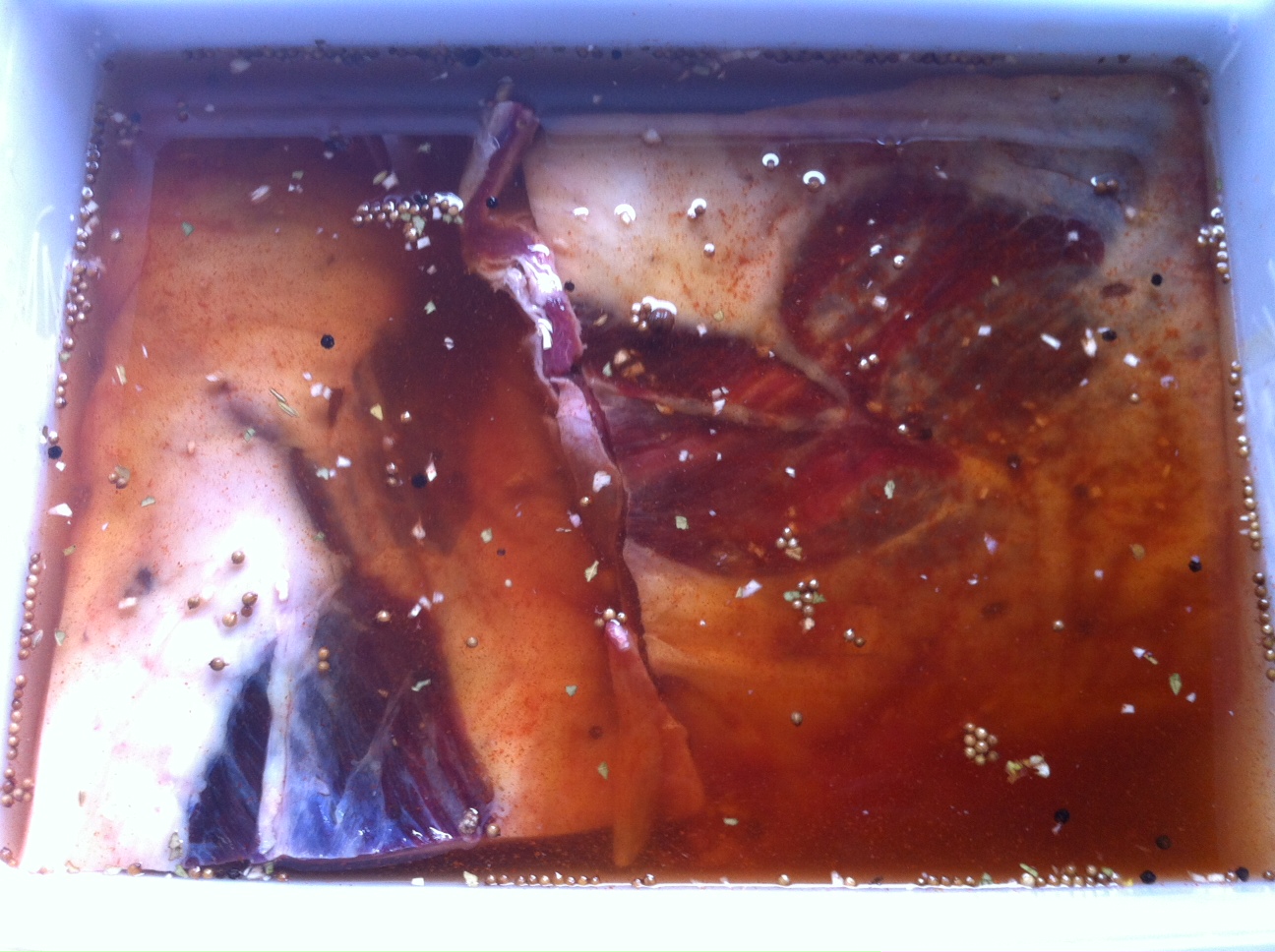
Brining the beef brisket

Brining the beef brisket

Step one: corned beef…

beef brisket (about 8-10 pounds)
2 tsp. paprika
1/4 cup warm water
3 cloves of minced garlic
2 tablespoons sugar
1 tablespoon mixed pickling spices
3/4 cup salt
2 quarts water

Place the brisket in a large container made of non-reactive material, like glass or plastic.

In the 1/4 cup of warm water, dissolve the sugar, minced cloves, paprika and pickling spices.

Dissolve the 3/4 cup of salt in the 2 quarts of water. Pour in the sugar/garlic/paprika/pickling spices mix and stir everything together. Pour the mixture over the meat in the container. Make sure the meat is totally beneath the surface of the liquid. (You may need to weigh it down to do this.) Cover the container.

Refrigerate the container and contents for 3 weeks, turning the meat once or twice per week. At the end of the third week, remove the container from the refrigerator and take out the meat. Soak the meat in several changes of fresh cold water over a period of 24 hours to remove the excess salt.

At this point, if you want corned beef, prepare and cook it using your favorite recipe. But I’m all about the pastrami!

Step two: making Pastrami…

pastrami


Brined and rinsed corned beef brisket from above recipe, patted dry with paper towels

1/4 cup Kosher salt

1/4 cup paprika

3 tablespoons coriander seeds

2 tablespoons black peppercorns

2 tablespoons yellow mustard seeds

1 tablespoon white peppercorns

3 tablespoons brown sugar

1 tablespoon granulated garlic

Combine coriander seeds, black and white peppercorns and mustard seeds in a spice grinder and grind coarsely. Place in a bowl. Add salt, paprika, brown sugar and granulated garlic. Mix well.

Rub the mix into the brisket well, covering all sides.

Heat smoker to 225 degrees and smoke for several hours using a less intense wood, like oak. When the internal temperature of the meat has reached 165 degrees, it’s done. It isn’t necessary to smoke pastrami as long as you would a regular brisket because the long brining time makes the meat tender.

It is very important that absolutely everything that comes in contact with the meat is very clean. (This includes your hands.) Also, make very sure that every inch of the meat reaches the 165 degrees before it is removed from the smoker. The corned beef is now pastrami.

Calamari is the official appetizer of the state of Rhode Island. And for good reason. Squid means big business, and what we catch in Rhode Island accounts for up to 50% of the east coast’s quota every year! Squid have a lifespan of 12 to 18 months, reproduce twice a year, and can be caught year-round, with very few catch limitations, making it lucrative for fishermen.

Great fried calamari is an art form. It may seem like a simple dish, but to make it light and crispy, you need to be on your game. That’s why it can be a real hit-or-miss item on most restaurant menus. And there’s nothing worse than getting what would have been a great plate of calamari had the chef not decided to pour sauce all over it, turning the crispy cephalopod into mush.

What makes great fried calamari are three basic elements: it needs to be wild caught in the US (preferably Rhode Island!) and properly cleaned…it needs to be fried at the right temperature for the right amount of time so that it’s perfectly cooked and not greasy…and the coating needs to be light and crispy.

calamari


1 lb. wild caught cleaned squid (thaw if frozen)

1 cup flour (I use gluten-free these days)

1 teaspoon dried oregano

1  teaspoon paprika

1 teaspoon dried parsley

1/2 teaspoon granulated garlic

1 1/2 teaspoons salt

1/2 teaspoon black pepper

1 cup milk

1 large egg

oil, for frying (I use avocado oil)

Thaw the squid and slice into bite-sized rings. In a bowl, whisk the milk and the egg together. Toss in all the squid pieces into the bowl to coat. Place the bowl in the fridge for at least 15 minutes.

In another bowl, combine flour, oregano, paprika, parsley, garlic, salt and pepper. Set aside.

Fill a large pan halfway with oil…or use a deep fryer if you have one. Heat the oil to 350 degrees.

Working in small batches, remove the squid from the milk and egg mixture, let some of it drip off, then place the squid in the flour mixture and toss to coat. Shake off any excess flour and place immediately into the hot oil. Fry until golden brown, about 4 minutes. Serve immediately with tartare sauce, tomato sauce, hot peppers, whatever you like. (But keep the sauces on the side for dipping.)

About the oil: I cook almost exclusively with olive oil. But for hot frying like this recipe requires, I go with avocado oil, which can take higher temperatures.