Posts Tagged ‘food’

Quarantine time is a time to try new recipes. So when I got a couple of pounds of ground venison from my buddy, Bruce, an avid hunter here in my town, I started thinking about what I could make with it.


I didn’t want to go with a venison burger right out of the gate. After all, venison is very lean, containing half the fat of beef, but with more protein. In fact, venison even challenges chicken in the protein department. But being really lean, it would dry out as a burger, so I decided to go with the safer option of making a taco with it.

Well, somewhere in the process of taco making, I thought of pork and beans and said: “Yeah, what if I made something like venison pork and beans? How bad could that be?”

Well, venison and beans can almost be called chili (depending on what rules you have about beans in chili), and I thought: “But I don’t really like chili.” But then I thought: “It’s not chili if I don’t call it chili.” Problem solved!


I used small red beans, but you can use what you like.


So what I finally came up with is a venison pork-and-bean chili taco…or something like that.

Whatever…it tastes pretty good!

And obviously, if you don’t have venison, you can use lean (like 93%) beef for this recipe.


1 tablespoon avocado oil
1 small onion, finely chopped
4 strips (about 40g) pre-cooked bacon, finely chopped
1 lb. ground venison
Taco seasoning (see the recipe below)
20 grape tomatoes (100g), chopped
1/2 cup ketchup
2 tablespoons spicy brown mustard (I like Gulden’s)
2 tablespoons Worcestershire sauce (Only Lea & Perrins will do)
4 tablespoons brown sugar
2 cans (15.5 oz. each) of small red beans, not drained


Pre-heat your oven to 350 degrees.

Spray a baking pan with oil spray (I use avocado) and set aside.

In a large pan, heat the avocado oil and add the chopped onion. Sauté the onion until it’s translucent.

Add the chopped bacon, and sauté until some of the fat starts rendering out of it.

Add the pound of venison, and cook until the meat has browned nicely, adding the taco seasoning to the meat as it cooks, little by little, until you’ve used all the taco seasoning up.

Add the chopped grape tomatoes, and stirring after each addition, add the ketchup, mustard, Worcestershire, and brown sugar.

Pour in the two cans of beans, liquid and all, and stir gently, letting it all come to a boil.


Pour the contents of the sauté pan into the baking pan, cover it with foil, and place it in the 350-degree oven to cook for 40 minutes.

After 40 minutes, remove the foil off the pan and cook another 10 minutes.


The Taco Seasoning…
2 teaspoons cumin
1 teaspoon salt
1 teaspoon black pepper
1 teaspoon oregano
1 teaspoon granulated garlic
1 teaspoon granulated onion
1 teaspoon paprika

Combine all the ingredients in a bowl, and set it aside.


Once the venison pork-and-bean chili taco meat has finished cooking, I like to use it in a flour tortilla, with shredded lettuce and a little shredded cheese on top.
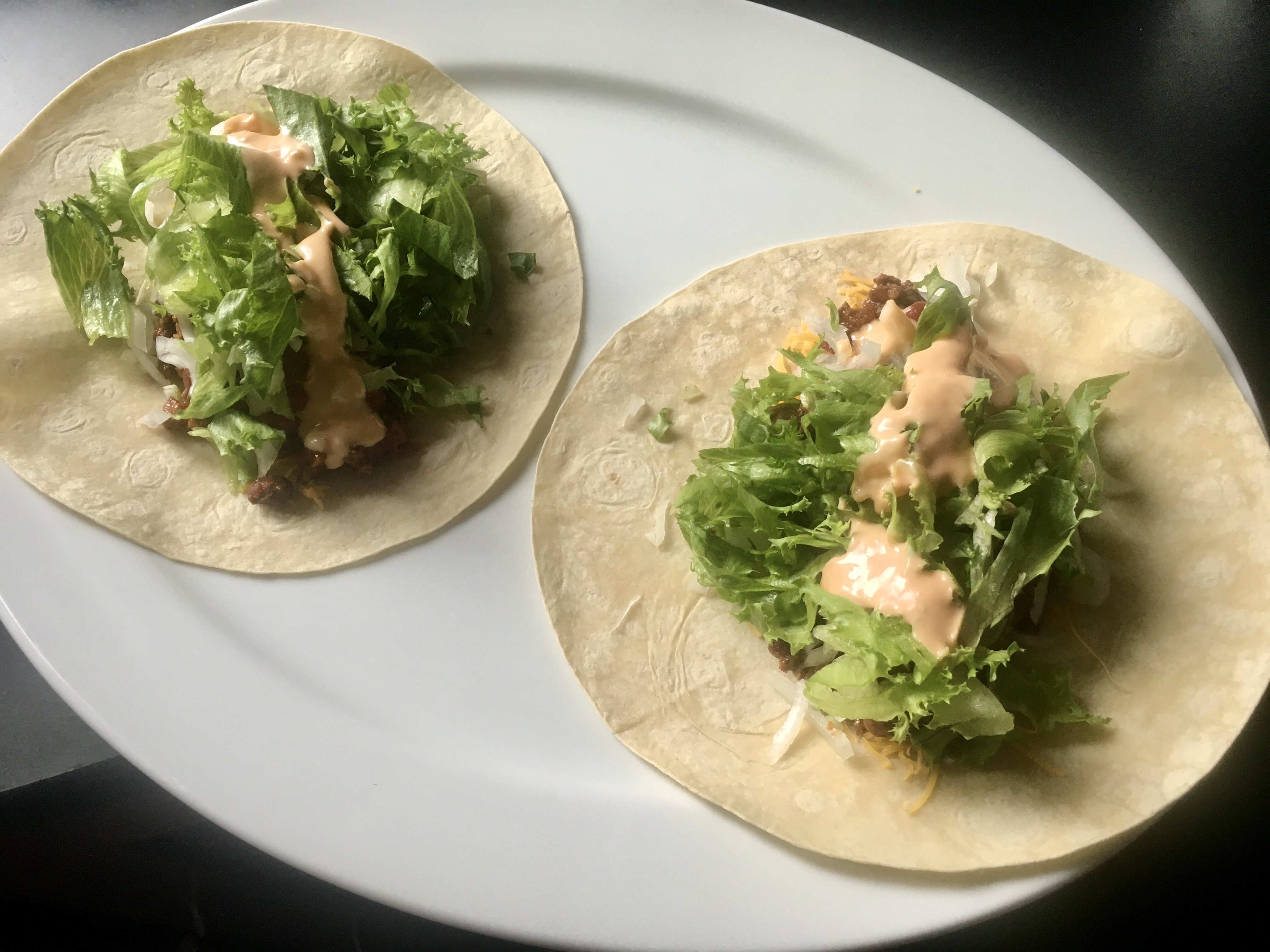
 

Shredded lettuce, grated cheddar cheese, some raw Vidalia onion, and a touch of 1000 Island dressing!


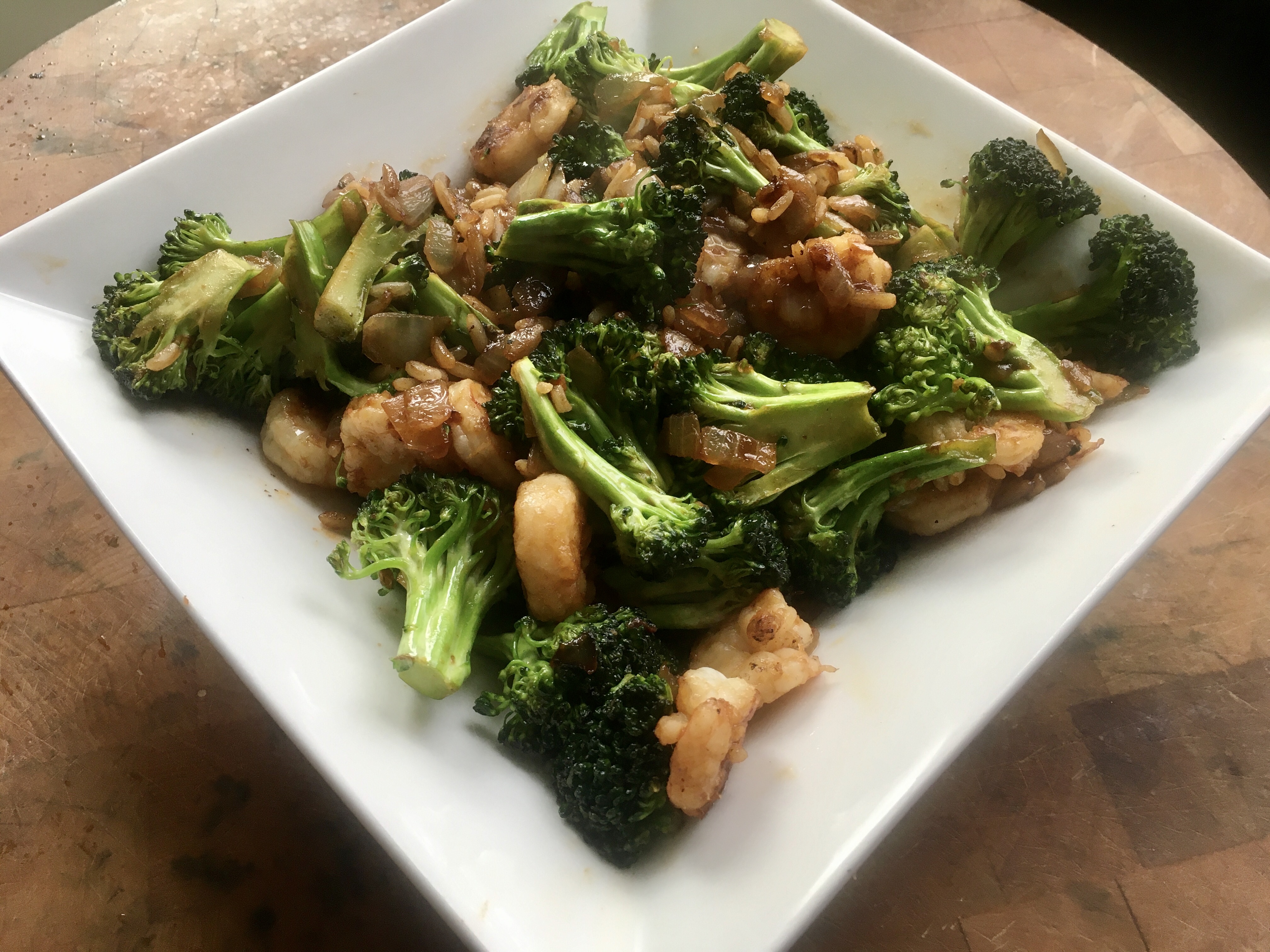
As much as I want to support my local restaurants, quarantining has kept me away more than usual. There are some dishes I crave more than others, and Chinese shrimp and broccoli is one of them. But it’s really quite easy to make it at home, and it’s surprisingly low in calories if you’re really careful with the amount of oil you use. Oil is the biggest culprit when it comes to calories in Chinese cooking.

Second on the list of calorie culprits is rice. It looks innocent enough, but a cup of rice has 170 calories, and if you’re limiting yourself to a daily calorie count of 1500, like I am, that becomes pretty significant.

The good news is that shrimp is actually one of the lowest calorie foods you can buy, checking in at only 1 calorie per gram. Broccoli is also low in calories, so if you skip the rice, you can really eat your fill of this delicious dish.


I’ve come up with what I call my “Asian Mix,” which is a combination of five ingredients commonly found in the supermarket in the Asian food section. Add these to your shrimp and broccoli, and you will never need to leave home for really good Chinese food!

Asian Mix…
1 tablespoon soy sauce
1 tablespoon hoisin sauce
1 teaspoon rice vinegar (unseasoned)
1/2 teaspoon sesame oil
1/2 teaspoon chili garlic sauce

Combine these ingredients in a bowl, mixing well. Set aside.


1 small onion, chopped
2 cloves of garlic, finely chopped
1 or 2 large heads broccoli, chopped into smaller, similar-sized pieces
1 lb. wild-caught American shrimp, peeled and deveined
Asian Mix, as listed above
peanut oil

I prefer peanut oil when cooking Asian dishes.

Heat a nonstick pan and add 1 tablespoon of peanut oil to it. Add the chopped onion, and cook until translucent.

Add the chopped garlic and stir for about 10 seconds.

Add the chopped broccoli and cook until the broccoli turns bright green but stays crunchy.

Empty the pan out into a bowl and, without wiping the pan down, add the shrimp to the pan (no more oil!), returning it to the heat. Let the shrimp heat in the hot pan for 30–60 seconds on one side, then flip the shrimp over and let them heat through for 30–60 seconds on the other side.That’s all you need to cook them, unless they’re really large. Just keep flipping them until they’re pink and firm, but don’t overcook them.

Remove the pan from the heat, and add a tablespoon of the Asian Mix to the shrimp, tossing them around to coat them with it. Don’t let them burn!

Now bring back the onions, garlic, and broccoli to the shrimp in the pan, tossing everything together, and adding more of the Asian Mix until everything is nicely coated.


Serve immediately…over rice or not!


I started a diet a few months ago, and one of the major changes in my eating habits was to incorporate more seafood and less meat into my diet. Seafood has a lot more protein and fewer calories. In fact, shrimp, lobster and oysters are some of the most delicious low-calorie foods you can enjoy, running about 1 calorie per gram. It’s what you add to them–oils, melted butter, batter–that makes them high in calories.

I’ve always loved sushi, but again, on a diet, I need to limit my intake of unnecessary calories, and rice is big on that list. I’ve found that I can use a lot less rice, or maybe none at all, when I make poke…and I get all the satisfaction of sushi or sashimi.

My two favorite fishes to eat raw are ahi tuna and wild-caught Alaskan salmon, like sockeye. There are many great purveyors of this super-high quality seafood online, and I usually buy a decent amount of fish at one time–hermetically sealed and frozen in 4-ounce packages–to last me a long time. (The price is often much better when you buy in quantity, because they have to be shipped frozen overnight.)


Yes, please.


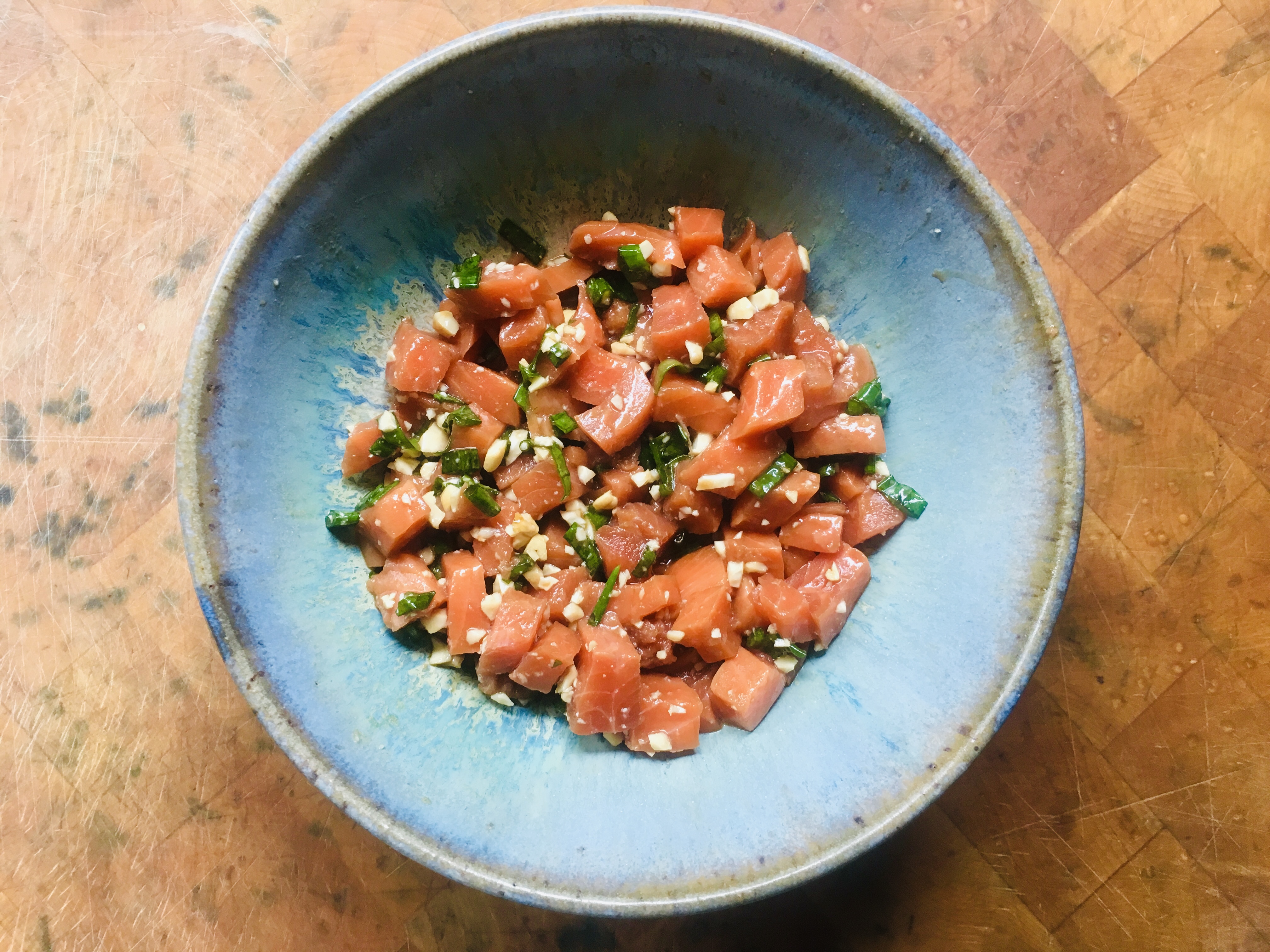
There are many ways to prepare poke, and the only limitations are what’s in your fridge. The first recipe, using salmon, is closer to a traditional poke recipe you’d find in a restaurant.


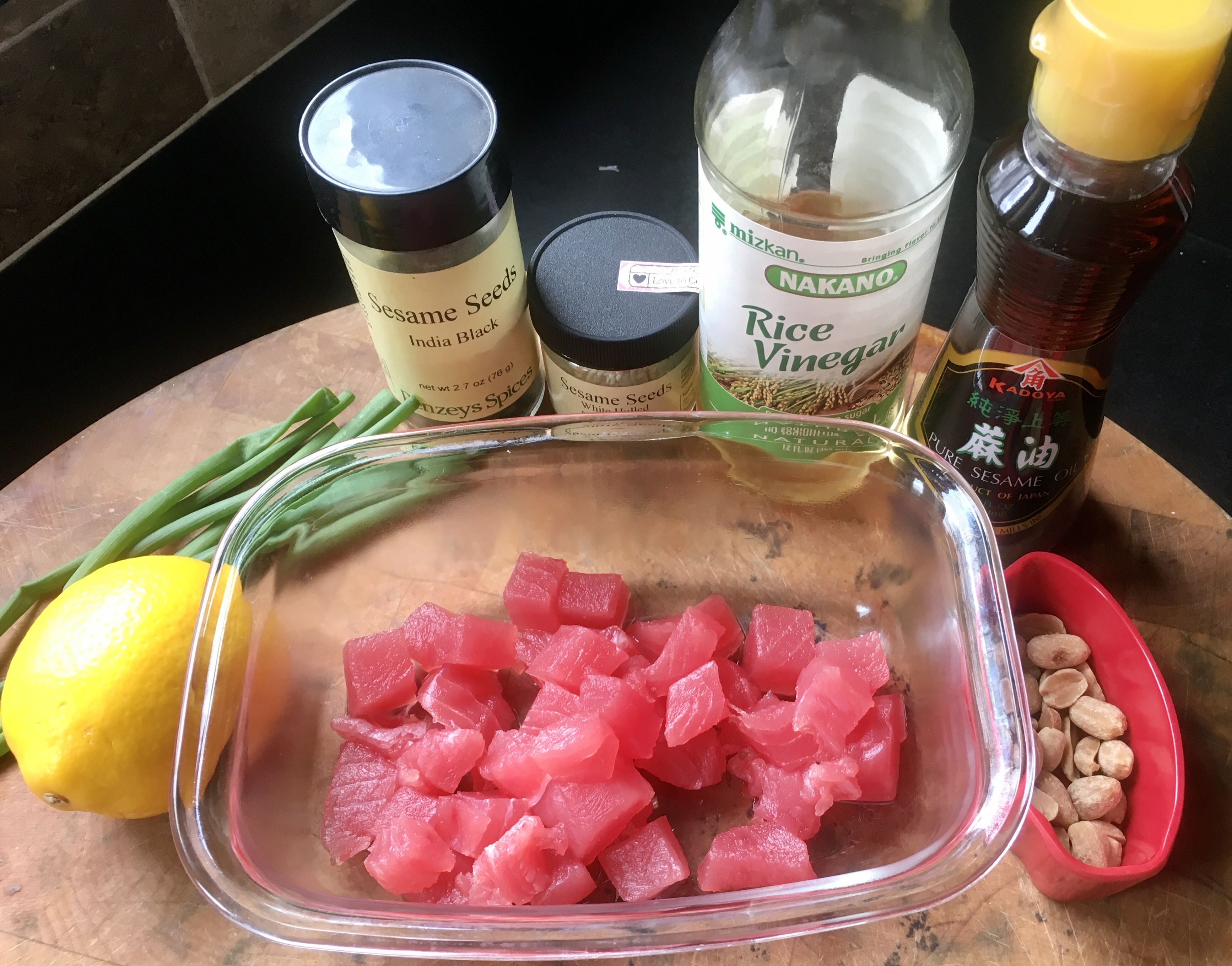
6.5 ounces wild-caught Alaskan salmon, in the refrigerator (thawed, if previously frozen)
1 tablespoon soy sauce
2 teaspoons sesame oil
1 teaspoon rice vinegar
1/2 teaspoon fresh lemon juice
1/3 cup chopped raw cashews
1 scallion, green and white parts finely chopped
Keep the thawed salmon in the refrigerator. Remove the salmon from the fridge, and remove the skin if it is still on the fish. Cut the fish into half-inch cubes. I like t place the salmon cubes on a clean paper towel to absorb excess moisture from thawing. Then I place the salmon cubes in a bowl and put it back in the fridge while I combine the other ingredients.
In another bowl, combine the soy sauce, sesame oil, rice vinegar, and lemon juice. Whisk them together.
Chop the cashews and add them to the bowl, mixing them in.
Cut the root ends off the scallions, chop the green and white parts finely, and add them to the bowl, mixing them in.
Add the salmon to the bowl, mixing gently, so that you don’t damage the fish.
Let it sit for 10 to 15 minutes, if you can wait that long, and then: eat!
My tuna poke recipes have also used similar ingredients…
More recently, I mixed up a batch of what I call my “Asian Mix,” a blend of five Asian flavors that really work well together: soy sauce, hoisin sauce, chili garlic sauce, rice vinegar, and sesame oil. I let my tuna or salmon marinate in this mix for about ten minutes before adding the other ingredients and feasting.

Tuna poke with lettuce, onion, pine nuts, black and white sesame seeds, rice and my “Asian Mix.”


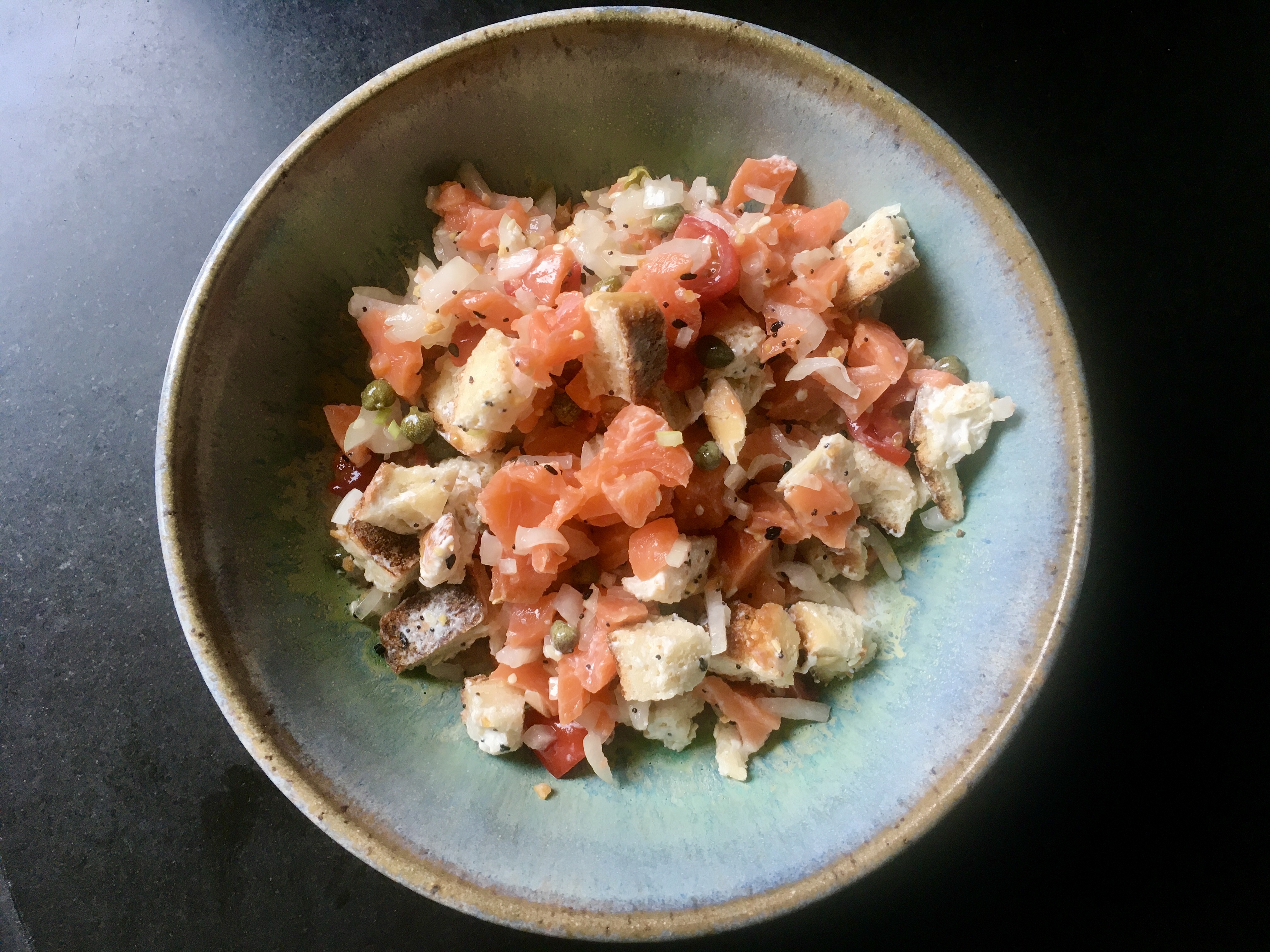
But my proudest achievement was taking my favorite sandwich from my home town of New York, and making it into a bowl. The sandwich is an everything bagel with salmon and cream cheese, and my poke version uses just a bit of the bagel, yet you still get the flavor without all the calories. The secret is a seasoning you can buy already prepared.
3 oz. wild-caught Alaskan sockeye salmon, cubed
1 tablespoon capers
1/2 small Vidalia or sweet onion, sliced very thin
1/2 tomato, seeds removed, sliced thin
1/4 of a toasted plain bagel
1 tablespoon cream cheese
2 teaspoons Everything Bagel seasoning
1 chopped hard boiled egg
Cut the salmon into small 1/2″ cubes and place it in a bowl. Add the tablespoon of capers (including some of the brine), chopped onion and tomato. Mix gently.
Toast the bagel and use only 1/4 of it (I use that little for the sake of calories. But you can use more, if you like!) Spread the tablespoon of cream cheese on the toasted bagel, then carefully chop it up into small cubes. Add this to the bowl. Sprinkle in the Everything Bagel seasoning and the chopped hard-boiled egg, and give it all one last gentle toss.
Then take a forkful, close your eyes, and imagine you’re in your favorite New York deli!

Did you have to go to work? Quarantined at home? either way, TGIF! Let’s make some drinks!

I’ve decided to look back at some of the more interesting cocktails I’ve had in my travels, and chances are, I still have most of the ingredients somewhere in the back of my bar to make them once again.

Coppa is a wonderful small enoteca in Boston’s South End, featuring small plates by award-winning chefs Ken Oringer and Jamie Bissonette. (They’re also the 2 creative forces behind Toro in Boston and NYC.)

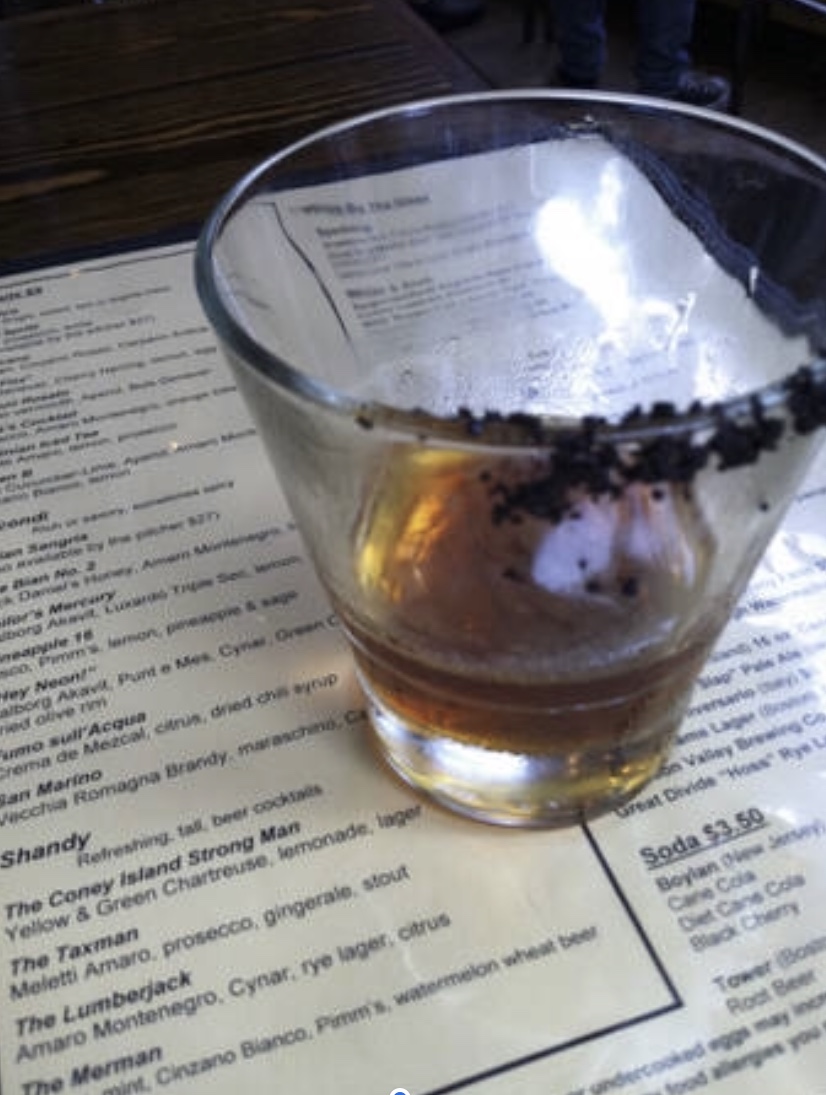
The food was incredible, and this drink, called “Hey, Neon,” was inspired. The glass was rimmed with dehydrated and finely chopped kalamata olives. I tried to recreate that at home, and couldn’t get the texture or the size right. And I could never get it to stick to the glass, either! Ultimately, I simply skewered a few kalamatas and placed them on the glass!


The original “Hey Neon” at Coppa.


“HEY NEON”

1 1/2 oz. Aalborg aquavit
3/4 oz. Punt e Mes
1/2 oz. Cynar
1/2 oz. Green Chartreuse

Add ice to a cocktail shaker and then add the ingredients. Stir well, until very cold. Strain into a martini glass. Add the skewer of kalamata olives.


Aalborg is a brand of aquavit (or akvavit), a clear alcohol similar to vodka but usually infused with other flavors, mainly caraway or dill, popular in Scandinavia.

Punt e Mes is a sweet vermouth, the so-called “little brother” of the granddaddy of all sweet vermouths: Carpano Antica Formula.

Cynar is an Italian bitter and digestif made from herbs, plants and artichokes. Strong in flavor, but delicious!

Chartruese is a French liqueur made by Carthusian monks since 1737, using a recipe that dates back to 1605. It contains 130 herbs and plants. It’s also one of the few liqueurs that ages in the bottle, changing over time. Green Chartreuse is 110 proof, and naturally colored from the maceration of its ingredients. Yellow Chartreuse, at 80 proof, is a milder and sweeter version.


My version of the “Hey Neon.”


It’s never a healthy option to eat fast food. Michael Pollan said it best: “It’s not food if it arrived through the window of your car.”

So while I’m quarantined in my home, it’s really not fair that I’m getting my biggest cravings ever for some of my favorite fast food guilty pleasures. The answer? Try to re-create them at home.

A few years ago, the nephew of Colonel Sanders revealed the 11 secret herbs and spices that made KFC‘s original recipe chicken a worldwide success. He claimed he worked for his uncle for many years and had to make huge batches of the seasoning mix.

For me, KFC is like crack. Although I’m a big proponent of grass-fed this and pastured that, my kryptonite is KFC‘s original recipe chicken. There’s a KFC right next door to a local Home Depot in my area and my car literally drives itself to the pick-up window…I can’t help it. I justify the consumption of this heavenly grease by asking for no sides–no biscuit, no nothing. I get one breast and one thigh, and I drive off, steering my car with my knees as I indulge in my dirty secret, the hot grease dripping down my chin, a roll of paper towels at my side.

Making the KFC chicken recipe at home means I do have some control over product quality. I can use pastured or organic chicken. I can use clean oil. I don’t have the fancy pressure fryer they use at KFC, but I can use the healthier option of oven-frying. That means I fry my chicken in oil until golden brown, then finish the cooking process in the oven.

I have to say, the recipe really works! Maybe if I placed the real KFC side-by-side with my home-made chicken, I’d notice a difference. But it was pretty damn close and absolutely delicious! If I could change one thing, I would use smaller chicken pieces next time. I used large pieces and the meat-to-breading ratio was off. Though it was mighty tasty, I was craving more breading per bite.

The recipe calls for all-purpose flour, but if you follow a gluten-free lifestyle, using Cup4Cup GF flour works just as well.


2 cups all-purpose flour
3 tablespoons paprika
1 tablespoon celery salt
1 tablespoon dried mustard
1 tablespoon garlic salt
1 tablespoon ground ginger
2 teaspoons black pepper
1/2 teaspoon white pepper
1 1/2 teaspoons thyme
1 1/2 teaspoons basil
1 1/2 teaspoons oregano
1 teaspoon salt
1 cup milk
1 egg
5 lbs. chicken pieces…your choice
oil, for frying


Combine the flour and the “11 herbs and spices” in a bowl. Mix well.

In another bowl, whisk together the milk and the egg. Add the chicken pieces to this bowl and let the chicken soak in it for 10 minutes.

Pre-heat the oven to 350 degrees.

Pour a couple of inches of the oil into a pan with high sides and heat it to 340 degrees, using a thermometer. Don’t fill it with too much oil, because oil expands when hot and it could spill over.

Take the chicken pieces out of the milk and egg mixture and coat them with the seasoning mix one at a time, making sure you coat them well. Carefully place the chicken in the hot oil. Don’t overcrowd the pan…work in small batches. Too much chicken could cause the oil to spill over the top.

Fry the chicken pieces just until golden…no need to cook them all the way through. Place the pieces on a baking sheet lined with non-stick aluminum foil. When all the chicken has been fried, place the baking sheet in the oven and cook until the chicken pieces reach an internal temperature of at least 160 degrees.


Make a lot! Leftovers are great, and they re-heat really well in the oven! (Don’t use a microwave…the oven is best.)

I give up! Everyone baking their hearts out right now, so I suppose I should, too! This is one of my favorites because it not only tastes amazing, it freezes really well.

My original banana bread recipe blog is featured directly below. It’s awesome. But if you follow a gluten-free lifestyle, no worries. My gluten-free version of the recipe, at the bottom of the page, is so good, you won’t miss the wheat!


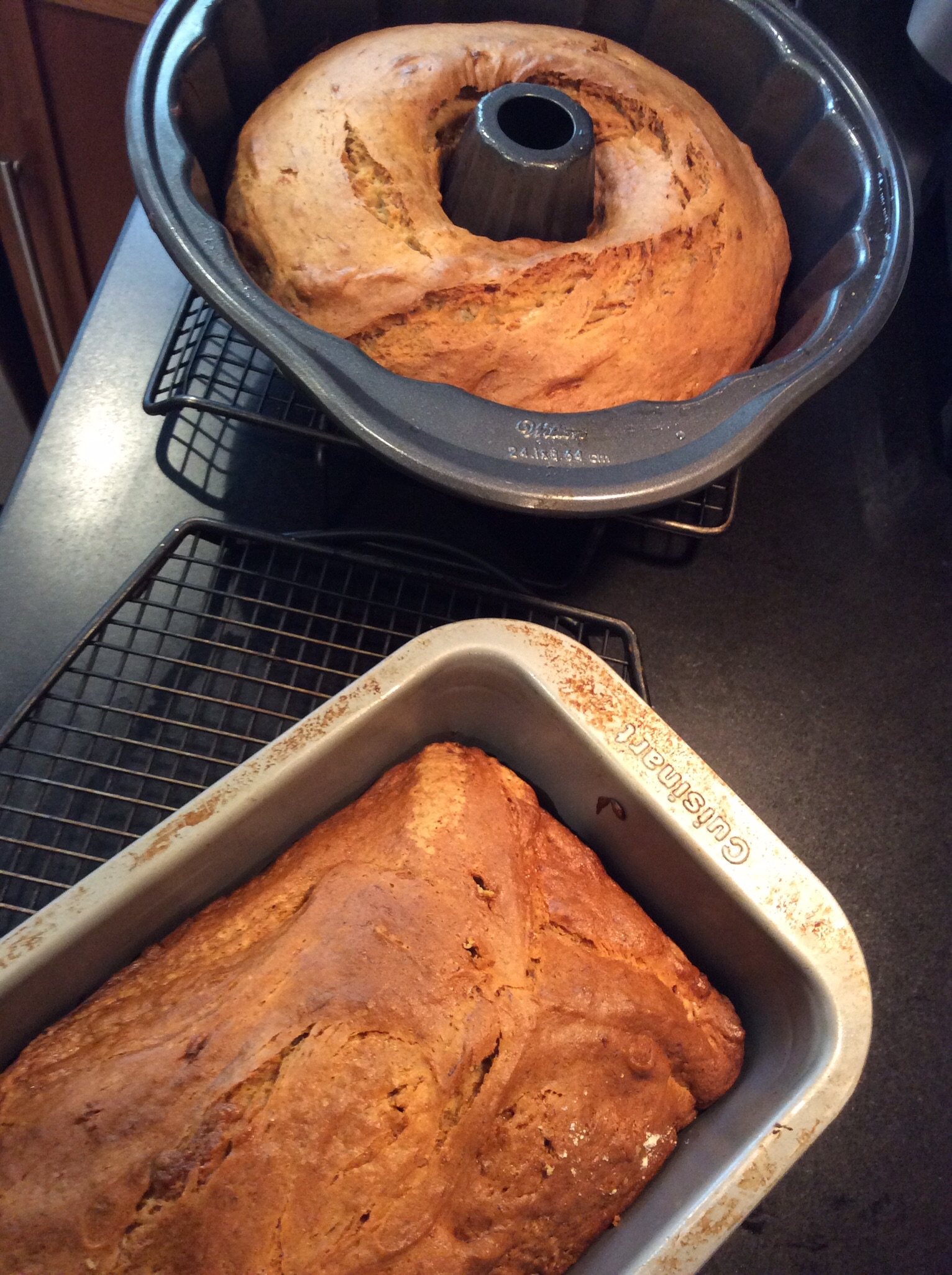
A gluten-free batch.


The original recipe…

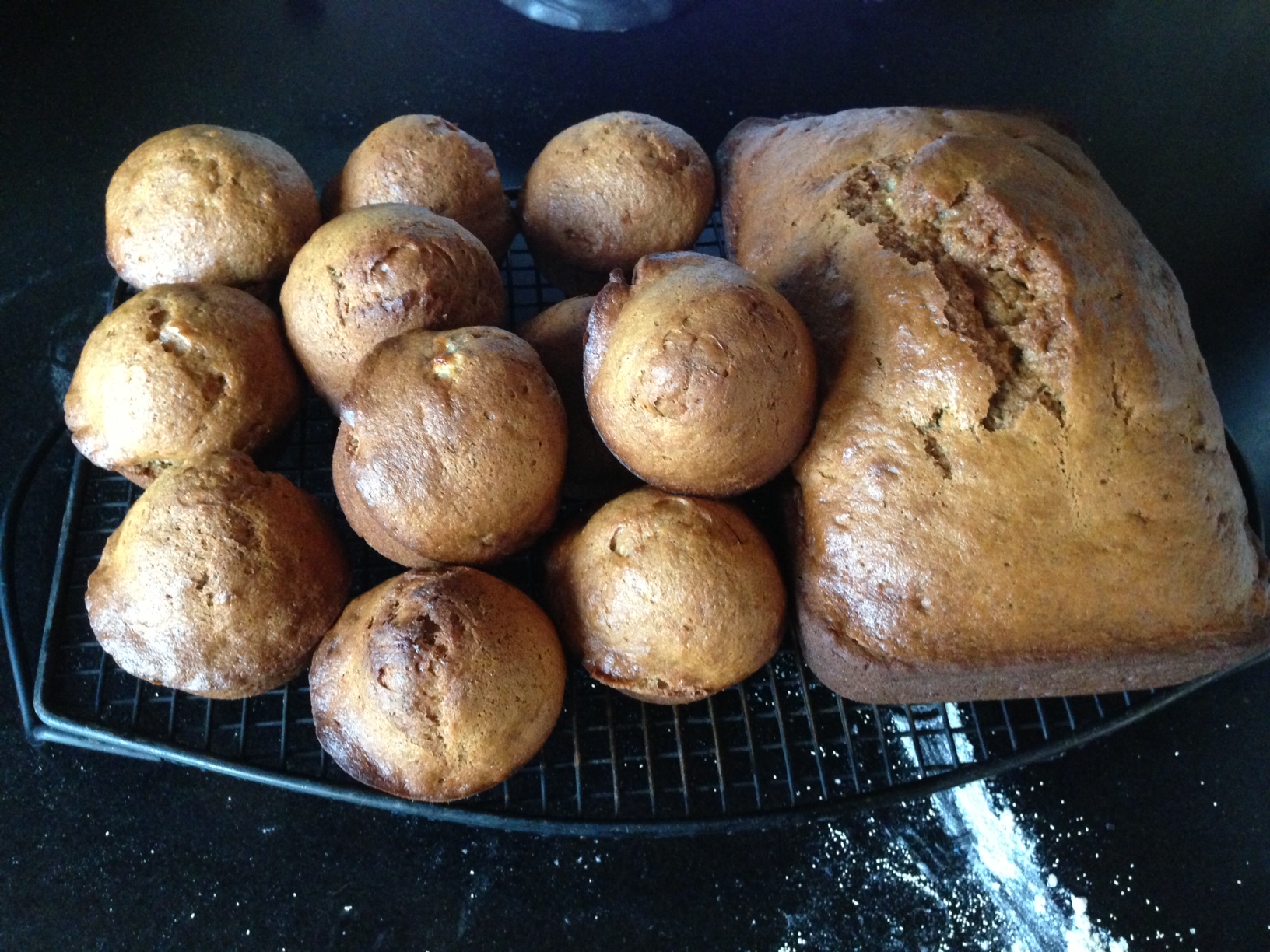
What makes this banana bread special is that it uses whole wheat flour…less sugar…and no artificial extracts that make most banana breads taste like crap. It relies on very ripe bananas to give it its wonderful natural flavor.

It’s not always easy to get bananas to ripen exactly when you’re trying to make your banana bread recipe. So I buy a large bunch of bananas and let them get very ripe at room temperature. I then take 5 at a time (for this recipe), peel them, and place the bananas in a Ziploc bag in the freezer. When it’s time to make banana bread, I just pull one of those Ziplocs out of the freezer, let it thaw, and mash with a potato masher.

Since Roundup is a very common herbicide used on wheat, and its cancer-causing characteristics are widely known by now, I always use organic wheat for my baking recipes.

I use organic cane sugar instead of regular sugar when I have it. I don’t use vegetable oils, especially not canola, so I use healthier avocado oil or olive oil. Eggs are pastured when I can get ’em. Bananas are organic. And I rub the pans with coconut oil or I use an olive oil cooking spray.


Nana bread blog


3 cups all-purpose flour
1/2 cup whole wheat flour
2 tsp baking soda
1/2 tsp salt
1 1/4 cup sugar
3/4 cup vegetable oil
2 eggs
5 medium-sized bananas, peeled and mashed
2 tsp real vanilla extract
Cooking spray

Pre-heat the oven to 350 degrees.

Combine the all-purpose flour, whole wheat flour, baking soda and salt in a medium bowl. Set aside.

Combine the sugar and oil in a mixing bowl and mix at medium speed for 2 minutes. (I use the whisk attachment.) Add the eggs, one at a time. Beat until the mixture is light and lemon colored.

With the mixer running at low-speed, add the flour mixture alternately with the bananas, beginning and ending with the flour mixture. Blend well after each addition. Add the vanilla extract and blend some more to mix.

Pour the batter into 2 loaf pans that have been sprayed with cooking spray. Bake for 45 minutes or until a wooden pick inserted in the center comes out clean. Cool 15 minutes in the loaf pan on a wire rack.

Remove from the pan and let it cool completely on the wire rack before slicing.

image


The gluten-free recipe…

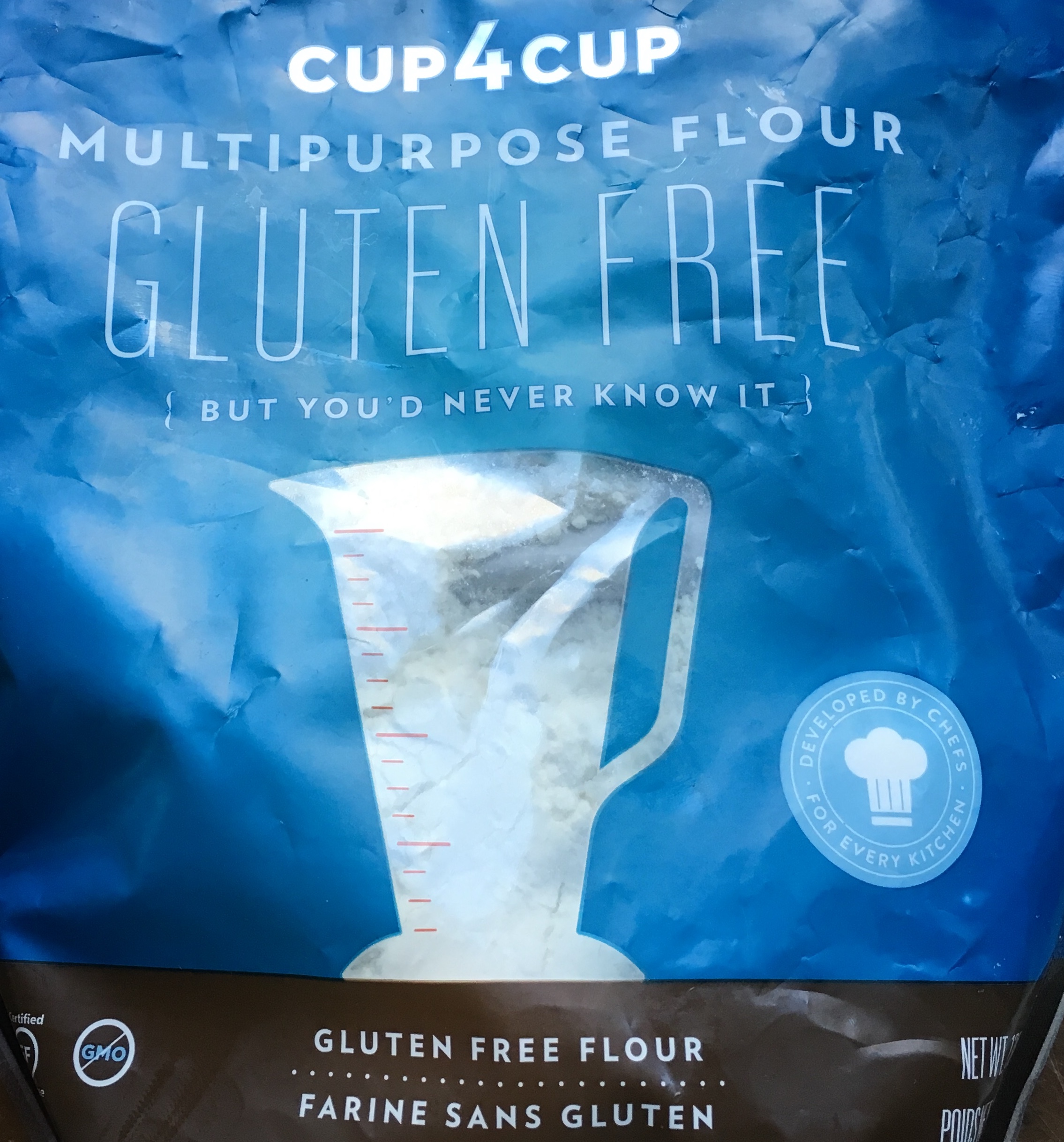
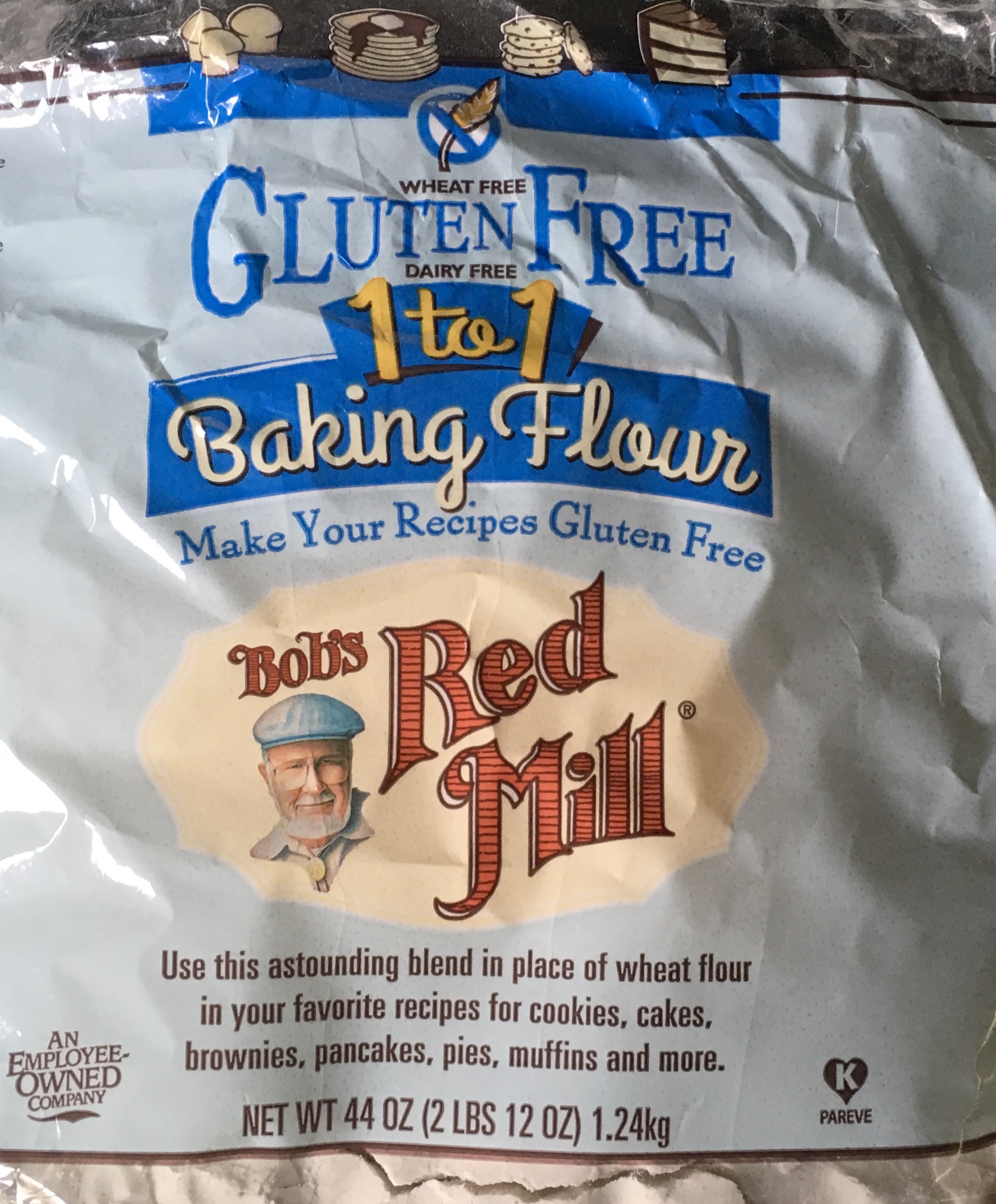
My go-to gluten-free flour is the brand called Cup 4 Cup. You can find it in most supermarkets. But this time I tried the gluten-free baking flour by Bob’s Red Mill. Both flours gave excellent–and tasty–results.


If you want a slightly more “rustic” flavor, you can substitute 1/2 a cup of corn meal for 1/2 a cup of the flour.


image


4 cups gluten-free flour
2 teaspoons baking soda
1/2 teaspoon salt
1 1/4 cup cane sugar
3/4 cup avocado or olive oil
2 eggs
5 medium-sized bananas, peeled and mashed
2 teaspoons real vanilla extract
coconut oil


Pre-heat the oven to 350 degrees.

Combine the flour, baking soda and salt in a bowl. Set aside.

Combine the sugar and oil in a mixing bowl and mix at medium speed for 2 minutes. (I use the whisk attachment.) Add the eggs, one at a time. Beat until the mixture is light and lemon colored.

With the mixer running at low-speed, add the flour mixture alternately with the bananas, beginning and ending with the flour mixture. Blend well after each addition. Add the vanilla extract and blend some more to mix.

Pour the batter into 2 loaf pans or one large bundt pan that have been rubbed with the coconut oil. Bake for 45–60 minutes or until a wooden toothpick inserted in the center comes out clean. Cool 15 minutes in the pan on a wire rack.

Remove from the pan and let it cool completely on the wire rack before slicing.


REUBEN SOUP

Posted: April 1, 2020 in bacon, cheese, Food, Recipes, sauerkraut
Tags: , , , ,

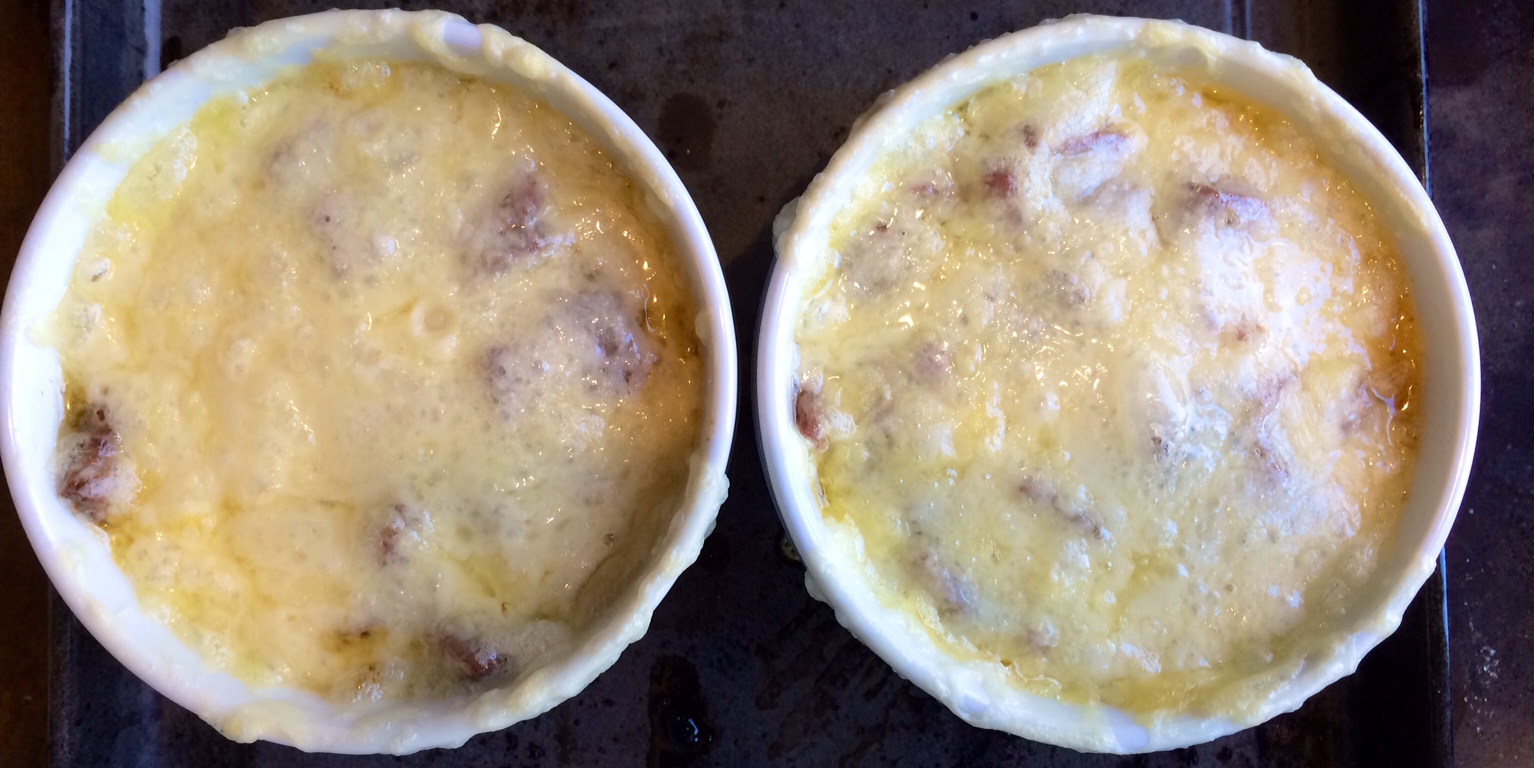
Why have soup and a sandwich when your soup can be your sandwich? I had all the ingredients to make a Reuben sandwich. But I wanted soup. So I made Reuben Seup…I mean Soup!

Think French onion soup, but using Reuben ingredients…


Rye bread slices
Sauerkraut, drained and rinsed
Chicken stock
Pastrami, sliced thinly
Swiss cheese, sliced thinly


I like to take the sauerkraut, rinse it under cold water, then toss it in a pot that already has some finely chopped bacon and onions cooking in it. Once the ingredients have cooked down, set it aside. (If you prefer not to use bacon and onions, that’s fine, too.)

Find a source for great pastrami, like a good deli in your neighborhood. I make a stop at the Forest Pork Store in Huntington, NY, every time I visit my Mom, and they have incredible pastrami you only dream about.

Heat the chicken stock in a pot. Take the thinly sliced pastrami and chop it up into bite-sized pieces. Place the pastrami in the chicken stock to warm through. Keep the stock warm on low heat.

Now you’re ready to assemble…

rye

Take an oven-proof soup bowl. Line the bottom with some rye bread.


kraut

On top of that, place a nice helping of the sauerkraut.


stock

Pour the warm chicken stock with the pastrami over the sauerkraut.


swiss

Layer slices of Swiss cheese over the top of the bowl. Place it under the broiler until melted.


melty

Eat!


eat

It satisfied my soup and sandwich craving!


I’ve always loved Manhattans and Negronis…two different cocktails, yet similar in certain respects. Both use sweet vermouth. Both have a touch of bitterness: Manhattans will often include a few dashes of angostura bitters, where a Negroni gets its bitterness from Campari. So when I visited Food Network chef Geoffrey Zakarian’s The Lambs Club restaurant in NYC a few years ago, and tasted my first Boulevardier, I was instantly hooked.

Loosely translated, a boulevardier is a “man about town.”

The cocktail was created by Erskine Gwynne, the publisher of “Boulevardier,” a magazine for expats living in Paris in the 1920s. It’s basically a Negroni with whiskey instead of gin.

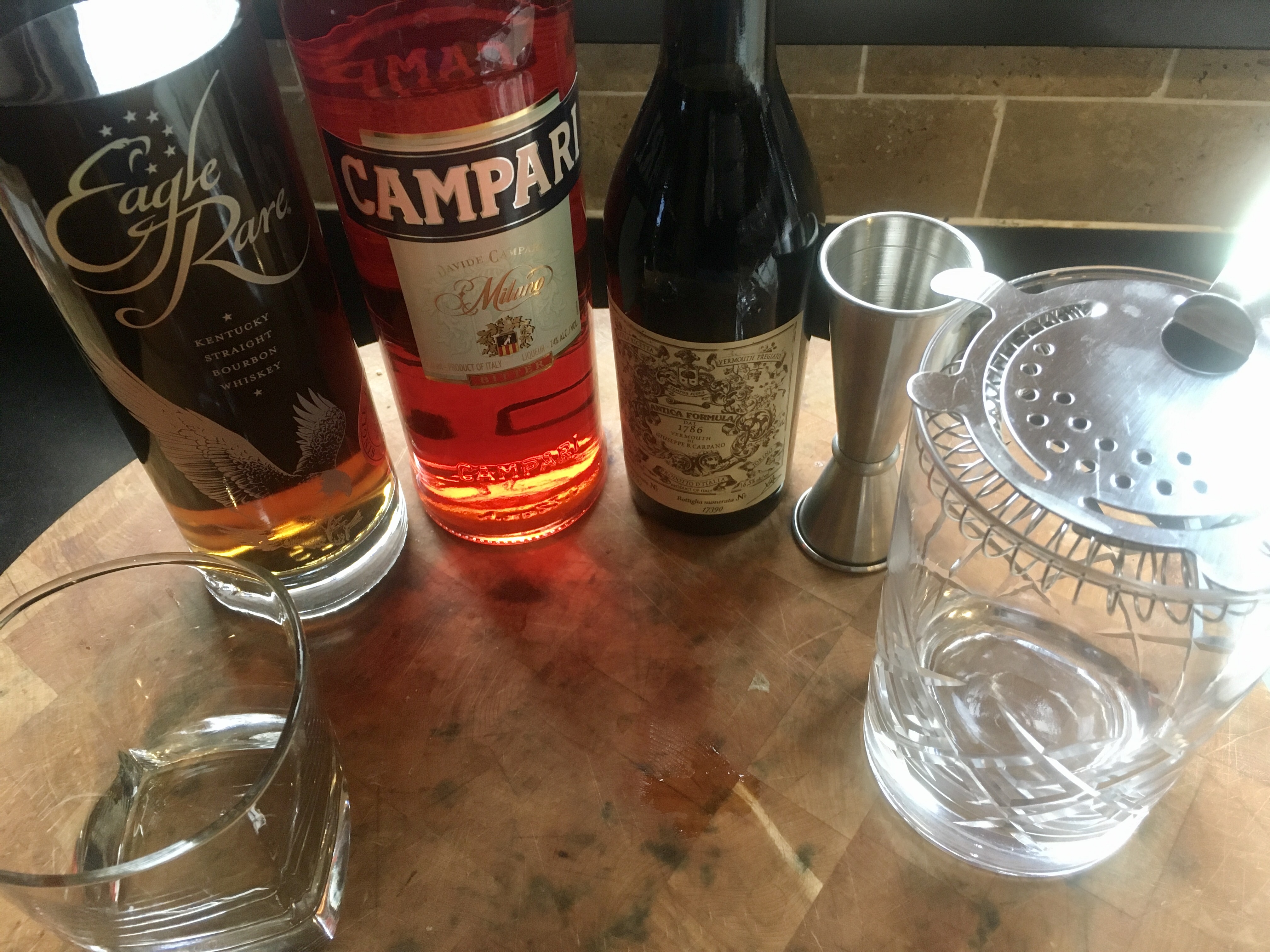
My personal preference for whiskey is bourbon, and one of my favorite bourbons to mix with is the very affordable Eagle Rare. And for sweet vermouth, nothing beats the grandaddy of them all: Carpano’s Antica Formula.

I was just reading an interview with food blogger and cocktail expert, David Lebovitz, in the Wall Street Journal, and he mentioned the Boulevardier as one of his favorite cocktails. I hadn’t had one in ages, and started digging in my bar inventory. Bourbon is something I always have…but I also found Campari and an unopened small bottle of Antica Formula. I was all set for a great night of quarantining!

Be very careful, especially with the vermouth. If you stray and buy some cheap brand, the drink will resemble nothing even close to what it could truly be!


2 oz. bourbon or whiskey
1 oz. Campari
1 oz. sweet vermouth (Antica Formula preferred)


Add some ice to a cocktail shaker. Add the ingredients and stir. Strain into a rocks glass with a large cube.


Perfection.


Eagle Rare bourbon: Everyone has their favorite bourbon, and I really enjoy this 10-year-old, because it mixes well and, at about $32 a bottle, is extremely affordable. Made by the Buffalo Trace distillery, who can pretty much do no wrong.

Campari: A liqueur, invented in 1860 by Gaspare Campari, considered an aperitif. Its alcohol content depends on the country it’s sold in. It’s unique bitter flavor is obtained from the infusion of herbs and fruit in alcohol and water.

Carpano Antica Formula: First invented in 1786 in Turin by Antonio Benedetto Carpano, it has survived in its original recipe thanks to the Fratelli Branca Distillerie. It costs more than the typical 5-buck bottle of vermouth, because it’s simply the best you can get. Buy it once and you’ll never buy another sweet vermouth again.


The combination of sweet with a little heat is something I just can’t get away from. Whether I’m barbecuing, putting together a poke bowl, or preparing my favorite Asian recipe, I gotta have it.

I was looking back at a previous blog I had written about Korean barbecue, and I was really craving a lot of the flavors in my recipe…but quarantined here at home, I wasn’t about to go out to the store to buy the one key ingredient I didn’t have: a spicy sauce called Gochujang. So, I looked in my fridge for a reasonable substitute, and there, on the shelf, was a brand new bottle of Chinese chili garlic sauce. It was exactly what I needed.


Chicken was in short supply at the supermarket last week, but I got lucky: I showed up just as they were replenishing their stock, limiting purchases to 2 packages per customer. I grabbed the chicken leg quarters, because there was more meat per package…plus, the quarters have a drumstick and a thigh, my favorite parts of the chicken.


*Raw chicken hack*
Long before the corona virus, I kept disposable gloves in my kitchen to use whenever I handled raw chicken. I’ve got a special trimming knife that I use…and it goes right in the dishwasher after I’m done. (I don’t normally put knives in the dishwasher, but this inexpensive blade goes in.) I also use acrylic cutting boards, because they, too, can go right in the dishwasher to be sanitized. Doesn’t matter how much you scrub a wooden board, it will absorb odors and liquids and never get completely clean. I have two beautiful wooden boards in my kitchen, but they’re more for show than practical use. And then the gloves: I wear them while trimming the chicken, then toss them when I’m done.


The amazing sauce that I use here will last through the preparation of this dish and then some. Once you’ve mixed up a batch, it might be good to separate it into 2 bowls. Use one bowl to brush it onto the raw chicken. The other bowl will be untouched by anything that touches the chicken, so you can use it cooked or uncooked. As soon as the brush you’re using touches the raw chicken and then sauce, you can no longer use it uncooked. (Salmonella!) No licking the bowl by accident!

The extra sauce will be awesome if you want to brush even more sauce on leftovers.


More sauce than you need, but trust me: you’ll keep slathering it on more and more!


3 lb. package of chicken parts (I used leg quarters)
3/4 cup ketchup
1/2 cup hoisin sauce
1/2 cup honey
1/2 cup soy sauce
1/4 cup brown sugar
1/4 cup chili garlic sauce
2 tablespoons freshly grated ginger
1 tablespoon unseasoned rice vinegar
1 teaspoon granulated garlic

Combine everything but the chicken in a bowl and mix well, then divide them into two bowls…one to use with the raw chicken and one for later.


*Ginger root hack*
I love fresh ginger. But I never use it often enough. It gets moldy in my fridge and I have to toss it out. But I learned a trick from a local organic farmer who grows their own ginger–my pal, Liz, at at Wishing Stone Farm in Little Compton, RI: Put the ginger root in a plastic bag, and keep it in the freezer. When you need it for a recipe, take the frozen root out of the freezer and grate it–skin and all–according to your recipe. Then put the rest back in the freezer. An amazing trick that really works, and you’ll never peel ginger again!


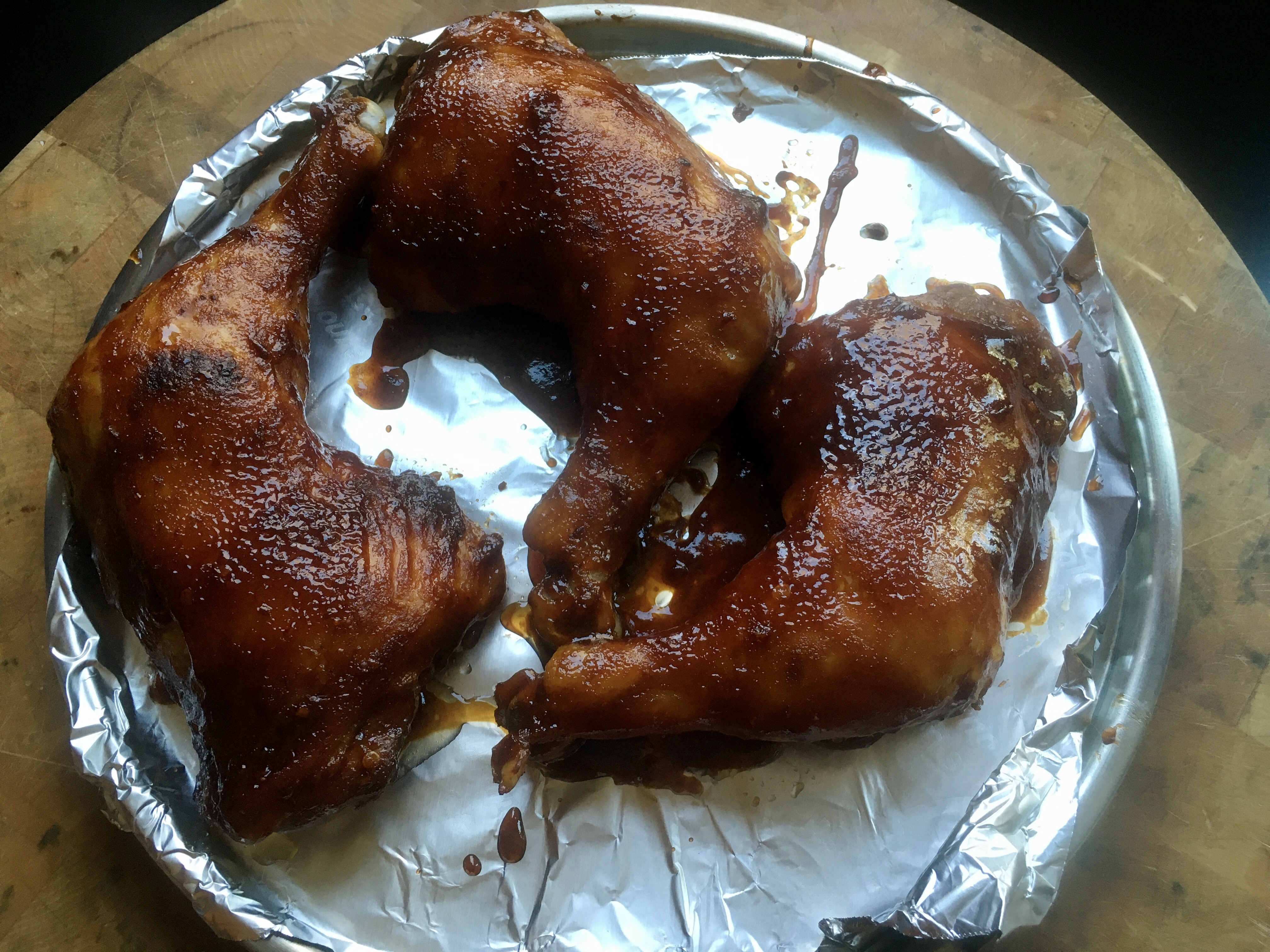
Looks good, but it’s not cooked yet! Once it’s basted, fold the foil over the top of the chicken to make a packet.


Grab a baking pan, and tear a long sheet of aluminum foil, placing it over it. Place the chicken pieces on the foil bottom-side up. (I need to use 2 sheets of foil overlapping each other because my chicken pieces were larger.)

Brush the bottoms of the chicken pieces with the sauce, then flip them over and brush the tops. Be generous!

Wrap the foil around the chicken pieces to make a pouch, making sure the pieces are not sticking out.

Pre-heat the oven to the highest temperature it will go. When the oven is hot, place the pan with the chicken in the oven, close the door, and turn the oven down to 325.

Bake the chicken for one hour.

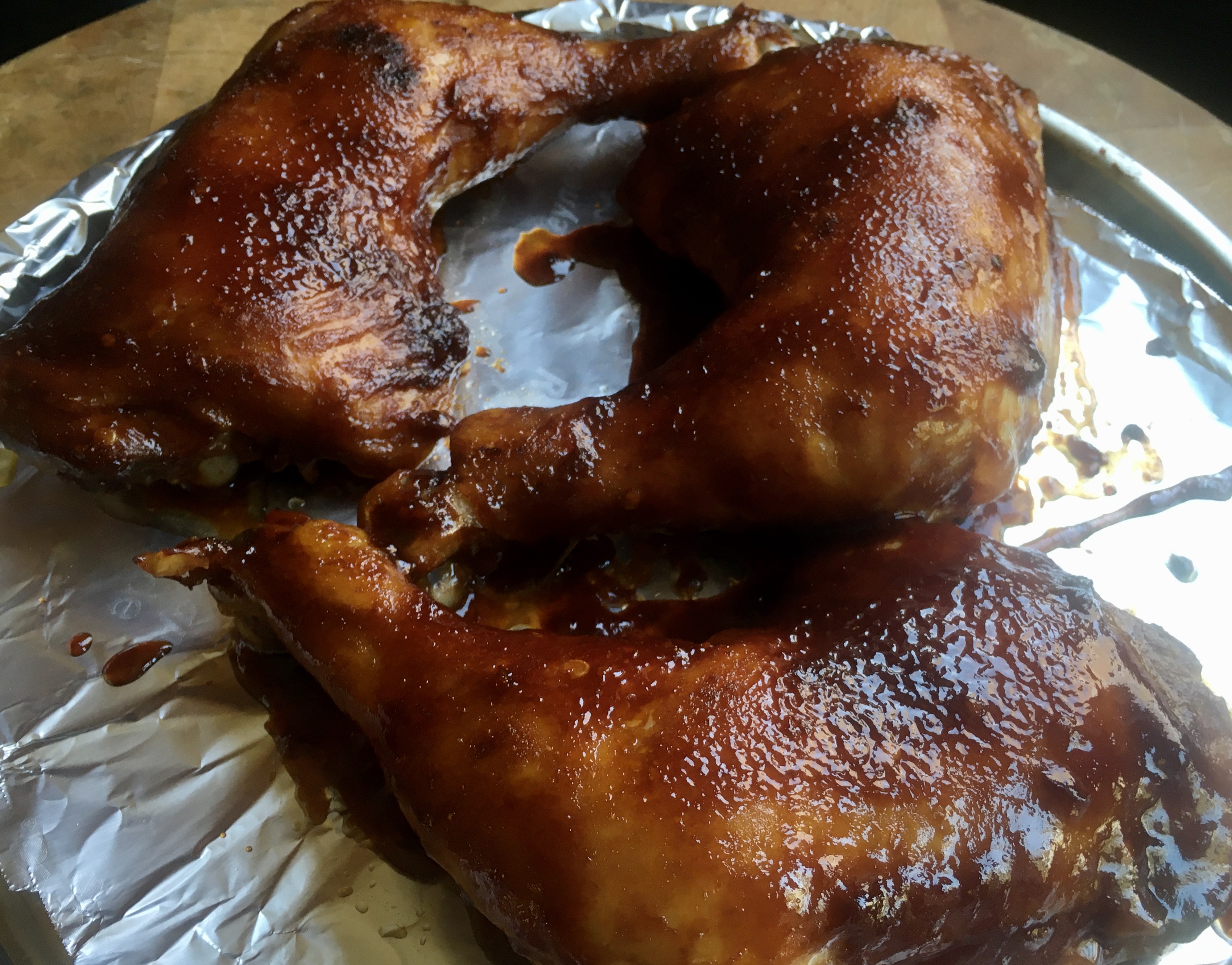
When the chicken is done, open the foil packet. It will look like this…


Carefully pour off the fat, then brush more of the sauce on the chicken, and place it under the broiler, watching it carefully so that the sugars in the sauce don’t burn. Broil it until it’s caramelized. (Another option is to light a charcoal grill and cook it on the grill rather than putting it under the broiler. It’s just a matter of how much time and effort you want to spend.)


I used a new sheet of foil and a new pan under the broiler.


Discard any of the sauce that touched the raw chicken. Use the “clean” bowl of sauce on the cooked chicken, if you want to add more.

Leftovers are awesome. Simply take the chicken out of the fridge, brush with more sauce, and place it in a 300-degree oven for about 10–15 minutes. It will take on an even darker color.


Leftovers the next day: I brushed more sauce on it before re-heating.


We’ve all got bottles of booze in our bar that probably haven’t been used in a while. Well, for me, quarantine time is the time to break them out and create! Let me share some of my favorite recipes with you…

When I go out to dinner (hoping I’ll be able to do that again soon), I’m always on the lookout for a great cocktail. These days, a great restaurant very often requires a great mixologist at the bar…not someone who can simply whip up a Cosmo, but someone who puts as much creativity in their drinks as the chef does in their dishes.

The classic negroni is made with gin, Campari, and sweet vermouth. I love negronis, and this cocktail is inspired by them. It comes from chef Tony Maws’ restaurant Craigie on Main in Cambridge, Massachusetts. It’s been a decade since we dined there but the drink remains a favorite of mine. When our server communicated to the bartender that I was willing to be his guinea pig for creative cocktails, I was served this one–so new at the time, they didn’t have a name for it. I took a sip and exclaimed: “Holy S*#t!” and the server laughed and said: “That’s as good a name as any!”


“HOLY S*#T!” COCKTAIL

1 1/2 oz. Bols Genever
1 oz. Gran Classico
1/2 oz. Punt e Mes

Add some ice to a cocktail shaker, and add the ingredients. Stir well. Strain into a rocks glass with one large ice cube.


Bols Genever is a Dutch spirit, the ancestor of gin, created from lightly distilled Dutch grains and a complex botanical mix. It’s made according to the original 1820 Lucas Bols recipe which stood at the basis of the cocktail revolution in 19th century America.

Gran Classico is an alcoholic aperitif/digestif created following a recipe dating from the 1860s. It’s made by soaking a mixture of 25 aromatic herbs and roots in an alcohol/water solution to extract their flavors and aromas. The maceration creates a natural golden-amber color, although many other producers, like Campari and Cynar, dye their product red.

Punt e Mes is a pleasantly bitter, slightly sweet red vermouth, the “baby brother” of Carpano Formula Antica. The formula was developed in 1870 in Antonino Carpano’s bar in Piedmont, and the distinctive 15-herb recipe is still a family secret.