Posts Tagged ‘food’

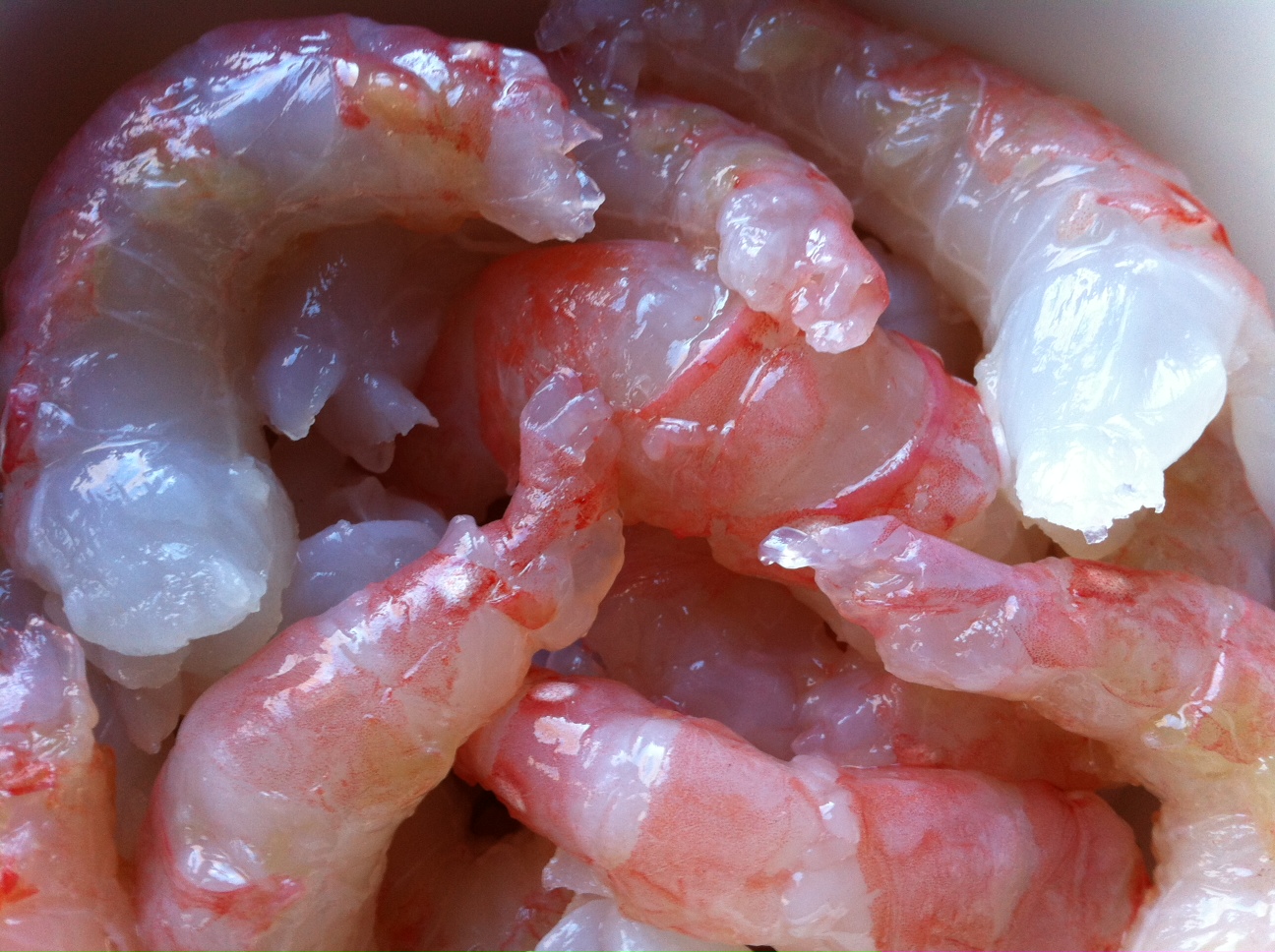
This is not your average shrimp! Found in the Pacific, from Southern California all the way up to Alaska, as well as Japan and Korea, these beauties, identified by the white spots on the sides of their first and fifth abdominal segments, live up to 11 years. And here’s the crazy part: each spot prawn (or spot shrimp) spawns once as a male and one or more time as a female!

prawns 1

Having read so much about them, I ordered a pound and decided that I would get full use of the shrimp by peeling them and making an intensely flavored sauce out of the shells.

Peeling and de-veining was easy: the shells slipped right off the shrimp, and they were so beautifully clean, their were no veins to remove!

If you can’t get  hold of Wild Pacific spot prawns, shrimp or lobster will certainly do. Just remember to ask your fishmonger for wild caught American shrimp, and not that horrible farmed stuff from Asia. If he doesn’t have it, shop elsewhere.
prawns 2


For the stock:

1 lb. wild Pacific spot prawns, thawed, peeled, and de-veined. Save shells and container water, if any.
1 tablespoon extra virgin olive oil
1/2 carrot
1/2 celery stalk
1/4 onion
1 smashed clove garlic
4 whole peppercorns
2 teaspoons ketchup
1/2 sprig rosemary
1/2 sprig thyme
6 cups water


For the shrimp:

1/4 teaspoon salt
1/4 teaspoon freshly ground black pepper
1/4 teaspoon sugar
4 Tablespoons butter, room temperature
1 Tablespoon extra virgin olive oil


The final touch:

1 Tablespoon extra virgin olive oil
1 shallot, finely chopped
2 garlic cloves, pushed through a garlic press
2 Tablespoons butter, room temperature
1/8 cup fresh chives or scallions, finely chopped


1 lb. pasta


For the stock:

Peel and de-vein the shrimp. Keep the peeled shrimp in the fridge, covered.

In a pot, heat the olive oil and add the carrot, celery, onion, garlic, peppercorns, ketchup, rosemary, thyme and shrimp shells. Saute for a few minutes to get the flavors going. Add the container water, if any, and 6 cups water. Bring it to a boil and let it simmer for 2 hours.

Strain the solids out and discard them. Place the stock in a smaller pot, and continue reducing it until about 1 cup of the stock remains.

Boil the pasta well-salted water and remove it from the water before al dente stage. (It will cook more later.) Strain it and set aside.


For the shrimp:

Combine the salt, pepper and sugar with the prawns in a bowl and toss to coat them evenly.

In a large saute pan, heat the butter and olive oil on medium-high heat. Add the shrimp and cook until lightly caramelized and almost cooked all the way through. Do not overcook! Set them aside.


The final touch:

In the same large saute pan that you cooked the shrimp, heat 1 tablespoon of olive oil and add the shallot. Saute for 1 minute, then add the garlic. Saute for 2 more minutes, then add some of the stock, the shrimp, the pasta, and the butter, and mix well. If it’s dry, add more of the stock until the pasta is coated, but not dripping. Salt and pepper to taste. Garnish with the chives.

prawns 3

Serve immediately!


These pancakes, based on a recipe from chef April Bloomfield (The Spotted Pig and The Breslin in NYC), are made from fresh homemade ricotta cheese. Light as air…and really delicious! I’ve made a few batches of fresh ricotta cheese in my day, but when the family has a craving for these pancakes at the last minute, a good-quality store-bought ricotta cheese will do.


1 1/2 cups all-purpose flour (I use Cup4Cup GF flour if I want to make these gluten-free)
1/4 cup yellow cornmeal
2 tablespoons sugar
1/2 teaspoon salt
1/2 teaspoon baking powder
1/2 teaspoon baking soda
2 cups milk
2 large eggs, separated
1/2 cup fresh ricotta


In a large bowl, combine the flour, cornmeal, sugar, salt, baking powder and baking soda. In another large bowl, whisk together the milk, ricotta,  and egg yolks. Fold the wet ingredients into the dry ingredients.

In a large stainless steel bowl, whisk the egg whites until they are stiff, but not dry. Fold gently into the batter.

Spray a non-stick griddle with a little cooking spray and drop about 1/4 cup of batter per pancake. Cook over medium heat for about 2 minutes per side, until golden and fluffy.

pancake

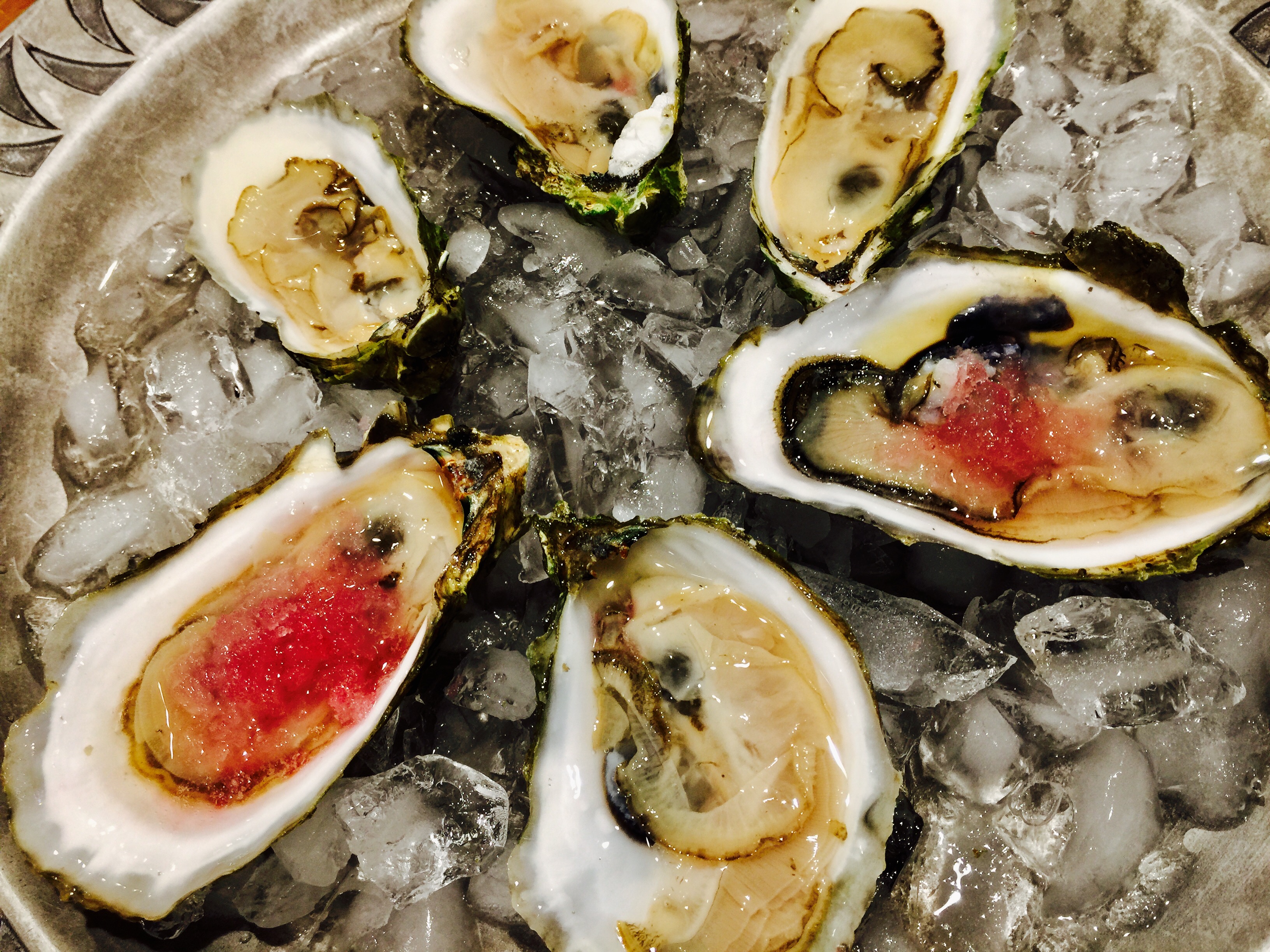
Here in New England, oysters are plentiful. We don’t just slurp ’em down: we go out and dig our own…we have our favorite buck-an-oyster bar for any given day of the week…and we debate over the best variety, from east coast to west, north to south.

So when a friend of ours who lives on Cape Cod dropped off about 5 dozen Barnstable oysters she just dug that morning, it was cause to celebrate.

oysters

Fresh oysters deserve an amazing cocktail sauce, and my recipe kicks butt: lots of horseradish, lots of flavor, and a secret ingredient: vodka. Not only does it give it a kick, it keeps it from freezing solid, so I can keep the cocktail sauce in the freezer until I need it.

2 cups ketchup
4 tablespoons prepared horseradish
1 tablespoon fresh lemon juice
1 teaspoon Worcestershire sauce
1/2 teaspoon Frank’s Red Hot, or other hot pepper sauce
5 grinds of fresh black pepper
1/4 teaspoon salt
1 teaspoon good quality vodka, like Tito’s

Combine all the ingredients. Store in a tight plastic container in the freezer.

Fresh shucked oysters with pickled red onion ice.

Freshly shucked oysters with pickled red onion ice.


When I’m in Portland, Maine, I visit one of the best oyster bars in the country: Eventide. Besides some wickedly creative dishes, they consistently have a fantastic variety of fresh oysters to choose from. And they offer a variety of “accoutrements” to go with them: anything from a red wine mignonette to kimchee ice. My favorite is the pickled red onion ice. All you need is a shot glass with a freshly shucked oyster inside, a half-shot of chilled vodka on top, and some pickled red onion ice, and you’ve got the best oyster shooter on planet Earth. I even suggested the shooter to the manager at Eventide. It has yet to make it to the menu. (But I remain hopeful!)


An oyster shooter with pickled red onion shaved ice. Bottoms up!

An oyster shooter with pickled red onion ice. Bottoms up!


I’ve managed to come up with a pretty good version of the pickled red onion ice at home, and I serve it alongside my cocktail sauce.

2 large red onions
1 tablespoon sugar
3 tablespoons apple cider vinegar


Peel and quarter the onions. Drop them in a medium-sized pot and cover with about a quart of water. Bring it to a boil and cook it down until it has reduced to a cup of concentrated onion water after straining.

Bring the strained onion water back to the stove, and on medium heat, add the sugar and vinegar, stirring. When the sugar dissolves, remove it from the heat and let it cool to room temperature before pouring it into a container and placing it in the freezer.

When it’s time to eat oysters, remove the block of red onion ice from its container, and, using a fine cheese grater, shave the ice over the top of the freshly shucked oysters and devour immediately!

fullsizerender-5


December 30 is National Bacon Day!

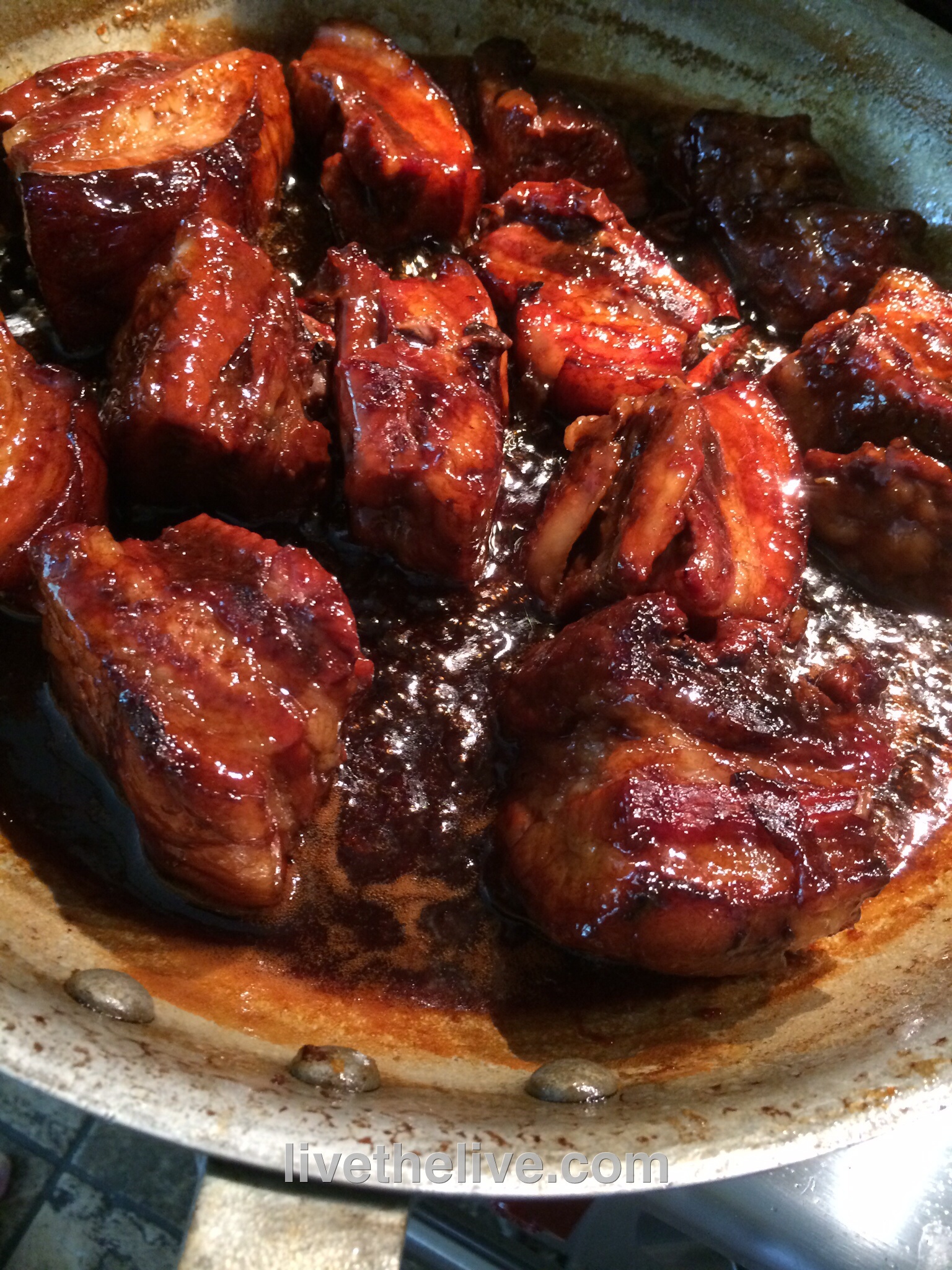
Sometimes the happiest of cooking accidents happen with bacon. My original plan was to make Chinese-style honey ribs for dinner. But instead of pulling a nice rack of ribs out of the freezer, I accidentally took out a slab of pork belly. I only realized my mistake when I thawed it and started cooking it, so I decided to continue the process with the pork belly instead. The results were pretty damn tasty.

image


Marinade:
¾ cup light soy sauce
6 Tablespoons hoisin sauce
5 lbs. pork belly
Zest and juice of 1 lemon
2 whole star anise
2 cinnamon sticks (3”)
1/2 cup honey
4 cups chicken broth
image
Mix the marinade ingredients. Set aside.
Cut the pork belly into pieces that are about 3 inches square. Place them in a large pot. Cover therm with water and bring to a boil. Boil for 5 minutes. Drain.
Place the pork belly pieces on a sheet pan lined with non-stick aluminum foil. Coat them with marinade. Let them sit for 10 minutes.
Pre-heat the oven to 350 degrees. Bake the pork belly pieces on the sheet pan for 30 minutes.
While the pork belly is baking, start the sauce in a large non-stick pan or pot: combine the lemon zest and juice, star anise, cinnamon sticks, honey and chicken broth. Bring it to a boil, then reduce to a simmer.
When the pork belly pieces have finished baking, add them to the sauce pot and simmer (covered) for at least 15 minutes or until meat is tender.
Turn heat on high, uncover pot and cook until the sauce is reduced to a glaze that coats the ribs. Reduce the heat as the sauce thickens to avoid the sugars in the honey from burning. When the pieces are sticky and gooey, they are ready!
Let a piece of pork belly cool…then slice to desired thickness and fry like regular bacon. Makes an amazing omelet!
image

Every Rhode Island home needs to have a box of corn meal in case of Johnny Cake emergencies. If you’ve never had a Johnny Cake before, you’re missing out on a simple, delicious Rhode Island treat. But that’s a topic of another blog. The point is, I always keep a box of white corn meal in my pantry, and I used it to make the coating for my chicken.

fullsizerender-4


Corn meal is great, because it adds a wonderful crunch while keeping my recipe gluten-free, an important factor in my house. But even if you don’t have to be on a GF diet, corn meal adds great flavor.

To keep the batter light, I add flour to the corn meal.


2 cups buttermilk (whole milk is fine, too)
1 tablespoon hot sauce (I use Frank’s Red Hot)
4 lbs. chicken wings
1 cup white corn meal
1 cup flour (I use Cup4Cup, a gluten-free flour)
1 1/2 teaspoons salt
1/2 teaspoon pepper
1/2 teaspoon granulated garlic
1/2 teaspoon granulated onion
1/2 teaspoon paprika
oil, lard or a combination of the 2 for frying

fullsizerender-3


Pour the buttermilk or whole milk into a large Ziploc bag. Add the hot sauce. Drop in the chicken wings, seal the bag,  and let them soak in the mixture in the fridge for at least several hours…overnight is better. Place the bag in a bowl to prevent bag leakage accidents.

In a separate bowl, combine the corn meal, flour, salt, pepper, garlic, onion, and paprika. Mix well.

Pre-heat the oven to 350 degrees.

I like to use a combination of olive oil and pork lard when frying. Carefully take the wings out of the bag one by one, and drop them in the bowl with the cornmeal mix, coating the chicken well on all sides, then shaking off the excess. Place the chicken wings in the hot oil carefully.

Cook the chicken in the oil on both sides for just a few minutes, until golden. You’re not trying to cook them all the way through.

Place the chicken pieces on a foil-lined baking sheet. when you’ve fried all the chicken, place the baking sheet in the oven and cook until the wings are done, about 25 minutes.


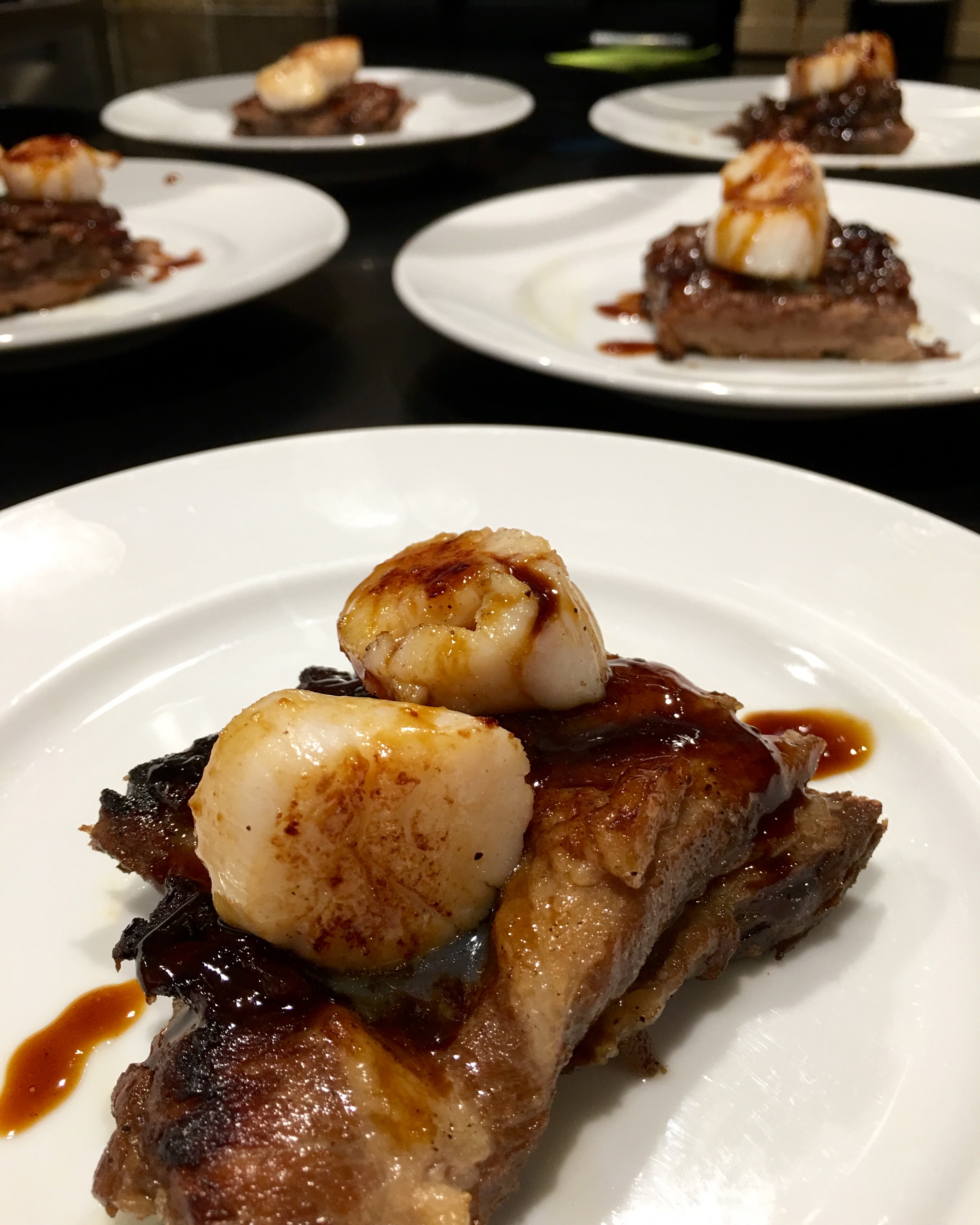
This is what I’m serving my guests at Christmas dinner. It’s a rich and delicious surf-and-turf, using wild Texas boar and locally caught Rhode Island scallops, that beats steak and lobster hands-down! Wild boar isn’t an ingredient you can find everywhere, but pork belly is, and it works just fine.


FullSizeRender (9)

For the pork belly…
3 lbs. fresh pork belly (I used wild boar belly)
salt and pepper
1–2 tablespoons leaf lard or olive oil
1 carrot, coarsely chopped
1 celery stalk, coarsely chopped
1 onion, roughly chopped
1 fennel bulb, quartered
2 sprigs fresh thyme
1 teaspoon black peppercorns
4 cups beef stock
1 cup hard cider or apple juice

Pre-heat the oven to 350.

Season the belly with salt and pepper. On medium-high heat, melt the leaf lard, then sear the meat on all sides in an oven-proof pot big enough to hold it in one layer. Add the carrot, celery, onion, fennel, thyme and peppercorns and continue cooking for another 5 minutes, until caramelized.

Add the beef stock and the cider. Cover the pot with a lid or seal with aluminum foil, and braise the belly in the oven for 3 hours, until tender.

Remove the pot from the oven, carefully remove the pork belly, and put it on a plate. Cover it with foil. If you’re cooking earlier in the day, you can place the belly in the fridge at this point.

Strain the leftover braising liquid from the pot and discard the vegetables and thyme. Skim off the excess fat. If starting this dish earlier in the day, you can put this liquid in the fridge and the fat will harden, making it easier to remove.

FullSizeRender (8)

For the glaze…
braising liquid, strained
1 tablespoon espresso
1 tablespoon honey

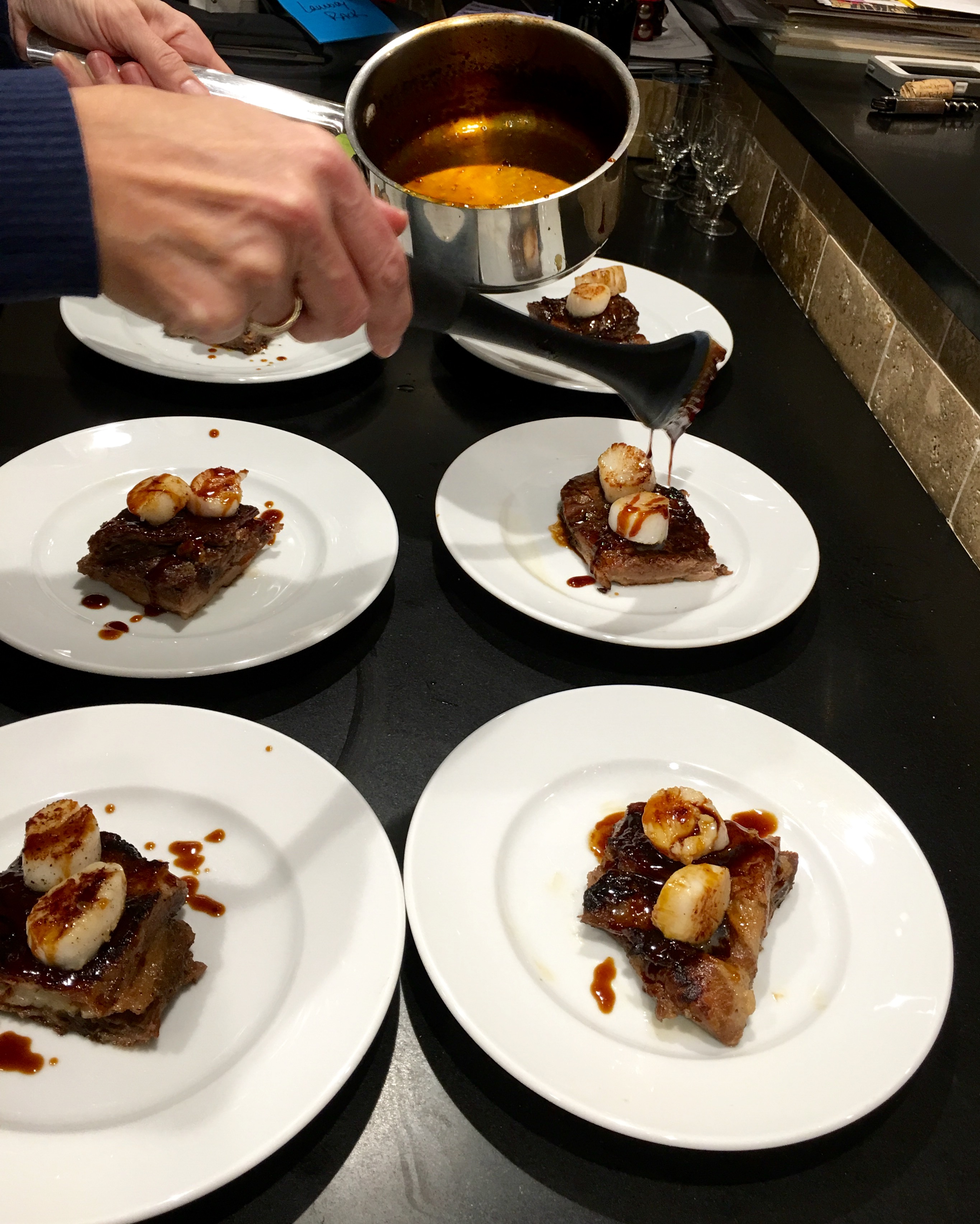
In a small saucepan, reduce the brazing liquid by half, then add the espresso and honey. Cook a few more minutes until the sauce thickens. When it coats the back of a spoon, it’s ready. Set aside.

For the scallops…
Fresh scallops
salt and pepper

When you’re ready to serve, heat a pan on high heat with a little more leaf lard. Cut the belly into equal pieces and sear on all sides for about a minute. Place the scallops in the same pan, season with salt and pepper, and sear them on both sides, being careful not to overcook them.

To serve, place the belly on a plate. Top with a scallop or two. Drizzle glaze over the top. Season with Fleur de Sel or sea salt and serve immediately.

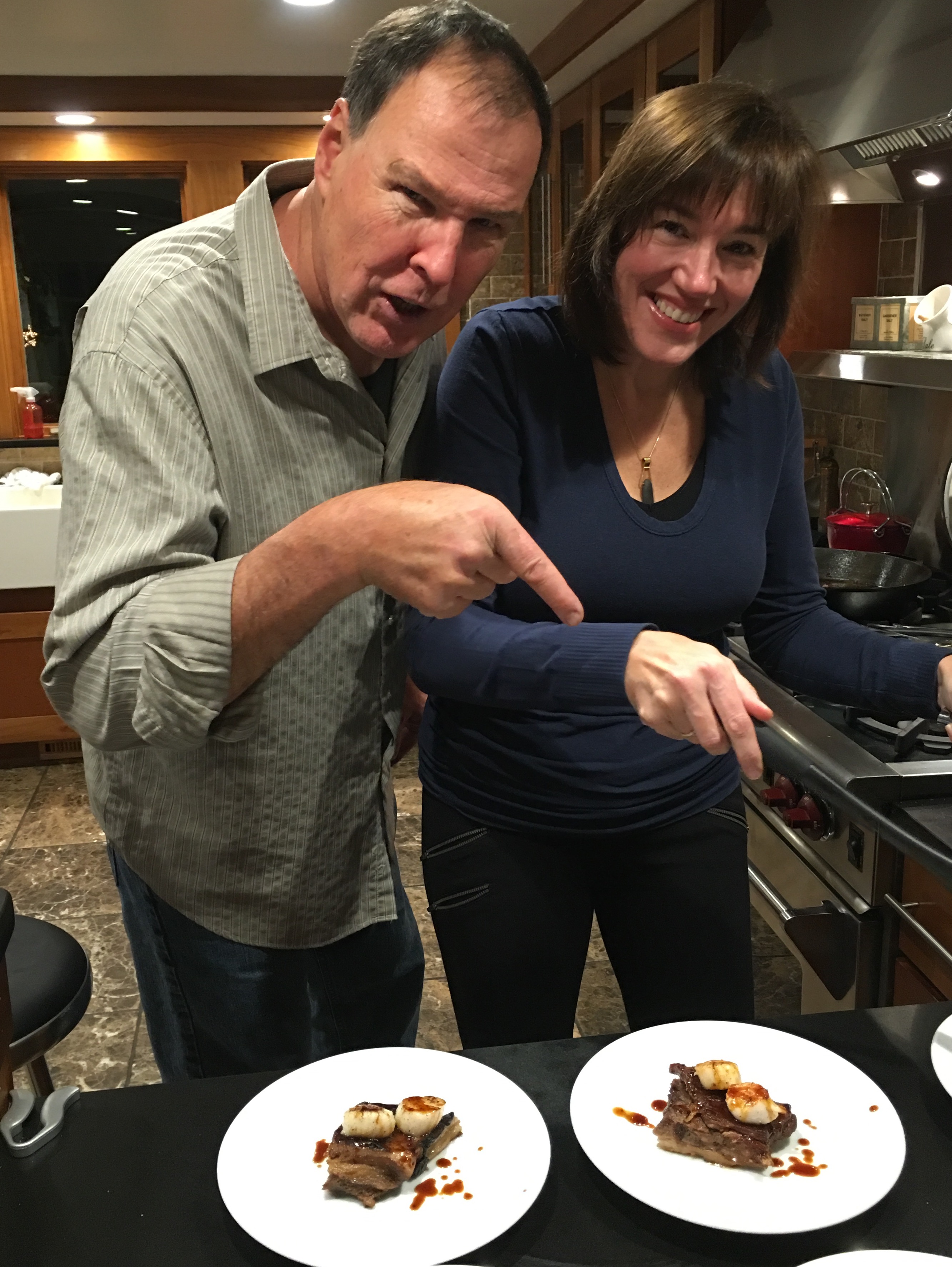
Always good to have a lovely food stylist around to make it look pretty.

Always good to have a lovely food stylist around to make it look pretty.


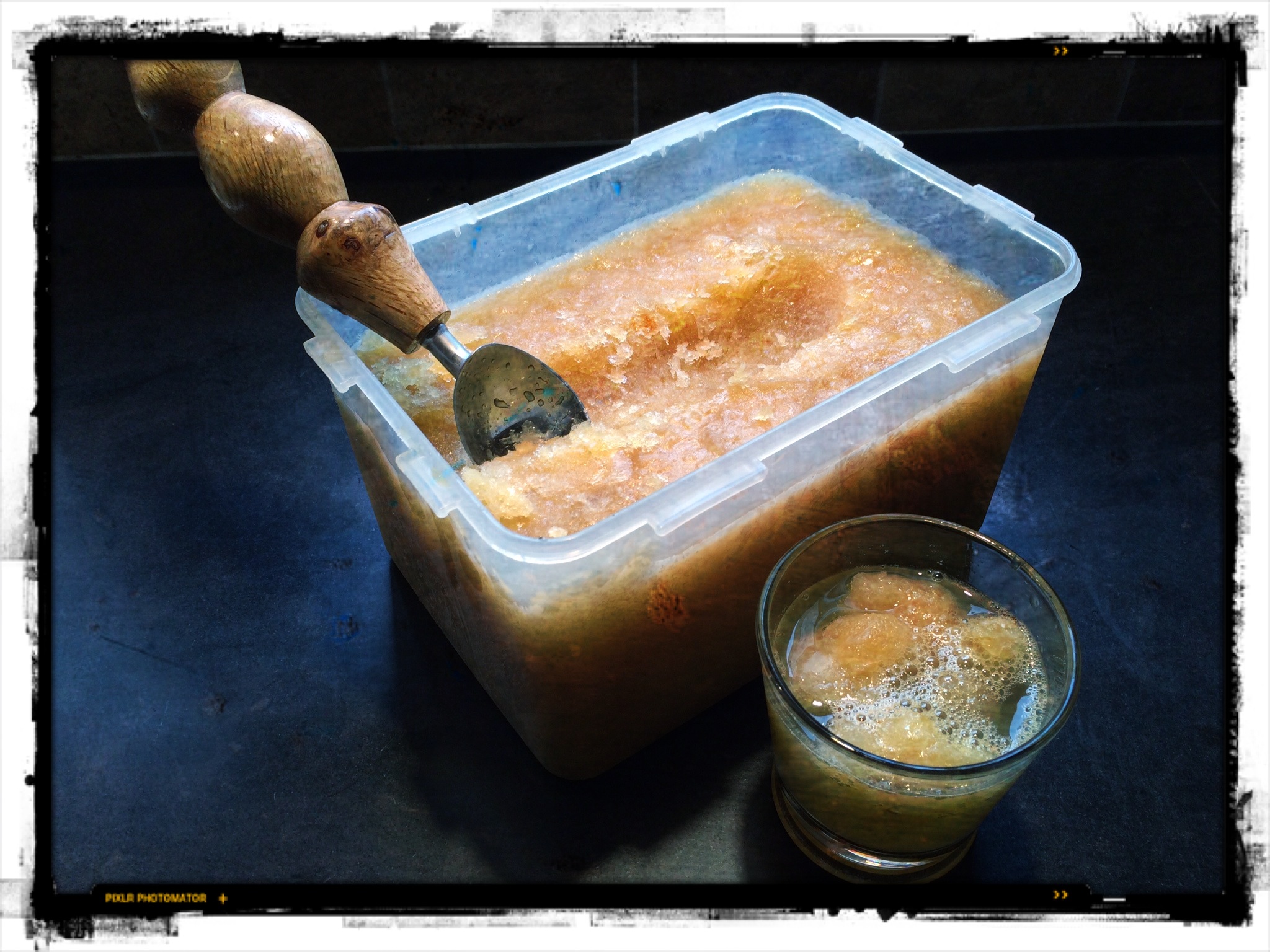
This is my version of a holiday drink I was introduced to by my mother-in-law from the Upper Peninsula of Michigan. I knew I was marrying into the right family after one sip!

Whiskey slush


9 cups water
2 cups sugar
4 “Constant Comment” tea bags
12 oz frozen OJ concentrate
12 oz frozen lemonade concentrate
2 cups whiskey (I use Crown Royal)
7Up or Sprite

Boil the water and sugar, making sure the sugar dissolves. Turn off the heat and steep the tea bags in the liquid for 10 minutes. Discard the tea bags.
Add the OJ, lemonade and whiskey. Mix well, then pour it into a freezeable container with a lid. Freeze.
To serve: Scoop the slush out of the container (it doesn’t freeze solid) and mix in a tall glass with 7 Up.

I think half my childhood was spent in the kitchen, watching my Mom and grandmother make koldūnai (kohl-DOO-nayh), the Lithuanian version of a pierogi, by hand at lightning speed. Some Lithuanian cooks make the dough, roll it out into a large flat sheet with a rolling-pin, then cut circles out with a glass or a cookie cutter. But my Mom and grandmother used a different method: they’d roll the dough into a log, cut it into 1″ pieces, and then twirl each piece in their hands to make a flat pancake that they would then fill with a spoonful of meat or mushrooms. It blew my mind that they could crank out over a hundred of these perfectly shaped dumplings in no time, placing them on a sheet pan and freezing them until it was time to cook.

One of the main reasons koldūnai beat pierogis every time is the filling. My Mom would mix ground beef with chopped onions sautéed in butter, a couple of eggs, and milk crackers soaked in milk. She’d add salt and pepper, then take a spoonful of the raw meat mixture and plop it in my mouth. “Enough salt?” she’d ask. I loved the taste of the raw beef like that…probably why I always order beef tartare when I see it on a restaurant menu.

The mushroom filling was usually reserved for special holidays like Christmas and Easter. Italy may lay claim to the porcini, but the fact of the matter is, Lithuania is porcini heaven. They’re called baravykai (buh-ruh-VEE-kayh), and when they’re dried and reconstituted, their incredible flavor is so intense, you don’t need many of them to flavor a large amount of cheaper button mushrooms. We’d get our dried boletes from relatives in Lithuania every year…the real deal. (They’d even have a radiation-free certification sticker on the bag, thanks to Chernobyl!) Mom would place a handful of the dried mushrooms in some boiling water and they would rehydrate, nice and plump, and could then easily be chopped and added to the other mushrooms. She’d pour the mushroom liquid into the pan as well, not wasting a bit of that magical porcini flavor. The mushrooms were simply sautéed in butter, cooled, then used to fill the koldūnai.

Basic Polish pierogi fillings include sauerkraut or potatoes with cheese. There’s no question the Lithuanians got this round.

koldunas-dough

It was time to try my hand at making koldūnai. As I recall, my Mom simply mixed water with flour to make the dough, kneaded it into a log, and off she went. My challenge was a bit more daunting: I needed to make them gluten-free as well. My sister, whose family lives the GF lifestyle, told me that they simply exchange all-purpose flour for gluten-free flour and it works fine. I had my doubts and first tried a recipe I found online that used a slurry of cottage cheese, eggs, and milk with the flour, but I found that it was overkill. The dough was very sticky and hard to work with. So I tried the simple recipe of water and flour (a half-cup of water for every cup of gluten-free flour) and it worked well.

Wearing disposable nitryl gloves was a stroke of genius. Not only were my hands protected from the sticky dough, it seemed that the dough didn’t stick to the gloves. I poured a cup of GF flour into a stainless steel bowl, added a half-cup of water to it, and mixed it around with my hands until it formed a ball of dough that pulled away from the sides of the bowl cleanly. (Sometimes a little more water or flour would be needed.)

I dusted a board with more flour, and moved the flour from the bowl onto the board. I kneaded it into a long log, about a foot long and 1 1/2″ thick. I cut it into 12 equal pieces, about 1″ wide.

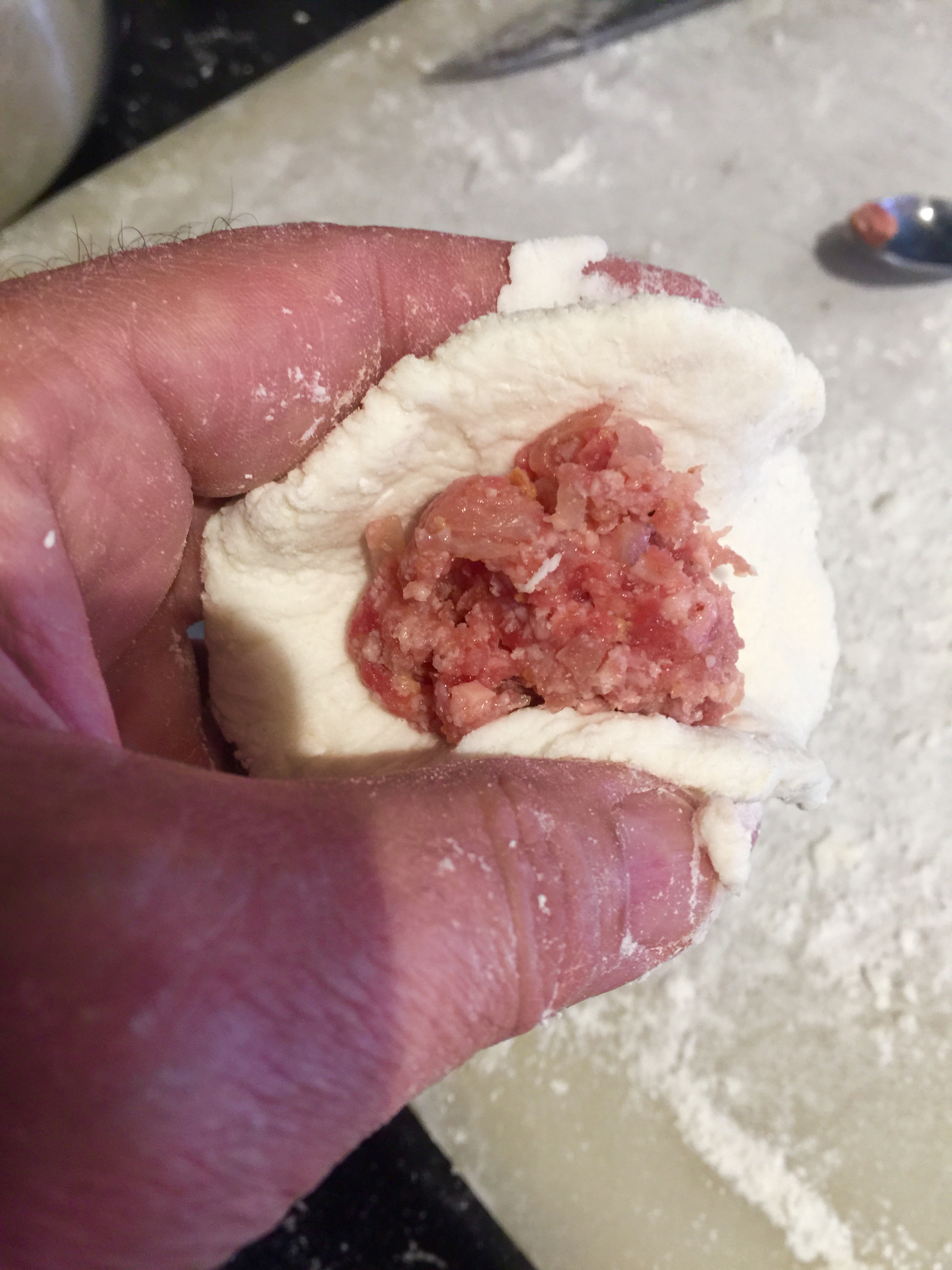
Taking one cut piece, and using my thumbs, I twirled the dough around, flattening it into a small pancake, the way I remember my Mom and grandmother used to do it.  I placed a teaspoon of filling in the center of the pancake, then folded one side over so that it met the edges of the other side. I pressed with my fingers to make the two halves stick together and formed a seal.


The beef filling. I decided to wear gloves soon after this photo.

The beef filling. I decided to wear gloves soon after this photo.

The biggest challenges I had with making koldūnai was my own clumsiness and lack of experience. But once I got the hang of it, things moved along steadily, and it didn’t take long for me to make a couple of dozen. I placed them on a sheet pan lined with non-stick aluminum foil (you can also use parchment paper) and placed them in the freezer to harden. Once hard, they go in freezer bags until ready to boil.

I made 3 types of koldūnai: mushroom, beef, and mac-and-cheese (by my daughter’s request.)

koldunai

The mushroom filling was nothing more than chopped button mushrooms combined with chopped porcinis that had been rehydrated, all sautéed in butter. The mac-and-cheese filling was a gluten-free mac-and-cheese dinner out of a box.

gf-mac

For the beef filling…

1/2 onion, finely chopped
1 pat of butter
1 lb. ground beef
1 egg
1/2 cup breadcrumbs (I use gluten-free)
1/4 cup milk


To make the breadcrumbs, I took a couple of slices of whole grain gluten-free bread and toasted them. Then I ground them up in a blender or food processor. The taste is far better than store-bought GF breadcrumbs, which usually are rock-hard rice nuggets.

I finely chopped the onion and sautéed it in a little butter until translucent. I let it cool, then added it to 1 lb. of thawed ground beef. I added the egg, the breadcrumbs, and the milk. I seasoned it with salt and pepper, and I mixed everything thoroughly, keeping the meat mixture in the fridge until I needed it.


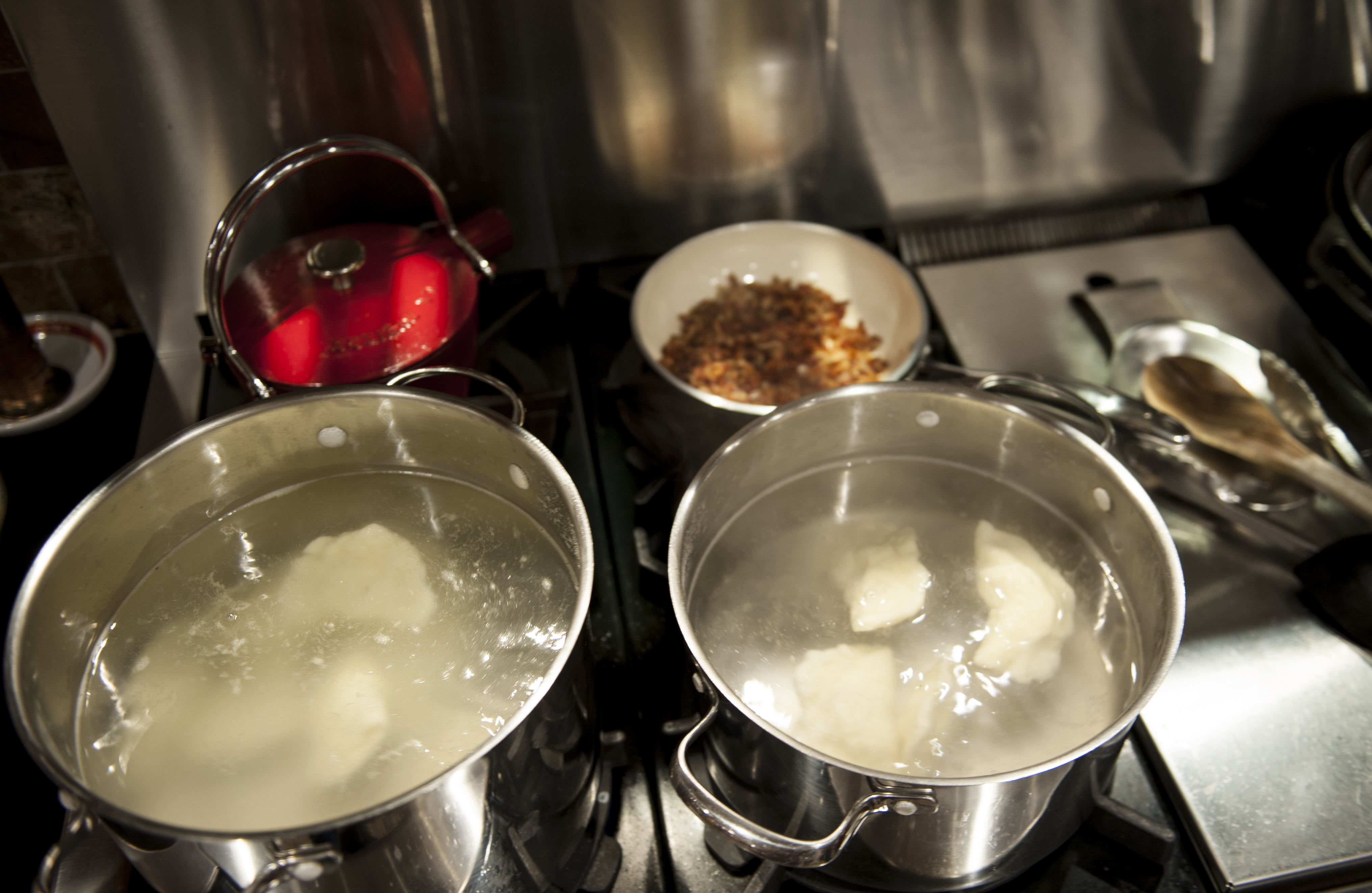
Two pots of boiling salted water: one for the meat-filled koldūnai, and one for the mac-and-cheese filled koldūnai.

Two pots of boiling salted water: one for the meat-filled koldūnai, and one for the mac-and-cheese filled koldūnai.

No Lithuanian koldūnas recipe is complete without spirgučiai…

1 lb. bacon, finely chopped
1 large onion, finely chopped

In a large pan, fry the chopped bacon until it’s almost crisp. I don’t drain the fat, but you can if you’re a wuss. Add the chopped onions and cook until they are soft. Set aside. These are called spirgučiai, (spir-guh-chay) and they are sprinkled on top of the finished koldūnai, just before serving. (My Mom always kept a stash of spirgučiai in a container in the fridge, and sprinkled them on anything and everything.)

duni 4

Once you’ve made the koldūnai, it’s up to you if you want to cook them right away or freeze them for later. Either way, when you’re ready, get a large pot of salted water boiling. Salt, just like when boiling pasta, is essential in giving the dough flavor.) Drop the koldūnai in gently, being careful not to overcrowd them. If the dough is thin, they will be ready when they float up to the surface. A thicker dough will need longer cooking. The best way to know if they’re done is by taking one out, cutting it open and having a look (and a taste!)

You can serve them straight out of the boiling water, but dropping them in a pan with a little butter to lightly sauté them a bit before serving is really the way to go.

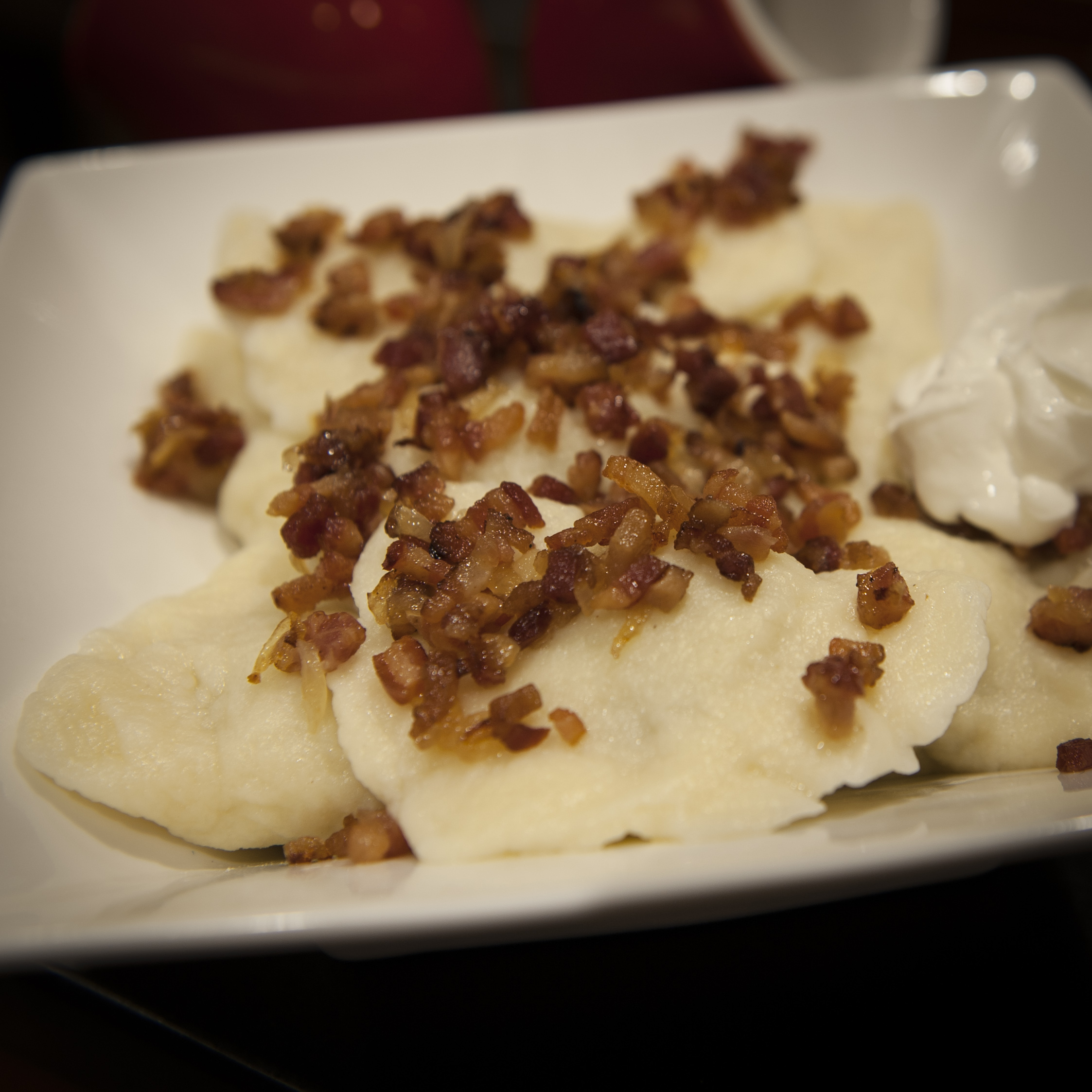
When plating, sprinkle generously with spirgučiai, and serve with sour cream.

Enjoying each variety of koldūnai on a cold winter's night with friends.

Enjoying each variety of koldūnai on a cold winter’s night with friends.


Let’s face it: there’s no such thing as healthy eggnog. This recipe kicks ass but is also a heart attack in a glass.

My buddy, Rick Sammarco, a wicked talented bartender, credits his father, Al, for this eggnog. The original recipe calls for a lot more of everything. I’ve cut it down to a “more reasonable” size. It’s been so long since I bought ice cream, that I didn’t even know that the standard half-gallon size was replaced by a 1.5 quart size!

A word about salmonella: most cases are caused by raw chicken, not raw eggs. Still, many people worry about it. You are adding a lot of booze to the mix. Some recipes tell you to make your eggnog weeks in advance to “sterilize” the drink. I’m not sure that works. Look…if you’re really worried about it, maybe this drink isn’t for you. I use a raw egg in my Caesar salad dressing and in other recipes, so I’m willing to risk it here.

eggnog


1.5 quarts vanilla ice cream (I use Breyer’s)
1 pint half and half
15 whole eggs (raw)
½ teaspoon vanilla extract
1/4 teaspoon cinnamon
1/4 teaspoon nutmeg
At least 3/8 cup of each:
spiced rum (I use Capt. Morgan)
whiskey (I use Crown Royal)
brandy (I use E&J)


Let the ice cream soften 1 day in the fridge. Mix ice cream, eggs, vanilla, half and half in a blender.

Add the spices and liquor. Blend until it’s frothy.

Taste, and add more cinnamon and nutmeg if you like.

After it’s fully blended, let it sit in fridge 12-24 hours for flavors to blend. Even longer is better.


It takes a few weeks for this limoncello recipe to be ready, so I usually start up a batch around Thanksgiving to have it ready for Christmas. But even if you start now, you’ll be able to enjoy it around the holidays!

Many years ago, my wife and I visited the Amalfi coast, and we spent several nights on the beautiful island of Capri. On our last night, we dined at the legendary Grand Hotel Quisisana, and our incredible meal ended with a glass of the most delicious limoncello I had ever had.

I asked the waiter if it was possible to get the recipe of the limoncello, and he made a big deal about the recipe being a “secret.” Though disappointed, I understood, and I left Capri thinking that I would never taste that limoncello again.

Two weeks later, now back at home, I was reading the latest issue of Conde Nast Traveler, and there in black and white, was the Quisisana limoncello recipe! WTF?

After making many batches of this limoncello, I started experimenting with other citrus, and the most successful by far was with grapefruit. Now I make a batch of each every year. Note: the recipe calls for 100-proof vodka. Most vodka is 80-proof, so you’ll need to go to a liquor store with a better selection to find it.

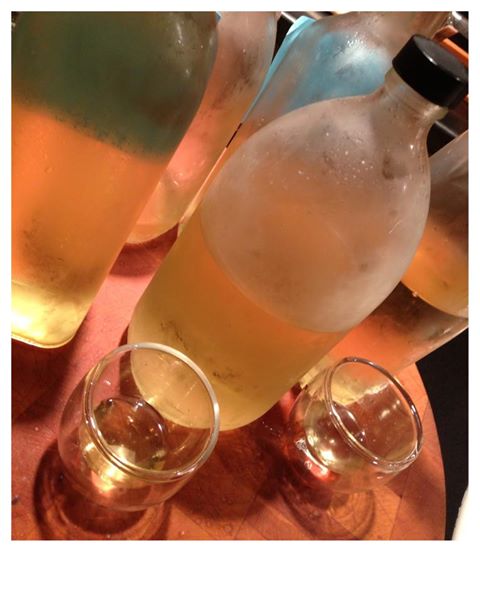
Sampling vintage limoncello and grapefruit-cello, aged 2 years or more

Sampling vintage limoncello and grapefruit-cello, aged 2 years or more

Four ingredients, easy to make. The toughest part is waiting for it to mellow a bit.


4 lbs. lemons, zest only
2 750-ml bottles 100 proof vodka (I prefer Absolut)
5 1/2 cups sugar
6 cups filtered water

Peel the zest off all the lemons, making sure you don’t get any of the white pith that could make the limoncello bitter. Place all the zest in the bottom of a glass jar with a lid that can hold all the vodka.

Pour the vodka on top of the lemon zest pieces, seal the container, and keep at room temperature for a week, swirling the jar around gently once a day.

On the sixth day, combine the sugar and water in a pot over medium-high heat, and stir until all the sugar completely dissolves. Remove from the heat, cover, and let it thoroughly cool to room temperature (overnight is best.)

On day seven, strain the lemon zest, pouring the infused vodka into a clean glass jar. Discard the lemon zest.

Pour the sugar/water mixture into the vodka and mix well.

At this point, you can pour the finished product into individual bottles, but let it mellow for about a month before drinking.

I keep my limoncello refrigerated.