Archive for the ‘Recipes’ Category

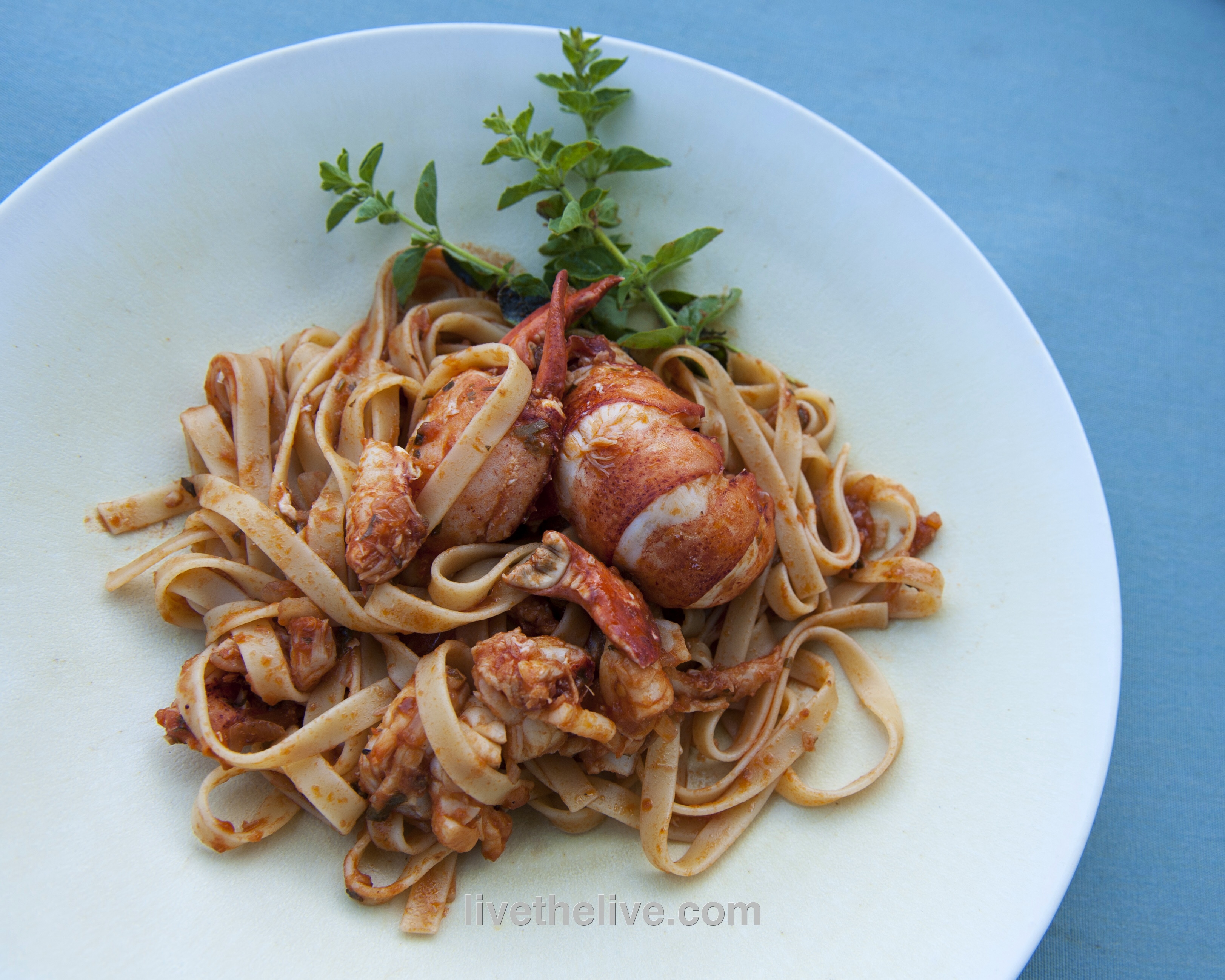
One of the most incredible dishes I’ve had on the beautiful island of Santorini, Greece, is lobster with pasta. It’s one of those dishes that takes time to prepare, because the pasta lobster sauce they make is a labor of love…time consuming but so spectacular.

Cooked lobster LTL

I often have friends over for dinner, but when I prepared this dish for them recently, it was the first time they all licked their plates clean!

To try to replicate that lobster sauce we had in Santorini, I started with a kick-ass lobster stock. It’s simple but flavorful:

Stock ingredients:

clean, empty claws, tails and bodies from two 1-1/2 lb. lobsters (use the legs, too)

12 cups water

1/2 onion

3 celery stalks

1 carrot

Place all ingredients in a large pot and set on high heat. Crush lobster shells with potato masher. Cook until it is reduced by half.

Strain the stock, discarding the lobster shells and veggies. Bring the stock back to the heat and reduce until all you have left is 1 cup of intense stock.

Now that you have the stock, you can make the sauce!

Pasta with lobster sauce

Sauce ingredients:

1/2 onion, finely chopped

1 garlic clove, finely chopped

pinch of Italian red pepper flakes

teaspoon parsley

extra virgin olive oil

1/2 cup lobster stock

1/4 cup San Marzano tomato sauce (see below)

splash of white wine (I use Alice white Chardonnay)

salt and pepper

1/2 lb. cooked pasta

Add some olive oil to a pan and saute the onions until translucent. Season with salt and pepper. Add the garlic and cook for 10 seconds. Add the red pepper flakes and parsley.

Add 1/4 cup of the lobster stock and let it cook, reducing by half. Add the other 1/4 cup of lobster stock and the tomato sauce. Let it cook for a couple of minutes and add the white wine. Cook for a few minutes more.

Cook pasta and drain even before it reaches the al dente stage. Place the pasta in the pan with the sauce, heating and coating thoroughly. Serve immediately.

For the San Marzano tomato sauce: I take a can of San Marzano tomatoes and place it in a food processor or Vita-Mix and blend until I get sauce. Pour into a pan and reduce over medium heat by half, until sauce has thickened.
It’s interesting that an Eastern European country that is as far north as Newfoundland has one of the most refreshing cold summer soups of any country in Europe. It’s a cold beet soup called Šaltibarščiai (pronounced shul-tih barsh-chay) and it’s classic Lithuanian cooking at its best.

No summer was complete without my Mom’s Šaltibarščiai on the table, and my Dad always insisted on eating it with boiled potatoes on the side. Now residing in an assisted living facility, my Mom has not had this soup in many years, so I made her a batch when she came to visit recently.

There are many different variations of this soup. For example, many Lithuanians today use keffir instead of buttermilk. My Mom insists this is a Russian influence and therefore not a good thing. I just think buttermilk tastes better.

securedownload


Ingredients:

1 quart buttermilk

4 hard-boiled eggs, peeled and chopped

3 cucumbers, peeled, seeded and chopped

8 beets, cooked, peeled and chopped

1 tablespoon finely chopped fresh dill

1 scallion, finely chopped, greens only

salt

a pile of boiled potatoes (optional)


Pour the buttermilk into a large bowl. If it’s very thick, you can dilute it a bit with fresh water.

Peel and chop the eggs and toss them in the bowl. Peel, seed and chop the cukes…then into the bowl.

I love Love Beets, hermetically sealed cooked and peeled beets, ready to use, available in most supermarkets. (In the old days, my Mom would simply use canned beets.) I open a couple of packs of Love Beets, pouring the beet juice into the bowl. I chop the beets and add them as well.

Grab some dill and chop it finely. Add it to the bowl. Finely chop the greens of one or two scallions and sprinkle some salt on them. Rub the salt into the scallions, mashing them a bit, softening them. Then add the to the bowl.

Stir everything together, put a lid on the bowl, and let it chill in the fridge for a few hours.

Remove from fridge, stir, and season with more salt if needed. Serve with boiled potatoes, if you like.


Inspired by the Stoli Doli cocktails at the Capital Grille, I tried to recreate that fabulous drink. But when I substituted Stoli Vanil for regular Stoli, I created something amazing. I call it Velvet Elvis.

Making my Velvet Elvis is incredibly easy and rewarding…

Velvet Elvis

Ingredients:

1.75 liter bottle Stoli Vanil

2 fresh pineapples, peeled, cored and sliced


Place pineapple slices in a glass 1-gallon container. Pour in the vanilla vodka, making sure it covers the pineapple. Seal the lid tightly, and swirl around for a few seconds.

Place the container away from light on a shelf at room temperature for 3 weeks.

At the end of the weeks, strain the liquid, and squeeze out as much as you can from the pineapple slices as well. Discard the used pineapple slices.

Enjoy Velvet Elvis on the rocks.

I don’t have the patience to boil Mason jars and lids and all that crap. But I love me my pickles, especially when I’ve got a cucumber surplus in the garden.

This is such an easy way to make great pickles, it’s almost unbelievable…and no water is needed! The salt extracts just enough moisture, like when curing meat, to make it work.

pickles


Ingredients:

6 fresh cucumbers

1 1/2 teaspoons sea salt (I like Fleur de Sel)

handful of fresh dill

1 clove garlic, thinly sliced


Get a large plastic bag.  Add the salt, dill and garlic and gently mix everything in the bag.

Cut the ends off the cucumbers and then slice them lengthwise, in half or in quarters. Add them to the bag and gently mix again.

Squeeze to remove air from the bag, close it tightly and place it in the fridge overnight. The pickles will be ready to eat the next day, but they’re even better after 48 hours.


It seemed almost silly to try to make one…but the classic James Bond martini has always fascinated me. I’m not talking about the clichéd Sean Connery “vodka martini, shaken, not stirred.”  I’m talking about the real James Bond martini, which appeared in Ian Fleming’s first 007 novel “Casino Royale” and only appeared in the most recent “Casino Royale” movie starring Daniel Craig.
Bondtini
To quote the novel:
‘A dry martini,’ he said. ‘One. In a deep champagne goblet.’ ‘Oui, monsieur.’ ‘Just a moment. Three measures of Gordon’s (gin), one of vodka, half a measure of Kina Lillet.  Shake it very well until it’s ice-cold, then add a large thin slice of lemon peel. Got it?’ ‘Certainly, monsieur.’ The barman seemed pleasant with the idea. ‘Gosh that’s certainly a drink,’ said Leiter. 

Bond laughed. ‘When I’m … er … concentrating.’ he explained, ‘I never have more than one drink before dinner. But I do like that one to be large and very strong and very cold and very well-made. I hate small portions of anything, particularly when they taste bad. This drink’s my own invention. I’m going to patent it when I can think of a good name.’ 

He watched carefully as the deep glass became frosted with the pale golden drink, slightly aerated by the bruising of the shaker. He reached for it and took a long sip. 

‘Excellent,’ he said to the barman, ‘but if you can get a vodka made with grain instead of potatoes, you will find it still better.’ 

To quote the movie: http://youtu.be/Vc7n7yyXWsU

Bond named this drink the Vesper martini, after a female agent in the story.
My version of this classic drink remains true to the original, though I’ve changed brands due to personal preference. In the novel, Bond just asks for “vodka.” (Of course, this was back in the 1950’s when we didn’t have 100 brands to choose from!) My choice for best-bang-for-the-buck grain vodka is Tito’s: it has just enough of an edge, which is what this drink needs, and it’s half the price of other grain vodkas, like Grey Goose.
Bond asks for Gordon’s gin. I’m partial to Hendrick’s, which adds wonderful floral notes to the drink.
And the original Kina Lillet has had its formula changed in the 1980’s to keep up with the times by reducing the quinine, which made it bitter. The French aperitif wine, Lillet, is today’s version: a blend of wine grapes, oranges, orange peels and quinine. Lillet is not a vermouth, though you’ll find it in the vermouth section of your favorite liquor store. Some aficionados claim the martini is just not the same without the original Kina Lillet formulation, but I find that the drink works just fine for me.
ingredients again
So…measurements true to Bond:
3 oz Hendrick’s
1 oz Tito’s
1/2 oz Lillet
I prefer combining these over ice in a cocktail shaker, and I stir, not shake.
I strain it into a chilled martini glass and I skip the lemon peel. I prefer three olives instead…stuffed with garlic, if my wife is away on a business trip!
Bondtini2
A side note: the correct pronunciation of Lillet is Lih-LAY. Grammatically in French, the double-l would make it sound like Lih-YAY. So to keep that from happening, they spelled it Lilet for a while until the French were used to the correct pronunciation, then they went back to Lillet on the bottle.

Since I’m busy tasting many bourbons these days, I’ve got some leftovers that may not make a great cocktail but would work great for a sauce. I had Maker’s Mark sitting around, so I came up with this sauce to use it up!

image

 Ingredients:

5 lbs St Louis style pork ribs

salt and pepper


For the sauce: 

1/4 cup honey

1/4 cup bourbon

zest and juice of 1 lime

zest and juice of 1 lemon

zest and juice of 1 orange

2 tablespoons Hoisin sauce

1 tablespoon Dijon mustard (I use Maille)

1 tablespoon soy sauce

2 teaspoons Worcestershire sauce

1 teaspoon chili oil

image

Season the ribs well with salt and pepper and cook in a smoker for 3 hours at 25o degrees, using hickory chips.

While ribs are smoking, combine sauce ingredients in a sauce pan, bring to a boil, then lower to medium heat and reduce the sauce by half until it thickens. Stir often, and don’t let the honey foam up and spill over the top.

Pre-heat oven at 250 degrees.

Remove ribs from the smoker and place in a sheet pan that is lined with aluminum foil, with enough foil to wrap around the ribs. Brush the ribs on all sides with the sauce, stacking no more than 2 sets of ribs on top of each other, and then wrap with foil.

Cook in the foil for 2 more hours, until tender.


KOHL-SLAW

Posted: July 8, 2014 in Food, garden, Recipes
Tags: , , , ,

Kohlrabi is probably one of the most misunderstood vegetables you’ll find in the supermarket. Most people don’t have a clue about what to do with them. Kohlrabi is a member of the cabbage family and can be eaten raw as well as cooked.

For me, the real joy of kohlrabi is biting into a crunchy, sweet, freshly picked and peeled bulb right out of the garden. Unfortunately, much of the kohlrabi you find in a supermarket is grown larger than a tennis ball, making it tough, woody and dry. And they usually remove all the leaves, which are delicious cooked or raw.

My kohlrabi harvest has just begun in my home garden, and I decided to make a slaw with the leaves and bulb, to best use all the parts of the plant. I used my Awesomesauce recipe as the dressing. Find the recipe here: http://wp.me/p1c1Nl-gT

kohlrabi LTL

Ingredients:


2 kohlrabi bulbs, with leaves

1 carrot

Alz Awesomesauce

salt and pepper to taste


Wash the veggies thoroughly before using. Pull the leaves off the kohlrabi bulb, and remove the stems. Grab a bunch of leaves at a time, roll them up tightly, and slice as thinly as you can into thin ribbons. Place in a bowl. Do this with all the leaves.

Peel the thick skin off the kohlrabi bulb and slice it as thinly as you can. Then take the slices and cut thin sticks out of them. Toss into the bowl.

Season the leaves and bulbs slices with a little salt and pepper, then add Awesomesauce to taste and toss well.

Refrigerate covered, and let the flavors blend for a couple of hours before using.

I love the flavors in Thai food…but I don’t enjoy extreme heat and my wife can’t deal with extreme garlic. So this is my more balanced version of a Thai grilled chicken dish…

thai chicken LTL


Ingredients:


3 lbs chicken pieces (I used drumsticks for this recipe)

2/3 cup soy sauce
1/2 cup fresh cilantro
2 tablespoons canola or peanut oil
2 garlic cloves, roughly chopped
1/2 teaspoon white pepper

1/2 cup sugar
1/4 cup white vinegar
1 teaspoon red pepper flakes or crushed dried chiles
1 teaspoon salt

Marinade: Combine soy sauce, cilantro, canola oil, granulated garlic and white pepper in a food processor and let it run. Place chicken pieces in a Ziploc bag and pour half of the marinade in. Save the other half for basting later. Seal the bag and let the chicken marinate overnight, or at least a few hours, squishing the bag around so that all the chicken gets marinated.

Sauce: In a saucepan, combine sugar, white vinegar, pepper flakes and salt. Bring to a boil and make sure the sugar dissolves. Remove from heat and let it cool to room temperature.

After marinating overnight, discard the used marinade in the Ziploc bag. Place chicken pieces over a hot hardwood fire or bake in an oven at 350, basting them with the leftover marinade until fully cooked. If the coal fire gets too hot, move the chicken to a cooler part of the grill to prevent burning. If using the oven, switch to the broiler at the end to give the chicken a nice char.

Serve with sweet pepper sauce drizzled on top.

Bitters have been around forever, but the recent resurgence in the art of mixology has made bitters a real buzzword among bartenders and cocktail enthusiasts alike. Ten years ago, I almost never would have asked for a cocktail that included bitters. Now, I almost always do.

But bitters aren’t the only way to spice up your libations. Other tinctures have been around for centuries as well, many of which are finding their way to the forefront of mixology. Two of those are falernum and shrub.

Despite that falernum and shrub sound like the name of a bad law firm, they are welcome additions to many simple spirits we enjoy.

Falernum is a sweet syrup used in Caribbean and tropical drinks. It often has flavors of almond, ginger, cloves, lime and sometimes vanilla or allspice. Some people drink falernum by itself on the rocks, but most often it is mixed in a cocktail. The bottle below is falernum made by my friend Roy, who used ginger, cloves and lime juice in an alcohol base.

image


Shrub, meanwhile, can be several different kinds of drinks. It was a fruit liqueur popular in 17th and 18th England, made with rum or brandy mixed with sugar or the juice or rinds of citrus fruit. A shrub was also a drink popular in American colonial times, featuring a mix of vinegared syrup mixed with spirits or water. But most times, today’s version of shrub is the sweetened vinegar-based syrup itself. If you’re curious about shrub, there’s a great source for a variety of shrub flavors: http://www.shrubandco.com.

I had a pound of leftover lobster meat (I know, I know…how could you ever have leftover lobster?!) So I wrapped it tightly and kept it frozen. When I had a craving for crab cakes, I figured I’d try my recipe out with lobster instead. So good, I sprained my arm patting myself on the back!

lobstercake2


Ingredients:

1 lb cooked lobster meat (thawed, if frozen)

1 cup mayo (I like Hellman’s)

1/4 cup Dijon mustard (I like Maille)
3/4 cup saltine crackers or oyster crackers
1 teaspoon old Bay seasoning
Olive oil

In a bowl, combine mayo, mustard and Old Bay Seasoning.

Chop the lobster into small pieces and add it to the mayo/mustard mix.

Pulse the crackers in a food processor until it resembles oatmeal. Add it to the bowl and gently combine the ingredients.

Form small patties. I use either a small beef slider mold or the lid from a small mouth Mason jar. I won’t kid you: it gets messy, but it’s worth it! Place the patties on a sheet pan lined with Reynold’s non-stick aluminum foil.

Place the sheet pan in the freezer for about 15 minutes to stiffen up the patties.

Heat some olive oil in a pan. Cook the patties on both sides until golden brown.

lobstercake1