Archive for the ‘Carnivore!’ Category

This is a great way to impress your guests at a holiday dinner or any big celebration.

Buying a large roast is not an inexpensive proposition, so I wanted to be as sure as possible that it was going to come out right. I got to work, researching recipes online and watching every You Tube video I could find. Every chef and home cook had their own ideas of spices and rubs, but the basic methodology was the same: start the roast at very high heat to form a delicious crust on the meat, then bring the oven temperature down and cook it more slowly to bring the roast to a perfect medium rare.

A big 10-lb. roast is going to cost around 150 bucks, so the first step is simple: don’t skimp by buying a cheap cut of meat. You will absolutely regret it. Get the best meat you can afford. The reward you’ll get when you slice it in front of the family, with all those “oohs and ahhhs” will totally be worth it!
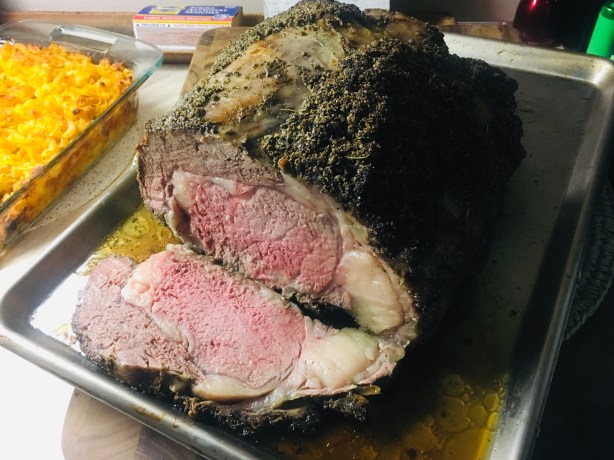
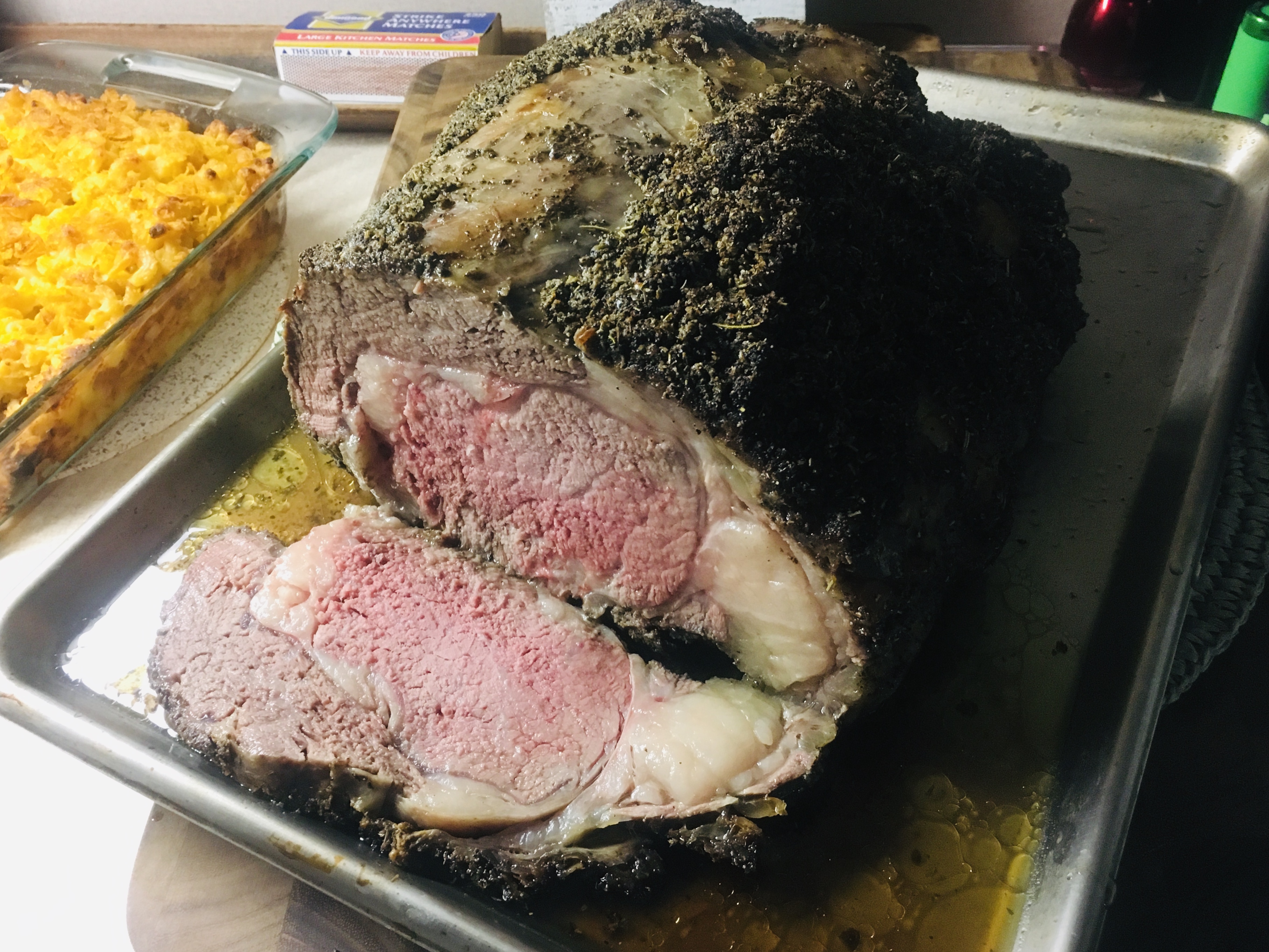
A perfectly cooked, perfectly delicious roast!

The second step is simple but very important: make sure the roast is at room temperature before cooking, and make sure the oven is really pre-heated properly to the right temperature before you put the roast in it. A cold roast will cook unevenly, and you won’t get that beautiful pink all the way through the meat when you slice it. It’ll be raw on the inside and overcooked on the outside. Take the roast out of the fridge for a good 2 hours before cooking…and if it’s frozen, back-time the heck out of it so that it’s truly thawed!

You can already see that back-timing is going to play an important part in a perfect roast. So, for example, if you want to be serving at 7PM, you need a half-hour (at least) for the meat to rest after cooking…about 2 hours of cooking time…and about 2 hours of bringing the roast to room temperature….give or take. Oven temperature settings vary, and roasts can be uneven. You’ll have to keep an eye on this thing.

That brings us to monitoring the temperature. If you have a basic instant-read meat thermometer, you’ll need to jab the roast a couple of times during the cooking process to know what temperature you’re at. I don’t like this method, because it means you’re pulling the roast out of the oven, dropping the oven temperature each time, and jabbing the meat, which releases juices every time you pull the thermometer out. I suggest investing in a probe that goes in the roast from the very beginning, and stays in the roast through the whole cooking process, monitoring the temperature the entire time. When the roast hits the perfect temperature of about 115°, it beeps and lets you know it’s time to remove it from the oven. It’s practically foolproof.

The monitor I have is old school, as you can see, but it does the job. These days, you can get a wireless model that calls your phone when you’ve reached the ideal temperature.
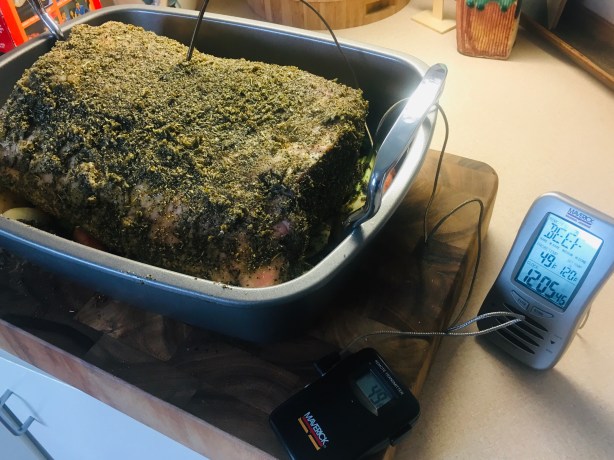
My old-school monitoring system. I had it set for 120°, but actually pulled the roast out at 115.

My old monitor still works like a charm. I use it at Thanksgiving to get perfectly roasted turkeys on a Weber grill, and it works great here as well. The probe goes into the meat, and it’s connected to a transmitter. It also has a receiver that can be as far away as 100 feet from the roast, and it will signal you when the desired temperature has been reached. That means you don’t have to stare at the roast all the time. You don’t have to open the oven door all the time. You can actually enjoy a cocktail in the company of your guests or family while the meat cooks.

2 onions
3 carrots
3 stalks of celery

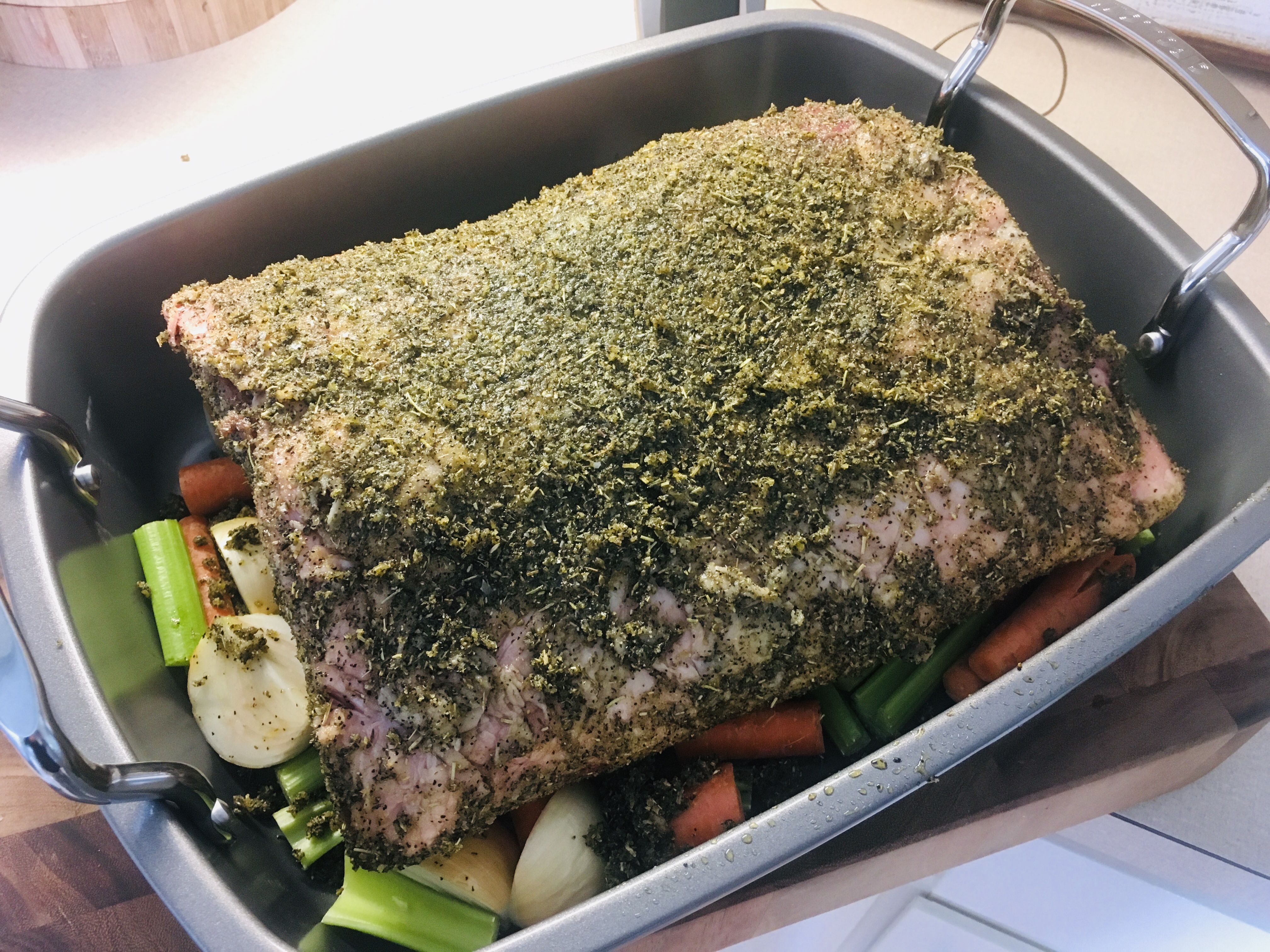
When it’s time to remove the roast from the fridge to bring it to room temperature, roughly chop the onions, carrots and celery and place them on the bottom of a roasting pan. Lay the roast on top.

The rub that you use on your roast is really a matter of what you like. Use the herbs and seasonings you love, and you can’t go wrong. Here’s my recipe for a 10 to 12-pound roast…

1/4 cup olive oil
2 tablespoons Kosher salt
1 tablespoon granulated garlic
1 tablespoon granulated onion
1 tablespoon dried oregano
1 tablespoon dried thyme
1 tablespoon fresh rosemary, finely chopped
1 1/2 teaspoons freshly cracked black pepper

Combine these ingredients in a bowl. You want it to be like a paste or wet sand. If it’s too dry, add a little more olive oil. Dried oregano and thyme are usually fine the way they are, but fresh rosemary from the supermarket can be hard like pine needles. I either chop them really fine or I put them in a spice grinder. I have a small rosemary plant growing indoors by my window, so the needles are usually soft and wonderfully fragrant when I chop them up.
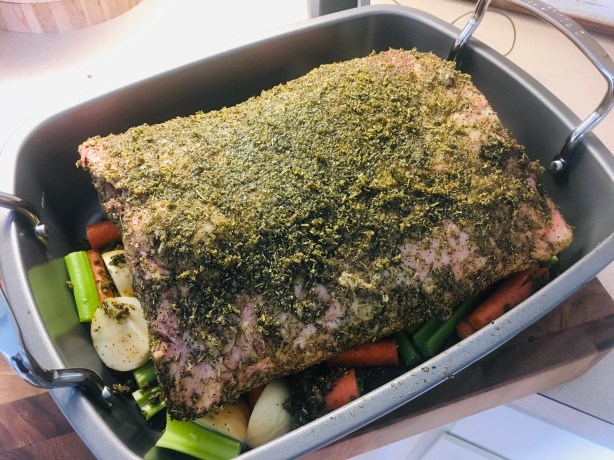
Seasoned and ready to cook!

Rub the seasonings all over the roast, making sure you get the bottom and the sides as well. Use it all up! You might think it’s too much salt, but remember: it’s a big hunka meat. Some of the seasonings will fall off. Be fearless!

To flavor the meat while cooking, I add a cup of red wine (optional) and 2 cups of beef or chicken stock in the pan with the vegetables. (In some cases, after the roast is cooked, you can use the juices at the bottom of the pan to make gravy. But give it a taste first. If you use a lot of salt on your roast, the juices could be too salty to use in your gravy. Gravy or not, a classic horseradish cream sauce on the side is a great choice. (The recipe is below.)

At least a half-hour before you want to start cooking, pre-heat the oven to 450°. You really want it hot to start. Roast the meat at 450° for 20 minutes, then turn down the heat to 325°.

This is where many recipes tell you to calculate how much more to cook based on the size of the roast, etc. If you’ve got a probe in the roast, you can see exactly how the temperature changes over time. If you decide that you’re going to “wing it,” you can go by the general math of 15 minutes per pound of meat, including that first 20 minutes. So, if you have a 10-pound roast, multiply that by 15 and you get 150 minutes. Subtract the first 20 minutes from that, and you need to cook the roast another 130 minutes at 325°. This is by no means a guarantee of success, but a very general guideline.

If you have a standard meat thermometer, you know that you can safely leave the roast in the oven at least an hour before taking the first temperature reading. Then play it by ear. (Like I said, you don’t want to be opening the oven door and poking the meat all the time.)

Although I had my probe set at 120°, I took the meat out at 115°, removing the roast from the pan, and placing it on a cutting board (or another clean pan.) Then I wrapped the roast with foil, and covered the foil with a clean bath towel, keeping all the heat in, letting the meat rest for AT LEAST 30 minutes. The meat inside continued to cook and reached a temperature of 130° before it started to slowly cool down. (If you leave the probe in while the meat is wrapped, you’ll actually see the temperature rise.)

After at least 30 minutes of resting, I unwrapped the roast and started slicing!

This is where you can pour off all the pan drippings and make a sauce if your spice mix wasn’t too salty or strong. As I mentioned, the classic horseradish cream sauce is great to serve with it…

1 cup sour cream
1/2 cup mayonnaise
6 tablespoons prepared horseradish (more if you like it!)
Juice of 2 lemons
1 tablespoon Worcestershire sauce

Combine all the ingredients, mixing well. Keep this refrigerated until it’s ready to serve.
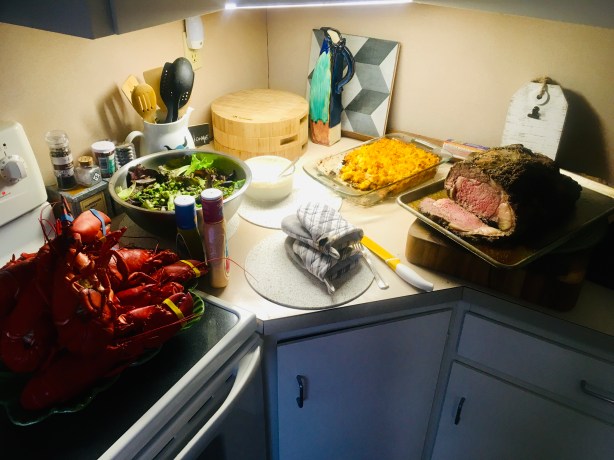
A previous family dinner with mac & cheese, salad, the amazing rib roast and lobsters from Sakonnet Lobster in Little Compton, RI!

With Thanksgiving on everyone’s mind, I’d like to share my recipe for what I consider to be the perfect turkey.

I often get asked if I deep-fry my turkey for Thanksgiving. I think it’s way too messy and time-consuming for nothing better than an “OK-tasting” bird. I lived in the South for a few years, and my friends fried a turkey on several occasions. I wasn’t that impressed.

When frying, you need to find a safe spot in the yard to blast the propane-fueled fryer so you don’t burn your house down. Then you need to stand outside and freeze your butt off while it fries, while your friends and family are all indoors having cocktails. Then you need to get rid of gallons of used oil, and clean up a huge mess at the end of it all. And through all this, you need to make sure the oil is at the right temperature so you don’t get a scorched turkey on the outside and a raw turkey on the inside.

No, thanks.

I get great results by cooking my turkey in my Weber grill. I’ve cooked it this way every Thanksgiving for about 30 years. The standard Weber allows me to cook up to a 15 lb. bird–big enough for my purposes–and it comes out crispy, smoky and delicious. If you’re afraid to try this for the first time at Thanksgiving when it really matters, I understand. That’s how I did it years ago, and I never looked back.


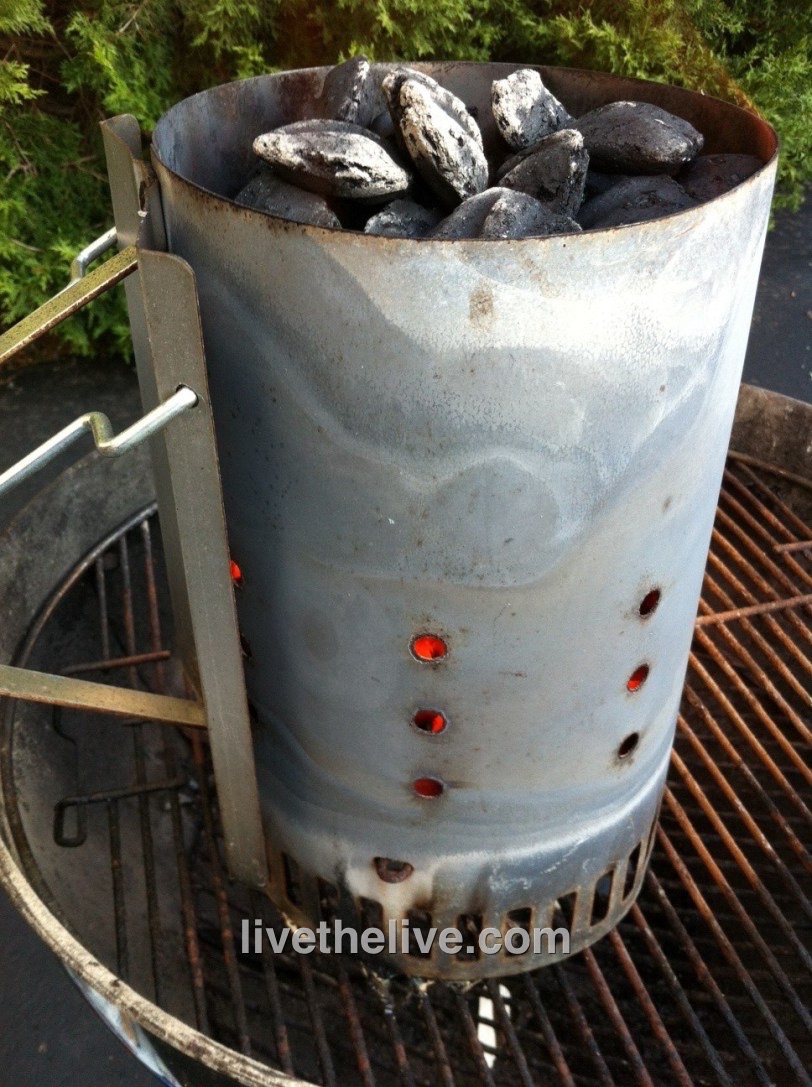
The charcoal chimney with hot coals awaits.

The charcoal chimney with hot coals awaits.


Although I’ve stopped using charcoal briquettes for basic grilling a long time ago, and now strictly use natural hardwood charcoal, this recipe works best with Kingsford briquettes. They burn slowly and evenly. I never use lighter fluid…I always start my fire with a few pieces of crumbled newspaper under a charcoal chimney.

The tools you need:
A Weber grill, with the dome top
Kingsford charcoal briquettes (don’t t use Match Lite or other pre-soaked briquettes)
A charcoal chimney, easily found at Home Depot or Lowe’s
A heavy-duty disposable aluminum pan
Ingredients:
Whole turkey, up to 15 lbs., thawed and brined (see my previous blog about brining a turkey)
Olive oil (to rub on the turkey)
2 yellow onions, chopped
4 stalks of celery, chopped
½ lb. (2 sticks) of unsalted butter, melted
1 tablespoon granulated garlic
1 tablespoon granulated onion
2 tablespoons salt
1 tablespoon pepper


Spreading the coals away from the center of the grill.

Spreading the coals away from the center of the grill.


If you want stuffing, it’s always wise to make it separately and cook it separately.

Light 8 to 10 lbs. of charcoal in the grill…depending on the size of the turkey and how cold it is outside.

If you brined the turkey first, you’ve already removed the giblets. If you’re not brining, go ahead remove the giblets from the thawed bird now. Place the turkey in the aluminum pan.

In a small bowl, mix the granulated garlic, granulated onion, salt, and pepper. (Add any other seasonings you might like.)

Coarsely chop the onions and celery. Place them in a another bowl. Mix them with the melted butter and 1/3 of the garlic/onion/salt/pepper mixture.

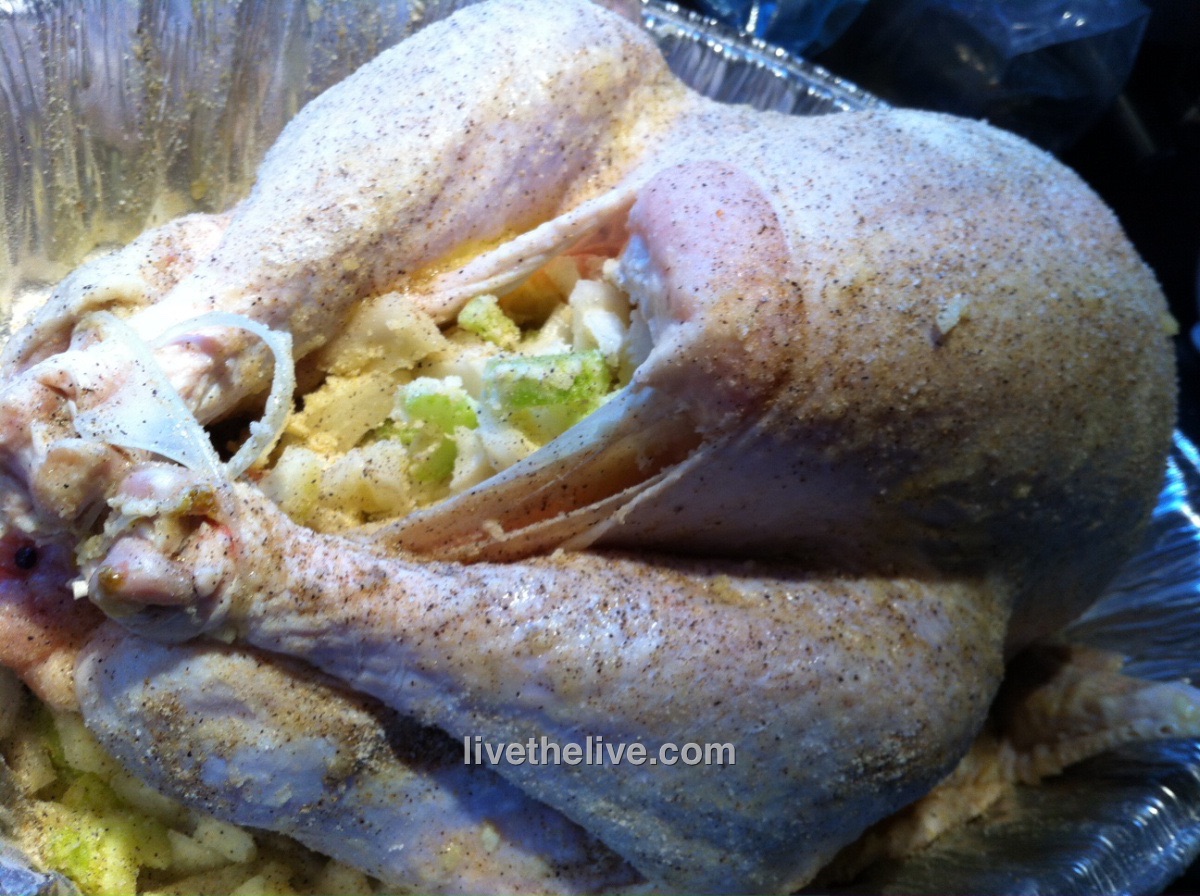
Place a small handful of this onion and celery “stuffing” mixture in the neck cavity of the turkey. Place the rest in the body cavity (where the stuffing would usually go.) You can fasten the bird with turkey skewers if you like. This “stuffing” is strictly to flavor the turkey…you don’t eat it!


The rubbed, stuffed and seasoned bird.

The rubbed, stuffed and seasoned bird.


Rub the outside of the entire turkey with the olive oil and sprinkle the rest of the garlic/onion/salt/pepper mixture on the outside of the bird. Make sure you get the bird on the bottom as well.

When the coals in the grill have ashed over, spread them to the outside edges of the Weber grill equally. Put the cooking grill rack in place. Place the aluminum pan with the turkey in the center of the grill, keeping it away from the direct heat of the coals. If you’re using a meat thermometer, insert the probe into the thickest part of the breast, being careful not to hit the bone. Place the lid on the grill. (You may need to bend your aluminum pan a bit.) Open the vents on the bottom of the Weber as well as the vents on the lid. It’s important to get air circulating!


My meat thermometer calls me from as far as 100 feet away! Time for a cocktail!

My old-school meat thermometer calls me from as far as 100 feet away! (Newer thermometers are wireless and talk to your smart phone.) Time to join family and friends for a cocktail!


No basting is necessary.

Now here’s the tough part: DO NOT OPEN THE GRILL TO CHECK ON THE TURKEY! (If you must look, shine a flashlight into the vent holes on the lid to take a peek at the pop-up timer, if there is one.) The whole point is to keep the heat inside the kettle. You’ll know your turkey is done when no more smoke or heat rises from the grill, and the turkey inside stops making sizzling noises. The internal meat temperature should be around 165 degrees.

And believe it or not, a 15-lb. turkey will be cooked in about 2 hours!

If you’re using a meat thermometer (recommended), remove the turkey when it hits about 155 degrees, wrap it in foil, leaving the thermometer still in the bird, and let it rest at least 20 minutes. The temperature will go up a bit to 165 or even a little higher, before it starts going down.


Beautifully grilled, and perfectly cooked in less than 2 hours!

Beautifully grilled, perfectly cooked!


I get requests to publish my holiday recipes every year, so, with Turkey Day on everyone’s mind,  let’s get it started…

I have to admit, I’m not a big fan of turkey. All things being equal, a roasted chicken is, in my opinion, a lot tastier. So turkey needs help. And one great way to give it lots of flavor is to brine it. No matter what method you prefer to cook your bird, brining it beforehand will make it so much tastier and juicier. It’s easy to do.

It’s basic high school science: the brine has a greater concentration of salt and water than the molecules of the protein (in this case, a turkey) that is soaking in it. By simple diffusion, the protein molecules suck up the salty water and keep it. When you cook the meat, some of the water evaporates, but the meat still has far more moisture in it than it would have without the brine soaking, and you get a moister, more flavorful bird.

Some people use giant syringes to inject their turkeys with crazy solutions, but I think that the old way is still the best when it comes to brining. Get a big pot, fill it with the brine, and soak the bird in it. Done.

Here’s my tried-and-true turkey brining recipe. Once the brining is done, you can cook the turkey whatever way you like best. I use a method where I grill it inside a Weber grill with charcoal. It comes out smoky and absolutely amazing. I’ll have that info in my next blog.

You must thaw the bird before brining, so use your favorite method to thaw your turkey so that it’s ready on Thanksgiving morning. Brining can take 4 to 6 hours, so start early!

For this recipe, you’ll need a large pot to boil the brine ingredients, and then a larger pot to hold the turkey submerged in the brine. I use a turkey no bigger than 15 lbs. for two main reasons: there are only 3 people in our family, and the Weber grill I will later use can’t handle anything bigger.


image

1 gallon of water
2 onions
3 carrots
3 stalks celery
1 cup Kosher salt (I use Diamond Crystal…see below)
1 tablespoon black peppercorns
1/2 cup light brown sugar
1 1/2 teaspoons whole allspice
4 bay leaves
1 gallon of ice water
14–15 lb. turkey, thawed

Pour the first gallon of water in a large pot. Quarter the onions, carrots and celery (no need to peel them) and add them to the water. Add the salt, black peppercorns, brown sugar, allspice, and bay leaves. (I specify Diamond Crystal Kosher salt because all Kosher salt does not weigh the same! For example, Morton Kosher salt is much heavier for the same 1-cup measurement, so the brine will be saltier.)

Let the pot come to a boil for a few minutes. Remove it from the heat and let the brine cool down to room temperature.

Remove the giblets from the thawed turkey and place the bird in a container just big enough to hold it and 2 gallons of liquid.

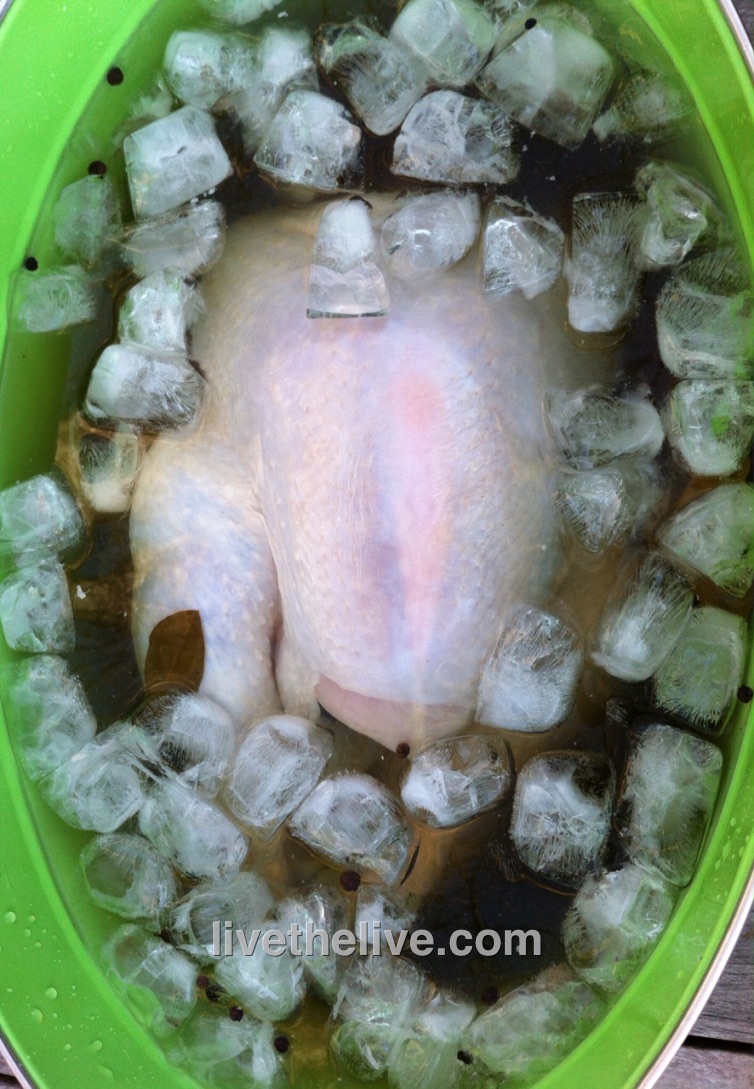
Pour the now-cooled brine over the turkey, then pour in the gallon of ice water.

Make sure the turkey doesn’t float up by placing a plate on top. Put the turkey container in the fridge (or a cold garage or basement) for 4 to 6 hours, flipping the turkey over in the container halfway through.

After 4 to 6 hours, drain the turkey, rinsing off any spices that stuck to it, then pat it dry with paper towels. Now it’s ready to cook, using your favorite recipe.

If I’m brining a turkey for Thanksgiving, I do the brining in the morning and the turkey is ready to cook by early afternoon. And grilling it on a Weber grill only takes a couple of hours. It’s fast, requires no basting, and is absolutely delicious! That’s next time!

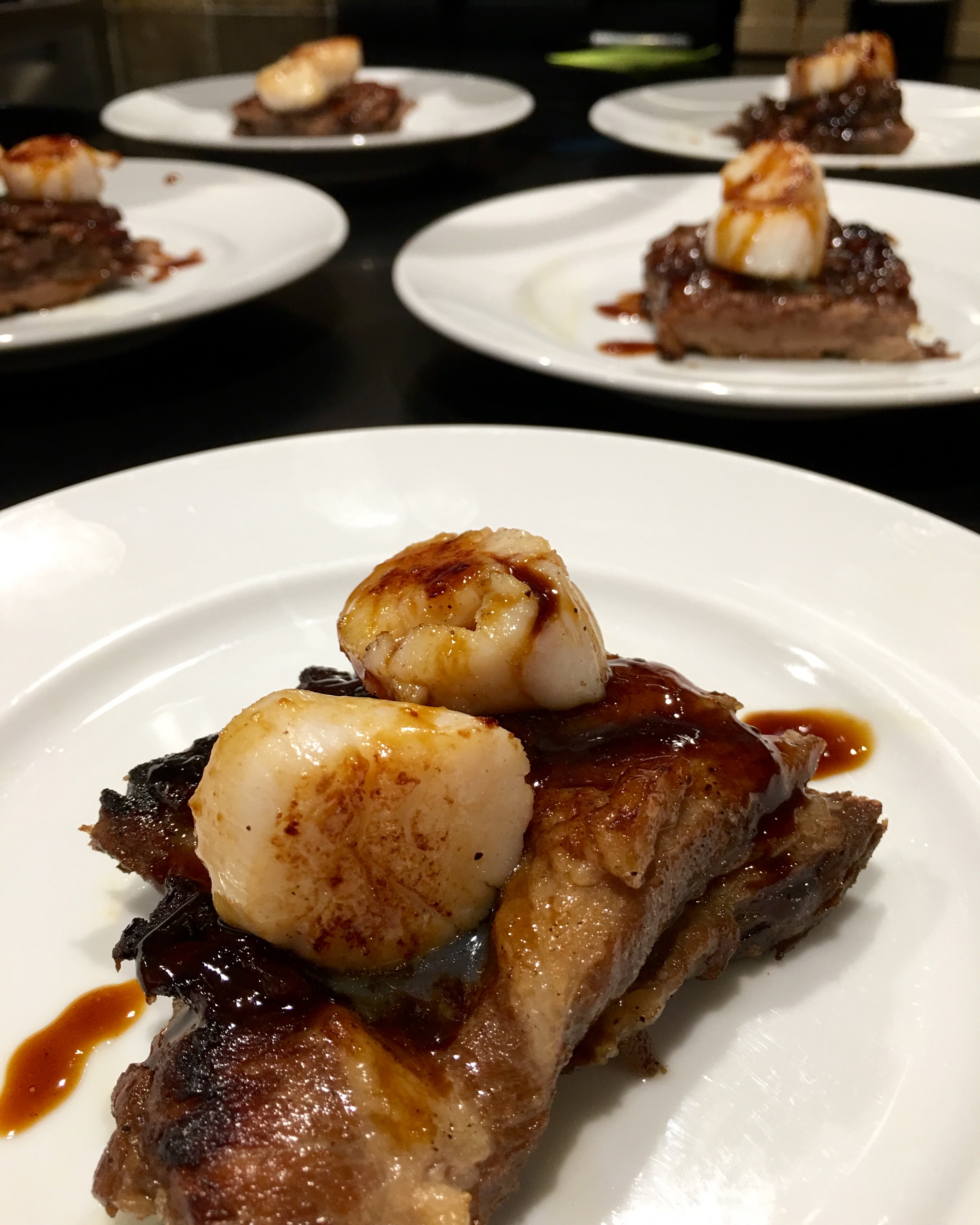
This is a rich, delicious, and unusual surf-and-turf, using wild Texas boar (I got it as a gift from my buddy, Dr. Chezwick!) and locally caught Rhode Island scallops. Wild boar is an ingredient usually only found online, so substituting pork belly, which you can find at your local butcher shop, is a great alternative.


FullSizeRender (9)

For the pork belly…
3 lbs. fresh pork belly
salt and pepper
1–2 tablespoons leaf lard or olive oil
1 carrot, coarsely chopped
1 celery stalk, coarsely chopped
1 onion, roughly chopped
1 fennel bulb, quartered
2 sprigs fresh thyme
1 teaspoon black peppercorns
4 cups beef stock
1 cup hard cider or apple juice

Pre-heat the oven to 350.

Season the belly with salt and pepper. On medium-high heat, melt the leaf lard, then sear the meat on all sides in an oven-proof pot big enough to hold it in one layer. Add the carrot, celery, onion, fennel, thyme and peppercorns and continue cooking for another 5 minutes, until caramelized.

Add the beef stock and the cider. Cover the pot with a lid or seal it with aluminum foil, and braise the belly in the oven for 3 hours, until tender.

Remove the pot from the oven, carefully remove the pork belly, and put it on a plate. Cover it with foil. If you’re cooking earlier in the day, you can place the belly in the fridge at this point.

Strain the leftover braising liquid from the pot and discard the vegetables and thyme. Skim off the excess fat. If you’re starting this dish earlier in the day, you can put this liquid in the fridge and the fat will harden, making it easier to remove.


FullSizeRender (8)

For the glaze…
braising liquid, strained
1 tablespoon espresso
1 tablespoon honey

In a small saucepan, reduce the brazing liquid by half, then add the espresso and honey. Cook a few more minutes until the sauce thickens. When it coats the back of a spoon, it’s ready. Set it aside.

For the scallops…
Fresh scallops
salt and pepper

When you’re ready to serve, heat a pan on high heat with a little more leaf lard. Cut the belly into equal pieces and sear them on all sides for about a minute. Place the scallops in the same pan, seasoning with salt and pepper, and sear them on both sides, being careful not to overcook them.

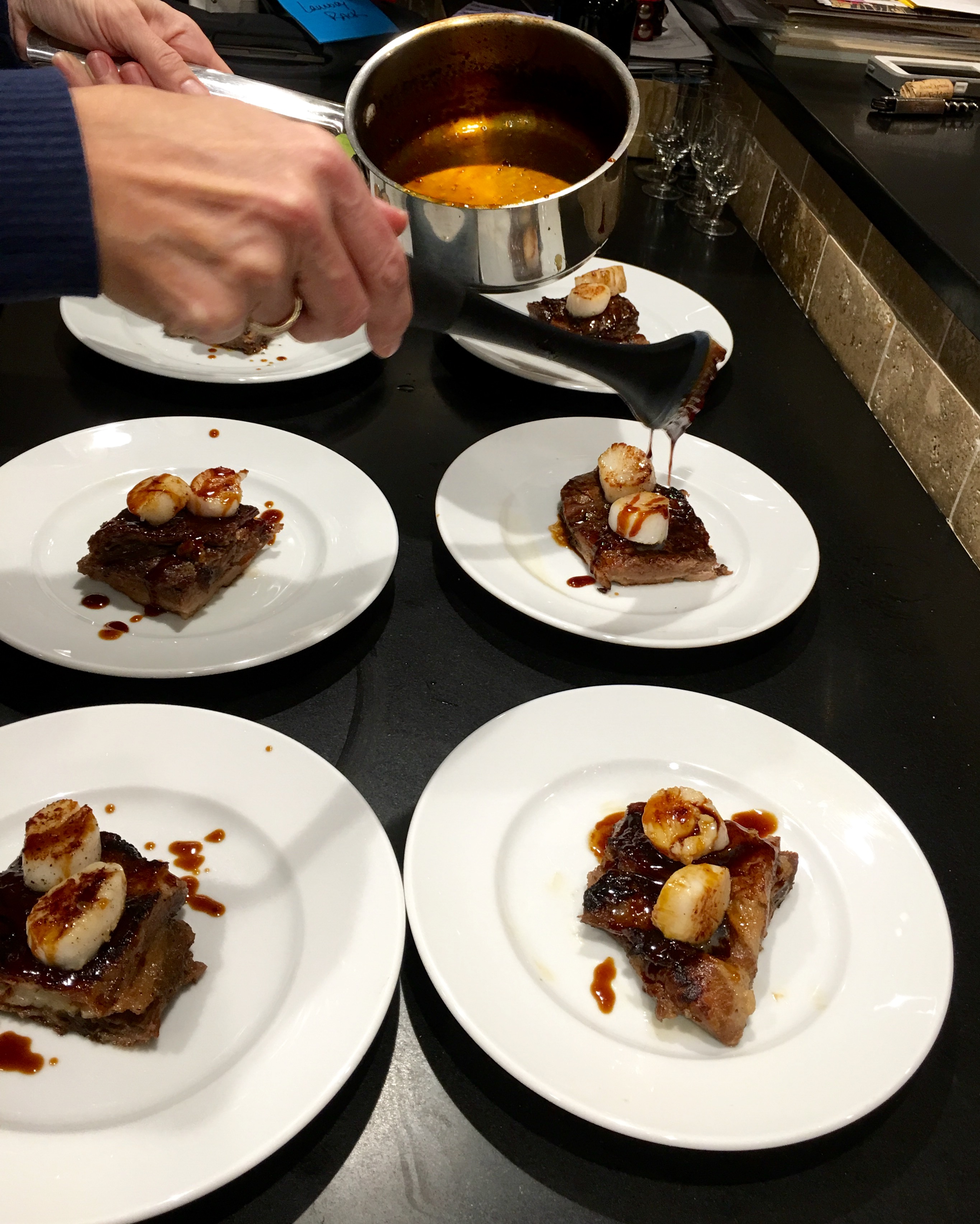
To serve, place the belly on a plate. Top it with a scallop or two. Drizzle the glaze over the top. Season with Fleur de Sel or other finishing salt and serve it immediately.

Like hot dogs and Slim Jims, jerky is one of those “mystery meats” we love but don’t really know how it’s made or what part of the animal it comes from.
Really excellent jerky is a rare treat, and once you have it, you will never go back to that rancid, preservative-filled dog meat you find in a bag at the supermarket. And the best part is: it’s easy to make.
Although I started my jerky-making endeavors with beef, I later acquired some beautiful venison from friends and family; hunters that had extra meat they were willing to share. I quickly realized that venison was the ideal jerky meat: really flavorful, with a wonderful texture.

Beautiful venison.

But venison is not all that east to find, and farmed venison is expensive. So beef is still the best option for most people.
Shop around for a really nice slab of London Broil or similar cut. You don’t need to buy an expensive piece of grass-fed beef, but the better the meat, the better the jerky. Remove all the gristle and fat that may be on the meat and then slice it against the grain and on a diagonal, into 1/4″ thick slices. Toss all the meat in a Ziploc bag. Once you’ve done that, all you need to do is make the marinade, marinate the beef overnight, and then dry it the next day. Your final product will be a flavorful beef jerky that is so good, you’ll find it very hard to stop eating it…or to share it.
If you use gluten-free soy sauce and teriyaki sauce (La Choy is the brand I use, found in any supermarket), this recipe can be considered gluten-free. Be careful: regular soy sauce, and even some tamari sauces, have wheat in them. Read the label!
image
1 tablespoon salt
1 1/2 tablespoons granulated garlic
1 teaspoon black pepper
1 teaspoon fresh minced peeled ginger
2/3 cup brown sugar
1 cup teriyaki sauce (I use La Choy)
1 cup soy sauce (I use La Choy)
8 lbs. raw, lean beef, like London broil, cut into 1/4″ thick diagonal slices, against the grain of the meat
Combine all the ingredients except the meat in a large bowl. Whisk it well. Place the meat in a large Ziploc bag, pour the marinade inside, seal it, and refrigerate it overnight. Squish the bag around once in a while, to make sure all the meat surfaces make contact with the marinade. Keep the bag in a bowl to prevent any accidental spillage in your fridge!
The next day, pour off the marinade and discard it. Using a food dehydrator, dry the meat by laying strips in a single layer. You can also dry them in a 140 degree oven on racks slightly elevated off a baking sheet. Drying could take several hours to half a day, depending on how dry and chewy you like your jerky, and how thickly you sliced it.
Jerky in the dehydrator.

Jerky in the dehydrator.

This recipe makes a lot of jerky, but it stores really well in the freezer. I put small amounts into individual freezer bags, then place all of them in one large freezer bag. Thaw as needed.

Years ago, I created an all-purpose sauce that worked with a variety of dishes. Because it has a base of mayo, mustard and ketchup, it’s awesome on burgers and fish…on lobster and crab salads and shrimp cocktail…and just about anything else you can think of. So…I called it Awesomesauce. And though I got tired of the name I gave it very quickly, I didn’t get tired of the sauce!

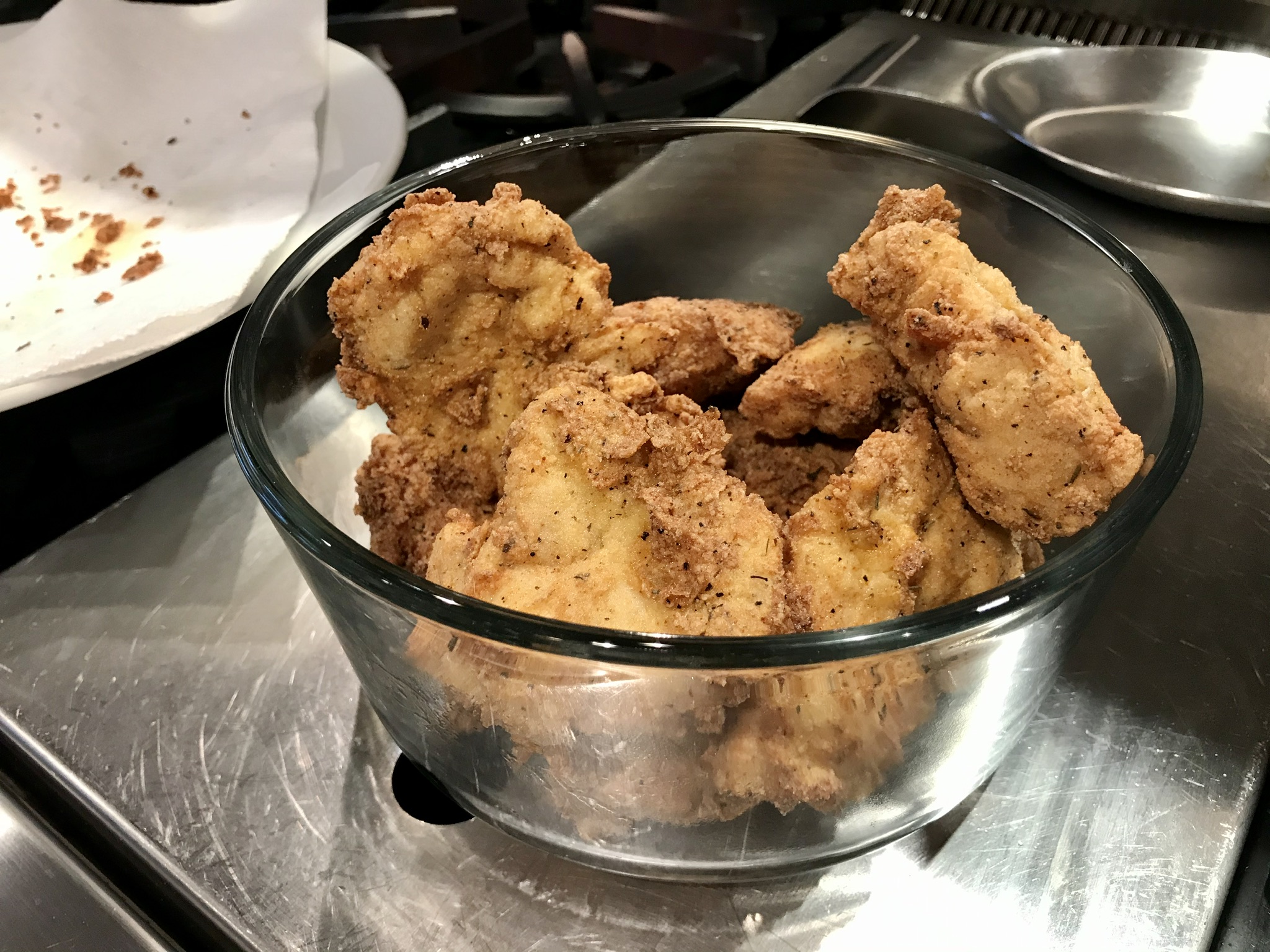
I made a batch of the sauce for taco night at the house, and decided to use the leftovers the next day to coat pieces of chicken before roasting. The chicken came out moist and delicious. And because I sprinkled some breadcrumbs on them, they had a nice added crunch.

I like to use gluten-free breadcrumbs, because some folks in my family live a GF lifestyle. But it’s easy to make them. I buy a frozen loaf of Udi’s bread, toast it, and then put the slices of bread in a food processor. Instant GF breadcrumbs that taste as good, by the way, as any bread with gluten. You’d never know the difference.


image

1/2 cup mayonnaise
1 tablespoon ketchup
1 tablespoon mustard (I like Gulden’s)
1 tablespoon dill pickle relish
1/4 teaspoon granulated garlic
1/4 teaspoon paprika
Pinch cayenne pepper
4 lbs. organic pastured chicken pieces
plain breadcrumbs (I use gluten-free)

In a bowl, combine the mayo, ketchup, mustard, dill pickle relish, garlic, paprika and cayenne. Mix it thoroughly and keep it in the fridge until you’re ready to use it.

Pre-heat the oven to 325°.

Rub the sauce all over the chicken pieces and lay them in a sheet pan lined with non-stick aluminum foil or parchment paper. Lightly sprinkle the breadcrumbs over the top of the chicken.

Bake until the chicken is cooked all the way through, and brown and crispy.


Sometimes the best ideas come from out of nowhere.

I had 5 lbs. of beautiful St. Louis-style heritage Berkshire (also known as Kurobuta) pork ribs thawing in the fridge, and I knew I wanted to create a new sauce or glaze with them, but I was feeling less than inspired. Our food-loving friends, Don and Johanna, showed up at our door with a gift they bought in Maine, at a shop called LeRoux Kitchen. It was a bottle of maple balsamic vinegar. It smelled wonderful…and tasted even better! I knew I had what I was looking for.

I used a smoker to make these ribs, but if you don’t have one (or just don’t want to bother with one), the ribs are just as awesome when baked in the oven.


You can easily make your own maple balsamic vinegar by combining a 1/2 cup of balsamic (not the super-expensive kind, but the $9-a-bottle kind) with 1 tablespoon of maple syrup. Add more or less maple to taste.


Yup…my old smoker…she’s been used a few times!


I originally used an electric digital smoker made by Masterbuilt. That beauty (above) has now made way for the Ninja Outdoor Woodfire Pizza Oven, which is also a smoker. I like the fact that I can set the temperature and time, and not have to constantly watch it. It has a side chute where I can add hickory smoking pellets when I want, and the results are consistent. I suppose some grilling fanatics might say I’m cheating, but a digital smoker allows me to live a life, hang out, do some yard work, whatever. I don’t have time to babysit.

I chose to smoke my ribs for about 4 hours in the smoker, lightly seasoning them first with Lawry’s Seasoned Salt, adding hickory chips to the smoker only once to give them a “light smoke.”

To avoid drying out the ribs, after a few hours of smoking, I like to brush them with a glaze, wrap them in foil, and then put them back in the smoker…or even in the oven. The glaze flavors the meat and also adds a little steam that tenderizes it.


Brushing with glaze, then wrapping in foil.

5 lbs. pork ribs (I get St. Louis-style Berkshire pork)
Lawry’s Seasoned Salt

1 cup water
1/2 cup maple balsamic vinegar (OR 1/2 cup balsamic vinegar + 1 tablespoon maple syrup)
1/4 cup brown sugar
1/2 teaspoon granulated onion
1/2 teaspoon granulated garlic
1/2 teaspoon cayenne pepper sauce (I like Franks’ Red Hot)

Prepare the ribs by removing the inedible skin on the back of the rack. The easiest way to do this is to cut a little “tab” of skin, then pull it with your fingers. Holding the skin with a dry paper towel will help your grip. I cut the racks in half to fit my smoker.

Season the ribs lightly with Lawry’s Seasoned Salt on both sides and place them into a 250° smoker (or oven, if you don’t have a smoker) for 3 hours, smoking lightly with hickory wood. (Skip the hickory if you’re using the oven.)

In a saucepan over high heat, combine the water, maple balsamic vinegar, brown sugar, onion, garlic, and cayenne pepper sauce. Stir well, and let it come to a boil. Let it reduce by half, leaving it still watery. Set it aside.

After 3 hours, remove the ribs from the smoker (or oven), placing them on a sheet of aluminum foil. (I use Reynold’s Non-Stick Foil, since the glaze will be sticky.) Brush both sides of the ribs with half of the glaze, and place the ribs meat-side-up on the foil before sealing the it around the ribs. Place the aluminum foil packets on a baking sheet, then into a pre-heated 250° oven (or back in the smoker.)


Remove the ribs from the oven or smoker after 1 hour. Open the foil packets so that the ribs are now exposed. Brush the top of the ribs one more time, then put the foil back over the top and cook for 1 hour more.


Sometimes the happiest of cooking accidents happen with bacon. My original plan was to make Chinese-style honey ribs for dinner. But instead of pulling a nice rack of ribs out of the freezer, I accidentally took out a slab of pork belly. I only realized my mistake after I thawed it, so I decided to use it! The results were pretty damn tasty.

I like maple syrup instead of honey, but use what you like!

image

Marinade:
¾ cup light soy sauce
6 Tablespoons hoisin sauce
5 lbs. pork belly
Zest and juice of 1 lemon
2 whole star anise
2 cinnamon sticks (3”)
1/2 cup honey or maple syrup
4 cups chicken broth (preferably homemade)
image
Pre-heat the oven to 350 degrees.
Mix the marinade ingredients. Set them aside.
Cut the pork belly into pieces that are about 2 inches square. Place them in a large pot. Cover them with water and bring the pot to a boil. Boil it for 5 minutes. Drain the water.
Place the warm pork belly pieces on a sheet pan lined with non-stick aluminum foil. Coat them with the marinade. Let them sit for 10 minutes.
Bake the pork belly pieces on the sheet pan in the oven for 30 minutes.
While the pork belly is baking, start the sauce in a large non-stick pan or pot: combine the lemon zest and juice, star anise, cinnamon sticks, maple syrup or honey, and chicken broth. Bring it to a boil, then reduce it to a simmer.
When the pork belly pieces have finished baking, add them to the sauce pot, lowering the heat to a simmer. Simmer (covered) for about 15 minutes or until meat is tender.
Turn the heat back on high, uncover the pot and cook until the sauce has reduced to a glaze that coats the meat. Reduce the heat as the sauce thickens to avoid the sugars in the syrup or honey from burning. When the pieces are sticky and gooey, they are ready!
Devour them just like that!
If you have leftovers, let the pork belly cool, then slice the pieces it to your desired thickness and fry them like regular bacon. They’re great with eggs!
image

I’ve got dozens of chicken wing recipes, but even so, sometimes I just want something different. I decided to take my favorite taco seasonings recipe and adapt it to chicken wings. Caramba! One of the tastiest wings I’ve made in a long time!

This is such an easy and delicious recipe to make, even for a crowd. At your next party, or watching your favorite football team play on a Sunday afternoon, just double or triple the recipe, as needed. And it works with a whole chicken as well.

2 teaspoons salt
2 teaspoons cumin
2 teaspoons oregano
1 teaspoon paprika
1 teaspoon granulated onion
1/2 teaspoon granulated garlic
1/2 teaspoon pepper
avocado oil
4–5 lbs. chicken wings

Preheat the oven to 375.

Combine the salt, cumin, oregano, paprika, onion, garlic, and pepper in a bowl. Mix well.

Cover a baking sheet with aluminum foil and spread the wings out on the sheet. Sprinkle the wings with the avocado oil and rub the oil all over the wings. This will help the wings cook evenly,  and it’ll help the seasonings stick to the wings.

Turn the wings bottom-side-up and sprinkle with the seasoning mix. Flip the wings over and sprinkle them again, coating them evenly.

Place the baking sheet in the oven and bake for about 45 minutes.

These wings are even better when they’ve been smoked. I recently bought a Ninja Woodfire oven, so it’s a bit of a cheat, since it’s an electric outdoor oven that burns smoking pellets. But the flavor I got was amazing!

Seasoned and ready to go.

After cooking/smoking at 250° for about 90 minutes using hickory pellets, they’re done!

Fourth of July weekend means it’s time to do some serious barbecue!

When I smoke my brisket low-and-slow in my smoker, I use a coffee steak rub that I developed a couple of years ago. It gives a deep, rich crust to the meat that is just fantastic.

Low and slow is the way to go! Deliciously smokey and juicy.

Depending on the size of the brisket, you might need to double the recipe. This is for a brisket that weighs about 9 pounds.

3 tablespoons brown sugar
1 tablespoon Kosher salt
1 tablespoon ground coffee (use your favorite)
1 teaspoon granulated garlic
1 teaspoon granulated onion
1 teaspoon unsweetened cocoa powder

If the brisket is frozen, I like to thaw it a couple of days ahead of cooking it, rubbing it down with the coffee rub, and placing it in the fridge for about 24 hours to rest. I bring it out about an hour before smoking, to let the meat come back to room temperature, and then I place it in the smoker for about 12 hours at 225 degrees, smoking it with hickory wood.

When it’s done, I remove it from the smoker, and wrap in foil and let it rest at least 30 minutes before slicing. If I’m not serving it right away, I place the wrapped brisket in the oven at the lowest setting, about 150 degrees, just to keep it warm.

When I’m ready to serve, I always slice the brisket on the bias, against the grain of the meat.