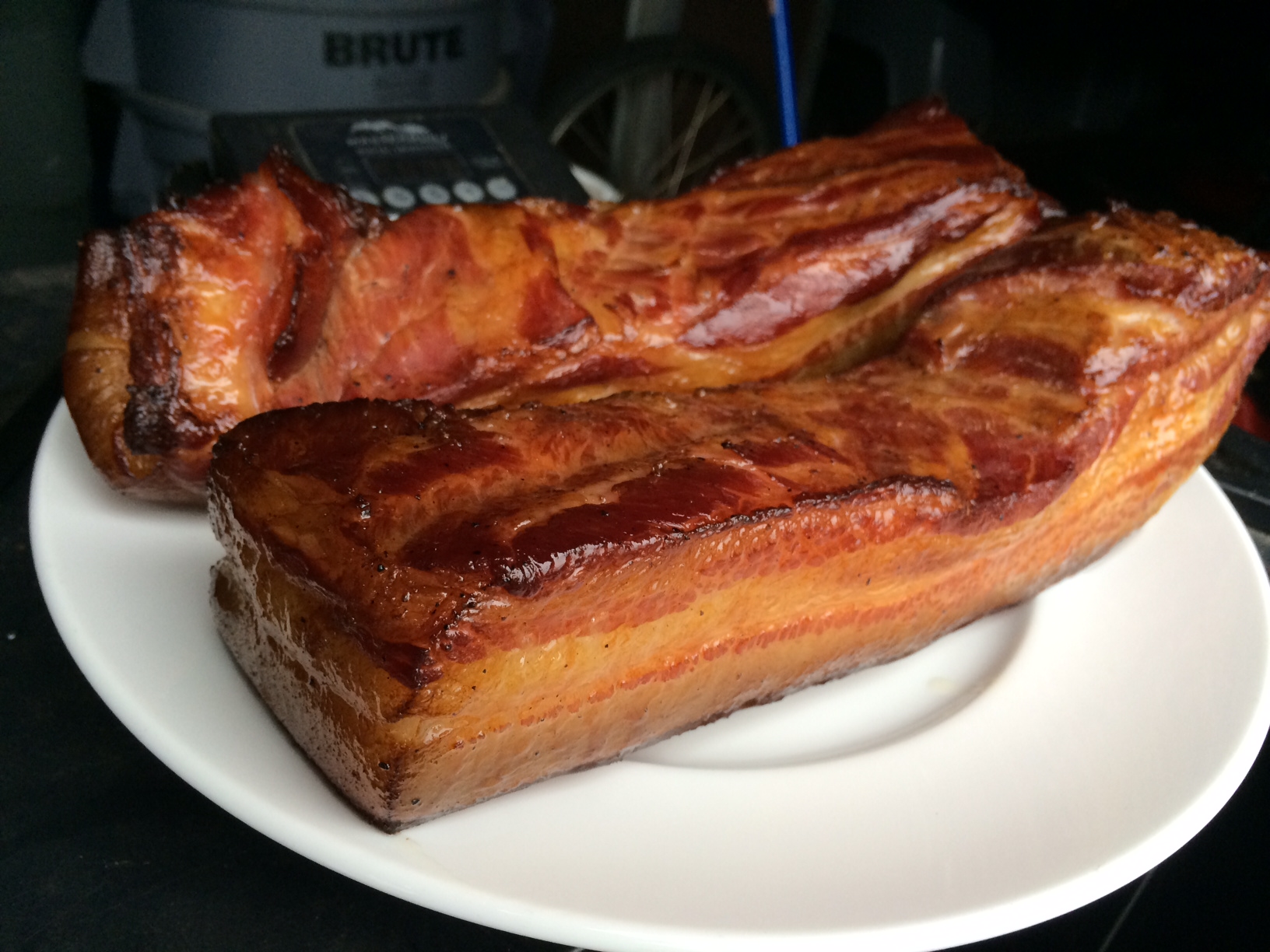
As if I needed more reasons to eat bacon, this Saturday, September 3rd, is International Bacon Day!

Let’s face it: there are few foods as magical as bacon. Add bacon to just about any dish you’re preparing, and it elevates it to incredible new heights of flavor. The BLT is possibly the greatest food combination ever invented: just a few simple, fresh ingredients, when placed together, transforming into one of the most amazing sandwiches on planet Earth.

Bacon comes from the pork belly. One of the places I buy pork bellies is from my friends at Fire Fly Farms in Stonington, CT (http://www.fireflyfarmsllc.com). I also get Berkshire pork bellies from Heritage Pork International (http://www.heritagepork.com). I follow the simple curing techniques outlined in “Charcuterie,” a great book written by Michael Ruhlman and Brian Polcyn.

To cure bacon, all you really need is Kosher salt and what they in the curing biz call “pink salt,” which is not to be confused with salt that happens to be pink, like Himalayan salt you’d find in a gourmet store. Pink salt is bright pink—to let you know that this is special salt that should only be used in small quantities for curing. The reason for that is because it has nitrites. Nitrites delay the spoilage of the meat, and help keep the flavors of spices and smoke. They also keep the meat nice and pink instead of an unappetizing gray. That’s good. But nitrites can break down into nitrosamines, which have been known to cause cancer in lab animals. But let’s face it: you would need to eat a ton of cured meat to really worry about this.

To make the basic dry cure:

1/2 lb. kosher salt
1/2 cup light brown sugar
1 ounce (5 teaspoons) pink salt

Mix the ingredients well. An important note: all Kosher salts do not all weigh the same (Diamond Crystal weighs less than Morton), so go by the weight and not a cup measurement. You can use this rub on your pork belly, but I make a large amount of the dry rub and keep it stored in my pantry. When it’s time to make bacon, I take it out and add other ingredients…


Bellies in the smoker

Bellies in the smoker.


Alz Bacon Rub:

1/2 cup basic dry cure
1/2 cup turbinado sugar (Sugar in the Raw brand)
1 teaspoon fresh cracked black pepper
1 teaspoon granulated garlic

Once you rub the pork belly thoroughly, place it in a Ziploc bag, squeeze the air out of it, and seal it tightly. another method is to wrap it tightly in plastic wrap, then seal it with tape. Place it in the fridge for a couple of weeks, flipping it over every few days to let gravity do its work. You’ll see that the salt will draw moisture out of the meat and form a brine. This brine will continue to cure your pork belly, so leave it in there.

After a few weeks, once the pork belly has been cured, wash the brine off the meat, pat it dry with paper towels. Now it’s time to cook. You can simply cook the pork belly at 200 degrees for about 2 hours, until the internal temperature reaches 160 degrees, but I always place the pork belly in a smoker, cooking it at 250 degrees for 1 hour, then add hickory chips and smoke it at 250 degrees for at least another hour.

Smoked bacon

Smoked bacon

That’s it. You have achieved bacon!

The reward is so worth the effort. You still have to fry it at this point…you can’t just take a bite out of the slab! But that first slice you cut off your bacon and toss in a pan to lightly fry for a few moments will be the best bite you’ve ever had in your life!
And if you’re making one slab of bacon, why not make it three or four? It freezes well. And…you will eat it. You know you will!

Frying in the pan!

Frying in the pan!

At a recent summer garden dinner for 12 of our friends, I wanted to serve my corn and tomato salsa that I featured here a few weeks ago.

We “smuggled” a few treats from a recent visit to Santorini Greece: capers, caper leaves and sun-dried tomatoes. Adding them to fresh corn and tomatoes gave it that salty bite that. I usually use feta cheese in this recipe, but we served a cheese plate as an appetizer, so I left the feta out. Turns out we like it even better this way…

1 dozen fresh ears of corn, lightly sautéed in olive oil
2 dozen (or more) tiny tomatoes, cut in half
1/2 small red onion, finely chopped
2 tablespoons capers
1 tablespoon caper leaves
2 tablespoons finely chopped sun-dried tomatoes
1/4 teaspoon black pepper
2 tablespoons white vinegar
1 tablespoon extra virgin olive oil (in addition to what you saute the corn with)

Slice the kernels of corn off the ears with a sharp knife. Saute them in a little olive oil, just to remove the raw taste. Don’t over cook them!

Combine the corn with all the other ingredients and place in a bowl in the fridge.

Just before serving, let it come back to cool, not cold, and check for seasoning. The capers and caper leaves are salty, so I’m careful not to over-salt.

The definition of a consomme is: “a clear soup made with concentrated stock.” I might add “mind-blowing” to that sentence, especially with this recipe. The key to success– and this is crucial–is to use absolutely garden-fresh, in-season ingredients. If you try this with greenhouse or supermarket tomatoes, you’re just wasting your time.

FullSizeRender (9)

4 1/2 lbs. of fresh garden tomatoes (my favorite is the heirloom: Brandywine)
1 large bunch of fresh basil, leaves and stems
1 2-inch piece of fresh horseradish, peeled
1 clove of garlic, peeled
1 tablespoon white wine vinegar (I use Alessi)
2 oz. vodka (I use Tito’s)
sea salt and pepper


Remove the core of the tomatoes, but leave everything else, including seeds and skin.

Put all the tomatoes, basil, horseradish, garlic, vinegar and vodka in a blender or food processor. You might need to do this in batches if your equipment can’t handle it all.

Process until you get a kind of slush.

Line a mixing bowl with a double layer of cheesecloth and pour the tomato slush mixture into it. Gather up the corners of the cheesecloth carefully, and tie them securely so you can lift the bundle up by the knot. Hang the bundle from a hook over a clean bowl in the fridge so that it catches the liquid that drips out, and leave the whole thing in there overnight. The liquid that drips out will be clear. (You can place an optional slice of beet in the bowl to add color, but I choose not to, because I think it changes the flavor.)

Cheesecloth bundle dripping overnight in the fridge.

Cheesecloth bundle dripping overnight in the fridge.

To serve, chill bowls (or in this case: the sipping glasses) in the fridge. When ready to serve, ladle out the consomme and garnish with a tiny basil leaf. A drop of excellent quality olive oil is optional.

Synthetic cheesecloth apparatus. The real thing works better.

Synthetic cheesecloth apparatus. The real thing works better.


I tried using a synthetic cheesecloth for this recipe, and I found that it doesn’t filter out enough of the solids to make a clear consomme. You could use it along with real cheesecloth, just to use the stand, or just hang it all in real cheesecloth, as described in this recipe.

I came up with this crunchy tasty appetizer a few years ago, when I needed a tasty bite for one of our famous summer parties. I wanted something fresh that highlighted the veggies of the season, so when I spotted these baby bell peppers in the supermarket, I came up with this tasty, crunchy appetizer. I get requests for the recipe every year. (I  grow my own baby bell peppers, but when we’re talking about feeding a large party, it’s time to go to the supermarket! )

image


Baby bell peppers
6 ears fresh corn, removed from the cob…or organic frozen corn
1/2 Vidalia onion, peeled, quartered, grilled, chopped
1 cup mayonnaise
1 teaspoon hot pepper sauce (I use Frank’s Red Hot)
6 oz. feta cheese or Queso Fresco, crumbled
Juice of 1 lime
Pinch of white pepper
1 tablespoon fresh parsley, finely chopped


image


Cut corn from ears, and saute very briefly in a little olive oil. Place in a bowl and let cool.

Peel and quarter the Vidalia onion, and throw it on a hot grill with a little olive oil to get some nice grill marks on it, leaving the onion still crispy, not soft. If indoors, throw the quartered onion in a hot pan with a little olive oil, and cook until you get some brown marks on it. Remove, let cool, then place in a food processor and pulse until the onion is chopped into small bits, just smaller than the corn kernels. Add onions to corn.

In a separate small bowl, combine the mayonnaise and Frank’s Red Hot. Pour in the crumbled cheese and mix well. Pour this into the corn and onion bowl and mix well.

Add the lime juice, white pepper and parsley to the bowl and mix well again.

Cut the baby bell peppers in half lengthwise, and remove the seeds and membrane. Stuff the peppers with the corn mixture and garnish with cilantro or parsley.


If you’r preparing this ahead of time, refrigerate the stuffed peppers until you’re ready to eat, but allow some time for them to warm up to a cool, not cold temperature.


We slurp down more clams and oysters in the summer here in New England than at any other time of year. Freshly shucked oysters and clams–or in this case–beautiful boiled wild-caught American shrimp, call for an equally amazing cocktail sauce…and this sauce kicks butt! And it features a key ingredient that you might not expect: vodka. The small amount of vodka in the mix keeps the cocktail sauce from freezing solid when stored in the freezer. Just scoop out what you need, let it thaw, and put the rest back in the freezer.

image


2 cups ketchup
4 tablespoons prepared horseradish
1 tablespoon fresh lemon juice
1 teaspoon Worcestershire sauce
1/2 teaspoon Frank’s Red Hot, or other hot pepper sauce
5 grinds of fresh black pepper
1/4 teaspoon salt
1 teaspoon good quality vodka, like Tito’s

Combine all the ingredients. Store in a tight plastic container in the freezer.

You may know my friends as Ativan and Ambien.

The fact is, despite all the places I’ve been to in the world, it’s a struggle for me to travel. I’m not a control freak, but I am a bad passenger. I always choose to be the one behind the wheel on family trips. I sit in the front of the bus so I can monitor the driver. I instinctively choose the bar car when I take the Acela into New York City. And I’m a lousy flyer. Sure, I know that statistics say flying is the safest form of travel. I’ve purchased a variety of CD’s and DVD’s to help me get over it. But there’s something about the fear of being in the air–and not in control–that I can’t shake.

But…I don’t want to stay home.

image

Enter my friend: lorazepam. Whenever I have a big trip planned, part of the pre-flight preparation is serious medication. But lorazepam itself doesn’t do the trick, of course. I’m a big guy, and if anyone thinks that a silly little pill is going to knock me down, they’re in for a surprise.

My standard medication routine goes like this: half a lorazepam the day of the flight to ease anxiety. I take a full pill once I’ve found my seat on the plane and I know it’s going to take off. This doesn’t knock me out. It simply eliminates “white knuckle” syndrome. And then I start drinking. By the time I’ve had a few, I’m feeling no pain as dinner rolls around. I have my meal, wash it down with another drink, and then, when I check with my wife to make sure that she and my daughter will be OK without me, I take a zolpidem. I’ve been told that this self-medication would knock a horse flat on its ass. It usually keeps me down for about 5 hours, just in time to have breakfast before landing the next morning on my trans-Atlantic flight.

Ironically, I prefer longer flights because with shorter flights, I just have to tough it out without the meds. (OK,  maybe I’ll sneak I half a pill in there.)

My wife and I have a deal: she takes care of our daughter on the plane, and then it’s my job to do so on land. And that system has worked well for us. It’s also allowed me to have incredible experiences I would not have had any other way:  riding an elephant in Thailand, exploring the souk in Marrakesh, landing with a helicopter on a mountaintop glacier in New Zealand (that took a record of three lorazepam’s, and I was still able to video the whole thing!), seeing beautiful sunsets in Santorini,  flying in a hot air balloon over the vineyards north of Barcelona, swimming with dolphins in Moorea…and more.

If course, I don’t recommend this combination of drugs to anyone. You need to talk to your own doctor. But I’m all set…because my doctor hates flying, too.

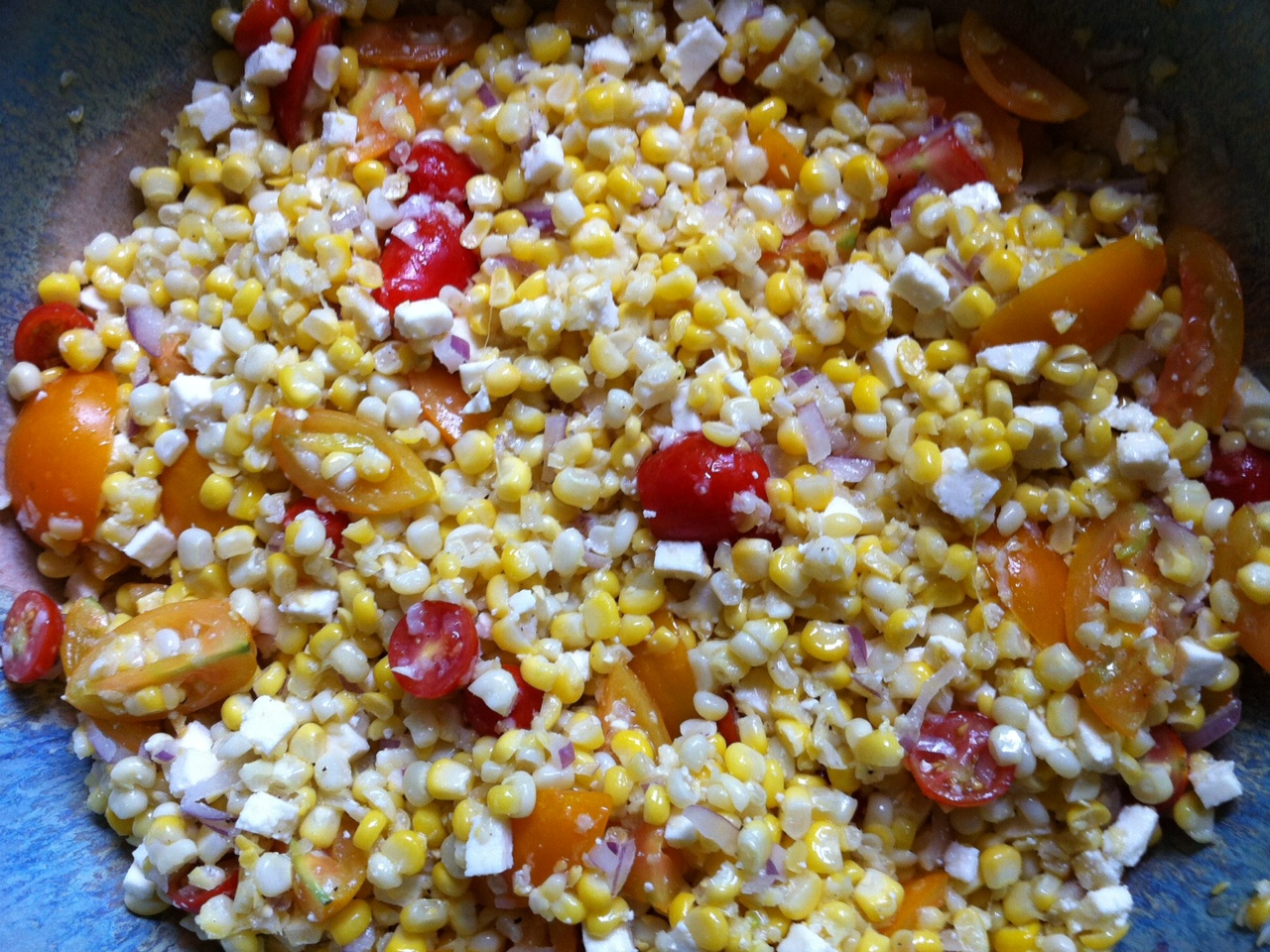
Corn and tomatoes…they’re in season and you just can’t beat the combination! This is a very simple salsa that takes advantage of their natural sweetness.

salsa


1 dozen fresh ears of corn or lb. frozen organic corn
2 large ripe organic tomatoes, seeded and chopped
1/4 small red onion, finely chopped
6 oz. mild crumbled cheese, like feta, cotija, or queso fresco
1 teaspoon Fleur de Sel or sea salt
pinch of black pepper
2 teaspoons white vinegar
2 tablespoons extra virgin olive oil


If you’re using fresh corn, remove the kernels from the ears by running a knife down the sides, slicing through the kernels. I stand my ear of corn up on the center hole of a bundt pan, letting the kernels fall into the bowl below. Pan sauté the corn for just a few minutes in a little olive oil, but leave it crisp! If you can roast the ears of corn over some coals, even better. Let it cool.

Mix the corn with all the other ingredients in a bowl. Cover and refrigerate.


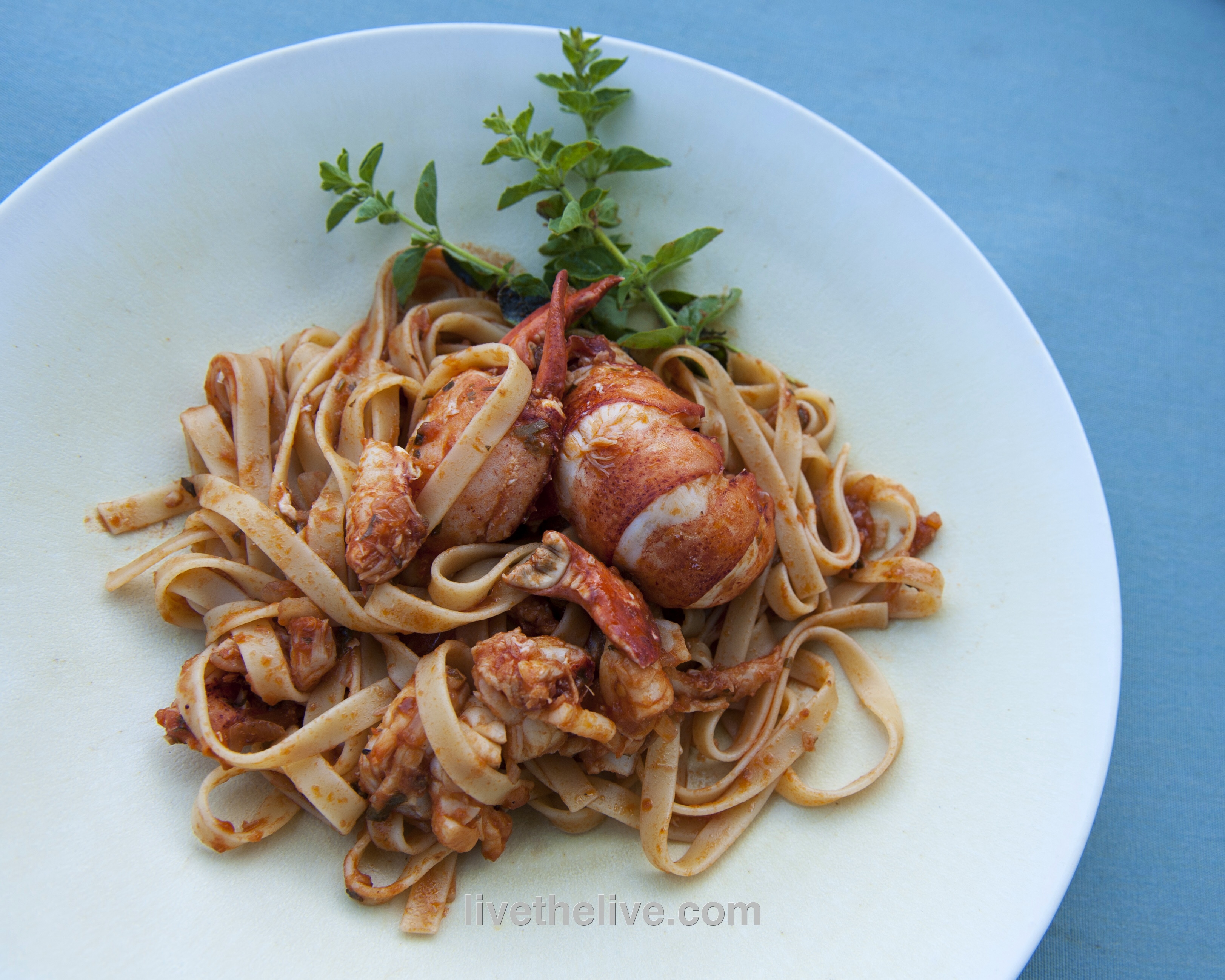
We’re in Santorini, Greece! Besides being one of the most magnificent places on earth, it’s where we first feasted on a beautiful lobster and pasta dish that we only dreamed about when we got home…until I got up the nads to give it a try. It’s one of those dishes that takes time to prepare…time consuming but so spectacular.

Where we first had our pasta with lobster sauce in Santorini.

Where we first had our pasta with lobster sauce in Santorini.

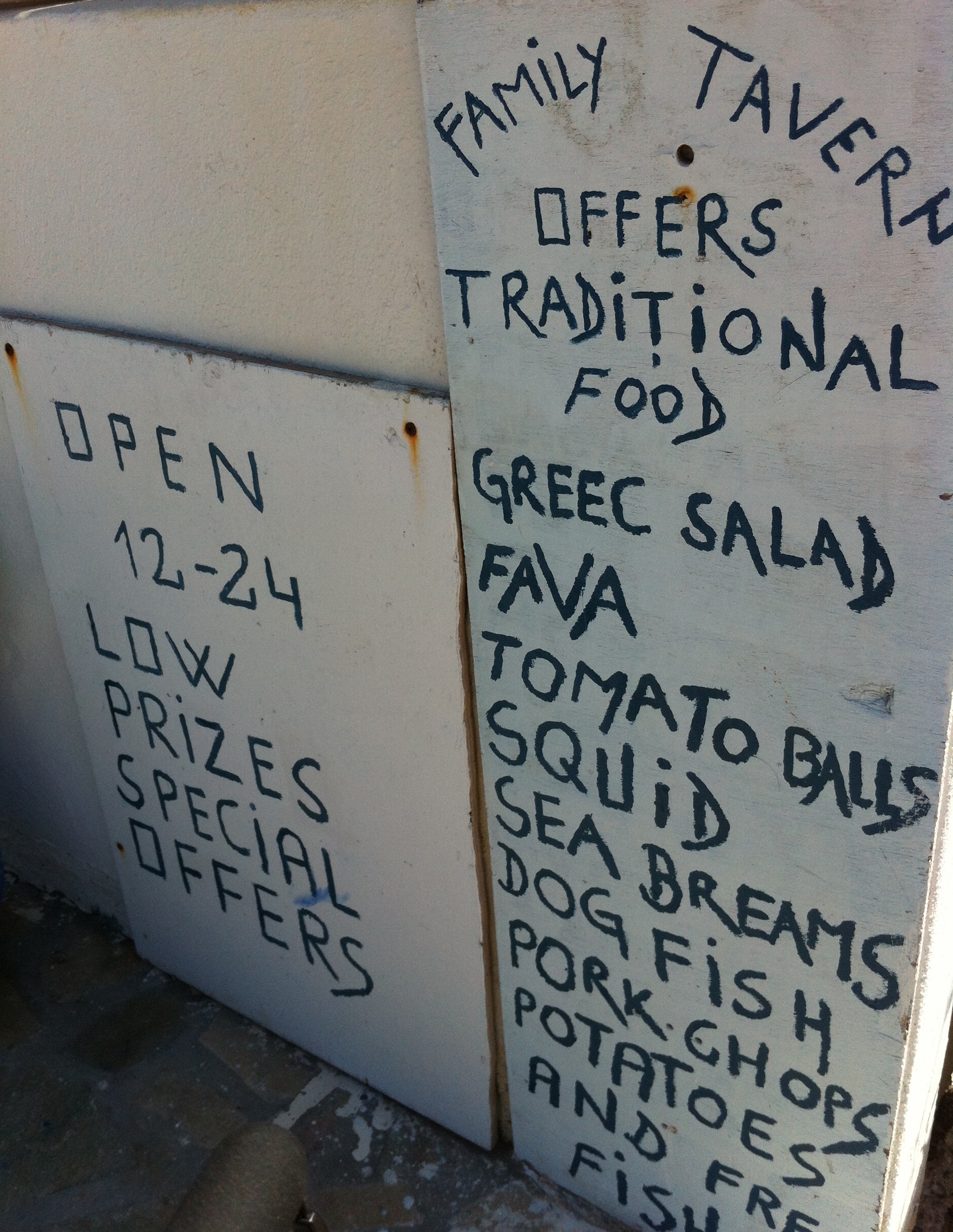
Love the signs!

Love the signs!

It’s absolutely important to make a good stock: the base for all the other flavors to follow.

Cooked lobster LTL


For the stock…
2 1-1/2 lb. lobsters, slightly under-cooked
12 cups water
1/2 onion, chopped into quarters
3 celery stalks, chopped into quarters
1 carrot, chopped into quarters


Under-cook (steam or boil, whatever your favorite method) the lobsters, less than the usual 8 minutes. Remove the lobster meat from the shells and set aside.

Place the cleaned lobster shells, claws, tails, legs and bodies in a large pot. (You don’t want any of the internal organs or tommaley.) Crush the shells so they fit in the pot. Add the water, onion, celery and carrot. Set the heat on high. Cook until it is reduced by half.

Strain the stock, discarding the lobster shells and veggies. Bring the stock back to the heat and reduce it until all you have left is 1 cup of intense stock.


Pasta with lobster sauce

For the lobster sauce…
1/2 onion, finely chopped
1 garlic clove, finely chopped
pinch of Italian red pepper flakes
teaspoon parsley
extra virgin olive oil
1/2 cup lobster stock
1/4 cup San Marzano tomato sauce (see below)
splash of white wine (I use Alice White Chardonnay)
salt and pepper


Final ingredients…
reserved lobster meat
1/2 lb. cooked pasta


Add some olive oil to a large pan and saute the onions until translucent. Season with salt and pepper. Add the garlic and cook for 10 seconds. Add the red pepper flakes and parsley.

Add 1/4 cup of the lobster stock and let it cook, reducing by half. Add the other 1/4 cup of lobster stock and the tomato sauce. Let it cook for a couple of minutes and add the white wine. Cook for a few minutes more.

Cook the pasta and drain it even before it reaches the al dente stage. Place the pasta in the pan with the sauce, heating and coating thoroughly. Add the reserved lobster pieces and warm them through, tossing in the sauce. Serve immediately.

For the San Marzano tomato sauce: I take a can of San Marzano tomatoes and place it in a food processor or Vita-Mix and blend. Pour into a pan and reduce over medium heat by half, until sauce has thickened.

My friend, Cindy, has cucumber overload in the home garden right now. Thanks to her for requesting a re-post of this recipe.

I don’t have the patience to boil Mason jars and lids and all that crap. But I love me my pickles, especially when I’ve got a cucumber surplus in the garden. These won’t last beyond the season, but if you want fresh pickles in a hurry, this is a great method to use.

No water is needed! The salt extracts just enough moisture, like when curing meat, to make it work.

pickles


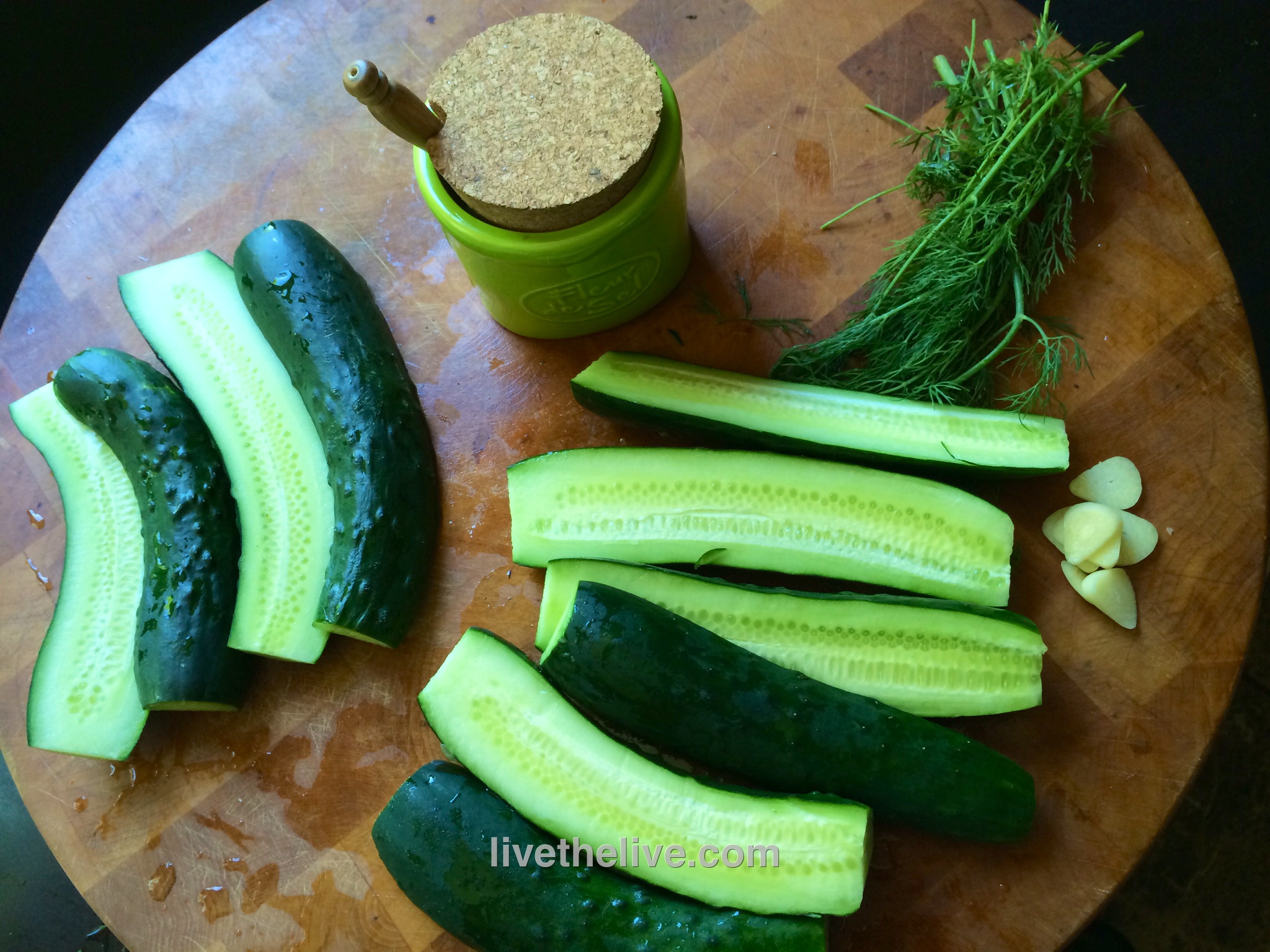
6 fresh cucumbers
1 1/2 teaspoons sea salt (I like Fleur de Sel)
handful of fresh dill
1 clove garlic, thinly sliced


Get a large plastic Ziploc bag.  Add the salt, dill and garlic and gently mix everything in the bag.

Cut the ends off the cucumbers and then slice them lengthwise, in half or in quarters. Add them to the bag and gently mix again.

Squeeze to remove air from the bag, close it tightly and place it in the fridge overnight. The pickles will be ready to eat the next day, but they’re even better after 48 hours.


It’s the peak of the summer season along the coast of the great state of Maine. My friend, Lee, recently bought a second home in Kennebunk, and it was all the excuse I needed to head up there and check out the town I visited with my parents during my childhood. My trip was less about the Lithuanian Franciscan monastery my parents would make a point to visit, and more about hitting every bar and restaurant we could in a 24-hour period.

image

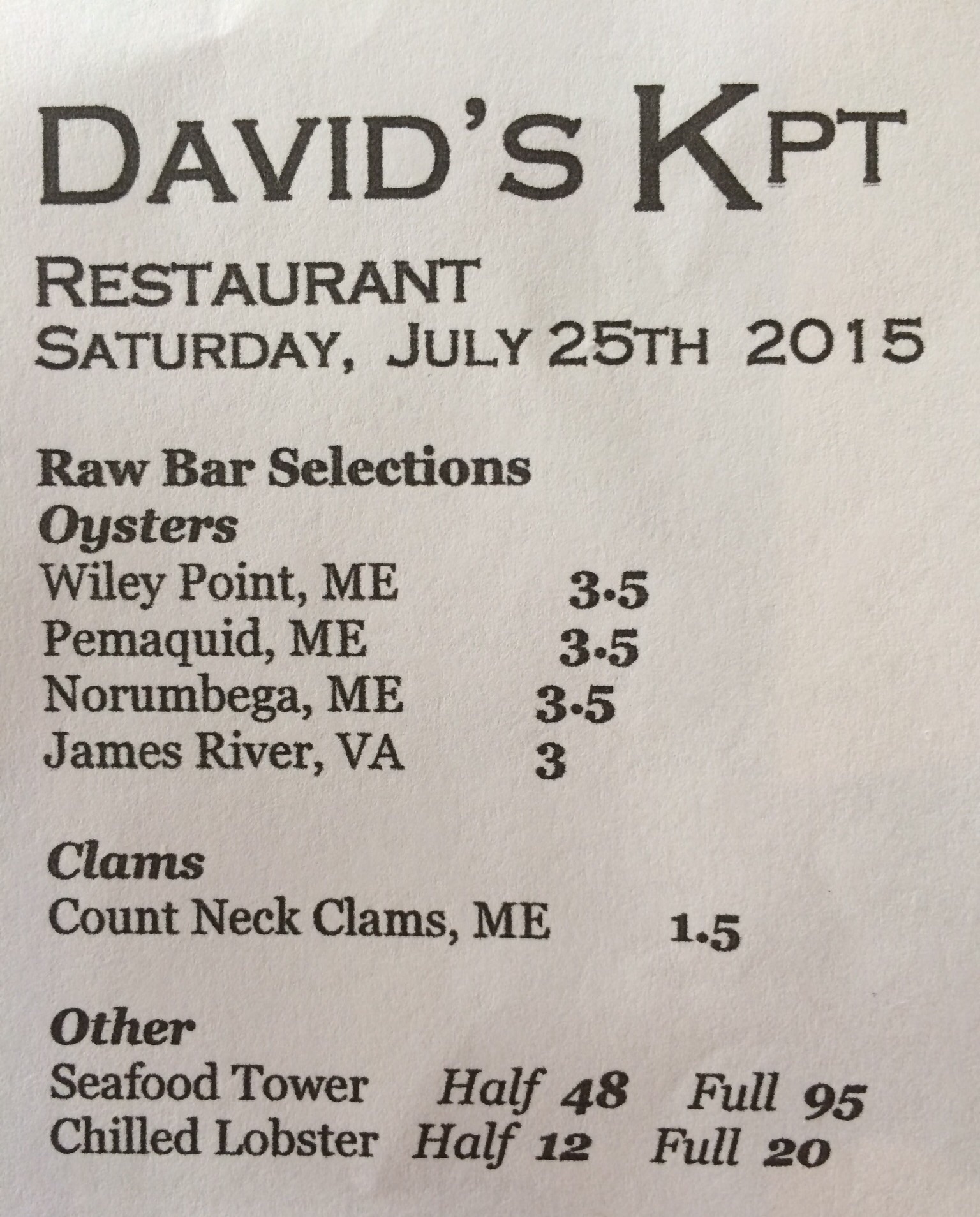
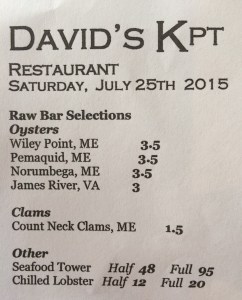
I arrived at lunch time and we went straight to David’s KPT, one of several restaurants owned by chef David Turin, who owns others in nearby Portland. I ate at the original David’s in Portland a few years ago and was not impressed, so it took a little coaxing to get me to come here. David’s KPT menu is simple, basic seafood, and for a restaurant on the water with great views, that’s about all you need. Nothing particularly creative here, just the basics, like fresh oysters but a rather bland lobster salad. Its key location also makes it a tourist trap and they jack the prices up, so some oysters go for $3.50 each! I don’t even pay that in New York City.
image

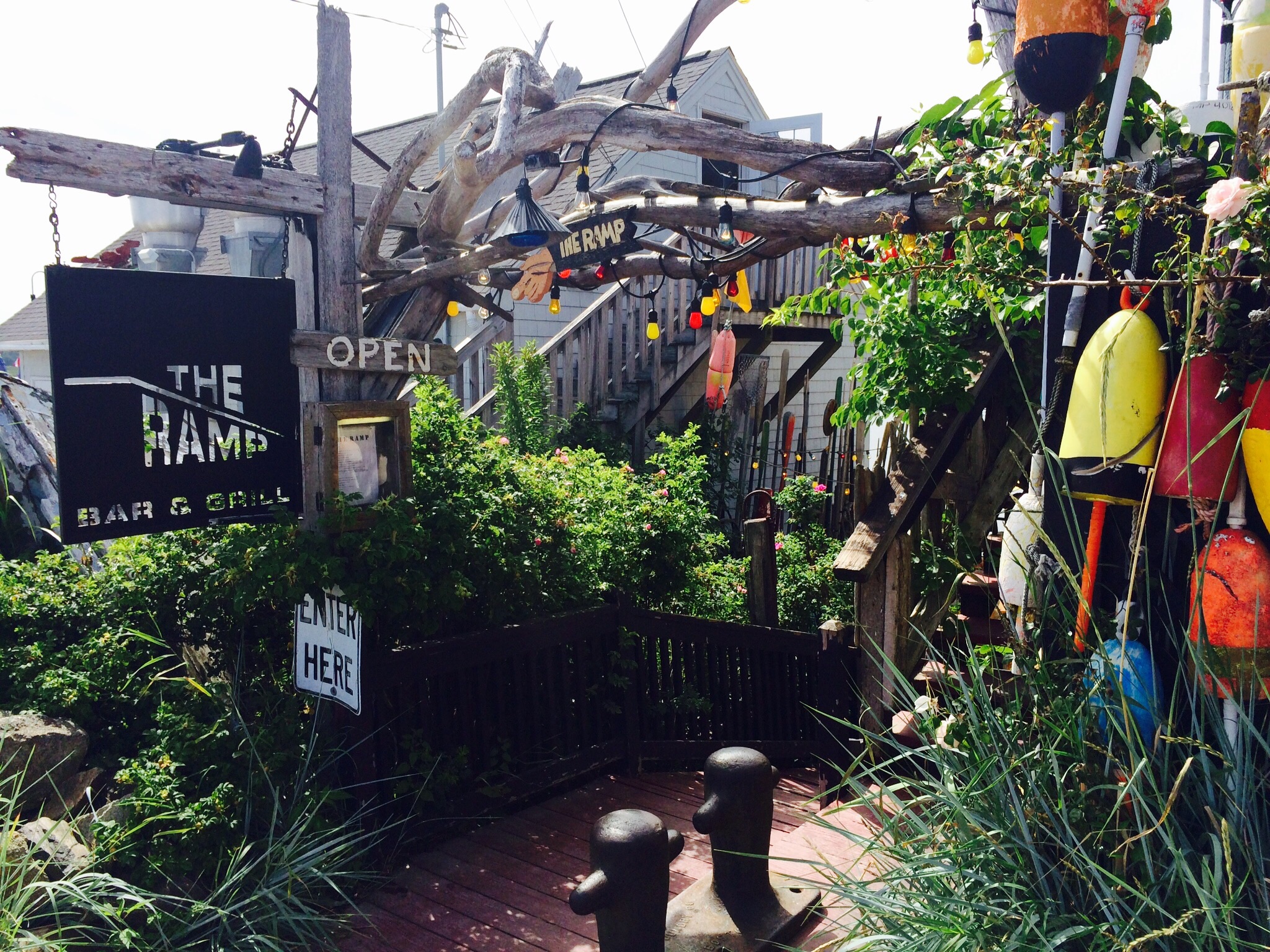
After lunch, we took a ride along the beautiful rugged Maine coast, passing the Bush family compound and the line of cars parked on the road with people taking snaps of the house for their scrapbooks. We stopped In Cape Porpoise, still a part of Kennebunkport, at a funky joint called The Ramp.

image

On the water, The Ramp is crowded and noisy, with old posters and souvenirs on the walls and ceiling, ranging from a NYC World Trade Center subway station sign to a “Vote for Marcos” campaign poster from the Philippines. We had to put our names on a list just to sit at the bar. But that was OK…we had a cocktail while waiting. By the time we finished our drinks and were ready to leave, our turn came up at the bar, so we handed our space off to the next person in line and moved on.

Our lovely server at The Ramp. Notice photos of former Presidents behind her.

Our lovely server at The Ramp. Notice photos of former Presidents behind her.

Back on the road, we drove into town, found a rare parking space on the street, and walked over to Tia’s Topside,with their signature giant lobster claws in the front yard.

imageimage

The menu was no great shakes, and it was clear the dude working the bar already had his fill of tourists for the season. No eye contact, just a “What do you guys want to drink?” That was a thumbs down in our book.

Walking back to the car, we popped into Ports of Italy for a pop. Looking at the plates of the people next to me at the bar, it seemed like we stumbled into a local version of the Olive Garden. The website makes everything we saw look much better. But we passed on the food. Generic drinks.

Clearly, the amount of drinks we had, and were still going to have, was going to be an issue, and Lee being the driver, was behaving to avoid any trouble with the law. Police are everywhere in Kennebunk, and they are notorious for pulling you over for even the slightest infraction. So we headed back to the condo to park the car and wait for the taxi we hired for the night to take us to dinner and beyond.

image

The culinary focus of the trip (I made reservations two months earlier) was Earth at Hidden Pond, a Ken Oringer restaurant in the center of a luxury resort just a short drive out of the center of town, hidden in the woods, surrounded by ridiculously expensive cabins.

Outdoor seating, great atmosphere at night when they light the torches and the fires.

Outdoor seating, great atmosphere at night when they light the torches and the fires.

Oringer is a crazy-talented chef, a Food Network “Iron Chef America” winner with a half-dozen respected restaurants to his name: Toro in Boston (personal favorite) and NYC, Clio in Boston, Coppa (excellent!) in Boston, and Uni in Boston. I was very glad to see that Earth lived up to my expectations.

The well-stocked bar at Earth.

The well-stocked bar at Earth.

Our evening got off to a slow start. It was a Saturday night, yet the main bartenders were nowhere to be found. (We heard that one was out due to a leg injury.) The woman that served us was great to talk to, but she clearly did not have a grasp on the crafting of the more complicated cocktails that Earth was known for. Our first drinks were good, but she literally had to read the recipes off a card to make them. And when I asked for Antica Formula in my Manhattan, she didn’t know what that was.

Enter Josh, a young, energetic bar assistant, who saw this as an opportunity to show off his mixology skills. He jumped right in and offered us a cocktails he created, and we welcomed his refreshing enthusiasm. I can’t even remember the ingredients list he had for each cocktail, but we thoroughly enjoyed them, and he custom-crafted them if we didn’t like a particular ingredient.
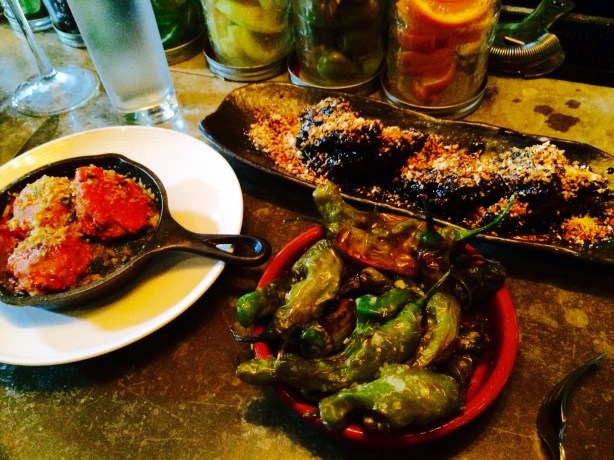
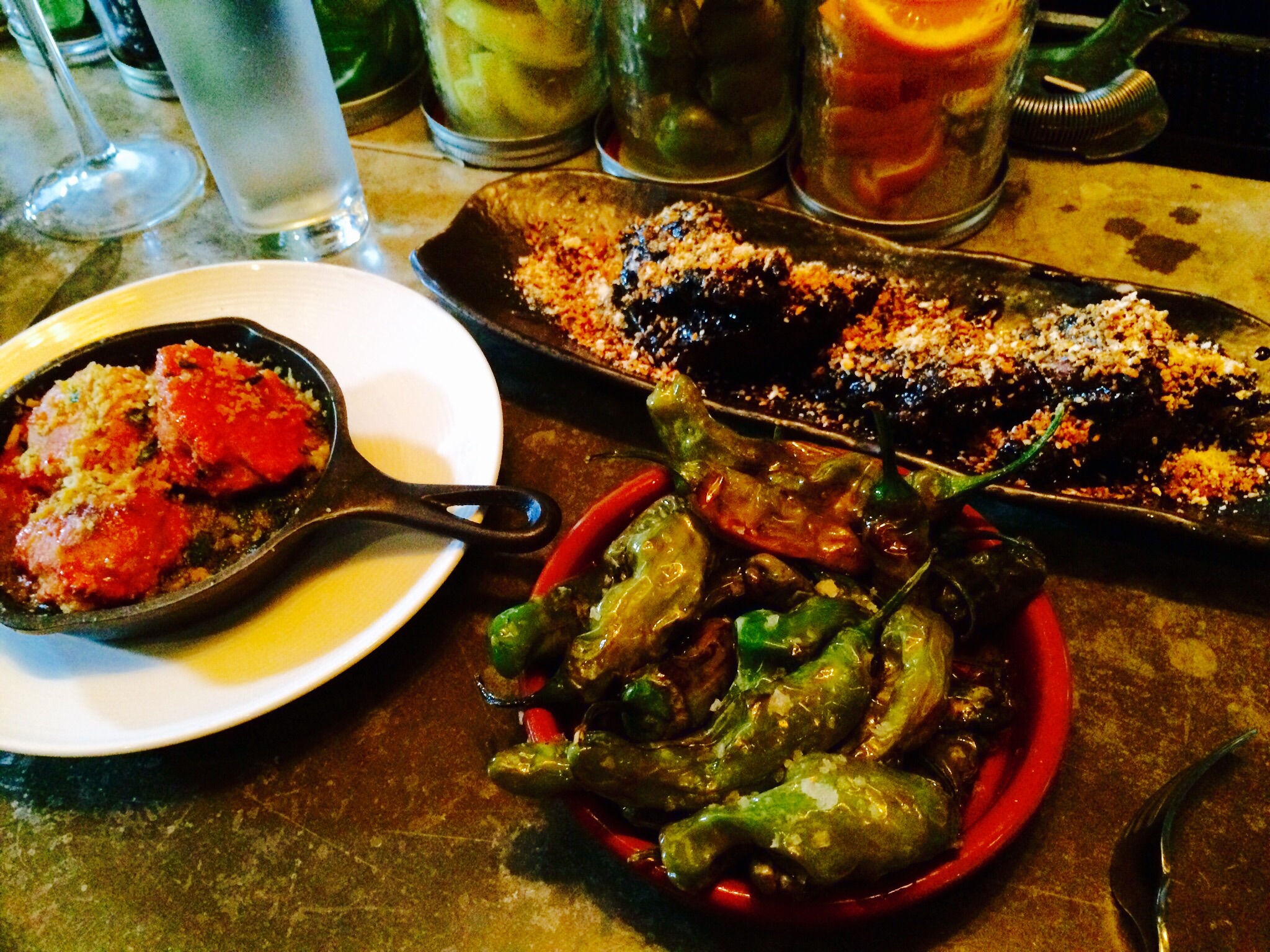
Small plates: meatballs, chicken wings with sesame and squid ink, shishito peppers.

Snacks: meatballs, chicken wings with sesame and squid ink, shishito peppers.

We started with a few apps, or snacks as they called them. The meatballs were good, average meatballs. The shishito peppers, roasted and salted, are a Ken Oringer signature dish, also served at his Toro restaurants. Usually 1 out of 10 are hot, but we had more than a few spicy bites on our plate. The chicken wings with squid ink were incredible: sweet, salty, briny. Probably the best wings I’ve ever had, and I’m dying to figure out how I can make them at home. I had a chance to talk to executive chef Justin Walker, and after he explained the process in detail, it was obvious it wouldn’t be easy!

A luxurious plate of seared foie gras followed. Couldn’t have been more perfect.

But after the foie, we had a dilemma: We made plans to have the taxi pick us up from the restaurant at 8:30, giving us 2 1/2 hours to eat dinner. It was after 8 already, and we had to focus on leaving, despite the fact that we didn’t have an entree yet. Our bartender suggested perhaps a dessert, and we decided to order a second plate of chicken wings to end our meal!

I was bummed that we didn’t give ourselves enough time to have a complete dinner. I suppose that meant we were having a good time and not just shoving food down our pie holes. It’s also my excuse to come back to Earth to “do things right” the next time!

image

Our last stop was back in town at Old Vines, a wine bar that also serves great food. Though we were seated quickly at the bar and got our first drinks, it seemed like forever before we could get the attention of our female bartender who was far more interested in the other females at the bar than us two old guys. Hey, I understand that, but we wanted to order some food. It was only when the owner showed up that we were asked what we’d like to eat and by then we were told the kitchen may be closed. Fortunately, we ordered two cold dishes, so they were easy to prepare: beef carpaccio and a burata salad. Both were excellent.

A cab ride home, and it was time to pass out.

FullSizeRender (12)

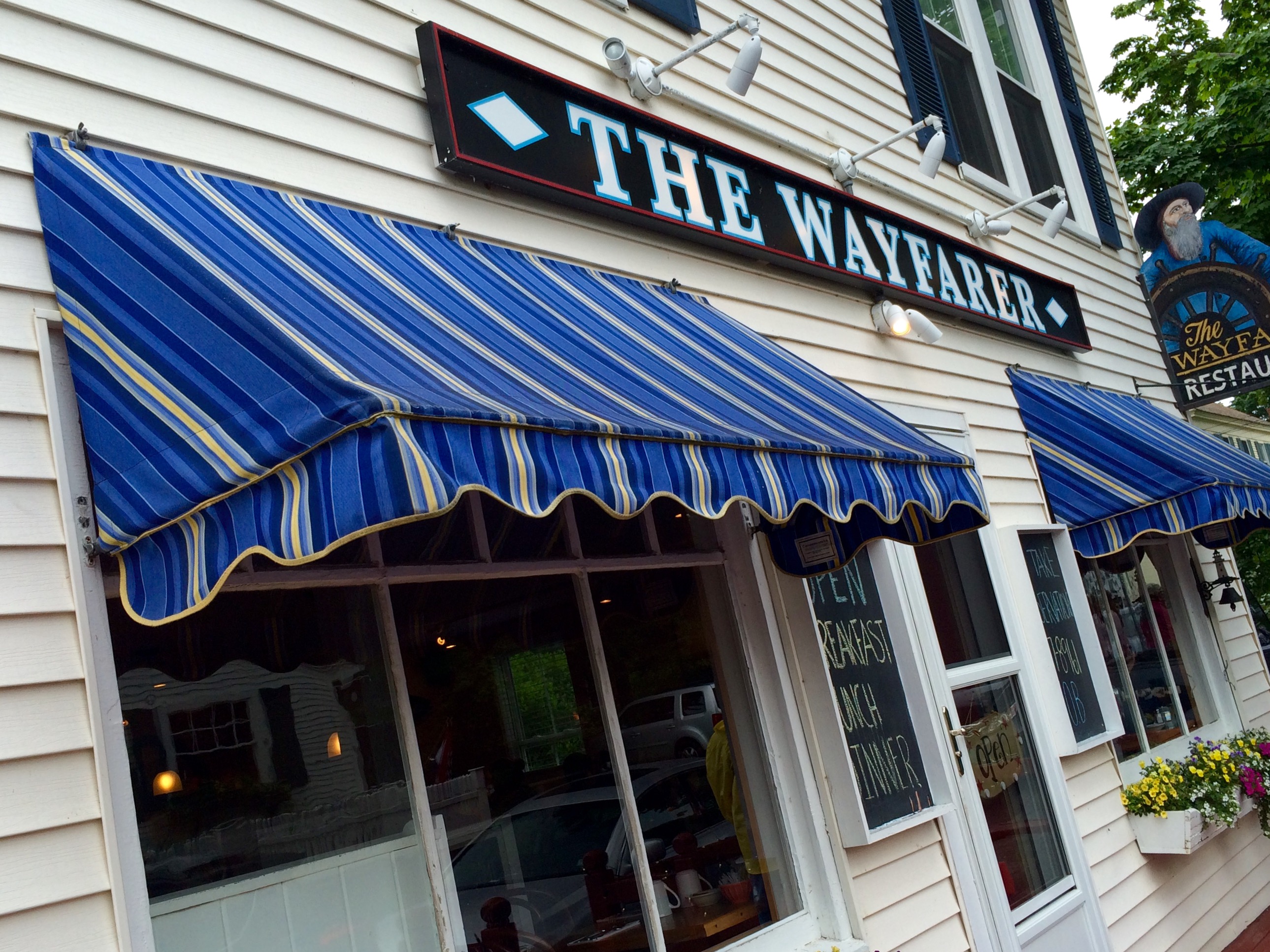
The next morning, breakfast was back in Cape Porpoise at The Wayfarer, a local favorite for years. Always crowded, we managed to find a couple of seats at the bar. Crowded because the menu offers breakfast favorites with their own twist: a scramble of the day, housemade sausage, and interesting takes on standards, like lobster and pork belly eggs Benedict.

FullSizeRender (6)

The creativity of this dish was excellent, the execution not so much. Hey, I love pork fat, but the pork belly wasn’t cooked enough so it was rubbery and the lobster meat was cold–should’ve been warmed through before putting it on top of the eggs.

That’s OK…lots of good coffee and smiling faces were a welcome sight the morning after a big night of drinking!

The ride back to Rhode Island was a bit rough with a hangover. Next time, it’ll be 48 hours in Kennebunkport and I’ll make sure I get some rest!